Entertainment
Dearest gentle reader, 'Bridgerton' has created a song for the first dance at your wedding

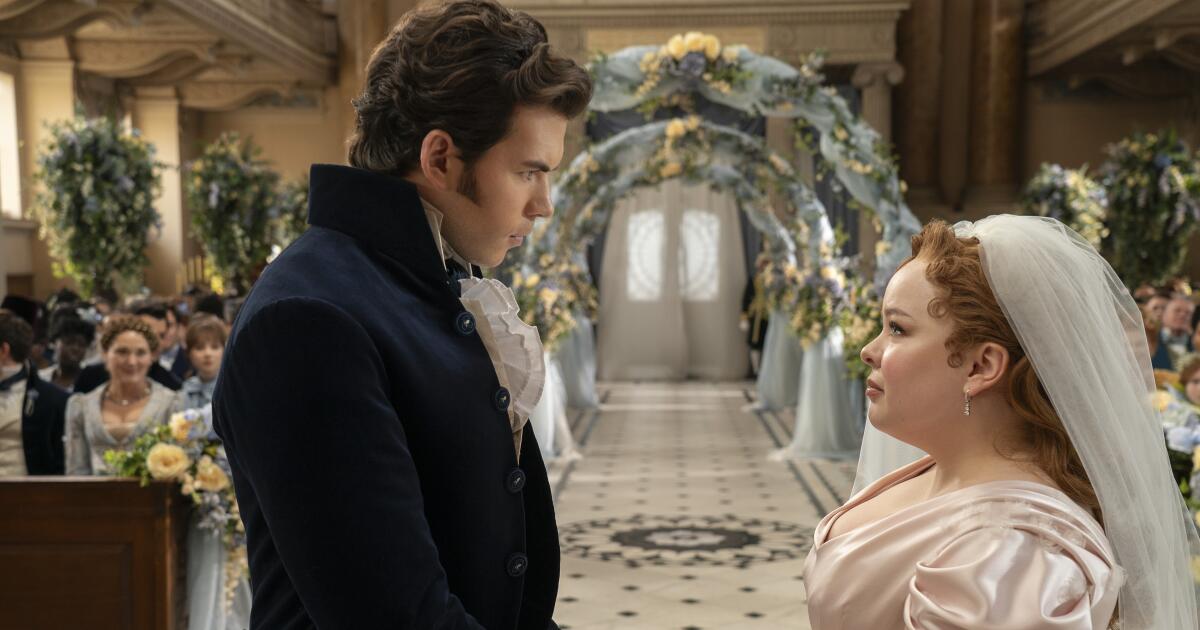
Each new season of “Bridgerton” brings a bounty of reveals: Steamy romances. Elaborate balls. Whistledown dispatches. And string quartet covers of pop hits to accompany it all.
“We’re always looking for covers that are pretty recognizable and also enhance the story we’re telling,” said music supervisor Justin Kamps. “Sometimes we like the more straightforward cover with the steady tempo that’s perfect for the ball sequences, and then other times we like the ones with a bit more creativity in the arrangement so it’s a bit more emotional.”
Picking and placing orchestral covers for the Netflix series is an intricate process, beginning with what Season 3 showrunner Jess Brownell estimates to be “a playlist of maybe 100 or 200 orchestral versions of pop songs” that — with input from directors, producers and Netflix — is trimmed down to a dozen or so standouts.
According to the Economist, it’s led to a surge of classical musicians recording pop covers, string quartet bookings at weddings, and live events that merge classical music and pop. After the release of the third season’s first batch of episodes last month, Spotify searches for “Bridgerton” content increased 1,700%, while the creation of “Bridgerton”-related playlists on Spotify spiked nearly 400% in the U.S.
“Bridgerton” includes orchestral covers of pop music, but the show finally debuted its first original song.
(Liam Daniel / Netflix)
“It’s been so exciting to watch the ‘Bridgerton’ sound become solidified and become so popular,” said the series’ composer Kris Bowers. “In the beginning, it was really an experiment, but now that we’re a few years into it, there’s this huge ocean of classical covers of pop songs that exists, either because of how many people were inspired by ‘Bridgerton’ or people who make one in hopes of getting into the show.”
After renditions of hits like BTS’ “Dynamite,” Ariana Grande’s “pov” and Taylor Swift’s “You Belong With Me,” Season 3 ends with an orchestral cover of “All I Want,” the franchise’s first original song. The cover evokes the series’ now-signature sound (this one performed by a string quintet instead of a quartet, noted Bowers) and echoes the pop sensibilities of songs regularly covered for “Bridgerton” — which is coincidental, because the songwriters for “All I Want” didn’t even know they were writing for the hit show.
“The prompt was to write a love song for a Netflix project that could be a first dance at a wedding,” said Rogét Chahayed, who wrote “All I Want” with friends and fellow songwriters Wesley Singerman, Taylor Dexter and Nicole Cohen in the span of a day. “It can be a lot of pressure to write to a prompt, but in the middle of the session, we all looked at each other and agreed that it sounded like a song you’d want to hear at a memorable event you share with your family and friends.”
According to Bowers, an original “Bridgerton” song has been in the works for years; he was part of an attempt to create one for last year’s spinoff series “Queen Charlotte,” but it didn’t come to fruition. For “Bridgerton” fans, “All I Want” is worth the wait: the full track features the intricate vocals of Tori Kelly; its lyrics are a litany of similes for perfect fits and long-lasting love.
“A lot of people [writing music today] try to be aware of TikTok and trends and things like that,” added Chahayed. “But we really wanted this song to almost outlive social media and feel timeless, sound beautiful and say something really heartfelt.”

So with all the work put into “All I Want,” why does the orchestral cover play during the final episode’s end credits, a section regularly cut short for the viewer by Netflix’s previews, instead of during a key “Bridgerton” scene? It’s because of timing. According to Kamps, the initiative was “mostly spearheaded by the Netflix music team and the Netflix marketing team” for the “Bridgerton” wedding event earlier this year (Kelly debuted the track for the first dance between two newly wedded superfans).
“Everyone loved the song so much that they wanted to try to find a way to incorporate it into the actual show as well,” he explained. “Kris then did an amazing job with the cover and we were looking for somewhere [in the show] that made sense, but we had already found all these other spots for music that we love. So now it’s a lovely way to cap off the season.”
Thankfully, fans who want to hear “All I Want” in full — both the Kelly version and the orchestral cover — can listen to it on the season’s soundtrack, now streaming on all digital platforms.

Movie Reviews
‘Fruit Gathering’ Review: A Factory Worker Falls for Her Female Colleague in a Delicate Burmese Debut

Caught between rural roots and urban opportunities, familial duty, friendship and forbidden carnal desire, young San Kyi (Nandar Myat Aung) struggles to find her place in Fruit Gathering, a sensitive Myanmar-Czechia-France co-production that just won Karlovy Vary’s top prize.
That’s an impressive achievement for Burmese writer-director Aung Phyoe, making his feature debut after several shorts. His flair for blending realist drama with more poetic, painterly imagery makes for a dreamy, hypnotic viewing experience, eased along by a confident, open-hearted performance from Nandar Myat Aung in the lead role. Fruit Gathering will be ripe for picking at further festivals, especially ones specializing in Asian and/or LGBTQ+ fare, possibly followed by niche distribution.
Fruit Gathering
The Bottom Line Juicy but not too sweet.
Venue: Karlovy Vary Film Festival
Cast: Nandar Myat Aung, Nandar Myint Lwin, Tin Tin Ei, Thida Soe Khant, Wutt Yeet Kyaw, Htet Aung Lynn, Khet Suu Myat, Min Nyo, Zun Pwint Phyu
Director/screenwriter: Aung Phyoe
1 hour 37 minutes
Self-transplanted with her mother (Tin Tin Ei) and grandmother from the countryside to industry-rich Yangon, San Kyi has so far managed to resist the pressure from her mom to get married or pursue a career in something upmarket like tech. Instead, eager for a job that doesn’t demand too much thinking, San Kyi works in a massive clothing factory, sewing seams all day in a ferociously noisy, scrap-strewn environment where the supervisor gets snotty if she takes a bathroom break without seeking permission first.
Incidentally, while the factory hardly looks inviting, the conditions don’t seem to be too bad compared to those seen in older documentaries about East and South Asian sweatshops. They’re comparable to what’s on display in, say, Chinese director Wang Bing’s doc Youth but without the company-owned residential housing. At least the workers are allowed to submit petitions circulated by labor organizers requesting better pay and more safety measures, although tellingly San Kyi refuses to sign lest she might get fired for it. A union leader (Wutt Yee Kyaw) pours scorn on her for not showing more solidarity with her colleagues.
Later, after she’s injured herself by a sewing accident, San Kyi will rethink her position on workers’ rights, but industrial relations in the textile industry are not the film’s main focus. It’s all background color, as much a part of the vivid landscape as the interludes where we see San Kyi back home visiting the mango farms and spirit-dance ceremonies of her agrarian childhood.
At least it’s at this factory that San Kyi meets Theint Theint Oo (Nandar Myint Lwin), a young co-worker around the same age as San Kyi with a radiant smile and street sense to burn. The two young women start out just hanging together during their lunch breaks but soon grow inseparable. The script suggests early on that Theint Theint may be the kind of pal who always forgets to bring enough cash for dinner. A darker interpretation might posit that she sees San Kyi as little more than a mark, but the truth probably falls somewhere in a grayer area.
Either way, by the time San Kyi is buying nearly identical blouses for the two of them to wear on strolls around town, it’s pretty clear that she’s smitten with Theint Theint. The latter is ambiguously flirtatious and keen to have languid girls’ night sleepovers in the same bed, but also open about the fact that she’s got a man in the background, who is conveniently always away working in another country. Afraid of losing her new limerent object of desire, San Kyi entertains the thought of going abroad with Theint Theint to work as housekeepers or factory workers in somewhere affluent like Singapore or Malaysia.
Clearly, things are heading for a smash up when San Kyi lends Theint Theint a substantial amount of money. Somehow the tension is heightened by the fact that Theint Theint gets closer to San Kyi’s family, even accepting a job offer that comes through the local guy whom San Kyi’s mom was trying to set San Kyi up with as a potential husband. It all serves to underscore how narrowly female relationships are usually defined in highly traditional, painfully patriarchal Myanmar society. The intense feeling between these two young women could never be openly romantic, although no one bats an eye when they walk hand and hand through the streets, much the way Queen Victoria is said to have refused to sign legislation banning lesbianism because she wouldn’t acknowledge such a thing even existed.
Aung Phyoe suggests the messy, uncontrollable nature of desire via some slightly heavy-handed imagery of flooded apartments and generally juicy, watery, somewhat soluble imagery. But the story surprisingly shifts tack halfway through and becomes less interested in the two women’s relationship and more in San Kyi’s personal development, especially after some hard knocks change how she sees the world.
Every so often, the camera will linger on a tiny detail like a vase that has some emotional significance, or the light coming in a window. There’s a tiny hint that these cinematic still life pictures are being seen through San Kyi’s eyes, like scenes in a book told through limited third-person point of view. Indeed, there’s a faintly literary quality to the filmmaking, as if inspired by romance and high-brow fiction, but Aung Phyoe’s touch is feathery soft, as gentle as the soft thud of a mango falling from a tree.

Tom Segura and Christina Pazsitzky have reportedly split.
The comedy power couple are calling it quits after 18 years of marriage, according to TMZ. A source told the outlet that the pair separated a couple of months ago but remain amicable and plan to continue co-hosting their podcast, “Your Mom’s House.”
Reps for Segura and Pazsitzky did not immediately respond to The Times’ request for comment.
Segura, 47, and Pazsitzky, 50, tied the knot in November 2008. Segura told “TigerBelly” podcast in 2018 that he met Pazsitzky while they were both doing open mic nights around Los Angeles. She was in a relationship with someone else (whom she lived with), so Segura and Pazsitzky were just friends. According to Segura, there was no flirtation in the early days, and he treated her with the respect he did any other fellow comic.
“I always thought she was attractive, but she was taken,” he said. “And then I got the call from one of my spies. … They broke up. And I was like, ‘I’m gonna swing in there, see what’s up.’”
According to Segura, he tried to ask Pazsitzky on what he thought was an L.A.-appropriate date — a hike — and she said no. He thought that meant she wasn’t interested in him, when, really, she just wasn’t interested in hiking.
“I called her the next time, and she’s like, ‘Hey, I know this bar you can still smoke at. Do you want to go there?’ And I was like, ‘OK. This is why she doesn’t want to go on a hike.’ So then, yeah, we went on dates and it just continued.”
Both comedians have used their marriage as source material for their comedy routines over the years and discuss their relationship on various podcast appearances, but especially on their own podcast, “Your Mom’s House,” which debuted in 2012.
In 2024, Pazsitzky told The Times that when they launched the podcast “we lived in a crummy two-bedroom apartment, we were newlyweds and we had no money. We got a mixing board, two mics and a computer, and at that point, we slept in one room and used the other room as an office. It bordered this other house where this lady would cook the smelliest food and have aggressive sex.”
“Oh, yeah, she was newly divorced and very performative with orgasms too,” Segura added.
The couple, who have two children, also spoke about their relocation from Los Angeles to Austin, Texas, in search of a slower pace and easier travel while touring. “Our lives are very normal, and we’re grounded family people. At the end of the day, we come home, our kids fart on Tom’s head, and I make dinner.”

Olivia Wilde, Seth Rogen, Edward Norton and Penélope Cruz star in The Invite.
A24
hide caption
toggle caption
A24
The new comedy film The Invite centers on an unhappy married couple who host another couple — they live upstairs — for an uncomfortable, and revelatory, evening of dinner and charcuterie. The film’s screenwriters, Rashida Jones and Will McCormack, are actors who are also longtime writing and producing partners.
Jones and McCormack met decades ago, when McCormack’s sister (actor Mary McCormack) set them up on a date. It didn’t work out as a romantic pairing. Instead, it was the start of a long-running creative partnership.

“We’re really like brother and sister who dated briefly, which is not weird,” McCormack jokes. “I think we both knew right from the very beginning that we were connected and that we had to be in each other’s lives. And it took us a minute to sit down to write, but finally we did, and I’m so glad we did.”
Jones says she and McCormack share a voice: “The two of us have the same clip, the same rhythm, and we’re so different in so many ways, but we just kind of like fit like puzzle pieces conversationally very quickly, which is a wonderful thing to have with a writing partner.”
Inspired by the 2020 Spanish film The People Upstairs, The Invite takes place over the course of one night in a chicly appointed apartment in San Francisco. Two couples gather for dinner, and as the evening unfolds, the stories they’ve been telling themselves about their relationships and about themselves fall apart.
McCormack describes the film as a sex comedy that’s not really about sex. “It’s about wanting to be seen and heard and valued,” he says. “You live with someone for so long and it’s really hard.”
Jones says it’s no accident that their work tends to focus on relationships and middle age: “Selfishly, it’s great that we can channel the thing we’re most interested in, which is relationships, living with other people, being parents, losing parents, being alive, getting older, being middle-aged, looking straight down the barrel of the back half of life. All these things we got to bring to this script.”
Interview highlights

Will McCormack and Rashida Jones attend the Los Angeles premiere of The Invite on June 23, 2026.
Valerie Macon/AFP via Getty Images
hide caption
toggle caption
Valerie Macon/AFP via Getty Images
On their working relationship
Jones: We write separately. We write together. We’re in an open relationship as writers, a very healthy, open relationship. But when we come together, there’s a thing that happens.
McCormack: I think we always found the same things funny. … And I think also the same things sort of broke our hearts, and I think that we wanted to try to say something together. There were movies that appealed to us both, and there was a voice that we shared from the beginning. There was just an easy rapport.
On acting out the dialogue together as they’re writing it
Jones: Well, we act while we’re writing, but that’s our discovery process of dialogue because we’re lucky, we both started as actors and can do a good job with that. So often we act out the scenes and if it’s not working, it doesn’t feel right … that’s easy to fix.
On why they’re drawn to stories about heartache

McCormack: Life is really just a series of losses. It’s one loss and one heartbreak after another. When your little summer ends and you don’t want it to end, and then you get your heart broken, and then you have kids, and they’re gonna break your heart, and then your parents die and then [you] start to lose bone density. …
Those moments can actually be the funniest because they’re so raw. And it’s when we feel connected, right? Like, heartbreak is the thing that binds us. Like, no matter who you are or no matter where you are or no amount of how old you are, like you’re gonna go through heartache. … And to be able to dig into some of those moments with Rashida has just been such a gift, and I don’t take that for granted to be able to do that for a living.
On Quincy, her documentary about her dad, Quincy Jones, and experiencing anticipatory grief
Jones: I filmed for six years, and the second to last year of filming, he went into a diabetic coma, and we stopped filming, and luckily my brother filmed a little bit in the hospital because we were going to kind of show him what he had been through if and when he came out and we were so lucky he did come out at 82. … But having that moment where he was that close to death, and then deciding to put that in the film and show him overcoming that, I think was my way of sort of preparing for the inevitable, you know? And I was so lucky to have him for another nine years after that, but ultimately, I knew what was coming, and it was really a love letter to my dad, but also a way to hopefully reach out to other people and say, listen, we’re all going to go through this and we want to be honest about what it’s like for our family to come to the other side of this.

My dad is obviously an icon and a culture shifter, and he had been documented a lot before. And what I felt like people missed, because he’s so successful at what he did, was they missed his personality. They missed the personal side of him, which is a very important part to why he was successful. It’s not just his talent and his hard work, but he had this gift with people. And he had a way of relating and being honest and getting to the heart and the honesty of something and the intimacy of something so fast with a stranger, with his kids, with the people who loved him, the people didn’t know him. And I really wanted that to be on screen.
On what they bring out in each other
Jones: Will is like my closest chosen family in a way. … I don’t wanna get emotional, but I feel like Will, and I see the child versions of ourselves and can really take care of that little kid in each other, because we’re both very hard on ourselves. … We sort of like, very kind of gently, love and respect each other and give each other the benefit of the doubt that we might not give ourselves. And then, I think, born of that is this sort of thing that lives in the intersection between pain and humor, and maybe hopefully something divine, like hopefully we leave some room, as my dad always said, “for God to walk in the door,” because that’s really our job ultimately is to channel. And so hopefully there’s something about us coming together that allows that to happen.
McCormack: I don’t want to get emotional either, but what she said.
Ann Marie Baldonado and Susan Nyakundi produced and edited this interview for broadcast. Bridget Bentz, Molly Seavy-Nesper and Meghan Sullivan adapted it for the web.
-

 News27 minutes ago
Mexico files criminal complaints in US over migrant deaths in custody
-

 Videos2 hours ago
New explosions near Iranian port cities, says state media | BBC News
-

 Los Angeles, Ca2 hours ago
Big rig crash spills cinder blocks on 101 Freeway; lanes blocked in Tarzana
-
 Detroit, MI2 hours ago
How to watch ‘The Odyssey’ in IMAX, 70mm and more in metro Detroit
-

 San Francisco, CA3 hours ago
Sold-Out SF Marathon 2026: The Races, Routes and Road Closures (Plus How to Watch It All) | KQED
-

 Dallas, TX3 hours ago
Top 10 Dallas Cowboys of 2026: Rashan Gary is Complete EDGE Dallas Needed
-

 Miami, FL3 hours ago
Girl, 12, shot while sitting in parked car in northwest Miami-Dade, deputies say
-

 Boston, MA3 hours ago
GBH Daily: Come sail away

