

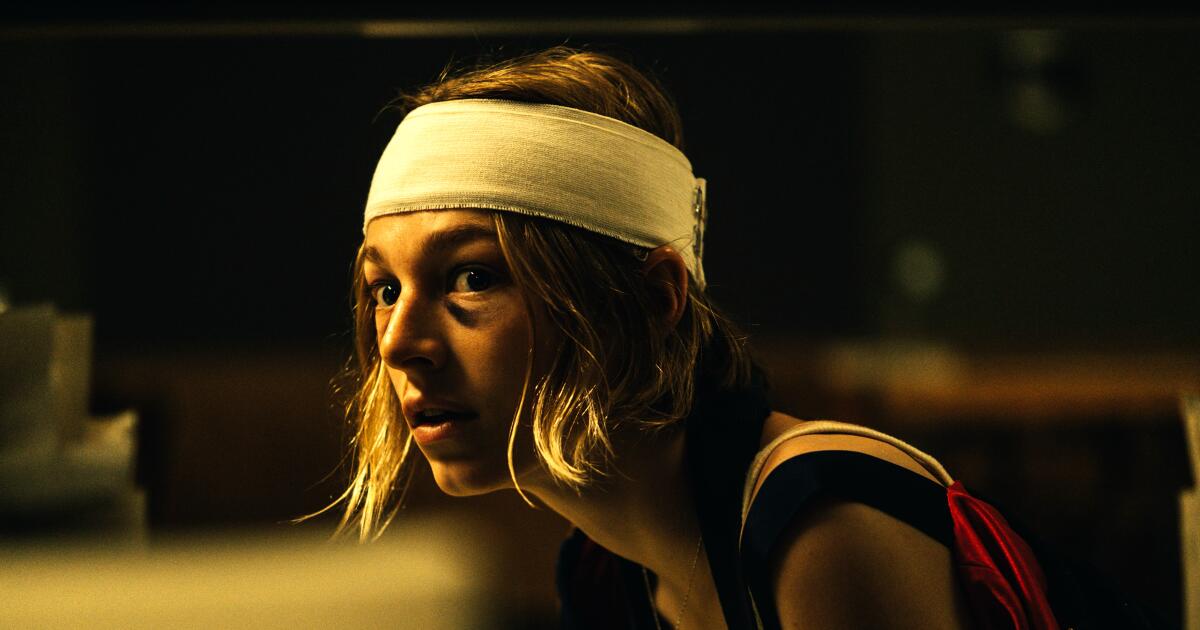



Monsoon sets in Mumbai with a bang. Rain drops ram the streets in desperation. The relief easily drifts into panic. Sea of umbrellas everywhere but one amongst them at a local station stands out. Wading through the downpour, its red colour drips with a warning. The person holding it exhibits a stone-cold demeanour, as she looks for an old man in the bustling chaos of the train at rush hour. She moves through the crowd inconspicuously and readies her umbrella, which secretly hides a gun as a trigger appears on its handle. She takes a muffled shot and disappears into the ensuing chaos.
The opening scene in Huma Qureshi’s Baby Do Die Do bears an uncanny resemblance to the real horrific killing of a young man in the local train recently, which laid bare the brutality that some people in the city carry within. An argument can escalate soon into homicide and there would be no one coming to rescue. Baby Karmarkar (Qureshi) carries a similar violence in her heart, that rises from the clutches of a city that failed her when she witnessed the death of her twin sister as a child. The city has turned her into a sociopath
The film however, doesn’t always treat the violence with gravity. Its tone is not always sharp and cynical even as it aims to critique the cornerstones of wealth and power on occasions by establishing the link between the builder lobby and mafia. Director Nachiket Samant largely uses the noir as part of the design element, lending a pulpy, comic-bookish layer to the narrative while the thematic undercurrents don’t really get time to marinate. As a result, the rainy undercurrents, moody lighting and dark humour gets dissolved just into style rather than adding complexity to the narrative.
Baby Do Die Do (Hindi)
Director: Nachiket Samant
Duration: 125 minutes
Cast: Huma Qureshi, Chunky Panday, Sikandar Kher, Seema Pahwa, Rachit Singh, Marudhar Shekhawat, Arun Kushwah
Synopsis: A deaf and mute assassin gets softened by love as she vows to take revenge from the man who murdered her twin sister
That being said, there’s more heart in Baby Do Die Do than the combined range of some of the other monotonous films that have come out in recent times. Its disregard for template is quite reassuring as it also aims to subvert genre cliches with a touch of quirk. The film doesn’t forget to have fun while juggling along with the grimness, as seen in an inventive item song which is inserted when Manu (a brilliant Marudhar Shekhawat), an associate of Baby, is tasked with an assassination that takes him to a gay pub in Andheri East. Saqib Saleem (also producer) makes a guest appearance as a sexy, ripped dancer, grooving seductively to a song with the hook line ‘Alpha Q’ repeated all along, creating an edgy innuendo. The gaze is empowering, building a sense of liberation to Saqib’s character, who controls his body and its movements. Rather than being an object of desire, he becomes its subject, withholding the capacity to flirt with anyone he wants, without crossing a boundary. Even the onlookers carry a sense of respect in their eyes as the camera doesn’t become a medium to represent lecherous gazes.

A still from the film
| Photo Credit:
Saleem Siblings/Youtube
All of this inherent loudness compliments the muted worries of Baby, who cannot hear and speak. It is delightful to see her first tryst with love unfold like a silent film as Siddhu (Rachit Singh), a likeable Sikh music teacher is smitten by her beauty. Their love story starts in a bus and later blooms in a cramped apartment, as there’s again a gender reversal at play, with Baby incorporating toughness as Siddhu stays dipped in vulnerabilities. There’s still a lot more to them that remains unexplored as the film has to fixate on the central conflict of Baby’s vengeance, which remains its weakest and most predictable link.

It is only when it digresses from the way that the film shows beguiling promise. Whether it is in smaller sketchy moments like when a character with vitiligo is called black and white in a humourous scene or the dwarf gangster Lucky (Arun Kushwah) immortalised by his brother, Zafar Katkar (Sikandar Kher) by putting his name on the tallest building in the city. The film also allows these dreaded gangster’s tiny moments to breathe, reflecting a common link between all the characters, born and raised on the same soil of Mumbai. Zafar gets into reverie during a violent hold up in a shanty when the distinct smell in the air takes him back to his childhood. He sniffs a blanket and talks of living in the underbellies and wanting to escape that netherworld as others seem to sympathise to his sentiments. All of them become Mumbaikars in that one moment before mayhem, disarmed of other identities when put in a space of mutual co-existence, rooting for the common concerns of roti, kapda and makaan. It is also short-lived for time has shaped each of them differently and they must react to the version that the city has forced them to be in the present.

Huma Qureshi and Chunky Panday in the film
| Photo Credit:
Saleem Siblings/Youtube
Kher inhabits this dichotomy with urgency, lending an astounding tragic-comic quality to his screen presence. He is a treat to watch but the screenplay just stops short of taking him to murkier territories while resorting to familiar, convenient turns to reach the resolution. Even Huma remains impressive as she stays silent for the most part and uses her face to translate Baby’s emotional turmoil. The real surprise in the mix comes from the restrained act put on by Chunky Panday, who represents the helpless middle-class Mumbaikar with remarkable honesty.
These are all characters that become much more superior than the immediate storyline which Baby Do Die Do struggles to run along with. Their dreams feel palpable, their anger unresolvable and their beauty merging with the soul of the city. On occasions, their collective aspirations represent the charms of Bombay films of the 70s and 80s by Sai Paranjpye and Basu Chatterjee. Even the twin sisters retribution tale seems to be a reworked ode to older Hindi movies. It is an aesthetic that is hurriedly disappearing from other contemporary city films.

So, although Baby Do Die Do imagines Mumbai as a cyberpunk landscape, it actually prospers while recollecting the unassuming everyday pulse of the metropolis, whether it is in the tale of a shoe polisher, who suffocated to his death on an overcrowded bridge, a peon in the High Court, who got killed by mistake and the mother whose sanity was taken away by the city’s violence. Then, in the compounding mess created by the bigger folks Murjhani and Bhambhani, it is important, like Baby, to be zara hatke, zara bachke. It is after all, Bambai meri jaan.
Baby Do Die Do is currently running in theatres


