Entertainment
Convicted 'American Nightmare' rapist pleads guilty to two more home invasions

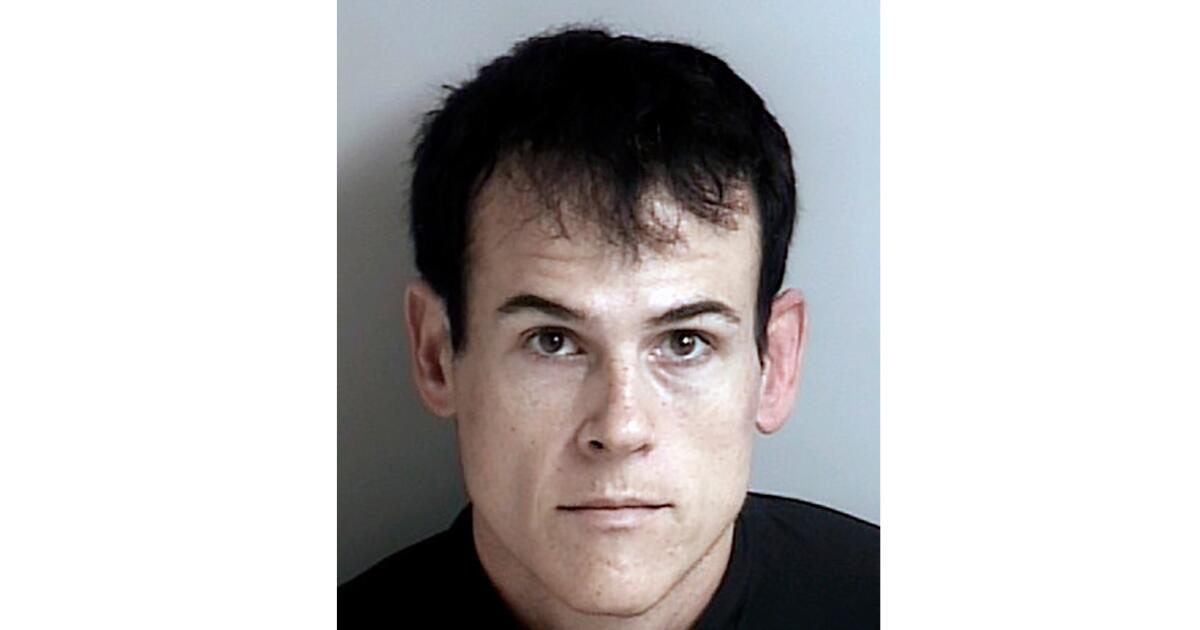
Matthew Muller, the notorious kidnapper whose most infamous crime was detailed in the Netflix documentary “American Nightmare,” appeared Friday in court and pleaded guilty to two additional crimes.
Wearing a brown Santa Clara County jail uniform, Muller, 47, replied with a taciturn series of “yes” answers as Superior Court Judge Cynthia A. Sevely confirmed he was admitting guilt in two home invasions in 2009. In both cases, Muller broke into homes in the early hours, bound his female victims and attempted to drug and sexually assault them.
In total, Muller is now suspected or convicted in at least six violent crimes, beginning when he was 16.
“This extremely dangerous person left a trail of traumatized and terrified victims,” Dist. Atty. Jeff Rosen said. “It took the collective courage of his victims and determined law enforcement officers to stop him. This nightmare is over.”
The Santa Clara charges against Muller came about as a result of the work of an unlikely team of law enforcement officers and the two victims in the Vallejo case, Denise Huskins and Aaron Quinn. Over the last 10 months, the pair said, they obtained clues about the crimes — and even confessions — from Muller before approaching local authorities with jurisdiction in the incidents.
“We knew there was more to this from the beginning, and clearly how things were handled from the beginning led to a lot of errors,” Huskins said in an interview last week. “We didn’t really have anyone in law enforcement that we trusted and we felt were doing this case justice.”
The first Santa Clara County incident took place on Sept. 29, 2009, when a Mountain View woman in her 30s told police she awoke to find a man on top of her. According to a description of the case from the Santa Clara County district attorney’s office, Muller demanded she drink a medicated beverage, then tied her up and said he was going to rape her.
The woman was able to persuade him to stop his assault, according to the district attorney’s office. Before leaving, Muller allegedly told her that she should get a dog for protection.
About three weeks later, on Oct. 18, 2009, a woman in nearby Palo Alto awoke to find Muller on top of her, according to the district attorney’s office. He tied the woman up and forced her to drink Nyquil.
Again, the woman was able to persuade him to stop, according to prosecutors. And again, before leaving, he gave the woman “crime prevention advice,” according to the district attorney’s office.
Last week, Muller was also charged in another new case, in the Contra Costa town of San Ramon, after authorities examined evidence brought to light through Huskins’ and Quinn’s investigative efforts.
After “American Nightmare” came out, Huskins and Quinn were contacted by an unlikely ally: the police chief in the Monterey Bay town of Seaside, Nick Borges. He had seen the documentary and wanted to help.
That Borges had nothing to do with the case didn’t stop him from becoming involved. He invited Huskins and Quinn to speak to law enforcement in Seaside to share their belief that police interrogation methods that focused on Quinn’s guilt had sent the investigation down the wrong road.
Borges also persuaded the detective ultimately responsible for Muller’s arrest, Misty Carausu, to come.
The four met with El Dorado County Dist. Atty. Vern Pierson, who has jurisdiction in the county where Huskins was held captive — and the seeds of a new investigation were planted.
At lunch after the law enforcement conference, Huskins and Quinn told Borges about their frustrations, and a desire to reach out to Muller personally to seek answers. But the couple feared that could present risks. Borges offered to write Muller on their behalf.
Muller wrote back, giving details of other crimes and even legal declarations with confessions.
Armed with the new information, Pierson, who had been working with the FBI and other agencies, in November traveled to Tucson to interview Muller in person. Over two days, according to Pierson, Muller shared more details, including information on a Northern California attack he claimed to have committed when he was 16. That case is still under investigation, Pierson said.
Attorney Anthony Douglas Rappaport, left, speaks at a 2016 news conference with clients Denise Huskins and Aaron Quinn. The couple reached a $2.5-million settlement with the city of Vallejo after police falsely accused them of fabricating Huskins’ kidnapping.
(Sudhin Thanawala / Associated Press)
In Huskins’ case, which the Netflix documentary is based on, Muller broke into her Vallejo home in March 2015 and drugged and bound her and her then-boyfriend, Aaron Quinn. Muller blindfolded them with swim goggles and gave them medicine to make them sleepy. He put headphones on Quinn and played recordings designed to make Quinn think he was dealing with more than one kidnapper.
Muller then put Huskins into Quinn’s car and drove off with her, eventually taking her to his family’s cabin in South Lake Tahoe. He held her there for two days and sexually assaulted her, before driving her across California and releasing her in Huntington Beach.
Initially, Vallejo police dismissed Quinn’s account of his girlfriend being spirited away by a kidnapper — or kidnappers — who put headphones on him and made him drink a substance that made him sleepy. Officers interrogated Quinn for hours, brushing aside his story and theorizing he was behind her disappearance.
When Huskins turned up, police grew more suspicious, questioning how a kidnapping victim could reappear hundreds of miles away wearing sunglasses and carrying an overnight bag.
Huskins “did not act like a kidnapping victim,” retired Vallejo Police Capt. James O’Connell later said in a sworn statement.
Police tried to get Huskins and Quinn to turn on each other and admit there had been no crime, offering immunity to whoever flipped first, according to statements from their family members.
Then, police went public with that sentiment. “There is no evidence to support the claims that this was a stranger abduction or an abduction at all,” Police Lt. Kenny Park said in a statement at the time. “Given the facts that have been presented thus far, this event appears to be an orchestrated event and not a crime.”
However, less than three months later, evidence gathered from a June 5, 2015, home invasion robbery in the Bay Area community of Dublin helped authorities link Muller to the kidnapping. That case led authorities and Carausu, the detective, to the Muller family’s South Lake Tahoe cabin, where they found, among other things, Quinn’s computer, goggles and tape with a strand of long blond hair.
Huskins and Quinn, who later married, sued the Vallejo Police Department for defamation and reached a $2.5-million settlement in 2018.
Muller, a Harvard-educated lawyer and former Marine, pleaded guilty in 2016 to kidnapping Huskins. In 2022, he pleaded guilty to additional charges of sexually assaulting her. Until he was transported to Santa Clara County to face the new charges, he was serving his 40-year sentence at a federal prison in Tucson.
Muller is expected to return to Santa Clara County Superior Court on Feb. 21 for sentencing.


Sam Raimi‘s Evil Dead films and TV series are a fine example of creativity within constraints, playfulness, self-awareness and outright slapstick comedy. The Evil Dead series after Raimi is very, very different. Starting with 2013’s Evil Dead by Fede Álvarez, followed by Evil Dead Rise by Lee Cronin, the new series takes itself more seriously and emphasises pure horror, violence and gore. Some have considered this praiseworthy as it avoids being a mere retread of the old films, but the reception has been mixed.
In Sébastien Vanicek’s Evil Dead Burn, Alice (Souheila Yacoub) loses her abusive husband (George Pullar) to a motor accident. When she goes home to stay with his family, the consequences of the work of their dead grandfather researching the Necronomicon and the Deadites manifest in terrible ways. One by one, the family are turned into the Evil Dead.
Horror is a genre that depends on you relating to the protagonists so you care what happens to them. In the case of Evil Dead Burn, Yacoub does a decent job with the character she’s given, but the gonzo horror elements manifest so early in the film that she may as well be collateral damage in the onslaught, especially as the film’s early point of view is that of her brother-in-law (Hunter Doohan).
Fans of gory violence will get their money’s worth here, but there’s not a lot going on besides that. The film is a descent into madness and carnage that is so resolutely unpleasant that, after some of the early kills, it becomes numbing. It’s hard to gather what the tone is supposed to be, with lots of callbacks to the early films’ style by setting up inevitable kills with Chekhov’s weed trimmer, Chekhov’s fork and every other potentially dangerous prop the camera lingers on. The family are all deeply unpleasant at some level and so their deaths register as meaningless. Yes, the film has the obligatory something to say about how our tendency to ignore domestic abuse creates demons that destroy families, but then absolutely panders to bloodlust by absolutely revelling in some of the most extreme violence imaginable between family members (and a pet). To say this is not a film for the sensitive is to understate things considerably. This is a film that absolutely earns its content guidance warnings.
Is there any comedy? Some, but it feels out of place given the absolute brutality inflicted on the cast. While most of the other films were self-aware about setting up a ludicrously grisly end for a villain as a payoff, in Evil Dead Burn,the kills have very little flair. It’s also hard to know what the rules for getting rid of a Deadite are, as some of them are still upright and chatty after losing most of the contents of their skull and some are dispatched by the repeated application of a blunt object to the head. Towards the end, a McGuffin is added to make the kills final, but before that, who knows?
Should you watch Evil Dead Burn,? It certainly gets vocal reactions from audiences in a cinema, and if you’re a gorehound you’ll be in for a ride. If you’re a horror fan, it’s certainly a horror film, but violent instead of scary. If you’re just a fan of cinema who likes good films whether or not they’re horror films, then this will be an alienating watch. In Evil Dead Rise the decay of the family was more than background noise and factored into the circumstances of the individual deaths, but not here. It has slight pretences of being a film with Themes and Ideas, but in the end it just feels like an excuse to serve up limbs being mutilated, skulls being crushed and any number of stabbings, slicings and gougings rendered with psychopathic visual fidelity. If that’s what you’re after, that’s what it’s got.
Entertainment
‘Children of Blood and Bone’ author won’t see film after feud with star Amandla Stenberg

Tomi Adeyemi, the author of the bestselling fantasy “Children of Blood and Bone,” isn’t planning to see the forthcoming film adaptation — even though she co-wrote it.
Over the weekend, the Nigerian American author posted a video on TikTok addressing fans who have been asking her the same question, “Why don’t you post about the adaptation of your first film adaptation anymore?”
“There is a reason I will not post anything about the adaptation of my work,” the author wrote in what appear to be screenshots of a group chat. “I have not seen the film, and I will not watch it.”
The adaptation of the first installment of Adeyemi’s “Legacy of Orïsha” fantasy trilogy is slated to hit theaters in January 2027. Gina Prince-Bythewood — who wrote and directed “Love & Basketball” and helmed “The Woman King” — is directing. The film stars Amandla Stenberg, Thuso Mbedu, Tosin Cole, Damson Idris, Cynthia Erivo, Lashana Lynch, Regina King, Idris Elba, Chiwetel Ejiofor and Viola Davis.
Alongside the screenshots of her comments in the group chat, she shared a February 2025 exchange with Stenberg that shows the author severing ties with the actor.
Adeyemi shared only her final message to Stenberg, which reads, “Do not ever use my name in an interview or video again. Do not text me. Do not call me.” That exchange is followed by a notification that she blocked Stenberg, who plays Princess Amari in the upcoming fantasy flick.
The message from Stenberg that preceded Adeyemi’s reply is not shown in full.
Stenberg, who played Rue in “Hunger Games,” Starr Carter in “The Hate U Give” and, recently, Verosha “Osha” Aniseya and Mae-ho “Mae” Aniseya in Disney’s “Star Wars” series “The Acolyte,” had been getting flack from readers of the series, who claimed colorism was an issue while casting the movie.
In February 2025, Stenberg posted a since-deleted nine-minute TikTok addressing the controversy and told followers that Adeyemi had given the actor her blessing when cast as the series’ princess.
“I am four months into training for ‘Children of Blood and Bone’ and I am getting my ass whooped,” Stenberg joked in the video, per BET.
“This year was mostly defined for me, honestly, by contending with what it felt like to receive racist death threats just for existing in the ‘Star Wars’ universe, and that was a really difficult thing for me to move through,” she continued. “But honestly, it feels so much more painful for me to feel like I’m at odds with my own community.”
Stenberg said that she considers her skin tone when navigating her career choices and would “never go after a role” she didn’t feel well suited for. “I know that colorism is an insidious system that relentlessly impacts every facet of entertainment.”
The actor continued that it was actually a meeting with the “Children of Blood and Bone” author that gave her the confidence to pursue the role.
“I had the opportunity to meet Tomi, the novelist, for the first time. … And she goes, ‘Amandla, I want you to know that when you were a little girl and you were cast as Rue in “The Hunger Games,” and people said that Rue’s death wouldn’t be as sad because you’re a Black girl — that inspired me to write this series so that Black girls like you and Black girls of all shades could have a story written about them,’” Stenberg said in the video. “We started crying, and I said to myself, ‘God wants me here.’”
Representatives for Stenberg, Adeyemi and Prince-Bythewood did not immediately respond to The Times’ request for comment.
Movie Reviews
‘Night Nurse’ Review: A Caretaker Explores Her Kink for Elder Abuse in the Year’s Strangest Erotic Thriller

There are any number of erotic thrillers in which rich old men are robbed blind and/or left for dead, but Georgia Bernstein’s admirably bizarre “Night Nurse” might be the first movie of its kind where elder abuse is the source — and possible subject— of its erotic thrills. If there are others, I’m not sure I want to know.
But this woozy debut feature doesn’t rely on its audience being turned on by the relationship between a nubile caretaker and her dementia-addled patient. Their psychosexual bond, meanwhile, hinges on cold-calling vulnerable old people under the guise of a grandchild in financial distress. (“I’m in trouble, nana, send me $10,000 or I’ll be left to rot in jail!” That sort of thing). With its slim wisp of a premise stretched into a Strickland-esque dreamscape that substitutes kink for conflict, the film itself hardly seems convinced by its own wrinkled lust — all desperate kisses and non-touching poses of subservience. More important to Bernstein is what that lust reveals about her characters’ deepest needs, specifically how their need to care and be cared for can be as easily perverted as any other form of desire.

As moody and weightless as the noir-accented score that blows through the movie like a curlicue gust of wind in an old cartoon (credit to musicians Sam Clapp and Steven Jackson), “Night Nurse” lacks the pulse required for its stray feelings to come alive. Still, the film ambiently taps into the latent eroticism of teasing out the distance between how you see yourself and who you really are. Bernstein plays with that distance like a telephone cord wrapped around her fingers, and Eleni — played by the excellent newcomer Cemre Paksoy, powerfully helpless — only frays even more as the receiver is brought near the hook. “Everything I did before today wasn’t me,” the nurse tells co-worker Mona (Eleonore Hendricks) after starting a new job at an Illinois retirement home. “It was somebody else.”
What she did before today remains unexplored (specifically, what she did to get herself fired from her last gig), but I’m guessing she’s probably changed less than she thought. There’s a faraway flicker in her eyes the moment she catches the vibe between Mona and Douglas (a ribald and elusive Bruce McKenzie), a white-haired seventysomething who shows early signs of dementia but still commands an undiminished sexual energy. “I’m not an invalid,” he coos as Mona bathes him in the tub, to which she replies, “yes, you are,” in a supplicant tone that hints at a rich history of power games between them.
Later that same night, Douglas will force Eleni to call a stranger, pretend that she’s their granddaughter, and ask for money — he’ll wrap the phone cord around the nurse’s body as she talks and shove her against the wall as they kiss. She’s into it. So into it that he has to clarify the terms of his whole deal: “If you’re looking for a pogo stick, I’m really not your guy.” But Eleni isn’t looking for anything to bounce on. She just wants to be needed, and maybe to need someone in return. Someone who will see her for who she really is and allow her the fantasy of pretending she isn’t being herself when she cons vulnerable strangers out of their money — when she exploits how enthralled those strangers are by the care they have for their loved ones.
“Night Nurse” doesn’t belabor the psychology, as Bernstein prefers to express her story through heavy-lidded suggestion. Somnambulating from the moment it starts, the film moves through a series of beautifully arranged poses that stretch their latent meaning thin across the surface (Lidia Nikonova’s cinematography lacquers every shot with a seductive dreaminess). We see Douglas smoking in a lawn chair with Mona and Eleni curled around his feet. Eleni riding in the backseat of a convertible as the wind blows through her curls. The full staff of nurses — all of them under Douglas’ sway — stumbling around his condo in a state of zonked out bliss as they roll on the prescription drugs they’ve stolen from the residents.
Once you’ve seen one shot of this movie, you’ve practically seen them all, at least until things escalate during a rushed and unsatisfying third act that forces Eleni into an honest confrontation with herself. People will do just about anything to feel needed — they’ll give whatever degree of care allows them to receive it in return. “Night Nurse” understands that desire, but remains far too numb to treat it.
Grade: C+
The Independent Film Company will relase “Night Nurse” in theaters on Friday, July 10.
-

 Nebraska23 seconds ago
HealthierU offers small group training for staff
-
 Nevada8 minutes ago
Nevada bystanders pull crash victim from burning motorhome on I-15 near Mesquite
-

 New Hampshire11 minutes ago
Townsend man arrested in connection with two armed robberies in New Hampshire and New Jersey, authorities say – The Boston Globe
-

 New Jersey15 minutes ago
Are all Freedom Fuel locations $3.47? Not anymore
-

 New Mexico23 minutes ago
New Mexico’s ban on liquor ‘minis’ yields mixed results five years later
-

 North Carolina25 minutes ago
NC state budget includes $27M for Madison County’s new public service complex
-

 North Dakota31 minutes ago
The Women’s College Fan Guide To 2026 Junior Nationals – FloWrestling
-

 Ohio37 minutes ago
Ohio reports nearly 200 cases of ‘explosive diarrhea’ illness

