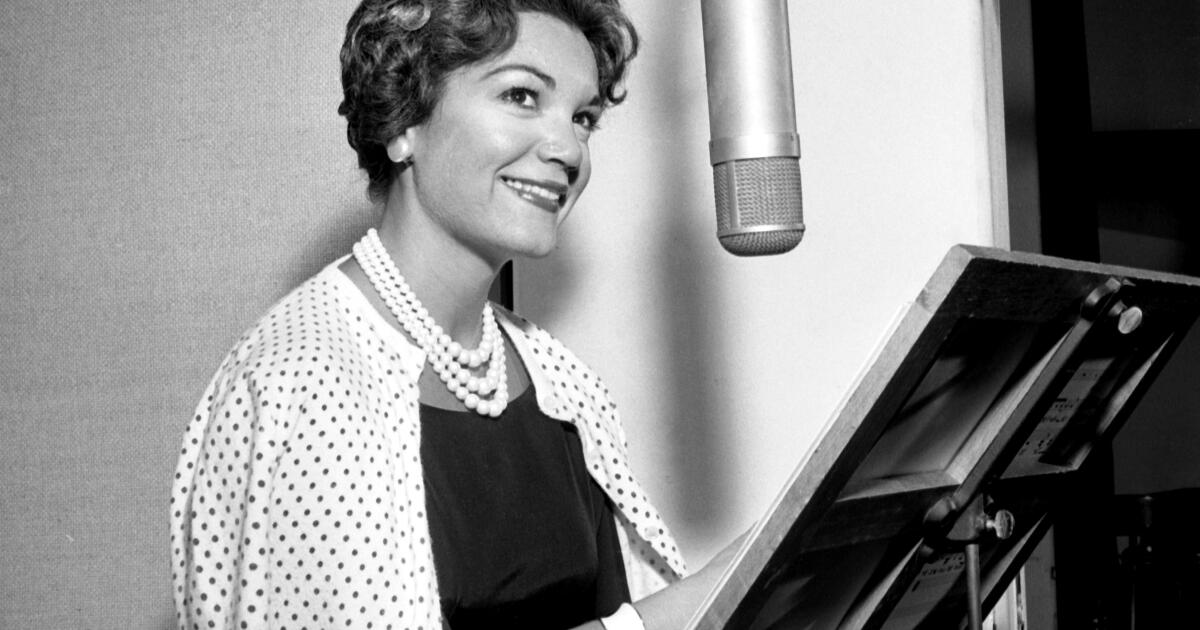
Connie Francis, the angelic-voiced singer who was one of the biggest recording stars of the late 1950s and early 1960s, has died. She was 87.
Her friend and publicist, Ron Roberts, announced the singer’s death Thursday, according to the Associated Press.
Less than a month prior to her death, Francis was hospitalized for “extreme pain” following a fracture in her pelvic area. The singer, who shared details about her health with fans on social media, used a wheelchair in her later years and said she lived with a “troublesome painful hip.”
Francis emerged when rock ’n’ roll first captivated America. Her earliest hits — a dreamy arrangement of the old standard “Who’s Sorry Now?,” the cheerfully silly “Stupid Cupid” and the galloping “Lipstick on Your Collar” — fit neatly into the emerging genre’s lighter side. Although she targeted teen listeners with such songs as the spring break anthem “Where the Boys Are,” Francis ultimately gravitated toward the middle of the road, singing softly lit, tasteful pop for adult audiences.
Francis’ commercial peak roughly spanned from Elvis Presley’s induction into the U.S. Army to the Beatles first setting foot on American soil. Over that five-year period, Francis was one of the biggest stars in music, earning three No. 1 hits: “Everybody’s Somebody’s Fool,” “My Heart Has a Mind of Its Own” and “Don’t Break the Heart That Loves You.” As her singles offered familiar adolescent fare, her albums were constructed for specific demographics. During the early ’60s, she cut records dedicated to “Italian Favorites,” “Rock ’n’ Roll Million Sellers,” “Country & Western,” “Fun Songs for Children,” “Jewish Favorites” and “Spanish and Latin American Favorites,” even recording versions of her hits in Italian, German, Spanish and Japanese.
Advertisement
This adaptability became a considerable asset once her pop hits dried up in the mid-’60s. Francis continued to be a popular concert attraction through the 1960s, her live success sustaining her as she eased into adult contemporary fare. A number of personal tragedies stalled her career in the 1970s, but by the ’90s, her life stabilized enough for her to return to the stage, playing venues in Las Vegas, Atlantic City and elsewhere until her retirement in the 2010s.
Connie Francis circa 1960.
(Archive Photos/Getty Images)
Connie Francis was born Concetta Maria Franconero on Dec. 12, 1938, in Newark, N.J. When she was 3, her father bought her an accordion and she spent her childhood learning Italian folk songs. By age 10, her parents enrolled her in local talent contests. When her father attempted to book her on the New York-based television show “Startime,” producer George Scheck only agreed because Francis played the accordion and he was “up to here in singers.” Francis remained a fixture on “Startime” through her early teens — Scheck served as her manager during these formative years — during which time she also appeared on Arthur Grodfrey’s “Talent Scouts.” Godfrey stumbled over her Italian name, suggesting she shorten it to something “easy and Irish,” thereby giving birth to her stage name.
Advertisement
Scheck managed to secure Francis a record contract with MGM in 1955. As she received work dubbing her singing voice for film actresses — she subbed for Tuesday Weld in 1956’s “Rock, Rock, Rock” and Freda Holloway in 1957’s “Jamboree” — MGM steadily attempted to move her from pop to rock. Nothing clicked until Francis recorded “Who’s Sorry Now?” as a favor to her father, giving the 1923 tune a romantic sway.
“Who’s Sorry Now?” caught the ear of Dick Clark, who regularly played the record on his “American Bandstand,” which had just expanded into the national market. Clark’s endorsement helped break “Who’s Sorry Now?” and sent it into the Billboard Top 10. MGM attempted to replicate its success by having Francis spruce up old chestnuts, but to no avail. The singer didn’t have another hit until she cut “Stupid Cupid,” a song co-written by Neil Sedaka and Howie Greenfield, a pair of young songwriters at the Brill Building who were navigating the distance separating Broadway-bound pop and rock ’n’ roll.
“Stupid Cupid” was the first of many hits she’d have with the songwriters, including the slinky ‘Fallin’” and the ballad “Frankie.” She later said, “Neil and Howie never failed to come up with a hit for me. It was a great marriage. We thought the same way.” Sedaka and Greenfield weren’t the only Brill Building songwriters to command Francis’ attention: She developed a romance with a pre-fame Bobby Darin, who was chased away by her father.
Over the next few years, Francis recorded both standards and new songs from Sedaka and Greenfield, along with material from other emerging songwriters, such as George Goehring and Edna Lewis, who wrote the lively “Lipstick on Your Collar.” Within less than two years, her popularity was such that MGM released five different Connie Francis LPs for Christmas 1959: a set of holiday tunes, a greatest-hits record, an LP dedicated to country, one dedicated to rock ’n’ roll and a set of Italian music, performed partially in the original language.
Connie Francis and Neil Sedaka in 2007.
(George Napolitano / FilmMagic / Getty Images)
Advertisement
With her popularity at an apex, Connie Francis made her cinematic debut in the 1960 teen comedy “Where the Boys Are,” which also featured a Sedaka and Greenfield song as its theme. Francis appeared in three quasi-sequels culminating in 1965’s “When the Boys Meet the Girls,” but she never felt entirely comfortable onscreen, preferring live performance. “Vacation” became her last Top 10 single in 1962 — the same year she published the book “For Every Young Heart: Connie Francis Talks to Teenagers.” Too young to be an oldies act, Francis spent the remainder of the 1960s chasing a few trends — in 1968, she released “Connie & Clyde — Hit Songs of the ’30s,” a rushed attempt to cash in on the popularity of Arthur Penn’s controversial hit film “Bonnie and Clyde” — while busying herself on a showbiz circuit that encompassed Vegas, television variety shows and singing for troops in Vietnam.
A comeback attempt in the early 1970s was swiftly derailed by tragedy. After appearing at Long Island’s Westbury Music Fair on Nov. 8, 1974, she was sexually assaulted in her Howard Johnson’s hotel room; the culprit was never caught. Francis sued the hotel chain; she’d later win a $2.5-million settlement that helped reshape security practices in the hospitality industry. As she was recovering from her assault, she underwent a nasal surgery that went astray, leading her to lose her voice for years; it took three subsequent surgeries before she regained her ability to sing. Francis spent much of the remainder of the ’70s battling severe depression, but once her voice returned, recordings happened on occasion, including a disco version of “Where the Boys Are” in 1978.
Connie Francis.
(ullstein bild via Getty Images)
Advertisement
Francis returned to the public eye in the early 1980s, first as a victims rights activist, then as a live performer. Her comeback was marred by further tragedy — the murder of her brother George, a lawyer who became a government witness after pleading guilty to bank fraud; the police indicated the killing was related to organized crime.
Francis continued to work in the wake of his death, playing shows and writing her 1984 autobiography, “Who’s Sorry Now?,” but she continued to be plagued with personal problems. She told the Village Voice’s Michael Musto, “In the ’80s I was involuntarily committed to mental institutions 17 times in nine years in five different states. I was misdiagnosed as bipolar, ADD, ADHD, and a few other letters the scientific community had never heard of.” After receiving a diagnosis for post-traumatic stress disorder, Francis returned to live performances in the 1990s; one of her shows was documented on “The Return Concert Live at Trump’s Castle,” a 1996 album that was her last major-label release. When asked by the Las Vegas Sun in 2004 if life was still a struggle, she responded, “Not for the past 12 years.”
Francis regularly played casinos and theaters in the 2000s as she developed a biopic of her life with Gloria Estefan, who planned to play the former teen idol. The film never materialized. In 2010, Francis became the national spokesperson for Mental Health America’s trauma campaign. By the end of the 2010s, she retired to Parkland, Fla., and published her second memoir, “Among My Souvenirs: The Real Story, Vol. 1,” in 2017.
Connie Francis married four times. Her first marriage, to Dick Kanellis in 1964, ended after three months; her second, to Izzy Marion, lasted from 1971 to 1972. She adopted a child with her third husband, Joseph Garzilli, to whom she was wed from 1973 to 1978. Her fourth marriage, to Bob Parkinson, ended in 1986 after one year.
Selected by Tajikistan but ultimately not accepted by the Academy to compete in the Oscar international feature category, “Black Rabbit, White Rabbit” begins ambitiously, with a famous quote from playwright Anton Chekhov about setups and payoffs — about how if a gun is established in a story, it must go off. Moments later, an inviting long take involving a young man selling an antique rifle ends in farcical tragedy, signaling an equally farcical series of events that grow stranger and stranger. The film, by Iranian director Shahram Mokri, folds in on itself in intriguing (albeit protracted) ways, warping its meta-fictional boundaries until they supersede its characters, or any underlying meaning.
Still, it’s a not-altogether-uninteresting exercise in exploring the contours of storytelling, told through numerous thematically interconnected vignettes. The opening Chekhov quote, though it might draw one’s attention to minor details that end up insignificant, ensures a heightened awareness of the movie’s artifice, until the film eventually pulls back and becomes a tale of its own making. But en route to this semi-successful postmodern flourish, its character drama is enticing enough on its own, with hints of magical realism. It begins with the tale of a badly injured upper-class woman, Sara (Hasti Mohammai), discovering that her car accident has left her with the ability to communicate with household objects.
Sara’s bandages need changing, and the stench of her ointment becomes a quick window into her relationships. Her distant husband rejects her; her boisterous stepdaughter is more frank, but ultimately accepting; her gardener and handyman stays as diplomatic as he can. However, the film soon turns the gunfire payoff in its prologue into a broader setup of its own, as a delivery man shows up at Sara’s gate, insisting that she accept delivery for an object “the deceased man” has paid for.
Mokri eventually returns to this story (through a slightly tilt-shifted lens), but not before swerving headfirst into a seemingly unrelated saga of extras on a film set and a superstitious prop master, Babak (Babak Karimi), working on a shot-for-shot remake of an Iranian classic. A mix of rapid-fire Tajik, Persian and Russian dialogue creates dilemma upon dilemma when Babak’s ID goes missing, preventing him from being able to thoroughly check the prop ammunition for an assassination scene.
Danger begins to loom — a recent Alec Baldwin case even warrants a mention on-screen — as the notion of faulty firearms yanks Chekhov’s wisdom front and center once more, transforming it from a writing tip into a phantasmagorical inevitability. In keeping with the previous story, the props even communicate with each other (through subtitles) and begin gossiping about what might come to pass.
Advertisement
After establishing these narrative parameters through unbroken, fluid shots filmed at a sardonic distance, Mokri soon begins playing mischievous temporal games. He finds worthwhile excuses to revisit scenes from either different angles or with a slightly altered aesthetic approach — with more proximity and intimacy — in order to highlight new elements of his mise-en-scène. What’s “real” and “fictional,” even within the movie’s visual parlance, begins to blur in surreal ways, largely pivoting around Babak simply trying to do his job. However, the more this tale engorges through melodic, snaking takes, the more it circles around a central point, rather than approaching it.
The film’s own expanse becomes philosophically limiting, even though it remains an object of curiosity. When it’s all said and done, the playfulness on display in “Black Rabbit, White Rabbit” is quite remarkable, even if the story’s contorting framework seldom amounts to much, beyond drawing attention to itself. It’s cinema about cinema in a manner that, on one hand, lives on the surface, but on the other hand, invites you to explore its texture in ways few other movies do.
Abraham Quintanilla, father and manager of the late Tejano pop icon Selena Quintanilla, has died. He was 86.
“It’s with a heavy heart to let you guys know that my Dad passed away today,” Quintanilla’s son, A.B. Quintanilla III, wrote on his Instagram account on Saturday. The cause of death has not been disclosed to the public.
As patriarch of the famous Mexican American music family, Quintanilla played a critical role in the development of his daughter Selena’s career. After her tragic death in 1995, he dedicated his life to safeguarding her legacy and overseeing primary control over her estate. This included managing the rights to her image, name and likeness — at times, to controversial ends.
Born in Corpus Christi, Texas, in 1939, Quintanilla began his music career as a member of the singing group the Dinos in 1956, a Chicano rock group that was met with racial discrimination. In one instance, a club owner paid the group not to perform after realizing they were Mexican American youth; but the group was also sidelined by its Mexican counterparts for not making Spanish-language music.
Quintanilla’s exasperation informed a real quote that was later made famous by actor Edward James Olmos, who played Quintanilla in the 1997 “Selena” biopic: “We have to be more Mexican than the Mexicans and more American than the Americans, both at the same time. It’s exhausting!”
Advertisement
Quintanilla would eventually step away from the group in the 1960s to start a family with Marcella Samora, whom he met in Tacoma, Wash., while serving in the U.S. Air Force. The family quickly grew following the births of A.B., Suzette and Selena. In them, he saw the potential to fulfill his own dreams of musical stardom.
With A.B. on bass, Suzette on drums and Selena as the tender vocalist, the trio would often perform at the family restaurant, PapaGayo’s, which later closed following the 1981 recession. The family was forced to sell their home in Lake Jackson, Texas, and move to Corpus Christi. In order to make ends meet, Selena y Los Dinos would perform on street corners, family parties and other social functions. Under the guidance of their father, who assumed the position of band manager, Los Dinos eventually signed with Freddie Records in 1984.
Selena was met with much skepticism from an early age as a young girl in a male-dominated genre, including by their first label head, Freddie Martinez. Still, Los Dinos persevered in the Tejano music scene, hopping from label to label before the group finally released eight albums under Manny Guerra’s independent labels, GP Productions and Record Producer Productions. With multiple albums under her belt, Selena was then able to dominate the Tejano Music Awards; she won the title of Female Vocalist of the Year in 1987.
Selena eventually caught the attention of Jose Behar, the former head of Sony Music Latin, who saw her crossover appeal — despite Selena’s primary language being English — and signed her to EMI Latin (Capitol Records) in 1989. This led to the release of her most career-defining hits across five albums, such as “Como la Flor,” “Amor Prohibido,” “Bidi Bidi Bom Bom” and the posthumously released ballad, “Dreaming of You.”
Following Selena’s murder in 1995 — by Yolanda Saldivar, the former president of her fan club — Quintanilla became a fierce protector of her image, which was often sensationalized by the public.
Advertisement
Because of the grisly and highly publicized nature of Selena’s death, Quintanilla felt that the film needed to be made sooner than later, in order to do justice to his daughter’s legacy, said “Selena” director Gregory Nava in a 2025 interview with De Los.
“For me, as a filmmaker, I wanted to really tell a true story,” said Nava. “I had conflict, not really with the family, but with Abraham. Her father was very protective of her.”
Tensions flared most when Nava began to shape the story of the singer’s elopement with guitarist Chris Perez, whom she married in 1992.
“You can’t put on the screen that it’s right for a young girl to disobey her father,” Nava recalled Quintanilla saying.
“Isn’t it a more important point to make that she is doing what she knows is right? And [that] she’s doing the right thing because she knows she loves Chris and Chris loves her?” Nava responded.
Advertisement
Eventually, Quintanilla relented. “I guess if I have to look bad to make Selena look good, I’ll do it,” Nava recalled him saying. “He has a soft heart. He finally saw that was the right thing to do, but it took hours of heated discussion.”
Although Suzette has said that the 1997 biopic came too soon in her eyes — and prompted criticism of her father, who some viewed as money-hungry and opportunistic — she ultimately stood by his decision, stating that there was a pressure within the family to control the narrative at the time.
Nava agreed.
“Abraham was very wise in pushing it through quickly,” he said. “Selena brought us all together, and it cemented her legacy in a positive way. All the negativity was dispelled by that movie. You see that in the film and you feel it.”
Kunal Nayyar in ‘Christmas Karma’
| Photo Credit: True Bit Entertainment/YouTube
Christmas jumpers are all I can remember of this film. As this reimagining of Charles Dickens’ A Christmas Carol dragged on with sickly-sweet sentimentality and song, my eyes constantly tried to work out whether those snowflakes and reindeer were printed on the jerseys or, if knitted, how complicated the patterns would have been.
Christmas Karma (English)
Director: Gurinder Chadha
Starring: Kunal Nayyar, Leo Suter, Charithra Chandran, Pixie Lott, Danny Dyer, Boy George, Hugh Bonneville, Billy Porter, Eva Longoria, Mia Lomer
Storyline: A miserly businessman learns the true meaning of Christmas when visited by ghosts of Christmas past, present and future
Advertisement
Runtime: 114 minutes
Gurinder Chadha, who gave us the gorgeous Bend it Like Beckham (who wants to make aloo gobi when you can bend the ball like Beckham indeed) has served up an unappetising Bollywood song-and-dance version of Dickens’ famous Christmas story.
A still from the film
| Photo Credit:
True Bit Entertainment/YouTube
A curmudgeonly Indian businessman, Ishaan Sood (Kunal Nayyar), fires his entire staff on Christmas Eve—except his accountant, Bob (Leo Suter)—after catching them partying at the office. Sood’s nephew, Raj (Shubham Saraf) invites him for a Christmas party which he refuses to attend.
He returns home after yelling at some carol singers for making a noise, the shopkeeper (Nitin Ganatra) at the corner for his business decisions and a cabbie (Danny Dyer) for being too cheerful.
His cook-housekeeper, Mrs. Joshi (Shobu Kapoor) tells him to enjoy his dinner in the dark as he has not paid for heat or electricity. He is visited by the spirit of his dead business partner, Marley (Hugh Bonneville), who is in chains with the spirits of all the people he wronged. Marley’s spirit tells Sood that he will be visited by three spirits who will reveal important life lessons.
Advertisement
A still from the film
| Photo Credit:
True Bit Entertainment/YouTube
The Ghost of Christmas Past (Eva Longoria), with Day of the Dead makeup and three mariachis providing musical accompaniment, shows Sood his early, happy days in Uganda as a child and the trauma of being expelled from the country by Idi Amin.
Sood comes to Britain where his father dies of heartbreak and decides the only way out is to earn a lot of money. He meets and falls in love with Bea (Charithra Chandran) but loses her when he chooses paisa over pyaar even though he tries to tell her he is being ruthless only to earn enough to keep her in luxury.
The Ghost of Christmas Present (Billy Porter) shows Bob’s twee house full of Christmas cheer, despite the roast chicken past its sell-by date, and his young son, Tim, bravely smiling despite his illness.
The Ghost of Christmas Future (Boy George, Karma is sure a chameleon!) shows Sood dying alone except for Bob and Mrs. Joshi. He sees the error of his ways and throws much money around as he makes everything alright. He even ends up meeting up with his childhood friend in Uganda.
Apart from the mixed messages (money makes everything alright, let us pray for the NHS but go to Switzerland to get well) and schmaltzy songs, Christmas Karma suffers from weak writing and wooden acting.
Advertisement
Priyanka Chopra’s Hindi rendition of George Michael’s ‘Last Christmas’ runs over the end credits featuring Chadha and the crew, bringing back fond memories of Bina Mistry’s ‘Hot Hot Hot’ from Bend it Like Beckham. Even a sitar version by Anoushka Shankar is to no avail as watching this version of A Christmas Carol ensures bad karma in spades.