Entertainment
China, opium and racial capitalism: Amitav Ghosh on the roots of a deadly business

On the Shelf
‘Smoke and Ashes: Opium’s Hidden Histories’
By Amitav Ghosh
Farrar, Straus and Giroux: 416 pages, $32
If you buy books linked on our site, The Times may earn a commission from Bookshop.org, whose fees support independent bookstores.
After the mid-18th century, when the British East India Co. was importing tea from China, few could have guessed that the industry would be revolutionized by a different plant: the opium poppy. Over the next century and beyond, Britain and other colonial powers, joined by American and Indian merchants, amassed unimaginable wealth by getting the Chinese addicted to opium. It was opium money from trade with China that primarily funded the expansion of so many Western corporations and institutions.
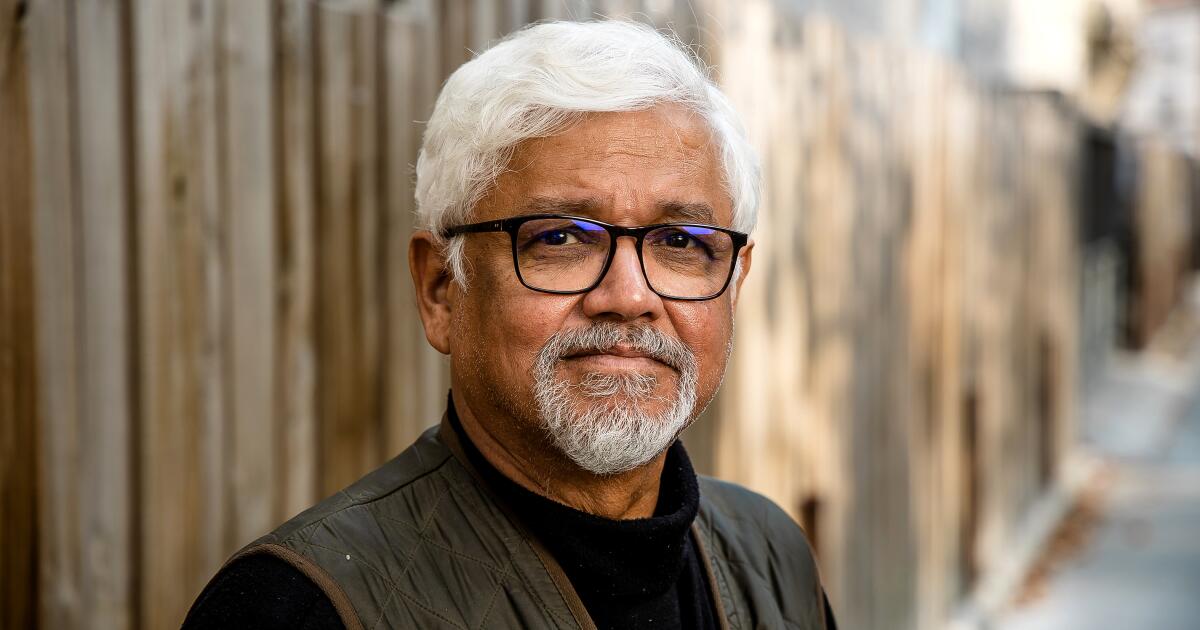
In his latest book, “Smoke and Ashes: Opium’s Hidden Histories,” Amitav Ghosh subverts Eurocentric history and digs open the recesses of racial capitalism, specifically Indian farmers coerced into growing poppy and the consequent pumping of opium into China. Ghosh exposes the hypocrisy of the Western world in perpetrating structural violence against Asians under the garb of free trade and progress and the uncanny similarities between the Machiavellian tactics of the opium business in China and of those who triggered the modern-day American opioid crisis. This conversation has been edited lightly.
China has long been perceived as an alien culture by the West. It has been demonized time and again, and after the COVID-19 outbreak, the animosity toward China has only worsened. But most Americans aren’t aware of the legacy in America of merchants who made their fortune in Guangzhou (Canton). Could you throw more light on that?
It might come as a shock to most readers that the U.S. has been dependent on China right from the very start. In 1783, when America was born, it was unable to trade with any of its neighbors that were still part of the British Empire. So, the Americans realized that it was essential for them to trade with China. In fact, one of the grievances that led to the birth of the U.S. was that the Americans were initially prohibited from trading with China because the trade was in the hands of the British East India Co. There was a lot of resentment against the East India Co.’s monopoly over tea. So almost immediately after the birth of the republic, China became the primary trading partner for the U.S. But the problem that the U.S. had in relation to China was the same that the British had — that the world again has today in relation to China — that the whole world buys Chinese goods, but the world doesn’t have any goods or enough goods to sell to China apart from resources because the Chinese make everything themselves. China was then, as it is now, the world’s great manufacturing hub.
(Farrar, Straus and Giroux)
So many of the technologies that we know today were stolen from China by the West, such as porcelain, gunpowder, compasses and bank deposit insurance. When the Americans started trading with China in the late 18th century, they started with furs and later sandalwood, but soon they just couldn’t find enough stuff to sell to China. So eventually they started doing what the British did: They started selling opium to China, sourced initially from Turkey and then later from India. For many generations, young Americans, especially very privileged white men predominantly from Massachusetts and other parts of New England and New York, would travel to China, and they would come back within four or five years with these immense fortunes. China gave them the experience of doing global trade, understanding currencies and foreign exchange, etc. They also became aware of the new industries that were then arising in Europe because of the Industrial Revolution. So, they came back to the U.S. and became the founders of all these modern industries, most importantly, perhaps the railroads.
You’ve drawn parallels between the Chinese opium crisis and the American opioid crisis. The British blamed the Chinese for being corrupt and mentally feeble. According to the British, they were simply meeting the Chinese demand for opium. Whereas we’ve seen in the American opioid crisis that it’s not demand but supply that dictates the flow of opium, as is evident in the case of the five states that had additional regulations to curb the prescription of opioids. These states (California, Idaho, New York, Texas and Illinois) experienced low growth in overdose deaths. So, it’s clear that it is supply and not demand that controls opium.
Initially, the British had trouble selling even 500 crates of opium to China, but once it got on, it was like a forest fire, and by the end of the 19th century, the Chinese were consuming hundreds of thousands of crates of Indian opium. So, when the anti-opium movement tried to constrain the British Empire from selling opium, the British deflected the blame onto the Chinese demand for it. This is essentially what the Sackler family also said in America when they introduced OxyContin; addicts were blamed. The British “logic”: There’s a demand for it, and if we don’t meet it, then someone else will.
The Sacklers were aided by a lot of historians and academicians who put forth revisionist arguments in favor of rehabilitating opioids. They even took the FDA into confidence, right?
That’s right. It wasn’t until the victims’ families began to protest in a very big way that the narrative changed. Until then, the people who were defending opiates had control of the narrative for the longest time. I think it’s also important to note that this kind of opioid crisis seems to go hand-in-hand with a certain kind of civilizational crisis. That was certainly the case with China when it started getting engulfed in the web of opium in the late 18th century. Suddenly, it found itself having to question its ideas of centrality in the world. It was facing, literally, an existential threat.
I think something very similar is happening in America today. There’s really a profound sense of civilizational crisis. And for ordinary Americans, they are facing life conditions that are unimaginably difficult. In a way, the opioid crisis took off because of all these other factors within society. Deindustrialization was happening, and old mining communities were disintegrating. Opium was sold to extremely vulnerable communities where there was a lot of pain and social difficulties. So, we really see a kind of playing out of what happened in China in the 19th century.
The anti-opium movement in the early 20th century rattled the British Empire, and eventually China succeeded in getting most of its population off opium. You’ve pointed out in your book that one of the problems with the American war on drugs was that it pinned the blame not only on the producers but also on the consumers, whereas the anti-opium drive only targeted the producers. The Chinese establishment ensured that they treated the addicts with sympathy.
This is the problem, really. The war on drugs was a state-led movement initiated by the U.S. armed forces and its security establishment. And there was a kind of double dealing involved because the Americans were using heroin, etc. in their conflicts in Southeast Asia, Latin America and so on. At the same time, they were also trying to suppress cocaine and other drugs, and they created an incredible mess. The first problem with the war on drugs is the idea of what exactly constitutes a drug. Many of the substances that they banned and considered drugs were, as we now know, in many ways beneficial to humanity.
Now they’ve changed strategies. More and more states are recognizing that many substances they call drugs are actually very beneficial, like psilocybin mushrooms, which can be used to treat depression. America now finds itself trying to control the circulation of heroin, fentanyl, etc. The problem is that again, it’s a state-led initiative, and it’s failing. Opioid-related deaths peaked during COVID-19, and it was thought that after the epidemic they would tail off. But no, it’s only continued to grow. Especially because fentanyl is so cheap and easily available, more and more people are dying of substance abuse.
What happened in Asia in the late 19th century and early 20th century was a very remarkable thing. You saw the emergence of a popular grassroots movement that was opposed to the free circulation of opioids, and that was effective. Even though, in China, the addiction problem continued until the 1950s, when, finally, the Communist Party did crack down on it. I don’t think any country will be able to reproduce that today.
One of the problems with addiction is that it happens indoors; the victims are out of sight. If you just look around America today, you wouldn’t think there was a problem. Many people who traveled to China in the 19th century thought everything was fine, but it wasn’t. In recent years, the U.S. Army has not been able to meet its recruitment goals. A recent survey found that not even 25% of young Americans are eligible to serve in the Army, partly because of obesity, mental health problems or drug use. Now that is a crisis.


In Sender, writer-director Russell Goldman’s high-anxiety debut, the filmmaker expands on his 2022 short Return to Sender, in which Allison Tolman starred as a woman who receives packages she didn’t order. That may not sound like a premise that would result in a paranoid, darkly comedic thriller, much less a feature. But in extending his story from 18 minutes to just over 90, Goldman follows a maddening scenario involving an online retailer called Smirk, a fictionalized Amazon counterpart. More significantly, he captures the frenzied mindset of his protagonist, who grapples with staying sober and several other major life changes—all compounded by a layer of justifiable paranoia brought on by the endless packages. Goldman’s tweaky style and elusive scripting create a peculiar, out-of-whack presentation that destabilizes the viewer, firmly placing us in his main character’s perspective. However, by the end, the journey through this cine-manic headspace doesn’t add up to much, and the potential character study at the center feels somewhat lost in the mechanics of the conspiracy.
Britt Lower (AppleTV’s Severance) stars as Julia, who has just lost her job and moved into a rental home to get her life on track. She is backed financially by her overbearing sister Tatiana (Anna Baryshnikov), who occasionally comes nosing around to verify that Julia doesn’t backslide. And she doesn’t. Julia attends regular Alcoholics Anonymous meetings, where she meets the steely Whitney (Rhea Seehorn), who isn’t interested in being her sponsor. But at home, Julia receives a Smirk package with her brand of lipstick. The problem? She didn’t order it. She calls customer service, and the representative doesn’t help much before telling her, “Be sure to stay alert and aware.” Wait, what? Sender is loaded with nagging, unplaceable details like this. They’re often amusing, intriguing, and exasperating in the same moment. But these pieces don’t complete a whole picture, at least not a narratively satisfying one.
The Smirk packages, delivered by the outwardly helpful, nice-guy driver Charlie (David Dastmalchian), contain a random assortment of objects, from drum kits to protein powder. The squirrelly Julia, already coming apart at the seams from her recent drama, doesn’t know what to make of it. She’s convinced there’s some plot against her, perhaps by someone at Smirk. To what end, she doesn’t know. But Goldman gives us a glimpse of the long-term consequences of her ordeal in the prologue, which features Jamie Lee Curtis (also a producer) as Lisa, a woman in circumstances similar to Julia’s. Lisa’s response to receiving a box of soil with a broken shin pad (with “Can’t Can’t Can” scrawled on it) entails an attempt to suffocate herself with the bubble wrap, only to do far worse with a sharp edge of the shin pad. To show Lisa’s fate, Goldman’s imagery becomes twisted and surreal but also cryptic.
Sender’s disorienting mood is matched by a skewed formal presentation. Cinematographer Gemma Doll-Grossman’s wide-angle lenses and arch angles might feel at home in a Ken Russell or Terry Gilliam feature such as The Devils (1971) or 12 Monkeys (1996). Julia’s half-remembered drinking binges, accented by blurry close-ups, suggest she may have slept with any number of coworkers. She can’t remember, and it embarrasses her. Her rental is dressed in simple if shabby décor, which gives way to Julia’s erratic collage-like overhaul. Melisa Myers’ stuffed production design makes the most of heightened colors and banal, cluttered rooms that lend a normality to the bizarre, ever more disturbing predicament. Nathan Ruyle’s erratic music delivers what must be described as a soundscape rather than a traditional score, with collusive sound effects and tones driving our certainty that Julia is onto something. Along with Marco Rosas’ discordant editing, Goldman’s technical approach effectively reflects Julia’s fragmented, sleep-deprived mind. But his work as a writer hasn’t done enough to justify this level of technique.
After Julia makes a revelatory discovery that small cameras have been embedded in the products from those mysterious packages, the eventual explanation about what has been happening and why strains logic and underwhelms. It also raises even more unanswered questions. Although well-made and acted—Lower and Seehorn should be on track to movie stardom—Goldman’s script could have used another draft to better work through what unfolds. Sender doesn’t give us enough of its characters’ inner lives beyond the situation at hand, so Julia, Charlie, Tatiana, and Whitney feel like devices in a scenario rather than well-drawn human beings. Even so, Goldman fills his film with deeply broken people who try to gain control of their lives by controlling others, exposing and preying on their weaknesses. Despite the material’s potential resonance, Goldman’s style is overpowering. Still, his kernel of an idea and the way he explores it demonstrate his clear skill, and for much of Sender, its sheer oddball energy earns admiration.

“Lethal Weapon” star Danny Glover has revealed he has been living with Alzheimer’s disease for years.
In an interview with NBC’s Lester Holt that aired on the “Today” show on Wednesday, the 79-year-old actor and activist opened up about living with the disease. According to People, he received his diagnosis in 2023, which was not long after he was awarded an honorary Oscar in 2022.
“I could live with it, in a sense,” Glover says of his condition, which has been affecting his movement, speech and memory. “I’m sure as it advances, things are going to be different and changing.”
A neurodegenerative disease, Alzheimer’s is a type of dementia that affects memory, thinking and behavior and worsens over time, according to the Alzheimer’s Assn. Holt reports that more than 7 million Americans over 65 are living with Alzheimer’s, with Black men suffering at a rate double the national average.
Glover and his family say the Hollywood icon is sharing his story now to “have ownership of his life” and to help remove the stigma around the disease.
“They’ve got my back,” Glover says of his family’s support.
Besides his portrayal of L.A. police Det. Roger Murtaugh in the “Lethal Weapon” film series, Glover is known for roles in movies including “Places in the Heart” (1984), “The Color Purple” (1985), “To Sleep With Anger” (1990), “Angels in the Outfield” (1994), “Dreamgirls” (2006) and “The Last Black Man in San Francisco” (2019). He’s also been a vocal advocate for social justice and humanitarian causes both in the U.S. and abroad.
He was the recipient of the Academy of Motion Picture Arts and Sciences’ Jean Hersholt Humanitarian Award in 2022.
“I don’t feel like it’s the end of my life,” he said in his interview with People about living with Alzheimer’s. “There’s work to do.”

Enter your email and we’ll send a secure one-click link to sign in.
WKRN is provided by Nexstar Media Inc., and uses the My Nexstar sign-in, which works across our media network.
Nexstar Media Inc. is a leading, diversified media company that produces and distributes engaging local and national news, sports, and entertainment content across its television and digital platforms. The My Nexstar sign-in works across the Nexstar network—including The CW, NewsNation, The Hill, and more. Learn more at nexstar.tv/privacy-policy.
-
 Sports7 minutes ago
Lakers announce summer league schedule, roster
-
World15 minutes ago
How the Entry-Exit System is becoming a nightmare for Europe's summer travellers
-

 News40 minutes ago
Newsom’s office responds to SCOTUS ruling on women’s sports as California faces ongoing trans athlete wave
-

 Los Angeles, Ca2 hours ago
Family of boy, 8, killed by falling tree branch at Calabasas park to get $14.6M
-

 Detroit, MI2 hours ago
The worst Detroit sports uniform from every pro team
-

 San Francisco, CA2 hours ago
Discovery Bay driver arrested for San Francisco fatal vehicle collision | Contra Costa Herald
-

 Dallas, TX3 hours ago
Erling Haaland’s Dallas Western wear purchase goes viral
-

 Miami, FL3 hours ago
Miami’s FIFA Fan Fest draws thousands to Bayfront Park to watch Team USA win World Cup match against Bosnia

