Entertainment
'Bridgerton’ boss on Julie Andrews' fate, Polin's heir and Season 4

This article contains spoilers for Season 3 of Netflix’s “Bridgerton.”
The call from Shonda Rhimes came on a Saturday.
It was spring 2021 and Jess Brownell — a writer on “Bridgerton” who was living in London’s Notting Hill as filming got underway on the second season — was preparing some tapas from the local grocery store alongside her wife as they readied for guests. Brownell assumed something was wrong. Rhimes, the prolific producer behind Netflix’s smash hit, whose TV oeuvre includes hit series “Grey’s Anatomy” and “Scandal,” doesn’t often make work calls on the weekends.
“The first thing she said was, ‘What would you think about stepping into the showrunner role going forward?’” Brownell recalled. “It was very surreal.”
“Bridgerton” creator Chris Van Dusen, who had developed Julia Quinn’s bestselling historical romance novels for television and overseen the first two seasons, was set to depart ahead of the third installment. Brownell, who had been a writer on the series since its first season, didn’t let self-doubt crash that fateful phone call with Rhimes — instead, as she tells it, she was quick to say she was ready.
“And then panic came the next day,” she said.
Harnessing the momentum of a globally popular franchise, after all, is as high-stakes as maintaining the anonymity of the ton‘s gossip columnist, Lady Whistledown. “Bridgerton” was an instant success when it was released in 2020, aided by the passionate romance between Daphne Bridgerton (Phoebe Dynevor) and Simon Bassett, the Duke of Hastings (Regé-Jean Page). (According to viewership data released by Netflix, 82 million households watched the first season in its first month of release.) Its sophomore outing — focused on another Bridgerton offspring, Anthony (Jonathan Bailey), and his angsty relationship with Kate Sharma (Simone Ashley) — was also a triumph. And “Queen Charlotte,” the prequel spinoff that tells the monarch’s backstory as she falls in love with King George III, continued the insatiable fandom.
When word spread that Season 3 would chronicle the friends-to-lovers dynamic between Colin Bridgerton (Luke Newton) and Penelope Featherington (Nicola Coughlan) — a fan favorite to many of the books’ readers — the pressure was intense to rise to the occasion.
Still, Brownell knows all too well the value of a little drama.
Like Van Dusen, she is a veteran of Shondaland, Rhimes’ production company. Three months after graduating from USC’s film school, Brownell landed a job as a second assistant to Betsy Beers, Rhimes’ producing partner, following a stint in a pilot program for aspiring Hollywood assistants coordinated by the Writers Guild of America. She’s been at Shondaland since, working her way up on “Scandal,” starting as a researcher — “I was very, very unqualified for it, but I’m good at Google, so it worked out” — until she got the opportunity to write a couple of freelance scripts and eventually was hired on.
“‘Scandal’ was a really interesting experience,” she said, explaining that she loved the show but the subject matter wasn’t in her wheelhouse. “I remember sitting in the writers room, sometimes with people around me pitching ideas, not having as many ideas as everyone else, and just going, ‘Oh, maybe I’m not that good at this.’” It wasn’t until she arrived in the “Bridgerton” writers room, her first job after “Scandal” ended, that she realized, “‘Oh, I was in the wrong sandbox. Now I’m in my happy place.’”
In a recent video call from London, while taking a break from the “Bridgerton” writers room, Brownell talked about the debate with Rhimes over Colin’s virginity, Julie Andrews’ fate as narrator on the series and the visual changes coming to Season 4. This interview has been edited and condensed for clarity.
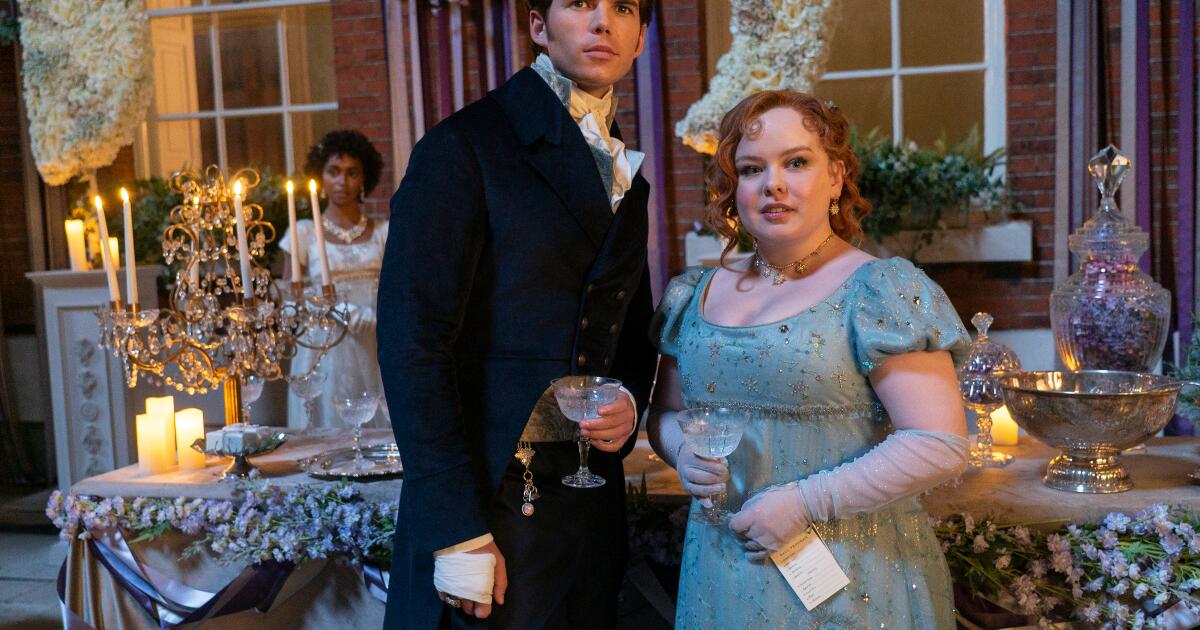
Luke Newton as Colin Bridgerton and Nicola Coughlan as Penelope Featherington in an episode from the third season of “Bridgerton.”
(Liam Daniel / Netflix)
The show has been an incredible success since it launched. How would you describe what it was like, taking over as showrunner?
The pressure was immense. I knew that if there was a drastic decline in the numbers or in the reception that I was the most obvious thing that changed, the thing to blame. It’s been a huge relief and really joyful to see people responding the way they have. I have been with the show from Season 1 and I am proud of my contributions to the show. That was the thing that I kept reminding myself: This isn’t my first time doing this. And I had an amazing writing staff who I really relied on.
The first half of the season generated a lot of chatter. Are you someone who reads comments and tweets?
I was really good the entire time we were writing and in production — I was nowhere near “Bridgerton” internet. But I have allowed myself to dip a little pinkie toe in since the [first half of the season] aired. I have a really sweet algorithm going on TikTok right now that’s basically just live carriage reactions. It’s the best thing ever. I spent three years working over Zoom, partly during the end of the pandemic, and to finally have it out there and to see people in their living rooms, reacting the way they are and going, “Oh my gosh, Pitbull!” — that was the coolest thing ever. The reaction to Pitbull has been a great surprise. That’s one of the few songs that I picked early on; it was in my showrunner’s cut. I was a little worried because I knew it was a slightly irregular choice, but the song just slaps so hard.
This was the first season of “Bridgerton” split into two parts. How did you feel about that decision?
We had actually already written and produced the entire season thinking it was going to all drop at once when Netflix approached us about splitting it. We did already have that midpoint with the carriage scene and so it worked pretty perfectly. I had concerns because I know, as a viewer, I’m someone who also wants to mainline TV shows that I love. But I was hopeful that it was going to be a good chance for people to pause and get to chat in their circles about the first half. What happens when you drop it all at once is that people are mostly just reacting to the end because that’s where usually all of the biggest “OMG” moments are. It’s been really gratifying as a writer to see people react to some of the earlier beats that we’re also really proud of.
Something that’s been tricky is people reacting before they’ve gotten to see the entire picture of what we’ve intended. I know there’s been some chatter about Colin being a whole other character. I’m like, “Yeah, that’s the point. Give us a minute!” I know that once people see the back half, they’re going to understand, but, of course, there are moments where I’ve felt frustrated with that.
I’m assuming the same release strategy will apply for next season. Is that shaping how you’re thinking about things?
I don’t know for sure that we’re going to be doing that, but it does seem to be something that Netflix wants to do. It seems to have helped the numbers. I would guess they would want to do it again. It doesn’t really change the way we approach story because we do always build to a major moment in the middle of the [season] that turns the action on its head.

Jess Brownell on taking over “Bridgerton”: “I knew that if there was a drastic decline in the numbers or in the reception that I was the most obvious thing that changed, the thing to blame, so it’s been a huge relief, and really joyful to see people responding the way they have.”
(Evelyn Freja / For The Times)
My TikTok algorithm likely looks a lot like yours — there’s no shortage of “Bridgerton” videos of declarations of love, like Anthony proclaiming to Kate: “You are the bane of my existence and the object of all my desires.” How did you and the writers want Colin or Penelope to express their love for each other?
After “I burn for you” became such a thing in Season 1, there was a moment in Season 2 where we got a little in our heads about trying to think what the moment was going to be, and it was not the one that we expected. We thought it was going to be “You vexed me.” And instead, obviously, it was Anthony’s wonderful line.
I’ve given up on trying to craft something for the sole purpose of it popping off. Also, if people have seen the entire season, they will know Colin is such a lover boy. He has so many different love confessions this season and so many big speeches about his adoration for his wife that it’s just impossible to predict which one is going to hit the hardest.
Unlike previous couples, Penelope and Colin have a backstory; there’s history there. How did that inform your approach?
It’s extra pressure because people love them so much. But it’s also a bonus that they’ve been established for two seasons, and that people have already invested in them. The challenge was making sense of everything we’ve already seen from them in Seasons 1 and 2, and building that into their arcs leading toward each other.
Of course, all writers on Season 1 have read all the [“Bridgerton”] books multiple times, but you have to take characters through some zigs and zags over the course of the season — especially with Colin, there was a lot of talk about how to reconcile the different actions we’ve seen from him, including proposing to Marina and saying he would have stayed with her even if she had told him about the baby. It’s not in the book for Colin’s character, but we were like, “Right, he’s got white knight syndrome.” He is a guy who wants everybody to like him. It’s very different from Anthony’s sense of duty and obligation. Colin’s need to be liked comes from a much more insecure place where he doesn’t really know what he has to offer, and doesn’t feel worthy.
The romance whirlwind that Penelope and Colin find themselves in is brief because Penelope’s secret — that she’s Lady Whistledown — sends things into a tailspin. What was the challenge of making so much fit in the eight episodes?
The Whistledown secret hanging over everything was a really helpful narrative device that we had this season, because it’s like Chekhov’s gun — you know that it’s going to go off at some point, and that provides the central tension in the back half of the season. Because we had that gun waiting to go off, we knew that we were going to be able to spend more time in the love bubble between Colin and Penelope in the back half. Whereas I think in previous seasons we had to build a ton of conflict directly between the main couple.
In the front half — I feel like Colin has been in love with Penelope all along. I think he’s just been too much of a dunderhead, as they would say in Regency times, to figure it out. It’s the way it is in the book. I do think that one kiss is really all that he needed to open up the door and go, “Oh, my God.” I understand that it is a little bit quick, but he’s known her forever.
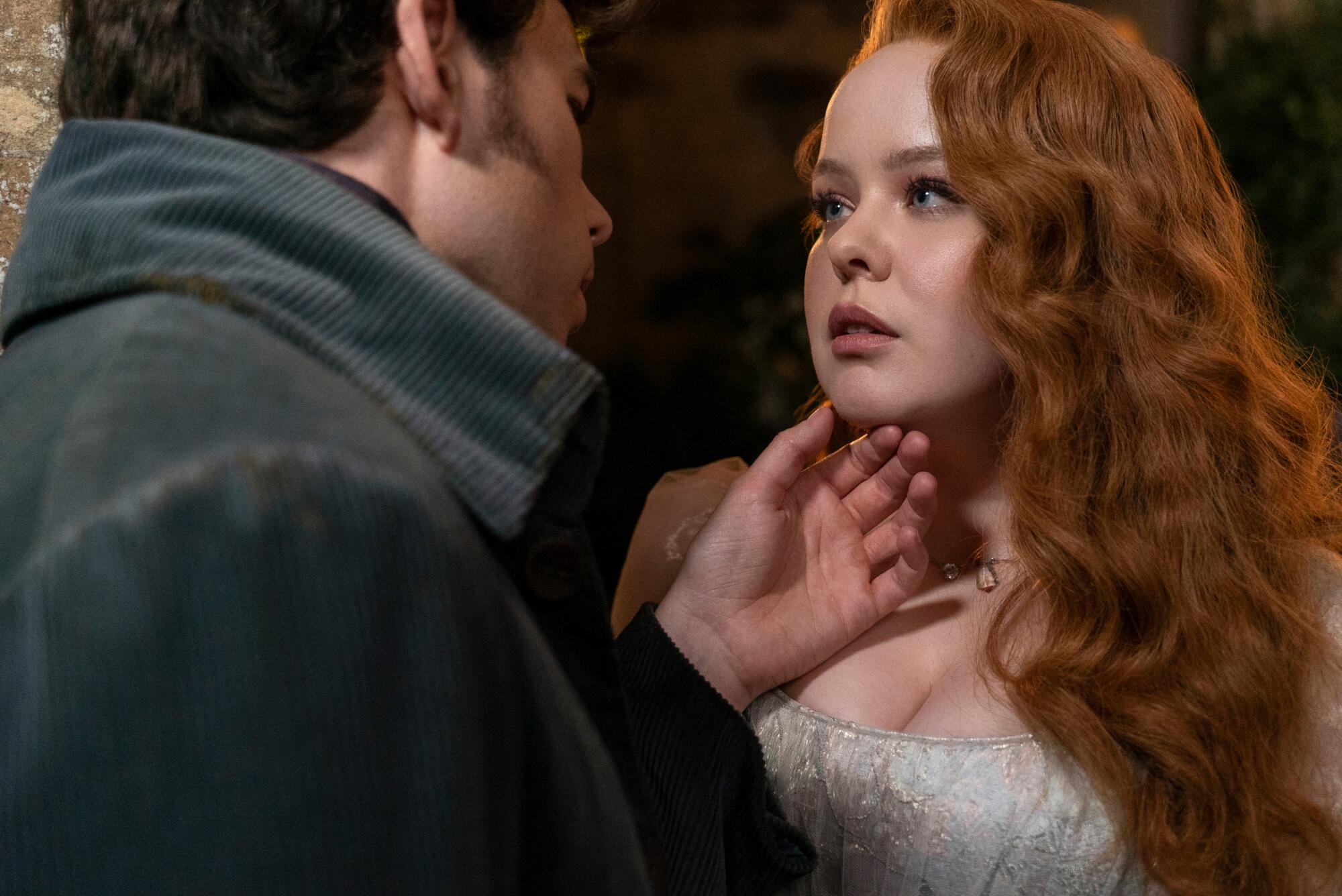
Colin Bridgerton (Luke Newton) and Penelope Featherington (Nicola Coughlan) in Season 3 of “Bridgerton.” Jess Brownell on their romance: “I wanted to get the dynamic right because there is such depth between those characters.”
(Liam Daniel / Netflix)
What was the most difficult scene or episode to execute? The carriage ride scene? The mirror scene?
The carriage scene and the mirror scene — those were just fun. We knew exactly what we wanted to do with those. I will say that the mirror scene, we really wanted to get right because it means a lot to me for the intimacy scenes to come from a storytelling place. I wanted to get the dynamic right because there is such depth between those characters and such a long-standing friendship that I wanted it to feel like a different kind of sex than we’ve seen. Finding those moments of laughter was really the key there.
Episodes 5 and 6 are always the hardest episodes to write in every season; that tends to be where the main drama has come to a peak, at the midpoint of the season. And then you’re waiting to get to the bigger stuff that is going to happen at the end of the season. Thankfully, the charades party with the ticking clock and Cressida deciding to come out as Whistledown provided us nice, new obstacles in the back half.
There’s an interesting thing that happens with this show, which is the tallying of intimate moments. Is that something you and the writers think about?
It feels like that maybe started happening after Season 2 had a different approach to intimacy than Season 1. I think people started getting very granular with the way they were talking about how “Bridgerton” does intimacy, But it’s so funny to me — I think of Season 2 as one of the sexiest seasons. This is a show, hopefully, for everyone, but I think when we’re talking about women and intimacy scenes, to me, the longing and the yearning and the pinkies grazing each other and the furtive looks from across a room — that is intimacy.
What is your approach to adaptation and assessing where you want to stay faithful to the book or when it’s appropriate to make tweaks for TV ?
Julia Quinn has been really lovely and understanding about some of the changes that we’ve made. A lot of romance novels, specifically, it’s a lot of internal monologue. But I think on television, you do have to find ways to externalize that. The charm-school plot, for example, and Colin being Penelope’s tutor, that is not in the book, but it’s really just a way of externalizing certain conversations they have about confidence and popularity. I really tried to honor the spirit of the book, the emotional journey of the book. In the writers room, on the first day, we talk about our favorite moments from the book that absolutely have to be there. Some of the scenes we’ve lost, it’s just been a calculation about figuring out how to weave in the ensemble stories — like the Whistledown hunt in the book comes from Lady Danbury, she’s the one who issues a reward. But we had been watching the queen hunt for Lady Whistledown for two seasons. … Sometimes it’s just a practical reason like that.
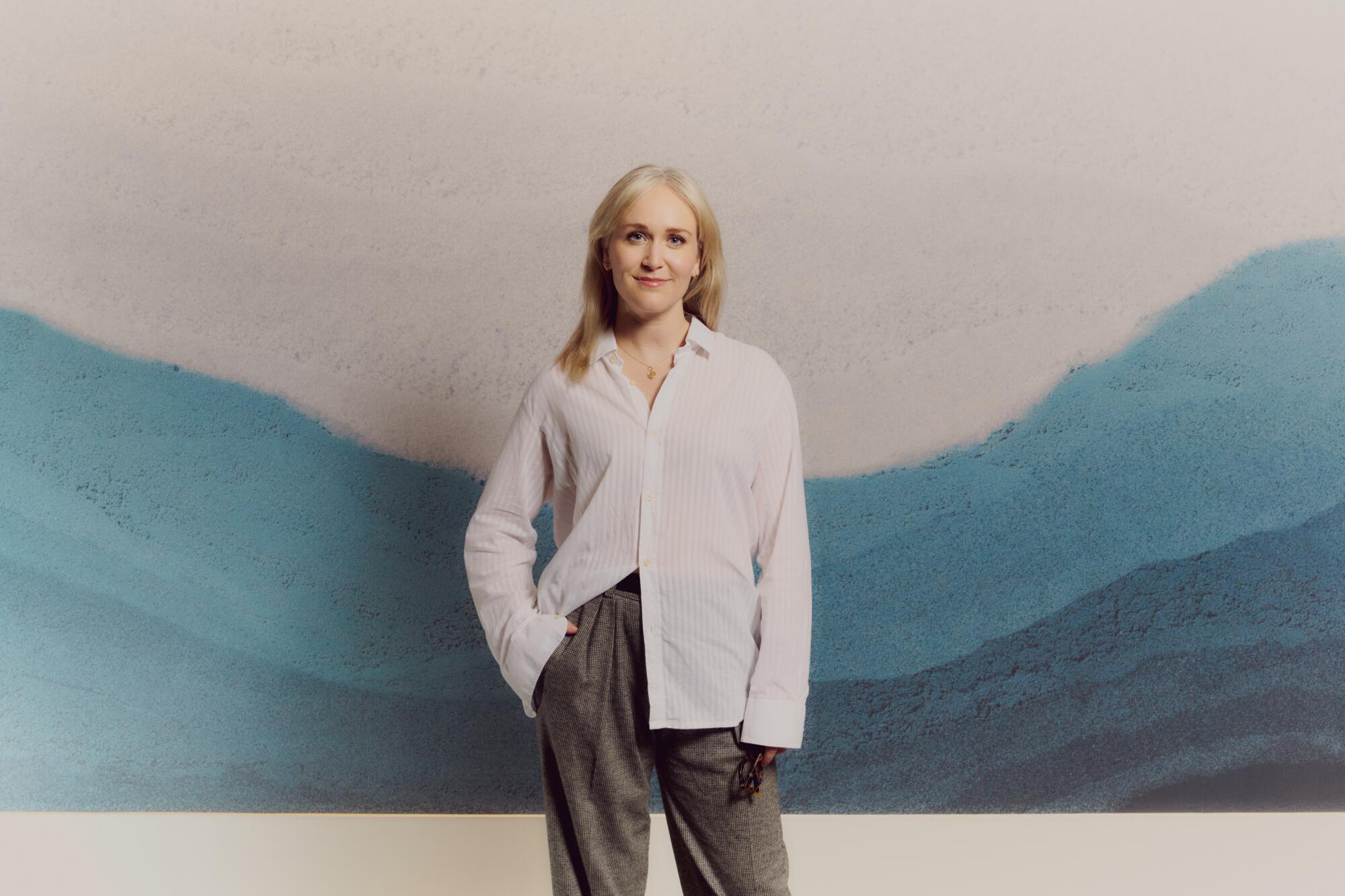
“Bridgerton” showrunner Jess Brownell on steamy moments: “This is a show, hopefully, for everyone, but I think when we’re talking about women and intimacy scenes, to me, the longing and the yearning and the pinkies grazing each other and the furtive looks from across a room — that is intimacy.”
(Evelyn Freja / For The Times)
In the book, Colin discovers that Penelope is Lady Whistledown before the carriage scene. Why change that?
When we were talking about it in the room, if you’re looking at Colin and Penelope as the leads of the season, that is the major dramatic moment between them. I’m really strict about structure. If you’re thinking about the season as a three-act structure, the way you would look at it with a movie, the end of Episode 6 is meant to be the low point or the end of Act Two in traditional storytelling structure. That’s the moment where you want to have the biggest fight or the biggest loss between your main couple. What could possibly be bigger than him finding out that she’s Whistledown and that she’s been lying to him this whole time? It also felt like if Colin finds out she’s Whistledown in the front half, it’s really all falling action from there. It would be difficult to keep the intrigue moving up and up to carry people through to Episode 8.
By the end of the season, the ton knows Penelope is Lady Whistledown and the narration changes to Penelope’s voice. Does this mean Julie Andrews is done as narrator?
It’s really a tough question because dramatically it would make sense to switch over to Nicola’s voice from now on because she’s owning her own voice. But it’s also freaking Julie Andrews. Her voice is so key to the feeling of the show. We’re playing around with it in Season 4. To be honest, we don’t know exactly what we’re going to do, but I think there’s a way to square that.
There is a friendship between Lady Danbury and Penelope that’s explored in the book that fans were interested in. We get a hint of it near the end.
I love the Lady Danbury friendship with Penelope in the book, it’s such a powerful one. But in the room, we talked a lot about the fact that Lady Danbury — she’s always been involved in other people’s stories. I think you run into somewhat problematic tropes with that, occasionally, when she’s there as an adult black woman, always helping the younger couples.
We wanted to center her own narrative, and build up her friendship with Violet, and show that her importance doesn’t rest squarely in her meddling in the lives of the young people, but that she can stand on her own two feet, story-wise. Now that we’ve built the friendship between Violet and Agatha so much, I’m excited about where we can go with it further in future seasons.
How do you see the storyline with Violet (Ruth Gemmell) and Lady Danbury’s brother Marcus (Daniel Francis) developing?
It’s a tricky trope to only have mothers act in service of their children. While we really want to honor the fact that her connection with Edmond is one for the ages, it felt appropriate for Violet to get to focus on herself a little bit in the same way we wanted to focus on Lady Danbury. Marcus Anderson is the exact right kind of character to help her very slowly dip her toes in the waters of dating. He’s very respectful, doesn’t look her directly in the eyes, knows that she needs to come to him and not the other way around. It’s a nice slow burn that that we’re going to take our time with going forward.
The season delves into the limitations of being a woman of that time and how it shapes some of their actions and behaviors —
Obviously “Bridgerton” has somewhat of a modernized feel to it, but I think the driving force of the show is still the gender roles that existed in the early 1800s and do still, to a certain extent, exist today, which is why I think people can relate to the stories. I’ll take Cressida, for example, and Lady Featherington this season. They are two characters who people have frequently talked about as villains. I was really interested this season in exploring the systemic factors that are going on. It misses the point entirely to villainize a woman in the Regency period because they were stripped of such little power and I think every action — it’s not to say that Cressida or Lady Featherington shouldn’t be held accountable for some of the things they’ve done, but there was a lot going on that was holding them back. And even if they still are playing as villains of a sort, at least now we understand why and we understand where they’re coming from.
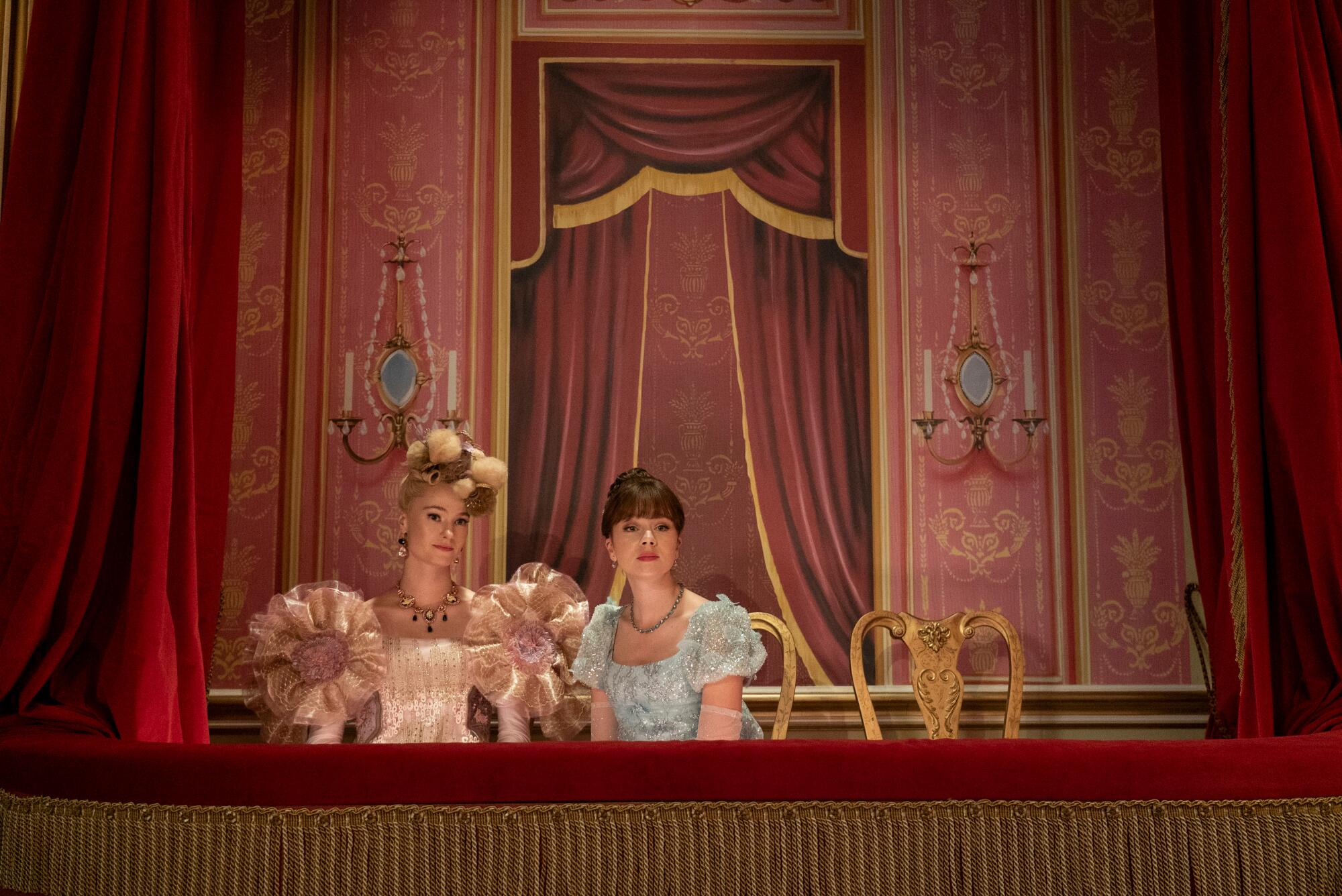
Cressida Cowper (Jessica Madsen) and Eloise Bridgerton (Claudia Jessie) in a scene from the show. “We’re not done with Cressida,” says “Bridgerton” showrunner Jess Brownell.
(Liam Daniel / Netflix)
We saw that in the end Cressida is sent off to live with her aunt — she appears in only two of the “Bridgerton” novels. Where does that character go from here?
We’re not done with Cressida, if I have my druthers. I have a storyline for her that I think gives a nice resolution to her journey. Initially, when we shot Cressida’s departure, we had it scripted that her mother, at the last minute, joins her in the carriage. She chooses her daughter, and it was really, really nice, but when I was talking about it with Shonda, we landed on the fact that we do want to do more with Cressida. If her mother had chosen her at the end, that’s an ending in a way. The fact that she hasn’t gotten her happy ending yet means that her story is not over.
Now I want to know if there was a Shonda note on Penelope and Colin.
That creative collaboration is so sacred. I will say Shonda and I debated Colin’s virginity. I was pro Colin being a virgin because it tracked with his character. In my mind, him coming back at the start of the season acting like he was this Regency F-boy was surely an act. But Shonda made a really good point, which was that if he is really trying to convince himself, he’s doing it [being a womanizer]. I think some of those scenes in the brothel, for example, which I know are very controversial, when Shonda and I were talking about it, these represent him trying to lean into this toxic masculinity and trying to prove to himself that he can be just like his older brothers. As you can see in the second [brothel scene], he can’t even convince himself for longer than a week or whatever that this is what he wants. I ultimately really agreed with her. She’s a genius at — I mean, she often gives notes that I know are going to be controversial, but they’re also going to be the thing that gets people excited about the storyline, and talking about it, and debating it. I’m glad that Shonda pushes me into a space where we’re making stronger creative choices.
The season ends with Penelope and Colin welcoming a son, a tweak from the book. What do you see for their future?
Colin and Penelope, in the book, initially had a daughter, and they named her after Lady Danbury, they named her Agatha. For us, because of the heir race, we felt like it was poetic justice for Penelope to be the one who pulls ahead of her two sisters who have dumped on her for so long. It made sense to give her the boy.
Just like with Anthony and Kate, Penelope and Colin will fall back. We’ll keep our focus on the main couple in Season 4, but I do think more than with other couples, there’s a bit more to tell because Penelope is Lady Whistledown. I’m really curious to see what it’s like for Penelope being a public gossip columnist, seeing whether she’s going to be able to be accountable in a way she hasn’t been in the past, if she’s going to use her pen for more righteous means going forward.
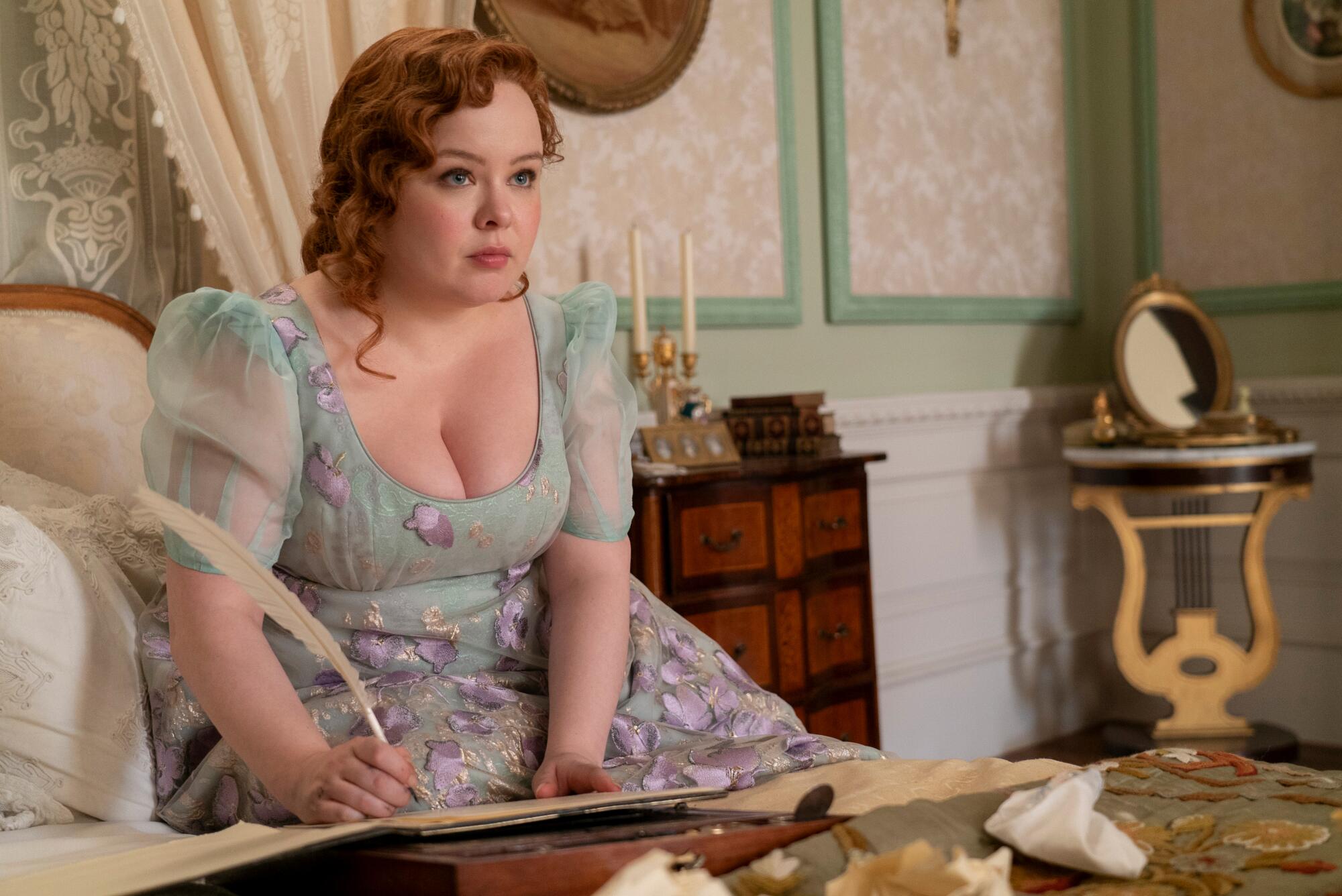
Now that Penelope Featherington’s (Nicola Coughlan) secret identity as Lady Whistledown has been revealed, “Bridgerton” showrunner Jess Brownwell says she’s “curious to see what it’s like for Penelope being a public gossip columnist.”
(Liam Daniel / Netflix)
This season explored a queer romance through Benedict Bridgerton (Luke Thompson). What are you setting up for next season?
Benedict’s fluidity is something we’ve been talking about from Season 1, which is why I think viewers have picked up on it. We wanted to do that storyline justice, and it felt like Season 3 was a good place to do that to make sense of some of the threads we’ve seen with him before. That storyline speaks in a bigger way to Benedict’s overall character arc, which has a lot to do with being someone who is learning how to exist between society and and being unconventional. Benedict [is] trying to figure out what his place is in the world and how to circumvent certain rules, which is something Tilley Arnold (Hannah New) is teaching him this season. I think we will continue telling the story of his fluidity going forward.
A character that caught people by surprise was John Stirling (Victor Alli ) and his relationship with Francesca Bridgerton (Hannah Dodd). You kept it under wraps.
The moment we cast Victor Alli, we knew he was going to be so beloved. He’s such an incredible actor, but we did want to sit on it just so that it could be a surprise when John Stirling shows up because book readers obviously know when they hear that name that he’s important to Francesca. Francesca and John are one of my favorite couples in the series. They have a kind of love that I would advise my girlfriends to seek. I think it feels really radical, or I hope it feels radical in a romance show, to focus on a love that is quiet and a love that is based on companionship and friendship and common interests and respect. I think there is also attraction there, but obviously, we are introducing Michaela at the end of the season, so there will be a second chapter for Francesca. But I want to emphasize that that doesn’t mean that we are disavowing what Fran and John have. I personally don’t believe in a hierarchy of love. I think there are lots of different ways to love and be loved.
Francesca is unlike the rest of the boisterous Bridgertons. John seemed to match her idiosyncrasies. Some fans felt it was a neurodivergent love story.
I actually think Fran and John’s relationship looks like so many more of the relationships I know than any of the romances on “Bridgerton.” We’re just not used to seeing that kind of relationship on television. I thought that the conversation around neurodivergence was really interesting and it was actually something we talked about in the room, but we didn’t necessarily set out to write a neurodivergent character with Francesca. As we were adapting her from the book, many of us thought maybe she is neurodivergent because she does share certain characteristics, and it’s just been beautiful to see people relating to that.
Is there a scene from this season that you’re excited fans finally get to see after sitting on it for so long?
It’s probably the the butterfly ball, as we called it internally. It has Penelope’s big monologue as she comes out as Lady Whistledown and then Philippa [Featherington, played by Harriet Cains] running across the ballroom shouting, “The bugs, Varley!” and then there are butterflies coming out. In Episode 6, when the Mondriches are throwing their first ball and they’re wanting to impress the Queen, in the writers room, we had come up with the idea of, “Oh, maybe they should do a butterfly release because that would surely titillate the queen.” Then one day I had this frying-pan-on-the-head cartoon moment of, “You, dodo. Butterflies! Hello, the Featheringtons. Like, hello, this is Penelope’s journey. She’s in a chrysalis. She’s a caterpillar, she’s becoming a butterfly.” Last minute, I had to tell our production designer, “You have to think of something else,” and she pitched that mechanical flower box so that we could save [the butterflies] for the final moment. I’m so glad and grateful to our crew for allowing me that last-minute change because it’s the perfect moment to underscore Penelope’s journey.
Let’s get into the music. How much of it is spitballing in the room, how much of it is being pitched by an artist’s team? And what led to the decision to feature the show’s first-ever original song?
Justin Camps, who is our music supervisor, gave me a playlist of maybe 100 or 200 orchestral versions of pop songs when we were starting production. We’re not really thinking about it when we’re writing. There are a few different ways [picking a song] happens. The process in postproduction is that an editor does a cut, then the director, then me and then Shonda. Then me, Shonda, Shondaland and Netflix give notes on the final cut.
Two songs in my cut that I was gunning for were Pitbull and a Demi Lovato song [“Confident”] in Episode 6 when Cressida has her big moment. I really tried to get [No Doubt’s] “Don’t Speak” in when Debling and Pen first have their dance, but it was just too melancholy, and [Billie Eilish’s] “Happier Than Ever” is actually perfect. Nicola suggested “Happier Than Ever.” A couple of the songs that the editors chose made it in there. Jack Murphy, our choreographer, does a choreographed dance with a set of dancers at every ball. Oftentimes, he would pick a song to choreograph a dance to and sometimes we would use the song that he picked. [Coldplay’s] “Yellow” being the song over the wedding was something that we all collaborated on and knew that the fans would love to see in that moment. It’s hitting that balance between something that’s not going to be so instantly recognizable that it’s going to take you out, but it has to be recognizable enough that after 10 seconds, you hit your knee, and you’re like, “Oh, it’s that one!”
With Tori Kelly, [behind this season’s “All I Want”] — that was the first time we’ve done an original song. I got the chance to see her perform the song live at the premiere in New York. I think it is such a beautiful song that speaks to so many themes of the seasons.
I know you’re a rom-com enthusiast. Were there films that you took inspiration from as you crafted this season?
I came of age in the ’90s and early 2000s. There’s a lot of nostalgia for movies from that period of time. The makeover moment for Penelope is, in some ways, an homage to “She’s All That” and Rachael Leigh Cook walking the stairwell. I had even, on one pass of my cut, put an orchestral version of “Kiss Me” in there, but it was just too on-the-nose. I’m really curious to see [the reaction] when the back half airs. There is a pretty obvious homage to a scene from “Notting Hill,” the Richard Curtis movie. The brownie scene. It’s one of the greatest scenes in modern rom-coms. There weren’t other really specific scenes, but I’ve been so influenced and informed by the banter in so many of the movies I grew up watching, whether it’s Nora Ephron or older classics. I just love good, awkward banter.
Is there anything you can tease about Season 4 that will make no sense now but will when it comes out?
I’ll tease this: You might be getting a different season from “Bridgerton.” We always live in this perpetual spring in “Bridgerton,” but we’re playing around with the idea of fall … for the first time. Some of that is about story and some of it is, honestly, just for practical reasons because we’re shooting in the fall. It’s still going to be just as lush and colorful, but just more in those warm fall colors instead of the pastels. There will still be some pastels, so it won’t look like a totally different show. I’ll give you that.



That’s both a promise and a challenge she delivers, since what follows may rub some viewers the wrong way. Yet Gyllenhaal’s full-throttle commitment to her vision is compelling in and of itself, and she has marshalled an absolutely smashing-looking and -sounding production. The story proper begins in 1936 Chicago, which, like everything and everyplace else in the movie, has been luminously shot by cinematographer Lawrence Sher and sumptuously conjured by production designer Karen Murphy. Her involvement is appropriate given that her previous credits include Bradley Cooper’s A STAR IS BORN and Baz Luhrmann’s ELVIS, since among other things, THE BRIDE! is a nostalgic musical. Its Frankenstein (Christian Bale), who has taken the name of his maker, is obsessed with big-screen tuners, and imagines himself in elaborate song-and-dance numbers. (Considering the reception to JOKER: FOLIE À DEUX, one must applaud the daring of Warner Bros. for greenlighting another expensive film in which a tormented protagonist has that kind of fantasy life.)
THE BRIDE! may be revisionist on many levels, but its characterization of its “monster” holds true to past screen incarnations from Karloff’s to Elordi’s: His scarred appearance masks a lonely soul who desires companionship. Frankenstein has arrived in Chicago to seek out Dr. Cornelia Euphronious (Annette Bening), correctly believing she has the scientific know-how to create an appropriate mate for him. Rather than piece one together, Dr. Euphronious resurrects the corpse of Ida (Jessie Buckley), whose consorting with underworld types led to her brutal death. Previously chafing against the man’s world she inhabited in life, she becomes even more defiant and unruly as a revenant, apparently possessed by the spirit of Shelley herself, declaiming in free-associative sentences and quoting rebellious literature.
Buckley, currently an Oscar favorite for her very different literary-inspired role in HAMNET, tears into the role of the Bride (who now goes by the name Penny) with invigorating abandon that bursts off the screen. Unsure of her identity yet overflowing with self-confident bravado, she’s the opposite of the sensitive “Frank,” but they’re united by the world that stands against them. That becomes literal when a violent incident sends them on the lam, road-tripping to New York City and beyond, on a trail inspired by the films of Ronnie Reed (Jake Gyllenhaal), Frank’s favorite song-and-dance-man star.
With THE BRIDE!, Gyllenhaal has made a film that’s at once her very own and a feverish homage to all sorts of cinema past and present. It’s a horror story, a lovers-on-the-run movie, a crime thriller, a musical and more, and historical fealty be damned if it makes for a good scene (as when Penny and Frank sneak into a 3D movie over a decade before such features became popular). In-references are everywhere: It might just be a coincidence that the couple’s travels take them past Fredonia, NY (cf. “Freedonia” in the Marx Brothers’ DUCK SOUP), but it’s certainly no accident that the former Ida is targeted by a crime boss named Lupino, referencing the actress and pioneering filmmaker whose works included noirs and women’s-issues stories. Penny’s exploits lead legions of admiring women to adopt her look and anarchic attitude, echoing the first JOKER (while a headline calls them “Twisted Sisters”), and the use of one Irving Berlin song in a Frankensteinian context immediately recalls a classic comedic take on the property.
Whether the audience should be put in mind of a spoof at a key point in a film with different goals is another matter. At times like these, Gyllenhaal’s pastiche ambitions overtake emotional investment in the story. As strong as the two lead performances are (Bale is quite moving, conveying a great deal of soul from behind his extensive prosthetics), it’s easier to feel for them in individual scenes than during the entire course of the just-over-two-hour running time. The diversions can be entertaining, to be sure, but they also result in an uncertainty of tone. The dissonance continues straight through to the end, where the filmmaker’s choice of closing-credits song once again suggests we’re not supposed to take all this too seriously.
There’s nonetheless much to admire and enjoy about THE BRIDE!, and this kind of risk-taking by a major studio is always to be encouraged (especially considering that we’ll see how long that lasts at Warner Bros. once Paramount takes it over). Beyond the terrific work by the aforementioned actors, there’s fine support from Peter Sarsgaard and Penelope Cruz as detectives on Penny and Frank’s heels, with Sandy Powell’s lavish costumes and Hildur Guðnadóttir’s rich, varied score vital to fashioning this fully imagined world. Kudos also to makeup and prosthetics designer Nadia Stacey and to Chris Gallaher and Scott Stoddard, who did those honors on Frank, for their visceral, evocative work. Uneven as it may be, THE BRIDE! is also as alive! as any film you’ll likely see this year.

New animated sequences of songs from “Encanto,” “Frozen 2” and “Moana 2” are headed to Disney+.
Disney Animation announced Wednesday that “Songs in Sign Language,” comprised of three musical numbers from recent Disney movies newly reimagined in American Sign Language, will debut April 27 in honor of National Deaf History Month.
Directed by veteran Disney animator Hyrum Osmond, “Songs in Sign Language” will feature fresh animation for “Encanto’s” chart-topper “We Don’t Talk About Bruno,” “Frozen 2’s” poignant ballad “The Next Right Thing” and “Moana 2’s” anthem “Beyond.” Produced by Heather Blodget and Christina Chen, the new versions of these songs were created in collaboration with L.A.-based theater company Deaf West Theatre.
“In the majority of cases, we created entirely new animation,” Osmond said in a press statement. “There were a lot of adjustments that we had to do within the animation to be true to the original intention.”
Deaf West Theatre artistic director DJ Kurs, sign language reference choreographer Catalene Sacchetti and a group of eight performers from Deaf West worked together to craft and choreograph the ASL version of the musical numbers for “Songs in Sign Language.” The creatives focused on being true to the concepts and emotion of the songs rather than direct translations of the lyrics.
Kurs said his team jumped at the chance to collaborate and integrate ASL into “the fabric of Disney storytelling.”
“Disney stories are the universal language of childhood,” Kurs said in a statement. “The chance to bring our language into that world was a historic opportunity to reach a global audience. Working on this project was very emotional. For so long, we have known and loved the artistic medium of Disney Animation. Here, the art form was adapting to us. I hope this unlocks possibilities in the minds and hearts of Deaf children, and that this all leads to more down the road.”
Osmond, who led a team of more than 20 animators on this project, said animation was the perfect medium to showcase sign language, which he described as “one of the most beautiful ways of communication on Earth.” The director, whose father is deaf, also saw this project as an opportunity to connect with the Deaf community.
“Growing up, I never learned sign language, and that barrier prevented me from really connecting with my dad,” Osmond said. “This reimagining of Disney Animation musical numbers helps bring down barriers and allows us to connect in a special way with our audiences in the Deaf community. I’m grateful that the Studio got behind making something so impactful.”

(Credits: Far Out / Elevation Pictures)
Maxime Giroux – ‘In Cold Light’
The action is relentless in the complex thriller In Cold Light, a tense combination of crime and fugitive tale and family drama. It is the third feature and first English language film by Maxime Giroux, best known for a very different kind of film, the critically acclaimed 2014 drama Felix & Meira.
The tension and high energy of In Cold Light almost overwhelm the film, but are relieved, barely, by moments of character development and introspection that keep the audience pulling for the restrained and outwardly cold main character.
Speaking at the film’s Canadian premiere, director Giroux admitted he found creating an action film a challenge. Part of his approach was using very minimal dialogue, especially for the central character, letting the action speak for itself, and allowing silence to intensify suspense. Giroux has said he likes the lack of dialogue and speaks highly of the importance of silence in cinema; he prefers using “physical aspects of communication” in his films.
Young Ava Bly (Maika Monroe) is a competent and businesslike drug dealer, working in partnership with her brother Tom (Jesse Irving) and a small team. As the film begins, Ava has just been released from a brief prison sentence. She is hoping to return to her former position, but her brother’s associates consider her a risk due to her recent incarceration. While she works to re-establish herself, a shocking encounter with a corrupt police officer sends Ava’s life into chaos and forces her to go on the run.
Ava’s fugitive experience introduces a new character, to whom Ava turns for help: her father, Will Bly, played by Troy Kotsur, known for his excellent performance in CODA. Their first interaction is handled in a fascinating way, as Will is deaf and the two communicate through sign language. This, of course, provides another form of the silent interaction the director prefers; he explained that much of the father-daughter interaction was rewritten with the actor in mind. Their conflict is nicely expressed through a scene in which their initial conversation is intermittently cut off by a faulty light which goes out periodically, making communication through sign momentarily impossible, nicely expressing the rift between father and daughter.
As Ava continues to evade danger, her escape becomes complicated by new information, placing her in a painful dilemma. We gradually learn more about Ava, her background, and her character through occasional flashbacks and glimpses of her dreams. The plot becomes more complex and more poignant, and gains features of a mystery as well as an action tale, as she is pressed to choose from among equally unacceptable alternatives.
The climax of her efforts to protect both herself and those close to her comes to a head as she meets with the director of a rival drug gang. Veteran actress Helen Hunt is perfect in the minor but significant role of Claire, the rival drug lord, who plays odd mind games with Ava in an intriguing psychological fencing match. It’s an unusual scene, in which Ava’s personality is made clearer, and Claire’s understated dominance and casual speech do not quite conceal the threat she represents.
The frantic pace and emotional turmoil are enhanced by the camera work, which tends to focus tightly on Ava, and by a harsh, minimal musical score that sets the tone without distracting from the action. Giroux chose to shoot the film in Super 60; he describes digital as “too perfect” for the look he was going for, and since “Ava is rough,” the film portrays her better. The director describes the entire movie as “rough,” in fact, and deliberately chose a dark, washed-out look for much of the footage, occasionally using light and colour, in the form of fireworks, lightning, or a colourful carnival, to both relieve and emphasise the darkness.
The dynamic, intense story holds the attention in spite of the lengthy, sometimes repetitive chase scenes and subdued dialogue. Ava’s predicament, and the difficult decisions she is forced to make, are made surprisingly relatable, from the initial disaster that starts the action to the surprising flash-forward that concludes the film, on as high a note as the situation could allow. Fans of action movies will definitely enjoy this one.

Hartford community grieves men killed in police shootings

Delaware’s largest data center proposal charges forward despite hurdles

Federal judge blocks DeSantis executive order declaring CAIR a 'terrorist organization'

Cal Men’s Basketball: Bears Stay Focused and Outlast a Beleaguered Georgia Tech 76-65

Kolekole Pass cleared for emergency evacuations out of West Oahu

Florida High School Football Rankings: Top 25 teams – Oct. 21

Cleary's 21 help Le Moyne down Central Connecticut State 69-64 in OT

How old is Bo Nix? What to know about Oregon quarterback ahead of 2024 NFL Draft

99th annual Pony Swim held in Virginia

Indiana Members Credit Union announced as new anchor tenant at Bottleworks District

DHS defends McLaughlin against allegations husband’s company profited millions from ad contracts: ‘Baseless’

Sánchez defies Trump in political gamble as Madrid say no to war

Satellite images show Iran school strike hit more buildings than earlier reported

US submarine sinks Iranian warship by torpedo in a first since World War II

Which oil and gas facilities in the Gulf have been attacked?
-

 World1 week ago
Exclusive: DeepSeek withholds latest AI model from US chipmakers including Nvidia, sources say
-

 Massachusetts1 week ago
Mother and daughter injured in Taunton house explosion
-

 Wisconsin3 days ago
Setting sail on iceboats across a frozen lake in Wisconsin
-

 Maryland4 days ago
AM showers Sunday in Maryland
-

 Denver, CO1 week ago
10 acres charred, 5 injured in Thornton grass fire, evacuation orders lifted
-

 Florida4 days ago
Florida man rescued after being stuck in shoulder-deep mud for days
-

 Oregon6 days ago
2026 OSAA Oregon Wrestling State Championship Results And Brackets – FloWrestling
-

 Massachusetts2 days ago
Massachusetts man awaits word from family in Iran after attacks