George Wendt, who will be famous as long as television is remembered as Norm from “Cheers,” died Tuesday. He passed in Los Angeles, where he lived, though the cities to which he is spiritually tied are Boston, where the show was set, and Chicago, where he was born and entered show business by way of Second City, and which he unofficially represented throughout his life, and which claimed him as one of its own. One of his last Facebook posts, earlier this month, as a Chicagoan educated by Jesuits, was, “pope leo XIV is a sout’ sider my friendts. his cassock size is 4XIV.”
Entering stage right, as the assembled cast shouted his name, Norm would launch his heavyset frame across the set to a corner stool where a glass of beer — draft, never bottled — would appear as he arrived. He was the quintessence of Regular Guy, a big friendly dog of a person, with some of the sadness that big, friendly dogs can carry.
“Cheers,” which ran for 11 seasons from 1982 to 1993 — Wendt appeared in every one of its 275 episodes — was a show about going where everybody knows your name but also, as in life and fiction, a place for people who had nowhere better to be, or nowhere else to go. Though Norm was nominally an accountant, and then a house painter, his real job was to sit and fence with John Ratzenberger‘s font-of-bad-information postman Cliff Clavin — they were one of the medium’s great double acts — and drink beer, and then another. His unpaid tab filled a binder. (“I never met a beer I didn’t drink,” quoth Norm, though there was never any suggestion of alcoholism, or even of drunkenness.)
But as a person with work troubles and a marriage that could get the better of him — Wendt’s own wife, Bernadette Birkett, supplied the voice for the off-screen Vera — he was also the vehicle for some of the show’s more dramatic, thoughtful passages. (That his service to the series was essential was borne out by six Emmy nominations.) Unlike some other “Cheers” regulars, there was no caricature in his character. His woes, and his pleasures, were everyday, and he played Norm straight, seriously, without affectation, so that one felt that the Wendt one might meet on the street would not be substantially different from the person onscreen.
Like many actors so completely identified with a part, Wendt, who spent six years with Second City, worked more than one might have imagined; there were dozens of appearances on the small and big screen across the years, including his own short-lived “The George Wendt Show,” which took off on public radio’s “Car Talk.”
Advertisement
After “Cheers,” he’s perhaps most associated with the recurring, Chicago-set “Saturday Night Live” sketch “Bill Swerski’s Superfans.” But he also did theater, including turns on Broadway as Edna Turnblad in “Hairspray,” as Yvan in Yasmina Reza’s “Art” and as Santa in the musical adaptation of “Elf.” There was “Twelve Angry Men,” with Richard Thomas in Washington, D.C., and he was Willy Loman in “Death of a Salesman” in Waterloo, Canada. In Bruce Graham’s “Funnyman,” at Chicago’s Northlight Theatre in 2015, he played a comic cast in a serious play, breaking out of typecasting.
We were connected on Facebook, where he regularly liked posts having to do with music and musicians; he was a fan, and sometimes a friend, of alternative and underground groups, and tributes to him from that quarter are quickly appearing. (When asked, he would often cite L.A.’s X, the Blasters and Los Lobos as among his favorites.) One of his own last posts was in memoriam of David Thomas, leader of the avant-garde Pere Ubu, twinned with “kindred spirit” Chicago Bears defensive tackle Steve McMichael, who died the same day.
Once, after he messaged me to compliment an appreciation — like this — I’d written about Tommy Smothers, I took the opportunity to ask, “Do I correctly remember seeing you at Raji’s a million years ago, probably for the Continental Drifters?” Raji’s, legendary within a small circle, was a dive club in a building long since gone on Hollywood Boulevard east of Vine Street; it wasn’t the Roxy, say, or other celebrity-friendly spots around town — or for that matter, anything like “Cheers,” except in that it served as a clubhouse for the regulars.
“Yep,” he replied. “Tough to get out like I used to, but please say hi if you see me around.” Sadly, I never did, and never will.
Directed by Ron Howard. Starring Sydney Sweeney, Jude Law, Daniel Brühl, Vanessa Kirby, Ana de Armas, Felix Kammerer, Toby Wallace, Jonathan Tittel, Ignacio Gasparini, Richard Roxburgh, Paul Gleeson, Thiago Moraes, Nicholas Denton, Tim Ross, Antonio Alvarez and Benjamín Gorroño.
SYNOPSIS:
Based on a factual account of a group of outsiders who settle on a remote island only to discover their greatest threat isn’t the brutal climate or deadly wildlife, but each other.
Advertisement
Based on true events, esteemed director Ron Howard (fallen on hard times, especially given both the quality of his last film and what it led to…) seems unsure of what tone to take with Eden, a look at a power struggle on Floreana, a Galapagos Island, circa World War I.
Divided into three groups, they have all escaped civilization for one reason or another, with Dr. Friedrich Ritter (Jude Law) dedicating time to a manifesto for a new, supposedly more sensible and humane brand of social norms. He is also a quack convincing his wife, Dora Strauch (Vanessa Kirby), that this self-imposed exile will also give him the peace and time necessary to focus on curing her multiple sclerosis. His rules for a more respectable society contain everything from vegetarianism to the usual clichéd rambling about pain functioning as a necessary ingredient to growth and happiness.
That quiet isolation is impeded upon, first with the arrival of the Wittmer family, looking to escape the war, poverty, and live freely, growing their garden. Sydney Sweeney slides right into the more traditionally conservative wife role of Margaret, currently pregnant and somewhat docile toward her husband, Heinz (Daniel Bruhl), a man she married not out of love but for a severe lack of experience, and that she was asked to take his hand. That does not mean that this is a boring role for Sydney Sweeney; even if she isn’t entirely convincing regarding looks (there are times that, even in the period piece clothing, she resembles a contemporary woman) and accent, the back half allows her character ample opportunity to show that, while often quiet and passive, her character bears much intelligence and is capable of making risky choices under pressure.
Soon after Dr. Ritter intentionally settles them into a plot of land he deems will make gardening impossible and them want to leave within a few weeks, a spoiled and flirty baroness (Ana de Armas) unexpectedly shows up with a couple of young and handsome sycophants (Jonathan Tittel and All Quiet on the Western Front’s Felix Kammerer) to do everything from make her feel important, cook her canned food, steal some more canned food (somehow, she stupidly assumes what she brought would be enough to last a lifetime, and is too entitled to eat anything homegrown on the island), fornicate, and last but not least, manipulate her way into control over the island as she is looking to build a ritzy hotel solely for the rich.
Dr. Ritter couldn’t give a damn about any of these people, quick to place them into unfortunate circumstances, pitting them against one another. The joke is on him, though, as these people are either more suited for this lifestyle or competent than he or his wife, causing him to start breaking the rules going into his manifesto. Each of them (more so the baroness) knows what buttons to push to bring out his anger and insecurities.
Advertisement
A solid idea for a psychological triple threat match, Ron Howard’s (co-writing alongside Noah Pink) approach to this is a clunky blending of tones that never gels. Anything involving the baroness is played over the top and campy, at odds with the more serious attempts at character study. Ana de Armas isn’t bad here, but she is in another movie entirely, and one that might have worked if that tone was consistent across the board. Giving confidence to this belief is that, once her character exits the story for reasons that won’t be spoiled, the dramatic rift between the other two groups suddenly becomes compelling, with a layer of deadly intrigue and darker impulses. At a little over 2 hours, Eden is also a film that benefits from such a running time, allowing for lengthy sequences dedicated to each group and letting their characters breathe outside the larger picture.
Eden has one last piece of frustration in store once the ending credits start, noting that there are two different perspectives to these factual accounts. How Ron Howard and Noah Pink arrived at the story they have told here is anyone’s guess (presumably trying to find the truth in the middle), but that piece of information suggests a much more narratively creative and ambitious approach to the story. That’s not to guarantee it would have been better, but, aside from the intriguing curiosity of essentially every Hollywood IT actress in one movie playing mental mind games for superiority over an island, this veers between dry and overly wacky, never finding a working middle ground until it’s too late.
It takes a lot for sweet-tempered 28-year-old Nick Darnell to transform himself into Christmas’ most sought-after sourpuss.
There’s colored contacts and facial prosthetics, a protruding belly and at least an hour of makeup. But for the devout Christian and preternaturally cheerful young actor, the real metamorphosis is psychological.
“People today love to connect with the villain,” said the viral Grinch impersonator. “The world is just a darker world now.”
Darnell called the chartreuse baddie he portrays “the modern-day Santa.”
Dr. Seuss’ holiday parable “How the Grinch Stole Christmas!” has been a seasonal favorite since it was published in 1957, ranking among the most popular and profitable of the author’s iconic rhyming picture books.
Advertisement
The story’s sassy, brassy antihero has likewise adorned Christmas trees and school library shelves for generations. His hornlike fur forelocks and pathological refusal to assimilate have led some critics to call the Grinch ambiguously antisemitic, but those concerns have largely been glossed over by years of nostalgia.
Experts say 2025 heralds the Grinch’s ascent from Yuletide bit player to Christmas A-lister. He now crowds out Kris Kringle in store displays, social media feeds and holiday meet-and-greets.
Unlike Santa, who ho-ho-hos his way through the holiday season, Grinches twerk and pout and scream in kids’ faces. Compilations of their antics on YouTube and TikTok routinely rack up millions of views.
“I do the things that people think,” Darnell said of the role. “I’m not restrained.”
Despite the Grinch’s anti-consumerist zeal, the market for his visage has exploded in recent years.
Advertisement
Target touts its “Grinchmas,” while Walmart has “WhoKnewVille.” McDonald’s sells Grinch fries, Starbucks features a “secret menu” frappuccino. Hanna Andersson, a popular purveyor of holiday pajamas, boasts roughly a dozen different Grinch patterns, compared to three Hanukkah options and just one Santa design in two colorways.
“I’m not restrained,” Grinch impersonator Nick Darnell, 28, says of his role.
(Christina House/Los Angeles Times)
Ownership of the Grinch’s likeness is guarded as jealously as the villain protects his lair: Dr. Seuss Enterprises holds the rights to the children’s book, Warner Bros. Discovery the 1966 animated TV special, and Universal Studios the 2000 live-action Jim Carrey film, which ranks among the highest-grossing Christmas movies of all time.
Advertisement
But impersonators, academics and even working Santas agree: Americans’ embrace of the Grinch in 2025 goes far beyond consumerism.
“It’s definitely more popular,” said ‘Santa’ Ed Taylor, the famed Los Angeles Santa behind the Worldwide Santa Claus Network, a training camp for the art of Christmas cheer. “It’s a little yin and yang. Maybe we need a little bit of both.”
Costume companies across Los Angeles say they’ve seen a deluge of demand for the Grinch this year. At Etoile Costume & Party Center in Tarzana, nearly half of Christmas costume rentals are now furry green villains.
“It’s about equal to Santa,” one employee said. “Maybe 40% Grinch and the rest Santa.”
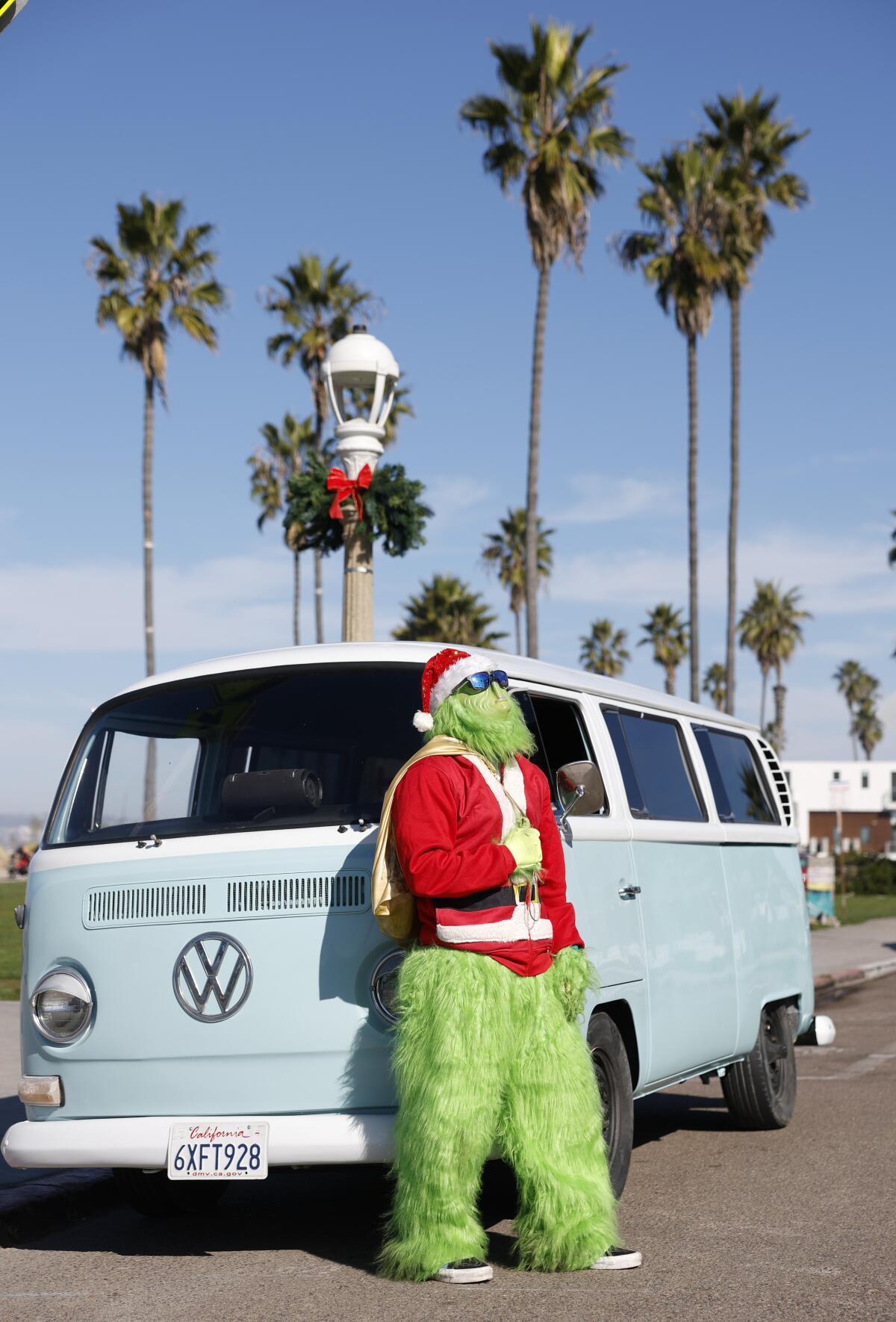
Ryan Ortiz, dressed in a Grinch costume, stands next to his 1969 Volkswagen Bus in San Diego on Dec. 21.
(K.C. Alfred / The San Diego Union-Tribune via Getty Images)
Advertisement
Fans of the hirsute sourpuss seek him out for his in-your-face edge — the opposite of Santa’s remote joviality. Santa enforces his regime of goodness through lists and surveillance. The Grinch will get in your face and yell at you to shut up.
“[Santa]’s supposed to be mysterious and unknown,” said Darnell’s fiancee JadaPaige. “He’s supposed to just come in the night and you’re never supposed to see him.”
“I grew up obsessed with Santa Claus — I did not grow up obsessed with the Grinch,” Darnell said. “I was the kid waiting up in the middle of the night, peeking, wondering if Santa’s down there. A lot of modern day kids aren’t having that journey.”
Instead, many Gen Alpha youths look to the Grinch for his views on “corruption or poverty or the oversaturation of commercialism,” Darnell said.
Advertisement
“Santa is looked at more like a godly figure, while the Grinch is a more everyday man,” the actor explained. “The world is so sinister and negative. [The Grinch] tells you how it is, rather than telling you everything is going to be fine.”
TikTok turbocharged that trend, with the infamous green meanie matching or beating his red rival in holiday clout.
“He has aura,” Darnell said.
Grinch impersonator Nick Darnell said the character he plays has become popular because, “He has aura.”
(Christina House/Los Angeles Times)
Advertisement
Today’s professional Santas are often retirees with a bit of a belly and some time on their hands. Grinches, by contrast, are more likely to be working actors like Darnell, who look reverently to Carrey’s performance as a blueprint for the character’s slapstick antics and snarky reads.
Still, experts say the Grinch’s 2025 glow-up likely owes as much to holiday exhaustion and broad consumer pessimism as it does vertical video virility.
“The Grinch is the opposite side of Christmas,” said Oscar Tellez, who owns Magic Dream Costumes and Party Rentals in East Los Angeles and says he’s seen a spike in Grinch requests even as overall holiday rentals have sagged.
“Especially with the Latino community, I don’t think they feel the enthusiasm to celebrate,” Tellez said. “They are more worried about what’s gonna happen next.”
Pop culture experts agreed.
Advertisement
“The economy is in big trouble, our political situation is chaotic, there’s a lot of hate — it’s no wonder that we would seek to express that through the embodiment of a monster like the Grinch,” said Michael M. Chemers, director of the Center for Monster Studies at UC Santa Cruz.
“You’ve seen these nativity displays popping up all over the country that have the Jesus figures removed and it says ‘ICE was here,’ ” he added. “I think there’s just a lot of Grinchy feeling right now in the world.”
Chemers and other scholars say the emergence of the Grinch as a foil to Santa is less a departure than a return to form: the Grinch is a “PG version” of the mythical Krampus, a shaggy, fork-tongued Germanic goat man who beats and even abducts naughty children, working as an enforcer for Father Christmas.
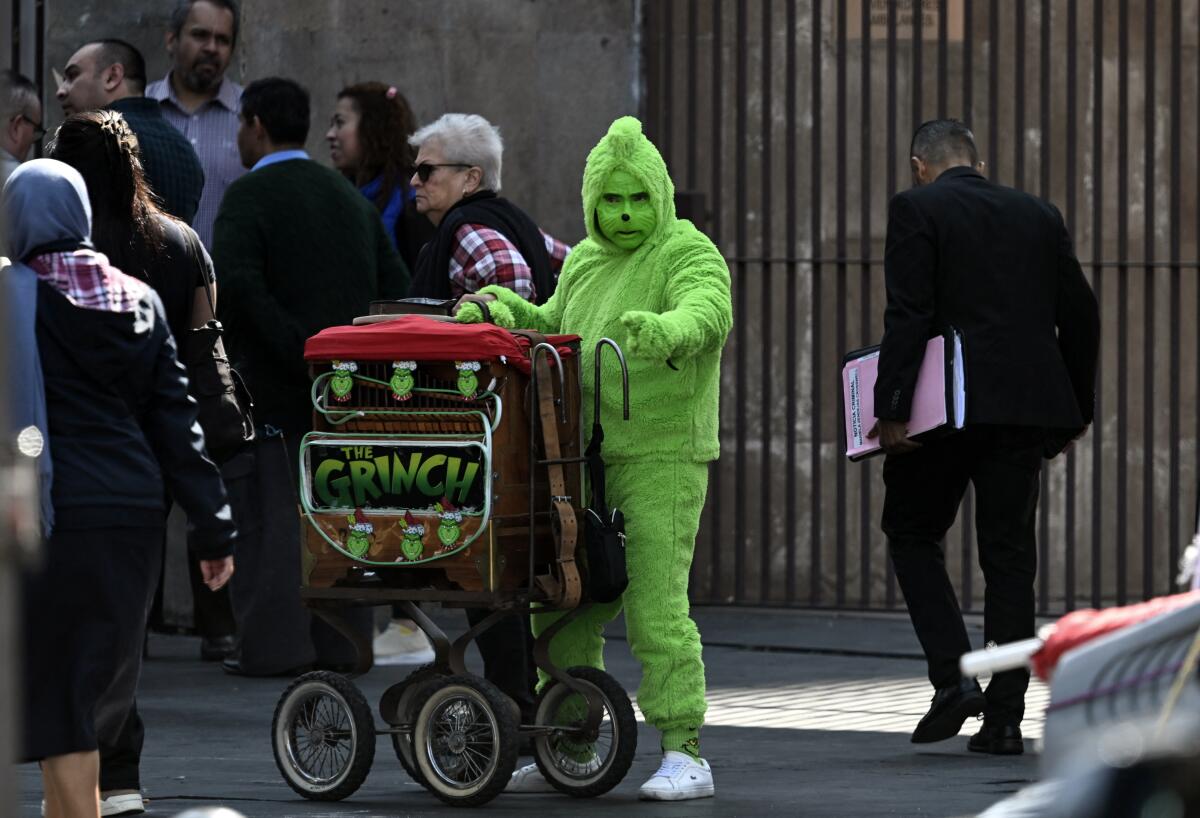
An “organillero,” or traditional street musician, dressed as the anti-Christmas character known as the Grinch plays on a central street in Mexico City on Dec. 9.
(Yuri Cortez/AFP via Getty Images)
Advertisement
“He’s been called the Christmas devil,” said Jeff Belanger, author of “The Fright Before Christmas,” a compendium of so-called “Yuletide monsters.”
“[Krampus] represented the consequence of bad behavior, while St. Nick rewards good behavior,” he said.
Krampus likely evolved from older, pre-Christian deities, just as Christmas absorbed solstice and midwinter customs, the author explained. The Christmas most Americans grew up with only emerged as a national holiday in the wake of the Civil War, he said, about a decade after the formal introduction of Thanksgiving in 1863. It was around this time that Christmas trees became popular in the United States.
“In 1867, Charles Dickens came over to Boston and that’s when he read his ‘Christmas Carol’ for the first time in America,” spurring President Ulysses S. Grant to declare Christmas a federal holiday, Belanger said. “It was truly on the back of that story.”
The holiday’s corpulent, white-bearded dandy arrived even later, his schmaltzy persona skimmed from bony St. Nicholas between Reconstruction and 1931, when Coca-Cola debuted its iconic, brandy-flushed Santa Claus.
Advertisement
“That’s when Christmas turned purely commercial, and there was no room for consequences anymore,” Belanger said.
Seuss’ Grinch sits somewhere in the middle — cuddlier than Krampus and pricklier than Santa — making him the perfect avatar for a moody, uncertain age.
Workers check Grinch inflatables ready for export at a factory in Suixi County in central China’s Anhui Province on March 19.
(Wan SC/Future Publishing via Getty Images)
Grinch boosters point out that the villain repents and reforms at the end of the story, shedding his pathological hatred of Christmas.
Advertisement
“I always tell people, ‘Don’t you just love how his heart grew three sizes?’ ” Taylor, the famous Santa, said of his increasingly popular crossover events.
Others note that it’s never the repentant Grinch who marauds through schools and holiday parades or blows up on social media.
“Once he’s rehabilitated, he’s no fun anymore,” Chemers said.
That makes it hard for the holiday villain to visit sick kids in the hospital, as legions of Santas do every year, or comfort children who confide in him about bullying.
“The message is one of encouragement and positivity and acknowledgment of accomplishments and encouragement to strive harder,” Taylor said. “It’s these beautiful personal development messages that Santa gets to be the conduit for.”
Advertisement
The Grinch, by contrast, can affirm where you are, without ever asking you to be better.
“He can hear you and know what you’re thinking, because he has the same thoughts,” Darnell said of his beloved version of the character. “People want to know his heart and his mind, and that’s something they wouldn’t be able to ask Santa.”
Jack Black, left, and Paul Rudd in a scene from “Anaconda.”
| Photo Credit: Matt Grace
How many times have we watched 1997’s Anaconda, about a documentary crew going down the Amazon in search of a legendary snake? Alongside Jennifer Lopez (before she became JLo), Owen Wilson and Ice Cube, Jon Voight chewed up the scenery as an Ahab-esque hunter with a bizarre accent. The unkillable snake was hilarious, especially its habit of gobbling humans like chocolate éclairs from Universal Bakery in Secunderabad.
Anaconda opens with Doug McCallister (Jack Black) giving a narration of what appears to be a horror film, as there is a snake chasing someone in the sewers. It is only when the camera pulls back to reveal his puzzled-looking audience that we realise Doug is a wedding videographer, and he is pitching to clients who just want a photo of the happy couple jumping in tandem.
At Doug’s birthday party, arranged by his wife, Malie (Ione Skye), he meets his childhood friends, Griff (Paul Rudd), an actor, Kenny (Steve Zahn), who is mostly wasted, and Claire (Thandiwe Newton), a lawyer who is recently divorced from her philandering husband.
Anaconda (English)
Director: Tom Gormican
Cast: Paul Rudd, Jack Black, Steve Zahn, Thandiwe Newton, Daniela Melchior, Selton Mello
Advertisement
Runtime: 99 minutes
Storyline: Friends reunite to reboot their favourite movie, Anaconda, only to find reel life turning real when a giant bloodthirsty snake hunts them
When Griff shows the horror film Doug made when they were all children, the gang remembers the good old days. Griff says he has the rights to Anaconda (there is a complicated story of how he got them or did not), and they should shoot a reboot/reimagining/spiritual sequel as a tribute to the film that afforded them so much joy.
After some initial hesitation from Doug, the friends head off to the Amazon, where they meet the snake wrangler, Carlos (Selton Mello), who cares very much for his snake. There are also some shady characters following a lovely maiden, Ana (Daniela Melchior).
Jack Black, left, and Paul Rudd in a scene from “Anaconda.”
| Photo Credit:
Bradley Patrick
As the shooting progresses, things go wrong with Carlos’s snake meeting a sticky fate and another impossibly huge snake slithering about, popping humans into its giant jaws like crisp bondas. Black is the beating heart of the film, with Rudd, Zahn and Newton giving ample support. There is a jolly charm about the film that seems just right for the season.
Advertisement
Watching the friends repeat dialogues from the earlier film, especially Voight’s teeth-gnashing Paul Serone growling, “You get the privilege of hearing your bones break before the power of embrace makes your veins explode,” you cannot help but grin happily. And if you are enough of a creature feature bhakt, you might well be repeating the dialogues under your breath!
With its silly snake, likeable cast, goofy humour (including astute jibes about IP), welcome cameos, and over-the-top action, Anaconda is the perfect holiday movie to watch with friends after a gargantuan feast or to get over a grand hangover.