Entertainment
A Black actor was denied a wig for a major Broadway tour. She's now suing for racial discrimination

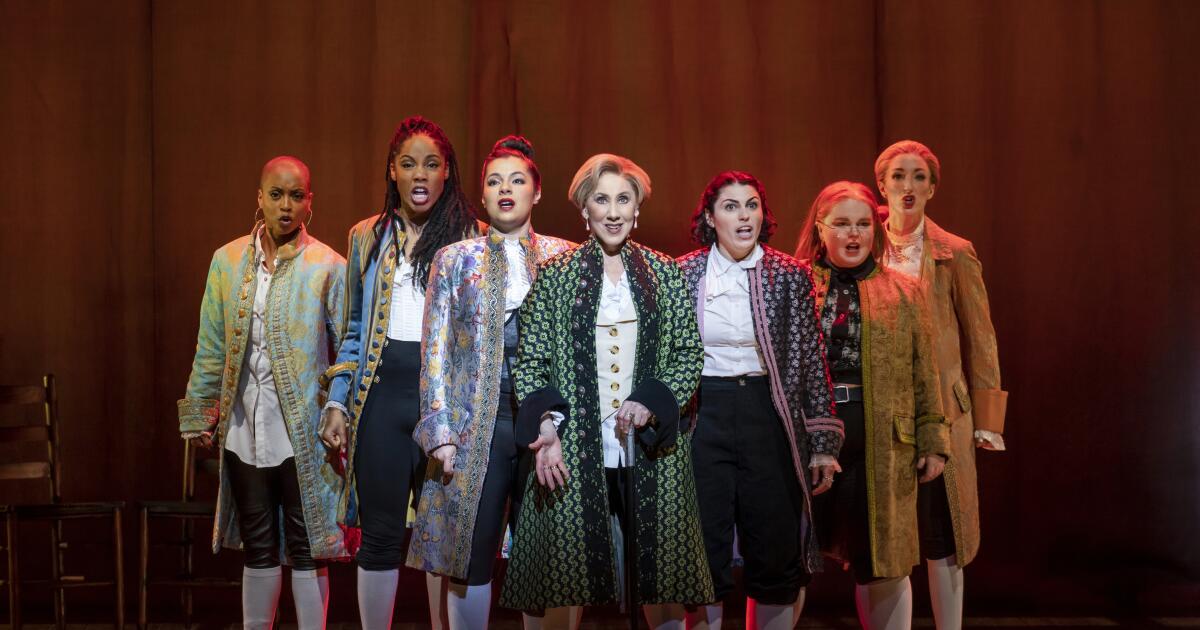
Out of town, on Broadway and on the road, the recent revival of “1776” was strategically cast in a nontraditional manner, with actors of diverse gender identities and racial backgrounds portraying the historically white, male Founding Fathers as they finalized the Declaration of Independence. “Putting history in the hands of the humans who were left out the first time around,” read the show’s marketing material.
But a complaint, filed earlier this week by actor Zuri Washington, alleges racial discrimination and retaliation on the show’s national tour. Washington hopes the complaint, which recounts producers’ dismissal of Washington’s hair preferences and alleges she was terminated after expressing an intent to submit a formal report of discrimination, reignites conversations about the industry’s inequitable treatment of Black hair and the harmful perpetuation of the “angry Black woman” stereotype.
“I was made to feel like I did something wrong in the course of this entire experience, and I know I didn’t do anything wrong,” Washington tells The Times. “I could have done things differently, perhaps. But what they did to me is like a legal version of tone-policing, and like I’m being constantly punished for existing and telling my truth.”
Washington filed the complaint against the tour’s production companies NETworks Presentations and 1776 Touring, and several of their employees. The tour’s production companies did not respond to The Times’ request for comment.
According to the lawsuit, Washington, upon getting cast as Robert Livingston in December 2022, reached out to the tour’s management to finalize a hair plan — a collaborative decision that prioritizes a production’s design preferences as well as a performer’s practical needs. During consultations with the tour’s associate hair designer, Washington said she expressed her discomfort with wearing her natural hair onstage, as well as her desire to wear a wig or, at the very least, to install a braided protective style.
“I love my natural hair, but [producers] don’t realize what wearing my natural hair for eight shows a week entails,” she says, citing the lengthy amount of time and numerous products needed for proper maintenance, especially amid the variety of climates they’d be exposed to while on tour. Washington learned this the hard way: while previously touring “Hairspray,” the changes in altitude, temperature and humidity wreaked havoc on her locks.
“I was devastated — my hair almost fell out of my head, and I had to cut it to my ears,” she recalls. “I promised myself, never again would I leave the fate of my hair, something that’s so close to me and that I care about so much, up to other people. And given the ethos of the production, I was hoping I would feel secure and supported by the team behind the scenes.”
Washington, fourth from left, and the national tour cast of “1776.”
(Joan Marcus)
The complaint outlines that, after multiple emails to various members of the tour’s creative team, Washington was told to wear a protective style — specifically, a two-strand “spring” twist. But these instructions didn’t specify whether this style was to fit under a wig or to wear on stage; when she asked for clarity on the matter, her emails went unanswered.
According to the suit, Washington wasn’t informed about her onstage hair design until she arrived at the tour’s first stop in Utica, N.Y., in February 2023. Though multiple white actors in the cast were provided with wigs, including someone Washington says didn’t even request one, Washington’s request for a wig, as well as those by the cast’s other actors of color, had been denied.
Washington was then presented with an image of a specific protective style the production team preferred her to wear, reads the complaint. Since there were no appointment openings at any nearby hair salons, the team offered to book one at the next tour stop and requested she wear her natural hair during performances in the meantime.
Though she felt pressured to do so by the production, Washington didn’t want to wear her natural hair on stage, so her hair was instead styled by the tour’s assistant choreographer into Marley twists, a style that’s arguably an easier one to do because it doesn’t need shaping. According to the suit, the process lasted until 3 a.m., amid tech rehearsals and during a meal break. The complaint also notes that another Black cast member had similar frustrations about their hair plan.
Had the production team informed her of their decision for her hair plan earlier, “I could have easily gotten it done when I was in New York, where there are braiding places everywhere,” says Washington, a Bronx native who’s the daughter of a hairstylist. “I could’ve bought products way in advance, and I would have showed up with my full arsenal. But they waited until the last minute to give me an answer.”
At the time of the “1776” tour, the contract governing touring productions — held between Actors’ Equity Assn., the national union representing more than 51,000 professional actors and stage managers working in live theater, and the Broadway League, the national trade association for the Broadway industry — only addressed the topic of hair in regard to changing one’s hair color or length for the duration of a role.
A new touring agreement, ratified in May 2023, specifically addresses hair texture as part of diversity, equity and inclusion standards — an addition made based on the historic New Deal for Broadway, the comprehensive industry-wide agreement led by nonprofit advocacy organization Black Theatre United. “We will not discriminate against anyone due to hair texture and will ensure all hair needs are addressed with respect and care,” reads the New Deal, signed by theater leaders in 2021.
“If the show genuinely requires hair of a certain texture that doesn’t match the actor’s natural hair, we, directors, commit to speaking with the actor and hair and costume designer early in the casting process (or, if that is not possible in the circumstances, as soon as possible thereafter) to outline our vision for the character and gauge the actor’s comfort level with alterations to their natural hair.”
Though productions are required to provide any hair products to maintain a performance hairstyle on tour, Washington said her requests often necessitated multiple follow-ups and took weeks to fulfill — long after those of the cast’s white actors, according to the complaint. Looking back, she considers it, at the very least, reflective of the industry’s wider misunderstanding of Black hair: “There’s definitely a lack of knowledge about how much time and money it takes to keep up, how politically charged it is and how it’s seen as a statement when in certain spaces.”
“Black hair has been a hot-button issue within the theatrical community for many years now so, at this point, it feels like willful ignorance,” she continues. “You’re putting us in these productions, but you’re not taking care of us, and it ends up imbuing harm on our spirits and our bodies that we have to use eight shows a week.”
Washington, third from right, and the national tour cast of “1776.”
(Joan Marcus)
Tensions continued to rise shortly after opening the tour, when the production held a meeting about its COVID-19 testing standards. There had already been one positive case in the workplace and, according to the complaint, several performers felt producers were not taking their safety concerns seriously, particularly as some actors suffered from preexisting conditions.
Washington, also delegated as the production’s Equity union deputy, voiced the group’s frustrations on the matter, swearing and slapping her hand against the back of a nearby chair for emphasis. After the meeting, the production’s general manager contacted Washington’s agent to report the actor as “unruly,” according to the complaint. Washington was the only cast member whose agent was called, even though Washington said numerous actors were impassioned in the meeting, including one who threatened to sue the show.
The complaint outlines that, in March 2023, Washington met with a third-party human resources professional, who informed her that the production’s management would not be issuing an apology for singling her out, and offered her the option of filing a formal complaint of discrimination with her union. “Yes, I will, because this is the only course of action available to me and I’m going to do it,” she replied, according to the complaint. “I’ll take these f— down that way if I have to. I’ve taken bigger f— down before and I’ll do it again. So yes, I will be filing an official complaint with HR.”
Hours after announcing an intent to file the report, Washington was called by her agent and told that her contract, scheduled for the duration of the tour through August, was being terminated, according to the suit. The following day, she received an official termination letter that cited alleged “aggressive, uncontrolled behavior and threatening statement” in the meeting, and her union representatives were later told that Washington was an “immediate safety concern.”
“Race discrimination has absolutely no business on Broadway,” said Washington’s attorney, Tanvir H. Rahman of Filippatos PLLC. “In the theater industry where talented actors, especially actors of color, are expected to keep their heads down and voices low, our client, Zuri Washington, an incredibly talented, principled and thoughtful Black actor, has courageously decided to tell her story and hold the producers of ‘1776’ accountable for violating her right to work in an environment free of bias and retaliation.”
Washington hopes that going public with her experience will encourage other actors to continue to advocate for themselves and each other. “I used to think I’m the only one this has happened to, and it’s so uncomfortable to hash through the stories,” she says. “But if I can make a difference in this way, it will have been worth it.
“We have so much power, as individuals and as a collective. And we can continue pushing this industry forward, even if they go kicking and screaming into the future.”



Movie Reviews
Is ‘Josie and the Pussycats’ (2001) Really Even A Rock N Roll Movie? (FILM REVIEW) – Glide Magazine

The satirical romp Josie and the Pussycats (2001) is a fun movie. But is it a great rock ‘n’ roll movie?
Eh, not so fast on that second one. Welcome back to Glide’s quest for what makes a good rock ‘n’ roll movie. Last month, we looked at Almost Famous, a great launching pad because it gets so much right. And every first Friday, we’ll take another look at a rock ‘n’ movie and ask what it means in the larger pantheon. This month, the Glide’s screening room brings you Josie and the Pussycahttps://glidemagazine.com/322100/almost-perfect-why-almost-famous-sets-the-gold-standard-for-rock-movies/ts. The film is a live-action take on the classic comic-and-cartoon property of a sugary, all-girl rock trio that exists in the world of Riverdale, a.k.a. fictional home of the iconic Archie Andrews.
But this Josie has next to nothing to do with Riverdale and is instead a satire of consumerism and ’00s boy bands. A worthy target, and a topic that has stayed worthy in the quarter-century since Josie dropped. The film was not a hit, but it has become something of a cult classic (like many movies featured in this series).
The plot is fairly simple. Wyatt Frame, an evil corporate type, is making piles of money off boy band Du Jour. They start to wise up to his evil scheme and have to be… taken care of. Frame needs a new group to front his plot, which revolves around mind control to push consumer culture. Enter Josie and the Pussycats, who are about to have a whirlwind ride to the top. And along the way, foil a plot with tentacles so far-reaching they have ensnared… Carson Daly?
Josie is a fun, clever movie, but it doesn’t have a whole lot to say about real rock ‘n’ roll, unless you want to simply accept a perspective that it’s just another cynical consumer-driven product. Even that is an argument that can be made, as long as you’re willing to ignore underground and indie scenes and passionate artists making amazing music.
And it is true that this is a theme of Josie. The band triumphs at the end via their authentic music. But it somehow doesn’t feel authentic, which makes it something of a hollow victory. Let’s consider the criteria already established for a good rock ‘n’ roll movie, and how Josie delivers on that front. The first is in the characters department. The film dodges the previously established Buckethead Paradox, which states that “The real-life rock stars are so much larger than life that you can’t make up credible fictional versions. There is no way someone like Buckethead would come out of a writer’s room and make it to a screen.”
For better or worse, Josie dodges the Paradox by essentially embracing it. The characters themselves are cartoons, and there’s no effort at realism. Given that intent is a huge part of art, it seems unfair to call these characters “cartoons” as a criticism, and it should probably be a compliment. At the same time, they aren’t particularly memorable, which is not a great quality.
And—as a bonus—Tara Reid is perfectly cast as drummer Melody Valentine. Josie was a few years after her turn in Around the Fire (1998), an unintentionally hilarious classic that plays like a jam band afterschool special from the producers of Reefer Madness (look for this amazing film in an upcoming piece).
The acting in general is good, with Rachel Leigh Cook as Josie McCoy and Rosario Dawson as bassist Valerie Brown rounding out the band. And Alan Cumming almost steals the show as sleazy corporate weasel Wyatt Frame.
The character of Wyatt is the film’s funniest riff on a rock ‘n’ roll archetype: the sleazy, corporate manager accompanied by assorted crooked accountants. From Colonel Tom Parker to Albert Grossman to The Great Rock ‘n’ Roll Swindle. It’s all about the benjamins. Which is where the music comes in. If the music is good, that’s what makes it worth it. And Josie’s music has aged particularly well. It’s well-recorded, produced and executed. The songs are particularly catchy. The vocals are by Kay Hanley of Letters to Cleo. Much of the soundtrack sounds like a lost album from The Muffs, and one wonders why Kim Shattuck wasn’t involved.
There’s an argument that power pop was never supposed to be dangerous, and that the Muffs aren’t dangerous either. Fair on the surface, but they played real punk clubs and came from a real scene. There’s not even a hint of that in Josie. So an argument that they play pop punk (which they kinda do) is really lacking the punk part.
And it was produced by Babyface, of all people. While that doesn’t seem like it should lead to great rock ‘n’ roll, sometimes preconceptions are wrong.
That said, this is a very commercial product and sound—as catchy as it is—so maybe it’s not a misconception. Maybe the right question to ask is whether it’s all too perfect? And that’s what gives this ostensibly rock ‘n’ film a smoothed-down edge? After all, the basic ingredients are there. But part of what makes good rock good is that it feels actually dangerous. Maybe there are some actual subversive messages, or a genuine counterculture scene. And Josie simply isn’t that film. The soundtrack is fondly remembered enough that Hanley appeared live and performed the songs at a screening in 2017. That appearance also included the film’s stars Cook, Dawson and Reid.
It’s worth noting that while Cook and company obviously lip sync to the songs in the film, their performances are credible. They went through instrument boot camp, so they pull off the parts.
In the end, the film is primarily a satire of consumer culture. And even more strangely, is loaded with actual product placement. Clearly, the joke was intended to “hit harder” with real products, but having Target in the film constantly makes it feel like more of what it is parodying than a parody. Where’s the joke if the viewer actually pushes to shop at Target while watching the film? And if the filmmakers actually took money (which they almost certainly did)?
And perhaps that is the lesson for this month: a great rock ‘n’ roll movie needs to have something to say about the larger meaning or culture of the music. And while Josie may have a lot to say about culture in general, and it may say it in a fun and likeable way, it’s just not very rock ‘n’ roll. There’s no grit. Now, does it have some things to say about being in a band? Yes, though they are arguably true of most collaborations.
If someone in a hundred years wanted to understand early 21st century rock, Josie and the Pussycats is a bad choice. It doesn’t show the sweat of a performance or the smell of beer. But it’s a great choice for anyone looking for a light-hearted, fun watch with a great soundtrack. We could all use some sugar in our lives these days.
Join us again next month, when we’ll look at one of the inspirations for Josie, A Hard Day’s Night, the legendary first film from The Beatles
Entertainment
Commentary: As ‘The Pitt’ suffers a digital meltdown, a human with analog experience saves the day
This article contains spoilers for Season 2, Episode 9 of “The Pitt.”
Midway through Season 2, “The Pitt” has taken on the perils of the digital age and given me a reason to love the show as much as everyone else does.
Don’t get me wrong — I understand perfectly why so many people, including recent Emmy and Golden Globe voters, have lost their minds over the HBO Max medical drama: The propulsive day-in-the-life of a Pittsburgh ER conceit, the dazzling ensemble cast, the writers’ heroic attempts to showcase our perilously broken healthcare system, the healing power of empathy and, of course, the Noah Wyle-ness of it all. His brilliant and gentle-voiced Dr. Michael “Robby” Robinavitch is as aspirational a character on television as we’ve ever seen.
But having recently spent almost six hours passing out and vomiting from pain in the waiting room of my local ER (which was empty except for one other man), while being told there was nothing anyone could do until the next shift arrived, I confess I have watched “The Pitt” with a jaundiced eye. The regular crowd shots of the waiting room too often reduce the afflicted into a zombie-like horde bent on making life more difficult for our beloved medical staff.
Sure it’s tough to work in an ER when you are worried about your mother’s expectations, grieving your dead mentor, struggling with addiction or worrying about your sister, but no doubt many of those in the waiting room are experiencing similar issues while also in terrifying and hideous pain.
I’m just saying.
In this second season, however, “The Pitt” gave me reason to cheer. It chronicles the day before Robby is set to leave on a three-month sabbatical, and in the early hours, we meet his temporary replacement, Dr. Baran Al-Hashimi (Sepideh Moafi). Having already attempted to force those suffering in waiting rooms to create their own “patient portals,” Dr. Al-Hashimi goes on to advocate for an AI-supported system to aid the doctors with pesky paper work.
Robby, of course, does not think any of this is a good idea and since he is always right (and no television writer is going to openly promote AI), her plan backfires almost immediately. First, with a medical notes transcription that gets Very Important words wrong and then after a complete digital blackout.
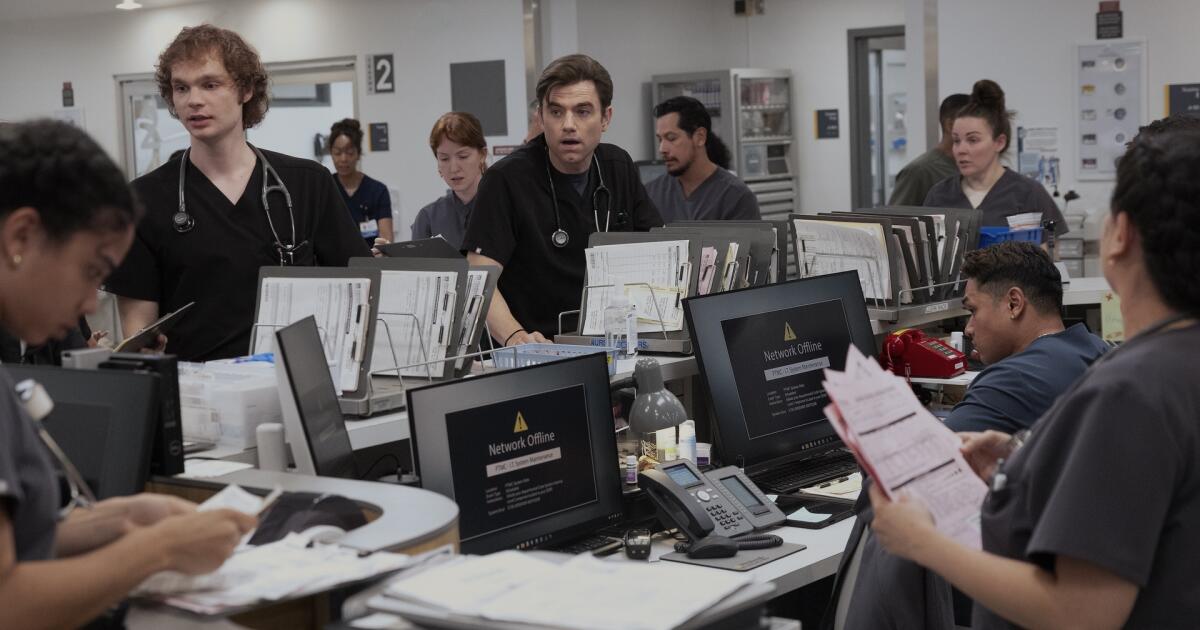
After a nearby hospital is hacked and ransomed, the higher-ups decide to defend its system by shutting it down, which means business must be conducted in the old-fashioned, paper-and-clipboards way.
The result is chaos, and a few too many jokes about young people not knowing how to work a fax machine or manage paper. Some of the more seasoned staff, including and especially the indefatigable charge nurse Dana Evans (Katherine LaNasa), remember the days before everyone carried an iPad well enough to keep things moving. Even so, Dana wisely calls upon the services of “retired” clerk Monica Peters (Rusty Schwimmer).
When the computer system at the Pitt is shut down, Dana (Katherine LaNasa), center, calls in Monica (Rusty Schwimmer), far right, who arrives to help.
(Warrick Page / HBO Max)
“Laid off by the digital revolution, not retired,” Monica corrects her. “And how’s all this digital s— working out for you now?”
This is where I cheered. I love the digital world as much as the next person currently typing on a computer to file a story that I have discussed with my editors on Slack and that I will not see in hard copy until it appears in the physical paper. But like pretty much everyone, I have suffered all manner of digital breakdowns and mix-ups, not to mention the inevitably increased workload that comes with the perception that I can do the work of previous multitudes with a few additional strokes of a keypad.
Except, of course, that’s a lie — a keypad is capable of nothing on its own. Neither are fingers, for that matter. They must be manipulated by someone whose brain has to figure out and execute whatever needs to be done. This requires an ability to navigate the ever-changing tech systems that store and distribute information (often in ways that are not at all intuitive) while also understanding the essentials of the actual work being done.
In “The Pitt,” that is the emergency medical treatment of human beings, which requires all manner of physical tasks. As this storyline makes clear, many of the medical staff do not quite understand how to order or handle these tasks without a screen to guide them.
Hence the need for Monica, representative of a large number of support workers who do understand because it was once their job to keep everything moving, to answer all manner of questions, prioritize what needs to be fast-tracked and make sure nothing falls through the cracks while also engaging with all and sundry on a human level.
The shutdown is obviously an attempt to underline the limits of AI but it also serves as a fine and necessary reminder of how readily we have surrendered people like Monica, with their knowledge and experience, to keyboards and touch pads (which, of course, don’t require salaries, benefits or lunch breaks).
But — and this is important — computers are tools not workers. Alas, that has not kept companies in virtually every industry from drastically cutting back on trained and experienced employees and handing large portions of their work (mental if not physical) to people, in this case doctors and nurses, who already have demanding jobs of their own.
But hey, you get a company iPad!

Nurse Dana (Katherine LaNasa), left, and Dr. Baran Al-Hashimi (Sepideh Moafi) have to resort to paper, clipboards and white boards to keep track of patients after the hospital’s systems are shut down.
(Warrick Page / HBO Max)
Often, including with those patient portals, what was once paid labor lands in the lap of the consumers, who in “The Pitt” are people sitting in an emergency room and likely not at the top of their game when it comes to filling out forms about their medical history or coming up with a unique password.
ER dramas, like the “The Pitt,” are inevitably fueled by the tension between the demands for speed and the need for humane care, something that is increasingly true, if not as intrinsically necessary, in all facets of our culture.
With computers in our pockets, we now expect everything to be available instantly. But when something in our online experience goes wrong, we need an actual human to help us fix it. Unfortunately, as the overwhelmed staff of the Pitt discover, those people are increasingly difficult to find because they have been laid off — even nurse Dana can’t do everything!
Dr. Al-Hashimi, like many, believes that patient portals and AI-assisted medical notes will save time, allowing the doctors and nurses to spend more of that precious commodity with their patients. But, as Dr. Robby and Dana repeatedly argue, what they really need is more staff.
There’s no point in saving a few minutes at the admittance window, or on an app, if you are then going to have to spend hours waiting for or trying to find someone who can actually help you when you need it.
That is certainly true in the medical sector, where digital technology has done little to eradicate long wait times for medical appointments or in emergency rooms. Being treated in a hospital hallway by people who can barely stop to talk to you is not an uncommon occurrence for many Americans. The U.S. is facing a critical shortage in hospital staff, with the ranks of registered nurses and other medical personnel having plummeted post-pandemic, often due to burn out.
The amount of time the staff of “The Pitt” spend with each patient, while dramatically satisfying, is almost as aspirational as the wisdom and goodness of Dr. Robby.
None of these problems is going to be solved by AI or any other “time-saving” device. We have not, as far as I know, figured out a way to extend an hour beyond 60 minutes or modified the human body so that it does not require seven to nine hours of sleep each night.
Medical institutions aside, I can’t think of any place I have visited lately that wouldn’t have benefited from more paid and experienced workers, especially those who know how to do things when computers glitch or fail.
The minute Monica sits down and starts barking orders in the ER, everyone feels much better. Here is someone who understands what needs to be done, why, and how to make it happen. Moreover, she has eyes, ears, hands and human experience enough to know that, in the end, people are less interested in saving time than getting the care they need.
In the ER and everywhere else.
Movie Reviews
Peaky Blinders: The Immortal Man review – Tommy Shelby returns for muddy, bloody big-screen showdown

After six TV series from 2013 to 2022, which caused a worrying surge in flat cap-wearing among well-to-do men in country pubs, Peaky Blinders is now getting a hefty standalone feature film, a muscular picture swamped in mud and blood. This is the movie version of Steven Knight’s global small-screen hit, based on the real-life gangs that swaggered through Birmingham from Victorian times until well into the 20th century. Cillian Murphy returns with his uniquely unsettling, almost sightless stare as Tommy Shelby, family chieftain of a Romani-traveller gang, a man who has converted his trauma in the trenches of the first world war into a ruthless determination to survive and rule.
As we join the story some years after the curtain last came down, it is 1940, Britain’s darkest hour and Tommy is the crime-lion in winter. He now lives in a huge, remote mansion, far from the Birmingham crime scene he did so much to create, alone except for his henchman Johnny Dogs, played by Packy Lee. Evidently wearied and sickened by it all, Tommy is haunted by his ghosts and demons: memories of his late brother, Arthur, and dead daughter, Ruby, and working on what will be his definitive autobiography. (Sadly, we don’t get any scenes of Tommy having lunch with a drawling London publisher or agent.)
But a charismatic and beautiful woman, played by Rebecca Ferguson, brings Tommy news of what we already know: his malign idiot son Erasmus Shelby, played by Barry Keoghan, is now running the Peaky Blinders, a new gen-Z-style group of flatcappers raiding government armouries for guns that should really belong to the military. And if that wasn’t disloyal and unpatriotic enough, Erasmus has accepted a secret offer from a sinister Nazi fifth-columnist called Beckett, played by Tim Roth, to help distribute counterfeit currency which will destroy the economy and make Blighty easier to invade. Doesn’t Erasmus know what Adolf Hitler is going to do to his own Romani people? (To be fair to Erasmus, a lot of the poshest and most well-connected people in the land didn’t either.)
Clearly, Tommy is going to have to come down there and sort this mess out. And we get a very ripe scene in which soft-spoken Tommy turns up in the pub full of raucous idiots who cheek him. “Who the faaaaaack is ‘Tommy Shelby’?” sneers one lairy squaddie, who gets horribly schooled on that very subject.
In this movie, Tommy Shelby is against the Nazis, and he can’t get to be more of a good guy than that. (Tommy has evidently put behind him memories of Winston Churchill from the first two series, when Churchill was dead set on clamping down on the Peaky Blinders.) The war and the Nazis are a big theme for a big-screen treatment and screenwriter Knight and director Tom Harper put it across with some gusto as a kind of homefront war film, helped by their effortlessly watchable lead. Maybe you have to be fully invested in the TV show to really like it, although this canonisation of Tommy is a sentimental treatment of what we actually know of crime gangs in the second world war. Nevertheless, it is a resoundingly confident drama.
SD Lottery Millionaire for Life winning numbers for March 5, 2026

Lady Vols fall to Alabama in SEC Tournament for seventh loss in row
GOP Rep. Tony Gonzales of Texas ends reelection bid after admitting to affair with aide

Utah Blanks Philadelphia, 3-0 | Utah Mammoth

Friends, family rally behind Vermont veteran charged with domestic terrorism

Florida High School Football Rankings: Top 25 teams – Oct. 21

Cleary's 21 help Le Moyne down Central Connecticut State 69-64 in OT

How old is Bo Nix? What to know about Oregon quarterback ahead of 2024 NFL Draft

99th annual Pony Swim held in Virginia

Indiana Members Credit Union announced as new anchor tenant at Bottleworks District

DOJ continues Biden autopen probe despite former president unlikely to face charges
Fact check: Did French border guards mock influencers returning from Dubai amid Iran war?

Iran’s fight for survival / The widening war / Trump’s nebulous goals : Sources & Methods

Map: 4.9-Magnitude Earthquake Shakes Louisiana

Paxton vows he’s ‘staying in this race’ even if Trump backs Cornyn in Texas GOP clash
-

 World1 week ago
Exclusive: DeepSeek withholds latest AI model from US chipmakers including Nvidia, sources say
-

 Wisconsin4 days ago
Setting sail on iceboats across a frozen lake in Wisconsin
-

 Massachusetts1 week ago
Mother and daughter injured in Taunton house explosion
-

 Maryland5 days ago
AM showers Sunday in Maryland
-

 Massachusetts3 days ago
Massachusetts man awaits word from family in Iran after attacks
-

 Florida5 days ago
Florida man rescued after being stuck in shoulder-deep mud for days
-

 Denver, CO1 week ago
10 acres charred, 5 injured in Thornton grass fire, evacuation orders lifted
-

 Oregon7 days ago
2026 OSAA Oregon Wrestling State Championship Results And Brackets – FloWrestling