Entertainment
8 movies to look out for at the Sundance Film Festival


How is this for whiplash? Fresh off a hot batch of Oscar nominations, we now turn to the week’s other big news, a new edition of the Sundance Film Festival, where independent cinema will make its stand for yet another year. As always, The Times will be in Park City, Utah, for all the buzz and world premieres — check back daily for reviews, news, video interviews and more. Evenings of single-digit temperatures await us, as do, we hope, a number of discoveries. For now, here are the titles that beguile us going in.
‘By Design’
Samantha Mathis, Juliette Lewis and Robin Tunney in the movie “By Design.”
(Patrick Meade Jones / Sundance Institute)
Juliette Lewis has played murderers, drifters, alcoholics, punk rockers, Reiki healers and roller-derby captains. Now, she plays a chair. (Yes literally, with wood and four legs.) “By Design,” by the playwright-turned-filmmaker Amanda Kramer, has one of this Sundance’s more mysterious hooks: What happens when a woman realizes that society prefers her inanimate? Kramer’s first two films, “Ladyworld” and “Please Baby Please,” introduced her as an arch stylist with bold ideas and an insouciant disregard for telling stories that play by the rules — if she were a chair, she’d wear a slipcover of sharp crystals. Clearly, audiences will have to check their commitment to reality at the door. Even within a cast that includes Melanie Griffith, Samantha Mathis and Udo Kier, I’m most curious to see Mamoudou Athie play a man who comes to possess (and sit) on Lewis’ seat. Athie is a performer of unusual conviction — and this unusual film is going to take everything he’s got. — Amy Nicholson
‘The Dating Game’

A still from the documentary “The Dating Game.”
(Wei Gao / Sundance Institute)
Much ado has been made over the lopsided mating pool of China, where the recent census showed a surplus of 30 million single men. With women scarce, the competition is steep — think “The Bachelorette” on steroids. Enter Hao, a dating guru who believes that being yourself is a myth. He runs a seven-day boot camp that remakes lonely guys both outside and in, including flashy shirts and haircuts to what he calls “strategic deception.” Hao’s own lovely wife, Wen, is a testament to his pickup skills. But the couple is still at odds. Wen not only disagrees with his instructional methods, she has her own coaching business that advises women to love themselves first. This documentary by Violet Du Feng studies the battle between the sexes on a scale that’s both intimate and grandly sociological. She’s pointed her camera at Chongqing, but she’s captured an empathetic universe of insecurity, flirtation and, hopefully, love. — Amy Nicholson
‘It’s Never Over, Jeff Buckley’

Jeff Buckley in the documentary “It’s Never Over, Jeff Buckley.”
(Merri Cyr / Sundance Institute)
Like so many, I discovered the beauty of Jeff Buckley’s music years after he drowned in the Mississippi River in 1997. There was a period when his lone studio album “Grace” was a constant in my three-disc changer, listening nightly as I drifted off to sleep. Even now, I revisit it often, 31 years after its release, because it remains a haunting and near-perfect album, and one that I count among the best of the last 50 years. Naturally, I am eager to see what Oscar-nominated documentarian Amy Berg (“Deliver Us From Evil,” “Janis: Little Girl Blue”) has unearthed for the film, the title of which references the lyrics of Buckley’s “Lover, You Should Have Come Over.” Berg convinced Buckley’s mother, Mary Guibert, to give her access to the artist’s archive. The documentary promises rare performances and “Buckley’s own diaristic narration,” according to the festival’s programming notes. It’s also a chance to introduce a new audience to an incredible artist, one who should be better known beyond his cover of Leonard Cohen’s “Hallelujah.” — Vanessa Franko
‘Lurker’

Archie Madekwe, left, and Théodore Pellerin in the movie “Lurker.”
(Sundance Institute)
I’ve been waiting for the British actor Archie Madekwe (“Midsommar,” “Gran Turismo”) to become a big star. Here, at least, he plays one on the rise — a musician who might need to get a better handle on his entourage. Before the velvet ropes go up, the artist allows a dubious average Joe (Théodore Pellerin) into his inner circle. I’m not sure what happens next in this thriller, but I have a feeling that Madekwe, recently seen in “Saltburn” as a snide, posh snob undone by Barry Keoghan, might put up more of a fight this time. Debuting filmmaker Alex Russell has two major TV credits on his resume — “The Bear” and “Beef” — which he wrote on and produced. Awkward tension is definitely his thing. If Russell’s depiction of burgeoning pop stardom feels as visceral as his depictions of kitchens and road rage, this one’s gonna be a scorcher. — Amy Nicholson
‘The Perfect Neighbor’
A still from the documentary “The Perfect Neighbor.”
(Sundance Institute)
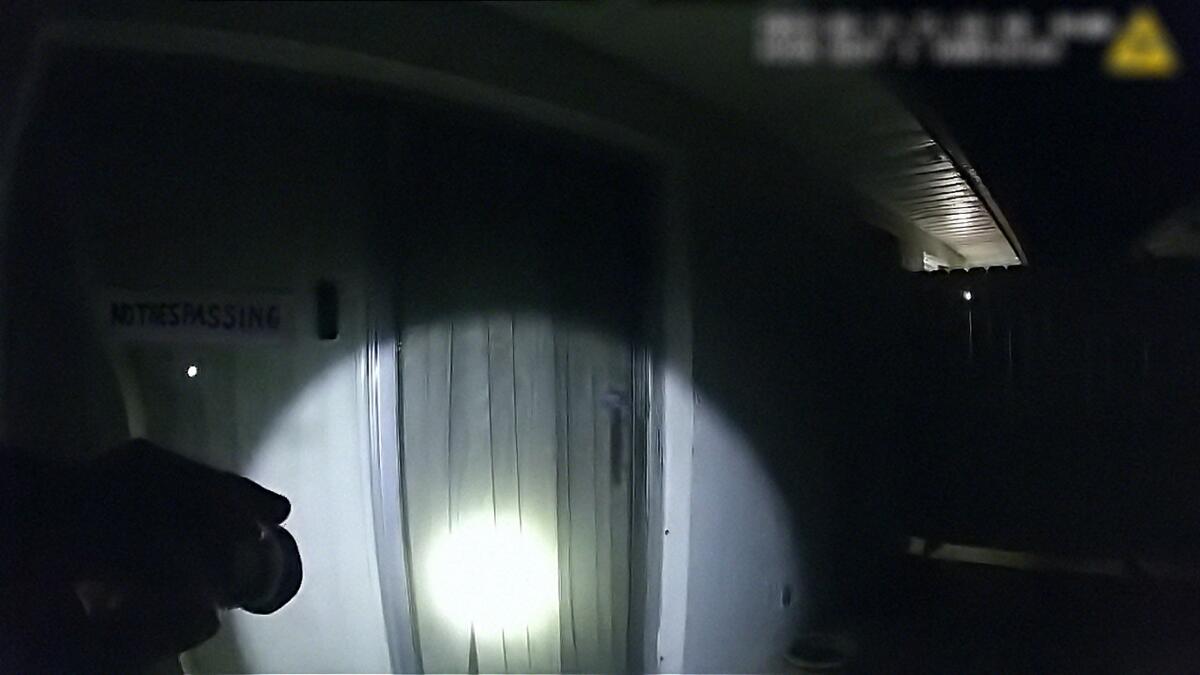
Many will likely remember aspects of the 2023 news story of how Ajike “AJ” Owens, a mother of four, was shot by her neighbor, Susan Lorincz, through a locked door following an escalating series of minor disputes. Directed by Geeta Gandbhir and premiering in the U.S. documentary competition, “The Perfect Neighbor,” recounts the build-up and aftermath of that startling incident in vivid, up-close detail. Told largely via the perspective of police body-cam video — the authorities were called to the otherwise quiet neighborhood so often that characters, story lines and subplots all clearly emerge — there is a genuine immediacy to the storytelling that reaches a devastating climax as the night of the shooting spirals into chaos and heartbreak. Lorincz was not initially charged with any crime because of Florida’s “stand your ground” self-defense law before later being brought to trial, as the film shifts to examine how a single act of violence can irrevocably change so many lives. — Mark Olsen
‘Serious People’

Miguel Huerta, left, and Pasqual Gutierrez in the movie “Serious People.”
(Pasqual Gutierrez and Ben Mullin / Sundance Institute)
The festival’s NEXT section is home to films that are too offbeat, too unconventional, just too plain weird to fit into other sections of the Sundance program. Directed by Pasqual Gutierrez and Ben Mullinkosson, “Serious People” is an exemplar of that ethos as its oddball charms unfurl. Pasqual, a music video director played by Gutierrez, wants to spend more time with his pregnant partner, so he hires a lookalike to take his place at work. The plan is for his double to unobtrusively play along during Zoom calls and production meetings, but the guy he hires turns out to be an unpredictable live-wire, prone to utterly impractical ideas and deeply inappropriate workplace behavior. Wildly funny, the film also has a tender side as it explores the need for a work-life balance even in creative fields that also require a commitment of passion. — Mark Olsen
‘Sorry, Baby’
Eva Victor in the movie “Sorry, Baby.”
(Mia Cioffi Henry / Sundance Institute)
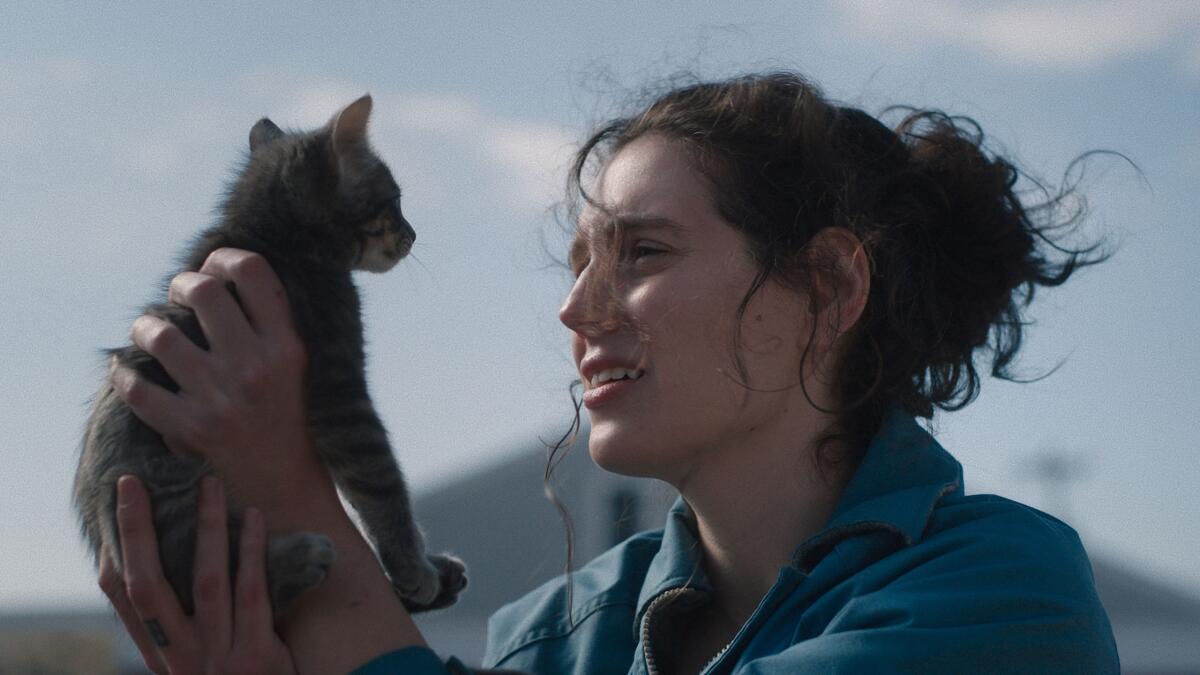
The debut feature from director-writer-star Eva Victor, “Sorry, Baby” is also a compact primer on why Sundance still matters. Serving as an introduction to an engaging new artistic voice, the film captures a certain laconic, free-floating malaise and anxiety that are indicative of an emergent generational sensibility. Told in an elliptical style with novelistic chapters, the story follows Agnes, a literature grad student turned junior professor at a small liberal arts college who is struggling to move forward from a traumatic event. Victor’s performance is touched by grace and whimsy while also pulling off dramatic emotional moments, sometimes within the same scene. With key supporting turns from Naomi Ackie, Lucas Hedges and John Carroll Lynch, the film is the sort of bold, inventive storytelling along with a discovery of fresh talent that is exactly what one wants out of the festival. — Mark Olsen
‘Zodiac Killer Project’

A still from the film “Zodiac Killer Project,” directed by Charlie Shackleton.
(Sundance Institute)
Given all the high-profile movies and series TV spun out from this still-unsolved criminal case, you’d think the actual Zodiac killer would have emerged by now, just to get a taste of the royalties. Of course, as any bleary-eyed obsessive knows, the real guy is most likely dead at this point, but don’t call filmmaker Charlie Shackleton late to the game. His humorous, bone-dry documentary gets at more than most, first by being a meta-confessional about how his own efforts to make a conventional movie failed. (He was denied the option rights to a book.) No matter: The film that he has made is revenge on an entire genre, detailing all the clichés that go into seemingly every true-crime project, including atmospheric, faceless re-creations and those gauzy title sequences that manage to both say everything and nothing. Narrated in his own witty British voice, Shackleton’s latest provocation joins prior titles “Beyond Clueless” and “Paint Drying” as an enjoyably self-deprecating study that takes aim at a mode of storytelling that could benefit from a little danger. — Joshua Rothkopf

Movie Reviews
‘Night Nurse’ Review: A Caretaker Explores Her Kink for Elder Abuse in the Year’s Strangest Erotic Thriller

There are any number of erotic thrillers in which rich old men are robbed blind and/or left for dead, but Georgia Bernstein’s admirably bizarre “Night Nurse” might be the first movie of its kind where elder abuse is the source — and possible subject— of its erotic thrills. If there are others, I’m not sure I want to know.
But this woozy debut feature doesn’t rely on its audience being turned on by the relationship between a nubile caretaker and her dementia-addled patient. Their psychosexual bond, meanwhile, hinges on cold-calling vulnerable old people under the guise of a grandchild in financial distress. (“I’m in trouble, nana, send me $10,000 or I’ll be left to rot in jail!” That sort of thing). With its slim wisp of a premise stretched into a Strickland-esque dreamscape that substitutes kink for conflict, the film itself hardly seems convinced by its own wrinkled lust — all desperate kisses and non-touching poses of subservience. More important to Bernstein is what that lust reveals about her characters’ deepest needs, specifically how their need to care and be cared for can be as easily perverted as any other form of desire.

As moody and weightless as the noir-accented score that blows through the movie like a curlicue gust of wind in an old cartoon (credit to musicians Sam Clapp and Steven Jackson), “Night Nurse” lacks the pulse required for its stray feelings to come alive. Still, the film ambiently taps into the latent eroticism of teasing out the distance between how you see yourself and who you really are. Bernstein plays with that distance like a telephone cord wrapped around her fingers, and Eleni — played by the excellent newcomer Cemre Paksoy, powerfully helpless — only frays even more as the receiver is brought near the hook. “Everything I did before today wasn’t me,” the nurse tells co-worker Mona (Eleonore Hendricks) after starting a new job at an Illinois retirement home. “It was somebody else.”
What she did before today remains unexplored (specifically, what she did to get herself fired from her last gig), but I’m guessing she’s probably changed less than she thought. There’s a faraway flicker in her eyes the moment she catches the vibe between Mona and Douglas (a ribald and elusive Bruce McKenzie), a white-haired seventysomething who shows early signs of dementia but still commands an undiminished sexual energy. “I’m not an invalid,” he coos as Mona bathes him in the tub, to which she replies, “yes, you are,” in a supplicant tone that hints at a rich history of power games between them.
Later that same night, Douglas will force Eleni to call a stranger, pretend that she’s their granddaughter, and ask for money — he’ll wrap the phone cord around the nurse’s body as she talks and shove her against the wall as they kiss. She’s into it. So into it that he has to clarify the terms of his whole deal: “If you’re looking for a pogo stick, I’m really not your guy.” But Eleni isn’t looking for anything to bounce on. She just wants to be needed, and maybe to need someone in return. Someone who will see her for who she really is and allow her the fantasy of pretending she isn’t being herself when she cons vulnerable strangers out of their money — when she exploits how enthralled those strangers are by the care they have for their loved ones.
“Night Nurse” doesn’t belabor the psychology, as Bernstein prefers to express her story through heavy-lidded suggestion. Somnambulating from the moment it starts, the film moves through a series of beautifully arranged poses that stretch their latent meaning thin across the surface (Lidia Nikonova’s cinematography lacquers every shot with a seductive dreaminess). We see Douglas smoking in a lawn chair with Mona and Eleni curled around his feet. Eleni riding in the backseat of a convertible as the wind blows through her curls. The full staff of nurses — all of them under Douglas’ sway — stumbling around his condo in a state of zonked out bliss as they roll on the prescription drugs they’ve stolen from the residents.
Once you’ve seen one shot of this movie, you’ve practically seen them all, at least until things escalate during a rushed and unsatisfying third act that forces Eleni into an honest confrontation with herself. People will do just about anything to feel needed — they’ll give whatever degree of care allows them to receive it in return. “Night Nurse” understands that desire, but remains far too numb to treat it.
Grade: C+
The Independent Film Company will relase “Night Nurse” in theaters on Friday, July 10.
Entertainment
Lucas Museum to give free annual passes to South L.A. neighbors, host community preview day

The Lucas Museum of Narrative Art, which is moving at light speed toward its Sept. 22 opening, announced Thursday that it will give free annual passes to its South L.A. neighbors living in the 90037 ZIP Code. The 300,000-square-foot, $1-billion museum located in Exposition Park will also host a special community preview day on Sept. 13, more than a week before the general public gets to step inside.
The 90037 ZIP Code has a population of more than 65,000 and is bordered roughly by the 110 Freeway to the west, Slauson Avenue to the south, Central Avenue to the east and Martin Luther King Jr. Boulevard to the north. Residents can register for passes at lucasmuseum.org/lm37 and will be alerted in August when the program launches. Pass holders can reserve tickets for themselves and one guest.
Tickets for non-pass holders go on sale July 21. They cost $25 for adults and $21 for seniors. Kids 17 and under are free.
“Storytelling has the power to bring people together and create a sense of community,” said Lucas Museum Chief Executive Tracey Bates in a news release about the program. “Through LM37, we are inviting our South Los Angeles neighbors to make the museum part of their lives and take their own path of discovery through the art, programs and experiences that will help shape this new cultural hub for Los Angeles.”
The community preview day is designed to give local business owners, community partners, civic leaders and registered LM37 pass holders a sneak peak of the 10,000 square feet of exhibition space, as well as the expansive gardens with 11 acres of park space.
The opening programming, curated by co-founder George Lucas, features 20 inaugural exhibitions across more than 30 galleries, including one titled “Star Wars in Motion,” containing vehicle designs, high-speed racers, flying vessels, props, costumes and illustrations from the first six films in the beloved franchise.
More than 1,200 objects will be on display from Lucas’ personal collection of narrative art. Highlights include work by Norman Rockwell and Dorothea Lange, as well as a variety of manga, children’s book illustrations and comics.

Last year’s “Superman” ended with Iggy Pop singing “Because I’m a punk rocker, yes I am” — an ironic coda for a superlatively square hero. But it rings straightforwardly true for Superman’s cousin.
Milly Alcock’s Kara Zor-El, or Supergirl, sports not a spandex suit but a Blondie T-shirt. When we meet her in Craig Gillespie’s “Supergirl,” she’s been on an interstellar bender for days. She’s more Courtney Love than Clark Kent.
Nonchalant and sarcastic, Kara is also a little Han Solo-ish, you might say, given that she moves capriciously through the galaxy in her junky spaceship while getting in fights in extraterrestrial bars. She’s a welcome, jagged riff on more buttoned-up superheroes, and Alcock is terrific in the role. If only “Supergirl” was as good as she is.
While the latest DC release, and second under James Gunn’s stewardship, has its moments, “Supergirl” struggles to match Kara’s punk-rock energy with an equally spirited supporting cast and story.
Skepticism seems to have gathered for “Supergirl” ahead of its release. Many fans have argued it wasn’t the right next step for DC Universe. But I’m not so sure. Alcock’s breezy cameo in “Superman” was one of that movie’s highlights. Handing the follow-up to her, and her faithful floating dog Krypto, strikes me as an extremely natural next step. When in doubt, follow the dog.
And much of “Supergirl” is winning. It resides almost entirely in space, touching down only momentarily on Earth. In its consistently creative production design, clever needle drops and underdog story arc, “Supergirl” resides a little closer to Gunn’s “Guardians of the Galaxy” movies than other DC entries. Its outer space is filled with cosmic detritus, mean characters and cute critters. Seth Rogen as the voice of a tiny alien co-piloting a space bus is an inspired concoction, as is a shabbier sci-fi realm with rest stops along the intergalactic highway.
-

 Georgia2 minutes ago
West Nile infections starting to raise concerns in Georgia
-

 Hawaii5 minutes ago
First 5 Hawaii is a comprehensive online resource that helps families with young children find and connect to state and federal programs and services.
-
 Idaho10 minutes ago
Brush fire prompts GO NOW evacuations near Mesa in Adams County
-

 Illinois17 minutes ago
Illinois waives tax penalties for 11 counties hit by storms, including Stephenson and Winnebago
-

 Indiana19 minutes ago
Attempted murder suspect arrested in Indianapolis for Bloomington shooting
-

 Iowa24 minutes ago
Iowa WWII veteran approaching 100th birthday honored in Cedar Rapids
-

 Kentucky29 minutes ago
Exantus may be subject to involuntary hospitalization due to Kentucky law
-

 Louisiana40 minutes ago
Parasitic stomach illness that can cause explosive diarrhea rises in Louisiana

