Crypto
German Law Enforcement Seizes Russian No KYC Exchanges – Chainalysis


On September 19, 2024, the German Federal Criminal Police (BKA) seized the infrastructure of 47 Russian-language no-KYC (Know Your Customer) cryptocurrency exchanges. Dubbed “Operation Final Exchange,” the takedown stands out not only for its breadth, but also for the light it has shined on the central role instant-swap style no-KYC exchanges play in facilitating on-chain cybercrime.
As their name suggests, no-KYC exchanges have no known process for collecting customer information before allowing any level of deposit or withdrawal. They do not require a name, phone number, or email address, and make no attempt to verify this information prior to permitting transactions. As such, these services allow a range of cybercriminals to abuse their services without KYC controls to identify or disrupt illicit activity. The BKA’s Operation Final Exchange landing page calls out ransomware affiliates, botnet operators, and darknet vendors as users of the 47 targeted exchanges. Beyond that, these services offered fiat on- and off-ramping for sanctioned Russian banks, creating an avenue for sanctions evasion.
Below, we’ll dive into these exchanges’ on-chain activity, explore their nexus to sanctioned Russian banks, and discuss the disruption’s implications.
Who are these 47 No KYC Exchanges?
Our data reveals interesting patterns about the services targeted by the BKA, with robust direct and indirect exposure to various illicit services. At least seventeen of the exchanges saw a month of more than 50% of direct inflows from illicit sources. At least twelve saw a month where more than 30% of direct inflows were from darknet marketplaces (DNMs). At least six saw at least one month where stolen funds comprised more than 30% of total direct inflows. At least five had at least one month where more than 30% of indirect inflows were from sanctioned entities.
This exposure demonstrates that for many of these services, laundering illicit funds was a substantial part of their businesses. Indeed, as depicted in the below Chainalysis Crypto Investigations graph, the top ten services targeted by the BKA transacted with a broad array of illicit services, including, but not limited to, sanctioned entities, ransomware actors, DNMs, and darkweb escrow and breached data brokers.
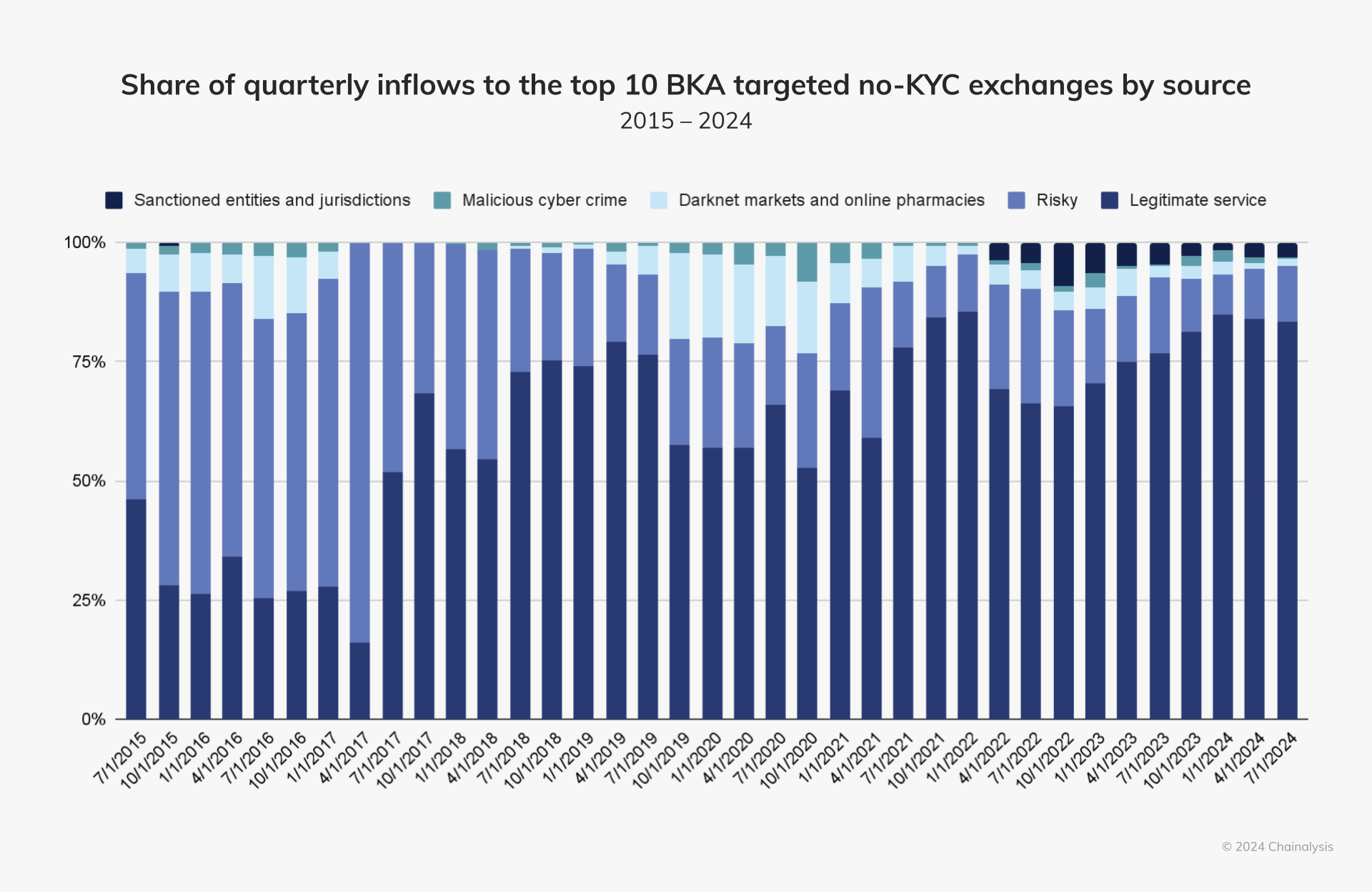
The chart below shows the quarterly inflows to the top ten exchanges taken down by the BKA. These services received value from a variety of sources, including periods of significant inflows from drug-related DNMs, online pharmacies, malicious cybercriminals such as ransomware gangs, and funds stolen in heists and scams.
There is also a notable increase over time in the proportion of inflows from legitimate sources, notably centralized exchanges. While this change to the composition of inflows might in other circumstances suggest that the services were in the process of cleaning up their platforms, the reality is likely more complicated. In this case, the increased inflows from otherwise legitimate sources most likely represent the growing use of these services for sanctions evasion on the part of Russian nationals, who are likely trying to leverage these no KYC exchanges to evade sanctions on Russian banks.
How do these services work?
These services operate as instant-swap style services, in which users, without providing any personal information or going through any verification process, can swap from one currency to another. The offerings include crypto-to-crypto and fiat-to-crypto swaps, allowing users to instantly exchange popular cryptocurrencies and stablecoins, or to connect their bank account to on-/off-ramp fiat to crypto instantly.
As with other categories of the illicit crypto ecosystem, we have observed that no KYC exchanges, particularly those targeted by the BKA, often have overlapping or similar on-chain infrastructure, and in some instances even share off-chain networks, such as website shells, employees and administrators, physical locations, and ownership structures, to name a few. More often than not, these websites have no affiliated company incorporation, registration, phone numbers, physical addresses, or any indicator of jurisdictional operation. Unlike other high-risk and illicit services, most of these services do not have a social media presence, instead offering users the ability to interface with a bot on their homepages. Despite using servers based in Germany, these services cater primarily to a Russian clientele, as suggested by their default language settings in Russian and information on banking services for fiat transactions provided by sanctioned Russian banks, such as Sberbank.
Connectivity to sanctioned Russian banks
Many of the 47 no KYC exchanges were Russian-language platforms offering fiat-to-crypto and crypto-to-crypto instant exchange services. As we covered in our recent analysis of Russia’s new cryptocurrency legislation, Russian-language instant exchangers can be exploited to quickly move fiat currency from sanctioned Russian banks to specified crypto wallets, enabling entities to evade sanctions. Given the dramatically increased sanctions pressure on Russian banks following the full-scale invasion of Ukraine in February 2022, instant exchangers have emerged as a convenient way to on- or off-ramp funds for sanctioned banks. Of the 47 no KYC exchanges targeted in Operation Final Exchange, all that we have identified on-chain accepted on- and off-ramping with sanctioned Russian banks.
Breadth of disruption likely to generate actionable inroads
Most of the exchanges targeted by BKA have been active since 2021 or before, and the top three in terms of transactions processed – Xchange.cash, 60cek.org, and Bankcomat.com – have been active since 2016 or before, according to the Operation Final Exchange landing page. The longevity of these services suggests a substantial portion of customers affected will need to establish alternative financial facilitation and laundering pathways.
The disruption’s impact is likely to extend far beyond the no KYC exchanges targeted. As the BKA stated, it is now in possession of these exchanges’ development, production, and backup servers, as well as transactional details, registration data, and IP addresses. This data will likely be instrumental in generating follow-on leads for the BKA and key international law enforcement partners in the months to come. We continue to track this phenomenon closely and will flag new no KYC exchanges that emerge as key players in this space.
This website contains links to third-party sites that are not under the control of Chainalysis, Inc. or its affiliates (collectively “Chainalysis”). Access to such information does not imply association with, endorsement of, approval of, or recommendation by Chainalysis of the site or its operators, and Chainalysis is not responsible for the products, services, or other content hosted therein.
This material is for informational purposes only, and is not intended to provide legal, tax, financial, or investment advice. Recipients should consult their own advisors before making these types of decisions. Chainalysis has no responsibility or liability for any decision made or any other acts or omissions in connection with Recipient’s use of this material.
Chainalysis does not guarantee or warrant the accuracy, completeness, timeliness, suitability or validity of the information in this report and will not be responsible for any claim attributable to errors, omissions, or other inaccuracies of any part of such material.



Crypto
Cryptocurrency News: Pepeto Nears Exchange Listing while the Cardano Price Prediction Could Flip After Hoskinson’s June Move

DUBAI, United Arab Emirates, June 20, 2026 (GLOBE NEWSWIRE) —
Pepeto moved into final preparation ahead of a major exchange listing, and the presale became the fastest closing raise of 2026 as rounds close inside days, because $10.29 million is raised, 170% APY staking runs live, three products are in production, and wallets are pouring in at a pace that tells the reader the sharpest capital has already locked the entry before the listing pulls the price out of reach forever.
The reason that capital is flowing this fast becomes clear the moment you check what the large caps are doing right now, since ADA is trading near six-year lows around $0.17 despite the highest stakes catalyst window in Cardano history, and every holder watching that gap should understand why the cardano price prediction and Pepeto keep landing together inside the same cryptocurrency news cycle this June.
Pepeto Exchange Listing Approaches While the Cardano Price Prediction Hangs on the June Rescue Plan
Cardano just walked into the highest stakes quarter in its history because ADA dropped below $0.20 in over five years following Charles Hoskinson’s June 3 break announcement per Yahoo Finance, and the bleeding only stopped on June 18 when ADA touched a $0.148 six-year low while Hoskinson rolled out a 10% protocol revenue buyback plan per CoinDesk.
While the Ouroboros Leios testnet is set to launch on June 23 per CoinMarketCap and Grayscale’s ADA ETF window opens August 9, with the bull cardano price prediction stretching $0.30 to $0.37 and the bear path back toward $0.148.
But the data that actually matters is what failed to follow the catalysts, since ADA stays trapped near six-year lows while daily trading volume has collapsed from $6.3 billion to $500 million and total value locked across Cardano DeFi has dropped 85% from $905 million to $139 million, with capital now flowing toward projects shipping live products rather than those grinding through roadmap delays, because even if the full cardano price prediction plays out a 2x from $0.17 toward $0.37 cannot reshape any portfolio.
That is the reason holders chasing the heaviest upside are pairing their ADA position with the presale carrying the biggest math behind it, since Pepeto walking toward its exchange listing is pulling the heaviest capital in the market right now and keeps showing up next to ADA across every fresh round of cryptocurrency news.
Why Pepeto Is Catching the Attention Cardano Spent Seven Years Trying to Build
The June 2026 data leaves ADA stuck in a sideways range while Pepeto keeps drawing serious money for reasons that run beyond community energy alone, because PepetoSwap runs as a zero-fee exchange across Ethereum, BNB Chain, and Solana with AI scanning every token for risk patterns.
Holders get zero gas bridging and contract checks that lock dangerous tokens out, a former Binance developer built the engine, and the Pepe ecosystem cofounder who grew a token past $7 billion now leads the team.
The Pepe comparison keeps drawing the heaviest wallets to this presale because Pepe coin lifted early holders into millionaire territory without shipping a single product and grew to roughly $11 billion in market cap while the creator of that same token now leads Pepeto.
Since everything that lifted Pepe higher is in place alongside live trading tools, and a $5,000 entry into Pepe grew into $750,000 at the peak, leaving Pepeto as the second chance at that entry while the cardano price prediction sits stuck under a slow recovery path.
Conclusion
The cardano price prediction and the upcoming Leios testnet both point toward a slow recovery and keeping ADA for stability is reasonable, but every cycle runs the same script because life-changing wealth never came from holding a large cap once the bottom held but from finding the right presale before anyone heard the name, and every signal in this cryptocurrency news cycle now leads to Pepeto as the single play of 2026.
The token remains in presale, and history proves entries placed before a token reaches an exchange carry the kind of returns holders chase for years, but presale windows are short and a simple decision to wait is how millions missed every cycle-defining entry and spent years hoping something this rare would appear again.
So once Pepeto hits a major exchange the entry closes the way Pepe coin pricing closed inside hours when the earliest wallets walked away with the returns the market still talks about today.
Click To Visit Pepeto Website To Enter The Presale
FAQs
What is the Cardano price prediction for 2026?
The cardano price prediction for 2026 targets $0.30 to $0.37 in the bull case per CoinDesk after Hoskinson’s June rescue plan, with $0.148 marking the six-year low.
Is Pepeto a stronger entry than Cardano right now?
Pepeto is a stronger entry than Cardano today because the presale opens access to a live exchange with a major listing approaching, while ADA at $0.17 offers limited multiplier room.


Key Takeaways
- Iran threatened to close the Strait of Hormuz, risking renewed oil market stability after an IDF blitz.
- CENTCOM countered on June 20, reporting 55 ships moved 17M barrels to stabilize oil prices.
- Oil dropped to $77, and Bitcoin topped $66K after the ceasefire, but a Strait closure would hit risk assets.
Iran Announced Closure of the Strait of Hormuz After Lebanon Strikes
The Iranian regime is taking action against what it qualifies as a breach of the previously signed memorandum of understanding to end the current conflict in the Middle East.
Local reports indicate that Iran’s Khatam al-Anbiya Central Headquarters, the operational headquarters of the Iranian military, announced that it would close the Strait of Hormuz, a strategic passage for 20% of the world’s oil, as a retaliatory measure after the U.S. failed to comply with the first clause of the memorandum of understanding (MoU) signed by President Donald Trump and Iranian President Masoud Pezeshkian.
The first clause of the document stresses that “the United States of America and the Islamic Republic of Iran and their allies in the current war, by signing this MOU, declare the immediate and permanent termination of military operations on all fronts, including in Lebanon, and undertake from now on not to initiate any war or any military operation against each other.”
The measure comes as the Israel Defense Forces (IDF) launches a massive air strike campaign against objectives in Lebanon, hitting at least 80 targets allegedly linked to Hezbollah, and killing dozens of its members. Nonetheless, Lebanese authorities claim that over 47 people were killed and 97 people were wounded during these strikes.
U.S. Central Command (CENTCOM) issued a statement contradicting the Iranian regime, stressing that commercial ship traffic “increased June 20 as U.S. forces continued operating in the general area to support freedom of navigation.” “Safe passage through the international waterway remained intact today as 55 merchant ships transited, moving large amounts of cargo and more than 17 million barrels of oil to global markets,” it stressed.
A new closure of the Strait would result in a general rise in prices of the West Texas Intermediate (WTI) and Brent oil benchmarks, which have fallen to $77 and $80, respectively, in response to actions taken to end the U.S.-Israel-Iran conflict.
The action could negatively affect crypto markets, as Bitcoin climbed above $66K immediately after the announcement of a framework to end the war, with market actors jumping to risk assets.

Key Takeaways
- On Thursday, Ireland’s Finance Minister, Simon Harris, launched a 30-point action plan to combat Irish money laundering and fraud.
- Crypto-assets and global financial networks face tougher regulations to halt digital illicit cash flows.
- An Garda Síochána and the Central Bank will continuously update enforcement policies through 2026.
Targeting Digital Assets and Crypto Loopholes
Ireland announced a sweeping crackdown on financial crime on June 18, unveiling a national strategy that places a major emphasis on targeting the misuse of cryptocurrency and digital finance by increasingly sophisticated criminal networks.
The new initiative, which includes a National Risk Assessment and a 30-point action plan, was launched by Tánaiste and Minister for Finance Simon Harris and Minister for Justice Jim O’Callaghan. Officials said the package is specifically engineered to close loopholes created by emerging technologies, with crypto-assets identified as a primary front in the country’s defense against illicit cash flows.
Under the new plan, Ireland will implement enhanced safeguards around crypto-assets to prevent their use in money laundering, fraud, and terrorist financing. The government plans to enforce tougher oversight on digital finance platforms alongside increased transparency around corporate ownership.
“Criminals are becoming increasingly sophisticated, exploiting technology, operating across borders and adapting rapidly to change,” Harris said during the announcement. “Government cannot stand still in the face of these threats.”
Harris emphasized that tech-driven financial crimes carry severe human costs. “Financial crime is not a victimless crime,” he said. “Behind every fraud, scam and money laundering operation, there are real victims — older people losing their savings, families being defrauded and communities harmed by criminal activity.”
The risk assessment warns that Ireland’s global financial networks are facing evolving threats. In addition to stricter cryptocurrency regulations, the 30-point plan introduces tougher anti-money laundering measures within the gambling sector, boosts intelligence sharing between state agencies, and mandates closer coordination among financial crime, tax, and customs investigators.
O’Callaghan said the roadmap provides a practical blueprint to keep Ireland’s regulatory and enforcement responses agile enough to match the pace of technological change.
“This National Risk Assessment provides a comprehensive picture of the threats we face and the actions required to address them,” O’Callaghan said, noting that the strategy will unify efforts across regulators, industry, and law enforcement.
Enforcement of the new policies will involve joint operations between government ministries, the Central Bank, Ireland’s tax authority, and An Garda Síochána, the national police force. Officials noted that the regulatory framework for digital assets will be continually updated to ensure Ireland remains a secure jurisdiction for international business.
-

 Hawaii14 seconds ago
Waianae encampment deadline extended amid pushback from lawmaker, community
-

 Idaho3 minutes ago
One dead, four injured in US 26 crash near Ririe – East Idaho News
-

 Illinois8 minutes ago
Illinois Prison Closure Deepens Small Town’s Fears
-

 Indiana15 minutes ago
Indiana Republicans nominate Max Engling for secretary of state at GOP Convention in Fort Wayne
-

 Iowa18 minutes ago
Why Iowa State Basketball Will Miss Star Potential of Milan Momcilovic
-

 Kansas23 minutes ago
Salvador Perez attended the Ecaudor-Curaçao match at Arrowhead. So did other royals — from the Netherlands
-

 Kentucky30 minutes ago
Kentucky Colonels executive to speak at Florence Rotary Club on Monday, public welcome to register
-
Louisiana33 minutes ago
Louisiana Lottery Powerball, Pick 3 results for June 20, 2026

