Business
What Caused the Air India Plane Crash? Here’s What Investigators Are Examining.


Investigators have begun sorting through the wreckage of Thursday’s plane crash in India, the nation’s deadliest in three decades. It could take months before a definitive explanation emerges, but videos of the accident and other evidence have begun to offer clues about what may have brought down the Air India flight, killing more than 260 people.
Here are some questions that investigators hope to answer in days and weeks ahead, according to aviation safety experts.
Were the wing flaps and slats properly extended?
Thursday’s crash occurred moments after the plane departed the airport in Ahmedabad, India. A short, blurry video showed what appeared to be the start of a routine takeoff, aviation safety experts said. But soon after leaving the ground, the plane, a Boeing 787 Dreamliner, began to descend before crashing and exploding.
At its most basic, the crash reflected a failure to meet the fundamental requirements of flight. To fly, a plane needs to generate enough lift to overcome gravity and enough thrust to overcome the air’s resistance, known as drag. The flight on Thursday seemed to fail on both accounts.
“There appeared to be an issue with the thrust and there appeared to be an issue with the lift,” said Anthony Brickhouse, an aviation safety consultant. “And we unfortunately saw what the result was.”
When an airplane takes off, flaps at the rear of the wing and slats at the front are typically extended to provide more surface area to create more lift as the plane gains speed.
“Just given the fact that this was a takeoff accident, begs the question regarding the settings of the wing slats and flaps, which is critical for taking off in a big jet that’s fully loaded with fuel,” said Jeff Guzzetti, a former accident investigator for the Federal Aviation Administration and National Transportation Safety Board.
It was not clear whether those flaps and slats were properly extended. If they weren’t, experts said, investigators will want to know why. Did the pilots choose not to extend them or fail to do so? Was there some kind of mechanical failure that prevented the pilots from extending those parts? Even if the slats and flaps were extended, it would be difficult to know if they were appropriately deployed because they can be configured differently for different situations. It’s also possible that they were extended but retracted too soon.
“The video is just too grainy, but that is something that’s clearly recorded in the flight data recorder,” said Mr. Guzzetti. “So hopefully, the recorders will tell the tale.”
Why was the landing gear down?
The video shows that the landing gear remained extended throughout the plane’s ascent and descent, which experts described as unusual. Landing gear creates drag, so retracting it is typically one of the first actions a plane’s pilots take after the plane is off the ground.
But experts said the pilots may not have retracted the gear for a number of reasons. A mechanical problem may have prevented the pilots from lifting the landing gear, for example. Or the pilots may have been preoccupied with another, more pressing problem.
“The airplane will climb fine leaving the gear down,” said Shawn Pruchnicki, a former accident investigator at the Air Line Pilots Association and an assistant professor of aviation safety at Ohio State University. If something else had gone wrong in the plane, the pilots may have focused on addressing that first, he said: “You have bells and alarms going off — there’s all kinds of stuff happening.”
Were there engine problems?
Engines provide thrust and investigators will want to know if they failed for any reason. An engine breakdown sometimes comes with telltale signs — smoke, fire, a flash — but experts said none of those are clearly apparent in the blurry videos of the crash.
One video shows what appears to be a dust cloud shortly after the plane leaves the ground. That could have been caused by an engine or it could have been caused by the wingtips disturbing the air, experts said.
Planes are designed to fly with just one engine, a situation that commercial airline pilots train for “excessively,” Mr. Pruchnicki said, adding that he believed the 787 Dreamliner probably didn’t experience a single engine failure, but both engines could have malfunctioned.
If that were the case, it would have happened at the “absolute worst time,” said Mr. Pruchnicki. A double engine failure occurring shortly after takeoff, when the plane was only several hundred feet off the ground, would have left the pilots without sufficient time to respond to the emergency.
“You can’t manage a double engine failure that close to the ground,” he said, recalling the 2009 “Miracle on the Hudson,” when a US Airways jetliner landed in the Hudson River after the aircraft lost power in both engines after striking a flock of birds. “These guys were in a residential area, a business area. They had no place to go either. There was no field to set it down gently. So, unfortunately, they ended up in buildings.”
A failure of both engines could have many causes: a bird or drone strike, inadvertent fuel shut-off, issues with automated thrust management. There is no evidence that these problems played a role in Thursday’s crash.
“There’s easily a hundred different explanations of possibilities,” Mr. Pruchnicki said. Analyzing the flight data recorder and inspecting the engine itself would provide an “unbelievably forensic” look at what happened, he added.
What was happening in the flight deck?
Investigators will also probably be sharply focused on what unfolded in the flight deck, or cockpit, before the crash.
There were two pilots on the Air India flight, which is typical in commercial aviation, with one pilot in charge of flying and the other providing support, monitoring the plane’s various systems. Were those duties split appropriately? What were the pilots saying to one another? And did they perform their jobs adequately?
Planes are also equipped with various warning systems to alert pilots of problems. Investigators will want to know if those warning systems worked as intended.
“Did they get the warning that they were supposed to receive or were they misconfigured? If they didn’t get a warning, then why? If they did, what did the crew do when they heard it?” said Mr. Guzzetti.
What other sources of evidence are there?
Investigators will also be on the hunt for more evidence.
Typically, they scour and analyze wreckage for clues and collect testimony from witnesses, such as airport personnel who may have seen the crash. They will also look for additional videos.
But their most important task will be recovering the wealth of technical information and audio recordings contained in the plane’s black boxes: a flight data recorder and a cockpit voice recorder, both of which have been recovered.
“Once they have that information, it will help focus the investigation into specific areas,” said John Cox, a former airline pilot and chief executive of Safety Operating Systems, a consulting firm. “So right now, it’s about gathering of documentation and evidence and keeping an open mind.”



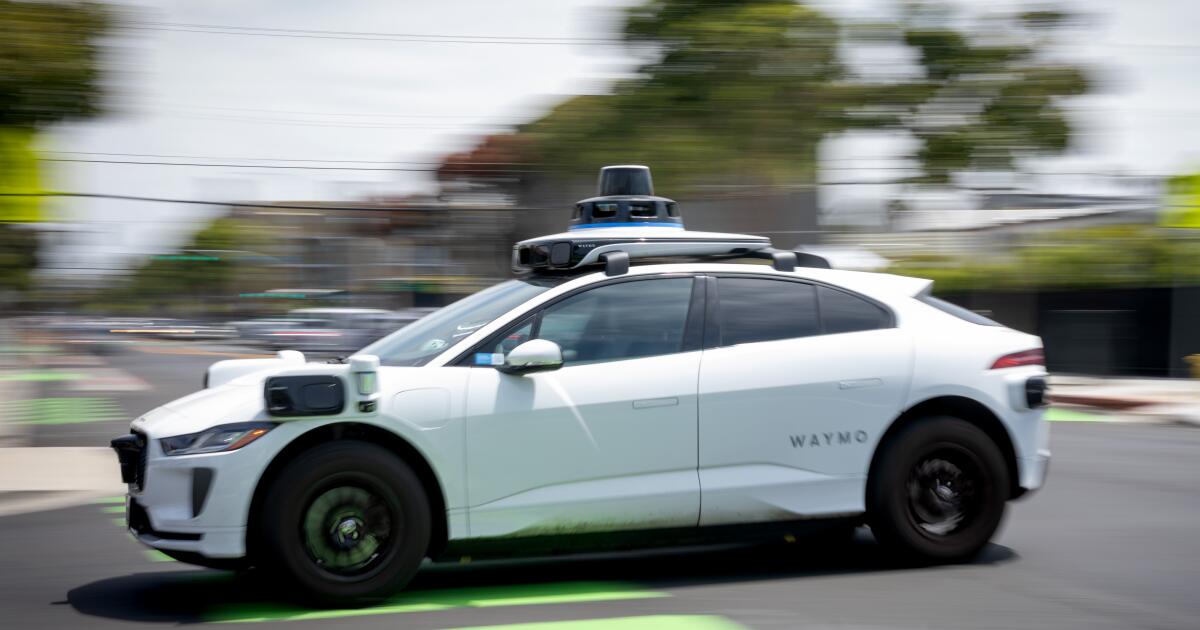
Waymo said that it’s pausing its robotaxi services on freeways in the U.S. as it updates its software to improve performance around construction zones and flooded roads.
Before the suspension, freeway operations were available in San Francisco, Los Angeles, Phoenix and Miami. The company said that street and other off-highway operations of Waymos will continue.
The company first confirmed the temporary pause to Reuters, and said that it was working to integrate recent technical learnings into software and expects to resume these routes soon.
“We are committed to being good neighbors for our riders and our communities. As part of that commitment, we make proactive decisions including temporarily pausing aspects of our service. We know riders count on us to get around, and we appreciate their patience as we work to get them where they’re going safely and reliably,” a Waymo spokesperson said in an email statement.
The company also paused operations in Atlanta, after a Waymo stopped in flood water. In early May, about 3,800 of Waymos autonomous taxis were recalled after a software defect caused some vehicles to drive into flooded roadways.
The suspension comes at a time when the Alphabet-backed company, which is based in Mountain View, Calif., has increased its pace of expansion into a number of new cities in the U.S. and across the globe, and getting them on freeways and local airports is important for expansion.
Competitors Tesla and Zoox have been playing catchup but don’t match the scale of Waymo yet.
The company said it has collected 170 million autonomous miles, with 13 times fewer injury-causing collisions compared with human drivers in the routes they operate in.
Waymo said it provides 500,000 trips every week, and aims to cross 1 million paid rides per week by 2026. While most Waymo models in use are Jaguar SUVs, it recently began testing a Chinese model Zeekr called Ojai in Los Angeles.
Waymo did not cite a specific instance that prompted the most recent recall, but the company has been forced to pause operations to improve software in several Southern states that have been hit by flash floods, including Texas, Tennessee and Georgia.
In 2025, Waymo recalled more than 1,200 vehicles due to a software defect resulting in minor crashes against obstacles in the road. Earlier this year, it faced renewed scrutiny after hitting a child outside a school in Santa Monica and running over a cat in San Francisco.

Since the war with Iran broke out, the average American household has spent an extra …
$190.47 on gasoline.
For many households, that is the equivalent of a month’s electricity bill.
Or a week’s worth of groceries for a couple.
The gasoline calculation is part of an analysis conducted by researchers at Brown University as they and others try to assess the economic costs of the prolonged fighting.
Calculating the cost of war — a skipped meal or a drive not made — is an imperfect science. But these estimates can offer a sense of how fighting far away can change behaviors large and small each day, disrupting American life.
Discomfort has not been spread evenly. As the price of gasoline has shot up, the national average is now …
$4.55 a gallon
In Illinois, it is more expensive …
$4.99 a gallon.
In California, it’s …
$6.13 a gallon.
Diesel, which is used to power factories and move most goods around the country, also quickly climbed.
Taken together, the amount of extra money Americans have collectively spent on gasoline and diesel since Feb. 28, when the United States and Israel attacked Iran, is staggering:
$0.0 billion
Hunting for cheaper gas, Americans are going to Costcos and Sam’s Clubs more often to fill up their tanks.
Drivers visited Sam’s Club gas stations 18 percent more in the last week of April than the same time last year.
They are filling their tanks with less gas.
One gallon fewer at a time.
They are riding more subways and commuter trains.
They are using bike shares more often.
People rode more buses in March than before the war:
45 million more rides.
People are spending less on essentials.
More than 40 percent of people in a recent poll said they were spending less on groceries and medical care.
They are putting less into savings.
Richer households are spending a relatively small share of their income on gas:
2.7%.
Poorer households are spending far more:
4.2%.
This is not the first time in recent years that the economy has been shocked by war.
After Russia invaded Ukraine in 2022, oil prices spiked, sending gasoline soaring. At its peak, the national average was …
$5.02 a gallon.
Where things go this time around is anyone’s guess. When the war does end, it will still take weeks or months for energy supplies to level off.
Nearly three out of four goods move across the country by truck.
Many of those trucks are powered by diesel, making them much costlier to drive, and what’s inside them costlier for consumers.
Last month, a tomato cost …
40% more
than it did the same time last year.
More expensive fuel isn’t the only culprit for rising costs. Extreme weather, tariffs and other factors have forced prices up for many industries. Gasoline also becomes more expensive as the summer approaches.
But inflation last month rose at its fastest pace in nearly three years, and gasoline was among the fastest rising categories.

The layoffs bludgeoning the tech industry continued this week as artificial intelligence reshapes the industry.
Mountain View-based Intuit, the maker of TurboTax, on Wednesday said it was laying off 17% of its workforce, or about 3,000 employees, as part of its restructuring to cut costs and invest in artificial intelligence.
The company said it had slowed down due to “too many organizational layers” and the cuts will simplify the organization to become a “faster, leaner, more focused company.” Intuit said it will close its offices in Reno and Woodland Hills and incur an estimated $300 million to $340 million in restructuring charges.
“We believe we can serve more customers and deliver breakthrough products that fuel our customers’ success by reducing complexity and simplifying our structure,” Sasan Goodarzi, chief executive of Intuit, said in a memo shared with employees.
Intuit announced the layoffs on the same day it reported its third-quarter results, in which revenue jumped 10% from a year earlier, to $8.56 billion.
Intuit adds to the count of more than 114,000 tech-sector employees laid off this year, according to Layoffs.fyi.
Meta laid off 8,000 workers on Wednesday, as the company cuts costs to ramp up investment in AI agents and infrastructure. The ever-expanding list of tech companies that have cut jobs includes Coinbase, Amazon, LinkedIn and more. Some have cited productivity gains enabling fewer workers to accomplish more with AI, while others pointed out restructuring and cost-cutting to prepare for the AI disruption.
In an earnings call, Intuit‘s chief financial officer, Sandeep Aujla, said the cuts were intended to make the organization leaner, and weren’t tied directly to Intuit’s AI use.
“AI is an important part of how we’re evolving as a company, but these decisions were not driven by AI replacing employees,” an Intuit spokesperson reiterated in an email .
Best known for its TurboTax platform, Intuit has branched into accounting with QuickBooks, credit scoring through Credit Karma and email automation via Mailchimp. Facing increased competition for AI-driven tax solutions, the company is integrating AI across its entire portfolio.
“Our AI agents are delivering value at scale, with our accounting AI agents powering recommendations across more than 50 million transactions each week, and business tax AI agents identifying millions of dollars in deductions,” Goodarzi said in the earnings call.
The restructuring will reduce overlapping roles in TurboTax and Credit Karma as the company integrates both into a single team.
A deep sense of anxiety has settled in the tech job market, propelled by consecutive layoffs and coding tasks being automated by AI.
Tech leaders have portrayed the role of human software engineers as a human in the loop, overseeing and verifying AI agents that do the work of coders.
By 2027, software developers are expected to see a 3% job contraction due to AI coding capabilities, according to Labor Automation Forecasting Hub by Metaculus, a popular website where forecasters predict how AI will reshape the workforce.
-
South Dakota5 minutes ago
SD Lottery Mega Millions, Millionaire for Life winning numbers for May 22, 2026
-
Tennessee11 minutes ago
TN Lottery Mega Millions, Cash 3 Morning winning numbers for May 22, 2026
-
 Texas17 minutes ago
Runoff heats up for RGV Democrats who hope to reverse GOP gains
-

 Utah23 minutes ago
Utah man pardoned for Jan. 6 discusses new $1.7B ‘anti-weaponization fund’ from Trump DOJ
-

 Vermont29 minutes ago
Yankee Magazine names these Vermont spots among New England’s prettiest
-

 Virginia35 minutes ago
Virginia Lottery Mega Millions, Pick 3 Night results for May 22, 2026
-

 Wisconsin47 minutes ago
Wisconsin Lottery Mega Millions, Pick 3 results for May 22, 2026
-

 West Virginia53 minutes ago
No. 9 West Virginia Battles Past No. 21 Arizona State, Punches Ticket to Big 12 Final

