Business
The Surveillance Tools That Could Power Trump’s Immigration Crackdown


Apps and ankle monitors that track asylum seekers in real time wherever they go. Databases packed with personal information like fingerprints and faces. Investigative tools that can break into locked phones and search through gigabytes of emails, text messages and other files.
These are pieces of a technology arsenal available to President Trump as he aims to crack down on illegal immigration and carry out the largest deportation operation in American history. To do so, his administration can tap a stockpile of tools built up by Democrats and Republicans that is nearly unmatched in the Western world, according to an analysis by The New York Times.
A review of nearly 15,000 contracts shows that two agencies — Immigration and Customs Enforcement, and Citizen and Immigration Services — have spent $7.8 billion on immigration technologies from 263 companies since 2020.
The contracts, most of which were initiated under the Biden administration, included ones for tools that can rapidly prove family relationships with a DNA test to check whether, say, an adult migrant crossing the border with a minor are related. (Families are often treated differently from individuals.) Other systems compare biometrics against criminal records, alert agents to changes in address, follow cars with license plate readers, and rip and analyze data from phones, hard drives and cars.
The contracts, which ranged in size, were for mundane tech like phone services as well as advanced tools from big and small companies. Palantir, the provider of data-analysis tools that was co-founded by the billionaire Peter Thiel, received more than $1 billion over the past four years. Venntel, a provider of location data, had seven contracts with ICE totaling at least $330,000 between 2018 and 2022.
The Biden administration used many of these technologies for immigration enforcement, including in investigations of drug trafficking, human smuggling and transnational gang activity. How Mr. Trump may apply the tools is unknown, especially as the whereabouts of many immigrants are known and the government faces a shortage of officers and facilities to detain people.
But Mr. Trump has already made clear that his immigration agenda is strikingly different from his predecessor’s. This week, he announced a barrage of executive actions to lock down the borders and expel migrants and those seeking asylum.
“All illegal entry will immediately be halted and we will begin the process of returning millions and millions of criminal aliens back to the places from which they came,” Mr. Trump said at his inauguration on Monday.
Tech products are almost certain to feature in those plans. Thomas Homan, the administration’s border czar, has discussed meeting with tech companies about available tools.
“They’ll certainly use all tools at their disposal, including new tech available to them,” said John Torres, a former acting assistant secretary for ICE.
A White House spokesman declined to comment. ICE said in a statement that it “employs various forms of technology, and information to fulfill its mission, while protecting privacy, and civil rights and liberties in accordance with applicable laws.”
Eric Hysen, the chief information officer for the Homeland Security Department under President Biden, said ICE and other immigration agencies have vast responsibilities. Many tools were designed for investigations of drug traffickers and other criminals, not tracking migrants, he said, while other technology like license plate readers could be used to ease traffic at border crossings.
The federal government has had longstanding internal policies to limit how surveillance tools could be used, but those restrictions can be lifted by a new administration, Mr. Hysen added. “Those are things that can change, but they are not easy to change,” he said.
Creating an arsenal
The buildup of immigration tech goes back to at least the creation of the Homeland Security Department after the Sept. 11, 2001, attacks. Interest in the tools fueled a boom that is expected to grow under Mr. Trump. Leaders in Europe and elsewhere are also investing in the technologies as some adopt increasingly restrictive immigration policies.
Many companies are racing to meet the demand, offering gear to fortify borders and services to track immigrants once they are inside a country.
In the United States, the beneficiaries include the makers of GPS tracking devices, digital forensics tools and data brokers. Palantir and others won contracts with ICE for storing and analyzing data. Thomson Reuters, Lexis Nexis and credit rating companies provide access to databases of personal information that can help government agents find the homes, workplaces and social connections of citizens and noncitizens alike.
Clearview AI, a facial recognition firm, had contracts worth nearly $9 million, according to government records. Cellebrite, an Israeli phone-cracking company, sold ICE about $54 million in investigative tools. The F.B.I. famously used Cellebrite tools in 2016 to unlock the iPhone of a mass shooter in San Bernardino, Calif., to aid the investigation.
Investors have taken note. The stock price of Geo Group, a private prison operator that sells monitoring technology to ICE, has more than doubled since Mr. Trump won November’s election. Cellebrite’s shares have also nearly doubled in the past six months and Palantir’s shares have risen nearly 80 percent.
Tom Hogan, Cellebrite’s interim chief executive, said the company was proud to help “keep our homeland and borders safe with our technology.” Thomson Reuters said in a statement that its technology is used by agencies to support investigations into child exploitation, human trafficking, drug smuggling and transnational gang activity. Lexis Nexis, Clearview and Palantir did not respond to requests for comment.
In an investor call in November, Wayne Calabrese, Geo Group’s chief operating officer, said the company expected the “Trump administration to take a much more expansive approach to monitoring the several millions of individuals” who were going through immigration proceedings but had not been detained.
“We have assured ICE of our capability to rapidly scale up,” he said.
In a statement for this article, Geo Group, based in Boca Raton, Fla., said it looked forward to supporting the Trump administration “as it moves quickly to achieve its announced plans and objectives for securing the country’s borders and enforcing its immigration laws.”
Tracking locations
One technology that may be used immediately in mass deportations can identify the exact location of immigrants, experts said.
About 180,000 undocumented immigrants wear an ankle bracelet with a GPS tracking device, or use an app called SmartLink that requires them to log their whereabouts at least once a day. Made by a Geo Group subsidiary, the technology is used in a program called Alternatives to Detention. The program began in 2004 and expanded during the Biden administration to digitally surveil people instead of holding them in detention centers.
Location data collected through the program has been used in at least one ICE raid, according to a court document reviewed by The Times. In August 2019, during the first Trump administration, government agents followed the location of a woman who was being tracked as part of the program. That helped the agents obtain a search warrant for a chicken processing plant in Mississippi, where raids across the state resulted in the detention of roughly 680 immigrants with uncertain legal status.
Sejal Zota, the legal director of Just Futures Law, a group that opposes government surveillance programs, said the Trump administration would likely need to rely on digital surveillance tools as it would be impossible to physically detain vast numbers of individuals without legal status.
“While this administration wants to scale up detention, and I believe that it will find ways to do that, it will take time,” she said. “I think that this program will continue to remain important as a method to surveil and control people.”
Troves of data
The Trump administration also has access to private databases with biometrics, addresses and criminal records. Agents can obtain records of utility bills for roughly three-quarters of Americans and driver’s licenses for a third of Americans, according to a 2022 study by Georgetown University.
These tools could potentially be used to track people high on ICE’s priority list, like those with a criminal history or people who do not show up for immigration court hearings. Investigators could use the databases to find someone’s automobile information, then use license plate readers to pinpoint their location.
During the first Trump administration, ICE could access driver’s license data through private companies in states like Oregon and Washington, even after the state tried cutting off access to the information to the federal government, according to the Georgetown study.
Mr. Torres, the former ICE official, said this information was critical for agents to find people.
“We know people give false addresses,” he said. Agents can use “big data sharing to triangulate their location based on habits.”
That has raised privacy concerns. “Privacy harms may seem theoretical on paper, but they’re never theoretical for vulnerable people on the front lines,” said Justin Sherman, a distinguished fellow at Georgetown Law’s Center on Privacy and Technology.
During the Biden administration, ICE also bought software from Babel Street, a tech company that gathers data from thousands of publicly available websites and other sources. Its services can assess people as potential security risks based on data. Babel Street did not respond to requests for comment. ICE has also paid about a dozen companies for software that can be used to overcome passcodes, surface deleted files and analyze email inboxes.
Some immigration experts have questioned how much of this technology the Trump administration may use. Some tools are most relevant for targeted investigations, not for widespread deportations, said Dave Maass, the director of investigations at the Electronic Frontier Foundation, a civil liberties group.
“What they are buying and what is actually useful may be totally different things,” said Mr. Maass. Regardless, he said, tech companies “are going to make a lot of money.”
Methodology
The New York Times analyzed government contract data from usaspending.gov. The data covered spending from Immigration and Customs Enforcement and Citizenship and Immigration Services from 2020 to the present. The Times filtered the data to technology-related contracts, using recipient information and contract description. The Times looked at money that had been spent, not just pledged, to calculate the total spending and total number of tech companies.




The race to bring air travel to the sky is heating up as Santa Cruz-based Joby Aviation and Toyota launch a joint venture to commercially produce air taxis.
The companies said in a news release Tuesday that they will work together on productivity, quality and costs and move toward mass production of Joby’s electric vertical takeoff aircraft. Joby and Toyota were first linked when Toyota made a nearly $400-million investment in the company in 2020. It has since increased its backing of the company to $900 million.
“It’s really meaningful for us to take on this challenge together with Joby, a partner that shares the same vision,” Toyota Chair Akio Toyoda said. “We believe this strengthened relationship is an important step forward in realizing the future mobility society.”
Joby‘s all-electric vertical takeoff vehicles are designed to hold four passengers and a pilot and can travel at up to 200 mph. The vehicle uses six tilting propellers to achieve vertical takeoff before switching to forward flight.
In February, Joby announced a partnership with Uber to start service in the United Arab Emirates this year, bringing on-demand air taxi rides to the country. It plans to expand to the U.S. after the completion of its final stage of Federal Aviation Administration testing.
Prior to its full FAA certification, Joby is hoping to launch early flight operations later this year as part of a White House program that will bring flights to several states, including New York, Texas and Arizona. Flights in California will not begin until after obtaining FAA certification.
Joby has been in a fierce battle to be the first with taxis in the sky with its Northern California competitor Archer Aviation. The two companies are involved in overlapping lawsuits, with Joby alleging corporate espionage against Archer, and Archer filing a suit alleging dubious ties to China that sparked an investigation into Joby by the U.S. International Trade Commission.
“Toyota has been by Joby’s side for nearly a decade, providing invaluable guidance and support as we built the foundation for manufacturing our aircraft,” JoeBen Bevirt, Joby’s chief executive and founder, said in the news release. “Together, we share a vision of making aerial mobility an everyday reality, and we look forward to delivering on that promise together.”
Joby Aviation’s shares, which have fallen more than 30% this year, climbed 3% on Tuesday to $8.92.

Disneyland Resort in Anaheim will offer $59 tickets for select evening admission to either theme park as part of a new promotion.
The one-day, one-park evening ticket offer will allow attendees to enter Disney California Adventure at 5 p.m. or Disneyland at 7 p.m. Park reservations are still required, as has been the case since the COVID-19 pandemic.
The offer only applies for admission from July 12 through Aug. 5 on Sundays to Wednesdays.
Disneyland Resort is commemorating its 70th anniversary through Aug. 9, and has introduced new shows and additions to rides as part of the occasion.
Walt Disney Co.’s theme parks and experiences business are a crucial boost to its finances, making up about 56% of the company’s operating income last fiscal year.
During the Burbank-based company’s most recent earnings call in May, Disney executives said attendance at its U.S.-based parks was down 1% compared with the prior year, a shift they attributed to “continued softness” in international visitations. However, the company said at the time that it was starting to move past those issues.
Disney’s experiences division reported $9.5 billion in revenue in that fiscal second quarter, up 7% compared with the same period a year ago, something executives said was due to higher guest spending domestically and more capacity on its cruise line.

An aging downtown office complex will be converted into apartments as part of an ambitious plan by local real estate companies to create 4,000 affordable housing units in Los Angeles.
The first project will be a $200-million makeover of the L.A. World Trade Center, a sprawling white elephant of an office complex on Figueroa Street built in the 1970s that will be turned into 512 apartments in one of the largest affordable housing conversions to date downtown.
Future projects being planned in the central city for delivery over the next five years will include other office-to-apartment conversions and new housing built from the ground up.
The 10-story World Trade Center, right, at Figueroa and Fourth streets in downtown Los Angeles, was built in the mid-1970s.
(Myung J. Chun / Los Angeles Times)
Behind the building campaign unveiled Monday are two of the region’s largest real estate companies, Jamison and Kennedy Wilson. Jamison is the city’s most prolific converter of offices to market-rate apartments and currently has a major makeover of a downtown office skyscraper underway for tenants who can pay top rents.
Kennedy Wilson, a real estate investment company based in Beverly Hills, owns Vintage Housing, which builds and operates affordable housing using tax credits and other state and federal financing to help fund it.
Vintage Housing and Jamison’s new affordable housing division, Arden Residential, will take on the campaign to build the housing where qualified tenants will pay rents below market rates.
Rents in the World Trade Center — which will be renamed Sky Castle when it opens in early 2028 — are expected to start at $937 for a one-bedroom unit. Some two- and three-bedroom units would rent for $1,100 and $1,300 per month, respectively, developers said.
Sky Castle will have shared amenities found in more expensive modern apartments, the developers said, such as a fitness center, resident lounge and co-working space. It already has six tennis courts on the roof, which may be converted to pickleball courts, Jamison Chief Executive Garrett Lee said.
The goal is to build higher quality affordable housing by using efficient construction methods Jamison has learned through building more than 8,000 market-rate apartments in the past, Lee said. The makeover of the World Trade Center will mark Jamison’s 15th conversion of an office building to housing.
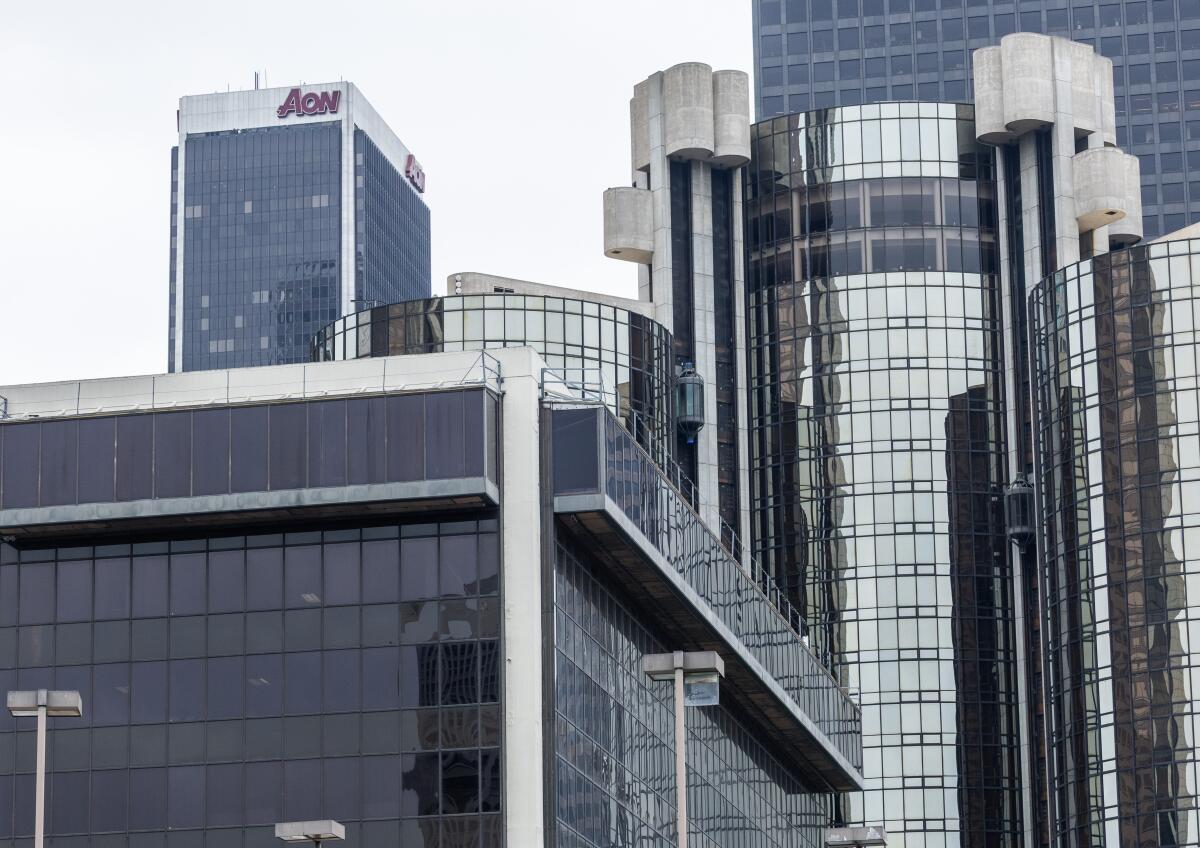
The plan to redevelop the L.A. World Trade Center, bottom left, is one of the largest affordable housing conversions to date downtown.
(Myung J. Chun / Los Angeles Times)
The 10-story World Trade Center was built in the mid-1970s to fanfare saying it would be home to international companies. In 1976, The Times described the center as a place to prepare for an overseas trip where visitors could get passports and visas, as well as exchange dollars for francs, marks, rubles and other currency. There was a language school and branches of U.S., Swiss and Japanese banks.
By the mid-1980s, the 400,000-square-foot office complex covering a city block at Figueroa and Fourth streets had lost its international flavor and was falling out of favor with corporate tenants who were moving into glossy new skyscrapers on Bunker Hill and in other locations.
The building has been cleared of remaining office tenants to allow work to begin in August, Lee said.
Kennedy Wilson is a nationwide operator of market-rate apartments that has also moved into building affordable housing in the last decade, said Nicholas Bridges, global head of capital markets at the company.
Building affordable, workforce housing “in almost all cases requires public subsidies,” Bridges said, and Kennedy Wilson has developed expertise in assembling “a cocktail of public financing sources” that includes low-income housing tax credits and tax-exempt bonds.
In the past, many housing developers have shied away from building affordable housing because assembling the subsidies needed to make construction profitable is challenging.

An artist’s rendering shows what the L.A. World Trade Center could look like after being redeveloped into affordable housing. The new complex is to be called Sky Castle.
(Ian Camarillo)
“It’s complicated,” Bridges said, “and not for the faint of heart.”
Eligible tenants must earn between 30% and 80% of the median income in the area where the housing is built.
Jamison and Kennedy Wilson will develop about 15 affordable housing projects between downtown and the 405 Freeway, Bridges said, many of them in aging office buildings such as the World Trade Center that are already owned by Jamison and are close to public transit.
Substantial potential for affordable housing lies in L.A.’s underused office buildings, he said.
“In this post-COVID world, the way people are utilizing office buildings, particularly older office buildings, has just fundamentally changed,” he said.
It makes sense for developers of conventional multifamily housing to move to building affordable housing, Lee said, because the government supports it through subsidies, zoning reform and the fast-tracking of construction permits. The city of Los Angeles also recently streamlined its adaptive reuse rules to make it easier to convert office buildings to housing.
“There are a lot of incentives pushing us in this direction,” Lee said.
-

 Los Angeles, Ca35 minutes ago
Knife-wielding man rushes at LAPD officers in tense body cam video
-

 Detroit, MI56 minutes ago
5 Potential Landing Spots For Former Detroit Lions CB Terrion Arnold
-

 San Francisco, CA1 hour ago
May 17 officially declared
-

 Dallas, TX1 hour ago
Dallas City Hall named to World Monuments Fund’s ‘Irreplaceable America’ list – Lake Highlands
-

 Miami, FL1 hour ago
Ex-con lists $138M in luxury penthouses, including Miami trophy condo
-

 Boston, MA1 hour ago
Celtics reportedly trading Jaylen Brown to 76ers for Paul George, picks
-

 Denver, CO1 hour ago
LeBron James to the Nuggets? Latest reports and betting odds
-

 Seattle, WA2 hours ago
Residents and activists clash over plan to curb SEPA appeals at Seattle hearing

