Business
The last days of California's oldest Chinese restaurant: From anonymity to history

The conundrum facing the Fong family of Woodland arose earlier this year, shortly after a UC Davis law professor grew interested in a sign posted above the counter that read: “The Chicago Cafe since 1903.”
The Fongs had never given that sign much thought, beyond taking pride in running a family business with a cherished history in the community.
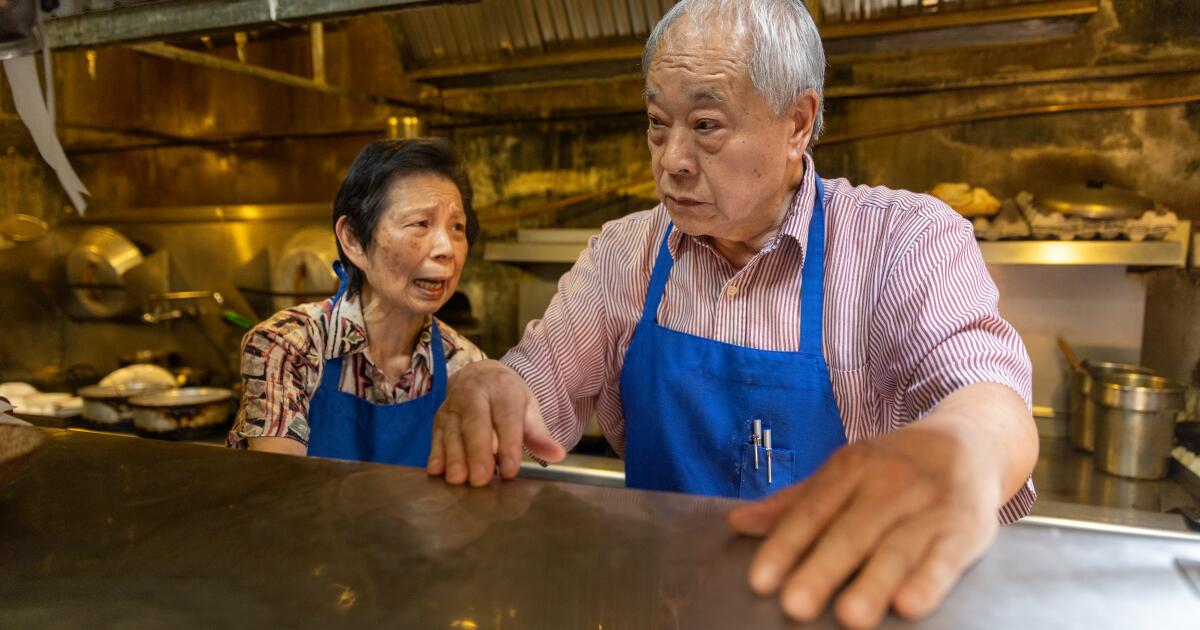
Not Paul Fong, 76, who has worked at the restaurant with his wife, Nancy, 67, since emigrating from Hong Kong in 1973.
Amy Fong has spent plenty of time at the Chicago Cafe in Woodland, Calif. Growing up, she headed to her parents’ restaurant every day after school to do homework and help with chores.
(Carl Costas / For The Times)
And not his children, Amy Fong, 47, a physical therapist, and Andy Fong, 45, a software quality engineer at Apple. They grew up sweeping floors and doing homework in the restaurant after school, but had gone off to college (UC Berkeley for Amy; San Jose State for Andy) under strict orders from their parents to find good careers, far from the grind of restaurant work. Now, with children of their own, they were looking forward to their parents’ retirement; they wanted their parents to be able to relax and spend time with their grandchildren.
Then, one day in 2022, Gabriel “Jack” Chin, a law professor at UC Davis, stopped in for lunch. Chin is an expert in immigration law, specifically the Chinese Exclusion Act of 1882 that made it incredibly difficult for Chinese people to immigrate to the U.S. And he knew something the Fongs didn’t, something that would complicate the family’s efforts to wind the business down: If the sign behind the counter was accurate, if the Chicago Cafe truly had been operating since 1903, that would make it a treasure of historic significance.
In January, UC Davis announced the results of Chin’s research: Of the tens of thousands of Chinese restaurants serving food in America, the Fongs’ unsung little diner is the oldest one continuously operating in California, and probably in the U.S. The Fongs suddenly found themselves in possession of an important piece of American history, which had been sitting in plain sight in a farm town 20 miles northwest of Sacramento.
The media rushed to cover the story, and hordes of new customers followed. The Woodland City Council issued a proclamation, which included testimonials from council members about their favorite dishes. And instead of retiring, Paul and Nancy were working twice as hard.
On a recent Friday, their daughter, Amy, came by the restaurant with her two children and took in the scene, in its usual state of friendly chaos. Customers occupied almost every table and banquette, many chowing down the restaurant’s signature chop suey — which, like a lot of food served at the Chicago Cafe, is a Chinese American dish unfamiliar in China itself.
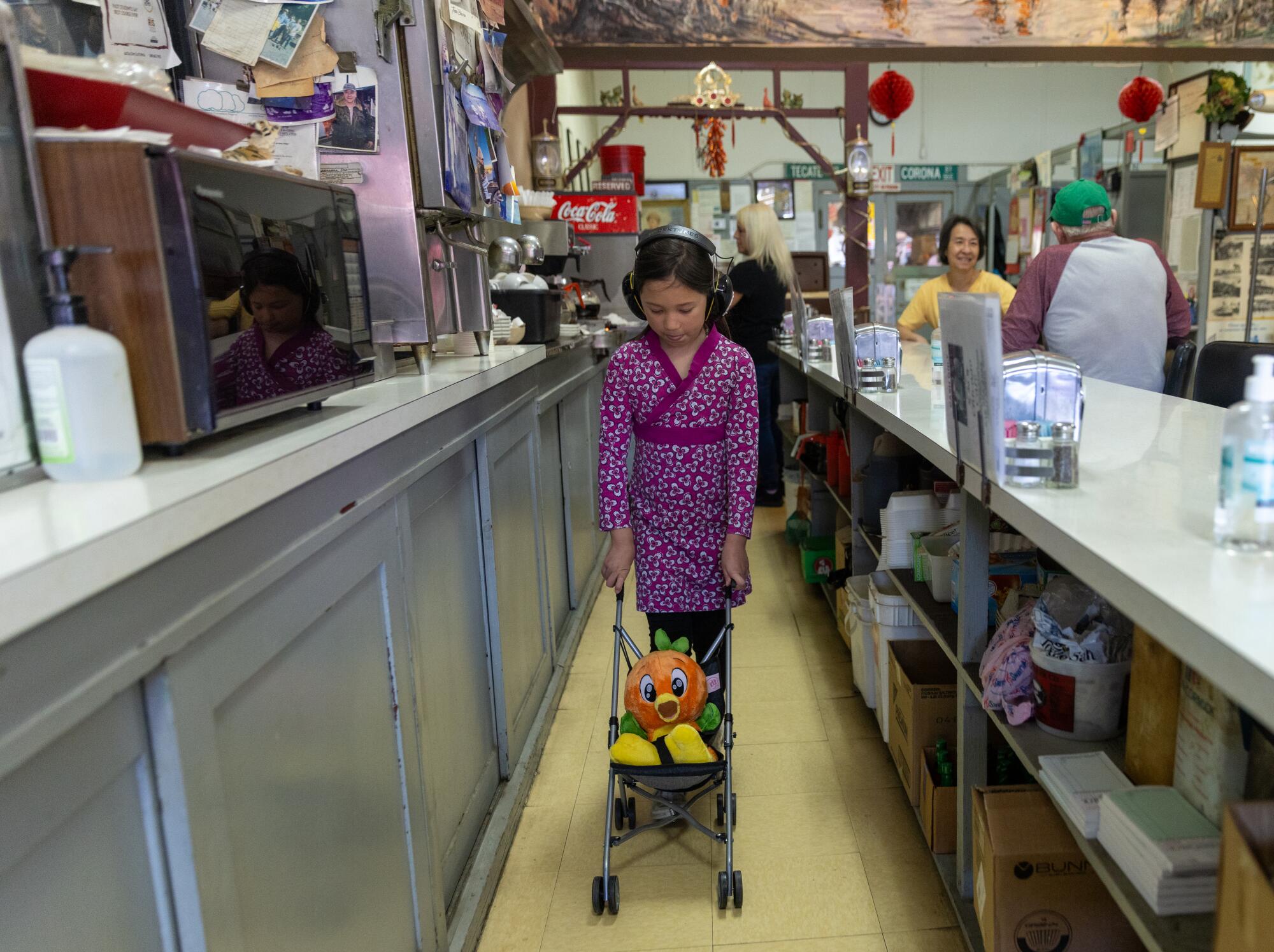
Amy Fong’s daughter, Kira Kranz, entertains herself during a visit to her grandparents’ restaurant.
(Carl Costas / For The Times)
The lone waitress, Dianna Oldstad, has worked with the Fongs for decades. She bustled to and fro, greeting regulars with gruff warmth. In the kitchen, Paul and Nancy raced from cutting board to grill with plates of meat and vegetables, and handed the finished dishes off with dizzying speed. Watching over it all were mounted deer and elk and a giant stuffed peacock with its tail unfurled in blue-green glory — gifts from customers over the years.
Paul’s pride in serving his diners, many of whom have become friends and fishing buddies, was evident. Still, his daughter noted with dismay: “They’re getting too old to do this every day.”
The family’s dilemma was so apparent that longtime customers chatted about it as they waited for their food: Would the Chicago Cafe simply end when Paul and Nancy retired? And how could its historic import have emerged just as the Fongs were finally ready to step back?
It is more complicated than one might guess to unearth the history of a Chinese restaurant that has been a fixture in a town for more than 100 years.
In part, that is because of the racism of the early 20th century: Local directories excluded Asian people and businesses until the 1930s, according to Chin. So records of the business had to be found elsewhere.
The Chinese Exclusion Act added another wrinkle. The law sought to prohibit immigration, but didn’t completely stop it. Instead, many Chinese people purchased the identity of Chinese Americans born in the U.S., and then posed as their relatives. The immigrants who came using fake identities were known as “paper sons.”
For a time, restaurants had their own exception to the Chinese Exclusion Act — which some coined “the lo mein loophole” — that allowed business owners to go to China on merchant visas to bring back employees. In the years after 1915, when a federal court added restaurants to the list of businesses allowed such visas, the number of Chinese restaurants in America exploded.
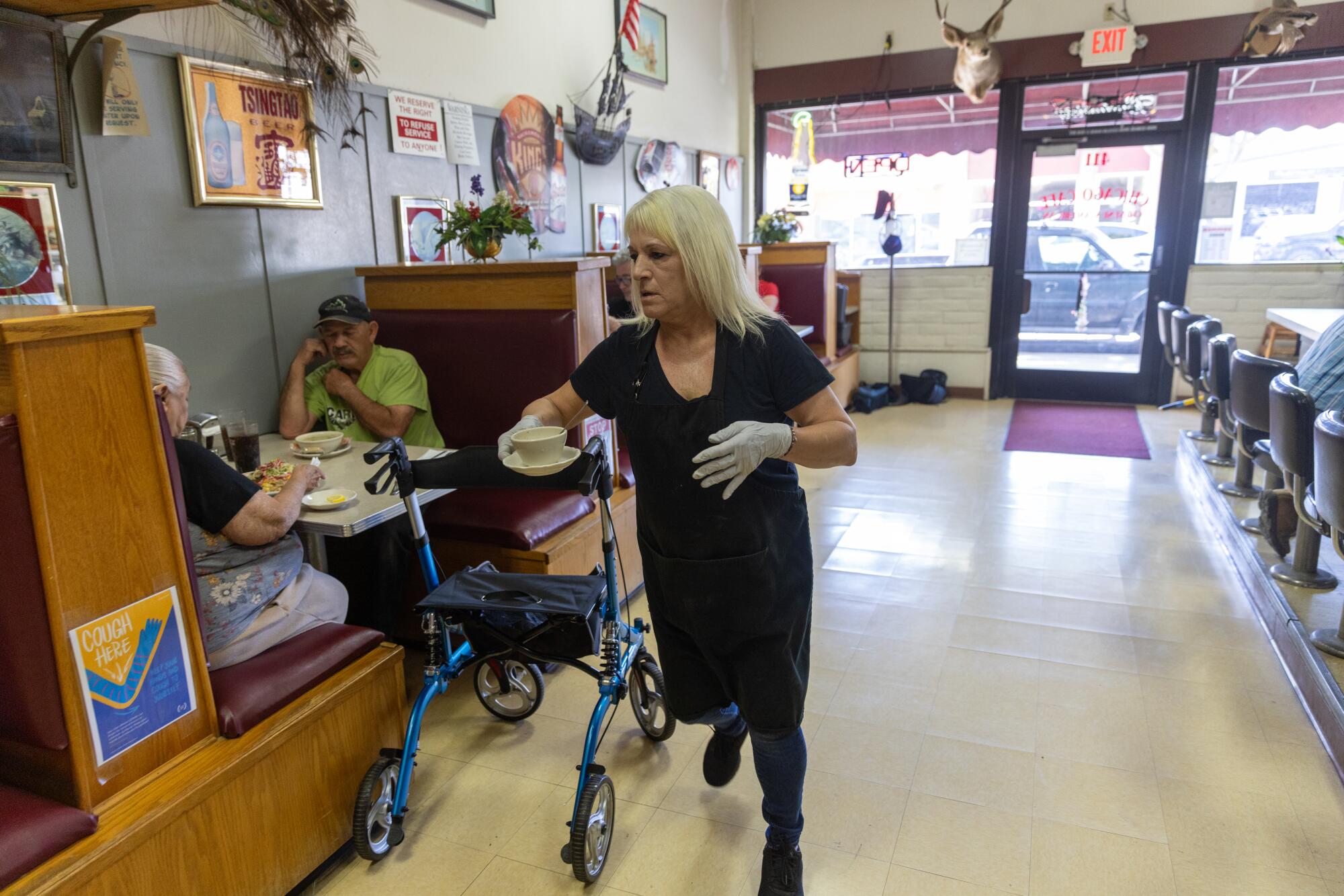
Dianna Olstad, the sole waitress at the Chicago Cafe, has worked with the Fongs for decades.
(Carl Costas / For The Times)
Paul Fong’s grandfather almost certainly came before the “lo mein loophole” went into effect. He came as a paper son, steaming into San Francisco Bay under the name Harry Young. The exact year is lost to history: The 1906 earthquake in San Francisco set off a fire that burned up reams of naturalization records — and also allowed many people to add extra “relatives” to the rolls when the records were reconstructed.
“Harry Young” made his way to Woodland, which had developed a busy Chinatown populated by immigrants who had come to work on the transcontinental railroad. At the time, many of Woodland’s neighborhoods were graced by stately Victorians, laid out on large lots shaded by towering oaks. Its Chinatown was a lot less grand: a collection of wood and brick structures built along Dead Cat Alley behind Main Street.
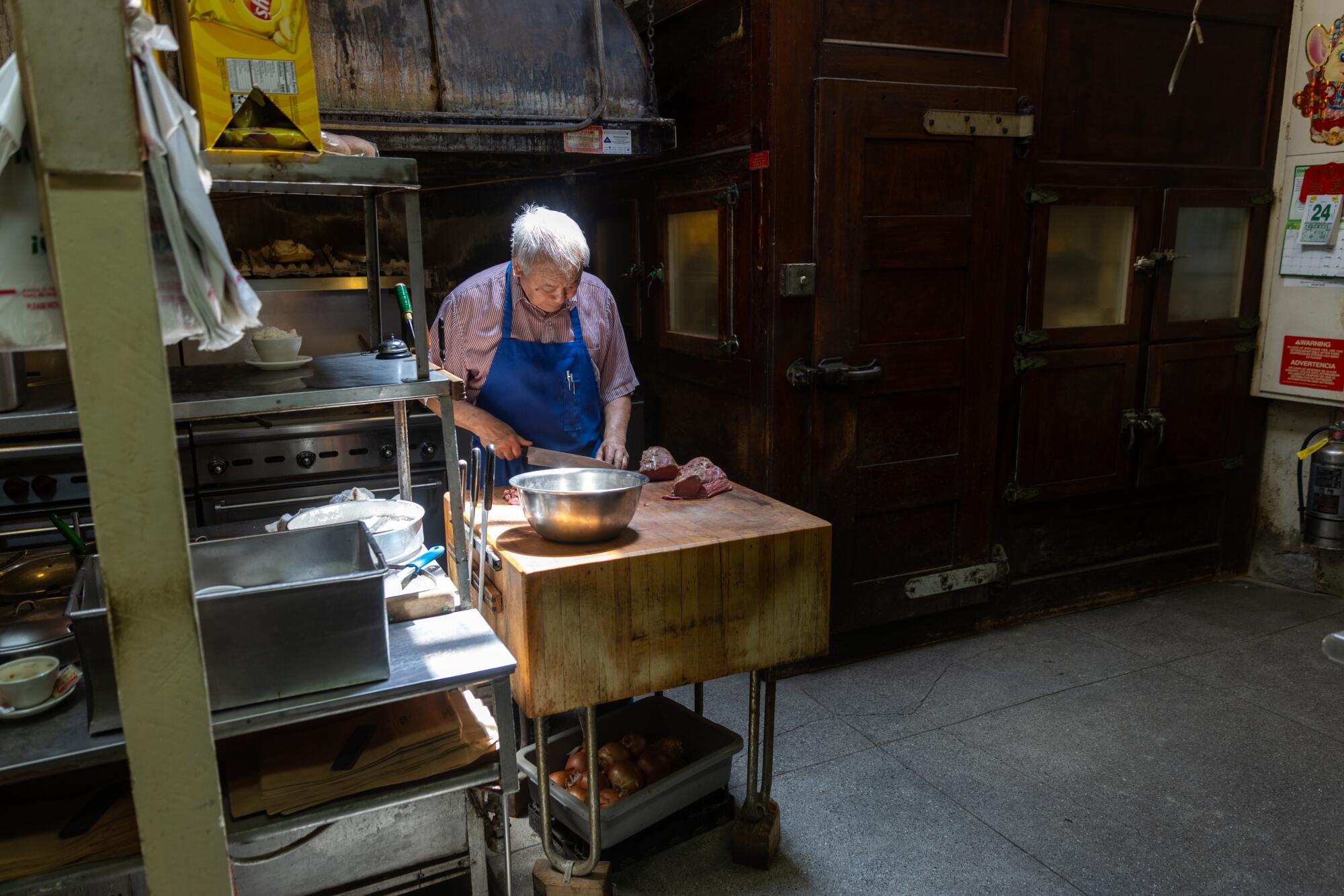
Paul Fong chops food in the solitude of his kitchen at the Chicago Cafe.
(Carl Costas / For The Times)
Paul Fong doesn’t know much about how his family came to have a restaurant, and why on earth they called it the Chicago Cafe. He was born in the Taishan area of Guangdong province long after his grandfather had left, and they never met. When Paul was still young, his own father left Taishan to join his grandfather in Woodland; he, too, came as a paper son, under the name Yee Chong Pang.
In 1973, Paul and his mother joined his father at the restaurant, along with Nancy. They would have come earlier, but because his father and grandfather had come as paper sons, there was bureaucracy to cut through even after passage of the Immigration Act of 1965, which finally opened the doors to immigration from Asia.
Paul came to Woodland from Hong Kong, a mega-city that even in 1973 had a population that topped 4 million. Woodland was home to just 20,000. It was a shock.
“In Hong Kong, so many people,” he recalled. The streets were bustling, the nightlife vibrant. The liveliest thing about nightlife in Woodland were the stars: The lack of city lights meant the stars sparkled more brightly.
But Paul grew to love it. Though he spoke limited English, he made friends. Amy recalled that bags of freshly shot duck and truckloads of zucchini would be dropped off periodically at the restaurant door. When a family friend accidentally ran over a peacock, it also wound up at the restaurant — mounted on the wall, not on a plate.
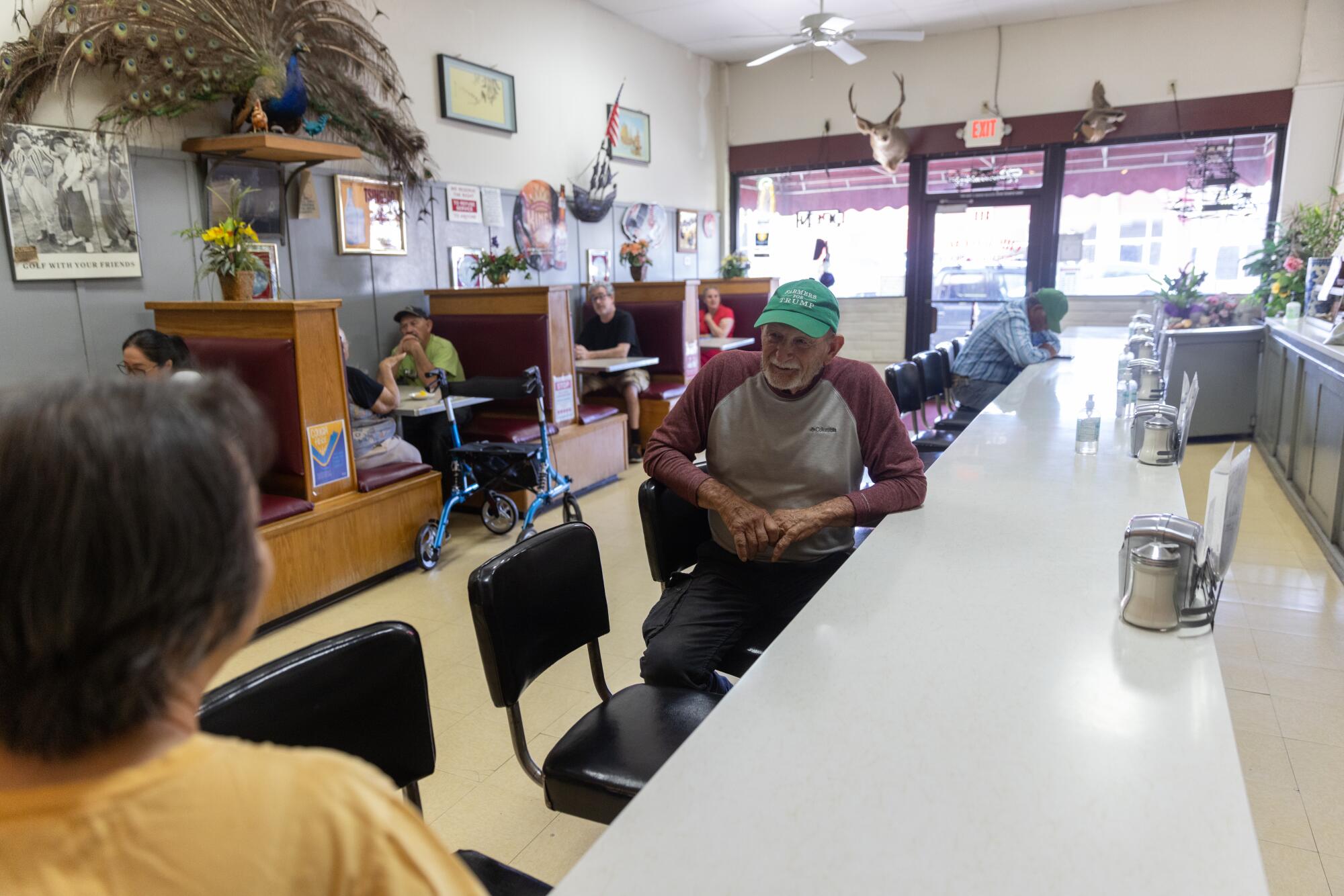
Jerry Shaw has been a regular at the Chicago Cafe for more than four decades.
(Carl Costas / For The Times)
Andy said his parents shared little over the years about how the family wound up in Woodland. He recalled going to visit the Woodland cemetery as a child to pay respects to his grandfather and being startled that the etching on the gravestone said “Young” instead of “Fong.” It was the first he’d heard of paper sons.
The Fong children went to the restaurant every afternoon after school. Looking back on their childhood, they could appreciate it was a local institution. Generations of families from all walks of Woodland life came for lunch and special events. At a recent City Council meeting, almost every council member had a personal story, some dating back decades.
“My family grew up eating at the Chicago Cafe,” said Mayor Tania Garcia-Cadena. Councilwoman Vicky Fernandez recalled that her family did too. “Your doors have always been open to all of us,” she said, adding that because her family was Mexican American, that had not always been true of all the restaurants in town.
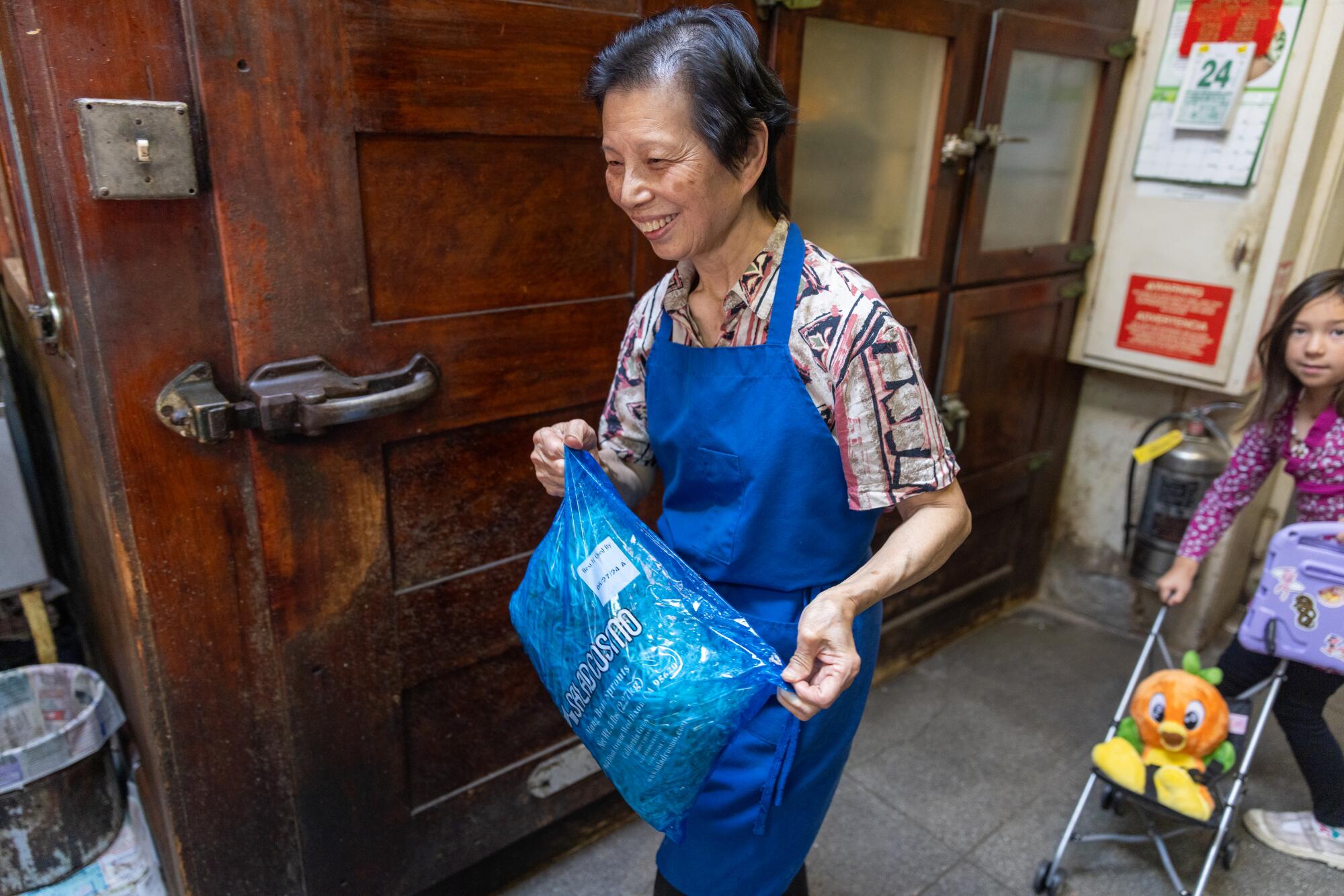
Nancy Fong gathers ingredients during a crowded lunch service at the Chicago Cafe.
(Carl Costas / For The Times)
Still, as proud as they were of their legacy, Paul and Nancy were always clear on one point: Their kids would not be joining the family business. “My dad explicitly told us that he wanted us to go to college. Not do what he was doing, working so hard,” Andy recalled.
When the time came for the couple to retire, the Fong family planned to get out of the restaurant business.
Ten miles down the road, in his office at King Hall on the UC Davis campus, Chin kept thinking about that sign above the counter that said “since 1903.”
Chin grew up in Connecticut and does not speak Chinese. But he was interested in old Chinese restaurants for what they revealed about the history of people of Chinese descent and the legal discrimination they faced for so long.
There are more Chinese restaurants in the United States than there are McDonald’s, and the food they serve is remarkably consistent given much of it would never be served in China.
“A lot of the foods that we think of as Chinese are actually more American and all but unknown in China: General Tso’s chicken, beef with broccoli (broccoli is originally an Italian vegetable), chop suey, egg rolls, fortune cookies. Especially fortune cookies,” journalist Jennifer 8. Lee explained in a 2008 essay about her book, “The Fortune Cookie Chronicles.”
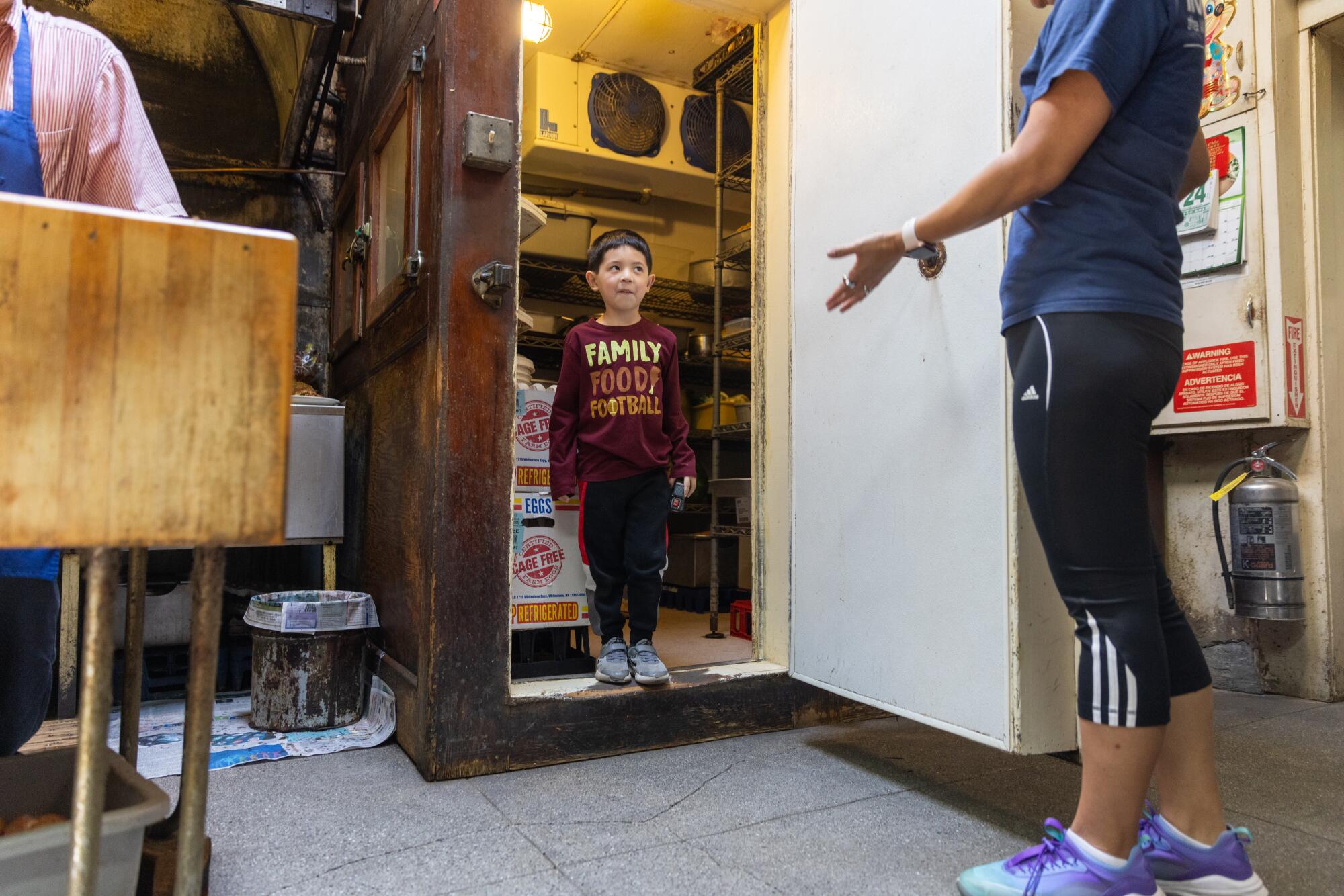
Torin Kranz bides his time in an aged walk-in cooler while his grandparents work the kitchen at the Chicago Cafe.
(Carl Costas / For The Times)
This is especially true at the Chicago Cafe, which serves sausage and eggs, pork chops and apple sauce and, on Fridays, clam chowder, along with traditional Chinese American fare such as chop suey and chow mein.
But if these old restaurants don’t reveal much about Chinese food, Chin said, they do reveal a lot about America.
As a law professor, Chin was interested in how elected officials and labor leaders had crafted laws to advance a larger anti-immigration agenda.
In 2018, he and a colleague published a paper called “The War Against Chinese Restaurants,” which laid out the innovative legal efforts — including zoning, licensing and trying to regulate women’s activities — employed in the early 20th century to drive Chinese restaurants out of business.
Researching that paper made him keenly aware of how many Chinese restaurants had operated in America — and how fleeting many of them were. He knew most authorities believed the oldest continuously operating Chinese restaurant was the Pekin Noodle Parlor in Butte, Mont., which dated to 1909 or 1911.
If the Chicago Cafe started in 1903, that made it older.
Chin asked the Fong family whether he could bring in archivists to try to get to the bottom of the mystery? Sure, the family said.
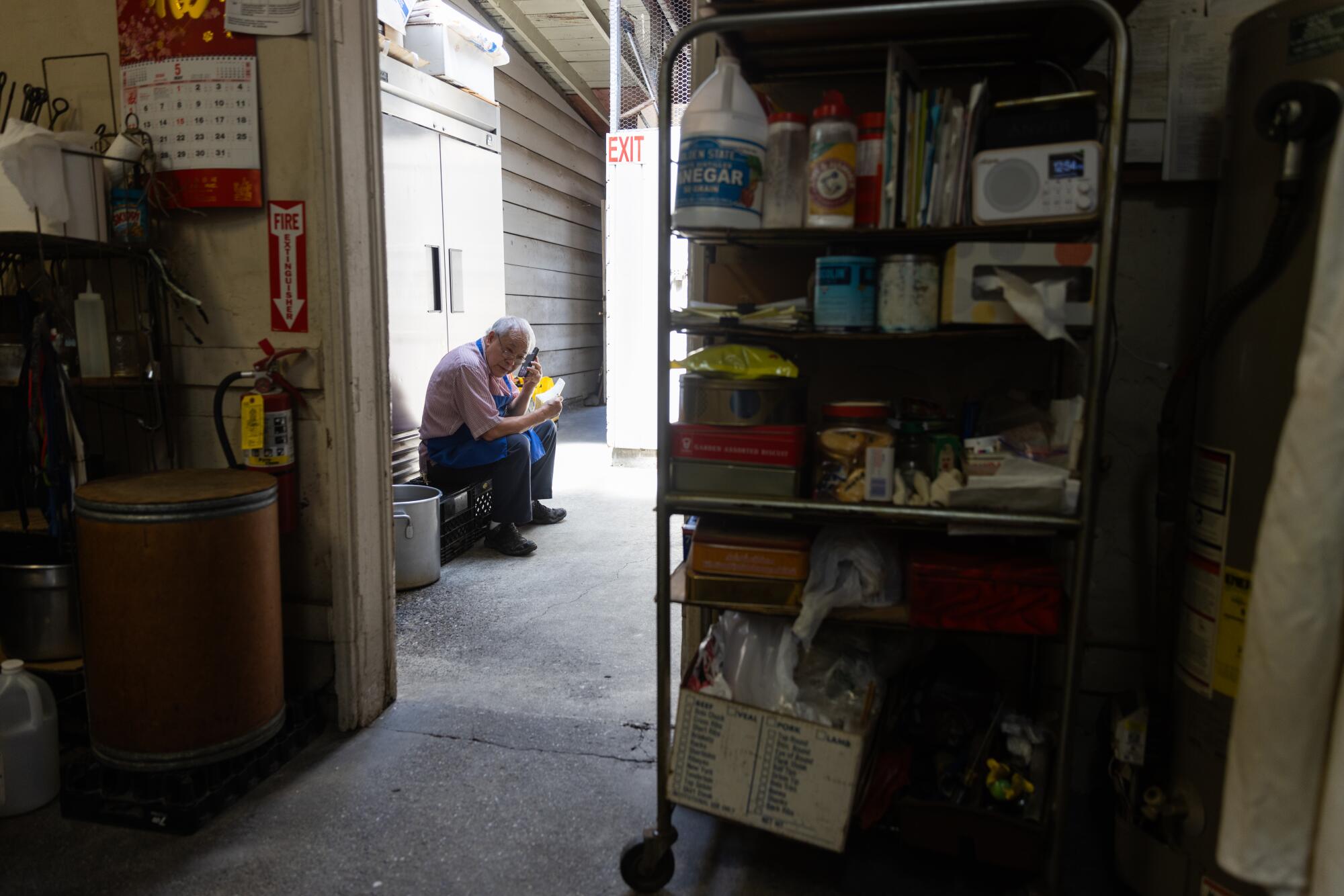
Paul Fong handles business calls during a busy lunch service at the Chicago Cafe.
(Carl Costas / For The Times)
A group descended on the restaurant, digging into dusty cabinets, the attic and the old storage room that included a bed where laborers used to grab naps. They pored over menus, tax receipts and letters. They dove into the archives of the Woodland Daily Democrat and old yearbooks from Woodland High School.
By last spring, Chin and his co-researchers had produced another scholarly paper. “We believe that this is the oldest continually operating Chinese restaurant in the United States,” Chin said of his finding.
The modest storefront on Main Street — with its cash-only policy — suddenly had a new cachet. Tourists came from Sacramento and San Francisco. Locals came flooding back.
“You can’t even get in now,” said Michelle Paschke, a longtime friend whose family used to run a neighboring store. Paschke sat at the packed lunch counter on a recent afternoon, waiting to pay. All around her, other patrons were in the same situation, holding cash out like supplicants while Olstad gestured that she would be there as quickly as she could.
“It’s been a blessing,” Andy said of the overwhelming interest. “At the same time,” he said, “I do want my parents to relax. And somewhat selfishly, I want them to spend time with their grandchildren.”
Back in the kitchen, Paul and Nancy turned out plates with a lightning rhythm, honed over years of practice. “It’s good I guess. It makes me pretty busy,” Paul said of the lunch crowd.
Still, he added, he couldn’t do this forever. “I’m old,” he said, smiling.
But on this day, he was still working, and the orders were piling up. Nancy gestured to a plate of pork ready to be fried. Paul stepped back to the grill.



Rocket Lab took a big step Monday to better compete with rivals SpaceX and Amazon, announcing an $8-billion acquisition of satellite communications company Iridium.
The Long Beach rocket-and-satellite maker is buying a company that provides critical communications services to pilots, mariners and others, while giving Rocket Lab a foothold in the emerging satellite-based mobile phone market.
“We are going to absorb it, optimize it and scale it into something that is really truly fantastic,” said Rocket Lab Chief Executive Peter Beck in a YouTube presentation of the deal.
Rocket Lab is paying $54 a share for McLean, Va.-based Iridium — $27 in cash and the rest in shares. Deutsche Bank and Wells Fargo are providing $3.6 billion in financing in the deal, which is expected to close next year.
Iridium’s 66 low-Earth-orbit satellites provide voice, data, navigation and other services to remote regions and across the globe to 2.55 million government, defense, aviation, maritime and commercial subscribers.
Iridium reported net income of $114 million in 2025, up 2% from the previous year. Revenue climbed 5% to $872 million.
The market for mobile cellular and other satellite-based communications is growing rapidly.
Elon Musk’s SpaceX spent $17 billion last year to acquire spectrum from EchoStar and then followed it up with a $2.6-billion purchase. The spectrum will allow its Starlink broadband satellite network to provide mobile phone service worldwide.
In April, Amazon agreed to acquire satellite operator Globalstar in a roughly $11.6-billion deal that would expand the services of its satellite system and the so-called direct-to-device smartphone market.
The competition has raised concerns about Iridium’s ability to compete.
SpaceX went public this month in the largest initial public offering ever, raising $86 billion, with the company now valued at more than $2 trillion.
In February, Iridium Chief Executive Matthew Desch said the company has shown it’s not “in decline,” dismissing concerns that it couldn’t compete with Starlink, according to Morningstar.
Founded in 2006 in New Zealand, Rocket Lab moved to the U.S. a decade ago and opened its Long Beach headquarters in 2020. It has manufacturing and mission operations in Virginia, New Mexico, Colorado, Maryland, Toronto and New Zealand.
The company manufactures a small rocket called Electron that has launched 262 satellites into space, making it the second-busiest U.S. launch provider behind SpaceX. Rocket Lab is developing a larger rocket called Neutron, and it also makes satellites, subsystems and space components.
Beck said the acquisition of Iridium will propel Rocket Lab into the satellite communications business. That would otherwise be a slow process, requiring the acquisition of spectrum, satellite development and establishment of a customer base.
“We think we’ve found a little bit of a shortcut here,” Beck said, noting the combined company will be vertically integrated, able to design, build, launch and operate its own satellites.
The deal is “very strategic” for Rocket Lab, William Blair analyst Louie DiPalma said in a note to clients, according to Morningstar.
Rocket Lab has announced multiple contracts this year.
Last week, the company said it would launch Electron rockets for three NASA missions from its New Zealand site.
In May, Rocket Lab announced a $30-million contract with Costa Mesa defense contractor Anduril for multiple hypersonic test flights in Virginia using Rocket Lab’s HASTE launch vehicle.
The company is among scores of businesses that have revitalized Southern California’s aerospace and defense industries since SpaceX was founded in 2002. SpaceX, now headquartered in Texas maintains operations in Hawthorne.
Secretary of Defense Pete Hegseth visited Rocket Lab’s headquarters in January during a stop on his tour of defense contractors in Southern California and across the country.
“This company, you right here, are front and center, as part of ensuring that we build an arsenal of freedom that America needs,” Hegseth told several hundred cheering workers. “The future of the battlefield starts right here with dominance of space.”
Iridium investors cheered the news. Its shares gained 25% to close Monday at $54.59. Rocket Lab shares jumped 16% to close at $97.95.

With SpaceX’s historic initial public offering minting a small army of new millionaires overnight, the Southern California housing market is bracing for a big wave of buyers looking to upgrade their digs or perhaps snag a second home, potentially driving up prices in some in-demand neighborhoods.
Shares of SpaceX started trading June 12 and ended the day having raised $75 billion and making founder Elon Musk the world’s first trillionaire. It was by far the largest IPO on record, more than double the 2019 offering by Saudi Arabia’s state-owned oil giant Saudi Aramco.
At least 4,000 current and former SpaceX employees are expected to become millionaires, with about 400 of them earning $100 million or more, said Andrew Benson, chief executive of Hill.com, an investment platform for trading stock in pre-IPO tech companies.
SpaceX’s compensation philosophy historically favored equity over cash salaries, so this windfall extends well beyond executives and engineers to include nontechnical staff, entry-level workers and even cafeteria employees.
Because SpaceX has its highest concentration of employees in humble Hawthorne south of the 105 Freeway, the homebuying spree is expected to be most pronounced in the sandy South Bay and the “Silicon Beach” tech corridor that includes Venice and Santa Monica, but it may also appear in other upmarket Los Angeles-area neighborhoods or even farther away in the form of second homes.
One SpaceX buyer has been eyeing a $32-million pocket listing of his in tony Brentwood for months while waiting for the IPO, according to real estate broker Cory Weiss of Douglas Elliman.
“People are starting to look,” he said, and most will spend $5 million or more.
Melissa Pilon, a real estate agent in the South Bay with Compass, heard from one SpaceX buyer the day the company went public on a property in north Redondo Beach, and expects to hear from more would-be homeowners.
“I’m not sure how this will play out, but I think real estate agents are feeling optimistic,” Pilon said. “I think there will definitely be an uptick, but I don’t know if it will be a sustainable thing. There might be some superficially inflated prices.”
The SpaceX IPO and planned initial public offerings of OpenAI and Anthropic could generate millions in capital gains tax revenue for the state over years as shareholders cash out.
Even without inclusion of those IPOs, state finance officials this year upped their forecast of capital gains income Californians would earn due to the huge run-up in the stock market driven by AI companies. On average, gains are taxed at 10%.
While SpaceX shares have fallen recently, current and former employees who were granted shares or options still would come away winners given the stock remains above the $135 IPO price. Shares closed Friday at $153.23, up 0.15%.
It could take several months for the housing market to feel the full effect of SpaceX millions, said Paul Habibi, a UCLA lecturer and real estate expert witness at Grayslake Advisors.
The most significant buying boom is likely to take place early next year, he predicted, after the standard lockup on stock sales is fully ended in December. Batches of limited stock sales will be allowed in the coming months, however, and some real estate agents and bankers are putting together workarounds to help expectant millionaires leverage their future gains to secure loans.
Habibi expects the largest concentration of purchases to be focused in the South Bay, primarily Manhattan Beach and Redondo Beach, with some spillover into Culver City and possibly north Orange County.
The gush of new money stands to drive up the cost of homes in neighborhoods already in hot demand, echoing a pattern that has occurred in the San Francisco Bay Area.
“A place like Manhattan Beach has roughly 11,000 housing units, so there could be a pretty significant impact if a lot of those folks decide that they want to go buy houses in those neighborhoods that have such a supply constraint,” Habibi said. “Those markets are already among the priciest in Southern California and I can only imagine that will continue with this new wealth creation.”
Hermosa Beach real estate agent Ed Kaminsky agrees interest will center in the South Bay, including Palos Verdes, and he has already heard from prospective SpaceX buyers. Their dream houses have ocean views, swimming pools and four or more bedrooms, which may be hard to find.
“There are a lot of buyers that were in rentals from the Palisades fire looking to buy now and combined with all of the IPOs this summer, I think inventory in South Bay could be tight,” Kaminsky said, “The question is whether we have the kinds of properties on the market that they’re looking for.”
The concentration of buyers looking to purchase property in the South Bay could temporary inflate prices in the area, similar to when Snap Inc., social media platform Snapchat’s parent company, went public in 2017 valued at $24 billion, Habibi said. SpaceX by comparison was valued at $1.77 trillion.
“What’s interesting about Snap is that the workforce was largely clustered on the Westside, and you could see almost immediate effects in Venice and Santa Monica within months of the IPO,” Habibi said. “That was a pretty notable and significant effect on that local housing market” that temporarily inflated prices in an already hot market.
“The amount of wealth and how it comes into L.A. is always very different and vacillates,” Weiss said. “I’m not saying this is groundbreaking and nothing like L.A.’s ever seen before, but I do know that there are people who have been waiting for this to happen.”
Among them are potential buyers who have toured condominiums in Century City, where some of the region’s most luxurious condo towers stand, he said.
Certain buyers may want to buy a condo in a fancy full-service building in L.A. to use as a pied-à-terre, Weiss said, while moving their families to a distant city or state where they could commute by plane on weekends.
San Diego County should see an influx of new buyers with SpaceX dollars, said Del Mar real estate agent Kristina Quesada, co-owner of the Yost Quesada Team at Douglas Elliman. They’ll join a recent wave of house hunters from the Bay Area flush with new tech fortunes and an appetite for second homes or vacation properties near the ocean.
Buyers want to “obtain that coastal lifestyle” for less money than it would cost in other California waterfronts, she said. Popular San Diego County locations run west of Interstate 5 from Carlsbad south through such seaside communities as Encinitas, Del Mar, La Jolla and Coronado Island. Prices start around $2 million.
San Francisco real estate agent Butch Haze of Compass has seen tech booms followed by ravenous bursts of homebuying since the first internet gold rush of the late 1990s.
“Show me a great job market and I’ll show you a really strong real estate market,” he said.
San Francisco’s surging tech industry, which is getting a burst of new business around artificial intelligence, may even have a knock-on effect on Los Angeles-area real estate, Haze said.
After making a fortune through an IPO or acquisition of their companies, “the single tech guys love to move down to L.A. to be closer to the beautiful people,” Haze said. “And they get their beachfront property.”

Tech stocks took another big hit Tuesday as investors sold off shares of companies that have powered the artificial intelligence boom.
Technology companies have been spending billions of dollars investing in data centers and infrastructure needed to support the race to advance AI. But sky-high valuations and geopolitical tensions have some investors questioning whether massive AI spending will pay off, analysts said.
Reflecting the unease, the tech-heavy Nasdaq composite dropped roughly 2%. The Standard & Poor’s 500, a stock market index that tracks the performance of the largest U.S. publicly traded companies, fell by more than 1%.
Share prices for major California tech companies including Nvidia, Qualcomm, Intel and Marvell Technology all dropped. Meta Platforms, Apple, and Google’s parent company, Alphabet, also saw their stock prices slide, though the decline wasn’t as large as the drop in chip stocks.
Shares of Micron Technology, a U.S. memory chip manufacturer, plunged by more than 13% a day before the company was scheduled to report its third-quarter financial results. Anxiety in the U.S. spilled over from Asia, where South Korean tech companies SK Hynix and Samsung Electronics, both major computer memory chip manufacturers, saw their stocks plunge Tuesday by more than 12%.
“Investors are just a bit skittish after very strong moves in tech stocks where any hint of caution causes some investors to hit the sell button,” said Dan Ives, an analyst who heads technology research at Wedbush Securities, adding that it’s a “gut-check moment.”
On Monday, SpaceX saw its shares plunge 16% after a record-breaking initial public offering this month. Its share price then rebounded Tuesday, closing up less than 1% to roughly $156.
Tech companies have been making big bets on the role AI will play in people’s work and personal lives. They’ve been improving chatbots that can generate code, words, photos and videos. The companies also are betting that “AI agents” will be able to proactively tackle more in the future, automating repetitive tasks in customer service, online shopping and other industries. They’re releasing more AI-powered hardware such as smartglasses.
Major tech companies are going head-to-head in the race to dominate AI, competing to sway talent and consumers into using their products. Alphabet saw its stock slip after two of the company’s prominent AI researchers left for rival companies OpenAI and Anthropic.
Despite profitability questions, AI use has been growing. Roughly half of U.S. adults use an AI chatbot, according to a Pew Research Center report released this month. They’re using these tools for search, work tasks, entertainment and even companionship. More U.S. adults reported using OpenAI’s ChatGPT, followed by Google’s Gemini, Microsoft Copilot and Meta AI.
Amid all the hype and spending, there also have been growing fears about whether AI will take over people’s jobs and whether the boom will lead to a bubble that will eventually burst. California AI startups OpenAI, valued at $852 billion, and Anthropic, valued at nearly $1 trillion, are preparing to potentially become publicly traded companies.
“I don’t view this as a bubble,” Ives said. “I view it as we’re going to go through these white-knuckle moments as tech stocks continue to move higher, but the bears will continue to yell fire in a crowded theater when we have these pullbacks.”
Economic factors also could affect how much people are willing to invest in tech company stocks. There’s anxiety over whether the new Federal Reserve Chair Kevin Warsh will raise interest rates, making it more expensive to borrow money. That could cut into a company’s profit margin or decrease consumer spending. United States’ war with Iran is driving up gas prices while the U.S. inflation rate rose to 4.2% in May.
The AI boom is fueling the demand for memory and storage chips, but prices for them are on the rise, prompting some companies such as Apple to look at raising prices for consumer electronics.
Globally, AI spending is projected to increase to $2.59 trillion in 2026, up 47% year over year, according to a forecast by research firm Gartner.
Driven by AI demand, memory and storage vendors have significantly outperformed the S&P 500 and the SOX index, a global semiconductor and microchip index, since the start of 2025, according to a note to clients from BNP Paribas.
Still, investors are on edge ahead of Idaho-based Micron Technology’s earnings report Wednesday, said Gil Luria, head of technology research at financial services company D.A. Davidson. Since January, Micron Technology’s stock has climbed more than 233% to more than $1,000 per share.
“Any indication of a slowdown in demand for AI is seen as a potential turn in the cycle,” Luria said. “While the overwhelming sense is that demand is still far exceeding supply, investors are waiting for Micron to indicate that is still the case.”
Times staff writer Nilesh Christopher contributed to this report.
-
Cleveland, OH6 minutes ago
Earth and Essence IV Spa Launches Free GLP-1 Weight Loss Consultation in Cleveland
-

 Austin, TX13 minutes ago
Austin Police search for suspects in 7-Eleven robbery
-

 Alabama16 minutes ago
Alabama under first heat advisory of the season as officials urge residents to take precautions
-

 Alaska21 minutes ago
Man with same name as Alaska Sen. Dan Sullivan can appear on GOP primary ballot, state’s Supreme Court rules
-

 Arizona28 minutes ago
Arizona Medicaid work requirements are 6 months away. What to know
-
Arkansas31 minutes ago
Arkansas Lottery Powerball, Cash 3 winning numbers for June 29, 2026
-
 California36 minutes ago
What you should know about the $351.7 billion state budget Newsom just signed
-
Colorado43 minutes ago
Colorado Democrats choose between insurgent progressives and veteran incumbents


