Business
Red state coal towns still power the West Coast. We can't just let them die

In the early morning light, it’s easy to mistake the towering gray mounds for an odd-looking mountain range — pale and dull and devoid of life, some pine trees and shrublands in the foreground with lazy blue skies extending up beyond the peaks.
But the mounds aren’t mountains.
They’re enormous piles of dirt, torn from the ground by crane-like machines called draglines to open paths to the rich coal seams beneath. And even though we’re in rural southeastern Montana, more than 800 miles from the Pacific Ocean, West Coast cities are largely to blame for the destruction of this landscape.
Workers at the Rosebud mine load coal onto a conveyor belt, which carries the planet-wrecking fuel to a power plant in the small town next door. Plant operators in Colstrip burn the coal to produce electricity, much of which is shipped by power line to homes and businesses in the Portland and Seattle areas. It’s been that way for decades.
“The West Coast markets are what created this,” Anne Hedges says, as we watch a dragline move dirt.
An aerial view of the coal mine outside Colstrip that feeds the town’s power plant.
(Robert Gauthier / Los Angeles Times)
She sounds frustrated, and with good reason.
Hedges and her fellow Montana environmentalists were happy when Oregon and Washington passed laws requiring 100% clean energy in the next two decades. But they’re furious that electric utilities in those states are planning to stick with coal for as long as the laws allow, and in some cases making deals to give away their Colstrip shares to co-owners who seem determined to keep the plant running long into the future.
“Coal is not dead yet,” Hedges says. “It’s still alive and well.”
That’s an uncomfortable reality for West Coasters critical of red-state environmental policies but not in the habit of urging their politicians to work across state lines to change them — especially when doing so might involve compromise with Republicans.
One example: California lawmakers have refused to pass bills that would make it easier to share clean electricity across the West, passing up the chance to spur renewable energy development in windy red states such as Montana and Wyoming — and to show them it’s possible to create construction jobs and tax revenues with renewable energy, not just fossil fuels.
Instead, California has prioritized in-state wind and solar farms, bowing to the will of labor unions that want those jobs.
It’s hard to blame Golden State politicians, and voters, for taking the easy path.
But global warming is a global problem — and whether we like it or not, the electric grid is a giant, interconnected machine. Coal plants in conservative states help fuel the ever-deadlier heat waves, fires and storms battering California and other progressive bastions. The electrons generated by those plants flow into a network of wires that keep the lights on across the American West.
Also important: Montana and other sparsely populated conservative states control two U.S. Senate seats each, and at least three electoral votes apiece in presidential elections. Additional federal support for clean energy rests partly in their hands.
Those are the practical considerations. Then there are the ethical ones.
For years, the West’s biggest cities exported their emissions, building distant coal generators to fuel their explosive growth. Los Angeles looked to Delta, Utah. Phoenix turned to the Navajo Nation. Albuquerque turned to the Four Corners region.
That wave of coal plants — some still standing, some demolished — created well-paying jobs, lots of tax payments and a thriving way of life for rural towns and Native American tribes. All are now struggling to map out a future without fossil fuels.
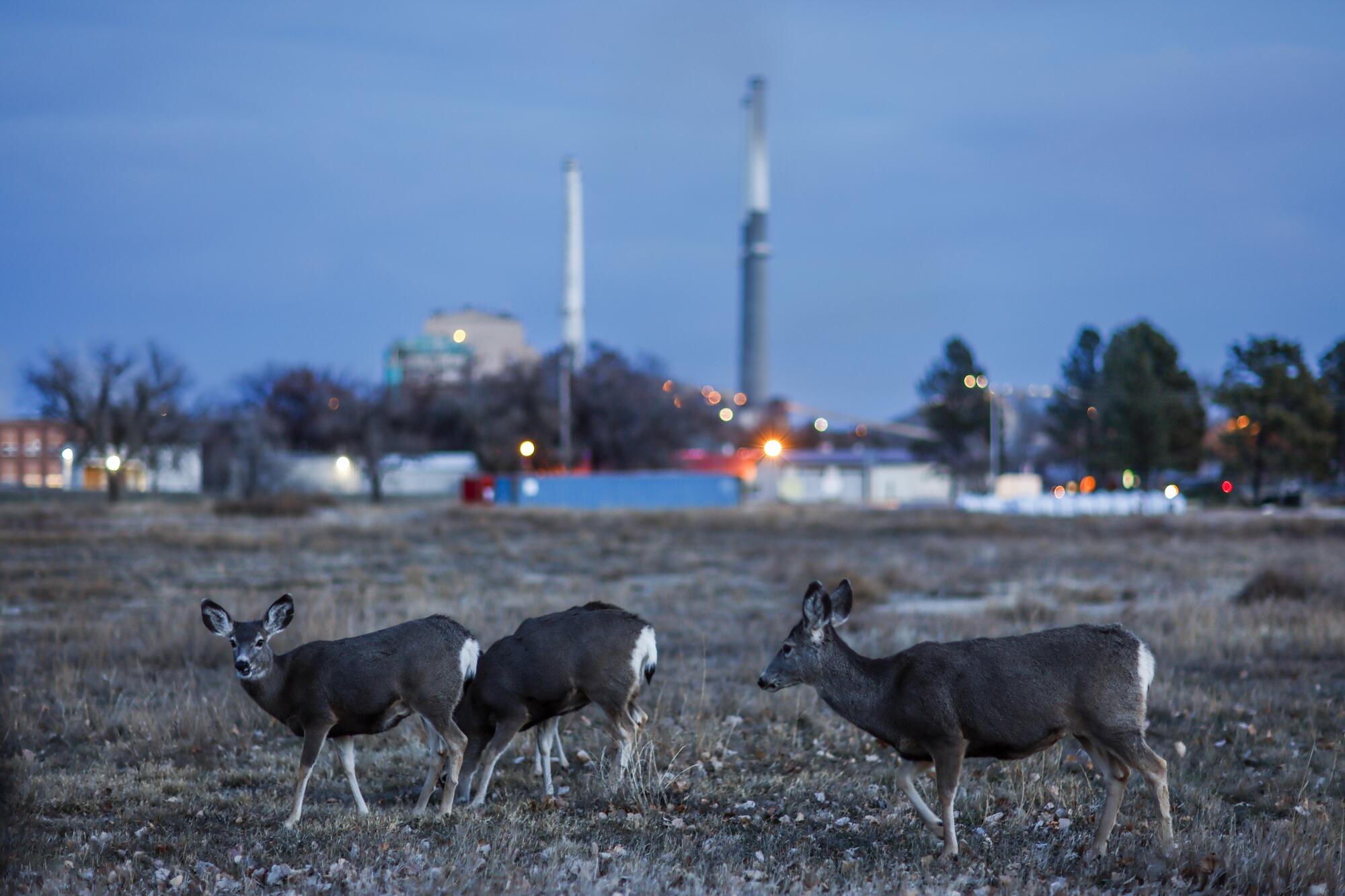
Mule deer roam through the town of Colstrip, not far from the power plant.
(Robert Gauthier / Los Angeles Times)
What do big cities owe those towns and tribes for producing our power and living with our air and water pollution? Can we get climate change under control without putting them out of business? What’s their role in the clean energy transition?
If they refuse to join the transition, how should we respond?
A team of Los Angeles Times journalists spent a week in Montana trying to answer those questions.
We explored the town of Colstrip, hearing from residents about how the coal plant and mine have made their prosperous lives possible. We talked with environmental activists who detailed the damage coal has caused, and with a fourth-generation rancher whose father fought in vain to stop the power plant from getting built — and wrote poems about his struggle.
Coal is going to die, sooner or later. For the sake of myself and other young people, I hope it’s sooner.
And for the sake of places like Colstrip, I hope it’s the beginning of a new chapter, not the end of the story.

Coal pays the bills. For now
For a community of 2,000 people, Colstrip doesn’t lack for nice things.
The city is home to 32 public parks and a gorgeous community center, complete with child care, gym, spin classes, tanning booth and water slide. The spacious health clinic employs three nurses and two physical therapists, with a doctor coming to visit once a week. There’s an artificial lake filled with Yellowstone River water and circled by a three-mile walking and biking trail.
Everybody knows where the good fortune comes from.
The high school pays homage to the source of Colstrip’s wealth with the hashtag #MTCOAL emblazoned on the basketball court’s sparkling floor. A sign over the entrance to campus celebrates the town’s 2023 centennial: “100 Years of Colstrip. Powered by Coal, Strengthened by People.”
“We have nothing to hide,” Jim Atchison tells me. “We just hope that you give us a fair shake.”
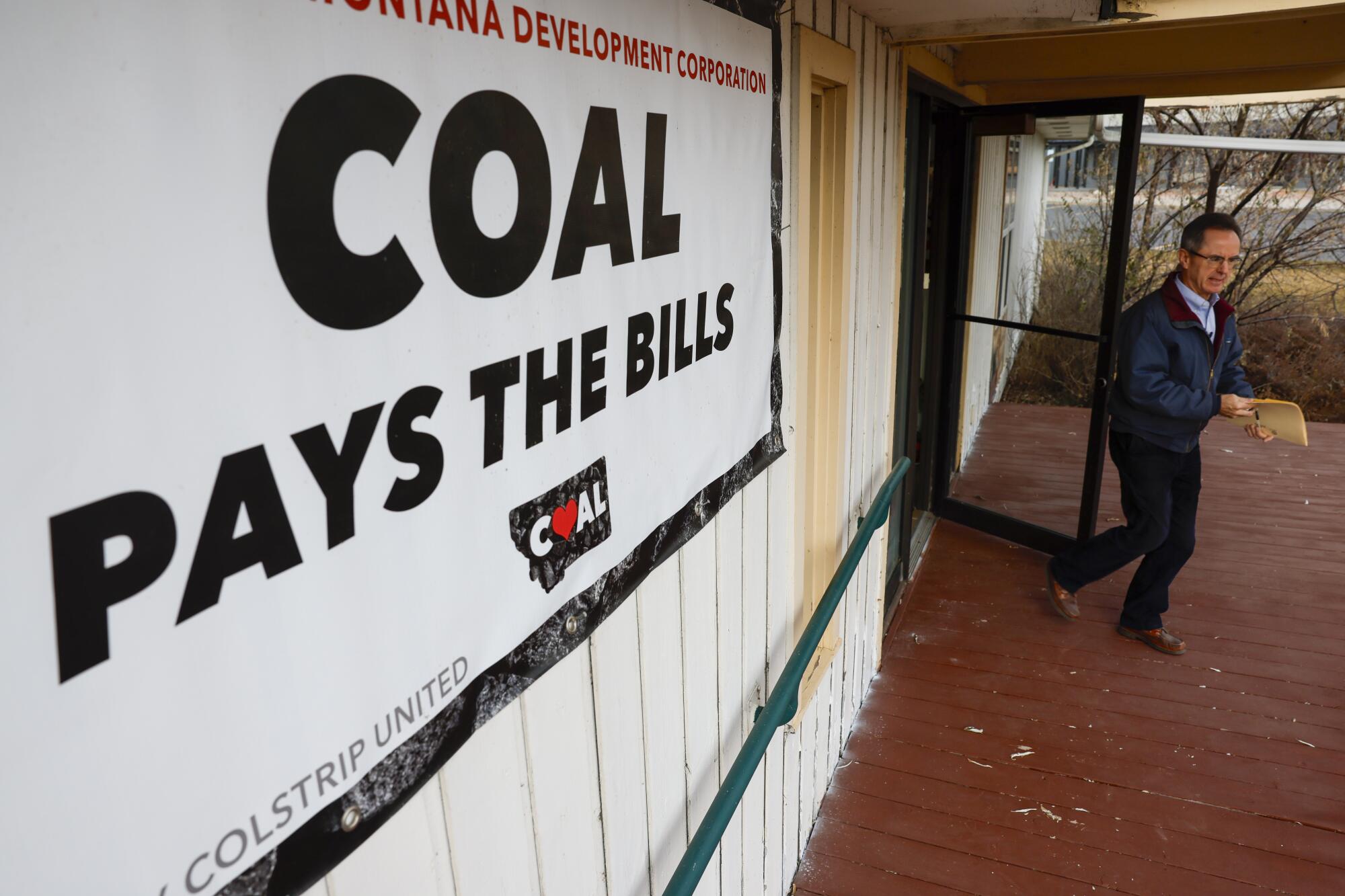
Jim Atchison steps out of his office in Colstrip.
(Robert Gauthier / Los Angeles Times)
I couldn’t have asked for a better tour guide than Atchison, who for 22 years has lived in Colstrip and led the Southeast Montana Economic Development Corp. He’s soft-spoken and meticulous, with a detailed itinerary for our day and a less ironclad allegiance to coal than many of the locals we’ll meet.
They include Bill Neumiller, a former environmental engineer at the power plant. We start our day with him, watching the sun rise over the smokestacks across the lake. He moved to Colstrip 40 years ago, when the coal plant was being built. He enjoys fishing in the well-stocked lake and teaching kids about its history, in his role as president of the parks district.
The plant, he says, pays the vast majority of the city’s property taxes.
“It’s been a great place to raise a family,” he says.
So many people have similar stories — the general manager of a local electrical contractor, the administrator of the health clinic. I especially enjoy chatting with Amber and Gary Ramsey, who have run a Subway sandwich shop here for 30 years.
“It takes us two to three hours to get through the grocery store, because you know everybody,” Gary says.
He didn’t plan to spend his life here. Sitting at a table at Subway, he tells us he grew up in South Dakota and went to college in North Dakota before taking a job teaching math and coaching wrestling in Colstrip. He planned to stay for a year or two.
Then he met Amber, who was working part time as a bartender and doing payroll at the coal plant.
“Forty years later, I’m still here,” he says. “We raised our kids here.”
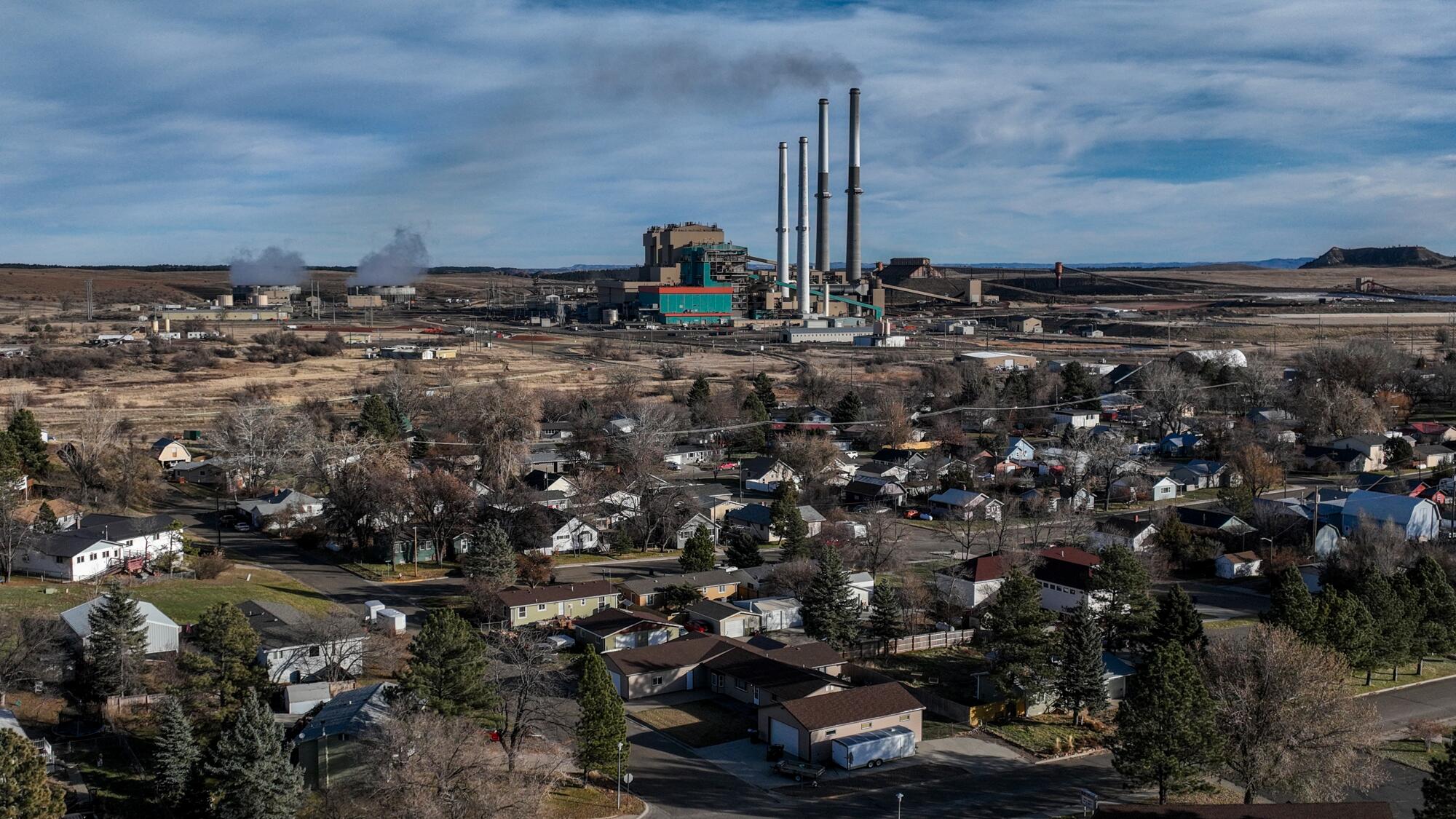
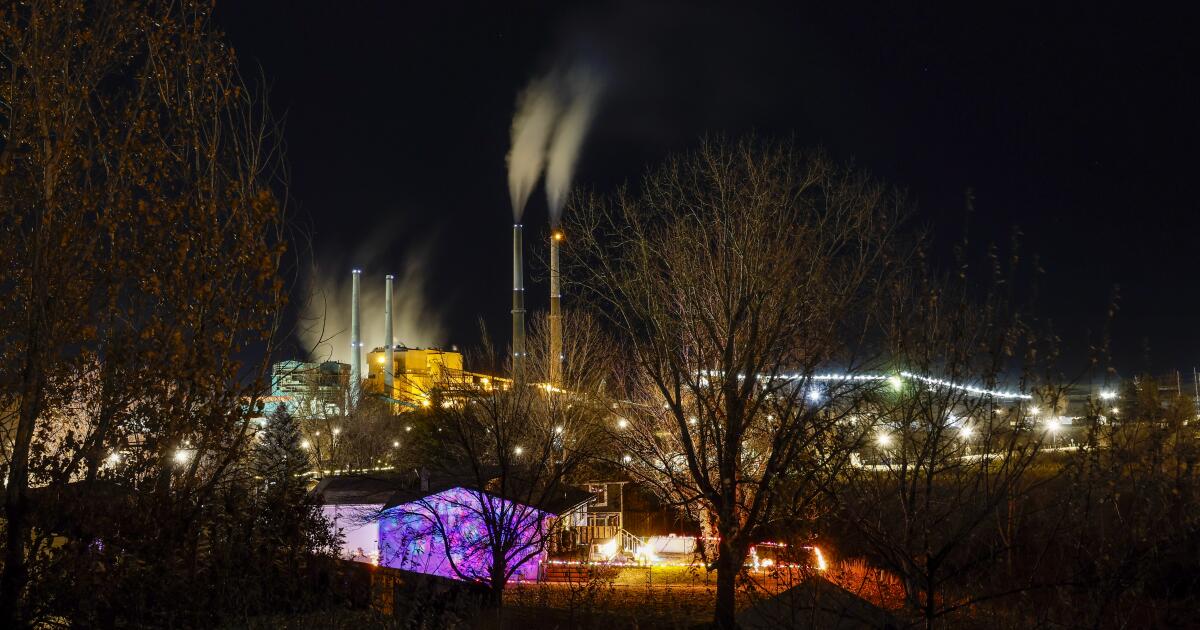
The power plant’s smokestacks are visible from miles away in the town of Colstrip.
(Robert Gauthier / Los Angeles Times)
John Williams was one of the first Montana Power Co. employees to move to Colstrip, as planning for the plant’s construction got started. Today he’s the mayor. He’s well-versed in local history, from the first coal mining in the 1920s — which supplied railroads that later switched to diesel — to the economic revitalization when the Portland and Seattle areas came calling.
Unlike many of the other Colstrip lifers who share their stories, several of Williams’ kids have left town. But one of his sons lives in a part of Washington where some of the electricity comes from Colstrip. Same for another son who lives in Idaho.
It’s hard for Williams to imagine a viable future for his home without the power plant.
“I believe they are intimately tied together,” he says.
And what about climate change, I ask?
Nearly everyone in Colstrip has a version of the same answer: Even if it’s real, it’s not nearly as bad as liberals claim. And without coal power, blackouts will reign. West Coast city dwellers don’t understand how badly they need us here in Montana.
Atchison is an exception.
Yes, he’s dubious about climate science. And yes, he wants to save the mine and power plant. His office is plastered with pro-coal messages — a sign that says, “Coal Pays the Bills,” a magnet reading, “Prove you’re against coal mining: Turn off your electricity.”
But he knows the market for coal is shrinking as the nation’s most populous cities and most profitable companies increasingly demand climate-friendly energy. So he’s preparing for a future in which Colstrip has no choice but to start providing it.
“We have one horse in the barn now,” Atchison says. “We need to add two or three more horses to the barn.”
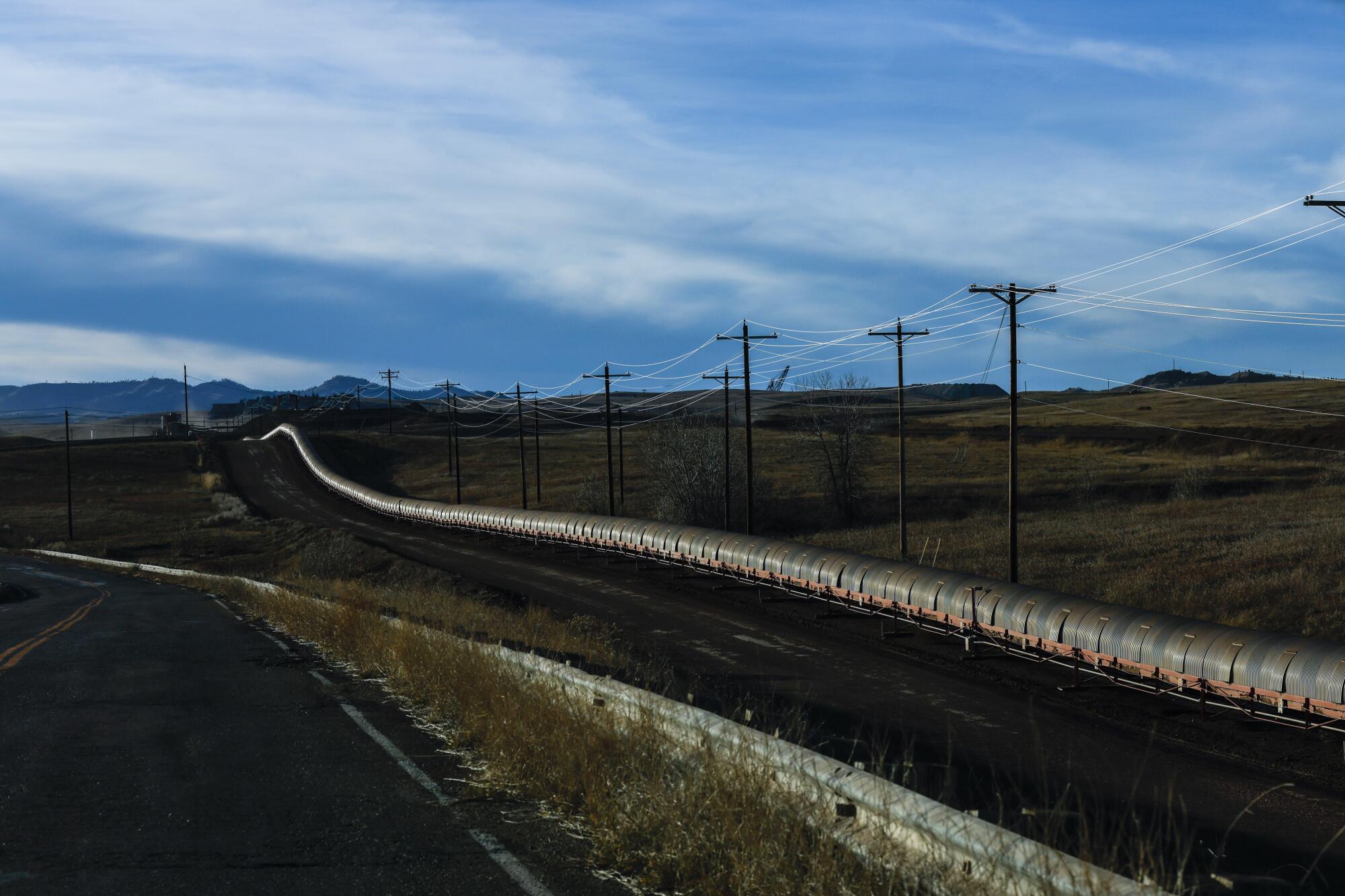
A conveyor belts carries coal from the Rosebud Mine to the Colstrip power plant.
(Robert Gauthier / Los Angeles Times)
Ever since President Obama started trying to tighten regulations on coal power, Atchison has been developing and implementing an economic diversification strategy for Colstrip. It involves expanding broadband capacity, building a business innovation center and broadening the local energy economy beyond coal. The transmission lines connecting Colstrip with the Pacific Northwest are an especially valuable asset, capable of sending huge amounts of clean electricity to the Pacific coast.
“Colstrip is evolving from a coal community into an energy community,” Atchison says. “We’re changing. We’re not closing.”
Already, Montana’s biggest wind farm is shipping electricity west via the Colstrip lines. A Houston company is planning another power line that would run from Colstrip to North Dakota. Federal researchers are studying whether Colstrip’s coal units could be replaced with advanced nuclear reactors, or with a gas-fired power plant capable of capturing and storing its climate pollution.
West Coast voters and politicians could speed up the evolution, for Colstrip and other coal towns. Instead of just congratulating themselves for getting out of coal, they could fund training programs and invest in clean energy projects in those towns.
They’ll never fully replace the ample jobs, salaries and tax revenues currently provided by coal. But nothing lasts forever. One hundred years is a pretty good run.
Some inconvenient truths
“Great God, how we’re doin’! We’re rolling in dough,
As they tear and they ravage The Earth.
And nobody knows…or nobody cares…
About things of intrinsic worth.”
—Wally McRae, “Things of Intrinsic Worth” (1989)
Growing up outside Colstrip in the 1970s could lead to strange moments for Clint McRae, the son of a cowboy poet.
He was a teenager then, and Montana Power Co. was working to build public support for Units 3 and 4 of the coal plant. One day his eighth-grade teacher instructed everyone who supported the new coal-fired generators to stand on one side of the classroom. Everyone opposed should stand on the other side.
McRae was the only student opposed.
“And then [the teacher] gave a lecture about how important the construction of these plants was and handed out bumper stickers that said, ‘Support Colstrip Units 3 and 4,’” McRae tells me, shaking his head. “It was terribly uncomfortable.”
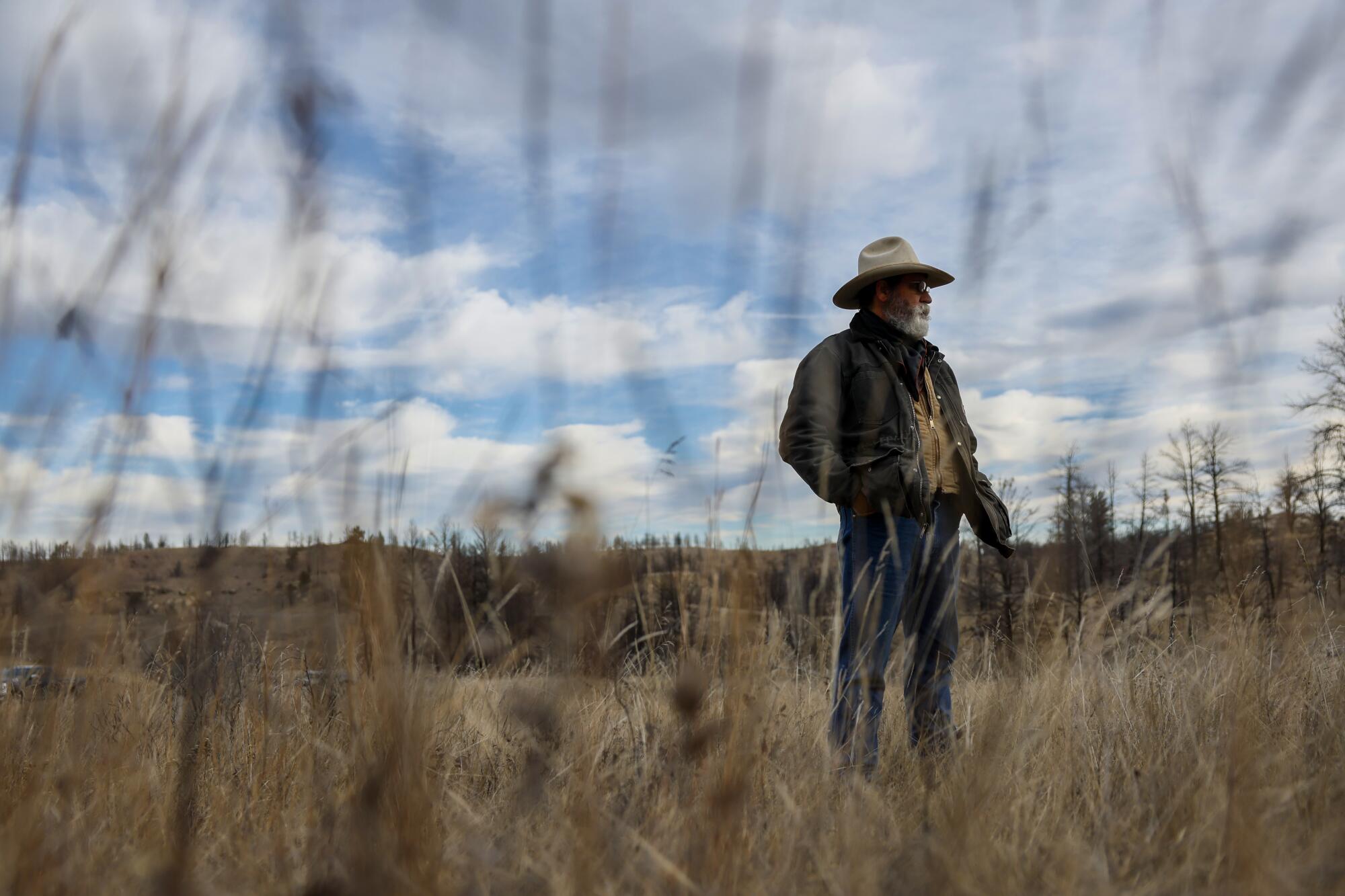
Rancher Clint McRae was raised outside Colstrip and has followed in his father’s footsteps.
(Robert Gauthier / Los Angeles Times)
Later, his mom was doing laundry and found a pro-coal bumper sticker in his pants pocket. She showed it to his cattle rancher father, Wally, “and I guess he went over there [to the school] and kicked ass and took names,” McRae says with a laugh.
Fifty years later, he’s carrying on his dad’s legacy.
We spend a morning in the Colstrip area on McRae’s sprawling ranch, admiring sandstone rock formations and herds of black Angus cows. The scenery is harsh but elegant, rolling hills and pale green grasses and pink-streaked horizon lines.
“This country has a sharp edge to it,” McRae says, quoting a photographer who visited the property years ago.
The land has been in his family since the 1880s, when his great-grandfather emigrated from Scotland. He hopes his youngest daughter — who recently moved back home with her husband — will be the fifth generation to raise cattle here.
“And we just had a grandchild seven months ago, and she’s the sixth,” he says.
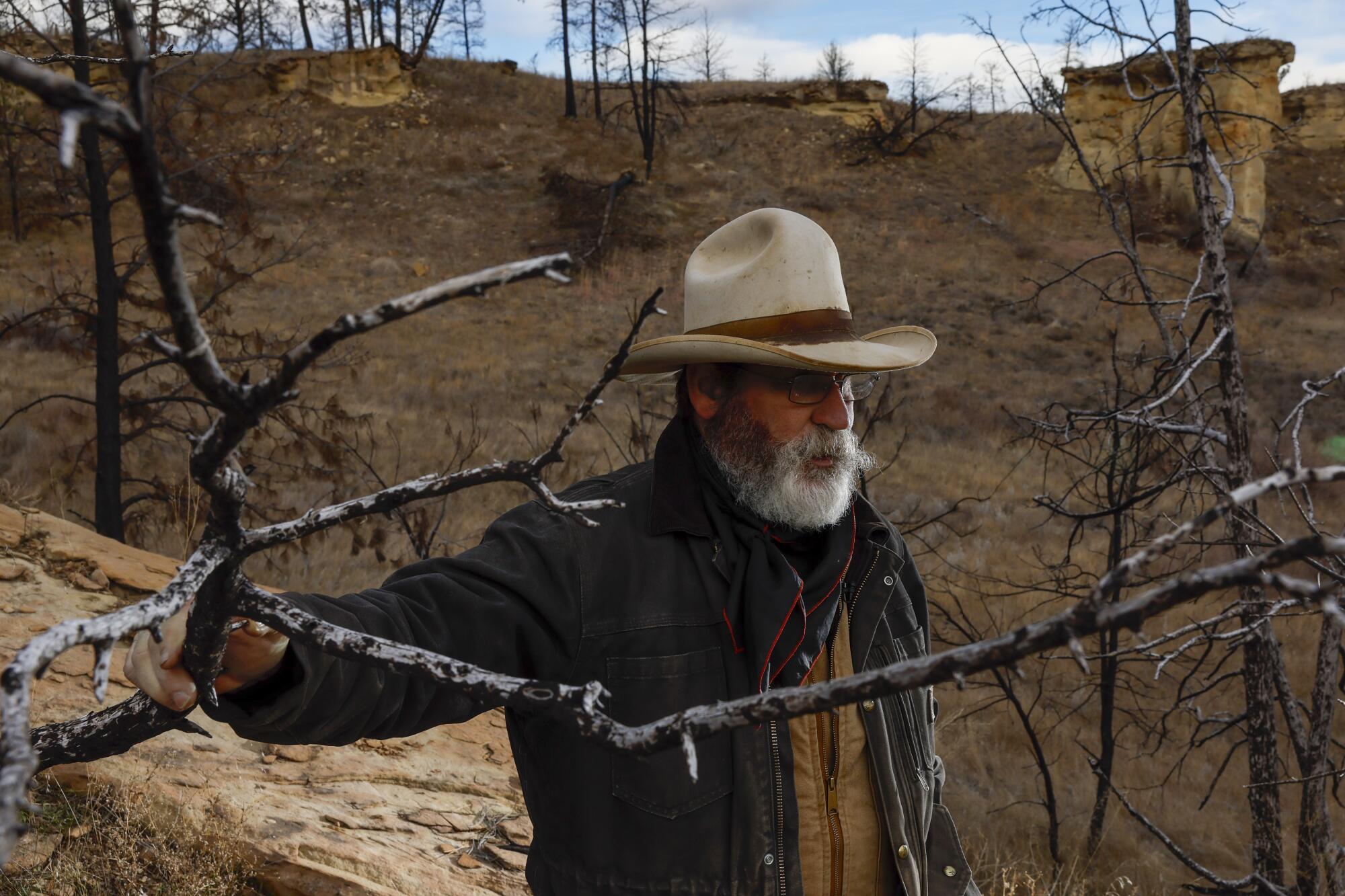
Rancher Clint McRae contemplates the environmental threats facing his family’s land.
(Robert Gauthier / Los Angeles Times)
McRae wears a cowboy hat and drives a pickup truck. He tells me right away that he’s “not the kind of person who participates in government programs unless I absolutely have to.” He’s certainly got no qualms about making a living selling beef.
But McRae and his forebears defy stereotypes.
His father, Wally, not only raised cows but was also a celebrated poet, appointed by President Clinton to the National Council on the Arts. In the 1970s, he joined with other ranchers to help found Northern Plains Resource Council, an advocacy group. They were moved to act by a utility industry plan for nearly two dozen coal plants between Colstrip and Gillette, Wyo.
“I and others like me will not allow our land to be destroyed merely because it is convenient for the coal company to tear it up,” Wally McRae said, as quoted in a 50th-anniversary book published by Northern Plains.
Now in his late 80s and retired from the ranch, Wally’s got every reason to be proud of his son.
Clint has fought to limit pollution from the coal plant his dad couldn’t stop — and to ensure the cleanup of dangerous chemicals already emitted by the plant and mine. He’s written articles calling for stronger regulation of coal waste, and slamming laws that critics say would let coal companies pollute water with impunity. Like his father, he’s a member of Northern Plains.
McRae wants me to know that even though he and his dad “damn sure have a difference of opinion” with many of the people who live in town, “it was never personal.” The coal plant employees are friends of his. He doesn’t want them to lose their jobs.
“Our kids went to school together, played sports together,” he says.
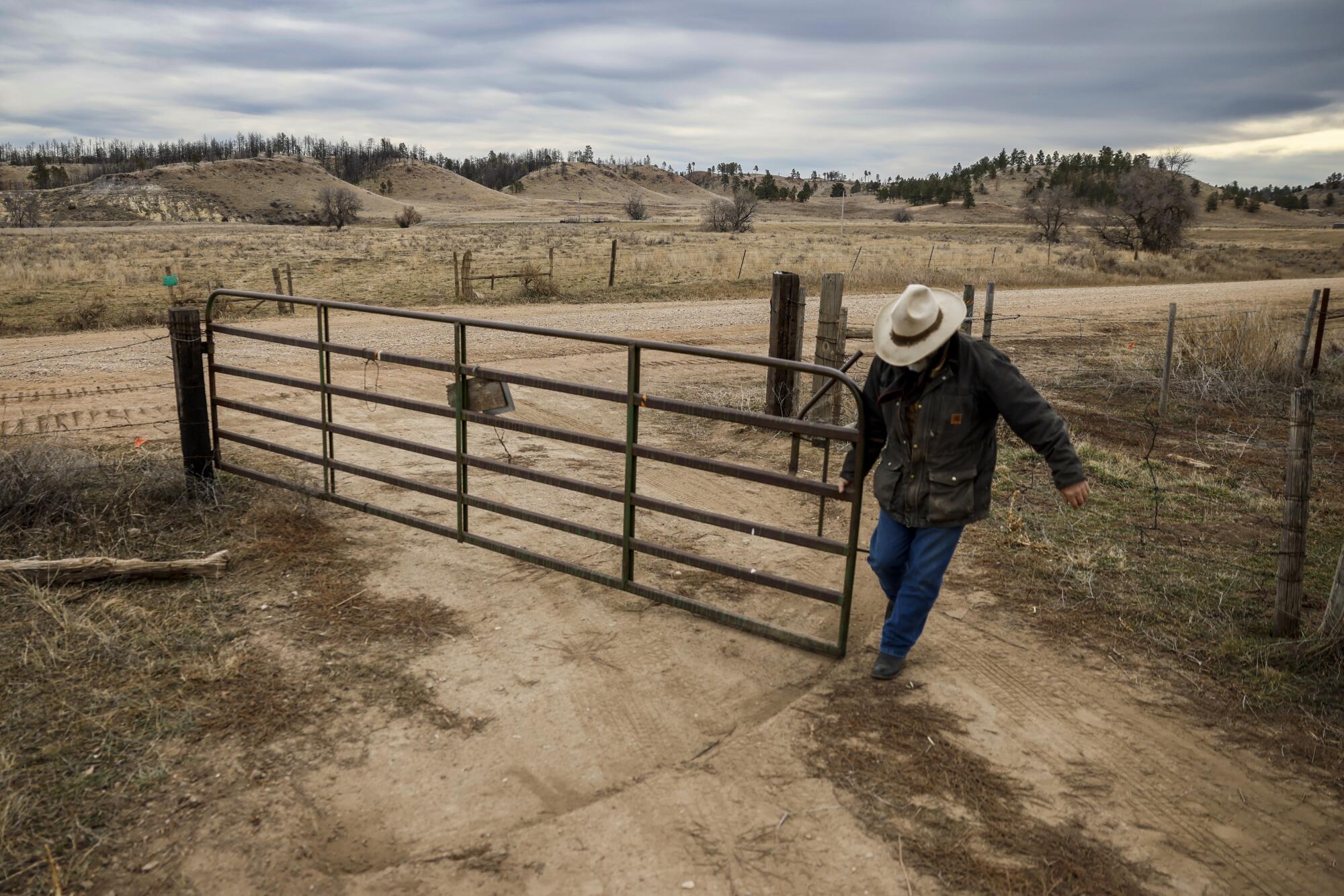
Rancher Clint McRae opens a gate on his family’s land outside Colstrip.
(Robert Gauthier / Los Angeles Times)
But even though McRae believes “we can have it both ways” — coal generation coupled with environmental protection — he’s not optimistic. And history suggests he’s right to be skeptical. Various analyses have found rampant groundwater contamination from coal plants, including Colstrip. Air pollution is another deadly concern. A peer-reviewed study last year estimated that fine-particle emissions from coal plants killed 460,000 Americans between 1999 and 2020.
Then there’s the climate crisis.
McRae doesn’t want to talk about global warming — “that’s not my bag,” he says. But he’s seen firsthand what it can look like.
In August 2021, the Richard Spring fire tore across 171,000 acres, devastating much of his ranch and nearly torching both of his family’s houses. He was on the front lines of the fast-moving blaze as part of the local volunteer firefighting crew. Temperatures topped 100 degrees, adding to the strain of dry conditions and fierce winds. McRae had never seen anything like it.
Two and a half years later, he’s still building back up his cattle numbers and letting the grass regrow.
“It burned all of our hay. It was awful,” he says.
McRae has a strong sense of history. As we drive toward the Tongue River, which forms a boundary of his ranch, he points out where members of the Arapaho, Lakota Sioux and Northern Cheyenne tribes camped before the Battle of the Little Bighorn in 1876, a few years ahead of his great-grandfather’s arrival in Montana. A few minutes later he stops to show off a series of tipi rings — artifacts of Indigenous life that he’s promised local tribes he’ll protect.
McRae is acutely aware that this wasn’t always ranchland — and that it probably won’t be forever.
“It’s gonna change,” he says. “Whether we embrace it or not.”
The wind and the water
Sturgeon. Bubbles. Salamander. Jimmy Neutron.
Those are “call signs” for some of the 13 employees at the Clearwater wind farm, where 131 turbines are spread across 94 square miles of Montana ranchland a few hours north of Colstrip. The nicknames are scrawled on a whiteboard in the trailer office.
Raptor. Goose. Sandman.
Clearly, they have fun here. And it’s an industry where you can make good money.
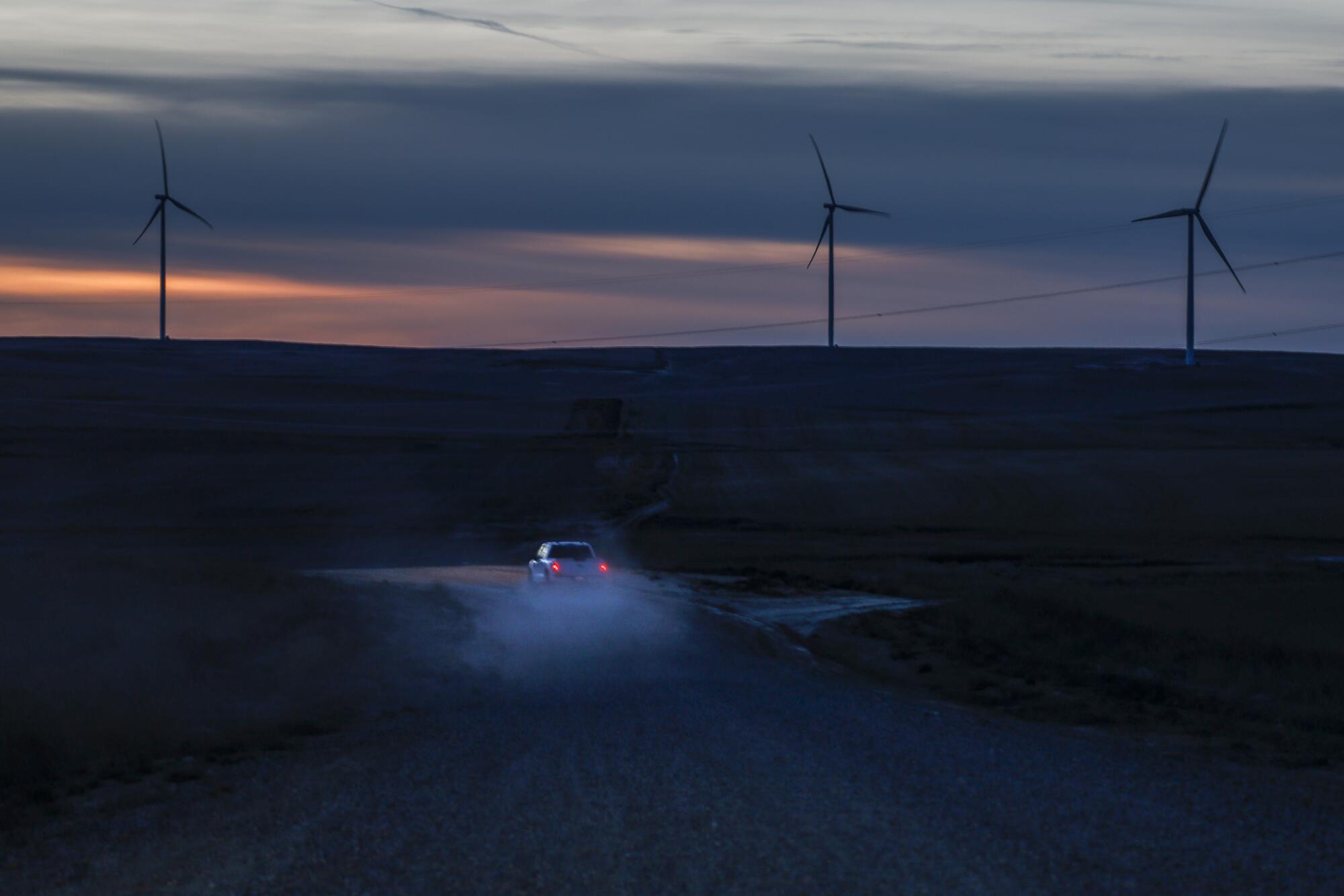
Turbines spin at sundown at NextEra Energy’s Clearwater wind farm, which sends power from Montana to Oregon and Washington.
(Robert Gauthier / Los Angeles Times)
Clearwater’s operator, Florida-based NextEra Energy, won’t disclose a salary range. But as of 2022, the median annual wage for a U.S. wind turbine technician working in electric power was $59,890, compared with $46,310 for all occupations nationally.
“If someone wants to stay close to home and still have a good career, we provide them that opportunity,” Alex Vineyard says.
Vineyard lives in nearby Miles City and manages Clearwater for NextEra, America’s largest renewable energy company. Clad in a hard hat, sweater vest and orange work gloves, he drives to a nearby turbine and walks up a staircase to show us the machinery inside. The tower is 374 feet high, meaning the tips of the blades reach 582 feet into the air.
Not far from here, hundreds of construction laborers are finishing the next two phases of the Clearwater project.
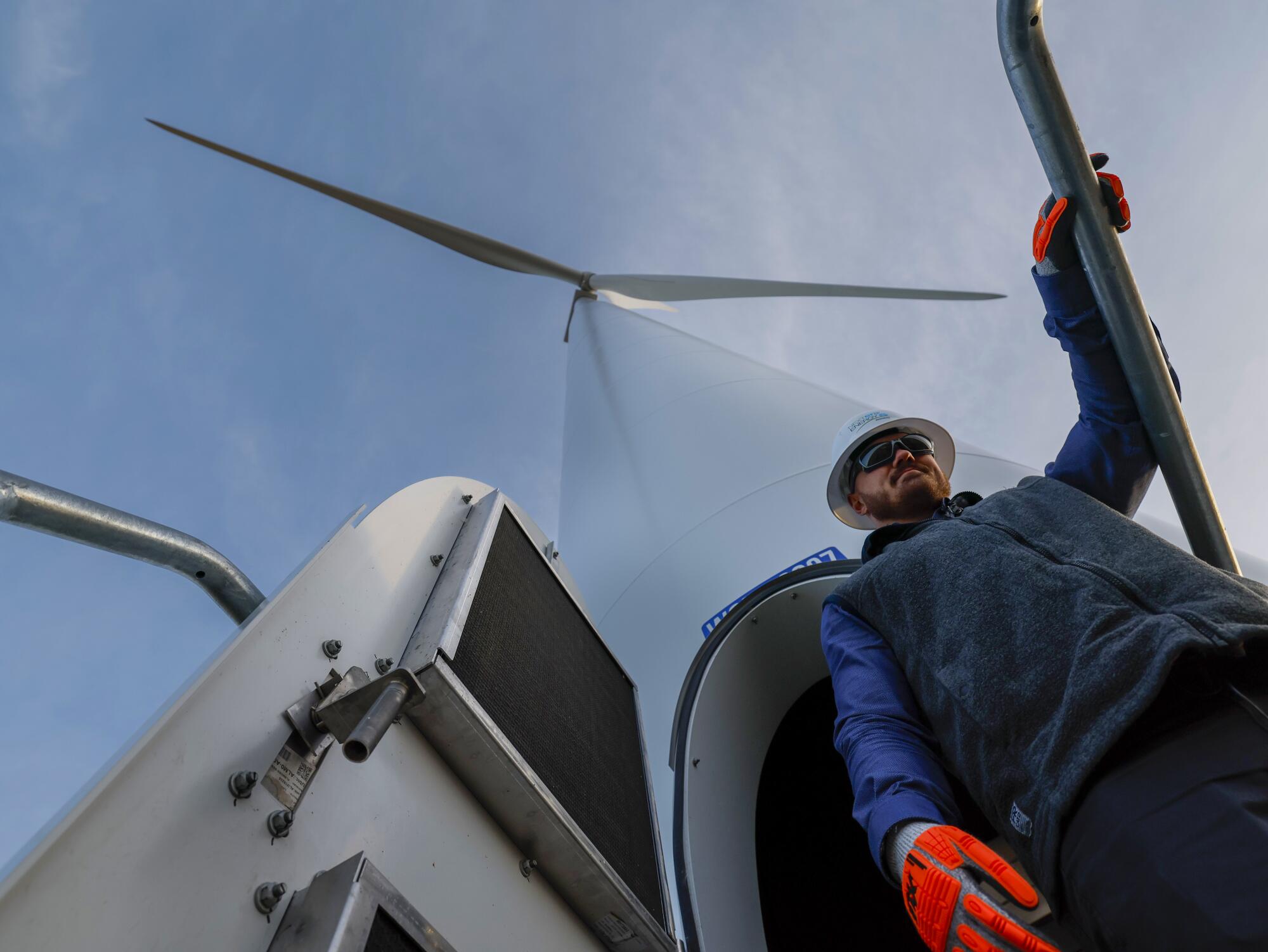
Alex Vineyard manages the Clearwater wind farm for NextEra, America’s largest renewable energy company.
(Robert Gauthier / Los Angeles Times)
“You can see where we build wind sites. It’s not downtown L.A.,” Vineyard says, the sunset casting a brilliant orange glow behind him. “Generally it’s rural areas — and there are limited opportunities for kids in those areas. Not a lot of great careers.”
Wind will never replace coal. The construction jobs are temporary, the permanent jobs far fewer.
But they’re better than nothing. A lot better.
As much as West Coast megacities owe it to coal towns like Colstrip to bring them along for the clean energy ride, coal towns like Colstrip owe it to themselves to take what they can get — and not let stubbornness or politics condemn them to oblivion.
Fortunately, they’ve got the power grid on their side.
In today’s highly regulated, thoroughly litigated world, long-distance power lines are incredibly hard to build. They can take years if not decades to secure all the necessary approvals — if they can get those approvals at all. As a result, wind and solar developers prize existing transmission lines, like those built to carry power from Colstrip and other coal plants to big cities.
The Clearwater wind farm offers a telling case study.
Two of Colstrip’s four coal units shut down in 2020 due to poor economics, opening up precious space on the plant’s power lines. That open space made it easier for NextEra to sign contracts to sell hundreds of megawatts of wind power to two of Colstrip’s co-owners, Portland General Electric and Puget Sound Energy — and thus get Clearwater built.
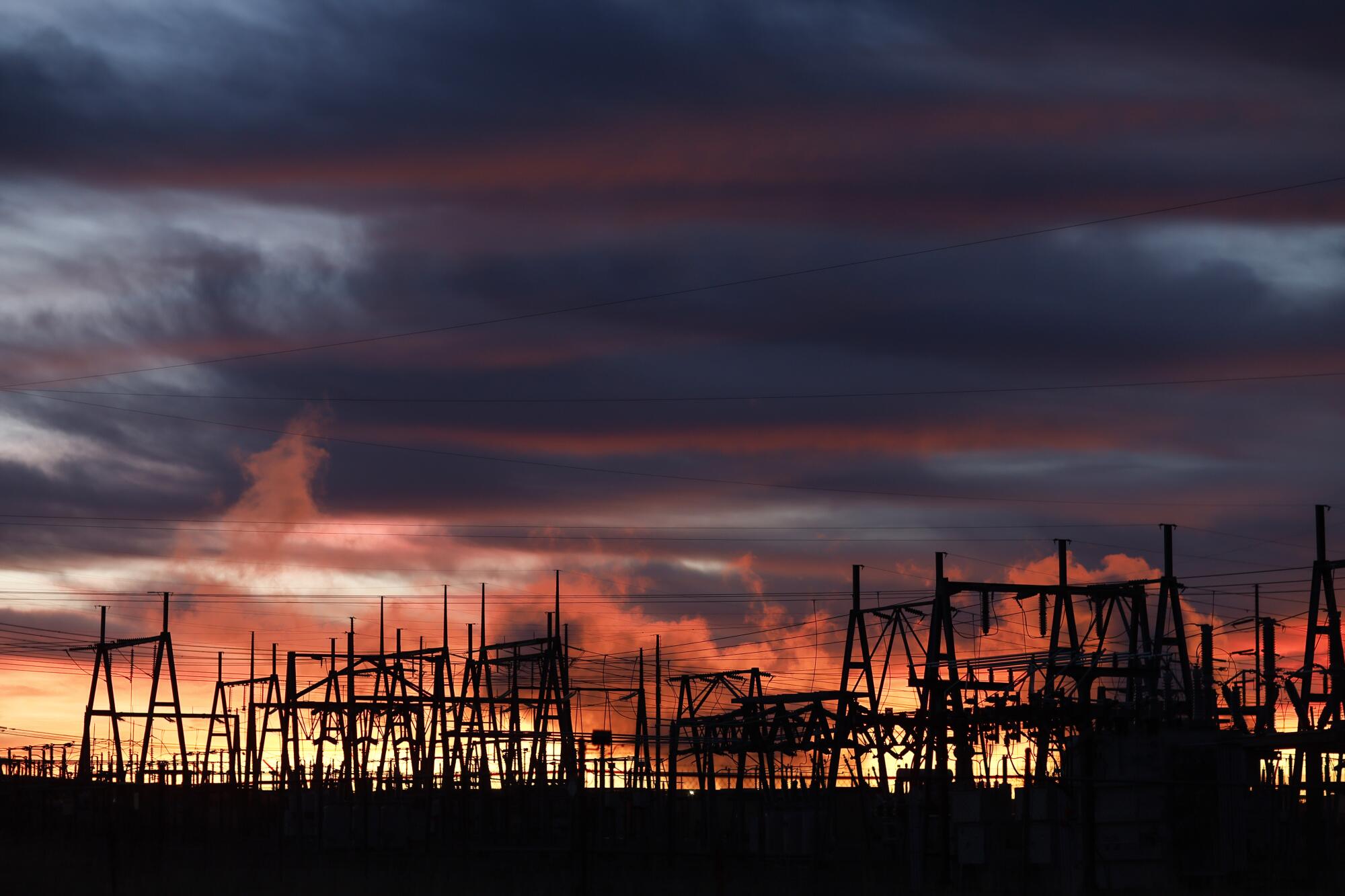
An electrical substation flanks the Colstrip power plant.
(Robert Gauthier / Los Angeles Times)
Montana wind is especially useful for Oregon and Washington because it blows strongest during winter, when those states need lots of energy to stay warm. On that front, Clearwater has been a huge success. During its first winter, it had a capacity factor of 60%, meaning it produced 60% of all the power it could possibly produce, if there were enough wind 24/7.
Sixty percent is a lot — “like a home run,” Puget Sound Energy executive Ron Roberts says.
He and his colleagues want more. Puget Sound plans to build more Montana wind turbines to serve its Washington customers — again taking advantage of the Colstrip power lines.
West Coast states need to keep investing in exactly this type of project if they hope to persuade their conservative neighbors to stop fighting to save coal. The more they can bring the benefits of wind and solar power to the rest of the West, the better.
And what about those low-wind, cloudy days when wind turbines and solar panels aren’t enough to avoid blackouts?
Carl Borgquist has a plan for that.
I meet up with him near Gordon Butte — a flat-topped landmass that juts up 1,025 feet from the floor of Montana’s Musselshell River valley, four hours west of Colstrip but just over five miles from the coal plant’s power lines. There are already wind turbines atop the butte, built by the landowning Galt family with Borgquist’s help.
Borgquist assures me as we drive to the top that I’ll soon understand why this steep butte is perfect for energy storage.
“It will intuitively make sense, the elegance and simplicity of gravity as a storage medium,” he says.
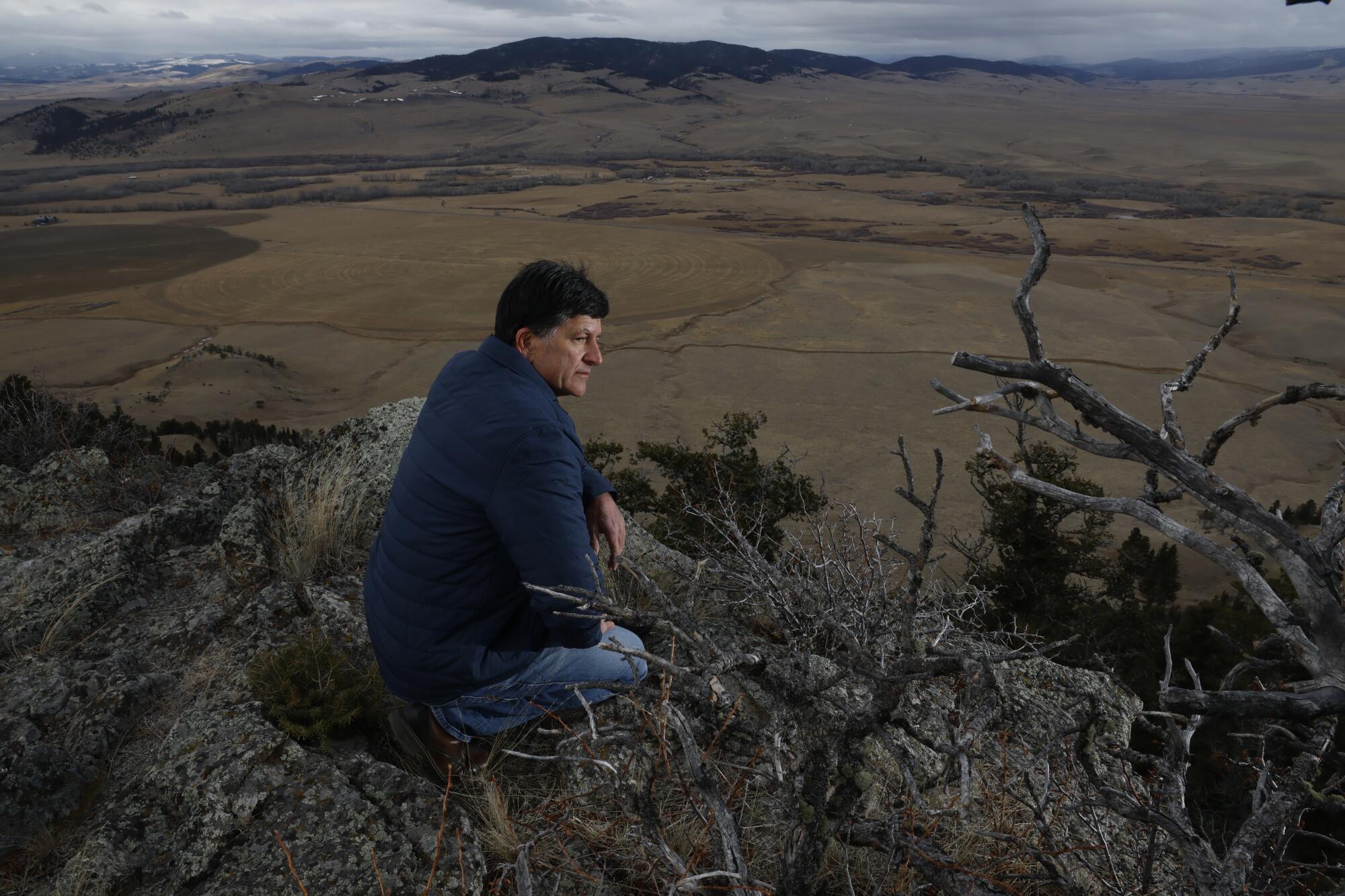
Carl Borgquist admires the views from atop Gordon Butte, where he’s got plans for a pumped storage project to augment Montana wind power.
(Robert Gauthier / Los Angeles Times)
There will be two reservoirs — one up on the butte, another 1,000 feet below. They’ll be filled with water from a nearby creek.
During times of day when there’s extra power on the Western electric grid — maybe temperatures are moderate in Portland and Seattle, but Montana winds are blowing strong — the Gordon Butte project will use that extra juice to pump water uphill, from the lower reservoir to the upper reservoir. During times of day when the grid needs more power — maybe there’s a record heat wave, and not enough wind to go around — Gordon Butte will let water flow downhill, generating electricity.
It’s called pumped storage, and it’s not a new concept. But compared with other proposals across the parched West, this one is almost miraculously noncontroversial. No environmentalists making hay over water use. No nearby residents crying foul.
Borgquist still needs to sign up a utility customer, or he would have already flipped Gordon Butte to a developer better suited to build the $1.5-billion project, which will employ 300 to 500 people during construction. But Borgquist is confident that before too long, one or two of the Pacific Northwest electric utilities preparing to ditch Colstrip will see the light.
“I’ve been waiting for the market to catch up to me,” he says.
Let’s hope it catches up soon. Because even though pumped storage won’t keep us heated and cooled and well-lit every hour of every day, neither will wind, or solar, or batteries, or anything else. No one technology will solve all our climate problems.
The sooner we learn that lesson, the sooner we can move on to the hard part.
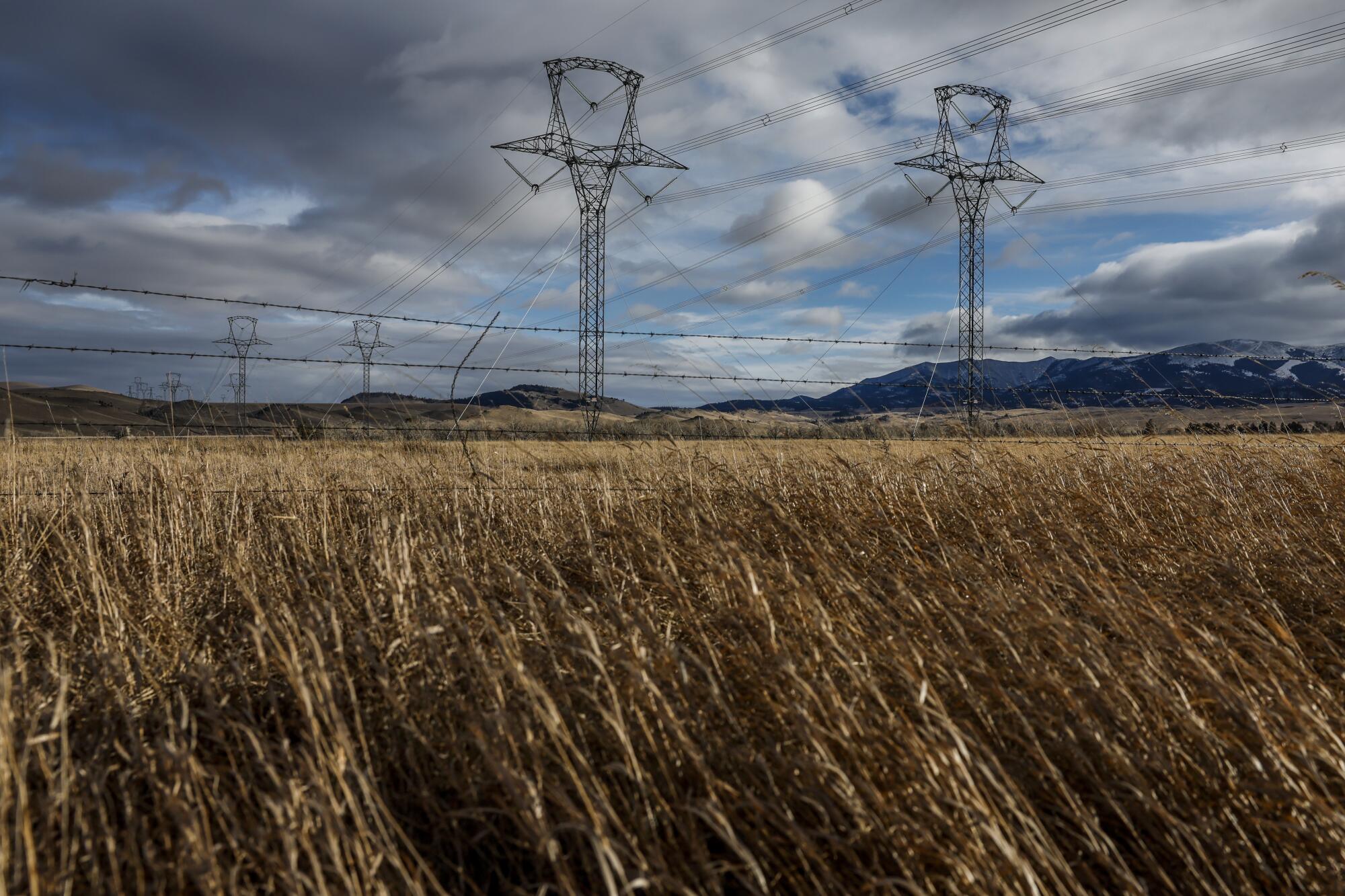
The Colstrip power lines run near Gordon Butte, carrying coal-fired electricity — and increasingly wind energy — from Montana to Oregon and Washington.
(Robert Gauthier / Los Angeles Times)
The art of the deal
I find myself wandering the halls of the state Capitol in Helena. Christmas is a few weeks away, and there’s a spectacular tree beneath the massive dome, flanked by murals of white settlers and Indigenous Americans.
On a whim, I step into Gov. Greg Gianforte’s office and ask if he’s in. Gianforte has fought to keep the Colstrip plant open, and I want to ask him about it. I’m also curious to meet a man who easily won election despite having assaulted a journalist.
One of his representatives takes down my contact info. I never get an interview.
Despite the state’s deep-red turn in recent years, Montanans have a history of environmental consciousness, owing to their love of fishing, hunting and the great outdoors (as seen in the film “A River Runs Through It”). They approved a new state constitution in 1972 that enshrined the right to a “clean and healthful environment in Montana for present and future generations.”
To the frustration of Gianforte and his supporters, that right may include a stable climate.
This time last year, a Montana judge revoked the permit for a gas-fired power plant being built by the state’s largest electric utility, NorthWestern Energy, along the banks of the Yellowstone River. The judge ruled that the state agency charged with approving the gas plant had failed to consider how the facility’s heat-trapping carbon emissions would contribute to the climate crisis.
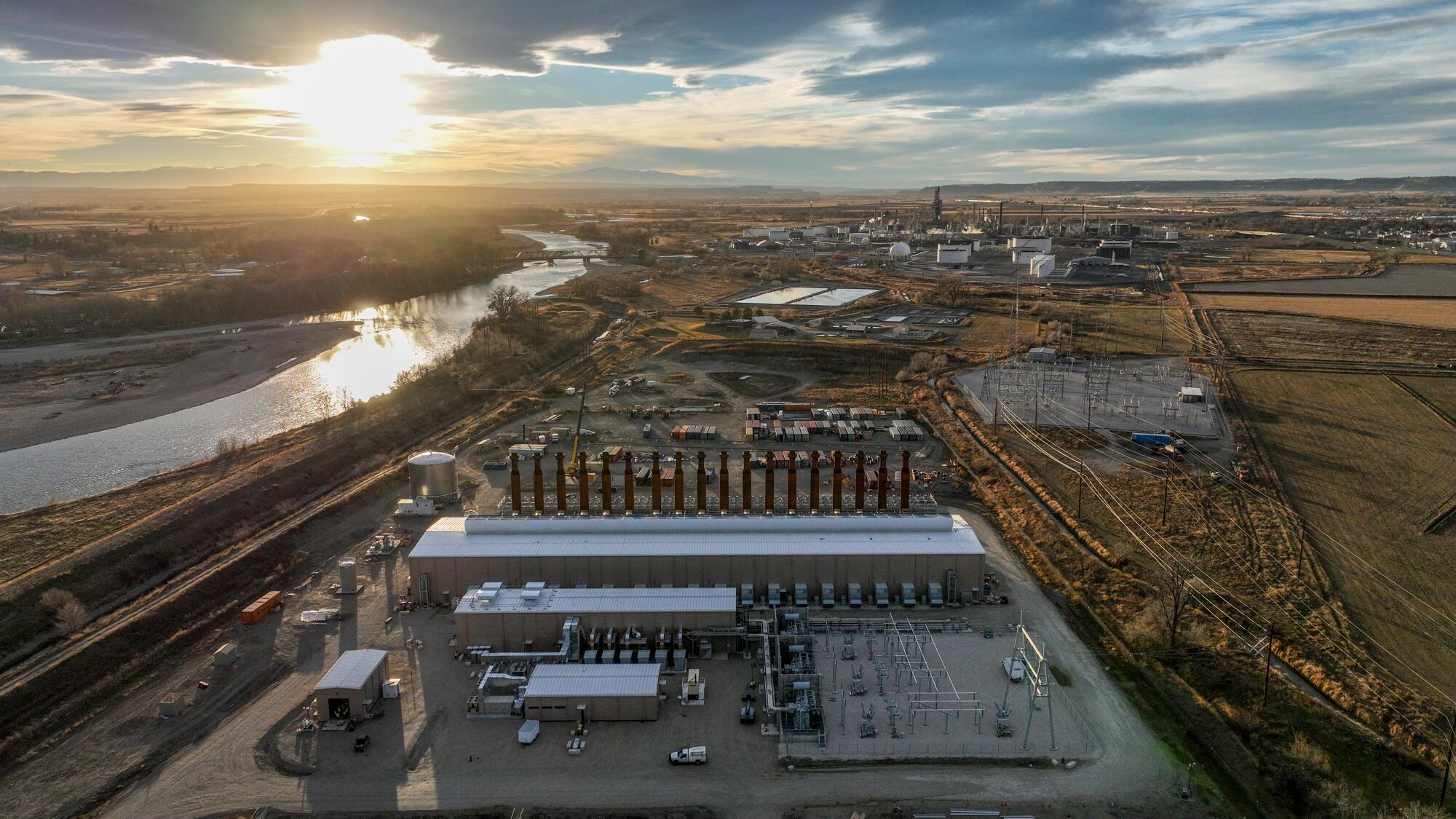
NorthWestern Energy says this gas-fired power plant on the Yellowstone River is needed to help keep the lights on for homes and businesses.
(Robert Gauthier / Los Angeles Times)
Legislators responded by rushing to pass a law that barred state agencies from considering climate impacts.
The Yellowstone River gas plant moved forward, but the law didn’t last long. A few months after it passed, another judge ruled in favor of 16 young people suing the state over global warming, agreeing that the legislation violated their constitutional right to a clean and healthful environment.
“This is such a solvable problem,” says Hedges, the Montana environmentalist critical of coal mining. “It’s just that nobody wants to solve it.”
Hedges is a leader of the Montana Environmental Information Center, where she’s spent three decades battling for clean air, clean water and a healthy climate. It was her advocacy group, along with the Sierra Club, that sued Montana over the state’s approval of the Yellowstone River gas plant, setting off the chain of increasingly consequential court rulings.
But as mad as she is at Gianforte — and at the local utility company executives who insist they need coal to keep the lights on in Montana — Hedges is at her most caustic when discussing the Pacific Northwest environmentalists who, in her view, have failed to do everything they can to get the Colstrip power plant shut down.
That includes the Sierra Club, which, Hedges says, has shifted its focus too quickly from shutting down coal plants to blocking the construction of new gas plants — even in places such as Montana, where coal, the dirtiest fossil fuel, isn’t dead yet.
Hedges’ frustration also includes the Washington state lawmakers who passed a much-lauded bill, signed by Gov. Jay Inslee, requiring electric utilities to stop buying coal power by 2025 — only to sit idly by as some of those utilities then made arrangements to give away their shares in the Colstrip plant to coal-friendly co-owners rather than negotiate agreements to shut the coal units.
“So they’re not actually decreasing carbon dioxide emissions even a little tiny bit. They are allowing this plant to continue, instead of using their vote to close this source of pollution. It’s maddening,” Hedges says.
1
2
3
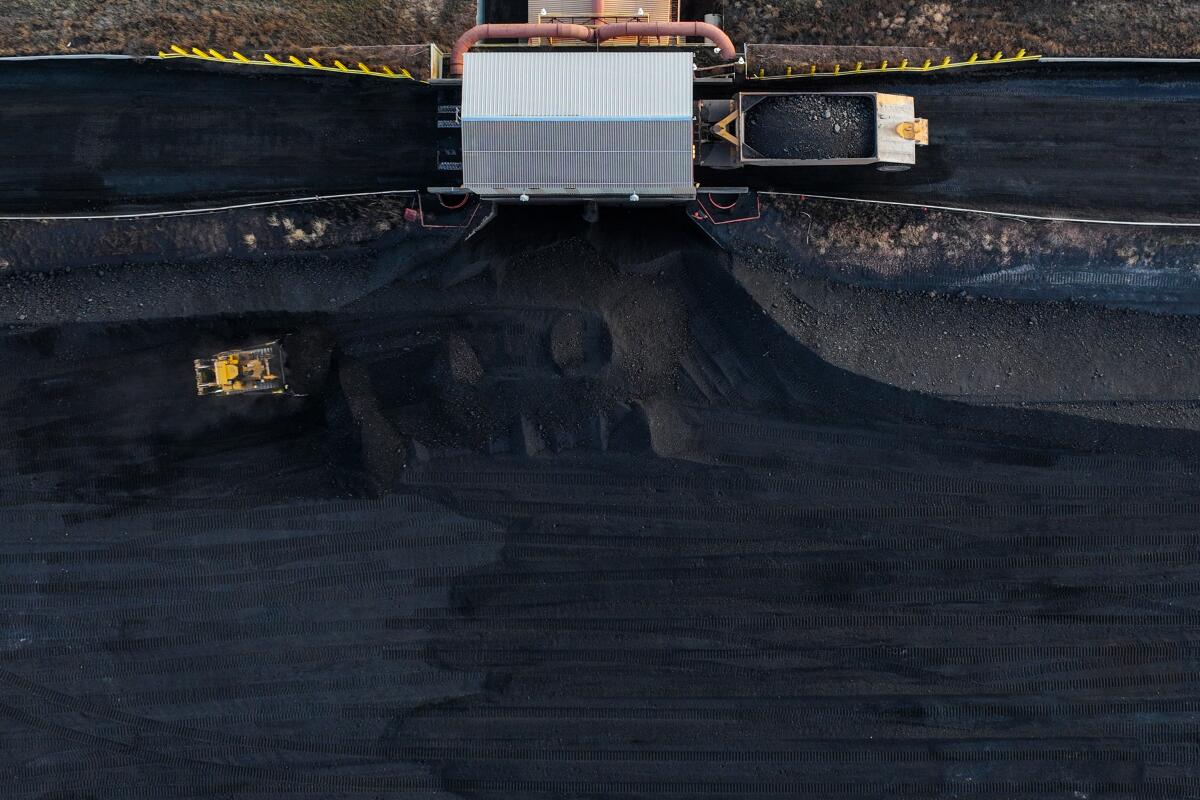
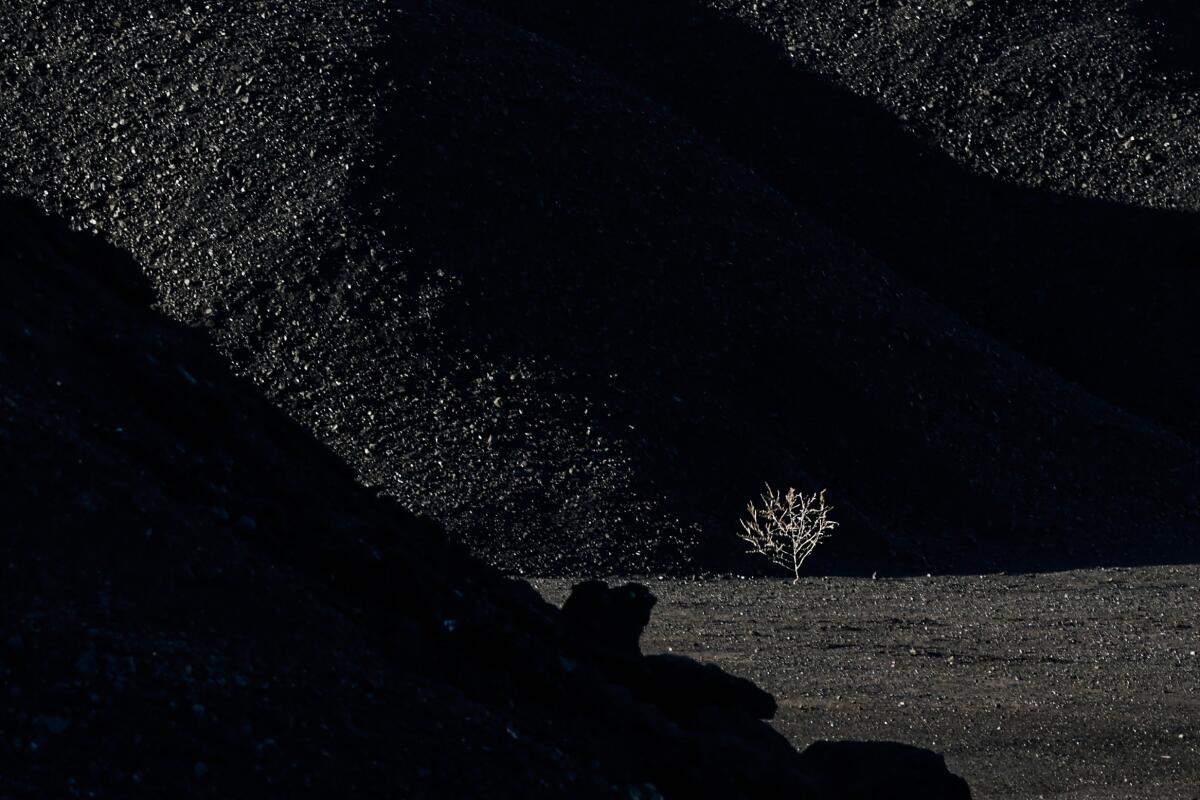
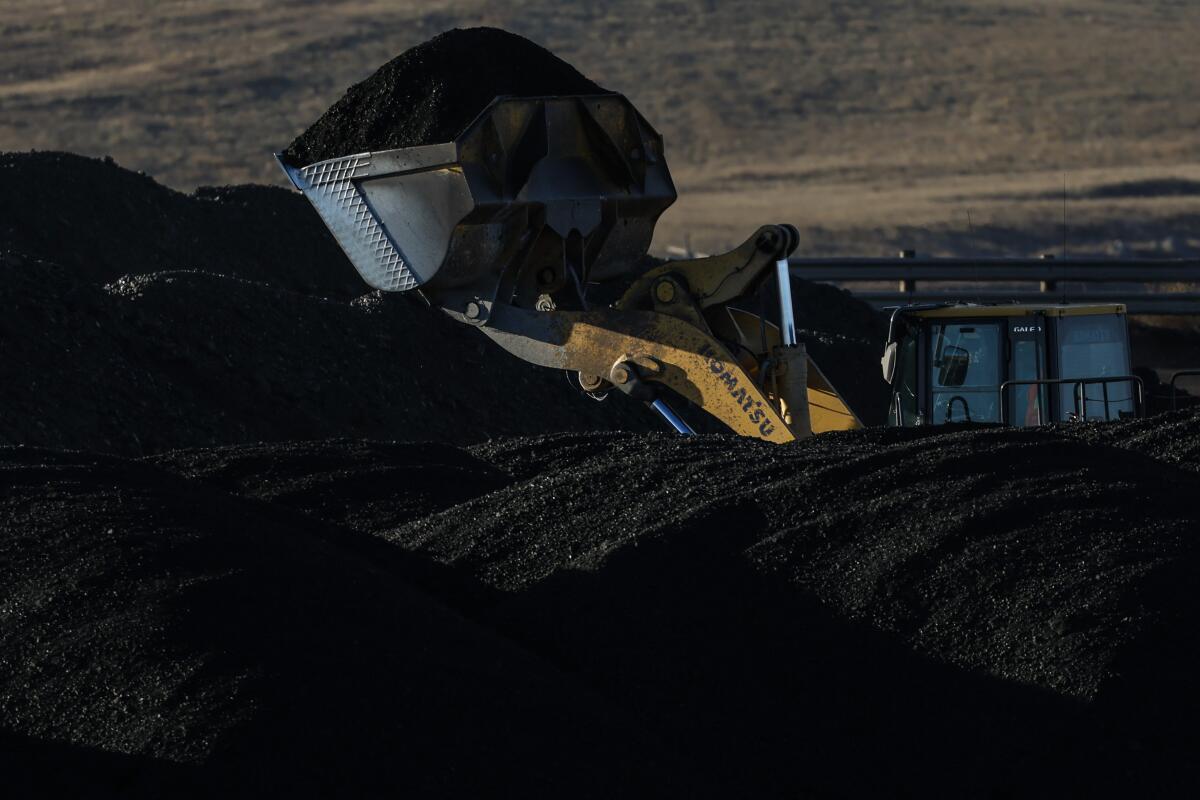
1. A lone tumbleweed blows through piles of coal at the Rosebud Mine outside Colstrip, a few miles from the power plant. 2. Coal is prepped for transport at the mine. 3. Coal is transferred to a truck at the mine. (Robert Gauthier / Los Angeles Times)
Washington officials say they tried to get Colstrip shut down but were stymied by the plant’s complicated six-company ownership structure, and by the Montana Legislature’s staunch support for coal. Sierra Club activists, meanwhile, say they’re still pushing for Colstrip’s closure, and for coal shutdowns across the country — even as they also oppose the construction of gas plants.
“From a climate perspective, gas is just as bad as coal,” says Laurie Williams, director of the Sierra Club’s Beyond Coal campaign.
To avoid a future of ever-more-dangerous fires, floods and heat, we need to ditch both fossil fuels — fast.
This is the hard part. This is the part that will require compromise — for conservatives who believe anything smacking of climate change is “woke” liberal propaganda, and for liberals who want nothing to do with conservatives spouting that belief.
So how do we do it? How do we stop clashing and start cooperating?
First off, West Coasters need to engage in good faith with the people who have supplied their power for decades — and strike deals that might persuade those red-staters to move on from coal. Deals like building more wind farms in Montana and not as many back home, even if that means fewer union jobs and lower tax revenues for California, Oregon and Washington.
It’s great that the coastal states are targeting 100% clean energy, but it’s not enough. They must bring the rest of the West along for the ride, or it won’t matter. Every solar farm in California is undermined by every ton of coal burned at Colstrip.
The lesson for folks who live in Colstrip and other Western coal towns might be even more difficult to swallow.
L.A. and Phoenix and Portland have funded your comfortable lifestyles a long time. Now they want something different.
If Colstrip wants to stick around, it needs to start offering something different.
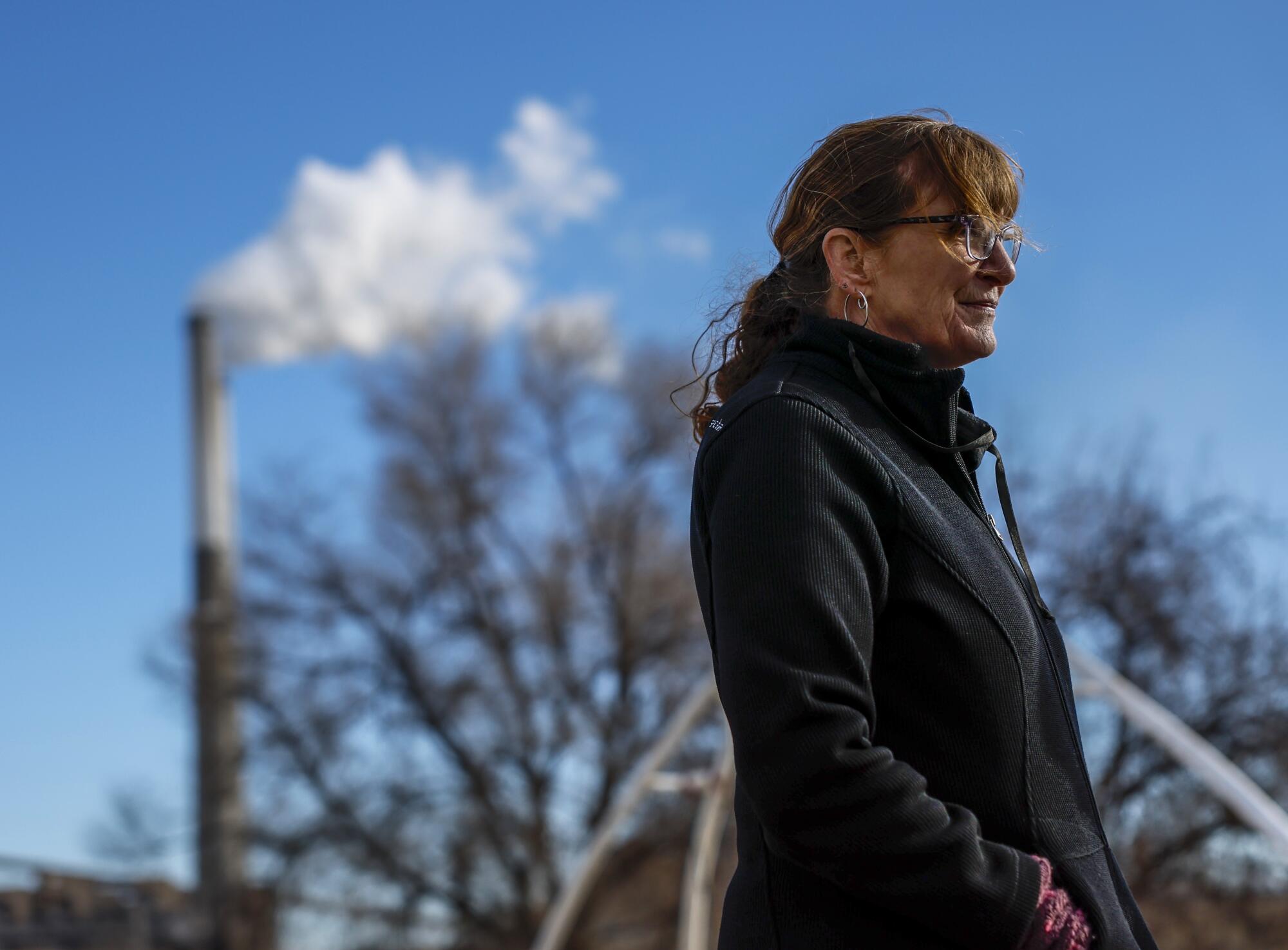
Climate activist Anne Hedges stands in a public park near the Colstrip power plant.
(Robert Gauthier / Los Angeles Times)
It’s easy to see why that’s a scary prospect. After we finish exploring the coal mine with Hedges, we drive into town and stop at one of the immaculately maintained public parks. The power plant’s two active smokestacks aren’t far, looming 692 feet over a swing set and red-and-blue bench with the letters “USA” carved into the backing.
“The climate doesn’t care who owns the power plant,” Hedges says, as steam and carbon and soot spew from the stacks.
The climate won’t care any more when Houston-based Talen Energy — which operates the plant, and which didn’t respond to requests for a tour or interview — becomes the facility’s largest owner next year, acquiring Puget Sound Energy’s shares.
Our ability to solve this problem doesn’t depend on which company is profiting off all that coal.
What it does depend on is our willingness to make hard choices, ranchers and miners and activists setting aside their differences and writing the West’s next chapter together, rather than fighting so long and so hard that the tale ends badly for everyone.
Change is scary. But it’s inevitable. Cowboy poet Wally McRae learned that the hard way.
Maybe 50 years from now, his great-grandchildren will wax poetic about the beauty of Colstrip without coal.
Support our journalism
Your support helps us deliver the news that matters most. Subscribe to the Los Angeles Times.
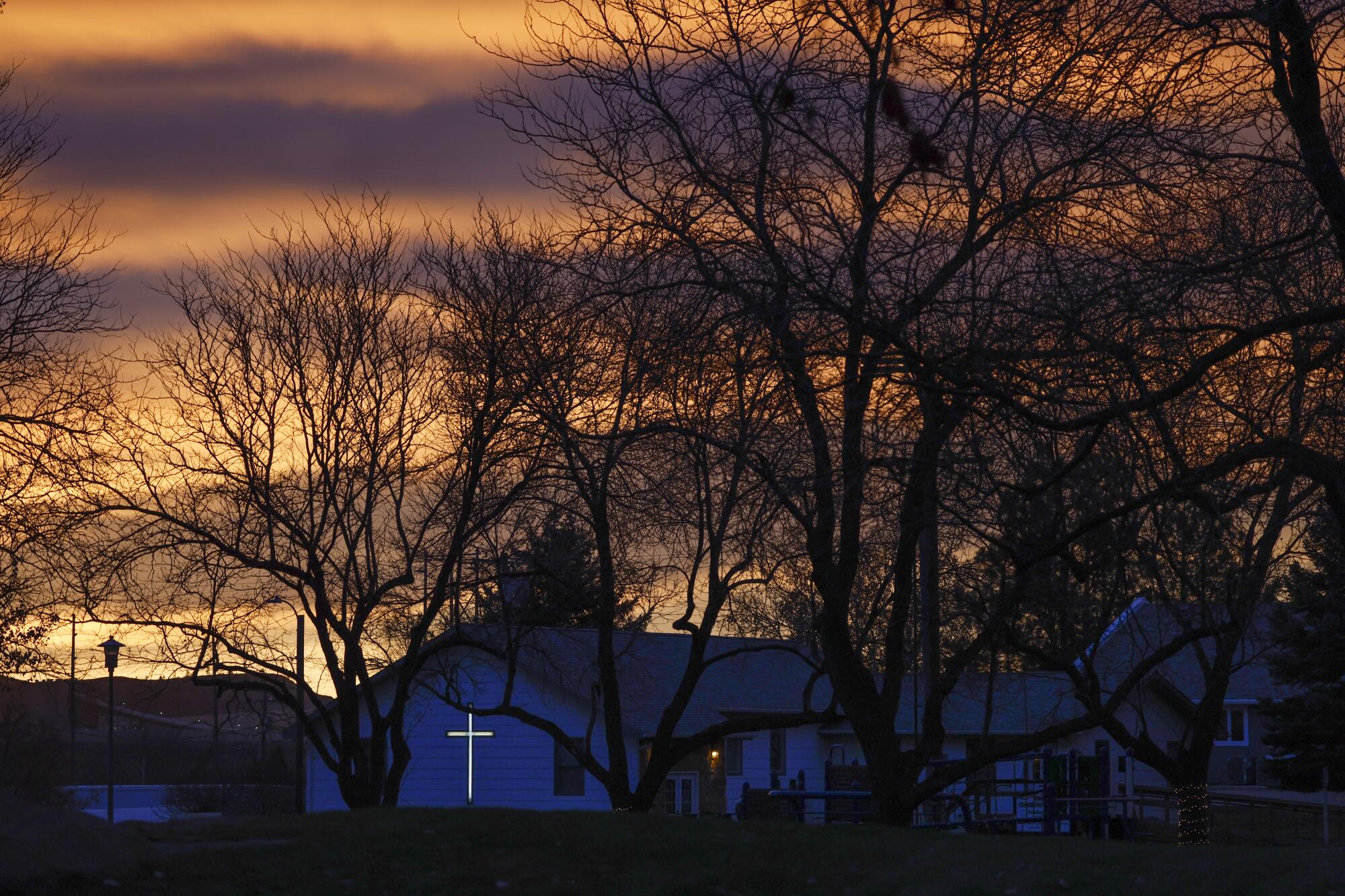
The early-morning sky glows red over the town of Colstrip.
(Robert Gauthier / Los Angeles Times)

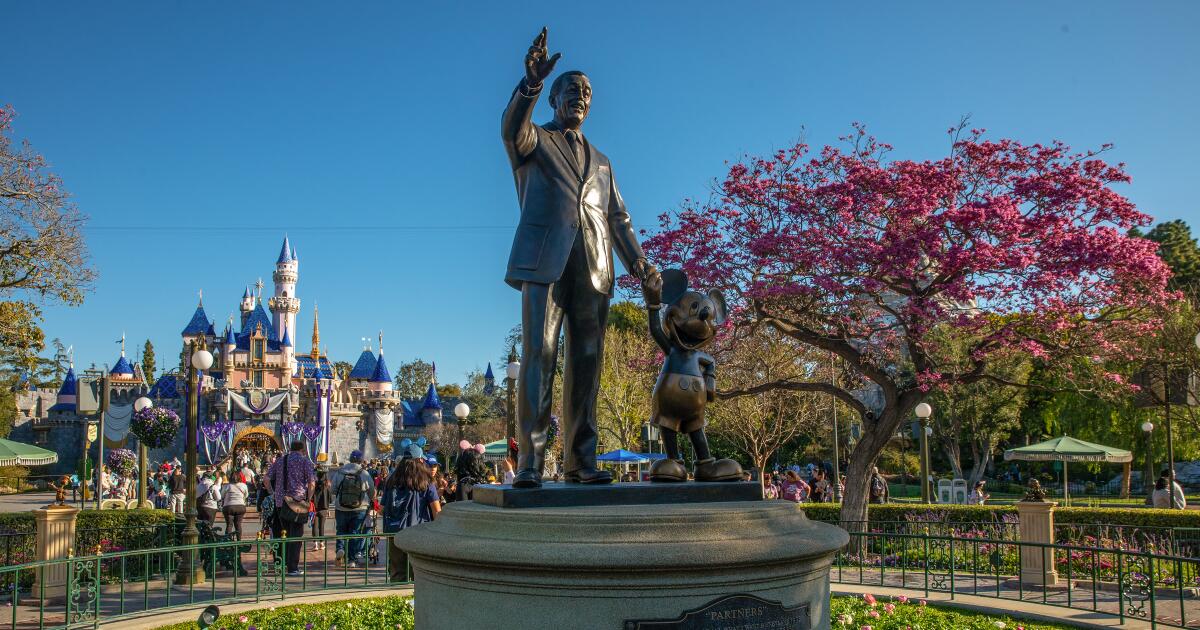
Disneyland Resort in Anaheim will offer $59 tickets for select evening admission to either theme park as part of a new promotion.
The one-day, one-park evening ticket offer will allow attendees to enter Disney California Adventure at 5 p.m. or Disneyland at 7 p.m. Park reservations are still required, as has been the case since the COVID-19 pandemic.
The offer only applies for admission from July 12 through Aug. 5 on Sundays to Wednesdays.
Disneyland Resort is commemorating its 70th anniversary through Aug. 9, and has introduced new shows and additions to rides as part of the occasion.
Walt Disney Co.’s theme parks and experiences business are a crucial boost to its finances, making up about 56% of the company’s operating income last fiscal year.
During the Burbank-based company’s most recent earnings call in May, Disney executives said attendance at its U.S.-based parks was down 1% compared with the prior year, a shift they attributed to “continued softness” in international visitations. However, the company said at the time that it was starting to move past those issues.
Disney’s experiences division reported $9.5 billion in revenue in that fiscal second quarter, up 7% compared with the same period a year ago, something executives said was due to higher guest spending domestically and more capacity on its cruise line.

An aging downtown office complex will be converted into apartments as part of an ambitious plan by local real estate companies to create 4,000 affordable housing units in Los Angeles.
The first project will be a $200-million makeover of the L.A. World Trade Center, a sprawling white elephant of an office complex on Figueroa Street built in the 1970s that will be turned into 512 apartments in one of the largest affordable housing conversions to date downtown.
Future projects being planned in the central city for delivery over the next five years will include other office-to-apartment conversions and new housing built from the ground up.
The 10-story World Trade Center, right, at Figueroa and Fourth streets in downtown Los Angeles, was built in the mid-1970s.
(Myung J. Chun / Los Angeles Times)
Behind the building campaign unveiled Monday are two of the region’s largest real estate companies, Jamison and Kennedy Wilson. Jamison is the city’s most prolific converter of offices to market-rate apartments and currently has a major makeover of a downtown office skyscraper underway for tenants who can pay top rents.
Kennedy Wilson, a real estate investment company based in Beverly Hills, owns Vintage Housing, which builds and operates affordable housing using tax credits and other state and federal financing to help fund it.
Vintage Housing and Jamison’s new affordable housing division, Arden Residential, will take on the campaign to build the housing where qualified tenants will pay rents below market rates.
Rents in the World Trade Center — which will be renamed Sky Castle when it opens in early 2028 — are expected to start at $937 for a one-bedroom unit. Some two- and three-bedroom units would rent for $1,100 and $1,300 per month, respectively, developers said.
Sky Castle will have shared amenities found in more expensive modern apartments, the developers said, such as a fitness center, resident lounge and co-working space. It already has six tennis courts on the roof, which may be converted to pickleball courts, Jamison Chief Executive Garrett Lee said.
The goal is to build higher quality affordable housing by using efficient construction methods Jamison has learned through building more than 8,000 market-rate apartments in the past, Lee said. The makeover of the World Trade Center will mark Jamison’s 15th conversion of an office building to housing.
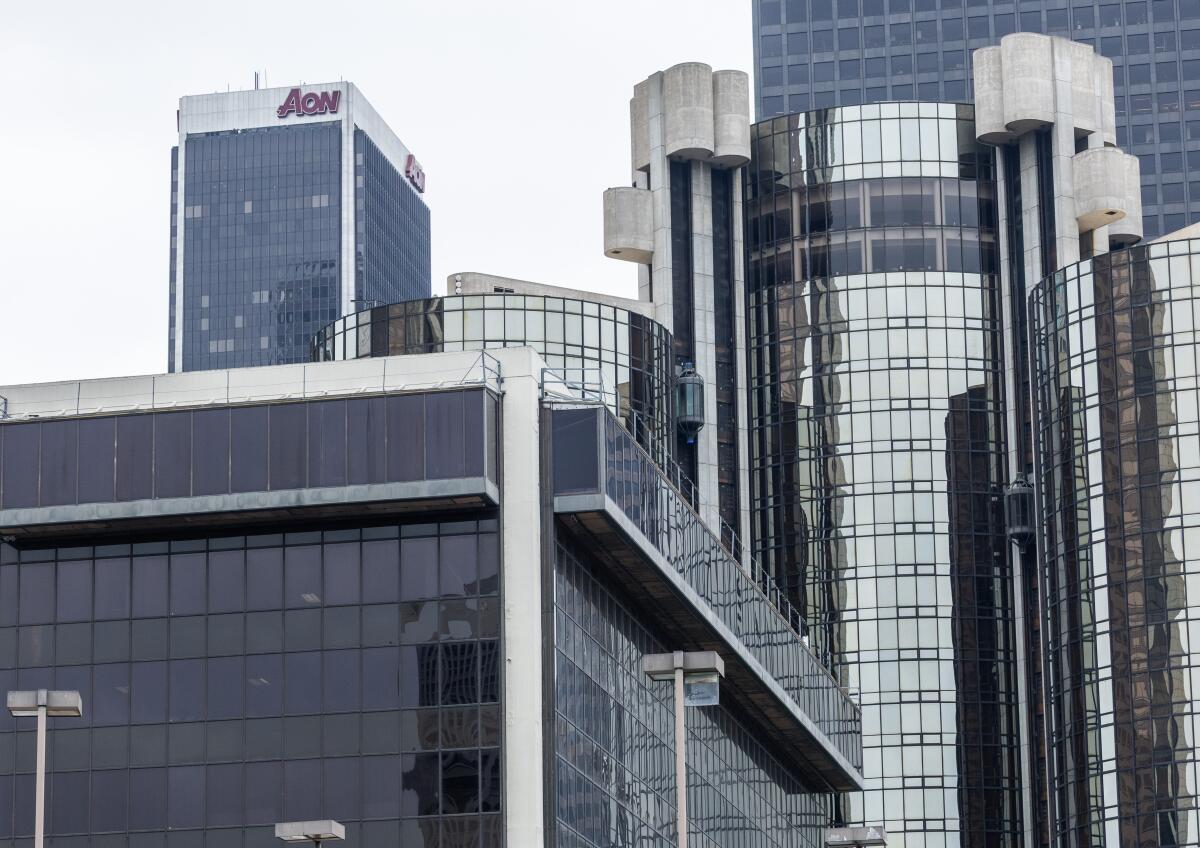
The plan to redevelop the L.A. World Trade Center, bottom left, is one of the largest affordable housing conversions to date downtown.
(Myung J. Chun / Los Angeles Times)
The 10-story World Trade Center was built in the mid-1970s to fanfare saying it would be home to international companies. In 1976, The Times described the center as a place to prepare for an overseas trip where visitors could get passports and visas, as well as exchange dollars for francs, marks, rubles and other currency. There was a language school and branches of U.S., Swiss and Japanese banks.
By the mid-1980s, the 400,000-square-foot office complex covering a city block at Figueroa and Fourth streets had lost its international flavor and was falling out of favor with corporate tenants who were moving into glossy new skyscrapers on Bunker Hill and in other locations.
The building has been cleared of remaining office tenants to allow work to begin in August, Lee said.
Kennedy Wilson is a nationwide operator of market-rate apartments that has also moved into building affordable housing in the last decade, said Nicholas Bridges, global head of capital markets at the company.
Building affordable, workforce housing “in almost all cases requires public subsidies,” Bridges said, and Kennedy Wilson has developed expertise in assembling “a cocktail of public financing sources” that includes low-income housing tax credits and tax-exempt bonds.
In the past, many housing developers have shied away from building affordable housing because assembling the subsidies needed to make construction profitable is challenging.

An artist’s rendering shows what the L.A. World Trade Center could look like after being redeveloped into affordable housing. The new complex is to be called Sky Castle.
(Ian Camarillo)
“It’s complicated,” Bridges said, “and not for the faint of heart.”
Eligible tenants must earn between 30% and 80% of the median income in the area where the housing is built.
Jamison and Kennedy Wilson will develop about 15 affordable housing projects between downtown and the 405 Freeway, Bridges said, many of them in aging office buildings such as the World Trade Center that are already owned by Jamison and are close to public transit.
Substantial potential for affordable housing lies in L.A.’s underused office buildings, he said.
“In this post-COVID world, the way people are utilizing office buildings, particularly older office buildings, has just fundamentally changed,” he said.
It makes sense for developers of conventional multifamily housing to move to building affordable housing, Lee said, because the government supports it through subsidies, zoning reform and the fast-tracking of construction permits. The city of Los Angeles also recently streamlined its adaptive reuse rules to make it easier to convert office buildings to housing.
“There are a lot of incentives pushing us in this direction,” Lee said.

Comcast is spinning off its NBCUniversal entertainment and news media businesses into a separate publicly traded company, a move that would unwind an audacious play the cable giant made for the storied Hollywood assets 15 years ago.
The plan would put broadcast networks NBC and Telemundo, NBC News, cable network Bravo, streaming service Peacock, the Los Angeles-based Universal film and television studios, Universal theme parks and British TV service Sky in a new stand-alone company.
Philadelphia-based Comcast would remain in its core business of distributing pay-TV channels, broadband internet and wireless services.
The spinoff would be the second such move by Comcast in two years. Late last year, the Brian L. Roberts-controlled company cast off most of its cable portfolio, including CNBC, USA Network, MS NOW and Golf Channel to form a new entity called Versant.
But the maneuver failed to budge Comcast’s listless stock, which has languished for years as its primary business lost thousands of broadband customers.
Comcast executives needed to make a bolder move to mollify frustrated investors.
Comcast stock peaked at nearly $26 per share Monday before closing at $24.22, up roughly 4.5% from Friday. Still, the stock remains below its 52-week high of $34.34.
The plan announced Monday would unravel Comcast’s bold decision to acquire NBCUniversal from General Electric Co. in 2011. At the time, Comcast saw tremendous value in marrying NBC’s entertainment operations, including its then-lucrative cable channels, with its cable TV distribution service that Roberts’ late father, Ralph, launched in Tupelo, Miss., in 1963.
“They were two distinct businesses,” longtime cable analyst Craig Moffett wrote in a Monday note to investors. “Having them under the same roof didn’t make either better.”
Consumers shifted to streaming, and Comcast’s attempt to build a top-tier digital service, Peacock, has fallen well short of its goal. Peacock lags behind rivals despite billions of dollars in investment from Comcast.
The concept of unwinding its NBCUniversal operation began in earnest in the fall, when Comcast joined the bidding for Warner Bros. Discovery. Comcast executives knew they could ill afford to spend billions to buy a rival; Wall Street would have pummeled the company.
So Comcast offered to spin off NBCUniversal and pair it with Warner Bros., turning two original Hollywood studios into a new media colossus.
But 43-year-old billionaire David Ellison prevailed in the bidding, agreeing to pay $111 billion to capture Warner Bros. Discovery. Losing the auction forced Comcast to find a different path forward.
On a call with investors, Roberts said the separation would bolster the two firms as they navigate increasing competitive challenges while technology companies continue to transform entertainment.
“We asked ourselves three basic questions,” Roberts said. “One, can these businesses stand alone and have the heft to stand alone in separate companies? Two, do they have a clear, viable capital allocation path to invest? And three, is now the right time? And the answer we came back with was yes to all counts.”
A free-standing NBCUniversal, home of the “Minions” and “Jurassic Park” franchises, probably would be an acquisition target, as media companies have been consolidating in an effort to get more content and mass distribution for their streaming services. Ellison’s Paramount is on track to close its Warner Bros. purchase, which would combine such media assets as HBO Max, CBS, CNN, Paramount Pictures and Warner Bros. studios.
With its Sky business, NBCUniversal has a toehold in Britain and Europe at a time when Amazon and Netflix are flexing their global distribution muscles.
Comcast would be positioned to combine with another cable and internet provider, such as Connecticut-based Charter, which owns the Spectrum television service. Charter is in the process of buying the smaller Cox cable service, which also has operations in Southern California.
Comcast is expected to complete the spinoff next year and will retain an 19% stake in the new entity.
The timetable could put NBCUniversal up for grabs by 2028 — when the company is set to broadcast the Summer Olympics, which will be held in Los Angeles.
Comcast acquired NBCUniversal in 2011. The industry-reshaping deal combined the largest distributor of TV channels with a provider of top-rated TV channels and a movie studio. But the streaming revolution has decimated the cable television business. Traditional TV viewing has been in a steady decline over the last decade. NBC has relied heavily on NFL broadcasts, and more recently, NBA and Major League Baseball games to remain relevant.
NBCUniversal has invested heavily in its streaming service, Peacock, but has been unable to reach the scale necessary for profitability. Comcast‘s stock price has struggled as a result.
Roberts, chairman and chief executive of Comcast, will continue to be involved in the leadership of Comcast and NBCUniversal, working in partnership with the CEOs of both companies.
Mike Cavanagh will remain as CEO of NBCUniversal, and Comcast’s former chief financial officer, Michael Angelakis, will return to run Comcast after the spinoff.
“Perhaps the best part of today’s welcome announcement … is that Mike Angelakis is coming back,” Moffett, the analyst, wrote. “He will now helm the cable business, [which] is unequivocally good news. With Mike Angelakis’s return, Comcast has come full circle.”
Moffett added that, despite Monday’s announcement, the 2011 combination was not a complete bust.
“The deal to acquire NBCU from GE was financially brilliant,” he said. “It was structured so that Comcast paid for just half of the acquisition and then let NBCU’s own cash flow pay for the rest.”
Over the years, Comcast has raked in billions in profit from its media holdings.
Comcast executives on the analyst call played down the notion that the two companies were being positioned for another deal.
“Absolutely not,” Roberts said. “This is the right move to put each company in the strongest position to create value, fully monetize its assets and aggressively pursue its own organic growth strategies.”
Cavanaugh, who has been running the combined company for three years, sounded more like a buyer than a seller.
“Our plan for NBCUniversal and Sky is to build and invest for growth,” he said. “We have the freedom now to explore adjacent businesses where we have the right to play, and that’s thanks to the stability of our company and management team.”
The spinoff announcement comes a week after Fox Corp. announced its deal to purchase the streaming platform Roku for $22 billion. The deal is aimed at ensuring that Fox has a means to get its portfolio of sports, news and entertainment channels into viewers’ homes as the traditional pay-TV business continues to erode.
-

 North Dakota2 minutes ago
June ND severe weather recap: 5 tornadoes, damaging winds impact numerous towns
-

 Ohio5 minutes ago
‘Pure evil’: Adults arrested after 16 children found in deplorable conditions in Ohio home
-

 Oklahoma10 minutes ago
Oklahoma Lottery Mega Millions, Pick 3 results for June 30, 2026
-

 Oregon17 minutes ago
What the Supreme Court’s transgender sports ruling means for Oregon
-

 Pennsylvania20 minutes ago
10-year-old stabbed Dollar Tree employee during robbery in Pennsylvania, police say
-

 Rhode Island25 minutes ago
Three generations killed during driving lesson after car plunges into river
-

 South-Carolina32 minutes ago
South Carolina Lottery Mega Millions, Pick 3 results for June 30, 2026
-

 South Dakota35 minutes ago
Vermillion’s Reuvers commits to South Dakota

