Business
President Trump Wants to Be Everywhere, All the Time


To understand how Mr. Trump has achieved this omnipresence, The New York Times reviewed the first 329 days of his second term, finding at least one instance each day when he attracted the public’s attention to himself and his actions.
The review encompassed more than 250 media appearances, more than 320 official appearances, and more than 5,000 Truth Social posts or reposts. The analysis shows that while Mr. Trump has lagged his predecessors in his number of official appearances, he has pursued a raft of innovative methods to force himself into the public consciousness on a daily, and sometimes even hourly, basis.
The battery of activity started from the moment he was inaugurated, when he traveled from the Capitol Building to the Capital One Arena to publicly sign a flurry of executive orders.
Since then, he has stayed in the public eye in part by doing things no president has ever done. High-stakes Oval Office meetings, like his negotiations with President Volodymyr Zelensky of Ukraine, are held on-camera and broadcast live on global news networks. His Q.-and-A. sessions with reporters frequently last an hour or more.
He regularly airs his opinions – on social media, in discursive asides at rallies – about idiosyncratic subjects that range widely across the zeitgeist, from Sydney Sweeney’s sexy denim ads to the redesigned logo of the Cracker Barrel restaurant chain to the mysterious fate of the aviator Amelia Earhart, who vanished over the Pacific Ocean in 1937.
And his engagement with the news media has soared well beyond the start of his first administration.
Through Dec. 14, Mr. Trump took reporters’ questions on 449 occasions, compared with 223 during the same period of his first term. On average, Mr. Trump has interacted with journalists roughly twice a day, doubling his rate from 2017, according to Martha Joynt Kumar, a Towson University political scientist who tracks presidential press interactions. Mr. Trump limits which news outlets can ask questions at small events, but in sheer volume, he is the most media-accessible modern president, and far outpaces his predecessor, Joseph R. Biden Jr.
“Reporters will be in my office asking me for the president’s reaction to a breaking news story,” Karoline Leavitt, the White House press secretary, said in an interview. “And I’ll just say to them, ‘I don’t know, why don’t you ask him yourself in 30 minutes?’”
President Trump’s media appearances have soared this year, more than doubling both the Biden administration’s and those of his own first term.
Finding the Cameras
Many of his public moments go viral online, like his diatribe about restoring the name of the Washington Redskins, or the A.I.-generated video meme he posted of himself dribbling a soccer ball with Cristiano Ronaldo in the Oval Office. They take on a life of their own, rippling across social media and dissected and amplified by influencers and mass media platforms alike.
The result is a president whose not-so-inner monologue is injected into our daily lives in myriad ways, when we are watching TV on the weekends or idly scrolling the web – a Greek chorus for our national narrative.
“He’s the most ubiquitous president ever,” said Douglas Brinkley, the presidential historian.
The media strategy aligns with his political strategy.
Dating back to his years as an outspoken real estate developer and reality TV star, Mr. Trump has relished being unavoidable for comment. But at age 79, he has been outdoing his younger self. And there is a logic to his logorrhea.
Mr. Trump’s allies often speak of the political benefits of flooding the zone: pursuing so many policies, ideas, and dramatic restructurings of the normal ways of governance as to overwhelm the system. “All pedal, no brake,” as Stephen K. Bannon, Mr. Trump’s one-time adviser, has called it.
“We joke internally that he is our ultimate director of communications,” Ms. Leavitt said. “He has incredible media instincts, and he is the final decision maker on all policy, and he has been in a ‘flood the zone,’ ‘do as much as possible’ mindset since he walked into the Oval Office on Jan. 20.”
All presidents benefit from the awesome news-making powers of the office, with its agenda-setting influence over a dedicated global press corps. But Mr. Trump has outstripped his predecessors in whipsawing the public’s attention onto matters small and large – and limiting the level of scrutiny that any one shocking remark or policy proposal receives.
“People can really only focus on a handful of things a day,” said Bill Burton, a deputy White House press secretary under former President Barack Obama. “This attention flood is working for Trump because he is able to do an extraordinary amount of executive actions and very little of it can get attention.”
Or as Mr. Brinkley put it: “He plays to win the day, every day, around the clock.”
His commentary takes on a life of its own.
One of Mr. Trump’s political assets is his instinct for virality.
With a natural feel for the web, Mr. Trump has a knack for amplifying wacky memes and pop culture curios that can drive days of online discourse. Sometimes, coverage of his offhand remarks or late-night social media posts can crowd out the more significant, norm-shattering changes he is making to American governance.
Late one Friday night in May, the president posted an obviously A.I.-generated image of himself as the pope. It struck a nerve.
Mr. Trump had already courted controversy days earlier, after the death of Pope Francis on April 21.
“I’d like to be pope,” the president told reporters who asked about who should become the next pontiff. “That would be my number one choice.”
The comment disturbed some Catholics, who said the notion was crude and insensitive. That reaction seemed only to prompt Mr. Trump to double down, posting the A.I.-generated image to his Truth Social account days later. By the weekend it had become a cultural phenomenon, mocked on “Saturday Night Live” and called out by experts as an example of misleading A.I. content.
After Mr. Trump posts the A.I. image …

May 2
Trump posts A.I. image of himself as Pope
There is nothing clever or funny about this image, Mr. President. We just buried our beloved Pope Francis and the cardinals are about to enter a solemn conclave to elect a new successor of St. Peter. Do not mock us.
May 3
NYS Catholic Conference says “do not mock us”
May 3
“Saturday Night Live” covers fake image
May 3 Vatican asked about image, declines to comment
May 4
Cardinal Joseph Tobin of New Jersey criticizes image as “not good”
May 4
JD Vance defends Trump on X, calling it a joke … some Catholics were outraged, prompting a news cycle focused on the controversy …
5
Says “the Catholics loved it”
… before Mr. Trump suggested he had nothing to do with it.
Mr. Trump, who is not Catholic, had plenty of defenders, too. They said his commentary and the A.I. image were simply jokes, part of the president’s unique comedic style.
“As a general rule, I’m fine with people telling jokes and not fine with people starting stupid wars that kill thousands of my countrymen,” Vice President JD Vance, who is Catholic, wrote on X.
In his quest for attention, the president is often aided by a cottage industry of right-wing influencers and activists who are primed to syndicate, reinforce and defend whatever content he pushes out each day. For this conservative media ecosystem, Mr. Trump’s messaging and commentary are the raw fuel that drives clicks, shares and views.
On June 7, the president’s visit to a raucous U.F.C. fight – complete with a “Trump dance” entrance into the arena – generated an immediate spike in online interest, including about 50,000 posts on X. Five days later, when he promoted a “Trump gold card” visa, his announcement led to roughly 30,000 posts on X.
A barrage that distracts from bad news.
One pattern in Mr. Trump’s behavior: When his administration is faced with bad news, he launches a fusillade of distraction.
This can take the form of outlandish, out-of-left-field claims about political opponents. Or he might weigh in on a pop culture subject far afield from Washington politics – from the ratings of late-night hosts like Seth Meyers to the physical appearance of a megastar like Taylor Swift.
The events of July 2025 offer a case in point.
As the Jeffrey Epstein files returned to the news – along with speculation that Mr. Trump might appear in them – the president embarked on a breathtaking series of tangents. Mr. Trump claimed without evidence that former President Bill Clinton had bankrolled an effort by senior intelligence officials to frame him for a crime, mused about stripping the actress Rosie O’Donnell of her U.S. citizenship, and accused the singer Beyoncé of accepting millions of dollars to endorse his erstwhile rival, former Vice President Kamala Harris.
July 8
F.B.I. publishes memo about Epstein files On July 8, the F.B.I. said it would not declassify more Epstein files.
10
Claimed intelligence officials tried to frame him
10
Pushed to defund NPR and PBS
10 Directed ICE to arrest protesters
12
Threatened Rosie O’Donnell’s citizenship
15
Claimed Adam Schiff engaged in mortgage fraud Over the following days, Mr. Trump seemed to lash out in every direction.
On July 18, the Justice Department filed a request to unseal grand jury testimony about Mr. Epstein, again raising questions about Mr. Trump’s involvement. The president promptly lobbed insults at late-night talk show hosts, dismissed the Epstein affair as “fake news” and shared fresh claims about a supposed Obama administration plot to undermine him after the 2016 election.
July 18
Request filed to unseal grand jury testimony
On July 18, the Department of Justice filed a request — later denied — to unseal grand jury testimony.
20
Criticized Washington Commanders name
21
Called the “Russia hoax” the “crime of the century”
22
Called Epstein controversy “fake news”
22
Criticized Kimmel and Fallon
24 Criticized Federal Reserve chairman
Over the following days, Mr. Trump bounced from topic to topic.
On July 25, The Wall Street Journal published a major scoop: The paper had unearthed a risqué birthday letter that Mr. Trump had apparently written to Mr. Epstein in 2003. Mr. Trump responded with his attack on Beyoncé and revived his threat to revoke the broadcast licenses of TV networks. Then he announced the imminent construction of an enormous gilded ballroom at the White House, at a cost of $200 million. (He has since revised the cost upward to $400 million.)
Asked if there was a deliberate strategy to distract from negative news, Ms. Leavitt noted that every administration seeks to minimize unhelpful headlines.
“Yes, there have been times in which we’ve tried to do that, but also often it just happens naturally, because the president is willing to weigh in on so many subjects,” she said. “Sometimes it’s really not deliberate. It’s just him speaking his mind on whatever news cycle or news story is brought to him in that moment.”
He has added tricks to his arsenal.
Mr. Trump’s devotion to Truth Social mirrors the hair-trigger Twitter habit of his first term; on one recent December evening, he posted 158 times between 9 p.m. and midnight. And he has continued to appear on Fox News with certain preferred hosts.
But this year, he has added to his media arsenal by appearing in many more public spaces that fall outside of a president’s typical itinerary.
Mr. Trump has stopped by a Washington Commanders N.F.L. game, popped up in the New York Yankees locker room, attended the Ryder Cup golf tournament and the men’s tennis final at the U.S. Open, sat ringside at numerous U.F.C. fights, and traveled to the Daytona 500. He is the first sitting president to attend a Super Bowl. When FIFA staged the Club World Cup final in New Jersey, Mr. Trump not only attended, but joined the winning team onstage for the trophy ceremony.
The net effect is a sense of inescapability, that no corner of American life remains Trump-free – which itself amounts to a potent expression of presidential authority and command. “His power, in part,” said Mr. Burton, the former Obama aide, “comes from the attention that people give him, or that he forces on them.”
Can it ever be too much?
In the fall of 2009, President Barack Obama appeared on David Letterman’s talk show, gave interviews to CNBC and Men’s Health magazine, and made the rounds of all five major network Sunday shows. Washington was abuzz about whether he was overexposed.
That debate sounds quaint today. But the question of whether a president can be too visible remains open.
“The public is being desensitized” to Mr. Trump’s omnipresence, argued Mr. Brinkley, the historian. “It starts becoming blather. The enemy for Trump isn’t Democrats; it’s the public being bored with the show.”
Ms. Leavitt said that if there was a risk to his ubiquity, “President Trump would not be president right now.” She added: “He is a businessman who speaks his mind and tells it like it is, and sometimes people don’t like that. But obviously the vast majority of our country does, or else he wouldn’t be in this office.”
During Mr. Trump’s first term, the public eventually tired of his frenzied pace. And in some ways, Mr. Trump appears to be slowing down physically as he approaches his 80th birthday in June (which he will celebrate in part by staging a nationally broadcast U.F.C. fight on the White House lawn). He has appeared to doze at some Oval Office meetings, and he is holding fewer formal public events than he did at this point in 2017.
Still, Mr. Trump and his team have embraced the everywhere-all-at-once nature of modern media. Average Americans, busy with work and family, do not tune in for daytime news conferences or Cabinet meetings. And 6:30 p.m. newscasts and local newspapers are no longer the primary vessels by which Americans learn about their commander-in-chief.
Instead, politics now suffuses our lives as a kind of ambient noise – via TikTok videos, social media posts, YouTube talk shows and family Facebook messages – never fully separate from our leisure pursuits. “Right now the game is attention, in terms of what’s culturally breaking through,” Mr. Burton said. “The fact that so much message exists is the point.”
Mr. Trump has both propelled this merging of culture and politics, and continues to strategically exploit it. In December, he became the first president to personally host the Kennedy Center Honors, comparing himself onstage to Johnny Carson and musing that he would do a better job than Jimmy Kimmel.
“This is the greatest evening in the history of the Kennedy Center,” Mr. Trump told the crowd. “Not even a contest. There has never been anything like it.”
His performance will air in prime time on CBS on Dec. 23.
Photo and video sources: Graham Dickie/The New York Times; Doug Mills/The New York Times; Roll Call Factba.se; PBS; Mauro Pimentel/Agence France-Presse — Getty Images; Kenny Holston/The New York Times; The New York Times; Annabelle Gordon/Reuters; Eric Lee/The New York Times; Fox; Cheriss May for The New York Times; Wilfredo Lee/Associated Press; Margo Martin, via Storyful; Mark Abramson for The New York Times; Global News; Al Drago/Getty Images; Fox News; Dave Sanders for The New York Times; Pete Marovich for The New York Times; Ted Shaffrey/Associated Press … Show all



Warner Bros. Discovery shareholders will soon render a verdict on Hollywood’s biggest merger in nearly a decade.
Warner has set an April 23 special meeting of stockholders to vote on the company’s proposed sale, for $31-a-share, to the Larry Ellison family’s Paramount Skydance.
The $111-billion deal is expected to reshape the entertainment industry by combining two historic film studios, dozens of prominent TV networks, including CBS, HBO, HGTV and Comedy Central, streaming services and two news organizations, CNN and CBS News. The tie-up would give Paramount such beloved characters as Batman, Wile E. Coyote, and Harry Potter, television shows including “Hacks,” and “The Pitt,” and a rich vault of movies that includes “Casablanca,” and “One Battle After Another.”
The $31-a-share offer represents a 63% increase over Paramount Chairman David Ellison’s initial $19-a-share proposal for the company in mid-September, and a 147% premium over Warner’s stock’s trading levels prior to news of Ellison’s interest.
“This transaction is the culmination of the Board’s robust process to unlock the full value of our world-class portfolio,” Warner Bros. Discovery Chief Executive David Zaslav said Thursday in a statement. “We are working closely with Paramount to close the transaction and deliver its benefits to all stakeholders.”
Paramount hopes to finalize the takeover by September. It has been working to secure the blessing of government regulators in the U.S. and abroad.
Should those regulatory deliberations stretch beyond September, Paramount will pay shareholders a so-called “ticking fee” — an extra 25 cents a share for every 90-day-period until the deal closes.
The transaction will leave the combined company with nearly $80-billion in debt, a sum that experts say will lead to significant cost cuts.
Paramount Skydance Chairman and CEO David Ellison attends President Trump’s State of the Union address three days before clinching his hard-fought Warner Bros. Discovery deal.
(Mark Schiefelbein / Associated Press)
For weeks it appeared that Netflix would scoop up Warner Bros.
Netflix initially won the bidding war in early December with a $27.75 offer for the studios and streaming services, including HBO Max. But Ellison refused to throw in the towel. He and his team continued to lobby shareholders, politicians and Warner board members, insisting their deal for the entire company, including the cable channels, was superior and they had a more certain path to win regulatory approval.
The Ellison family is close to President Trump. This week, Trump named Larry Ellison to a proposed White House council on technology issues, including artificial intelligence.
Warner’s board, under pressure, reopened the bidding in late February to allow Paramount to make its case. Warner board members ultimately concluded that Paramount’s bid topped the one from Netflix and the streamer bowed out. Paramount paid a $2.8-billion termination fee to Netflix and signed the merger agreement on Feb. 27.
Warner’s board is advising its shareholders to approve the Paramount deal. Failure to cast a vote will be the same as a no-vote, according to the company’s proxy.
Warner’s largest shareholders include the Vanguard Group, BlackRock, Inc. and State Street Corp.
Zaslav has significant stock and options holdings, worth about $517 million at the deal’s close, according to the proxy.
The regulatory filing also disclosed that a mysterious bidder had surfaced at the auction’s 11th hour.
A firm called Nobelis Capital, Pte., reportedly based in Singapore, alerted Warner on Feb. 18 that it was willing to pay $32.50 a share in cash.
The firm said it had placed $7.5 billion into an escrow account. However, Warner’s bankers “could not find the purported deposit at J.P. Morgan,” according to the proxy. And there was no evidence that Nobelis had any assets or any “equity or debt financing” lined up, Warner said, adding that it “took no further action with respect to the Nobelis proposal.”

new video loaded: How Kharg Island May Change the Trajectory of the Iran War
By Peter Eavis, Gilad Thaler, Edward Vega, Lauren Pruitt and Joey Sendaydiego
March 25, 2026
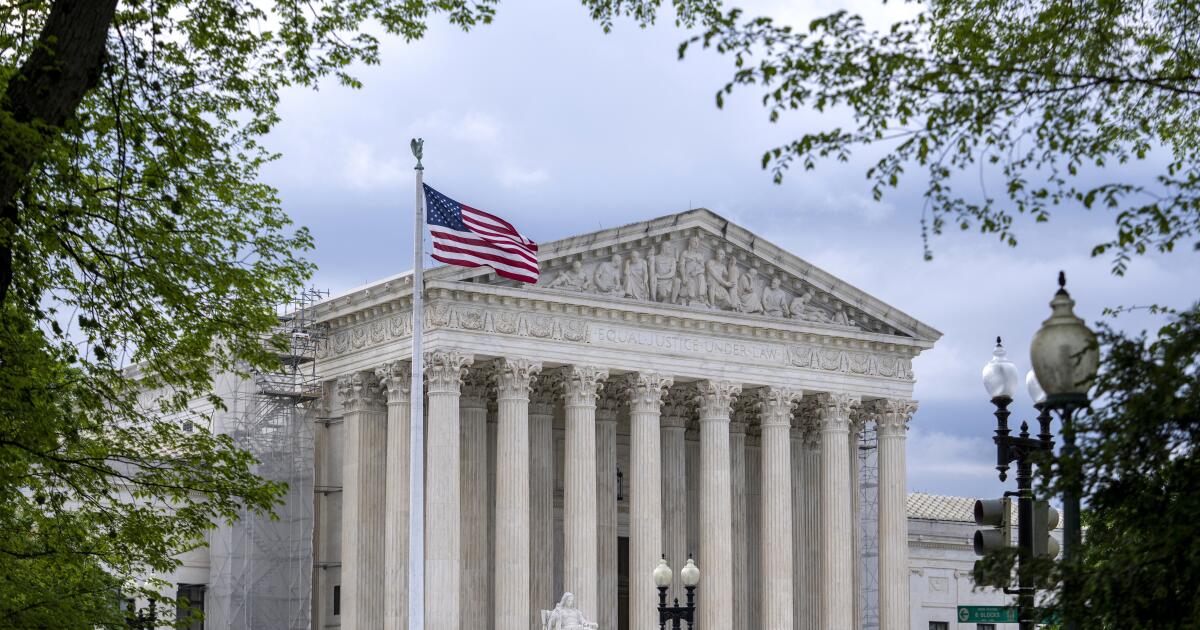
WASHINGTON — The Supreme Court on Wednesday made it harder for music and movie makers to sue for online piracy, ruling that internet providers are usually not liable for copyright infringement even if they know their users are downloading copyrighted works.
In a 9-0 decision, the justices threw out Sony’s lawsuit and a $1-billion jury verdict against Cox Communications for copyright infringement.
Lower courts upheld the lawsuit against Cox’s internet service for contributing to music piracy, which the company did little to stop.
Sony’s lawyers pointed to hundreds of thousands of instances of Cox customers sharing copyrighted works. Put on notice, Cox did little to stop it, they said.
But the high court said that is not enough to establish liability for copyright infringement, which remains a hot button issue in the music and film industries with the advent of AI tools that have spread the misuse of copyrighted content and sparked lawsuits between studios and AI companies.
“Under our precedents, a company is not liable as a copyright infringer for merely providing a service to the general public with knowledge that it will be used by some to infringe copyrights,” Justice Clarence Thomas wrote for the court.
Two decades ago, the court sided with the music and motion picture producers and ruled against Grokster and Napster on the grounds their software was intended to share copyrighted music and movies.
But on Wednesday, the court said “contributory” copyright infringement did not extend to internet service providers based on the actions of some of their users.
“Cox provided Internet service to its subscribers, but it did not intend for that service to be used to commit copyright infringement,” Thomas said. “Cox neither induced its users’ infringement nor provided a service tailored to infringement.”
Mitch Glazier, the chairman of the Recording Industry Assn. of America, said he was “disappointed” in the court’s ruling, as the case was “based on overwhelming evidence that the company knowingly facilitated theft.”
“To be effective, copyright law must protect creators and markets from harmful infringement and policymakers should look closely at the impact of this ruling,” Glazier said in a statement. “The Court’s decision is narrow, applying only to ‘contributory infringement’ cases involving defendants like Cox that do not themselves copy, host, distribute, or publish infringing material or control or induce such activity.”
Karyn Temple, senior executive vice president for the Motion Picture Assn., said in a statement that the decision “upends the critical legal doctrine of contributory infringement for copyright.” She added: “Unfortunately, the Court’s opinion today ignores this well-established rule and congressional intent, which is particularly disappointing amidst a growing consensus about the need for more accountability for facilitating harmful online conduct, not less.”
In its defense, Cox argued that internet service providers could be bankrupted by huge lawsuits for copyright infringement, which they said they did not cause and could not prevent.
“The decision means that the Supreme Court isn’t coming to the entertainment industry’s rescue,” said attorney Michael K. Friedland. “The copyright infringement problem is a technological problem. The modern internet makes infringement really easy. The decision means that the industry is going to have to solve the problem itself — by developing its own better technology to protect its intellectual property.”
Rachel Landy, who teaches copyright law at Cardozo Law School in New York, said the music industry has no good options and may need to go to Congress.
“The record industry could go after the individual users who share works online without authorization, but that led to suboptimal outcomes in the past: bad publicity and judgment-proof defendants,” Landy said. “And now, the court has narrowed the contributory liability doctrine such that they are also unlikely to get recourse from the deeper pockets. It may be that their best recourse is to go to Congress for a fix.”
The American Civil Liberties Union and the Center for Democracy and Technology joined the case in support of Cox and welcomed the decision.
It is “a win for freedom of speech,” said Samir Jain, a CDT attorney. “If the court hadn’t decided in favor of Cox, it would have turned internet service providers into censorship machines acting on behalf of powerful rights-holders.”
Times staff writer Cerys Davies in Los Angeles contributed to this report.

‘Gas station heroin’ banned in another state amid nationwide crackdowns

NHL star’s fiancée makes emotional return after undergoing harrowing heart transplant ordeal

Roblox is changing online safety with AI
Warner shareholders to vote on Paramount takeover

Dash Crofts, ‘Summer Breeze’ hitmaker with Seals & Crofts, dies at 87

Florida High School Football Rankings: Top 25 teams – Oct. 21

How old is Bo Nix? What to know about Oregon quarterback ahead of 2024 NFL Draft

Cleary's 21 help Le Moyne down Central Connecticut State 69-64 in OT

99th annual Pony Swim held in Virginia

Indiana Members Credit Union announced as new anchor tenant at Bottleworks District

Photos: More than one million displaced by Israel’s evacuations in Lebanon

DHS shutdown live updates as Senate holds test vote on funding bill

Video: Jury Rules Against Meta and YouTube for Addictive Features

New Jersey Gov Sherrill signs law barring ICE agents from wearing face coverings to shield identities

Escalation in the Middle East – Not Europe’s war? MEPs in the Ring
-

 Detroit, MI1 week ago
Drummer Brian Pastoria, longtime Detroit music advocate, dies at 68
-

 Science1 week ago
How a Melting Glacier in Antarctica Could Affect Tens of Millions Around the Globe
-

 Movie Reviews1 week ago
‘Youth’ Twitter review: Ken Karunaas impresses audiences; Suraj Venjaramoodu adds charm; music wins praise | – The Times of India
-

 Sports5 days ago
IOC addresses execution of 19-year-old Iranian wrestler Saleh Mohammadi
-
 Science1 week ago
I had to man up and get a mammogram
-

 New Mexico4 days ago
Clovis shooting leaves one dead, four injured
-

 Texas6 days ago
How to buy Houston vs. Texas A&M 2026 March Madness tickets
-

 Tennessee3 days ago
Tennessee Police Investigating Alleged Assault Involving ‘Reacher’ Star Alan Ritchson