Business
Pixar needs original animated hits. They're much harder to come by at the box office


For decades, Pixar could hardly miss with its original animated films.
Whether the subject was toys, fish or a cantankerous old man, the Emeryville-based computer animation studio churned out hit after hit.
But since the COVID-19 pandemic, Pixar and other animation studios have struggled to break through at the box office with the same kinds of original movies that defined the industry. Instead, sequels such as “Inside Out 2” have ruled the genre.
This weekend, Walt Disney Co.-owned Pixar will face its latest test with the release of “Elio,” an original film about a young boy who seeks connection with aliens to make up for his loneliness on Earth.
The movie is tracking to bring in $18 million to $25 million in ticket sales from the U.S. and Canada during its opening weekend, according to box office analysis. (The film’s reported budget is in the range of $150 million to $200 million.)
That would be considered a soft debut by Pixar standards, indicating the dilemma the animation business — and the movie industry writ large — faces with original content. While audiences often say they want to see new stories, box office ticket sales show they gravitate toward sequels, reboots and other familiar fare.
“You need to be launching new franchises to keep the pipeline fresh,” said Doug Creutz, senior media and entertainment analyst at TD Cowen. “Since the pandemic ended, original animated films have just been getting killed at the box office … no matter how good they are.”
Pixar executives, nonetheless, say they’re committed to telling original stories, which are key to the future health of the industry.
“You wouldn’t have Pixar without ‘Toy Story,’ our first original film 30 years ago!” Pixar Chief Creative Officer Pete Docter wrote in an emailed statement. “And while we also love digging into new layers of familiar worlds and characters through our sequels, I’d say there’s a unique thrill in unearthing a new story.”
Disney and Pixar’s previous original movie “Elemental” made just $29.6 million in its opening weekend in 2023, causing many in the industry to write it off as a flop, before strong word-of-mouth reviews propelled the film to a solid worldwide gross of $496 million.
Sister studio Walt Disney Animation Studios has also recently struggled with originals, including 2022’s “Strange World” and 2023’s “Wish.”
The pandemic had a major effect on theatrical attendance for animated films. At the onset, studios including Pixar put their new animated movies on streaming services to give families something to watch during the COVID-19 stay-at-home orders and keep people from spreading the disease.
Movies such as 2020’s “Soul,” 2021’s “Luca” and 2022’s “Turning Red” were all sent straight to the Disney+ streaming service. Despite critical acclaim — winning an Academy Award for animated feature — “Soul” grossed just $121.9 million in worldwide theatrical revenue.
Even when movie theaters started reopening, families were slow to return due to health concerns and familiarity with watching movies at home, which dented animated films’ box office potential. Pixar’s 2022 “Toy Story” spinoff “Lightyear” did poorly at the box office partially due to this timing, as well as quality issues, marketing challenges and right-wing backlash to an on-screen kiss between a same-sex couple.
Other studios, too, face challenges with originals.
Universal Pictures’ 2023 original animated movie “Migration” also saw a soft box office total. The same year, Universal grossed more than $1 billion from “The Super Mario Bros. Movie,” based on the Nintendo game franchise.
Last year, Universal’s “The Wild Robot,” which is adapted from a 2016 children’s book, debuted to strong reviews, but grossed $333 million in box office revenue, compared with the $492 million reaped by Paramount Pictures’ “Sonic the Hedgehog 3.”
Now family films are ruling the box office.
So far this summer, many of the films that have propelled the box office are family-friendly — Warner Bros. Pictures’ “A Minecraft Movie,” and live-action remakes “Lilo & Stitch” from Disney and “How to Train Your Dragon” from Universal.
Last year, Pixar’s “Inside Out 2” hauled in nearly $1.7 billion in global box office revenue last year, while Universal and Illumination Entertainment’s “Despicable Me 4” grossed $969.6 million worldwide and Disney’s “Moana 2” made $1 billion.
The common denominator among these films? They’re all sequels, reboots or rely on known intellectual property.
But industry insiders and analysts say that simply focusing on new chapters of existing stories risks making the animation space stale.
“If you’re trying to grow the business, you need new content, you need new franchises, you need new things for people to be excited about,” said Creutz of TD Cowen.
But beyond the box office, Pixar original films can get exposure — and drive business — through other parts of the Disney empire. Movies eventually debut on Disney+ and characters will show up on merchandise or in the theme parks, which can expand a film’s reach.
“Pixar is in the long-term business,” said David A. Gross, who writes a movie industry newsletter. “They want to create stories that last, and if that works in bringing back a sequel, great, but there is enormous value for streaming for these pictures, whatever they do in theatrical. There are a lot of revenue streams.”
Pixar intends to release three movies every two years, and the company’s strategy is to make one original for every sequel, company sources said. For instance, “Elio” was intended for release in 2024, but was delayed by the dual writers’ and actors’ strikes of 2023. Instead, it swapped with “Inside Out 2” since sequels can be easier to move through the production process due to existing assets.
“Pixar was really instrumental in defining the look and the feel and the tone of computer-animated films,” said Christopher Holliday, a senior lecturer in liberal arts and visual cultures education at King’s College London, who wrote a book about computer-animated films.
The company “is now at one of those crossroads where they are trying to balance films that have an audience built into them,” Holliday said. “And then they’re also balancing their identity as a studio of innovation that is pushing the boundaries and the limits of computer animation.”
Next year, Pixar plans to release “Toy Story 5” as well as an original film called “Hoppers” about a new technology that allows humans and animals to communicate. In 2027, Pixar said it will debut “Gatto,” an original movie about a cat with multiple lives.
“We think audiences love originals too,” Docter said. “Sure, it might be a bit harder nowadays to break through all the noise out there, but if we do our jobs, and create something that people will love, we trust that audiences will show up.”


Robotaxis could be turning into robocops.
A self-driving Waymo reported two teens to San Mateo, Calif., police on Monday after they were found drinking alcohol and shooting toy guns in the back of the vehicle.
According to a social media post from the San Mateo Police Department, officers detained two 15-year-olds after the Waymo they were riding in contacted the department and stopped in a parking lot until law enforcement arrived.
“Parents do you know where your teens are?” the San Mateo Police Department wrote on Facebook following the incident. “Waymo does!”
Officers removed both teens from the vehicle and determined they were using toy guns to shoot Orbeez out the windows. Orbeez are small, water-absorbing beads sold at toy stores.
“Toy guns, water guns, and BB guns all pose real dangers, especially to an untrained eye,” the Police Department said. “The simple handling of them can cause fear in [passersby].” “
A video posted on Facebook shows at least five officers and a police dog responding to the scene and approaching the Waymo with their weapons raised.
Waymo did not immediately respond to a request for comment.
Waymo vehicles have internal cameras and microphones that may be used in an emergency or to “promote safety and security,” according to Waymo’s online support page.
The cameras are also used to ensure the vehicles are clean and to help find lost items, according to the support page.
The company said it does not use facial recognition or other biometric identification technologies to identify individuals.
“In more urgent circumstances, support may access live video during a trip,” the Waymo page said.
The San Mateo Police Department’s Facebook post has garnered nearly 60 comments, with one user accusing Waymo of “snitching.”
“At least they got a designated driver?!” one user commented.
Business
Commentary: How right-wing anti-transgender attacks led to a Supreme Court ruling upholding sex discrimination
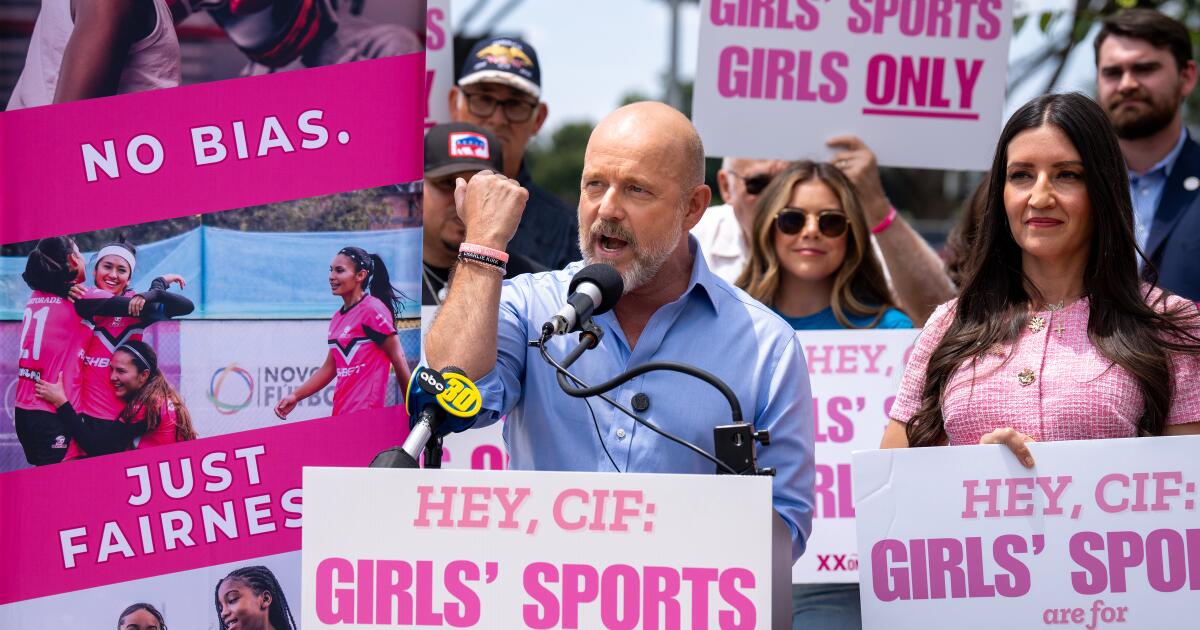
At the Supreme Court, the unfounded fear of boys masquerading as girls in youth sports rolled the clock back on gender equality.
On the surface, the Supreme Court’s June 30 opinion upholding state laws barring transgender girls from women’s and girl’s sports teams looks like a victory for women’s rights.
The 6-3 opinion by Justice Brett M. Kavanaugh certainly presents itself that way. “Females and males have inherent physical differences relevant to athletic performance,” Kavanaugh wrote. “Therefore, in contact sports, forcing female athletes to compete against males can create significant safety risks.” He also asserted that “forcing female athletes to compete against males can undermine competitive fairness.”
The ruling applied to prohibitions enacted in Idaho and West Virginia against “biological” males’ participation on women’s teams in public schools. Federal judges in both states overturned the bans. The Supreme Court majority restored them. The ruling essentially upholds similar bans enacted in 25 other states.
There was no record of any transgender person participating in school sports in the State, let alone any ‘problem’ with transgender students … creating unfair competition or unsafe conditions.
— Justice Sonia Sotomayor, demolishing the Supreme Court’s argument in favor of banning transgender girls from girl’s sports
Kavanaugh, like Donald Trump and others in the anti-transgender camp, maintained that one’s gender is an immutable fact of life, established even before birth.
Anything else, Trump stated in an executive order he issued on inauguration day 2025, could only be the product of “gender ideology extremism.” The U.S., his order stated, recognizes “two sexes, male and female. These sexes are not changeable and are grounded in fundamental and incontrovertible reality.” That’s a “biological truth,” he declared.
In his own version of this overconfident and factually insupportable conclusion, Kavanaugh wrote: “As all agree, females and males have inherent physical differences relevant to athletic performance.”
Science recognizes that some people are “born with sex traits that don’t fit into typical male or female patterns,” to cite a discussion on the Cleveland Clinic web page on the topic “intersex.” The condition “may involve chromosomes, hormones, reproductive organs or genitals.”
From a psychological standpoint, medical science recognizes “gender dysphoria” as a real condition often requiring counseling and medical intervention such as the use of puberty blockers and hormones to stave off the development of secondary sex characteristics until the condition can be resolved.
No one disputes that there are physical differences between the sexes. Few would dispute that on average or even at the median, males may be bigger and more powerful than females, or that in certain contact sports the difference may be telling and on occasion dangerous.
But that’s not the same as asserting that the physical differences between males and females invariably mean that men will invariably prevail over women in all competitions or that their participation will endanger women.
The International Olympic Committee — in a policy statement Kavanaugh cited incompletely — says that in “most running and swimming events,” males have a 10% to 12% advantage over women. That’s a range that would accommodate the full spectrum of outcomes — transgender females win, cisfemales win, they tie. (The “cis” prefix denotes those living consistent with their birth gender.)
West Virginia and Idaho addressed this ambiguity by banning transgender women from all girls’ teams. So under their rules transgender girls can’t play football or soccer with cisgirls. But what’s the argument in favor of banning them from the 100-yard dash, or cross-country track, or diving, or archery?
But something else is going on here. The Supreme Court’s ruling was almost preordained, given the years-long campaign by conservatives to demonize transgender individuals as if they’re members of an alien species.
It will be recalled that during his presidential campaign, Trump spun a despicable fantasy in which children were kidnapped in school and secretly subjected to sex-change operations.
Trump’s executive order wiped out policies aimed at protecting transgender adults from discrimination. He moved to outlaw gender-affirming medical therapies for anyone under 19 by cutting off federal funding for healthcare institutions that provide such care.
He banned transgender individuals from serving in the military and ordered federal prison officials to move transgender inmates into the general populations consistent with their birth genders, which exposes them to physical assault. (Federal Judge Royce Lamberth of Washington, D.C., has blocked the government from transferring three transgender women into the male prison population or terminating their hormone treatments.)
I wrote during Trump’s first term, when his anti-transgender policies were still gestating, that the goal was to show that “one can target any community, as long as it doesn’t have a strong political voice or political power. These are the actions of bullies and cowards, pretending to be strong.”
Last year, the Supreme Court struck its first blow against transgender rights by upholding a Tennessee law banning transgender care, including puberty blockers and hormone therapy, for minors. Similar laws have been enacted in 25 other states. The majority in that ruling by Chief Justice John G. Roberts Jr. was identical to the one in the June 30 ruling — Roberts, Kavanaugh, and Justices Clarence Thomas, Samuel A. Alito Jr., Neil M. Gorsuch and Amy Coney Barrett.
Who are the targets of this ideological campaign? They number only about 1.6 million U.S. adults, or one-half of 1% of the U.S. population. About 300,000 adolescents ages 13 to 17, or 1.4%, identify as transgender, according to a study by UCLA School of Law.
In West Virginia, as Justice Sonia Sotomayor observed in her dissenting opinion, “there was no record of any transgender person participating in school sports in the State, let along any ‘problem’ with transgender students … creating unfair competition or unsafe conditions.”
In endorsing the flat bans directed at transgender women in Idaho and West Virginia, Kavanaugh argued that any attempt to implement case-by-case judgments of students’ requests to join sports teams inconsistent with their biological gender would create “an enormous practical and administrability problem.”
Is that so? That wasn’t the case in Maine, where the annual K-12 population is more than 170,000. There, a committee was charged with determining whether a student’s participation in a sport consistent with their gender identity but inconsistent with their biological sex would “result in an unfair athletic advantage” or present a risk of injury to others. The committee held 56 hearings from 2013 through 2021, or an average of seven per year. During the entire time span, only four involved transgender girls. (The outcome of those hearings couldn’t be learned.)
It was Maine’s policy, one might recall, that provoked a confrontation between Trump and Maine Gov. Janet Mills at the White House last year, when Trump threatened to withhold federal funding from the state unless it barred transgender students from competing on women’s sports teams. “We’ll see you in court,” Mills snapped.
Whether the Idaho and West Virginia laws genuinely protect girls from unfair competition is questionable. (The Idaho law is styled the “Fairness in Women’s Sports Act.”) In practice, the laws may subject women in public schools to “invasive sex verification procedures,” as educational expert George Theoharis of Syracuse University wrote after the court ruling.
They’re also based on a retrograde view of women as fragile creatures needing men’s protection, Theoharis wrote — “the same logic that has historically been used to justify excluding women from making their own healthcare decisions and girls from rigorous math and science; that physically demanding work is simply beyond them.” (There don’t appear to be any state laws barring transgender women from competing in men’s sports.)
Becky Pepper-Jackson, the plaintiff in the West Virginia case, in which she is identified only as B.P.J., is the only transgender girl who sought to join girl’s teams — track and cross-country — in the state. That was in 2021, just after West Virginia passed its law and she was about to enter sixth grade. She didn’t appear to pose any competitive risk to others on the track and cross-country teams she applied to join — her lawyers told the Supreme Court that on those no-cut teams, she “came in near the back.”
Anyway, she had not gone through male puberty, which theoretically might have endowed her with a competitive advantage, because she had been taking puberty blockers and female hormones.
Thanks to the court’s ruling, Sotomayor observed in a dissent joined by Justices Elena Kagan and Ketanji Brown Jackson, West Virginia can deny Becky access to school sports “because it thinks they have an inherent athletic advantage, even if the facts show that they do not.”
B.P.J., Sotomayor wrote, “cannot practice on girls’ teams, even if she would not take anyone’s spot in an eventual competition, even if everyone who tries out for the team makes it, and even if having the chance to participate could aid immensely in treating B. P. J.’s gender dysphoria.”
So whose interest was really protected by the Supreme Court?

An Orange County real estate investor accused of criminally defrauding an Arizona bank of nearly $100 million pleaded not guilty Monday and remains in custody.
Mahender Makhijani, 44, of Corona del Mar — who also was ordered by an arbitrator to pay $1.34 billion in a separate civil fraud case — was arraigned in Santa Ana federal court on two charges.
He is accused of bank fraud and making a false statement to a bank in a June 8 case involving a $100 million real estate loan made by Phoenix-based Western Alliance Bank. He was taken into custody on June 10.
Makhijani is accused of providing bogus collateral for the October 2024 loan now in default. In a civil lawsuit, Western Alliance said the outstanding balance as nearly $99 million.
Prosecutors say he falsified title insurance policies that showed the bank would have a first lien on the underlying collateral if the loan went bad, when in fact it did not.
A trial was set for August 11 before U.S. District Judge David O. Carter in Santa Ana.
Michael Schachter, his criminal defense attorney, did not respond to messages seeking comment.
In the civil case, an arbitrator in May ordered Makhijani to pay Laguna Beach real estate mogul Mohammad Honarkar $1.34 billion after ruling he had fraudulently induced him into a 2021 joint venture — and then wrested control and lost to creditors more than two dozen properties Honarkar had owned.
Makhijani has not been criminally charged in that case, but prosecutors alleged in an affidavit in support of the bank fraud charges that he used “force and threats” in his dealings with Honarkar and others — including taking over the landmark Hotel Laguna in 2023 that Honarkar was renovating.
Prosecutors sought to hold Makhijani without bail after his arrest.
The affidavit noted he is a legal Indian immigrant with a home and bank accounts in that country, has access to private jets and threatened to “run away” if caught in a difficult situation.
The request was denied and he was granted $500,000 bail.
However, Makhijani remains in custody after a hearing sought by prosecutors last month before Magistrate Judge Autumn Spaeth.
The judge declined to accept a $450,000 cashier’s check submitted by a Makhijani associate for the bail, finding insufficient proof the source of the funds was legitimate, according to court records.
Makhijani is not prominent outside Orange County real estate circles, but he established a thriving distressed-assets business over the last decade that attracted prominent Southern California real estate investors.
Prosecutors said it paid for a lifestyle that included two multimillion-dollar homes in Corona del Mar, a luxury apartment in Newport Beach and various luxury vehicles.
As of last month, prosecutors had not fully traced his assets, which they believe are not held in his name and some of which may be in India.
The businessman employed an array of shell companies and strawmen to sign documents on his behalf, and to stand in for him as operators of his companies, according to the affidavit.
Makhijani told an associate he took extra precautions because wanted to insulate himself from litigation and that “they were sharks in the distressed world who took advantage of people,” the affidavit stated.
-
 Lifestyle9 minutes ago
Why Gen Z is movie-maxxing : Pop Culture Happy Hour
-

 Technology19 minutes ago
Meta’s glasses will turn off the camera if you tamper with the privacy light
-

 World24 minutes ago
WATCH: Mike Waltz tells Cuban delegation ‘this is not Havana’ during heated UN speech
-

 Politics31 minutes ago
Abbott orders probe after Texas hospital advertises ‘birth packages’ in Mexico: ‘Citizenship is not for sale’
-

 Health39 minutes ago
Dr Oz warns Medicare scammers are stealing billions — and your personal information could be next
-

 Sports46 minutes ago
Donovan Mitchell signs massive $273M Cavaliers extension as LeBron James return speculation grows
-
Business54 minutes ago
Waymo reports teen riders for bad behavior and delivers them to the police
-
 Entertainment1 hour ago
Tito Double P seizes the spotlight with his latest album, ‘Acomodo’

