Business
Phillips 66 will shut historic Wilmington-area refinery complex

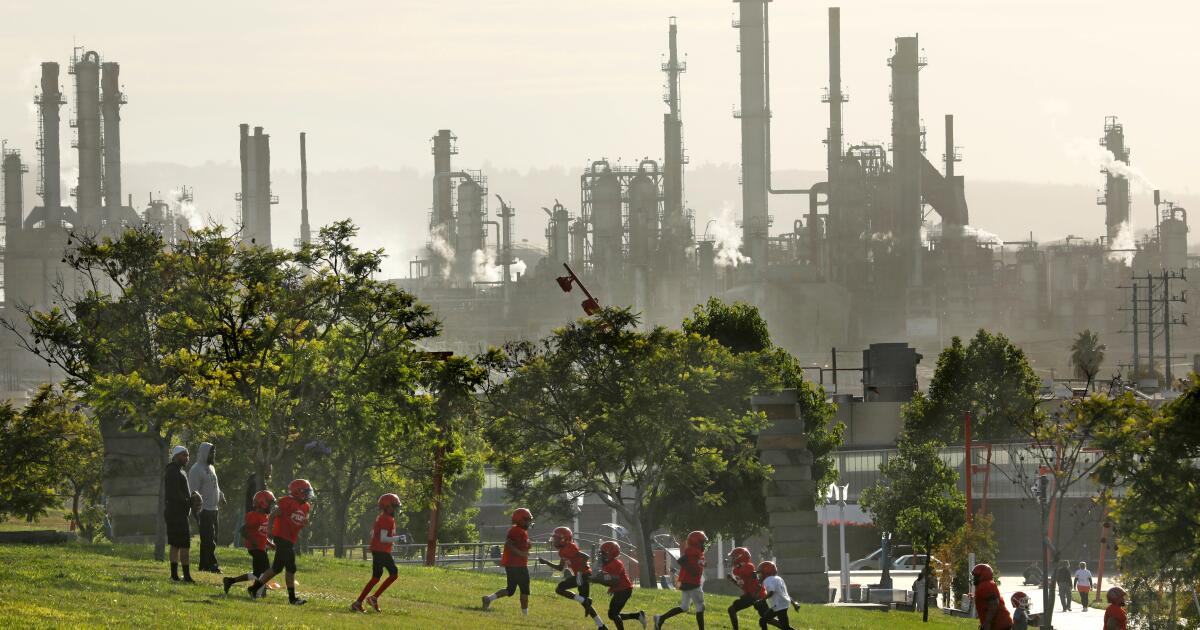
Phillips 66 announced Wednesday that it will shut its historic Wilmington-area oil refinery complex but will work with the state to continue supplying fuel to consumers.
The refinery near the Port of Los Angeles will cease operations in the fourth quarter of 2025, with the company saying it will replace its output with sources “inside and outside its refining network” and with renewable diesel and sustainable aviation fuels from a San Francisco Bay-area complex. The refinery contributes about 8% of the state’s gasoline supply.
“Phillips 66 remains committed to serving California and will continue to take the necessary steps to meet our commercial and customer demands,” said Mark Lashier, chairman and chief executive of Phillips 66. “We understand this decision has an impact on our employees, contractors and the broader community. We will work to help and support them through this transition.”
About 600 employees and 300 contractors currently operate the refinery, the company said.
The refinery complex consists of two facilities linked by pipeline located five miles apart in Wilmington and Carson, about 15 miles southeast of Los Angeles. The Carson facility was built in 1923 and the Wilmington facility was built in 1919, according to the company’s website.
“There’s no question we are going to lose refineries over time, because demand is going to go down as we transition to electric vehicles, but I did not expect to see any of them exiting this quickly,” said Severin Borenstein, faculty director of the Energy Institute at UC Berkeley’s Haas School of Business.
California “over the medium term” will now have to rely more on imports, he said. “I think part of the response the state’s going to need to consider is how to make sure that we can import sufficient gasoline to meet our needs.”
In announcing the closure, Phillips 66 said that the “long-term sustainability of our Los Angeles Refinery” was “uncertain and affected by market dynamics.” However, the closure immediately became a political football, with Republicans and gas station operators blaming the policies of California Gov. Gavin Newsom.
The announcement comes the same week the governor signed a new state law that allows the state to require oil refiners to maintain a minimum inventory of fuel to avoid supply shortages that create higher gasoline prices. It also authorizes the California Energy Commission to require refiners to plan for resupply during refiner maintenance outages.
“Thanks to Gavin Newsom’s showboating and incompetence, hundreds of workers will lose their jobs while California drivers will face a massive price hike,” Assembly Republican Leader James Gallagher of Yuba City said in a statement. “Great work, Gavin.”
The California Fuels and Convenience Alliance, an industry trade group representing fuel marketers, gas station owners and others, directly blamed the legislation.
“Unfortunately, the announcement today is not much of a surprise, as we continually warned the Legislature and Administration about how ABX2-1 would negatively impact supply,” said Alessandra Magnasco, the alliance’s governmental affairs and regulatory director. “This is exactly what happens when our leaders are more concerned with political theater than solving real problems.”
The association blamed higher gas prices on “exploding overhead costs to run our stations, costly environmental regulations.”
However, a spokesperson for Phillips 66 told Politico the announcement was not in response to Newsom’s signing the law.
The governor’s office referred questions to the California Energy Commission.
“The company has committed to minimizing impacts on Californians while they continue to meet fuel demands, maintain reliable supplies, and ensure they take necessary steps to fulfill both commercial and customer needs,” California Energy Commission Vice Chair Siva Gunda said in a statement.
Phillips 66 said it has has engaged Catellus Development Corp. and Deca Cos. to examine future uses for the 650-acre site.
“Historically, the South Bay industrial real estate market has been extremely tight and this will allow a ton of new inventory and capacity that should help the market by providing more warehouse and distribution space” around the Port of Los Angeles, said real estate broker Mike Condon Jr. of Cushman & Wakefield, who helped manage the process of selecting a development partner for Phillips 66.
The company, based in Houston, also has been the subject of controversy over its role in climate change, leading to calls for the removal of its iconic “76” sign at Dodger Stadium.
In the second quarter, Phillips 66 posted net income of $1.02 billion, down 40% from the same period a year ago. Shares have dropped 17% in the last six months. They closed Wednesday at $132.31, up nearly 1%.
Times staff writer Roger Vincent contributed to this report.






new video loaded: The Hidden Number Driving U.S. Job Growth
By Ben Casselman, Christina Thornell, Christina Shaman, June Kim and Nikolay Nikolov
February 13, 2026

Barbie manufacturer Mattel took a hit this week after its superstar doll failed to deliver.
The El Segundo company behind many of the world’s most iconic toys was walloped in the stock market — its shares plunged 25% Wednesday — after it announced that holiday-season sales were weak and that it expects another slow year.
It was overoptimistic about how many Barbies and other products consumers would want and had to slash prices to move them, even as it grappled with higher costs from tariffs, analysts said.
“2025 was marked by uncertainty,” Ynon Kreiz, chief executive of the company, said after earnings were unveiled Tuesday.
While Mattel’s Hot Wheels were hot, and its party card game Uno attracted new fans, Barbie has been struggling. Mattel’s Fisher-Price line, which makes educational toys for infants, toddlers and preschoolers, also lagged.
The doll and its many variants have been losing momentum since her latest 15 minutes in the spotlight following the 2023 hit movie “Barbie.” This year, Mattel says it will increase its focus on making more digital games and toys tied to movie franchises.
Last year, its net sales were about $5.3 billion, down 1% from the year before, according to the company’s unaudited financial statements. Its projection for this year also disappointed investors. The company lost close to $1 billion in market value as investors dumped its shares.
The movie that was the fun half of the “Barbenheimer” summer took in close to $1.5 billion at the box office and rejuvenated buzz around the 60-something Barbie, sparking more than $150 million in sales from dolls and other related products. At the time, it seemed to validate the toymaker’s strategy of turning its legacy brands into modern media properties, with live-action films. It has not been able to repeat that success yet, and that failure has weighed on its earnings.
Despite efforts to create buzz around the Barbie brand — including a diabetes Barbie and an autism Barbie — gross billings for Barbie products slid 11% last year, following a similar decline in 2024.
Mattel on Tuesday said it plans to double down on its strategy to become, as its CEO called it, an “IP-driven play and family entertainment business.” That means it wants to make more money from video games and movies.
Though toys are foundational to Mattel, the company said it is trying to broaden its reach by focusing more on content licensing and digital games, which tend to be more profitable.
Mattel has long worked with Disney to make princess dolls and has partnered with Netflix to make toys inspired by characters from the 2025 movie “KPop Demon Hunters.” The K-pop-inspired products will ship in the spring, and Mattel expects them to boost doll sales.
This week, it announced a deal to develop and market toys tied to the Teenage Mutant Ninja Turtles franchise, which is scheduled to have a new movie next year. It can also expect a jump in interest around its toys connected to the Masters of the Universe franchise and Matchbox brand, both slated to have movies this year.
“Success in our toy business will drive success in entertainment, and success in entertainment will drive greater success in toys,” Kreiz said. “We are looking to fully capitalize on this virtuous cycle.”
The company literally doubled down on one of its biggest bets on digital games.
Mattel announced plans to spend around $160 million to acquire the other half of mobile games studio Mattel 163, a joint venture between Mattel and the Chinese internet and video game company NetEase.
The studio has released four games based on Mattel’s intellectual property since it was established in 2018.
Mattel plans to make more “games based on Mattel IP that drive sustained engagement for fans,” Kreiz said in a statement.
The acquisition will temporarily impact Mattel’s bottom line but is intended to “accelerate growth in top and bottom lines in 2027 and beyond,” Kreiz said on the call.
For some, Mattel’s big plans to diversify away from toys haven’t been successful enough to spark confidence that the company can pull it off this year.
Morningstar analyst Jaime Katz said Mattel’s digital strategy has not panned out in the decade since company leadership started touting it.
“Every year we’re expecting the next year to be a growth year,” Katz said. “It looks now like we’re going to have another year where it’s stuck.”
Business
Disney to pay $2.75 million to settle alleged violations of the California Consumer Privacy Act

Walt Disney Co. will pay $2.75 million to settle allegations that it violated the California Consumer Privacy Act by not fully complying with consumers’ requests to opt out of data sharing on its streaming services, the state attorney general’s office said Wednesday.
The Burbank media and entertainment company allegedly restricted the extent of opt-out requests, including complying with users’ petitions only on the device or streaming services they processed it from, or stopping the sharing of consumers’ personal data through Disney’s advertising platform but not those of specific ad-tech companies whose code was embedded on Disney websites and apps, the attorney general’s office said.
In addition to the fine, the settlement, which is subject to court approval, will require Disney to enact a “consumer-friendly, easy to execute” process that allows users to opt-out of the sale or sharing of their data with as few steps as possible, according to court documents.
“Consumers shouldn’t have to go to infinity and beyond to assert their privacy rights,” Atty. Gen. Rob Bonta said in a statement. “In California, asking a business to stop selling your data should not be complicated or cumbersome.”
A Disney spokesperson said in a statement that the company “continues to invest significant resources to set the standard for responsible and transparent data practices across our streaming services.”
“As technology and media continue to evolve, protecting the privacy and preserving the experience of Californians and fans everywhere remains a longstanding priority for Disney,” the spokesperson said.
The settlement with Disney stemmed from a 2024 investigation by the attorney general’s office into streaming devices and apps for alleged violations of the California Consumer Privacy Act, which governs the collection of consumers’ personal data by businesses.
Under the law, businesses that sell or share personal data for targeted advertising must give users the right to opt-out.
Disney’s $2.75-million payment is the largest such settlement under the state privacy act, Bonta’s office said.
The attorney general has also reached settlements with companies such as beauty retailer Sephora, food delivery app DoorDash and SlingTV for alleged violations of the privacy act.

A dangerous nuclear moment : Consider This from NPR

Sanctuary policies let alleged child predator roam free until DHS made Portland, Oregon, airport arrest

Don Lemon defiant after pleading not guilty in Minnesota church case, vows he will ‘not be intimidated’

Former Jack Smith deputy involved in prosecuting Trump announces run for office

Newsom stop in key presidential primary state sparks more 2028 speculation

Florida High School Football Rankings: Top 25 teams – Oct. 21

Cleary's 21 help Le Moyne down Central Connecticut State 69-64 in OT

How old is Bo Nix? What to know about Oregon quarterback ahead of 2024 NFL Draft

99th annual Pony Swim held in Virginia

Indiana Members Credit Union announced as new anchor tenant at Bottleworks District
A dangerous nuclear moment : Consider This from NPR

Video: Pride Flag Returns to Stonewall, Defying Federal Order

DHS shutdown explained: Who works without pay, what happens to airports and disaster response

More than 5,000 ISIL detainees transferred from Syria, says Iraqi ministry

Second US aircraft carrier is being sent to the Middle East, AP source says, as Iran tensions high
-

 Politics1 week ago
White House says murder rate plummeted to lowest level since 1900 under Trump administration
-

 Alabama6 days ago
Geneva’s Kiera Howell, 16, auditions for ‘American Idol’ season 24
-

 San Francisco, CA1 week ago
Exclusive | Super Bowl 2026: Guide to the hottest events, concerts and parties happening in San Francisco
-

 Ohio1 week ago
Ohio town launching treasure hunt for $10K worth of gold, jewelry
-

 Culture1 week ago
Is Emily Brontë’s ‘Wuthering Heights’ Actually the Greatest Love Story of All Time?
-

 News1 week ago
The Long Goodbye: A California Couple Self-Deports to Mexico
-

 Politics1 week ago
Trump admin sued by New York, New Jersey over Hudson River tunnel funding freeze: ‘See you in court’
-
 Science1 week ago
Tuberculosis outbreak reported at Catholic high school in Bay Area. Cases statewide are climbing