Sports
Surviving and thriving in the nastiest spot on NHL ice


You gotta want it, right? That’s what they always say, “they” being the NHL players who dare tread into the lawless border between slot and crease, the coaches who send them there, and the fans in the 300-level relentlessly calling for blood.
It’s about desire. It’s about a willingness to take the punishment, and an eagerness to dole it out. It’s about fearlessness and an almost wanton disregard for life and limb. That’s where the pain is, yes — the cross-checks to the back of the head, the slashes to the ankles, the elbows to the gut — but that’s also where the goals are. They’re called the scoring areas for a reason. They’re called the dirty areas for a reason, too. Pay the price, reap the reward. A red light is worth a black-and-blue every single time.
Easy to say that, of course. A tad more difficult in practice. Ever turn your back on an angry giant with a weapon in his hand? Ever step in front of a frozen projectile traveling at triple digits?
Ever do both at the same time?
“It’s scary at first,” Nashville Predators forward Filip Forsberg said. “When you had Zdeno Chara behind you and Shea Weber shooting it at you — that’s the best of both worlds right there.”
Yes, it takes guts to work the net front in the NHL. But it’s facile, folly even, to say it’s simply about who wants it most. There’s a true art to working the net front — for the forwards trying to create havoc, the defensemen trying to prevent havoc, and the goaltenders trying to see through the havoc. It requires courage, sure. But it also requires precision timing, exquisite hand-eye coordination, uncanny instincts, physical fortitude and quick thinking.
And yes, a bit of a nasty attitude doesn’t hurt. Hey, gotta want it, right?
“It’s always chaos,” Colorado Avalanche defenseman Cale Makar said. “But you’ve just got to try and make it a little bit of controlled chaos.”
The defensemen
Let’s start not with the trespassers but those patrolling the fence line.
For defensemen protecting the crease, it’s much more complicated than simply outmuscling an intruding forward — though that’s certainly part of it. It starts with picking your battles. Or more accurately, when to battle.
Just because a forward is in front of the crease doesn’t mean it’s time to start jockeying for position. As a defenseman, you have to conserve energy for when you truly need it. So if the puck is wedged between a slew of skates and sticks in the corner, you merely keep an eye, not your whole body, on that forward lurking in the goal mouth. Otherwise, you’ll tire yourself out before the real fight begins.
Former Chicago Blackhawks coach and 21-year NHL defenseman Luke Richardson made a point of having his blueliners — particularly his smaller, more offensive-minded ones — watch video of Toby Enstrom and Kimmo Timonen, a pair of 5-foot-10 guys who protected the crease from power forwards who outweighed them by 20, 30, 40 pounds while conserving enough energy to exit the zone and maintain possession once they did, rather than just dumping the puck and going for a line change. Enstrom and Timonen would use their stick as a spacer more than a weapon. Or they’d stick their arms out and stiffen them, forcing forwards to go around them, making them expend just a little more energy and just a little more time before getting themselves planted. Every fraction of a second counts when forwards are looking for drive-by tips and screens.
Now, once the puck skitters free, or you sense that a shot is coming, it’s time to start boxing out.
But wait a second, dumb question — how do you box someone out on slippery ice?
“It’s turning your skates,” Blackhawks defenseman Connor Murphy said. “You can actually dig in more than you can in shoes because of your edges, if you turn them outwards. So you plant your feet sideways — duck-footed, or whatever it’s called — and you can be tough to move. Sometimes, if a guy’s coming at you from the side, you just kind of lean into them and wait for the right time to push off of him to get the rebound. It’s all just feel and strength, really.”
Five-foot-10 Kimmo Timonen (44) made a living boxing out much larger players, such as 6-3 Patrick Maroon (62). (Jim McIsaac / Getty Images)
Getting there first is key, too. Better to be the guy trying to stand still than the guy trying to move the guy trying to stand still. Anticipate the play, get into position, jam those skates into the ice, get a strong and wide base and dare the other guy to dislodge you.
This, of course, is where the nastiness begins — jockeying for position can mean a light shove or it can mean a full-on two-hander to the spine. Back in Richardson’s time, it got truly violent among that amorphous mass of bodies. How violent?
“As violent as I was allowed to be,” Richardson said. “(But) you would be careful who you’re up against. I might not have been as violent against Bob Probert as I was against a smaller guy that wasn’t as tough.”
It went far beyond the usual two-handed shoves in the back that you still see today.
The can-opener — wedging your stick between the forward’s legs and either dumping them to the ice or maneuvering them around like a marionette — was popular in Richardson’s time. And good luck to the knees and ankles of any forward in the 1980s who got close enough to a Ron Hextall or a Billy Smith, who’d take their big goalie paddles and chop a forward down like a lumberjack.
That stuff is all verboten today. These days, even especially aggressive cross-checks will get you two minutes. With rising slap shots screaming toward the goal mouth, a poorly timed — or well-timed, depending on how old-school you are — cross-check can put a player’s face right into the line of fire. For obvious reasons, the league doesn’t like that.
“The game has changed,” Vegas center Tomáš Hertl said. “Hockey got a lot smaller, guys got a little faster. I got into the league when it was still Chara and Weber. It was different — there were big, strong guys and they could break their stick over your back. It’s changed, but it’s still not easy in there. The next morning, you still feel it.”
Modern defensemen have to find subtler ways to hinder a forward’s ability to tip a point shot, redirect a slap pass or pounce on a rebound. A quick stick is critical. Most intentional deflections happen on the ice, so Murphy said he’s usually trying to get his stick underneath the forward’s stick and lift it off the ice. On the flip side, when a forward intentionally raises his stick as a shot is on its way, the defenseman’s instinct is to whack it down back to the ice with his own stick or use his body to angle the player away from the net. Whatever the forward’s trying to do, don’t let him do it.
Of course, the more bodies in that net-front battle, the harder it is for a referee to see what’s really going on in there.
“I wouldn’t say it’s like free game in there,” Makar said. “But you’re still going to do anything to keep the puck out of your net. If that means grabbing a guy’s stick or something, you try to do that.”
There is another option — leave the scrum entirely and try to step in front of the shot yourself. That involves unspoken communication with a defensive partner and a trust level with the goaltender. Some goalies love it when a defenseman sacrifices his body for a blocked shot. Other goalies want a clear line of sight to the puck and would prefer to handle it themselves.
So, get there first. But monitor the puck closely so you don’t waste energy. Make sure you and your defensive partner know which forward is his and which one’s yours. Then, decide if you want to fight for position or block a shot. And if you choose to fight, determine whether the forward is going for a deflection — and what type — or if he’s looking to roll off and pick up some loose change around the net. And don’t get a penalty, but be sure to get away with whatever you can.
Oh, and process and accomplish all that in a second or two. Maybe three.
“It’s instinct,” Murphy said.
“It’s fun,” Makar said.
The forwards
Washington’s Tom Wilson can’t exactly articulate what it is that makes him effective in front of the net. It all happens too fast, too chaotically, to distill into an easily digestible soundbite that accurately conveys the experience to a layperson.
“A lot happens really quickly — we’re talking tenths of a second, pucks flying,” said Wilson, a quintessential example of what seems to be a dying breed in the NHL — the power forward. “It’s a hectic game. A lot of the best players around the league are able to slow it down and make plays.”
He was talking about extraordinary tippers like Joe Pavelski and Chris Kreider. Or quick-twitch rebound guys such as Anders Lee and Sean Monahan. Or guys with an innate ability to plant themselves in just the right spot along the blue paint for redirects and tap-ins, such as Zach Hyman and Tyler Bertuzzi.
But in the anarchic area in front of the net, sometimes skill is overrated. Being an agent of chaos can be just as effective. Maybe not like Sean Avery turning his back on the play and waving his arms in front of Martin Brodeur like a basketball player guarding an inbound pass, but, well, not not like that, either.
“There are times where maybe it’s part of my job to make it a little bit crazy,” Wilson said. “I try to thrive in that environment. That’s hockey.”
This is what players mean when they say they want to “take the goalie’s eyes away.” It’s bodies in the way, it’s arms and sticks flailing, it’s planting yourself a millimeter outside the blue paint, your backside taking up as much of the goalie’s field of vision as possible.
“Goalies are so good now, so you need to do that,” Forsberg said. “You need to find any advantage, even if it’s just causing some kind of distraction.”
As for the rest of it, it’s a lot of the same things and thoughts defensemen are working through — just in reverse. Navigate the towering trees, avoid getting mauled, keep your stick on the ice, and get in the way as much as possible. For big guys like Wilson, who is 6-4, 220 pounds, it’s often about brute strength. For smaller forwards, it’s about using your lack of size to your advantage — whether that means using your lower center of gravity to knock bigger defensemen off balance or squeezing through tight spaces and finding open ice.
Utah’s Clayton Keller used to be hesitant to get too involved in the goal mouth. But once he started scoring goals from there, it got a lot less intimidating.
“For a guy like me, a smaller guy, I try to spin off guys, and that’s when you get the rebound, or sometimes you get the tips,” Keller said. “But for a smaller guy, it’s mostly about arriving at the right time and not always standing there. Being around it and getting used to it is the most important thing. That’s where a lot of the goals are scored.”

Veterans such as Corey Perry can dig into their deep bag of tricks in front of opposing goalies. (Jason Mowry / Getty Images)
Savvy forwards can take advantage of the clutter and get away with bending the rules, too. Richardson pointed to a game last February in which Edmonton’s Corey Perry flat-out slashed the stick out of the hands of Anaheim goalie John Gibson, leading directly to an Evander Kane goal. The rules can be very different for a young guy versus a crafty veteran.
“Some guys get away with things because they’ve been around a long time, and they have relationships with the referees that the young guys don’t have,” Richardson said. “You’ve got to play that card, too. If you’re a younger guy trying to earn your stripes, play fair and don’t bark at the referee.”
When Alex DeBrincat first broke into the league, he was regularly getting into physical battles in front of the net, often leading to full-blown scraps after the whistle. Despite being 5-8, tied for the shortest player in the league, DeBrincat too often went toe-to-toe with some of the league’s biggest, strongest players.
He’s a little wiser now at 27 years old.
“I was a little bit more frisky earlier in my career,” he said. “But it’s just playing hockey. I’ve done it for so long, it’s just kind of second nature. I’m not always right in front of the net, but when I am, I’m just trying to get an edge on the other guy and trying not to get pushed out of the net. Sometimes I get a little angry, but usually I’m trying to stay out of the box. I like scoring goals better than fighting.”
The goaltenders
The Boston Bruins’ Jeremy Swayman is 6-3, 195 pounds. By most standards, he’s pretty big. By modern hockey goalie standards, he’s average at best.
“I’m still growing, trust me,” he said. “We’ll get there one day.”
There are 240 forwards and defensemen who have played in the NHL this season who are 6-3 or taller. And very often, several of them are standing directly in front of him while the puck is moving along the blue line. So eight years after arriving at the University of Maine as a scrawny, somewhat short goalie, he’s still trying to see over people’s heads so he can do his job.
“As a freshman, I had to find ways to find and track that puck because these defensemen and forwards were so good at tipping pucks, so good at sifting pucks through,” Swayman said. “And obviously, the forwards in front of me are using their bodies to take away the goalie’s eyes. So I still love bobbing and weaving. I’m probably a little more physical than most goalies, too, making sure I see the puck. Because at the end of the day, I don’t care how it’s done, I just want to see the puck.”
At 6-4, Detroit Red Wings goaltender Cam Talbot tries to peer over the scrum, too. The New York Rangers’ Jonathan Quick is one of the few remaining goalies who likes to get low, coiling his body in the crease like a snake and peering through everybody’s legs. Whatever line of sight you prefer, being able to track the puck through all the traffic might be the most important skill a goalie can have.
And if that traffic backs into you a few times each possession, so be it.
“That’s what you sign up for, right?” Talbot said. “It’s their job to make it as hard on us as possible, and it’s the D’s job to help us out as much as they can.”

Goalies such as Cam Talbot rely on their defensemen as much as their defensemen rely on them. (Bruce Bennett / Getty Images)
You’d think communication between goalie and defenseman would be key, but it’s more of a luxury, really. The action’s happening too fast to truly divvy up responsibilities on the fly. There’s usually not even time for trash talk between opponents; that has to wait for the inevitable post-whistle skirmish. Talbot is more vocal than most, though, and has no trouble yelling at his teammates to get out of his way.
“They’re pretty good about it,” Talbot said. “And sometimes they come back and tap me on the pads and say, ‘Good, I didn’t want to eat that one, happy to let you take it.’”
Just as video review has made most forward-initiated contact with the goalie a thing of the past, those Hextall stick swipes have mostly disappeared, too. But if the swarm of bodies in front of the net seeps into the crease, it’s not uncommon to see a goalie take matters into his own hands and start shoving people out of his way.
And sometimes it’s not just the opponents.
“I’m color blind, so sometimes my own guys get in the mix,” Swayman said with a laugh. “Like I said, I don’t care how I get it done, I just want to make sure I see the puck.”
Shoves from behind. Shoves from ahead. Cross-checks to the back of the neck, butt-ends of sticks in the ribs, stick blades in the skates, gloves in the face. All while that hard chunk of rubber could be rocketing in — throat-high or knee-high or toe-high — at any moment.
No, it’s not glamorous at the net front. But when you do it right — whether it’s scoring a goal or stopping one — it’s totally worth it.
“It’s great in there,” Forsberg said. “OK, yeah, it’s awful sometimes. But when you get rewarded, there’s nothing better. Those are the best goals you can score. You earned those.”
(Illustration: Will Tullos / The Athletic; Photos: Maddie Meyer, Ethan Miller, Scott Taetsch, David Berding / Getty Images)



NEWYou can now listen to Fox News articles!
All eyes were on Caitlin Clark on Wednesday night as she made her anticipated return from injury in a road matchup in Los Angeles.
But instead of a triumphant comeback, the Fever spent the entire night chasing the Sparks as Clark’s rough return fueled a 106-92 rout.
The superstar never found a groove, looking completely out of sync in her return from a back injury.
STEPHANIE WHITE GIVES CAITLIN CLARK STATUS UPDATE AHEAD OF FEVER-SPARKS, BUT HER NEXT MOVE RAISES QUESTIONS
Caitlin Clark huddles with teammates as the Indiana Fever battle the Sparks. (Photo by Katelyn Mulcahy/Getty Images) ((Photo by Katelyn Mulcahy/Getty Images))
Much of that disjointed performance falls squarely on head coach Stephanie White, who kept Clark on a ridiculously tight leash by limiting her to just 16 minutes. The stop-and-go approach could have sabotaged any chance for the phenom to establish a rhythm.
Clark finished with just 9 points, 4 rebounds and 3 assists. Her minus-16 plus-minus told the story.
The Los Angeles Sparks were severely shorthanded, taking the floor without stars Kelsey Plum and Cameron Brink.
MERCURY’S NOW-DELETED SOCIAL MEDIA POST MOCKING CAITLIN CLARK DRAWS SCRUTINY AFTER STAR’S INJURY
Yet while a depleted Sparks roster played to win, Indiana spent the night over-managing its biggest asset.
With Clark on a minutes restriction and Aliyah Boston out of the lineup, Kelsey Mitchell was forced to shoulder the entire offensive burden.
Mitchell did her part, pouring in 29 points while shooting 5-of-9 from beyond the arc.
Caitlin Clark orchestrates the Fever offense as Indiana battles the Los Angeles Sparks in primetime action. (Photo by Katelyn Mulcahy/Getty Images) ((Photo by Katelyn Mulcahy/Getty Images))
But one hot hand couldn’t stop an efficient LA squad.
The Sparks shot 45% from three-point range, going 9-of-20 from deep to cruise to the 106-92 victory.
White’s next move is to sit Clark against the Mercury on Thursday while Boston returns.
CLICK HERE TO DOWNLOAD THE FOX NEWS APP
After Wednesday’s loss to a shorthanded Sparks team, it’s fair to question whether Indiana’s cautious approach is working. The Fever dropped to 12-9.
Caitlin Clark and Dearica Hamby face off as Fever and Sparks battle at Crypto.com Arena in Los Angeles. (Photo by Tyler Ross/NBAE via Getty Images) ((Photo by Tyler Ross/NBAE via Getty Images))
Send us your thoughts: alejandro.avila@outkick.com / Follow along on X: @alejandroaveela
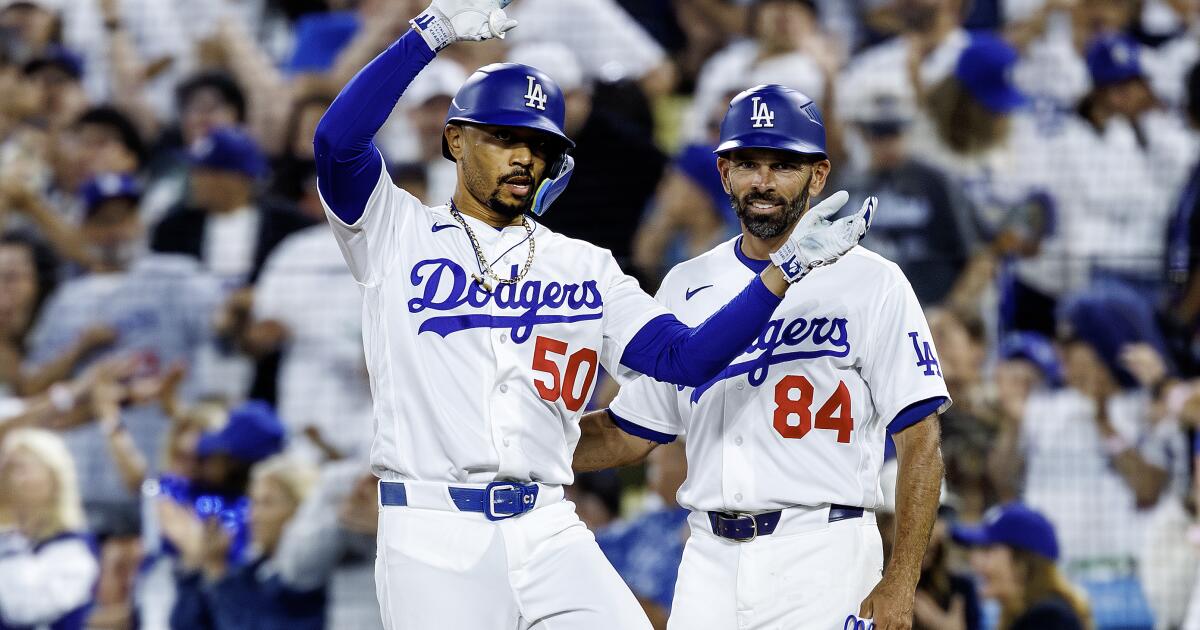
Mookie Betts’ first hit this series against the Rockies couldn’t have come at a more opportune time. With the crack of the ball against his bat, Tommy Edman scored from third, giving the Dodgers the lead.
And as Betts reached first, he pointed to Freddie Freeman, whose single put Edman in scoring position. It had taken a team effort to overcome another middling start from Roki Sasaki, and Betts, who had little to show before his game-winning hit, took the chance to highlight the joint contribution in the Dodgers’ 4-3 rubber-match win over Colorado (38-56).
“It feels great,” Betts said of his nine-pitch battle. “Helping the boys win, that’s really all it is. We play the game to win, and coming through in a big moment is kind of what, when you’re a kid, playing in the backyard, getting that hit is what you always strive to do, and fortunately, I was able to do it.”
Given a three-run lead in the first inning, brought to the Dodgers by a wild pitch and Kyle Tucker’s two-run, line-drive single to left field, Sasaki seemed set up for success.
Still, he gave away the lead as quickly as it came. In the second inning, he left a fastball too far over the plate, and third baseman Kyle Karros drove the ball over the left-center wall. The slider he dealt two batters later to second baseman Edouard Julien also crossed the zone too far over the plate, and Julien rounded the bases with another homer. In the third, a sacrifice fly by Mickey Moniak evened the scored, 3-3.
Sasaki’s troubles this season have been hard to pin down since his last win on May 23, as Sasaki tries to claw back the triple-digit velocity that’s escaped him as of late.
Against the Rockies, his fastball topped out at 99.1 miles per hour before steadily dropping to 98. He had managed five strikeouts in his six innings when manager Dave Roberts replaced him with Jack Dreyer, though the three earned runs couldn’t be ignored.
But Roberts also acknowledged the possibility that the pitcher had been tipping his pitches, possibly since he was playing in Japan, and Sasaki has tried to address it after a three-inning, six-run start last week. Even if he had fully self-corrected, his control issues remain. In the third inning, he walked the tying runner, Brett Sullivan.
“I’ve been working on a lot of things like the tipping stuff,” Sasaki said through interpreter Kensuke Okubo. “Also, I need to make quality pitches.”
Sasaki regained some of his confidence in the fourth when he worked out of a two-base jam with two strikeouts and a flyball to right, something that didn’t go unnoticed by Roberts.
“You can see the demeanor walking off the mound, the confidence,” Roberts said. “For me, it was more of let him end on a high note, feeling good about his outing, and then go from there.”
The Dodgers’ problems were compounded by Alex Call wasting the team’s two challenges in his at-bat in the first inning when the team had already taken the lead. And maybe it would’ve been excusable if Call had driven in the runners on first and second, but instead he ended the inning on a strikeout, stranding both. Roberts called the situation an “outlier” and didn’t feel as though he needed to have a conversation with Call regarding the situation.
After the three-run first, the Dodgers (61-33) remained hitless until Max Muncy laced a double down the right-field line in the sixth, though to little avail. As the innings ticked forward, Colorado’s chances seemed to increase. The Rockies hold the best league batting average (.297) in the eighth and ninth innings (the Dodgers are fourth with .268). And the Dodgers relievers, within the same constraints, have a 3.83 ERA — not bad, but not in the top 10 either.
Third baseman Max Muncy can’t get his glove on a line-drive double by Kyle Karros in the fourth inning.
(Gina Ferazzi/Los Angeles Times)
So when Alex Vesia struggled against the Rockies in the eighth inning and Muncy suffered a throwing error, Colorado seemed in position to score with the bases loaded and one out. Vesia struck out TJ Rumfield and Edgardo Henriquez (4-0), his replacement, retired Karros on a fly ball to right.
After Betts’ single allowed the Dodgers to take the lead, Tanner Scott (13) shut down the Rockies with back-to-back strikeouts, avoiding the team’s eighth series loss of the season.
“Didn’t feel great,” Roberts said. “Fortunately, we won a series, but that’s not the kind of way you want to do it.”
Sports
Justin Verlander announces he will retire after this season: ‘I’ve realized that time has come’

NEWYou can now listen to Fox News articles!
One of the greatest pitchers in the history of baseball will be hanging up his cleats after this season.
Three-time Cy Young Award winner Justin Verlander announced on Wednesday that the 2026 season will be his last.
Amid an injury-riddled season with the Detroit Tigers, Verlander decided it’s time to go.
Detroit Tigers pitcher Justin Verlander watches from the dugout during a game against the Chicago White Sox at Comerica Park in Detroit June 21, 2026. (David Rodriguez-Munoz/USA Today Network via Imagn Images)
“This season has challenged me in ways I haven’t experienced before, both physically and mentally. I’ve always believed that as long as I could compete at the level I expect of myself, I’d keep playing. I never wanted to retire because of a milestone, a number, or a date on the calendar. I wanted the game to tell me when it was time. Over the last several months, I’ve realized that time has come,” Verlander said in a social media post.
“While I’m fully committed to giving my team everything I have for the rest of this season, I’ve decided this will be my last. It’s fitting that I get to finish where it all started – with the Detroit Tigers, the organization that drafted me and gave me my first opportunity.”
Verlander inked a one-year deal with the Tigers, with whom he spent his first 12½ seasons before being traded to the Houston Astros, in the offseason. In Houston, he returned to dominance, winning both of his World Series titles and two of his Cy Young Awards.
“Baseball has given me more than I could have imagined. It taught me discipline, resilience, and the value of continuing to adapt and evolve. I’ve been fortunate to play with and against incredible players, for outstanding organizations, and compete in-front of fans who deeply appreciate the game,” Verlander added in his announcement.
Justin Verlander of the Houston Astros celebrates after the Astros defeated the Philadelphia Phillies in Game 6 of the 2022 World Series at Minute Maid Park Nov. 5, 2022, in Houston, Texas. (Mary DeCicco/MLB Photos via Getty Images)
PHILLIES STAR SAYS ‘BS RULE’ IS KEEPING HIM FROM BEING NAMED ALL-STAR IN FRONT OF HOME CROWD
“To every teammate, coach, player, clubhouse attendant, and fan who has been part of this journey – thank you. It’s been a privilege to share the field with you. To my family, especially my wife Kate, thank you for standing beside me through every season, every rehab, and every high and low. I couldn’t have done this without you. It’s time for the next chapter. But first, I’m excited to finish this season the only way I know how – with everything I’ve got.”
Verlander is the active leader with 3,554 strikeouts, which is good for eighth all-time. He needs 21 to surpass Don Sutton and 87 to pass Tom Seaver.
The 43-year-old made his MLB debut in 2005 and won the American League Rookie of the Year Award the following season in what was just a small glimpse of what was to come.
Verlander was a Cy Young Award finalist on four other occasions, consistently near the top of the leaderboard in just about every pitching stat. MLB Commissioner Rob Manfred gave Verlander a legend’s exemption to this year’s Midsummer Classic, making him a 10-time All-Star.
One could argue that Verlander should have at least one more Cy Young Award on his mantle, but he is on the fast track to Cooperstown and very much in the conversation to join Mariano Rivera as the only player unanimously elected to the Hall of Fame.
Verlander’s best season came in 2022, when he pitched to a career-best 1.75 ERA along with a 0.829 WHIP. However, that came after he missed the entire 2021 season due to Tommy John surgery for an injury he suffered after pitching just one inning in the abbreviated 2020 season.
Houston Astros starting pitcher Justin Verlander throws against the Boston Red Sox during the first inning Aug. 22, 2023, in Houston. (AP Photo/Michael Wyke)
CLICK HERE TO DOWNLOAD THE FOX NEWS APP
He won his first Cy Young Award in 2011, when he was also awarded the MVP Award, and his second in 2019. Verlander’s 11 seasons between his first and final Cy Young Awards are the second-most behind Roger Clemens, who had 18 seasons between his first and seventh.
Verlander led the majors in innings and WHIP four times while recording the most strikeouts in three seasons.
Follow Fox News Digital’s sports coverage on X, and subscribe to the Fox News Sports Huddle newsletter.
-

 Hawaii1 minute ago
Three West Hawaii sex offenders arrested – West Hawaii Today
-

 Idaho4 minutes ago
Idaho Power crews respond to outage affecting 2,163 customers in Canyon County
-
 Illinois16 minutes ago
As Illinois enters 10th year under Evidence-Based Funding model, equity remains an elusive goal
-

 Indiana19 minutes ago
FAIRFIELD NATIVE AND HIS WIFE FOUND DEAD IN THEIR NEWBURGH, INDIANA HOME
-

 Iowa24 minutes ago
From caviar nuggets to bison, 10 new Iowa State Fair food trends
-

 Kentucky34 minutes ago
Kentucky lawmakers hold town hall on AI data centers in Louisville
-

 Louisiana39 minutes ago
Norman C. Francis library naming honors Lafayette education legacy
-

 Maine46 minutes ago
Live updates: U.S. and Iran escalate attacks; jockeying starts in Maine after Graham Platner drops Senate bid

