Business
Hotel strike nears end as union reaches more tentative deals with holdouts

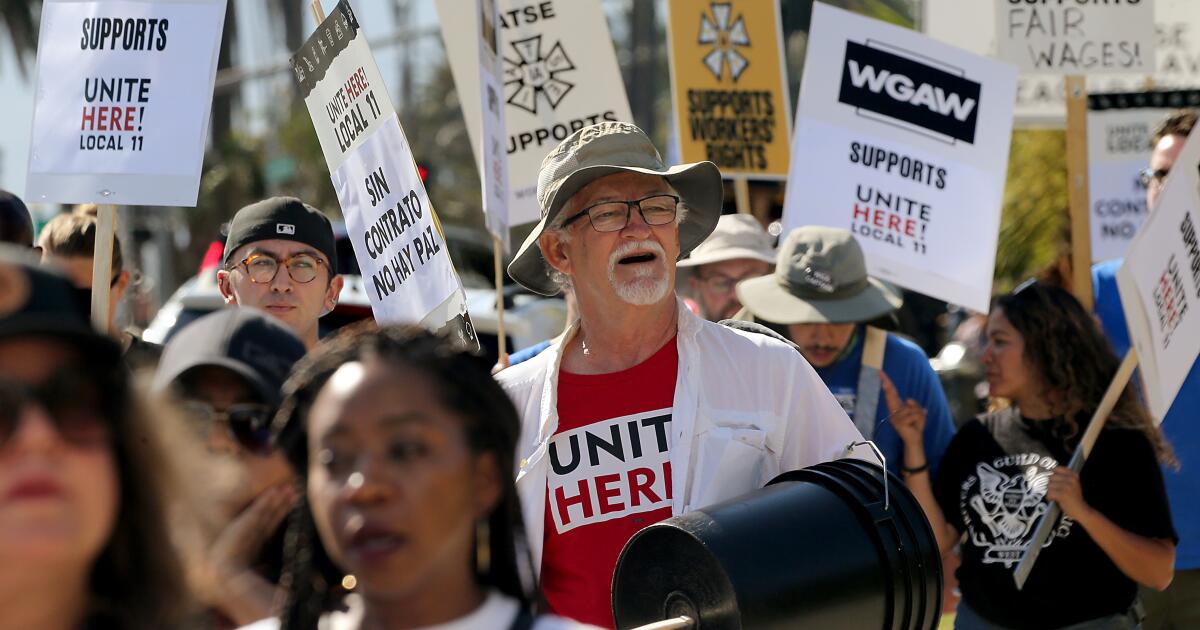
The almost 10-month-old strike that initially involved roughly 60 hotels and more than 15,000 workers in Los Angeles and Orange counties is nearing its end.
In late April, the powerful hospitality union Unite Here Local 11 announced it had reached tentative contract agreements with 12 Southern California hotels. And on Friday, Unite Here Local 11 officials said the union had negotiated agreements with six more local hotels in recent days.
So far, nearly three dozen other hotels have struck deals with workers over the course of on-and-off strikes that began in July. The new contracts awarded higher pay and other benefits to thousands of housekeepers, cooks, dishwashers, servers and front desk workers.
“Hotels are falling in line,” Unite Here Local 11 co-president Kurt Petersen said. “We’re winning more the longer this goes on.”
Stephanie Peterson, a spokesperson for Aimbridge Hospitality, which operates six area hotels that recently settled, said in a statement: “We are pleased to have reached an agreement with the Union that puts our people first, and we are taking the immediate steps to begin issuing the backpay our associates have been waiting for.”
The new contracts include an almost immediate raise of $5 per hour for workers who don’t typically earn tips, including front desk clerks, dishwashers and housekeepers. Those workers will see a total hourly wage boost of $10 over the course of the contract that expires in January 2028.
Hotel Figueroa, LA Grand and Glendale Hilton are among nine hotels whose owners remain in contract negotiations with the union.
A point of contention had been the practice of some hotels recruiting recent migrants living in a Skid Row shelter to replace striking employees.
In a compromise, four hotels agreed to give the migrant workers priority in hiring for permanent positions. The hotels include the Le Meridien Delfina Santa Monica, the Four Points by Sheraton, the Holiday Inn LAX and the Pasadena Hilton.
“This is a testament to the idea of no workers left behind,” Petersen said. “Our members saw workers exploited and had a sense of solidarity. The bosses’ plan to divide people didn’t work.”
As part of the union’s agreement with Sheraton Park Anaheim, workers who had raised allegations of sexual harassment and were banned from the property will be brought back to work.
Fairfield Inn & Suites and Aloft hotels in El Segundo, which are owned by a real estate affiliate of the Blackstone Group, also approved deals with the union.
Blackstone Group spokesman Jeffrey Kauth said, “The agreement substantially increases wages and benefits over the term of the contract and provides a framework to recognize a broader number of employees who will benefit from these increases. We are proud to continue our positive working relationship with the union.”
During months of strikes, tensions have spiked on picket lines at various hotels and have continued at some locations even after deals are struck.
Outside the Hilton Pasadena, a worker and two union members who were picketing were issued noise citations by local police and are facing criminal charges for using handheld bullhorns.
The union as well as advocates with the American Civil Liberties Union of Southern California sharply criticized the city for pursuing the charges at a Monday city council meeting.
Peter J. Eliasberg, chief counsel at the ACLU of Southern California, sent a letter May 15 to Pasadena’s City Council members, chief of police and city attorney urging the city to drop the charges, saying they “very likely violate the First Amendment and Liberty of Speech Clause of the California Constitution.”
Video footage captured by the union’s general counsel Jeremy Blasi, and reviewed by The Times, shows two police officers recording decibel measurements of several picketers on a public sidewalk a few feet away.
“The City supports the free speech rights of protesters and does not take sides in disputes, but must balance the rights of those protesting with those nearby residents and businesses impacted by protest activities,” said Lisa Derderian, a spokesperson for the city of Pasadena, in an emailed statement.
Pasadena Mayor Victor Gordo said the city planned to review issues raised by the ordinance, but said he couldn’t comment on the claims.
Long Beach Mayor Rex Richardson called the deal a “historic contract agreement that ensures hospitality workers will have the dignity of living wages and industry-leading benefits to support their families,” according to a Unite Here Local 11 news release in April.
“Over the next four years, as we prepare for the 2028 Olympics and welcome visitors from around the world to our vibrant Long Beach community, we can be proud that our local tourism economy continues to thrive, while placing value on the workforce that keeps our hospitality industry running,” Richardson said.


The race to bring air travel to the sky is heating up as Santa Cruz-based Joby Aviation and Toyota launch a joint venture to commercially produce air taxis.
The companies said in a news release Tuesday that they will work together on productivity, quality and costs and move toward mass production of Joby’s electric vertical takeoff aircraft. Joby and Toyota were first linked when Toyota made a nearly $400-million investment in the company in 2020. It has since increased its backing of the company to $900 million.
“It’s really meaningful for us to take on this challenge together with Joby, a partner that shares the same vision,” Toyota Chair Akio Toyoda said. “We believe this strengthened relationship is an important step forward in realizing the future mobility society.”
Joby‘s all-electric vertical takeoff vehicles are designed to hold four passengers and a pilot and can travel at up to 200 mph. The vehicle uses six tilting propellers to achieve vertical takeoff before switching to forward flight.
In February, Joby announced a partnership with Uber to start service in the United Arab Emirates this year, bringing on-demand air taxi rides to the country. It plans to expand to the U.S. after the completion of its final stage of Federal Aviation Administration testing.
Prior to its full FAA certification, Joby is hoping to launch early flight operations later this year as part of a White House program that will bring flights to several states, including New York, Texas and Arizona. Flights in California will not begin until after obtaining FAA certification.
Joby has been in a fierce battle to be the first with taxis in the sky with its Northern California competitor Archer Aviation. The two companies are involved in overlapping lawsuits, with Joby alleging corporate espionage against Archer, and Archer filing a suit alleging dubious ties to China that sparked an investigation into Joby by the U.S. International Trade Commission.
“Toyota has been by Joby’s side for nearly a decade, providing invaluable guidance and support as we built the foundation for manufacturing our aircraft,” JoeBen Bevirt, Joby’s chief executive and founder, said in the news release. “Together, we share a vision of making aerial mobility an everyday reality, and we look forward to delivering on that promise together.”
Joby Aviation’s shares, which have fallen more than 30% this year, climbed 3% on Tuesday to $8.92.
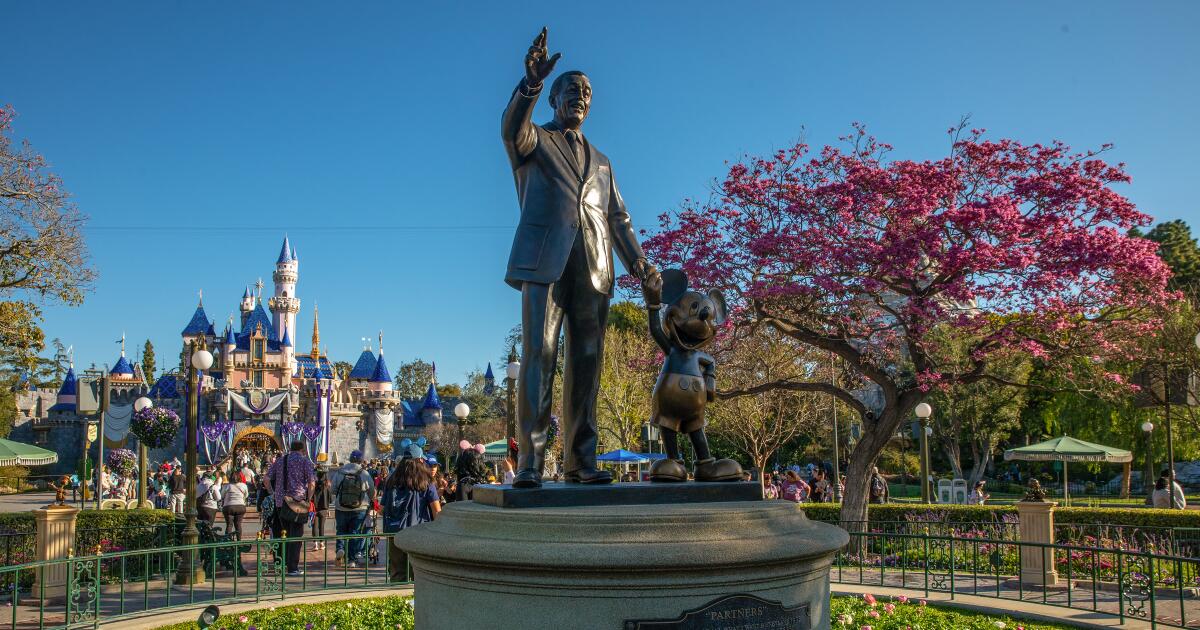
Disneyland Resort in Anaheim will offer $59 tickets for select evening admission to either theme park as part of a new promotion.
The one-day, one-park evening ticket offer will allow attendees to enter Disney California Adventure at 5 p.m. or Disneyland at 7 p.m. Park reservations are still required, as has been the case since the COVID-19 pandemic.
The offer only applies for admission from July 12 through Aug. 5 on Sundays to Wednesdays.
Disneyland Resort is commemorating its 70th anniversary through Aug. 9, and has introduced new shows and additions to rides as part of the occasion.
Walt Disney Co.’s theme parks and experiences business are a crucial boost to its finances, making up about 56% of the company’s operating income last fiscal year.
During the Burbank-based company’s most recent earnings call in May, Disney executives said attendance at its U.S.-based parks was down 1% compared with the prior year, a shift they attributed to “continued softness” in international visitations. However, the company said at the time that it was starting to move past those issues.
Disney’s experiences division reported $9.5 billion in revenue in that fiscal second quarter, up 7% compared with the same period a year ago, something executives said was due to higher guest spending domestically and more capacity on its cruise line.

An aging downtown office complex will be converted into apartments as part of an ambitious plan by local real estate companies to create 4,000 affordable housing units in Los Angeles.
The first project will be a $200-million makeover of the L.A. World Trade Center, a sprawling white elephant of an office complex on Figueroa Street built in the 1970s that will be turned into 512 apartments in one of the largest affordable housing conversions to date downtown.
Future projects being planned in the central city for delivery over the next five years will include other office-to-apartment conversions and new housing built from the ground up.
The 10-story World Trade Center, right, at Figueroa and Fourth streets in downtown Los Angeles, was built in the mid-1970s.
(Myung J. Chun / Los Angeles Times)
Behind the building campaign unveiled Monday are two of the region’s largest real estate companies, Jamison and Kennedy Wilson. Jamison is the city’s most prolific converter of offices to market-rate apartments and currently has a major makeover of a downtown office skyscraper underway for tenants who can pay top rents.
Kennedy Wilson, a real estate investment company based in Beverly Hills, owns Vintage Housing, which builds and operates affordable housing using tax credits and other state and federal financing to help fund it.
Vintage Housing and Jamison’s new affordable housing division, Arden Residential, will take on the campaign to build the housing where qualified tenants will pay rents below market rates.
Rents in the World Trade Center — which will be renamed Sky Castle when it opens in early 2028 — are expected to start at $937 for a one-bedroom unit. Some two- and three-bedroom units would rent for $1,100 and $1,300 per month, respectively, developers said.
Sky Castle will have shared amenities found in more expensive modern apartments, the developers said, such as a fitness center, resident lounge and co-working space. It already has six tennis courts on the roof, which may be converted to pickleball courts, Jamison Chief Executive Garrett Lee said.
The goal is to build higher quality affordable housing by using efficient construction methods Jamison has learned through building more than 8,000 market-rate apartments in the past, Lee said. The makeover of the World Trade Center will mark Jamison’s 15th conversion of an office building to housing.
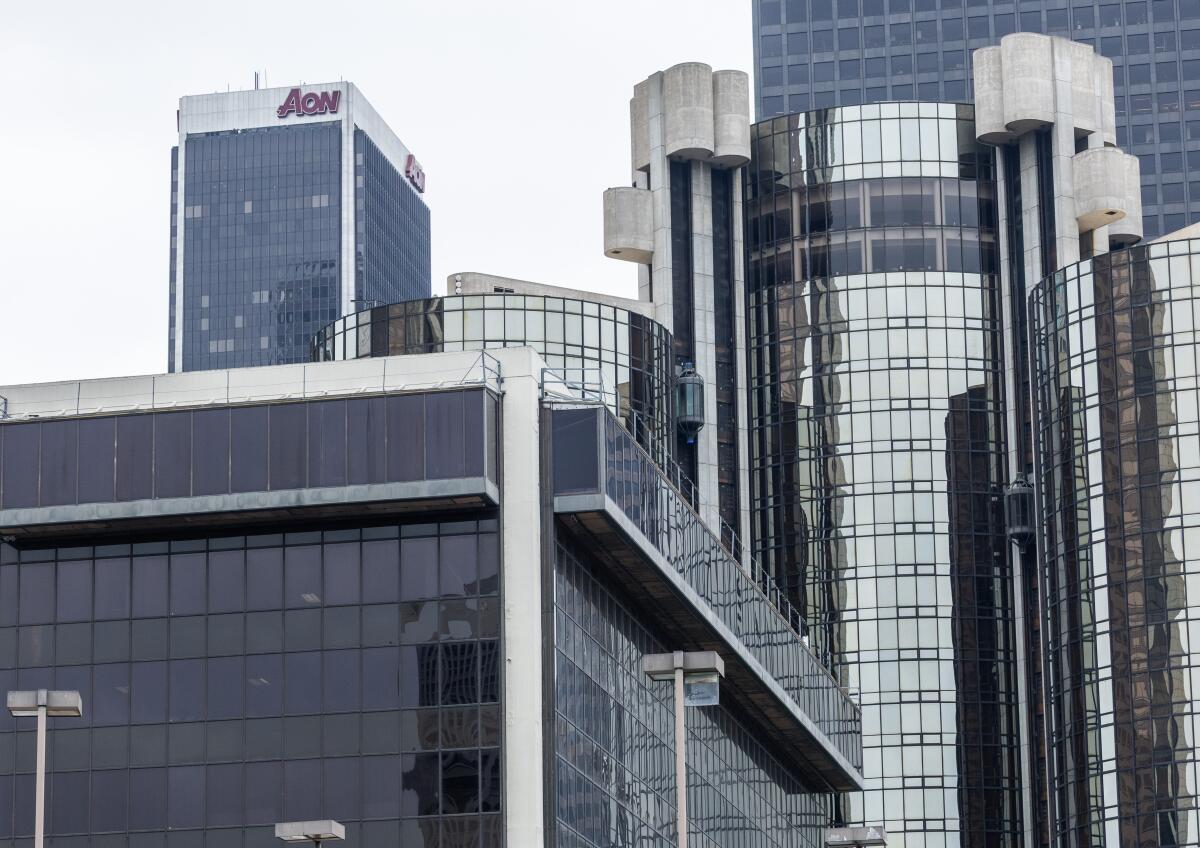
The plan to redevelop the L.A. World Trade Center, bottom left, is one of the largest affordable housing conversions to date downtown.
(Myung J. Chun / Los Angeles Times)
The 10-story World Trade Center was built in the mid-1970s to fanfare saying it would be home to international companies. In 1976, The Times described the center as a place to prepare for an overseas trip where visitors could get passports and visas, as well as exchange dollars for francs, marks, rubles and other currency. There was a language school and branches of U.S., Swiss and Japanese banks.
By the mid-1980s, the 400,000-square-foot office complex covering a city block at Figueroa and Fourth streets had lost its international flavor and was falling out of favor with corporate tenants who were moving into glossy new skyscrapers on Bunker Hill and in other locations.
The building has been cleared of remaining office tenants to allow work to begin in August, Lee said.
Kennedy Wilson is a nationwide operator of market-rate apartments that has also moved into building affordable housing in the last decade, said Nicholas Bridges, global head of capital markets at the company.
Building affordable, workforce housing “in almost all cases requires public subsidies,” Bridges said, and Kennedy Wilson has developed expertise in assembling “a cocktail of public financing sources” that includes low-income housing tax credits and tax-exempt bonds.
In the past, many housing developers have shied away from building affordable housing because assembling the subsidies needed to make construction profitable is challenging.

An artist’s rendering shows what the L.A. World Trade Center could look like after being redeveloped into affordable housing. The new complex is to be called Sky Castle.
(Ian Camarillo)
“It’s complicated,” Bridges said, “and not for the faint of heart.”
Eligible tenants must earn between 30% and 80% of the median income in the area where the housing is built.
Jamison and Kennedy Wilson will develop about 15 affordable housing projects between downtown and the 405 Freeway, Bridges said, many of them in aging office buildings such as the World Trade Center that are already owned by Jamison and are close to public transit.
Substantial potential for affordable housing lies in L.A.’s underused office buildings, he said.
“In this post-COVID world, the way people are utilizing office buildings, particularly older office buildings, has just fundamentally changed,” he said.
It makes sense for developers of conventional multifamily housing to move to building affordable housing, Lee said, because the government supports it through subsidies, zoning reform and the fast-tracking of construction permits. The city of Los Angeles also recently streamlined its adaptive reuse rules to make it easier to convert office buildings to housing.
“There are a lot of incentives pushing us in this direction,” Lee said.
-

 Detroit, MI4 minutes ago
5 Potential Landing Spots For Former Detroit Lions CB Terrion Arnold
-

 San Francisco, CA13 minutes ago
May 17 officially declared
-

 Dallas, TX19 minutes ago
Dallas City Hall named to World Monuments Fund’s ‘Irreplaceable America’ list – Lake Highlands
-

 Miami, FL26 minutes ago
Ex-con lists $138M in luxury penthouses, including Miami trophy condo
-

 Boston, MA29 minutes ago
Celtics reportedly trading Jaylen Brown to 76ers for Paul George, picks
-

 Denver, CO34 minutes ago
LeBron James to the Nuggets? Latest reports and betting odds
-

 Seattle, WA41 minutes ago
Residents and activists clash over plan to curb SEPA appeals at Seattle hearing
-

 San Diego, CA44 minutes ago
San Diego family celebrates UCSD graduation amid ICE fears

