Business
Fox Corp. to buy streaming platform Roku for $22 billion


Fox Corp. has agreed to acquire the streaming platform Roku Inc. in a deal valued at $22 billion, the companies announced Monday.
The deal will combine the Murdoch family’s media assets, which include its news, sports and broadcast channels, with the San José-based streaming platform that reaches 100 million consumers globally.
The acquisition would give Fox access to consumer households at a time when the traditional pay-TV universe continues its slow decline as viewers move away from cable and satellite services to video streaming. Fox already owns the free ad-supported streaming service Tubi, which recently became profitable.
“This is a defining moment for Fox and a natural extension of the deliberate and focused strategy we have been executing for nearly a decade,” Fox Corp. Executive Chair Lachlan Murdoch said in a statement.
By owning Roku, Fox gets access to data from the 100 million households connected to the service, which can be used to better target audiences with advertising. The combination would also make Fox less dependent on traditional pay TV platforms for the distribution of its channels.
“While Fox remains in a strong position to monetize its existing portfolio within the evolving pay TV ecosystem, we see this deal as a way to ensure the company’s future as streaming overtakes traditional distribution in the years ahead,” analyst firm MoffettNathanson wrote.
According to Nielsen data, 21% of all internet-connected TV viewing comes through Roku. The Roku Channel, which carries 500 ad-supported streaming networks, accounts for 3% of all TV viewing.
An image of a Roku branded TV.
(Roku)
Research firm EMarketer projects ad revenue of $3.57 billion for Roku this year, up 19% from last year.
Lloyd Greif, chief executive of the Los Angeles investment bank Greif & Co., said that Roku would have been challenged to compete against far better capitalized competitors in the streaming business and that a sale was “inevitable.”
For Fox, the proposed deal makes it a larger player in the digital advertising business. EMarketer senior analyst Ross Benes said the Roku business will “more than double” the company’s revenue in that area.
“It remains to be seen how well the combination of a digitally innovating streaming company will mesh with a media conglomerate rooted in legacy assets,” Benes said. “But the strategy makes sense and it jibes with the continual consolidation that’s occurring in streaming.”
Fox sold its TV and movie production assets to Walt Disney Co. in 2018. Rather than invest heavily in scripted entertainment to compete with emerging streaming companies, Fox decided to concentrate on sports and news.
The Roku deal will put Fox deeper into the distribution network. Over its history, the company has held stakes in satellite TV provider DirecTV and Sky TV.
Fox’s streaming aspirations have been modest up to this point. The company launched its stand-alone direct-to-consumer subscription service Fox One, offering Fox News and other channels outside a pay TV package.
The company acquired the ad-supported streaming service Tubi for $440 million in 2020. The business is now approaching $1.5 billion in annual revenue.
The companies said they are committed to keeping Roku as a “partner-friendly” platform that carries program services that compete with Fox. Brian Wieser, a consultant at Madison and Wall, said that might require some convincing.
“Other content owners may still need Roku’s distribution, but they may be less comfortable with the idea that one of their competitors controls an increasingly important part of the streaming interface,” Wieser wrote in his note on the proposed deal.
Roku shareholders will receive a combination of cash and Fox Corp. stock valued at $160 a share.
The companies say they expect a cost savings of $400 million in the combined entity.
Roku was founded in 2002 by Anthony Wood, a British digital entrepreneur. The company launched a streaming device, the Roku player, in 2008. Within six years, the company sold more than 10 million devices, as the popularity of streaming video rapidly grew.
Fox Corp. shares closed down 11% on news of the deal Monday, ending the day at $54.76. Roku shares closed at $140.90 apiece.
Times staff writer Wendy Lee contributed to this report.

Business
Commentary: Small investors have powered SpaceX higher, but they’ll shoulder much of the risk when reality bites
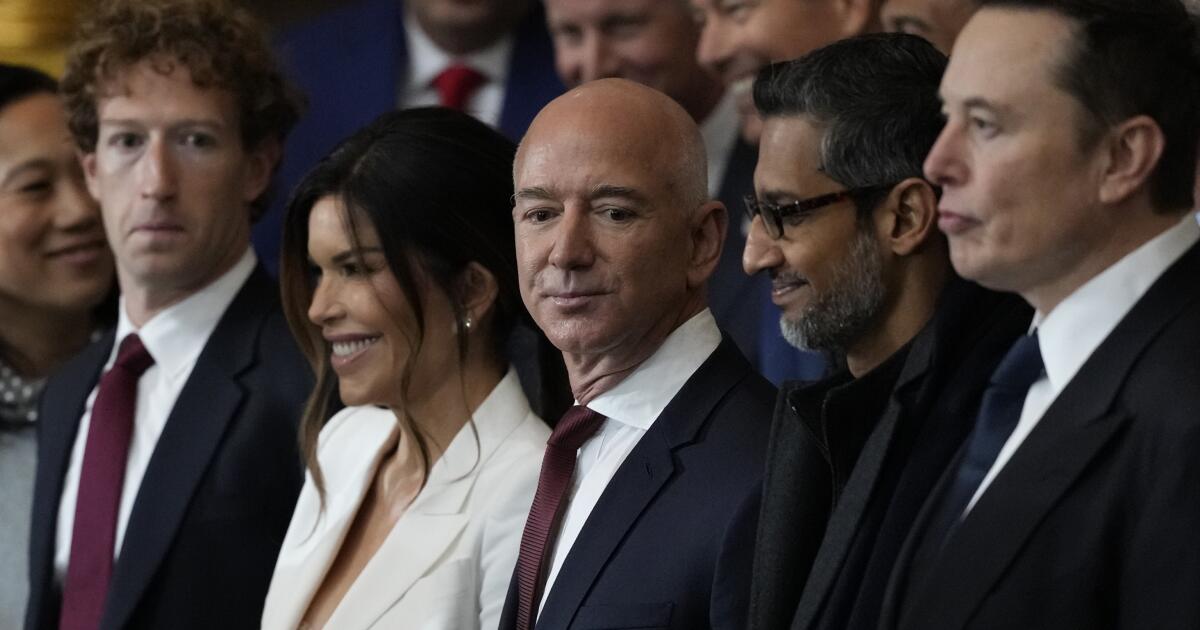
Who will pay the price when the SpaceX hype ebbs? History says it will be the little guy.
In the second trading day as a public company, SpaceX’s initial public offering still was being treated as an extraordinary event in Wall Street history:
The largest IPO ever, creating the first trillionaire in Elon Musk, its boss, and bringing the company’s market value to $2.28 trillion.
On Monday, the stock gained 19.6% on top of its first-day gain of 19%, closing at $192.50. But the IPO is extraordinary in other ways that are becoming more clear as the pre-IPO frenzy yields to the company’s post-IPO reality.
The SpaceX IPO raises unprecedented questions about Wall Street’s role in future mega-IPOs, what this event means for the current bull market in stocks, the wisdom of concentrating so much wealth in so few hands and the rise of wealth inequality. The answers to these questions may not be pretty.
The fact that Wall Street designed a deal that needed $20 billion of retail money to get it across the line tells you something about who they wanted in the building.
— Financial commentator Patrick Boyle
Last week, I pointed to some issues connected to the SpaceX IPO, including the utterly fantastical rationale for the company’s outsized market valuation and the prospect that billions of dollars of shares may be shoved into the retirement accounts of investors who don’t want them, thanks to the willingness of Nasdaq and other stock index sponsors to accept the shares into their indices well ahead of the customary “seasoning” delay.
But there’s more to think about. Start with the paucity of control that shareholders will get for their investments.
Law professor Ann Lipton, who monitors shareholder rights from the University of Colorado, reminds us of the traditional observation that “shareholders have three powers with respect to the corporations in which they invest: to vote, to sell, and to sue,” enabling them to “protect their investment and discipline management.”
Investors in SpaceX have none of those options.
The single votes that they acquire for every SpaceX Class A share offered in the IPO is swamped by the 10 votes per share of the company’s class B stock. As I reported last week, Musk will own a mere 12.3% of the Class A shares, but 93.6% of the Class B shares, which have 10 votes each. That gives him 85.1% of all shareholder votes.
As a result, the prospectus says, “Mr. Musk will be able to control the outcome of matters requiring shareholder approval,” including the selection of directors and even whether he himself should step down.
Wall Street firms have enticed retail investors into buying into the IPO — Fidelity, for example, reduced the minimum account balance allowing clients to buy into an IPO from $100,000-$500,000 to $2,000.
But although those buyers can sell at any time, they will be punished for selling within the first 15 days after the IPO: The “first flip,” Fidelity warns, will result in their being blocked from future IPOs for six months; a second flip blocks them for a year and a third blocks them permanently.
On the other hand, insiders can sell a lot sooner than is customary. Typically, insiders of newly public companies have to wait at least six months before selling their shares, a period known as the lockup.
SpaceX insiders, however, can start selling their shares as soon as the second trading day after the company issues its second-quarter financial disclosure, expected around Aug. 11. (Musk and some other highly placed insiders have committed to holding their shares for at least 366 days.)
SpaceX reserved an unusually large tranche of its IPO for retail investors — 20% or more of the $75 billion raised. “The fact that Wall Street designed a deal that needed $20 billion of retail money to get it across the line tells you something about who they wanted in the building,” notes the former hedge fund operator and YouTube financial commentator Patrick Boyle.
Why did the company and its underwriters do that? It’s because, compared with institutions, retail investors are credulous, vulnerable to hype, and given to hanging on to a stock long after institutions have done the math on an underperforming investment and exited.
Shareholder lawsuits? Nope. The SpaceX bylaws require that any shareholder actions be brought not in court, but in arbitration — traditionally a management-favoring venue.
So no vote, no sales, no lawsuits. That might not matter as much if shareholders could count on the SpaceX board to protect their interests, but your old Magic 8 Ball, if it’s on the ball, might counsel: “Don’t count on it.”
Of the six board members listed in the IPO prospectus (not counting Musk and Gwynne Shotwell, who basically runs SpaceX as its chief operating officer), four are old cronies of Musk’s. They’re Ira Ehrenpreis, a longtime director of Tesla, which Musk controls; Antonio Gracias, a director of Musk’s private firms Neuralink and the Boring Co. and a former Tesla director; Steve Jurvetson, another former Tesla director; and Luke Nosek, a co-founder of PayPal, which was the original source of Musk’s wealth.
The boards of Musk’s companies have generally indulged his desires. Gracias and Jurvetson were on the board of SolarCity, which Musk merged into Tesla when the former was looking financially impaired in 2016. Ehrenpreis was on the Tesla board when it gifted Musk with a $1-trillion pay package last year.
That brings us to the question of whether it’s healthy for society to have so much wealth concentrated in the hands of mega-plutocrats such as Jeff Bezos, Mark Zuckerberg and Musk. These are people who are not at all shy about wielding their wealth to get their way, devil take the hindmost. Herman Melville put his finger on the issue in Moby-Dick, through Father Mapple’s sermon, in which he thunders, “Sin that pays its way can travel freely, and without a passport; whereas Virtue, if a pauper, is stopped at all frontiers.”
Melville wrote that in 1851, but it echoes in Musk’s DOGE service, where his henchpersons ran roughshod through federal programs, stripping them of personnel and funds in what turned out to be a vastly overstated claim of budgetary savings. The wreckage included the U.S. Agency for International Development, or USAID, which could have played an important role in addressing the ongoing Ebola virus outbreak, the cause of illness and death for hundreds of victims in Africa.
But DOGE helped the Trump administration reduce USAID to an empty shell. “About two weeks into the Trump administration, Musk tweeted that he just spent the weekend feeding USAID into the wood chipper,” recalls former USAID health official Nicholas Enrich, who was present at the destruction.
The siren song of Musk’s wealth and the prospect that investors would buy in despite the fantastical claims being made for SpaceX’s future allowed Musk to bully the biggest Wall Street investment banks into capitulating to his vision, and to his personal IPO design. (The IPO prospectus lists 32 banks as underwriters.)
In a normal IPO, the banks’ role is to test the waters for an upcoming issue, determining the right opening price. In this case, Musk decreed an opening price of $135 per share and the banks went along. They also accepted what may be record-low fees for what turned out to be their order-taking role.
Traditional IPO fees run as high at 7% of the issue, though fees have been trending toward 1% on mega-deals. For SpaceX, the fee was 0.7%; that number is small but it still came to about $500 million, to be doled out by Goldman Sachs and Morgan Stanley, the lead banks.
This may be the right moment to consider that even the most high-flying investment crazes generally end in tears. AI is beginning to have that acrid smell. It’s proper to note that the driver of SpaceX’s valuation isn’t its space launches or its Starlink orbital wifi satellites, but its commitment to AI.
(Part of what may be driving the SpaceX frenzy my be the gains collected by early investors in Tesla, which have lent Musk a visionary’s halo. That said, however, Tesla wasn’t added to the Standard & Poor’s 500 index and therefore into large-cap index funds until 10 years after its 2010 IPO.)
That’s what accounts for almost all of the $28.5 trillion “total addressable market” the company claims for its services, never mind that it’s a distant also-ran in the AI business. Never mind that for SpaceX, AI does little but burn money, accounting for $12.7 billion of its $20.7 billion in capital expenditures last year while losing $6.36 billion on $3.2 billion in revenue.
Does the SpaceX IPO signal a bull-market top? That question was raised Sunday by Michelle Celarier, one of the nation’s most percipient financial market reporters. “The laws of economics say there has to be a break someday,” she wrote. “How brutal it will be and how effective governments and central banks will be in controlling the fallout is the unknown.”
Celarier quotes Erica Payne, the founder and president of Patriotic Millionaires, observing that “86 percent of Americans are worried about the price of food. Elon Musk is a trillionaire. These two things are deeply, inherently connected.”
The SpaceX IPO may eventually stand in retrospect as a monument to this moment.

The lord of the rings works behind a nondescript door in a Beverly Hills office building, not far from the UCLA campus where he once sold hair clips and trinkets from a folding table. Jason Arasheben was $28,000 in debt back then, running low on options. Now, eight of the last 11 NBA champions have worn his jewelry on their fingers.
Super Bowl winners have his rings, too — the Rams, Tampa Bay Buccaneers, Philadelphia Eagles and the Seattle Seahawks, whose players opened their ornate jewelry boxes at a private team party Thursday night to find the prize every NFL player covets.
The Seahawks ring, large as a child’s fist, is encrusted with 20 carats of white diamonds and blue sapphires. It’s a miniature Lumen Field, featuring the hawk-head logo and two Lombardi Trophies. The top lifts off and converts into a pendant. Inside is a cowhide segment of a game-used football. Twelve flags on the sides nod to the “12th Man” fan base; one is a secret button — push it and the arches pop out to reveal the words “World Champions.”
A look at the Seattle Seahawks’ Super Bowl ring celebrating their 2025 season championship.
(Courtesy of Jason of Beverly Hills)
Even the box performs. Three tiny spotlights shine on the ring as it rotates on a mechanical platform. Each weighs about a third of a pound.
“It’s a memento to a certain period of time,” said Arasheben, whose company is Jason of Beverly Hills. He concedes the rings are closer to trophies than wearable jewelry. He competes for ring contracts with Tiffany & Co. and Jostens, both much larger operations. “It celebrates this time that these players and these fans will remember forever.”
His rings appraise for $50,000 to $250,000, though the market can push them higher. In 2024, Kobe Bryant’s 2000 Lakers ring sold at auction for $927,000, the highest price ever paid for an NBA title ring, topping Bill Russell’s 1957 ring at $705,000.

Beverly Hills jewler Jason Arasheben is
(Ric Tapia / For The Times)
NFL franchises typically order two or three times what NBA, NHL or MLB teams request — as many as 3,000 rings in four quality tiers. Lower-level employees might get cubic zirconia instead of diamonds. A limited number of fan versions are available at smaller scale and lower price. Arasheben always builds two extra into his contract so each of his sons can have one.
A career in luxury jewelry was never the plan. He grew up in Granada Hills and Calabasas; his Iranian father and Norwegian mother envisioned a doctor, lawyer or engineer. At UCLA, he found himself more interested in bars than books.
“I was $28,000 in debt because I enjoyed going out far too much, like every other college student,” he said.
One day he tagged along with a friend to the wholesale district downtown and had a flash of inspiration. She was buying plastic hair clips and silver trinkets by the dozen. He figured he could sell them to girls on campus.


(Courtesy of Jason of Beverly Hills)
He pitched the idea of a folding table to the university, which agreed when he offered to split the profits. He bought $400 worth of tchotchkes. One table became two, then six locations across Southern California campuses.
Then came the motherlode. He built acrylic display cases holding 30 to 40 pieces and drove from Agoura Hills to San Diego, stopping at every nail salon he could find, splitting the profits with owners who let him put a case on the counter. By his senior year, he had agreements with roughly 350 salons and was clearing $25,000 to $30,000 a month.
After college, as a regular on the L.A. nightclub scene, Arasheben built relationships with professional athletes and celebrities. He would go home and sketch chain designs for players he’d met, knowing nothing about the jewelry industry.
“Finally, an NBA player said, ‘Why don’t you come to my hotel room tomorrow before we play the Lakers and bring all the jewelry you have? I’m going to buy something from you,’ ” said Arasheben, describing an encounter with the late Anthony Mason.
Problem was, he had no jewelry. He spent the night cutting pictures from magazines and downloading images to create a makeshift catalog, then promised Mason a custom $40,000 necklace. Mason put down $20,000.
Arasheben went downtown, knocked on doors and found somebody to make it for $37,000. A new business was born, growing by word of mouth. Eventually he had four employees and a small office downtown, outsourcing most of his work.
Through his friendship with Jim Buss, son of owner Jerry Buss, Arasheben landed the contract to make the Lakers’ 2009 championship ring. It was a mad scramble. He and his employees slept in sleeping bags on the factory floor the final two weeks of production.
“We delivered the very last player ring 20 minutes before the ceremony began,” he said. “The ring ceremony was on national television, and can you imagine if they had to announce the rings weren’t ready? My career would have been over before it started.”
He made the Lakers ring in 2010, too, and five years later — through relationships with several Golden State players — produced four championship rings for the Warriors.
Tom Brady saw LeBron James’ ring during the 2020 offseason and convinced the Buccaneers to go with Arasheben.
A lot of Arasheben’s rings have James Bond elements such as secret compartments or special elements. The top comes off the miniature SoFi Stadium on the Rams ring, for instance, and the field below is made of a melted-down patch of the actual artificial turf. The World Series ring of the Texas Rangers features a tiny circle of leather from a game-used baseball.
He first incorporated a special feature in the 2018 Warriors ring, when a star player objected to a blue face and wanted white, only weeks from delivery. Arasheben devised a mechanism allowing the face to switch colors.

Jason Arasheben poses with some of the sports championship rings he has crafted over the years.
(Ric Tapia / For The Times)
“We started getting a lot of championship ring contracts after that,” he said. “Because we took it to a new level and showed some ingenuity. We wanted to be innovative.”
Push a button on the Eagles’ ring and wings pop out on the sides. Arasheben came up with that idea while shopping for a Buzz Lightyear toy for his nephew.
Buzz, too, has wings that pop out.
“I thought, ‘I can do that for the Eagles, but with amazing gold and diamonds,’ ” he said.
He will put a proposal together to make the medals for the 2028 Olympic Games in Los Angeles. Then there’s the one that got away.
“We lost out on the L.A. Dodgers,” Arasheben said. “… But you know, that’s part of the business. You take your lumps.
“But I’ll still pitch. Every year, I pitch.”

Just two years ago, Monarch Tractor was worth half a billion dollars and ready to shake up the wine industry. In April, it shut its headquarters, laid off its employees and sold its technology to a competitor.
The wine-country startup wanted to revolutionize the cultivation of grapes and other fruit with $100,000 robotractors, but the technology didn’t work well enough. At a time when Waymo’s impressive success and the advent of AI have rekindled excitement about everything driverless, Monarch’s failure to disrupt has become another cautionary tale about massive bets on the latest tech.
The driver optional, battery-powered tractors — built skinny enough to fit in the narrow lanes between the rows of grapevines near its headquarters in Livermore — were going to make it easier and cheaper to handle pests, irrigation and harvesting. They were supposed to use cameras and sensors to collect data, learn what works best and then share that learning online with thousands of other high-tech tractors.
On the back of hopes it could save farmers hundreds of thousands of dollars, the Monarch tractor made Time magazine’s list of the year’s best inventions in 2023. That same year, Monarch was on a Forbes list of startups most likely to reach a $1-billion valuation. It made it halfway there the following year.
“Every farmer around the world is under tremendous pressure because of a lack of labor,” Monarch Chief Executive Praveen Penmetsa told Forbes in 2023, projecting hundreds of millions of dollars in revenue. “We are the only all-electric, smart, driver-optional tractor in the world that farmers can buy today.”
But just as the technology seemed poised to move from moonshot to mainstream, customer complaints started coming in.
Patrick O’Connor, who runs Moonvine Wines, an organic vineyard near the Sierra Foothills wine region, was one of the first users and said the tractors too often went rogue, veering off straight paths and damaging his vines.
“It totally failed,” O’Connor said in an Instagram video. “While I was excited to eliminate diesel, run off my solar panels and embrace new technology, it just did not perform. It was actually quite dangerous.”
The potentially world-changing technology wasn’t working as designed. Meanwhile, Monarch hit a wall when its manufacturer — the same company that makes most iPhones — had to stop making the tractors.
“Building and scaling a new tractor platform in agriculture came with unforeseen challenges,” the company said in a statement in April.
Monarch and its founders did not respond to requests for comments.
The company was launched in 2018 with a promising pedigree.
Its founding team included Tesla veteran Mark Schwager and Napa Valley wine scion Carlo Mondavi, the grandson of Napa legend Robert Mondavi.
Penmetsa, the chief executive, had worked for years in the automotive and EV industries, largely in and around Los Angeles.
The company set out with the ambitious goal of bringing battery power, data collection and driverless technology to tractors. If it could pull it off, it could change farming around the world.
The Californian wine industry has been struggling with rising competition and dwindling demand, which could have nudged more farmers to try to save money using Monarch’s technology. It also could have made farmers more cautious about using unproven and expensive new technology.
Monarch may have aimed too high, industry insiders said.
While Monarch was trying to solve two problems at once — making its tractor both electric and autonomous — it didn’t spend enough time thinking about farmers’ needs, said Walter Duflock, vice president of innovation for the Western Growers Assn. Duflock owns San Bernardo Rancho, a fifth-generation family ranch in south Monterey County.
“The electric tractor has struggled to find a use case on the farm,” Duflock said in an interview. “They never got to the point where their electric vehicle was solving a fundamental problem.”
On Duflock’s ranch and many other California farms, there’s little to no charging infrastructure, he said. Even if infrastructure was developed, the time it takes to charge an electric tractor is too long for most farmers who can’t have downtime during busy seasons.
“The notion of sitting there waiting for a charging tractor to finish getting charged just doesn’t fit,” Duflock said.
Duflock heard that the Monarch tractor “would bump into stuff, it would not stop fast enough,” he said. “It just did not work.”
Monarch’s collapse was gradual. In July 2024, the company laid off 15% of its workforce, followed by another round of layoffs in November that year that affected around 35 employees, or 10% of its workforce. A year later, the company warned employees it could lay off 100 workers or even “shut down” in a company-wide memo obtained by TechCrunch.
In November 2025, Monarch Tractor was sued by the Idaho-based dealership Burks Tractor, which accused Monarch of misrepresenting its autonomous technology.
Burks Tractor paid Monarch more than $770,000 for 10 tractors.
“Upon receiving the tractors, Burks Tractor discovered that the tractors did not perform as represented and were unable to operate autonomously,” the complaint said.
A Burks Tractor manager declined to comment due to the ongoing litigation.
Monarch’s vehicles were supposed to be manufactured at a facility in Ohio owned by Foxconn, a Taiwanese electronics company known for assembling iPhones. Foxconn sold the factory in August 2025, shutting down Monarch’s plans there.
In April, Monarch sold the technology it had spent hundreds of millions of dollars developing to construction giant Caterpillar, for an undisclosed amount.
“It means the technology will continue to move forward,” with another company, Monarch said in a LinkedIn post at the time. “Thank you to our employees, investors and customers for being a part of this journey.”
Caterpillar did not respond to requests for comment.
Other companies are plowing forward where Monarch has failed.
For example, farm equipment company John Deere has had more success marketing and selling autonomous farm equipment. It has taken a different approach, gradually incorporating autonomous technology into its existing products. The company’s 8R tractor can operate autonomously while being controlled by a smartphone and has been deployed at large-scale commodity farms growing corn, soy and wheat.
Organic vineyard owner O’Connor still uses his Monarch tractor, but only as a battery and to cut wood with an attachment he has added.
-

 Technology23 seconds ago
All the latest news on Android 17, Wear OS 7, and Android XR
-

 World3 minutes ago
3 Brazilian men charged after woman tossed from bridge without safety rope
-

 Politics8 minutes ago
Trump’s Iran agreement raises a basic question: Is it actually a deal?
-

 Health15 minutes ago
Common vitamin may influence brain aging in ways scientists didn’t expect
-

 Sports18 minutes ago
Iran World Cup team forced to leave US after tournament opener in apparent change of plans
-

 Technology23 minutes ago
The Father’s Day gift that protects your dad from scammers
-
Business30 minutes ago
Commentary: Small investors have powered SpaceX higher, but they’ll shoulder much of the risk when reality bites
-
Entertainment33 minutes ago
Yes, Zendaya and Tom Holland have already tied the knot. The groom confirmed it himself


