Business
Commentary: Small investors have powered SpaceX higher, but they’ll shoulder much of the risk when reality bites

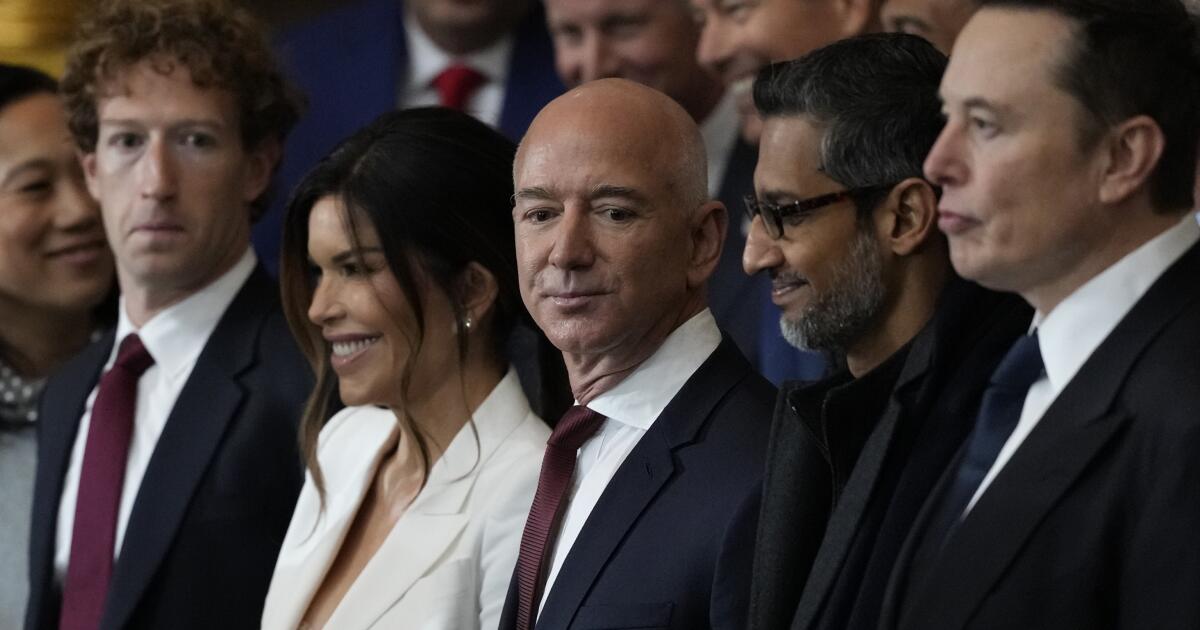
Who will pay the price when the SpaceX hype ebbs? History says it will be the little guy.
In the second trading day as a public company, SpaceX’s initial public offering still was being treated as an extraordinary event in Wall Street history:
The largest IPO ever, creating the first trillionaire in Elon Musk, its boss, and bringing the company’s market value to $2.28 trillion.
On Monday, the stock gained 19.6% on top of its first-day gain of 19%, closing at $192.50. But the IPO is extraordinary in other ways that are becoming more clear as the pre-IPO frenzy yields to the company’s post-IPO reality.
The SpaceX IPO raises unprecedented questions about Wall Street’s role in future mega-IPOs, what this event means for the current bull market in stocks, the wisdom of concentrating so much wealth in so few hands and the rise of wealth inequality. The answers to these questions may not be pretty.
The fact that Wall Street designed a deal that needed $20 billion of retail money to get it across the line tells you something about who they wanted in the building.
— Financial commentator Patrick Boyle
Last week, I pointed to some issues connected to the SpaceX IPO, including the utterly fantastical rationale for the company’s outsized market valuation and the prospect that billions of dollars of shares may be shoved into the retirement accounts of investors who don’t want them, thanks to the willingness of Nasdaq and other stock index sponsors to accept the shares into their indices well ahead of the customary “seasoning” delay.
But there’s more to think about. Start with the paucity of control that shareholders will get for their investments.
Law professor Ann Lipton, who monitors shareholder rights from the University of Colorado, reminds us of the traditional observation that “shareholders have three powers with respect to the corporations in which they invest: to vote, to sell, and to sue,” enabling them to “protect their investment and discipline management.”
Investors in SpaceX have none of those options.
The single votes that they acquire for every SpaceX Class A share offered in the IPO is swamped by the 10 votes per share of the company’s class B stock. As I reported last week, Musk will own a mere 12.3% of the Class A shares, but 93.6% of the Class B shares, which have 10 votes each. That gives him 85.1% of all shareholder votes.
As a result, the prospectus says, “Mr. Musk will be able to control the outcome of matters requiring shareholder approval,” including the selection of directors and even whether he himself should step down.
Wall Street firms have enticed retail investors into buying into the IPO — Fidelity, for example, reduced the minimum account balance allowing clients to buy into an IPO from $100,000-$500,000 to $2,000.
But although those buyers can sell at any time, they will be punished for selling within the first 15 days after the IPO: The “first flip,” Fidelity warns, will result in their being blocked from future IPOs for six months; a second flip blocks them for a year and a third blocks them permanently.
On the other hand, insiders can sell a lot sooner than is customary. Typically, insiders of newly public companies have to wait at least six months before selling their shares, a period known as the lockup.
SpaceX insiders, however, can start selling their shares as soon as the second trading day after the company issues its second-quarter financial disclosure, expected around Aug. 11. (Musk and some other highly placed insiders have committed to holding their shares for at least 366 days.)
SpaceX reserved an unusually large tranche of its IPO for retail investors — 20% or more of the $75 billion raised. “The fact that Wall Street designed a deal that needed $20 billion of retail money to get it across the line tells you something about who they wanted in the building,” notes the former hedge fund operator and YouTube financial commentator Patrick Boyle.
Why did the company and its underwriters do that? It’s because, compared with institutions, retail investors are credulous, vulnerable to hype, and given to hanging on to a stock long after institutions have done the math on an underperforming investment and exited.
Shareholder lawsuits? Nope. The SpaceX bylaws require that any shareholder actions be brought not in court, but in arbitration — traditionally a management-favoring venue.
So no vote, no sales, no lawsuits. That might not matter as much if shareholders could count on the SpaceX board to protect their interests, but your old Magic 8 Ball, if it’s on the ball, might counsel: “Don’t count on it.”
Of the six board members listed in the IPO prospectus (not counting Musk and Gwynne Shotwell, who basically runs SpaceX as its chief operating officer), four are old cronies of Musk’s. They’re Ira Ehrenpreis, a longtime director of Tesla, which Musk controls; Antonio Gracias, a director of Musk’s private firms Neuralink and the Boring Co. and a former Tesla director; Steve Jurvetson, another former Tesla director; and Luke Nosek, a co-founder of PayPal, which was the original source of Musk’s wealth.
The boards of Musk’s companies have generally indulged his desires. Gracias and Jurvetson were on the board of SolarCity, which Musk merged into Tesla when the former was looking financially impaired in 2016. Ehrenpreis was on the Tesla board when it gifted Musk with a $1-trillion pay package last year.
That brings us to the question of whether it’s healthy for society to have so much wealth concentrated in the hands of mega-plutocrats such as Jeff Bezos, Mark Zuckerberg and Musk. These are people who are not at all shy about wielding their wealth to get their way, devil take the hindmost. Herman Melville put his finger on the issue in Moby-Dick, through Father Mapple’s sermon, in which he thunders, “Sin that pays its way can travel freely, and without a passport; whereas Virtue, if a pauper, is stopped at all frontiers.”
Melville wrote that in 1851, but it echoes in Musk’s DOGE service, where his henchpersons ran roughshod through federal programs, stripping them of personnel and funds in what turned out to be a vastly overstated claim of budgetary savings. The wreckage included the U.S. Agency for International Development, or USAID, which could have played an important role in addressing the ongoing Ebola virus outbreak, the cause of illness and death for hundreds of victims in Africa.
But DOGE helped the Trump administration reduce USAID to an empty shell. “About two weeks into the Trump administration, Musk tweeted that he just spent the weekend feeding USAID into the wood chipper,” recalls former USAID health official Nicholas Enrich, who was present at the destruction.
The siren song of Musk’s wealth and the prospect that investors would buy in despite the fantastical claims being made for SpaceX’s future allowed Musk to bully the biggest Wall Street investment banks into capitulating to his vision, and to his personal IPO design. (The IPO prospectus lists 32 banks as underwriters.)
In a normal IPO, the banks’ role is to test the waters for an upcoming issue, determining the right opening price. In this case, Musk decreed an opening price of $135 per share and the banks went along. They also accepted what may be record-low fees for what turned out to be their order-taking role.
Traditional IPO fees run as high at 7% of the issue, though fees have been trending toward 1% on mega-deals. For SpaceX, the fee was 0.7%; that number is small but it still came to about $500 million, to be doled out by Goldman Sachs and Morgan Stanley, the lead banks.
This may be the right moment to consider that even the most high-flying investment crazes generally end in tears. AI is beginning to have that acrid smell. It’s proper to note that the driver of SpaceX’s valuation isn’t its space launches or its Starlink orbital wifi satellites, but its commitment to AI.
(Part of what may be driving the SpaceX frenzy my be the gains collected by early investors in Tesla, which have lent Musk a visionary’s halo. That said, however, Tesla wasn’t added to the Standard & Poor’s 500 index and therefore into large-cap index funds until 10 years after its 2010 IPO.)
That’s what accounts for almost all of the $28.5 trillion “total addressable market” the company claims for its services, never mind that it’s a distant also-ran in the AI business. Never mind that for SpaceX, AI does little but burn money, accounting for $12.7 billion of its $20.7 billion in capital expenditures last year while losing $6.36 billion on $3.2 billion in revenue.
Does the SpaceX IPO signal a bull-market top? That question was raised Sunday by Michelle Celarier, one of the nation’s most percipient financial market reporters. “The laws of economics say there has to be a break someday,” she wrote. “How brutal it will be and how effective governments and central banks will be in controlling the fallout is the unknown.”
Celarier quotes Erica Payne, the founder and president of Patriotic Millionaires, observing that “86 percent of Americans are worried about the price of food. Elon Musk is a trillionaire. These two things are deeply, inherently connected.”
The SpaceX IPO may eventually stand in retrospect as a monument to this moment.

Business
Many indie festival films struggle to get distribution. Alamo Drafthouse is trying to change that
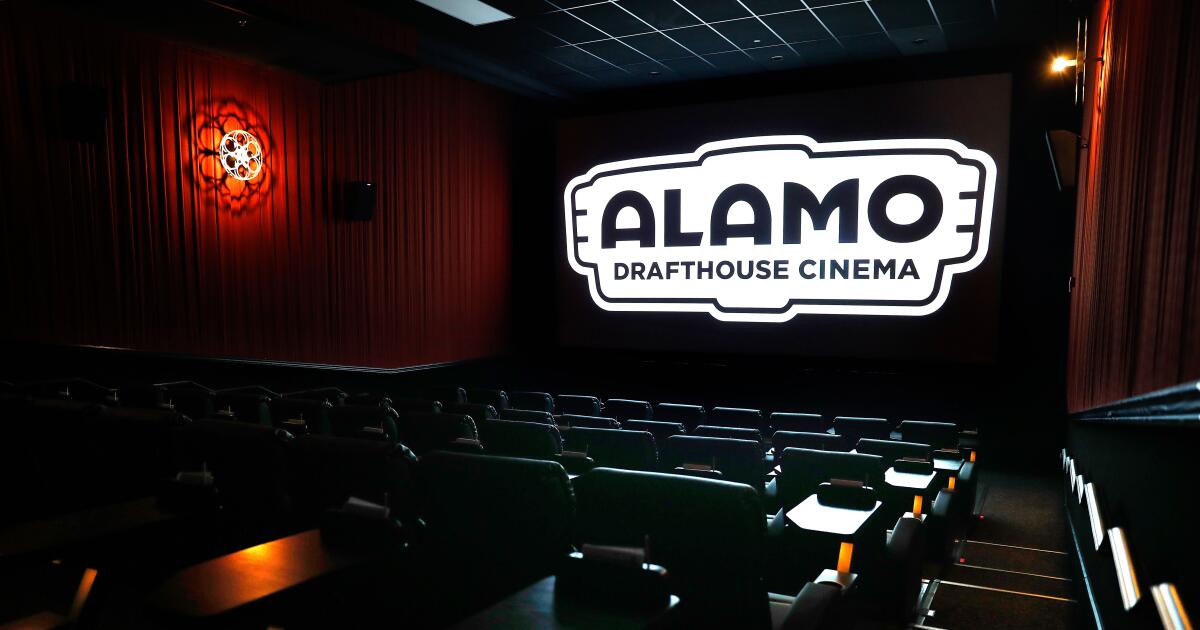
Dine-in movie theater chain Alamo Drafthouse Cinema is launching a new initiative to show unreleased independent films that had successful festival runs, a move that comes as specialty films have struggled to gain distribution.
The Alamo Exclusives program, announced Wednesday, will give limited theatrical runs to films that showed at festivals including Sundance, the Toronto International Film Festival, Tribeca Festival and South by Southwest festival, as well as Alamo’s own Fantastic Fest.
The idea is to help showcase films that received critical acclaim, but did not secure distribution or acquisition deals. The chain will not acquire these films, but instead will enter into agreements with filmmakers to exhibit their films on Alamo Drafthouse screens. By showing these films to audiences on the big screen, these films could get the momentum they need for further opportunities.
The program’s first film will be the documentary “Butthole Surfers: The Hole Truth and Nothing Butt,” which debuted last year at South by Southwest and chronicles the history of the punk rock band.
The film will be shown in Alamo Drafthouse theaters for a limited time later this summer.
The Austin-based chain, which is owned by Sony Pictures, has a long history of curating indie films for its audiences, giving Alamo Drafthouse confidence that its viewers want to see these kinds of movies, company chief executive Michael Kustermann said in a statement.
“Time and again, they’ve shown they’ll come out to support bold, original films when given the opportunity,” he said. The new Alamo Exclusives “gives us another way to champion filmmaker-driven films that deserve to be discovered and connect them with the wider Alamo Drafthouse audience.”
The initiative comes at a difficult time for indie films. Since the pandemic upended the movie business, traditional studios and distributors have had less appetite for risk, including betting on smaller indie films out of festivals.
And as the 2023 dual writers’ and actors’ strikes thinned out theatrical lineups, that aversion to uncertainty became a push for reliable and profitable hits.
“Too many incredible films premiere at festivals and then never receive the theatrical life they deserve,” Lisa Dreyer, director of Fantastic Fest and film innovation at Alamo, said in a statement. “We are actively searching for films across all genres, from horror to comedy, to everything in-between, to champion in this new, exciting way.”
The recall of a popular chip brand over salmonella concerns was recently upgraded to the U.S. Food and Drug Administration’s highest level, just ahead of the Fourth of July holiday and countless backyard barbecues.
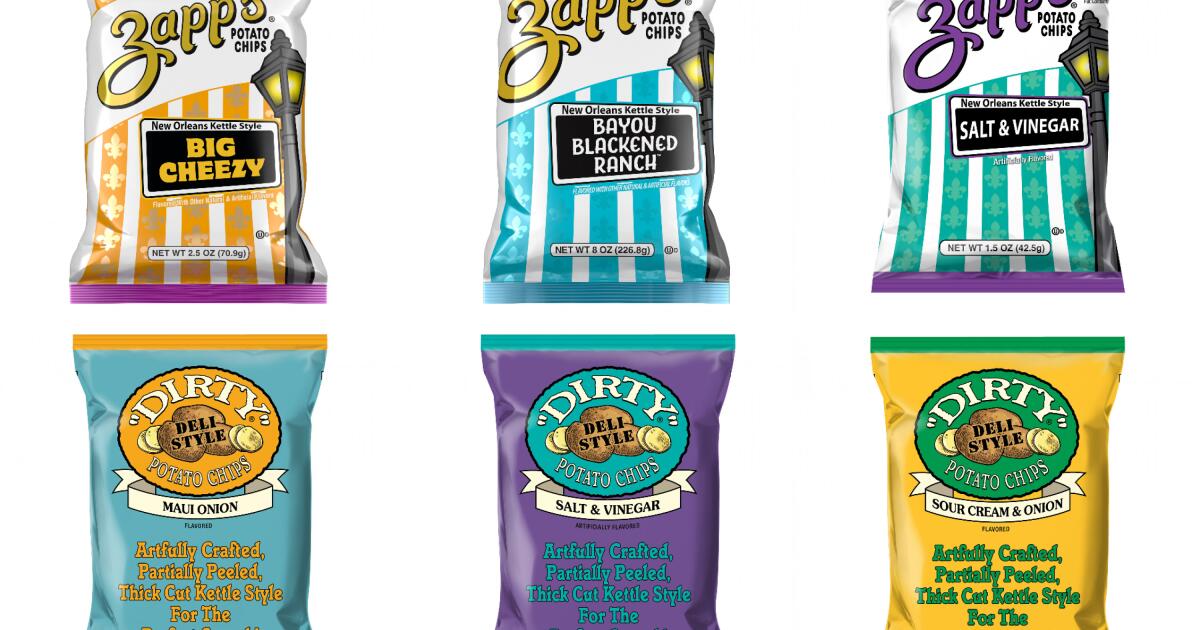
On June 24, the FDA designated the recall of several varieties of Zapp’s and Dirty brand potato chips as Class I, meaning it’s “a situation in which there is a reasonable probability that the use of or exposure to a violative product will cause serious adverse health consequences or death.”
FDA has classified the following items as Class I:
Zapp’s
- 1.5-ounce Zapp’s Bayou Blackened Ranch Kettle Chips
- 2.5- and 8-ounce Zapp’s Bayou Blackened Ranch Potato Chips
- 1.5- and 8-ounce Zapp’s Big Cheezy Potato Chips
Dirty
- 1.5- and 2-ounce Dirty Brand Salt and Vinegar Potato Chips
- 2-ounce Dirty Maui Onion Chips
- 2-ounce Dirty Sour Cream and Onion Potato Chips
The chips are produced by Utz Quality Foods, LLC, which on April 28 issued a recall after learning “that a seasoning containing dry milk powder, sourced from California Dairies, Inc. and supplied by a third-party supplier, may contain the presence of Salmonella.”
Salmonella can lead to sometimes deadly infections in elderly people, young children and those with weakened immune systems, according to the FDA.
More than 680,000 bags are included in the recall.
Anyone who has these products should not eat them and should discard them immediately.
What to look for
Salmonella is a foodborne illness that can be fatal to young children, pregnant women, older adults and people with weakened immune systems, according to the National Institutes of Health.
Symptoms may develop 12 to 72 hours after infection, according to the FDA.
The FDA said that people with strong immune systems infected with salmonella may experience fever, diarrhea (which may be bloody), nausea, vomiting and abdominal pain. The illness can last four to seven days.
In rare cases, the infection may produce more severe illnesses such as arterial infections, endocarditis and arthritis, the agency added.
What to do if infected
If you contract salmonella, the Centers for Disease Control and Prevention recommends drinking plenty of fluids to prevent dehydration.
The CDC advises consulting a doctor before taking antidiarrheal medicine or antibiotics. If severe symptoms continue after two days, seek medical help, the agency says.
Because those with diarrhea can spread salmonella to others, it’s also recommended to avoid sharing food or preparing meals for others, sexual contact and swimming in public pools, and to stay home while sick.
Times staff writer Jasmine Mendez contributed to this report.
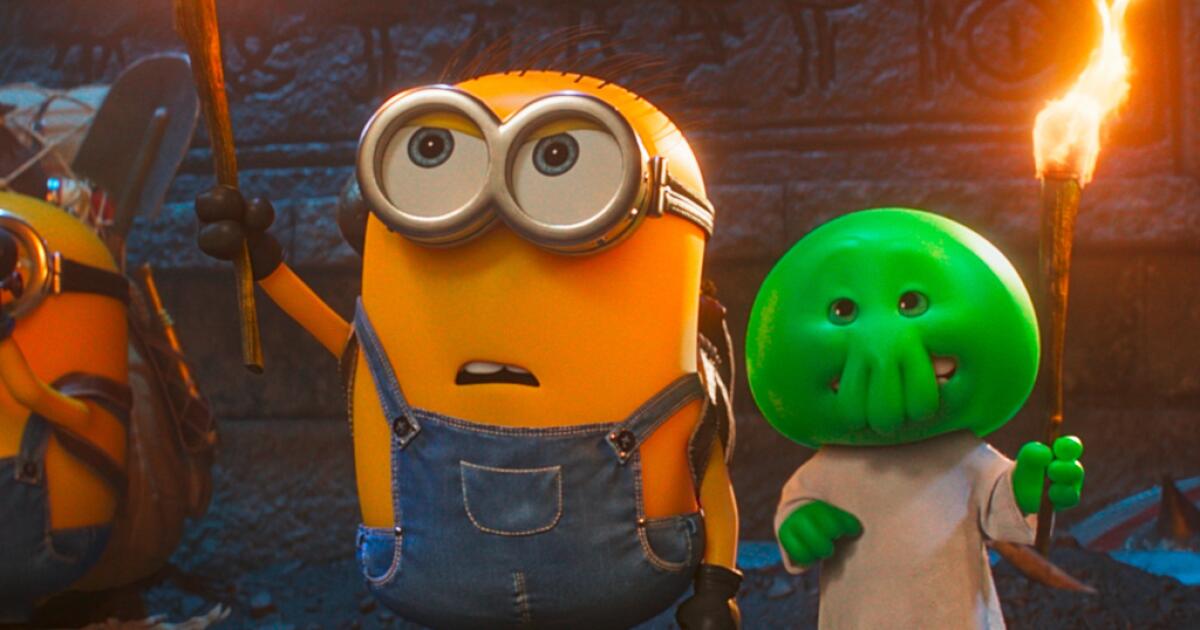
The Minions took over theaters this weekend as Universal Pictures and Illumination’s “Minions & Monsters” won the top spot at the box office, though with a lower-than-expected domestic haul.
The animated movie, which follows the Minions’ takeover of Hollywood, took in $61.4 million in the U.S. and Canada for the five-day Fourth of July holiday weekend, according to studio estimates. That haul was lower than analysts’ expectations for a domestic opening of about $68 million. The movie’s three-day total was $36.4 million.
But the Minions performed well internationally, bringing in about $85 million. In total, “Minions & Monsters” made $159.9 million worldwide on a production budget of about $85 million.
The film is the latest in the powerhouse franchise that began with “Despicable Me” in 2010. Across its previous six installments, the “Despicable Me” and “Minions” franchise has made more than $5.6 billion at the global box office. The last movie, 2022’s “Minions: The Rise of Gru,” made more than $940 million worldwide.
“Minions & Monsters” marks the lowest opening for the franchise. Part of the issue could be timing — the box office can be negatively affected when the Fourth of July lands on a Saturday, said Paul Dergarabedian, head of marketplace trends at Rentrak.
Walt Disney Co. and Pixar’s “Toy Story 5” came in second at the box office this weekend with a domestic three-day gross of $31 million. Angel Studios’ biopic “Young Washington” ($20.8 million), Warner Bros. and DC Studios’ “Supergirl” ($9.6 million) and Universal’s “Disclosure Day” ($6 million) rounded out the top five, according to Rentrak.
The haul for “Minions & Monsters,” coupled with the strong holdover performance of “Toy Story 5,” proved again that family films are making a dent in the summer box office.
“Toy Story 5” has now brought in a total of $764.3 million worldwide, and last month, Universal, Illumination and Nintendo’s “The Super Mario Galaxy Movie” crossed $1 billion at the global box office, becoming the first film of any kind to do so this year.
The rest of the summer theatrical lineup is also expected to bring in audiences and push domestic box office totals closer to pre-pandemic figures. Next week, Disney will release its live-action “Moana,” followed by Christopher Nolan’s “The Odyssey” and Sony Pictures’ “Spider-Man: Brand New Day.”
To date, the summer box office is now about $2.3 billion, a nearly 12% increase compared with the same period a year ago, according to Rentrak data. Compared with pre-pandemic 2019’s numbers, however, it is still down about 7%.
-

 Indianapolis, IN6 minutes ago
Former Colts center Ryan Kelly opens up about life after retirement
-

 Pittsburg, PA8 minutes ago
Pittsburgh Public Safety responds to third teen takeover in 7 days on Fourth of July
-

 Augusta, GA21 minutes ago
Cushman & Wakefield Brokers $87M Sale of Apartment Community in Augusta
-

 Washington, D.C23 minutes ago
The hottest T-shirts in DC are from Metro – WTOP News
-

 Cleveland, OH29 minutes ago
Medical examiner identifies woman found dead in backyard of Cleveland home
-

 Austin, TX35 minutes ago
How much daylight are we losing in Texas this month?
-

 Alabama38 minutes ago
Sweet Home 250 draws thousands to Montevallo for Alabama’s o…
-

 Alaska44 minutes ago
A frozen ground under Alaska’s tundra looks like ordinary soil from above, but scientists have put a $43 trillion price tag on what happens when it thaws

