Lifestyle
Her water bill was ‘insane.’ So she tore out her lawn and planted a ‘wabi-sabi’ wonderland

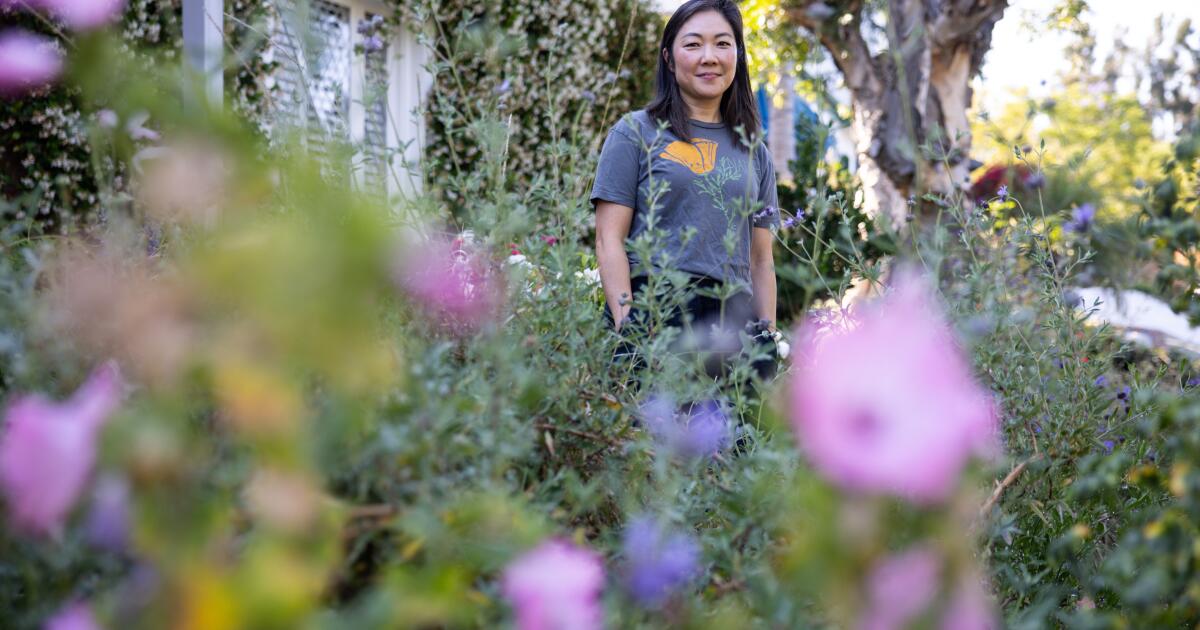
Water-hungry lawns are symbols of Los Angeles’ past. In this series, we spotlight yards with alternative, low-water landscaping built for the future.
Julia Lee had no need for a new garden when she and her husband purchased their Cheviot Hills home eight years ago. The traditional 1950 home came with mature tropical plants in the back and a sprawling grass hillside lawn in front, and it suited them just fine. But as drought and wildfires dragged on in California in recent years, she started to question whether keeping the thirsty lawn made sense.
“Our water bill was insane,” she says as she offers a tour of the former lawn, which is now filled with colorful native plants and drought-tolerant plants. “It was a waste of space. Our kids were getting older and didn’t play on the lawn. There was just no reason to keep a big green lawn.”
After reading a Times story about Georg Kochi, a retiree who swapped his Koreatown lawn with plants suited for California, Lee was inspired by Kochi’s wild, wabi-sabi-style garden, which embraces the art of imperfect beauty.
“I’m into chaos,” Lee says, bending down to smell the minty fragrance of a native Woolly bluecurls (Trichostema lanatum) shrub. “It’s an accurate reflection of my personality.”
Lee’s lawn in Cheviot Hills before she sheet-mulched it with cardboard.
(Julie Lee)

So in 2022, Lee decided to replace her lawn with a drought-tolerant landscape, using the LADWP Free Landscape Design Program, now called the Landscape Efficiency Assistance Program, for help. She also applied for the Metropolitan Water District’s turf replacement rebate, which was $3 per square foot at the time (now $5), and got $5,310 back when the garden was finished.
She wanted to learn more about native plants, so she took a garden design class at the Theodore Payne Foundation for Native Plants in Sun Valley. But the class felt overwhelming. “I love Theodore Payne,” she says, “but I hate measurements and trying to figure out hardscape. I’m not a math person. The instructor wanted us to use a compass and draw a scale drawing of the whole lawn, and I thought, ‘I can’t do this.’”
Feeling paralyzed, she thought about hiring someone to help her, even though she didn’t want to spend the money on a landscape designer. But when Lee shared her frustrations with her graduate school adviser, noted author and avid gardener Jamaica Kincaid, she got the encouragement she needed. “She told me to do it myself,” Lee says, “as she designed her own gardens herself, and they are idiosyncratic just like she is.”
1

2

3

1. Native Clarkia. 2. A ladybug sits on a dill plant. 3. Non-native Borage.
With encouragement from Kincaid, Lee, 49, began by planting small sages that would grow quickly and help prevent erosion, since water, mulch and rain often ran down the hillside to the sidewalk. She also spread Theodore Payne’s Rainbow Mix wildflower seeds throughout the landscape, including California poppies, Arroyo lupine, Desert Bluebells and Clarkia. In the spring, the yard was full of colorful wildflowers, but for the rest of the year, it stayed dormant. “People loved it because it was like a wildflower meadow in the middle of the city,” she says.
Walking through Lee’s garden, as birds, bees and butterflies zoom around the yard’s bright flowers, it’s obvious she loves color. With help from her friend Ben Liou, who replaced his lawn with native plants, Lee filled the space with a lively mix of sages and flowering perennials, including yellow Bladderpod, pink Palmer’s Penstemon, blue California lilac and poppies. Also, in the mix, there are California poppies, Channel Islands Tree poppies and tall Matilija poppies that look like fried eggs.

An endangered Western monarch caterpillar nibbles on some California native milkweed.

A “Think Global, Plant Local” sign rests next to a handwritten plant identification tag.
(Kayla Bartkowski / Los Angeles Times)
She was surprised to find that working in her garden helped her connect with her neighbors in unexpected ways.
“I was worried the neighbors would complain,” she says. “But I’ve met so many people because I’m out here every day. Other gardeners are curious and often ask me, ‘What’s that interesting yellow plant? Oh, Palmer’s Indian Mallow?’ I even know all the dogs’ names now.”
When she and her gardener sheet-mulched the front yard with cardboard Amazon boxes she had collected from her neighbors in October, one neighbor joked that it looked ready for Halloween. “She told me it looks like a graveyard,” Lee says, laughing.


An aerial view of Lee’s garden.
Not all the plants survived, partly because half the garden is shaded by a large magnolia tree on the parking strip. Lee estimates she lost about 70% of her plants in the first year because she didn’t water enough. “The very first year you’re supposed to water regularly, and I did not hand-water enough, so everything basically died. The water bill went down dramatically, though.”
Three years later, after losing so many plants, she decided to add an irrigation system. Liou and her gardener helped Lee install it and build a bioswale to catch rainwater, using stones from Valley Builders Supply and some larger rocks from Bourget Bros. “We installed it in one day,” she says. “It was my birthday present to myself.”

Lee installed the bioswale in just one day with help from a friend and her gardener.
At first, she was nervous about adding something so different from the other traditional lawns on her street. “There weren’t any other houses that had anything like that,” she says. “But now I like it because it breaks up the front lawn into separate planting sections.” She can also walk down the bioswale to work in the garden. “I find garden maintenance so relaxing,” she adds. “It’s meditative.”
Lee says plants help her connect with people. One neighbor who knew the home’s previous owner gave her succulents. Another brought her some aromatic California sagebrush, also called Cowboy Cologne. “I really like the fact that I can point to certain things and remember who gave them to me,” she says. “That’s really nice.”
She hopes the golden yarrow will spread, and she’s especially proud of the large white sage she grew from seeds that a friend gave her. “It’s so happy over there,” she says, clearly excited by its growth. “Look at how big it is. I am so proud of it.”

Not all the plants in the unamended soil are California natives or even drought-tolerant. Lee kept some plants that have been growing in the yard for decades, like the jasmine climbing around the front of the house as well as the white roses. “I really don’t like lantana,” she says, “but I hate killing things.”
Someday she hopes to set up a free seed library, and she’s excited to see bluebird hatchlings in the bluebird house that Venice beekeeper Ian Kimbrey installed in her tree. “I just need to be patient,” Lee says about the bluebird box, which is still empty. “I’ve entered that phase of my life where I just love to see so many birds and bees and other animals in my garden. It’s good for my mental health.” She also wants to add a water feature where birds and butterflies can bathe and sip, and she plans to plant more berries to attract more pollinators.
Lee, who grew up in L.A. and teaches English at Loyola Marymount University, says her unkempt garden reminds her of Los Angeles in some ways. “Everybody just wants to look young and perfect all the time, and that’s not healthy,” she says. “My garden is beautiful in the spring; then it goes dormant in the summer. And that’s OK.”
1

2

3

4

5

1. Blue non-native Cornflowers. 2. Pink Cosmos, also a non-native. 3. Lee reaches to sniff some hardy Cleveland sage 4. A native Clarkia flower. 5. Pink and white native Clarkia flowers.
She hopes her story will encourage others who who can’t afford a landscape designer or simply feel overwhelmed by the idea of replacing their lawn. “I think sometimes it’s helpful just having somebody who’s there to hold your hand,” she says of her friend Liou. “For me, that was critical. I don’t think I would have ever made any progress without him.”
The project was ultimately about more than just saving water. It gave Lee a chance to connect with her community while experimenting in what she calls a “test garden.” She calls her garden a work in progress, and although she has suffered failures along the way, she values the friendships she has made outside her front door. “My garden doesn’t look designed because it isn’t. I’ve learned it’s OK if things aren’t perfect.”
Actually, she says, an imperfect,-always-evolving garden is “a good lesson for life.”

Lee looks for bees inside the Matilija poppies in her garden.
(Kayla Bartkowski / Los Angeles Times)
Plants used in this garden
California native shrubs/flowers
Coulter’s Matilija poppy (Romneya coulteri)
Pigeon Point Coyote Brush (Baccharis pilularis “Pigeon Point”)
Twin Peaks No. 2 Dwarf Coyote Bush (Baccharis pilularis “Twin Peaks No. 2”)
Lilac Verbena “De La Mina” (Verbena lilacina “De La Mina”)
Armstrong California Fuchsia (Epilobium canum “Armstrong”)
Marin Pink California Fuchsia (Epilobium canum “Marin Pink”)
“Bert’s Bluff’ California Fuchsia (Epilobium canum)
Catalina California Fuchsia (Epilobium “Catalina”)
Hummingbird sage (Salvia spathacea)
California Sagebrush (Artemesia Californica)
California Buckwheat (Eriogonum fasciculatum)
Red Buckwheat (Eriogonum grande var. rubescens)
“Warriner Lytle” Buckwheat (Eriogonum fasciculatum “Warriner Lytle”)
Ashyleaf Buckwheat (Eriogonum cinereum)

Lee grew the white sage from seed.
Sea Cliff Buckwheat (Eriogonum parvifolium)
Ceanothus “Julia Phelps”
Yankee Point Carmel Ceanothus (Ceanothus thyrsiflorus var. griseus “Yankee Point”)
Coyote Mint (Monardella villosa)
Woolly Blue Curls (Trichostema lanatum)
Golden Currant (Ribes aureum var. gracillimum)
Bush Monkeyflower (Diplacus longiflorus)
Jelly Bean Red (and Pink, and Orange, and Fiesta Marigold) Monkeyflower (Diplacus “Jelly Bean Red,” etc.)
Canyon Prince Giant Rye (Elymus condensatus “Canyon Prince”)
Island Alumroot (Heuchera maxima)
Santa Ana Cardinal Alumroot (Heuchera “Santa Ana Cardinal”)
California bee plant (Scrophularia californica)
California Huckleberry (Vaccinium ovatum)
Common Snowberry (Symphoricarpos albus var. laevigatus)
Fragrant Pitcher Sage (Lepechinia fragrans)
“Whirly Blue” Cleveland sage (salvia clevelandii “Whirly Blue”)
“Celestial Blue” Cleveland sage (salvia clevelandii “Celestial Blue”)
Winnifred Gilman Cleveland sage (salvia clevelandii “Winnifred Gilman”)
Allen Chickering Cleveland sage (salvia clevelandii “Allen Chickering”)
“Bee’s Bliss” sage (Salvia “Bee’s Bliss”)
“Mrs. Beard” creeping sage (Salvia sonomensis “Mrs. Beard”)
Russian sage (Salvia yangii)
Santa Barbara Mexican Bush sage (Salvia leucantha “Santa Barbara”)
Deer grass (Muhlenbergia rigens)
California bush sunflower (Encelia californica)
Margarita BOP penstemon (Penstemon heterophyllus “Margarita BOP”)
Palmer’s Indian Mallow (Abutilon palmeri)
Island Mallow (Malva assurgentiflora)
White sage (salvia apiana)
Black sage (saliva mellifera)
Butterfly bush (Buddleja)
California Yarrow (Achillea millefolium)
Oregano (Origanum vulgare)
French lavender (Lavandula dentata)
Bush Anemone (Carpenteria californica)
Channel Islands tree poppy (Dendromecon hartfordii)
Manzanita
Blue Grama (Bouteloua gracilis)
Showy Island snapdragon (Gambelia speciosa)
Bladderpod (Cleomella arborea)
Wildflowers (Native and non-native)
California poppies (Eschscholzia californica)
Blue Globe gilia (gilia capitata)
Elegant Clarkia (Clarkia unguiculata)
“Farewell to Spring” Clarkia (Clarkia amoena)
Cornflowers (Centaurea cyanus)
Theodore Payne’s Rainbow Mix wildflower seeds
“Indian Summer” Black Eyed Susan (Rudbeckia hirta, “Indian Summer”)
Cosmos (cosmos bipinnatus)
Various breadseed poppies (papiva somniferum)


How to enter your Sporty Spice era.
Getty Images/quantic69/Olga Kurbatova/Anastasiia Zvonary/Photo Illustration by NPR
hide caption
toggle caption
Getty Images/quantic69/Olga Kurbatova/Anastasiia Zvonary/Photo Illustration by NPR
Reality dating and professional sports are not as different as you’d think.
Brittany is in her Sporty Spice era – she watched the NBA playoffs, she’s following World Cup games, and she’s watching the New York Liberty play their WNBA season. These games are daily – and so is the reality dating show Love Island. And she noticed that the two formats are not very different at all. Defector.com staff writer and co-owner Kelsey McKinney came to the same conclusion – so the two of them discuss why these games of athleticism and love can bring us together… and why they get valued differently in our culture.
For more episodes on sports and reality TV, check out:
Get rich or die trying: how sports betting is changing our love of the game
Is this the end of reality TV?
The ugly truth of America’s expensive homes
Support Public Media. Join NPR Plus.
Follow Brittany on Instagram: @bmluse
This episode was produced by Liam McBain. It was edited by Neena Pathak. Our Supervising Producer is Cher Vincent. Our Executive Producer is Barton Girdwood. Our VP of Programming is Yolanda Sangweni.


As the nation marks the 250th anniversary of its founding, NPR asked students all around the country to reflect on the moment and to make podcasts about the American experience and what “life liberty and the pursuit of happiness” means to them.


We received more than 700 entries, including many conversations with immigrant parents, grandparents, aunts and uncles about why their family decided to move to the United States. Others scored high-profile interviews with veterans, government officials and even Gloria Steinem.
We listened to reenactments and retellings of histories like the Battle of Monmouth, the Stonewall riots, the Underground Railroad and a special presentation on President Theodore Roosevelt’s pets. Other podcasts take place in the present, including one in which students report on civics education in their school.
Our team chose a handful of winning entries and honorable mentions from fourth graders, middle and high schoolers. Here they are, in alphabetical order:
Winners
Abridged
Students: Grace Kepka and Angelika Garrett, Montgomery Blair High School in Silver Spring, Md.
Teacher/Sponsor: Kyle Wannen
High schooler Grace lives in Takoma Park, Md., one of the handful of cities in the United States that allow 16 year olds to vote in all local elections. In her podcast with her friend Angelika, they discuss the power of the youth vote, and how voting rights encourage residents to learn about their government and be more politically active in their communities.
Civics in Our Schools
Students: Izabella Anthony, Benjamin Baigel, Bridget Castellon, Rile DeLeon, Maxwell Gibbs, Daniel Hernandez, Malcolm Johnson, Sylpa Kafle, Mason King, Kyle Li, Maximus Lin, Emmerson Quinn, Ariella Schoenfeld, Owenize Udevbulu and Dara Widzowski, Hewlett Elementary School in Hewlett, N.Y.
Teacher/Sponsor: Jaime Harrington
“Here’s the surprising truth. Many Americans, even grownups, don’t know the basics of how our country was founded or how our government works.” In Civics in Our Schools, a group of fifth graders voice their concerns about the lack of good civics education and discuss what they can do to be better citizens.
Leaving Greece
Student: Livie Courser, Wickliffe Progressive Elementary School in Upper Arlington, Ohio
Teacher/Sponsor: Shelly Hughes
Livie interviews her grandfather about his move from Greece to the United States. “How did it feel to immigrate to the U.S.?” she asks. “Very hard. Very very hard,” he responds. He shares with his granddaughter why he took the risk, and how his move to the U.S. allowed him to work hard at a factory, dream big and eventually open up his own restaurants.
Researching the Underground Railroad
Students: Travis Bozeman and Oliver Heering, South Douglas Elementary School in Douglasville, Ga.
Teacher/Sponsor: Thomas Bruno
“Did you know around 100,000 slaves escaped using the Underground Railroad?” In a deep dive into a slice of history they learned from school, fourth graders Travis and Oliver report on the Underground Railroad. They present their research in the podcast, and weave in the expert interview they scored.
The American Dream
Student: Makayla Cheung, Mercer Island High School in Mercer Island, Wash.
Teacher/Sponsor: Lauren Schechter
In her podcast about her father, Makayla explores how different everyone’s American Dream is. Case in point, her dad moved from Hong Kong to the United States because of his talent in running. He tells Makayla he had a hard time adjusting at first and understanding his coach. But cross country, he says, didn’t require too much communication, and the sport gave him confidence and a way for him to find community and connect with other people.
The Journal
Student: Violet Maxinoski, Carmel High School in Carmel, Calif.
Teacher/Sponsor: Shelley Grahl
In an interview with her daughter Violet, Sandi Maxinoski revisits stories from her journal from the years she served in Iraq. She describes being in “cities fractured by bombings, checkpoints, smoke and uncertainty,” then returning to the United States where she felt an “intense amount of security” being able to walk down the street without the fear of something blowing up. Through these conversations, Violet discusses how the “life, liberty and happiness” she’s gotten used to shouldn’t be taken for granted.
Welcome Home, Grandpa
Student: Ursula Koestner, Roslyn High School in Roslyn Heights, N.Y.
Teacher/Sponsor: Matthew Vogt
“The Vietnam War destroyed more than it saved, even decades after its end,” high schooler Ursula says in her podcast. “My grandfather remains one of its victims despite returning home alive.” In her moving podcast, Ursula shares her family’s story and explores the generational trauma and lasting impact the Vietnam War has on veterans.
Honorable Mentions
America the Beautiful
Students: Pareena Gupta and Vidushee Bala, Amador Valley High School in Pleasanton, Calif.
Teacher/Sponsor: Stacey Sklar
America: The Ups and the Downs
Student: Alana Burwell, The Waldorf School of Philadelphia, Philadelphia, Pa.
Teacher/Sponsor: Anyta Thomas
America’s New Favorite Sport-Girls’ Flag Football
Students: Josephine Barry-Kao and Malcolm Barry-Kao, Lowell High School in San Francisco, Calif.
Teacher/Sponsor: Jacqueline Moses
An Intro to Differing Perspectives
Student: Waylon Heikinen, Ingomar Middle School in Franklin Park, Pa.
Teacher/Sponsor: Heath Gamache
Becoming American
Students: Karolina Zientek, James Gearhart, Andrea Vezmar, Troy Murray and August Hutchison, Greenwich High School in Greenwich, Conn.
Teacher/Sponsor: Lukasz Zientek
Before You Drop A Track: America’s 250th Anniversary
Student: Lukas Boulom, Public Academy For Performing Arts in Albuquerque, N.M.
Teacher/Sponsor: Su Hudson
Dawg Talk | Are we equal now?
Students: Makenna Aniszewski, Trinlee Leitner, Nagamoshitha Manivannan, Nethra Prabhu, Vaishnavi Tiwari and Sophia Van Dorn, Otwell Middle School in Cumming, Ga.
Teacher/Sponsor: David Miller
Democracy for Everyone or No One
Student: Jeju Daisy Ahn-Miles, Punahou School in Honolulu, Hawaii
Teacher/Sponsor: Christine Ahn
Everything Given Forward
Student: Lara Leon, Mountain View High School in Mountain View, Calif.
Teacher/Sponsor: Tom Chang
Fifty Stars, One Banner
Student: Naina Dhillon, Khan Lab School in Palo Alto, Calif.
Teacher/Sponsor: Emily Lindsey
Freedom’s Shore
Student: Dipa Chéry, The Kinkaid School in Houston, Texas
Teacher/Sponsor: Olen Rambow
From One Immigrant To Another
Student: Afomia Lemma, St. Mary’s Lynn in Lynn, Mass.
Teacher/Sponsor: Tiringo Endalamaw
Hope and Resistance
Student: Zinnia Bender, North Fork High School in Hotchkiss, Colo.
Teacher/Sponsor: Clara Pena
How Is My Life Like In US
Student: Yicheng Sun, Rectory School in Pomfret, Conn.
Teacher/Sponsor: Andrew Barker
Life of a Soldier
Students: Della Axelband, Peyton Johnson, Lily Epstein and Lilly Murillo, Jupiter Middle School in Jupiter, Fla.
Teacher/Sponsor: Sireesha Rutter
More Than A Photograph
Student: Josie Sloan-Westmoreland, The Learning Community School in Swannanoa, N.C.
Teacher/Sponsor: David Bird
Moving From Country to Country
Students: Ida Buerckert, Daniella Cubas, Ayano Enishi and Anastaiia Koshyk, Irving A. Robbins Middle School in Farmington, Conn.
Teacher/Sponsor: Alysson Olsen
Picketts Charge
Student: Zoe Snyder, Susquenita High School in Duncannon, Pa.
Teacher/Sponsor: Terrance Shepler
“So What??”
Student: Caroline Harris, Marin Academy in San Rafael, Calif.
Teacher/Sponsor: Kelly Kurtzig
Somewhere Over the Rainbow
Student: Lark (Miles) Jackman, Public Academy For Performing Arts in Albuquerque, N.M.
Teacher/Sponsor: Su Hudson
Teddy Roosevelt and His Pets
Student: Abbott Mearns and Keaton Rainwater, College Place Middle School in Lynnwood, Wash.
Teacher/Sponsor: Colindra Connolly
The Battle of Monmouth: A Twist on History
Students: Leonardo, Zinna and Kaiden, Marlboro Middle School in Marlboro, N.J.
Teacher/Sponsor: Tara Meara
The Freedom to Fail
Students: Abraham Coher and William Pan, Polytechnic School in Pasadena, Calif.
Teacher/Sponsor: Aliya Coher
The Government Exodus: Why Federal Workers Resign
Student: Anna Su, Montgomery Blair High School in Silver Spring, Md.
Teacher/Sponsor: Kyle Wannen
The Name I Chose Polly Bemis (September 11, 1853 – November 6, 1933)
Student: Jubilee Sung, Imaginate Ink in Irvine, Calif.
Teacher/Sponsor: Clarissa Ngo
The Pig and Potato Podcast
Student: Petra Rouhana, Maryvale Preparatory School in Lutherville, Md.
Teacher/Sponsor: Deirdre McAllister
The Small Pond of Peace
Students: Noam Dekel, Ronnie Dekel, Ian Rodriguez, Leonardo Leon-Espinoza, Singary Fofana, Ashly Arboleda-Osorio, Olumide Martin and Salma Elshaarawi, P.S. 333 Manhattan School for Children in New York, N.Y.
Teacher/Sponsor: Karin Patterson
to be united as citizens
Student: Josh Langlois, Cloverleaf Home Education in Highlands Ranch, Colo.
Teacher/Sponsor: Tony Winger
Two Worlds, One Dream
Student: Allayar Maratov, Rectory School in Pomfret, Conn.
Teacher/Sponsor: Andrew Barker
What is Home?
Student: Siobhan Allen, The Hewitt School in New York, N.Y.
Teacher/Sponsor: Jonathan Sabol
-

 Kentucky43 seconds ago
8 vehicle crash closes I-24 in Kentucky
-

 Louisiana8 minutes ago
Louisiana Supreme Court quashes arrest warrant for AG Liz Murrill
-

 Maine11 minutes ago
Historic island house on 25 acres in Maine hits market
-

 Maryland23 minutes ago
Registered nurses at Ascension Saint Agnes Hospital in Baltimore set to strike
-

 Michigan26 minutes ago
AAA: Michigan gas prices fall below $4 per gallon
-

 Massachusetts31 minutes ago
Wrong-way driving is becoming more common and deadly in Mass. The state is racing to prevent it. – The Boston Globe
-

 Minnesota38 minutes ago
Vandals smash car windows in St. Louis Park neighborhood
-

 Mississippi41 minutes ago
Top Mississippi high school football offensive linemen for 2026 MHSAA, MAIS season

