Business
Does insurance cover flooding and mudslides?

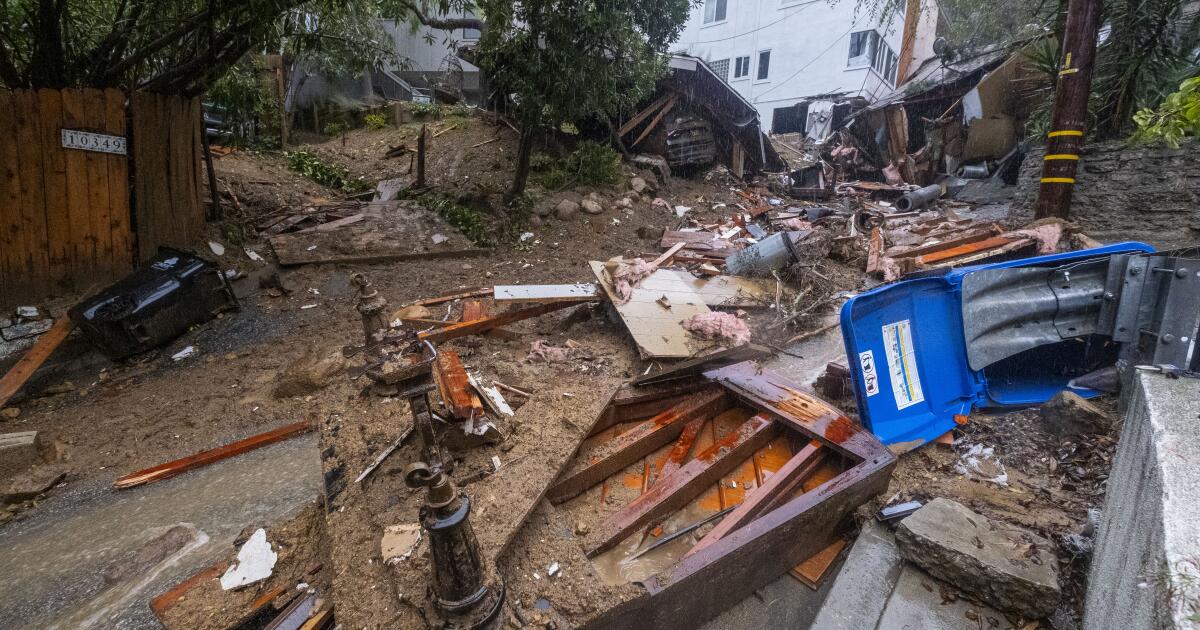
This week’s rain is turning streets into creeks and hillsides into mudslides. Homeowners across Southern California are facing major damage to their homes as a result — and in most cases, they won’t get any help cleaning up the mess from their insurance companies.
The standard homeowners’ policy does not cover losses from flood damage. Mudslides, mud flows and debris flows aren’t covered by typical homeowners’ insurance, either — though in particular circumstances, a homeowner’s policy might cover some of the damage from these events. Damage from falling trees or other wind-related impacts should be covered by homeowners’ policies, however, and the comprehensive coverage in an auto insurance policy should cover any damage to Californians’ cars.
Flood insurance has been underwritten by the federal government since 1968, as part of the National Flood Insurance Program. Homeowners have to purchase this coverage separately from the NFIP, which is administered by the Federal Emergency Management Agency, if they want their house to be protected from flood damage.
But Californians, by and large, haven’t ponied up for flood insurance. Out of the over 4.6 million flood policies in the country, 190,000 — just over 4% — are for California homes and businesses, according to data from the NFIP. In the eight Southern California counties under a state of emergency from the current storm, only 52,820 homes and businesses are covered.
Los Angeles County, home to nearly 10 million people, has just 14,580 flood insurance policies on the books.
The good news for policy-holders is that flood insurance covers most of the ways that dirt, water and debris can damage a home, as long as a major flood event is in progress.
Essentially, as long as mud or debris that damages the home is being carried by water, then flood insurance kicks in, said Janet Ruiz, director of strategic communication at the Insurance Information Institute, an industry group. The technical terms for these sources of destruction are mudflows and debris flows.
If a wildfire is involved in creating the mud or debris which then flows into a house, the fire coverage section of a typical homeowners’ policy can cover that damage. This kicked in during the deadly 2018 floods and mudflows in Montecito, which claimed 21 lives and led homeowners to file $388 million in insurance claims. Since the floods came on the heels of the massive Thomas fire in late 2017, that incident was deemed the “proximate cause” of the damage. But this specific set of circumstances is not common, and after a relatively sedate 2023 fire season, is unlikely to help many homeowners dealing with damage this week.
But mudslides — which have a technical definition distinct from the colloquial use of the word — are not covered by flood insurance, and are rarely covered by any kind of insurance policy at all. If water is picking up mud and debris and moving it into a home, that’s a mudflow in insurers’ books. But if the wet ground that a home is on slides away, shifting the house off its foundations (or causing it to fall off the side of a hill), then that’s a mudslide, and few policies will help the homeowner out.
“That’s ground movement, so that’s homes sliding off their foundation,” Ruiz said. “That’s not covered under a homeowners’ or flood insurance policy.”
The same goes for landslides, like the one that caused a cluster of houses in Rolling Hills Estates to pitch into a ravine in 2023.
But in a very specific scenario, a normal homeowners’ policy will cover some damage related to a mudslide or other earth movement: “If your neighbor’s house slides into yours, then their homeowners’ insurance would be liable to pay for your house,” Ruiz said.
Private insurers do offer flood coverage, and Ruiz said that it’s becoming more popular among the wealthy. The federal policy caps out at covering $250,000 in damage to a residential property and $100,000 for its contents. Even though flood losses are typically partial — Ruiz points out that California floods rarely affect the second stories of homes — some homeowners turn to the private market for more coverage.
Then there’s the basement issue. The NFIP does not cover most damage to basements, which pushes some homeowners to buy specific policies for their underground lairs. “There’s some pretty cool basements out there,” Ruiz said; “some people really trick them out.”


Paramount Skydance Chief Executive David Ellison made his case directly to theater owners Thursday, pledging to release a minimum of 30 films a year from the combined Paramount and Warner Bros. Discovery company during a speech at the CinemaCon trade convention in Las Vegas.
“I wanted to look every single one of you in the eye and give you my word,” Ellison said in a brief on-stage speech, adding that Paramount has already nearly doubled its film lineup for this year with 15 planned releases, up from eight in 2025.
He also said all films will remain in theaters exclusively for 45 days, starting Thursday. Films will then go to streaming platforms in 90 days. The amount of time that films stay in theaters — known as windowing — has been a controversial topic for theater owners, as some studios reduced that period during the pandemic. Theater operators have said the shortened window has trained audiences to wait to watch films at home and cuts into theater revenues.
“I have dedicated the last 20 years of my life to elevating and preserving film,” said Ellison, clad in a dark jacket and shirt with blue jeans. “And at Paramount, we want to tell even more great stories on the big screen — stories that make people think, laugh, dream, wonder and feel — and we want to share them with as broad an audience as possible.”
Ellison’s CinemaCon appearance comes as more than 1,000 Hollywood actors and creatives have signed a letter opposing Paramount’s proposed acquisition of Warner Bros. Supporters of the letter have said the deal would reduce competition in the industry and “further consolidate an already concentrated media landscape.”
Some theater operators have also questioned whether the combined company could achieve its goal of releasing 30 films a year, particularly after the cost cuts that are expected after the merger closes.
“People can speculate all they want — but I am standing here today telling you personally that you can count on our complete commitment,” Ellison said. “And we’ll show you we mean it.”
The speech came after a star-studded video directed by “Wicked: For Good” director Jon M. Chu that was shot on the Paramount lot on Melrose Avenue and showcased directors and actors including Issa Rae, Will Smith, Chris Pratt, James Cameron and Timothée Chalamet that are working with the company.
The video closed with “Top Gun” actor Tom Cruise perched atop the Paramount water tower.
“As you saw, the Paramount lot is alive again,” Ellison said after the video. “And we could not be more excited.”

new video loaded: Why Your Paycheck Feels Smaller
By Ben Casselman, Nour Idriss, Sutton Raphael and Stephanie Swart
April 18, 2026

Nearly two years after actor Alec Baldwin was cleared of criminal charges in the “Rust” movie shooting death, a long simmering civil negligence case is inching toward a trial this fall.
On Friday, a Los Angeles Superior Court judge denied a summary judgment motion requested by the film producers Rust Movie Productions LLC, as well as actor-producer Baldwin and his firm El Dorado Pictures to dismiss the case.
During a hearing, Superior Court Judge Maurice Leiter set an Oct. 12 trial date.
The negligence suit was brought more than four years ago by Serge Svetnoy, who served as the chief lighting technician on the problem-plagued western film. Svetnoy was close friends with cinematographer Halyna Hutchins and held her in his arms as she lay dying on the floor of the New Mexico movie set. Baldwin’s firearm had discharged, launching a .45 caliber bullet, which struck and killed her.
The Bonanza Creek Ranch in Santa Fe, N.M. in 2021.
(Jae C. Hong / Associated Press)
Svetnoy was the first crew member of the ill-fated western to bring a lawsuit against the producers, alleging they were negligent in Hutchins’ October 2021 death. He maintains he has suffered trauma in the years since. In addition to negligence, his lawsuit also accuses the producers of intentional infliction of emotional distress.
Prosecutors dropped criminal charges against Baldwin, who has long maintained he was not responsible for Hutchins’ death.
“We are pleased with the Court’s decision denying the motions for summary judgment filed by Rust Movie Productions and Mr. Baldwin,” lawyers Gary Dordick and John Upton, who represent Svetnoy, said in a statement following the hearing. “He looks forward to finally having his day in court on this long-pending matter.”
The judge denied the defendants’ request to dismiss the negligence, emotional distress and punitive damages claims. One count directed at Baldwin, alleging assault, was dropped.
Svetnoy has said the bullet whizzed past his head and “narrowly missed him,” according to the gaffer’s suit.
Attorneys representing Baldwin and the producers were not immediately available for comment.
Svetnoy and Hutchins had been friends for more than five years and worked together on nine film productions. Both were immigrants from Ukraine, and they spent holidays together with their families.
On Oct. 21, 2021, he was helping prepare for an afternoon of filming in a wooden church on Bonanza Creek Ranch. Hutchins was conversing with Baldwin to set up a camera angle that Hutchins wanted to depict: a close-up image of the barrel of Baldwin’s revolver.
The day had been chaotic because Hutchins’ union camera crew had walked off the set to protest the lack of nearby housing and previous alleged safety violations with the firearms on the set.
Instead of postponing filming to resolve the labor dispute, producers pushed forward, crew members alleged.
New Mexico prosecutors prevailed in a criminal case against the armorer, Hannah Gutierrez, in March 2024. She served more than a year in a state women’s prison for her involuntary manslaughter conviction before being released last year.
Baldwin faced a similar charge, but the case against him unraveled spectacularly.
On the second day of his July 2024 trial, his criminal defense attorneys — Luke Nikas and Alex Spiro — presented evidence that prosecutors and sheriff’s deputies withheld evidence that may have helped his defense . The judge was furious, setting Baldwin free.
Variety first reported on Friday’s court action.
-
Nebraska2 minutes ago
Nebraska Lottery results: See winning numbers for Pick 3, Pick 5 on April 19, 2026
-

 Nevada8 minutes ago
Armed Robbery at the Tamarack Casino
-
New Hampshire14 minutes ago
NH Lottery Pick 3 Day, Pick 3 Evening winning numbers for April 19, 2026
-
New Jersey20 minutes ago
NJ Lottery Pick-3, Pick-4, Cash 5, Millionaire for Life winning numbers for Sunday, April 19
-

 New Mexico26 minutes ago
Los Alamos Public Schools Students Compete At 2026 New Mexico State Science & Engineering Fair
-
North Carolina32 minutes ago
NC Lottery Pick 3 Day, Pick 3 Evening results for April 19, 2026
-

 North Dakota38 minutes ago
Windy conditions fuel shop fire in rural Mapleton
-

 Ohio44 minutes ago
Wanda Lou Bailey, Louisville, Ohio