Business
Commentary: She looked like a pro-worker Trump cabinet appointee. But now she's gutting the Labor Department

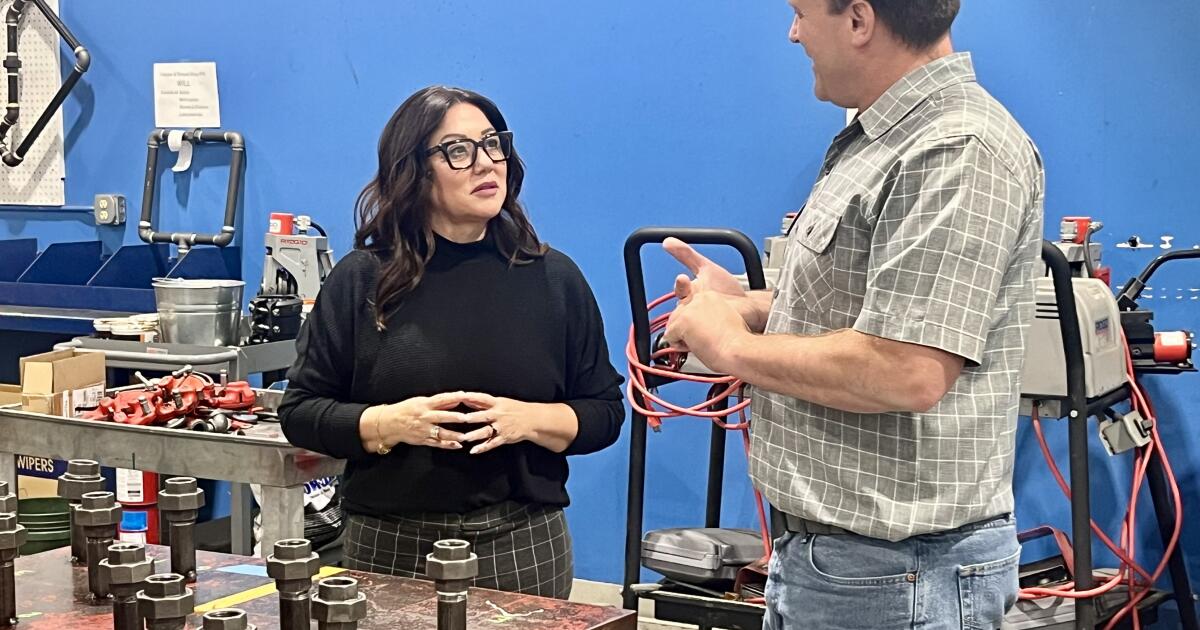
You may have detected a cautious note of relief among worker advocates when Donald Trump named Lori Chavez-DeRemer as his secretary of Labor.
During her sole term as a Republican member of Congress from Oregon (2023-25), Chavez-DeRemer was one of only three House Republicans to vote in favor of the so-called PRO Act, which would significantly strengthen collective bargaining rights. The measure passed the House in 2019 and 2021 but has been stifled ever since.
Her nomination and subsequent Senate confirmation elicited optimistic noises from the pro-union camp, as I reported in December.
This is an onslaught on people’s basic protections at work.
— Rebecca Reindel, AFL-CIO
“Her record suggests real support of workers & their right to unionize,” tweeted Randi Weingarten, president of the American Federation of Teachers, when Trump nominated Chavez-DeRemer in November.
AFL-CIO President Liz Shuler said she was “encouraged” by Chavez-DeRemer’s confirmation in March, “given her history of supporting the freedom of workers to organize, join unions and other fundamental values of the labor movement.”
The union leaders tempered their optimism with concerns about the anti-labor policies emanating from the Trump White House: Weingarten said she hoped the appointment signaled that “the Trump administration will actually respect collective bargaining and workers’ voices,” and Shuler said the AFL-CIO was “clear-eyed” that Chavez-DeRemer would be “joining an administration that’s been openly hostile to working people on many fronts in its first two months.”
Can you guess which way the ball has bounced?
On May 1, the Labor Department ordered its staff to cease enforcing a Biden administration rule that had raised the bar preventing businesses from designating their workers as independent contractors instead of employees, depriving those workers of the legal protections and wage and hour benefits typically due employees.
A few days later, Chavez-DeRemer submitted a proposed budget to Congress that would slash her agency’s discretionary funding by more than 35%, to $8.6 billion from $13.2 billion, and cut its workforce by nearly 4,000 full-time workers, a reduction of more than 26%. Among the services to be eliminated would be the Job Corps, which assists low-income youth to complete their high school education and provides job training and placement. (A federal judge in New York has blocked the suspension of Job Corps services and set a hearing for Monday.)
On July 1 came what could be the biggest blow. Chavez-DeRemer announced a plan to rescind 63 regulations that had been designed to help workers. With language that sounds cribbed from the MAGA playbook, she said her goal is to “eliminate unnecessary regulations that stifle growth and limit opportunity.”
She boasted of launching “aggressive deregulatory efforts in push to put the American worker first,” and added that “these historic actions will free Main Street, fuel economic growth and job creation, and give American workers the flexibility they need to build a better future.”
I’ve asked the Labor Department to provide specific rationales for the deregulatory actions but haven’t received a reply.
The effects, however, are clear. “Two-thirds of these have to do with worker health and safety protections,” says Rebecca Reindel of the AFL-CIO. “They’re being proposed to be either eliminated or severely weakened.”
Chavez-DeRemer’s actions as Labor secretary resemble less the image she fostered as a member of Congress than the policymaking of Trump’s first term. Then, as I wrote at the time, the Department of Labor was “a black hole for worker rights.” His second Labor secretary, Eugene Scalia (son of the late Supreme Court Justice Antonin Scalia), had made his name professionally as a corporate lawyer fighting pro-worker government initiatives.
The standards on the chopping block include those issued by the Occupational Safety and Health Administration, a unit of the Labor Department, that were developed after years of effort. OSHA standards, Reindel told me, take an average of seven years — and as long as 20 years — to draft. “This is an onslaught on people’s basic protections at work.”
One category of threatened regulations applies to standards for respirators and filters to screen out workplace pollutants including asbestos, arsenic and lead. The department proposes to eliminate requirements that workers exposed to occupational pollutants be medically evaluated to ensure that their respirators fit properly and don’t cause health problems on their own.
The agency, asserting that such rules are “unnecessarily prescriptive,” proposes to give employers “greater flexibility in the respirators they select for exposed workers.” Removing some of these regulations, Reindel says, “basically would allow employers to make the determination if a respirator is needed for specific chemicals. They’d give employers more flexibility at the expense of workers’ health.”
One of the more potentially far-reaching proposals would narrow the application of OSHA’s “general duty clause,” which requires employers to maintain safe workplaces even when no specific OSHA regulation applies. In the most notable case, OSHA cited the clause in fining SeaWorld of Florida $12,000 in connection with the 2010 killing of trainer Dawn Brancheau by an orca during a performance. SeaWorld sued to overturn the penalty but lost in a 2-1 decision by the federal appeals court in Washington, D.C.
The three-judge panel found that even though the dangers of cavorting with wild animals for a public show were understood, SeaWorld should have done more to protect its human performers. (Who represented SeaWorld in that case? Eugene Scalia.)
The department is proposing to exempt from the rule “professional, athletic, or entertainment occupations” that are intrinsically dangerous. In justifying its proposal, the department cites a dissenting opinion in the appellate case by then-Appeals Judge Brett Kavanaugh, who is now on the Supreme Court.
In his dissent, Kavanaugh maintained that the agency exceeded its Congressional mandate: “The bureaucracy at the U.S. Department of Labor has not traditionally been thought of as the proper body to decide whether to ban fighting in hockey, to prohibit the punt return in football, to regulate the distance between the mound and home plate in baseball, to separate the lions from the tamers at the circus, or the like,” he wrote. The Department of Labor now maintains that Kavanaugh’s analysis, even though it was a minority finding, was right.
More than 115,000 athletes, actors and other entertainers could be affected by the change, the agency acknowledges.
The department also proposes to rescind a 2024 regulation that guaranteed the right of migrant agricultural workers to host union organizers in company-owned housing.
The Biden administration asserted that the regulation was needed to “protect workers’ fundamental rights of association” and observed that the isolation of workers in company-furnished quarters and their “unique vulnerabilities renders them particularly at risk of … workplace abuses, labor exploitation, and trafficking.”
The department, however, cites several court rulings in red states that have held that the regulation was “an infringement on the property rights of employers.” Indeed, that was the reasoning of the Supreme Court in overturning a California law providing for similar access on farm property in 2021.
“The access regulation grants labor organizations a right to invade the growers’ property,” wrote Chief Justice John Roberts for a 6-3 majority, with the court’s three liberal justices dissenting. “It therefore constitutes a per se physical taking” without compensation.
Worker advocates fear that the July 1 announcement is a precursor of more rollbacks to come. “I think the announcement is just the beginning of their deregulation effort,” says Margaret Poydock, a senior policy analyst at the labor-affiliated Economic Policy Institute. “These 63 rules they referenced were just two days’ worth of posting.”
One rulemaking effort that worker advocates are watching closely involves heat-related injuries. A proposed rule was posted in August and is still under consideration, with bipartisan support; public hearings on the rule were completed earlier this month, and final action is expected by the end of September. The Trump administration hasn’t taken any steps to quash it, thus far. But it has been fiercely opposed by business interests.
The U.S. Chamber of Commerce, for instance, submitted a 20-page comment arguing that the proposal “would result in OSHA micromanaging workplaces, imposing unreasonable burdens, and creating confusion as to what employers would be required to do.”
The proposal, which would apply to almost all employers, would be triggered whenever employees were exposed to a heat index — a measure taking into account heat and humidity — of 80 degrees or higher for more than 15 minutes in an hour-long period.
In those conditions, employers would be required to supply cool drinking water, break areas with cooling and paid rest breaks, among other measures. A heat index of 90 degrees would require mandatory rest breaks of 15 minutes every two hours and other heightened measures.
In the absence of a specific federal heat regulation, workplaces are subject to the general duty clause. But that’s inadequate, worker advocates say. “The general duty clause is reactive — it addresses what happens once a worker is already exposed,” Poydock told me. “It does not prevent workers from becoming sick from heat or having heat stroke or dying from heat.”
The Chamber’s objection is that the current proposal is a “one-size-fits-all approach” that fails to account for regional conditions.
“Businesses operating in consistently high-heat regions, such as Arizona, Florida, and Texas, where these temperatures are the norm,” would be disproportionately affected. “People in hotter climates tend to be more acclimatized to heat, including working in temperatures above 80° F, and thus have a lower risk of heat injury or illness.”
The labor leaders who once saw a glimmer of light in Chavez-DeRemer’s appointment have seen their hopes dashed. Until recently, one might have said that the jury was out on whether she would be a good Labor secretary or another MAGA cabinet member. Now, sadly, the jury’s verdict is in.


Nearly a year after the expiration of a $7,500 federal tax incentive for new electric vehicles, California is stepping in to try to motivate buyers to go electric.
Gov. Gavin Newsom allocated $135 million in his new state budget to provide incentives for new and used EVs. Participating automakers will match the funds.
California leads the nation in EV adoption, though the market has taken a hit under the Trump administration.
The state budget — a more than $350-billion spending plan — went into effect Wednesday. The EV incentives will take effect in the coming weeks as the California Air Resources Board irons out agreements with dealerships.
Here’s what you need to know.
What are the incentives worth?
Senate Bill 168 tasked the California Air Resources Board with setting incentive amounts for new and used electric vehicles sold in California.
Eligible buyers will receive $3,500 off for new EVs and $1,750 off for used ones. Unlike the federal tax credits that expired in September, these incentives offer an instant discount and don’t require buyers to apply for credit later.
State funds will cover half of the incentive amount, and auto manufacturers will cover the other half.
The rebates will mean that most eligible buyers will effectively get between 4% and 7% of their money back.
For used EVs, “this incentive helps what’s already a good deal become an even better deal,” said auto analyst Brian Moody. “I think that’s the perfect use of these kinds of dollars.”
What are the rules and exceptions?
The new incentives can’t be used on all electric vehicles — they apply only to new EVs with a manufacturer’s suggested retail price of $50,000 or less, and used EVs with a sale price of $25,000 or less.
The $50,000 maximum rules out many options on the market, but legislation outlining the incentive program makes a special exception for California-based companies. Buyers purchasing a new or used EV from a company with headquarters in California can claim the discount regardless of the vehicle price.
That’s good news for Lucid, with headquarters in Newark, Calif., and for Irvine-based Rivian. Neither company currently offers new vehicles for less than $50,000. Rivian said it plans to launch a $44,990 SUV in 2027.
Who is eligible?
California’s new EV discounts are available only to first-time EV buyers, according to the legislation.
SB 168 says the buyer’s eligibility will be “confirmed by a buyer attestation” that they have not previously owned a zero-emission vehicle.
The new EV incentive is less than half of the federal incentive that expired nine months ago. Whereas the federal incentive may have been enough to spark interest in a range of buyers, Moody said the lesser amount will probably appeal mainly to people who already have their eye on an EV.
“I think you have to already be considering it, or in the market,” Moody said. “I think that the amount is just right for that.”
What are California’s clean car goals?
The incentives are intended to help California reach its electric vehicle and air quality goals as those targets have been under fire from President Trump.
Shortly after taking office, Trump signed an executive order that revoked California’s authority to set its own EV regulations, which included a goal of having 100% of new vehicle sales in the state be zero-emission by 2035.
California sued the administration in response. The state also has goals, including some that have been in place since 2012, that set declining limits on smog-causing pollutants and required automakers to sell increasing percentages of electric and hybrid vehicles through 2025.
In March, the administration filed a new lawsuit again trying to block California’s ability to set stricter-than-federal emissions standards for cars.
Early this year, California announced that more than 2.5 million zero-emission vehicles had been sold in the state since 2010, surpassing a target to put 1.5 million zero-emission vehicles on the road by 2025.
Business
Want an AI-proof job? New research says you may be safer at companies embracing the technology

While AI is often cited as one of the reasons for mass layoffs, particularly in the tech sector, for fast-growing companies it also seems to be creating new jobs in many companies, according to a study published Tuesday from financial services company Ramp and employment database Revelio Labs.
“Our early result is that it looks like firms are starting to look for more entry-level hires, likely people who are more AI native,” said Ara Kharazian, the lead economist at Ramp, a financial services company that found a rise in early-career hiring by companies in the period they started spending heavily on AI.
The study tracked AI spending and the workforce records of nearly 22,000 U.S. companies between January 2021 and February 2026.
It found that firms that spent more on AI ended up increasing their workforce headcount by an average of 10% over the two years after rolling out the technology. Companies that made the largest AI investment expanded entry-level job hiring by 12%.
“If you are a job seeker, or you are graduating from college, and you’re choosing between two different firms that are otherwise similar, I would choose the one that’s using AI,” Kharazian said. “Our paper shows that that firm is going to grow faster.”
The early and intense AI adopters spent more than $100 per month per employee on AI and had their employees using advanced AI, such as coding subscriptions, as opposed to simple ChatGPT subscriptions.
The low-intensity, casual AI adopters didn’t see any hiring gains and reduced headcount.
The Ramp study showed a positive effect on employment from AI because it focused on firms adopting AI, many of them fast-growing, venture-backed companies hiring AI-native junior employees.
It reached a different conclusion than a November 2025 Stanford University study, which examined payroll data across the entire labor market and found that employment among young software developers had declined by nearly 20% from its late-2022 peak.
The two findings can both be true, Kharazian said, because the Stanford study was broader and didn’t focus just on the firms that use AI.
“While there may be overall weak hiring for young people, what we found is that hiring is actually strong at the firms that use AI, and the firms that use AI intensely,” he said.
In another recent study on the impact of AI on jobs, the California AI-unemployment tracker examined the state across industries, education levels and region and highlighted some worrying trends.
It seemed to disprove the understanding that AI has been hurting mostly younger employees and those in entry-level jobs.
It found that unemployment insurance claims among college-educated workers in high-AI-exposed jobs, such as customer service and software development, increased after ChatGPT’s release in 2022 and remained elevated through May 2026.
Unemployment insurance claims among master’s and PhD holders in highly AI-exposed occupations have also risen, moving from a baseline average of 13,000 claims per month in November 2022 to between 16,000 and 22,000 claims per month since mid-2023, the study found.
The study also categorized unemployment claims by age and found that a significant portion of claims were from those aged 36 to 65, signaling that AI’s effect doesn’t only affect early-career jobs.
It also found a higher rate of insurance claims in the San Francisco Bay Area compared with the rest of California, and that job loss claims were concentrated in the technology sector.
In 2026, tech companies have let go of more than 160,000 workers, according to trueup.io, a website tracking industry layoffs.
Many companies have said AI was one of the main reasons for layoffs. Meta, Oracle, Microsoft and other big tech companies have laid off tens of thousands of employees, while simultaneously investing billions in AI data centers.
Ramp’s findings that heavy AI adoption can lead to increased hiring suggests that some of the companies announcing large layoffs may be guilty of blaming regular cost cutting on AI, a practice dubbed “AI washing.”
“When you hear CEOs talk about layoffs and they attribute it to AI, I would be skeptical,” Kharazian said.
Business
Commentary: It’s not just vaccines — from infancy to adolescence, Republicans are waging war on children’s health
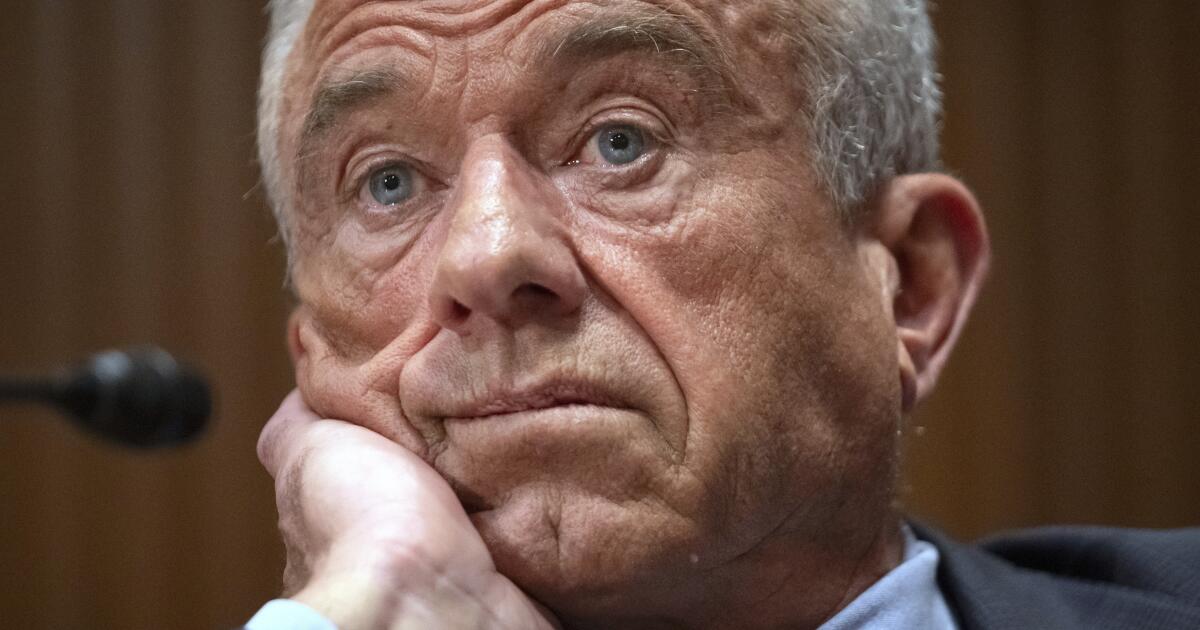
The conservative assault on child health starts with the anti-vaccine campaign and proceeds to cutbacks in nutrition assistance and narrowed access to healthcare.
In the old days, before accepted medical protocols came under partisan assault, infants typically received a vitamin K shot to enhance blood-clotting capability and a few drops of an antibiotic to stave off eye infections before leaving the hospital, followed by a thorough round of vaccines against life-threatening diseases.
Americans assumed that “whatever a family could afford, the country had already decided this child was worth protecting,” Robert B. Shpiner, a critical care expert at UCLA medical school, wrote recently. “I have seen children harmed by disease, poverty, by bad luck. I had not, until now, seen them harmed so methodically by their own government.”
Shpiner’s targets were the changes in healthcare policies instituted by the Trump administration generally and Health and Human Services Secretary Robert F. Kennedy Jr., as well as the mistrust in medical authority that Kennedy and his followers have helped to foment.
We’re going to be paying this bill for years to come, because the lack of proper nutrition has profound effects on learning and disability.
— Robert B. Shpiner, UCLA
As Shpiner wrote in the Guardian, the administration’s assault on child health begins with its anti-vaccination policies. In January, Kennedy’s agency reduced the list of recommended childhood immunizations to 11 from 17, removing shots for COVID-19, hepatitis and meningitis, among other diseases. The agency made the changes without the customary professional consultations, KFF has reported.
But that’s only the tip of the iceberg. “It’s just one thing after another,” Shpiner told me.
What triggered him into writing his Guardian essay, he says, was learning that congressional Republicans had advanced an agriculture appropriations bill that would cut the fruit and vegetable benefit for children in WIC, the supplemental nutritional program for women, infants and children to $10 a month from $26.
“That got me to looking at this as a sequence,” he says, starting with the reduction of child immunizations, followed by the proposed cuts in WIC and the cuts in food stamps enacted as part of the Republican budget bill that Trump signed one year ago Saturday (i.e., the Fourth of July, 2025).
“The image of us taking food away from kids and not giving them enough money to buy some apples and berries—the short-term response is outrage,” he says, “but the medium- and long-term effect is that we’re going to be paying this bill for years to come, because the lack of proper nutrition has profound effects on learning, and disability and anemia. A number of measures of health and success match with nutrition.”
At almost every stage of childhood development, he notes, programs aimed at preserving or enhancing children’s health have gone on the chopping block.
“A vaccine rule one week, a food program the next,” he wrote. “Each change arrives wrapped in a reasonable rationale: fiscal discipline, local control, parental choice. But arrange them in the order a child actually grows, and the rationales stop mattering.”
Judging from their rhetoric, one would think that Republicans would move heaven and earth to foster child immunizations, nutritional assistance and access to medical care.
In “Communion,” his recent book about his conversion to Catholicism, for example, Vice President JD Vance writes: “We want more children in our society because children are profoundly good — the greatest value add we can create.”
Yet the programmatic cutbacks advocated for and implemented by the Republican Congress and Trump give the lie to that sentiment. Let’s examine chapter and verse.
Measles is the canary in the coal mine for vaccination and public health, and at this moment, the canary is singing a doleful tune. The Centers for Disease Control and Prevention count 2,134 cases in the U.S. as of June 25. That’s poised to exceed the 2,288 cases in all of 2025, which was the worst outbreak since 1991.
There’s no question why this is happening. It’s because of a decline in measles vaccinations below the 95% generally considered to provide “herd immunity,” in which the disease is so rare that even unvaccinated individuals are protected from exposure.
Kennedy may not deserve all the blame for the immunization decline, but as pseudoscience debunker Steven Novella has pointed out, as secretary he has “done everything possible to undermine vaccine science and confidence in health institutions.”
Kennedy has paid lip service to the value of the MMR vaccine, which combines immunizations for measles, mumps and rubella. But he has claimed without evidence that the vaccine causes deaths “every year” and that the vaccine hasn’t been safety-tested, which isn’t so. He has asserted that it shouldn’t be subject to a government mandate. He also has promoted treatments for measles that aren’t known to be effective.
(The Department of Health and Human Services didn’t respond to my request for comment on the vaccine initiatives.)
As children grow, the crisis of malnutrition kicks in. The House GOP’s cuts to WIC are still only on the drawing board. But the Republican budget bill incorporated cuts to food stamps — the Supplemental Nutrition Assistance Program, or SNAP — that have driven some 4 million people off the program. In 13 states that have published data, according to the Center on Budget and Policy Priorities, child enrollment fell by more than 800,000, or 16%, between July 2025 and May of this year.
“This is where the nutrition cuts become a medical, not merely a moral, story,” Shpiner says. “Iron-deficiency anemia in infancy is associated with poorer cognitive, motor, and behavioral outcomes that persist more than 10 years after the deficiency itself has been corrected — the deficit does not fully reverse even with later treatment. Withdrawing produce and protein from WIC and SNAP at the peak window of brain growth is not a budget line that resets the following year; it is a developmental exposure with a long tail.”
The combination of reduced immunization and poor nutrition build on each other. “Unvaccinated kids are going to get sicker,” he told me. “If they’re malnourished, they’re going to get sicker. If their parents don’t get affordable care, they’re going to be strapped. It becomes a synergistic and multiplicative cascade.”
Indeed, the administration’s assault on Medicaid and the Affordable Care Act intensifies the damage. Enrollment in Medicaid and the Children’s Health Insurance Program, which is part of Medicaid, fell by 4.8 million people, or 6%, from March 2025 through March 2026, according to government data. The enrollment decline for children alone came to more than 1.9 million, or 5%.
White House spokesperson Kush Desai challenged the latter figure when I asked for comment. But it came from KFF, which sourced it to the government’s Centers for Medicare and Medicaid Services, or CMS.
“Nothing has been done to alter insurance or Medicaid coverage of any vaccination,” Desai told me by email, “and parents are encouraged to seek out the counsel of their pediatrician to make the best decisions for their children.”
The prospects are for further declines. That’s because new work requirements for enrollees in Medicaid expansion under the Affordable Care Act are almost certain to drive enrollment down, due to obstacles including paperwork burdens and administrative snafus, resulting in even some eligible enrollees losing their coverage.
(These problems became so pronounced in Arkansas, which implemented work requirements during the first Trump term, that a federal judge axed the program.)
The work rules enacted last year as part of the Republican budget bill aren’t scheduled to start until Jan. 1, but three states are starting early — Nebraska (May 1), Montana (Wednesday) and Iowa (Dec. 1). The impact on enrollment isn’t yet clear.
Whatever the effect of these changes, the public is going to know less about them than before. The reason is that the administration has shrunk the requirements for reports of immunization from states, changing the reports from mandated to voluntary. The affected data include childhood immunization rates against diphtheria, tetanus, pertussis, polio, measles, mumps and rubella, hepatitis, chicken pox and flu; and rates for 13 year olds and expectant mothers.
“While seemingly a small, technical change, the removal of vaccine reporting in Medicaid and CHIP may make it more difficult to monitor and understand vaccination trends for a large share of children in the U.S.,” KFF noted.
I asked the Department of Health and Human Services to explain the rationale for these changes, and specifically whether they were aimed at obscuring the effect of the narrowing of vaccine recommendations, but didn’t hear back.
-
 News6 minutes ago
Paul Pelosi in hit-and-run in California, car left with major damage, authorities say
-

 Los Angeles, Ca1 hour ago
Firefighters battle Fourth of July blazes around Los Angeles
-

 Detroit, MI2 hours ago
Storm chances linger into the start of the week across Metro Detroit
-

 San Francisco, CA2 hours ago
Relay for America runs flag from San Francisco to D.C. in message of unity
-

 Dallas, TX2 hours ago
Cowboys newcomer already looks like a waste of money in Dallas
-

 Miami, FL2 hours ago
Police search for suspect after man is shot while on a boat near hotel in Fort Lauderdale on 4th of July
-

 Boston, MA2 hours ago
Sonny Gray shines again, and the Red Sox make it two straight wins at the Angels to start grinding road trip – The Boston Globe
-

 Denver, CO2 hours ago
Aldi expanding into Colorado, applies for permits at two Denver locations

