Business
Commentary: Has Musk lied about self-driving Teslas? California says so

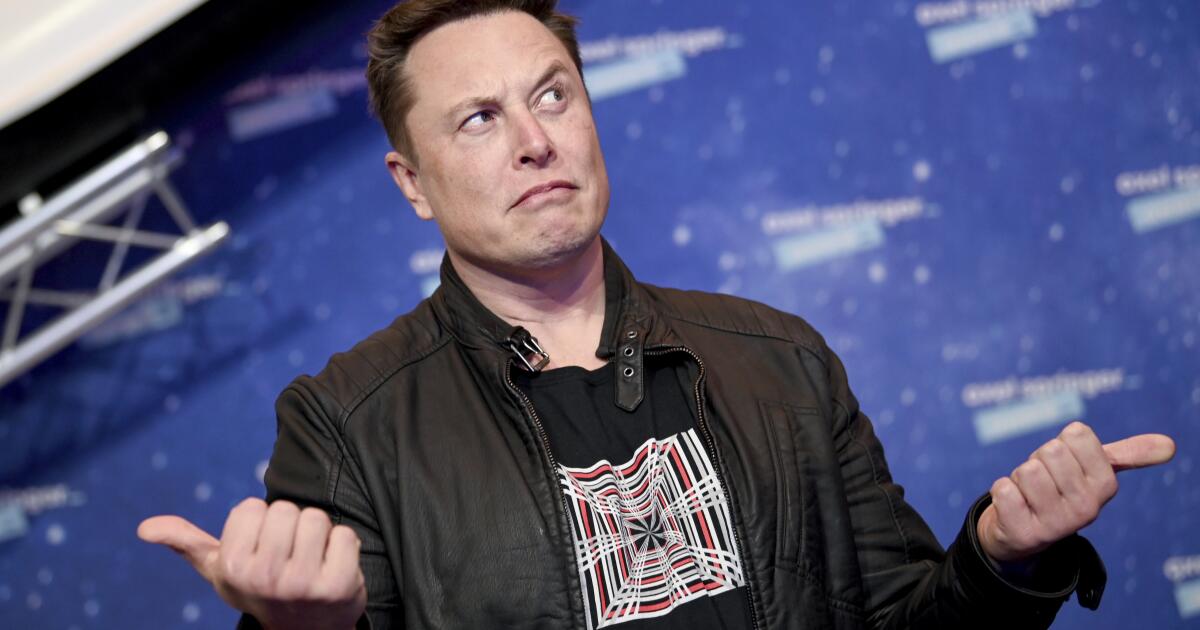
Over the years, Elon Musk has been known for making extravagant promises about the capabilities of Tesla cars, and for falling short.
California has finally called him out, via a lawsuit accusing Tesla of leading buyers to believe that its vehicles can operate autonomously — as self-driving cars — which they “could not and cannot do.” That amounts to false advertising, the Department of Motor Vehicles asserts.
The DMV is seeking to bar Tesla from selling cars in the state for at least 30 days. A five-day hearing in the case began Monday in Oakland before a DMV administrative law judge.
Professional investors, and most amateur investors as well, know how to devalue the optimism of corporate executives.
— Tesla, defending its unproven claims for its cars’ self-driving capabilities
A suspension of car sales in California would be a serious problem for Tesla, given that the state has generally accounted for some 30% of its U.S. domestic sales; the U.S. has accounted for roughly half of worldwide sales.
Through June this year, Tesla sales have fallen more than 18% in California compared with the same period a year ago, at least in part because of Musk’s increasingly visible engagement with right-wing politics, his online embrace of racist and antisemitic viewpoints, and the rampage through federal agencies conducted by his minions at DOGE.
Tesla’s EV market share in the state fell to 45.3% in the first half from 53.4% in the first half of 2024.
Tesla’s second-quarter results, released after the stock market’s close Wednesday, bore no reason for joy among investors. The company reported a 12% revenue decline compared with the same quarter in 2024, which it attributed to a decline in auto deliveries, and a 42% decline in operating profit.
Tesla has had to fight accusations of false claims about its cars’ autonomous capabilities before. Indeed, lists of overly optimistic or overconfident forecasts by Musk of Tesla sales and technological capabilities are common on the web. Not a few investors have learned to build in a standard deflation factor to bring these projections closer to reality or plausibility.
“Within two years,” Musk said in 2016, “you’ll be able to summon your car from across the country. It will meet you wherever your phone is … and it will just automatically charge itself along the entire journey.” In 2020, he told an engineering conference that he was “confident that we will have the basic functionality for Level 5 autonomy complete this year.”
Level 5, as defined by the Society of Automotive Engineers, is the highest self-driving category, allowing a vehicle to operate without a human driver ever taking control and in all conditions. No manufacturer has yet turned out a Level 5 vehicle, and some engineers doubt it will ever be possible. The most advanced autonomous vehicles today are Level 2 or 3, in which human drivers must take control all or some of the time.
A video posted on Tesla’s website in 2016 featured a car purportedly stopping at a red light and obeying other traffic signals, with the caption, “The person in the driver’s seat is only there for legal reasons. He is not doing anything. The car is driving itself.” A Tesla engineer later testified that the car followed a mapped route and that it did not have the capabilities shown in the video.
A Tesla shareholder lawsuit filed in 2023 cited more than 20 false or misleading statements Musk or Tesla made about the stage of its self-driving technology, its safety and its capabilities, dating back to 2019.
During a podcast that year, for example, Musk claimed that by the end of the year a Tesla car “will be able to find you in a parking lot, pick you up, take you all the way to your destination without an intervention … I’m certain of that. That is not a question mark.” The California authorities assert that that’s still not possible, in 2025.
Tesla’s defense in the shareholder case included the argument that statements like those were “mere corporate puffery, vague statements of optimism.” They shouldn’t be part of a lawsuit, the company said, because “professional investors, and most amateur investors as well, know how to devalue the optimism of corporate executives.”
We’ve heard the “puffery” defense before. Typically, businesses use it to defend against charges that its advertising claims are deceptive, on the grounds that no one believes advertisements anyway.
Wells Fargo used it in an attempt to fend off a 2018 shareholder lawsuit alleging that the bank’s claim that it was working to “restore trust” among its customers after a string of scandals was false. The bank’s response was that such statements were “puffery” — so generic that they couldn’t “cause a reasonable investor to rely upon them.” Wells Fargo eventually settled the lawsuit for $300 million, without admitting wrongdoing.
A federal judge dismissed the shareholder lawsuit last year, finding that some of the statements by Tesla and Musk were indeed mere “puffery” and others were either true or otherwise irrelevant. The plaintiffs, which are public pension funds, have appealed the dismissal.
California authorities filed their case against Tesla in July 2022. Their accusation has four main components. They argue that by labeling its autonomous driving functions “Autopilot” and “Full Self-Driving Capability,” the company has implied to customers that the cars can drive themselves.
The state also cited two snippets of language on the Tesla website. One stated, “The system is designed to be able to conduct short and long-distance trips with no action required by the person in the driver’s seat.” The other said, in part, “All you will need to do is get in and tell your car where to go. … Your Tesla will figure out the optimal route, navigating urban streets, complex intersections and freeways.”
Tesla didn’t reply to my request for a comment. But in its trial brief, filed July 17, the company asserted that its Autopilot and Full Self-Driving descriptions have always been qualified by warnings to users that the available features “require active driver supervision and do not make the vehicle autonomous.” It said that more than a year ago it dropped the label “Full Self-Driving Capability,” or FSDC, and replaced it with “Full Self-Driving (Supervised).”
As for the language the state cited, Tesla said that the phrases appeared only on “an aspirational webpage designed to recruit engineers … to develop future FSDC features,” and weren’t aimed at buyers — in other words, they were not meant to be factual claims. In any case, Tesla said, that webpage “no longer exists.” Its web address now steers users to the webpage for Full Self-Driving (Supervised).
Tesla also contended that there is no “direct evidence of consumer confusion” over the autonomy of its vehicles. The DMV, it said, merely concluded that “consumers may interpret Autopilot of FSDC terminology as being synonymous” with autonomous operation, but that’s not enough for a false advertising claim. (Emphasis in the original.)
It’s true that Tesla’s self-driving features haven’t been successfully blamed in court for producing injuries or fatalities; Tesla has settled at least three cases involving claims that its self-driving systems were responsible for fatal accidents. One case involved the death of an Apple engineer whose Tesla struck a highway barrier while he was playing a video game with Autopilot allegedly activated. The settlement terms were undisclosed.
Tesla’s record could change, however, with the outcome of a trial currently taking place in federal court in Miami. The case was brought by the families of two victims who died when a Tesla with Autopilot engaged slammed into an SUV near where they were standing. One died and the other suffered serious injuries. The driver of the Tesla had taken his eyes off the road to search for a cellphone he had dropped, and the vehicle continued through an intersection before striking the SUV.
In certifying the case for trial, federal Judge Beth Bloom ruled that “a reasonable jury could find that Tesla acted in reckless disregard of human life for the sake of developing their product and maximizing profit.” She also cleared the plaintiffs to seek punitive damages if the jury finds against Tesla.
These legal developments come at a sensitive moment for Tesla. Sales are down not only in California, but also in much of the world. In the European Union, Tesla sales fell 45.2% this year through May, compared with a year earlier.
Tesla’s sales of regulatory credits to automakers that don’t exclusively market EVs but have needed to meet federal fleet emission standards are likely to evaporate; the budget bill recently signed by President Trump eliminates the financial penalties for automakers that don’t meet those standards, removing their incentive to buy credits from Tesla.
Sales of those credits came to $2.76 billion last year, nearly 40% of Tesla’s reported profit for the year. Without the credit sales, which came to $595 million in the first quarter of this year, which ended March 31, Tesla would have reported a loss for the quarter instead of a $420-million profit. Tesla is scheduled to report second-quarter financial results next week.
The company faces challenges other than Musk’s waning public esteem and its sales decline. As I reported in March, the company faces ever-stiffer secular headwinds, including competition from legacy automakers moving into the electric vehicle market.
Its reputation for cutting-edge technology is eroding; the company’s largest Chinese rival, BYD, recently announced a new charging technology it says can add about 250 miles of range to an EV in five minutes — even less than the time it takes to fill a conventional car’s gas tank to the same level. Tesla says its top-of-the-line superchargers need 15 minutes to add 200 miles of charge.
Tesla’s product lineup is looking increasingly antique. Its clunky and widely disdained Cybertruck is beginning to look like a lemon. In March, regulators ordered a recall of all the trucks — the eighth recall since its introduction in 2023 — this time to address the tendency of metal trims along both sides to get ripped off at highway speeds because the glue that attaches them fails.
Sales have been sinking: Kelley Blue Book reported earlier this month that Tesla sold only 4,306 Cybertrucks in the second quarter this year, down by nearly one-third from the second quarter of 2024, and down by 50% in the first half of 2025 compared with last year’s first half.
Tesla’s stock has long been buoyed by Musk’s reputation as a farsighted entrepreneur — based in part on his enticing visions of Tesla’s prospects. Those are beginning to fray, and the full dimensions of the wear-and-tear may not yet be fully evident.



The sale of Warner Bros. — whether in pieces to Netflix or in its entirety to Paramount — is stirring mounting worries among Hollywood union leaders about the possible fallout for their members.
Unions representing writers, directors, actors and crew workers have voiced growing concerns that further consolidation in the media industry will reduce competition, potentially causing studios to pay less for content, and make it more difficult for people to find work.
“We’ve seen this movie before, and we know how it ends,” said Michele Mulroney, president of the Writers Guild of America West. “There are lots of promises made that one plus one is going to equal three. But it’s very hard to envision how two behemoths, for example, Warner Bros. and Netflix … can keep up the level of output they currently have.”
Last week, Netflix announced it agreed to buy Warner Bros. Discovery’s film and TV studio, Burbank lot, HBO and HBO Max for $27.75 a share, or $72 billion. It also agreed to take on more than $10 billion of Warner Bros.’ debt. But Paramount, whose previous offers were rebuffed by Warner Bros., has appealed directly to shareholders with an alternative bid to buy all of the company for about $78 billion.
Paramount said it will have more than $6 billion in cuts over three years, while also saying the combined companies will release at least 30 movies a year. Netflix said it expects its deal will have $2 billion to $3 billion in cost cuts.
Those cuts are expected to trigger thousands of layoffs across Hollywood, which has already been squeezed by the flight of production overseas and a contraction in the once booming TV business.
Mulroney said that employment for WGA writers in episodic television is down as much as 40% when comparing the 2023-2024 writing season to 2022-2023.
Executives from both companies have said their deals would benefit creative talent and consumers.
But Hollywood union leaders are skeptical.
“We can hear the generalizations all day long, but it doesn’t really mean anything unless it’s on paper, and we just don’t know if these companies are even prepared to make promises in writing,” said Lindsay Dougherty, Teamsters at-large vice president and principal officer for Local 399, which represents drivers, location managers and casting directors.
Dougherty said the Teamsters have been engaged with both Netflix and Paramount, seeking commitments to keep filming in Los Angeles.
“We have a lot of members that are struggling to find work, or haven’t really worked in the last year or so,” Dougherty said.
Mulroney said her union has concerns about both bids, either by Netflix or Paramount.
“We don’t think the merger is inevitable,” Mulroney said. “We think there’s an opportunity to push back here.”
If Netflix were to buy Warner Bros.’ TV and film businesses, Mulroney said that could further undermine the theatrical business.
“It’s hard to imagine them fully embracing theatrical exhibition,” Mulroney said. “The exhibition business has been struggling to get back on its feet ever since the pandemic, so a move like this could really be existential.”
But the Writers Guild also has issues with Paramount’s bid, Mulroney said, noting that it would put Paramount-owned CBS News and CNN under the same parent company.
“We have censorship concerns,” Mulroney said. “We saw issues around [Stephen] Colbert and [Jimmy] Kimmel. We’re concerned about what the news would look like under single ownership here.”
That question was made more salient this week after President Trump, who has for years harshly criticized CNN’s hosts and news coverage, said he believes CNN should be sold.
The worries come as some unions’ major studio contracts, including the DGA, WGA and performers guild SAG-AFTRA, are set to expire next year. Two years ago, writers and actors went on a prolonged strike to push for more AI protections and better wages and benefits.
The Directors Guild of America and performers union SAG-AFTRA have voiced similar objections to the pending media consolidation.
“A deal that is in the interest of SAG-AFTRA members and all other workers in the entertainment industry must result in more creation and more production, not less,” the union said.
SAG-AFTRA National Executive Director Duncan Crabtree-Ireland said the union has been in discussions with both Paramount and Netflix.
“It is as yet unclear what path forward is going to best protect the legacy that Warner Brothers presents, and that’s something that we’re very actively investigating right now,” he said.
It’s not clear, however, how much influence the unions will have in the outcome.
“They just don’t have a seat at the ultimate decision making table,” said David Smith, a professor of economics at the Pepperdine Graziadio Business School. “I expect their primary involvement could be through creating more awareness of potential challenges with a merger and potentially more regulatory scrutiny … I think that’s what they’re attempting to do.”

Businessman Brian Kahn has pleaded guilty to conspiracy to commit securities fraud in a case that brought down a hedge fund, helped lead to the bankruptcy of a retailer and damaged West Los Angeles investment bank B. Riley Financial.
Kahn, 52, admitted in a Trenton, N.J., federal court Wednesday to hiding trading losses that brought down Prophecy Asset Management in 2020. The Securities and Exchange Commission alleged the losses exceeded $400 million.
An investor lawsuit has accused Kahn of funneling some of the fund’s money to Franchise Group, a Delaware retail holding company assembled by the investor that owned Vitamin Shoppe, Pet Supplies Plus and other chains.
B. Riley provided $600 million through debt it raised to finance a $2.8-billion management buyout led by Kahn in 2023. It also took a 31% stake in the company and lent Kahn’s investment fund $201 million, largely secured with shares of Franchise Group.
Kahn had done deals with B. Riley co-founder Bryant Riley before partnering with the L.A. businessman on Franchise Group.
However, the buyout didn’t work out amid fallout from the hedge fund scandal and slowing sales at the retailers. Franchise Group filed for bankruptcy in November 2024. A slimmed-down version of the company emerged from Chapter 11 in June.
B. Riley has disclosed in regulatory filings that the firm and Riley have received SEC subpoenas regarding its dealings with Kahn, Franchise group and other matters.
Riley, 58, the firm’s chairman and co-chief executive, has denied knowledge of wrongdoing, and an outside law firm reached the same conclusion.
The failed deal led to huge losses at the financial services firm that pummeled B. Riley’s stock, which had approached $90 in 2021. Shares were trading Friday at $3.98.
The company has marked down its Franchise Group investment, and has spent the last year or so paring debt through refinancing, selling off parts of its business and other steps, including closing offices.
The company announced last month it is changing its name to BRC Group Holdings in January. It did not immediately respond to requests for comment.
At Wednesday’s plea hearing, Assistant U.S. Atty. Kelly Lyons said that Kahn conspired to “defraud dozens of investors who had invested approximately $360 million” through “lies, deception, misleading statements and material omissions.”
U.S. District Judge Michael Shipp released Kahn on a $100,000 bond and set an April 2 sentencing date. He faces up to five years in prison. Kahn, his lawyer and Lyons declined to comment after the hearing.
Kahn is the third Prophecy official charged over the hedge fund’s collapse. Two other executives, John Hughes and Jeffrey Spotts, have also been charged.
Hughes pleaded guilty and is cooperating with prosecutors. Spotts pleaded not guilty and faces trial next year. The two men and Kahn also have been sued by the SEC over the Prophecy collapse.
Bloomberg News contributed to this report.

Chatty bots are sharing their hot takes through hundreds of thousands of AI-generated podcasts. And the invasion has just begun.
Though their banter can be a bit banal, the AI podcasters’ confidence and research are now arguably better than most people’s.
“We’ve just begun to cross the threshold of voice AI being pretty much indistinguishable from human,” said Alan Cowen, chief executive of Hume AI, a startup specializing in voice technology. “We’re seeing creators use it in all kinds of ways.”
AI can make podcasts sound better and cost less, industry insiders say, but the growing swarm of new competitors entering an already crowded market is disrupting the industry.
Some podcasters are pushing back, requesting restrictions. Others are already cloning their voices and handing over their podcasts to AI bots.
Popular podcast host Steven Bartlett has used an AI clone to launch a new kind of content aimed at the 13 million followers of his podcast “Diary of a CEO.” On YouTube, his clone narrates “100 CEOs With Steven Bartlett,” which adds AI-generated animation to Bartlett’s cloned voice to tell the life stories of entrepreneurs such as Steve Jobs and Richard Branson.
Erica Mandy, the Redondo Beach-based host of the daily news podcast called “The Newsworthy,” let an AI voice fill in for her earlier this year after she lost her voice from laryngitis and her backup host bailed out.
She fed her script into a text-to-speech model and selected a female AI voice from ElevenLabs to speak for her.
“I still recorded the show with my very hoarse voice, but then put the AI voice over that, telling the audience from the very beginning, I’m sick,” Mandy said.
Mandy had previously used ElevenLabs for its voice isolation feature, which uses AI to remove ambient noise from interviews.
Her chatbot host elicited mixed responses from listeners. Some asked if she was OK. One fan said she should never do it again. Most weren’t sure what to think.
“A lot of people were like, ‘That was weird,’” Mandy said.
In podcasting, many listeners feel strong bonds to hosts they listen to regularly. The slow encroachment of AI voices for one-off episodes, canned ad reads, sentence replacement in postproduction or translation into multiple languages has sparked anger as well as curiosity from both creators and consumers of the content.
Augmenting or replacing host reads with AI is perceived by many as a breach of trust and as trivializing the human connection listeners have with hosts, said Megan Lazovick, vice president of Edison Research, a podcast research company.
Jason Saldanha of PRX, a podcast network that represents human creators such as Ezra Klein, said the tsunami of AI podcasts won’t attract premium ad rates.
“Adding more podcasts in a tyranny of choice environment is not great,” he said. “I’m not interested in devaluing premium.”
Still, platforms such as YouTube and Spotify have introduced features for creators to clone their voice and translate their content into multiple languages to increase reach and revenue. A new generation of voice cloning companies, many with operations in California, offers better emotion, tone, pacing and overall voice quality.
Hume AI, which is based in New York but has a big research team in California, raised $50 million last year and has tens of thousands of creators using its software to generate audiobooks, podcasts, films, voice-overs for videos and dialogue generation in video games.
“We focus our platform on being able to edit content so that you can take in postproduction an existing podcast and regenerate a sentence in the same voice, with the same prosody or emotional intonation using instant cloning,” said company CEO Cowen.
Some are using the tech to carpet-bomb the market with content.
Los Angeles podcasting studio Inception Point AI has produced its 200,000 podcast episodes, accounting for 1% of all podcasts published on the internet, according to CEO Jeanine Wright.
The podcasts are so cheap to make that they can focus on tiny topics, like local weather, small sports teams, gardening and other niche subjects.
Instead of a studio searching for a specific “hit” podcast idea, it takes just $1 to produce an episode so that they can be profitable with just 25 people listening.
“That means most of the stuff that we make, we have really an unlimited amount of experimentation and creative freedom for what we want to do,” Wright said.
One of its popular synthetic hosts is Vivian Steele, an AI celebrity gossip columnist with a sassy voice and a sharp tongue. “I am indeed AI-powered — which means I’ve got receipts older than your grandmother’s jewelry box, and a memory sharper than a stiletto heel on marble. No forgetting, no forgiving, and definitely no filter,” the AI discloses itself at the start of the podcast.
“We’ve kind of molded her more towards what the audience wants,” said Katie Brown, chief content officer at Inception Point, who helps design the personalities of the AI podcasters.
Inception Point has built a roster of more than 100 AI personalities whose characteristics, voices and likenesses are crafted for podcast audiences. Its AI hosts include Clare Delish, a cooking guidance expert, and garden enthusiast Nigel Thistledown.
The technology also makes it easy to get podcasts up quickly. Inception has found some success with flash biographies posted promptly in connection to people in the news. It uses AI software to spot a trending personality and create two episodes, complete with promo art and a trailer.
When Charlie Kirk was shot, its AI immediately created two shows called “Charlie Kirk Death” and “Charlie Kirk Manhunt” as a part of the biography series.
“We were able to create all of that content, each with different angles, pulling from different news sources, and we were able to get that content up within an hour,” Wright said.
Speed is key when it comes to breaking news, so its AI podcasts reached the top of some charts.
“Our content was coming up, really dominating the list of what people were searching for,” she said.
Across Apple and Spotify, Inception Point podcasts have now garnered 400,000 subscribers.

Griz outlast power outage, surge to big win – University of Montana Athletics

Donovan Jones Urges Huskers to use Bowl Prep to Set the Tone for Nebraska’s Future

Justice Dept. sues Nevada over voter rolls

Hudson, NH Police arrest four following drug trafficking investigation

Nemec Out, As Wounded Devils Host Ducks | PREVIEW | New Jersey Devils

Florida High School Football Rankings: Top 25 teams – Oct. 21

Cleary's 21 help Le Moyne down Central Connecticut State 69-64 in OT

How old is Bo Nix? What to know about Oregon quarterback ahead of 2024 NFL Draft

99th annual Pony Swim held in Virginia

Video: ‘It Didn’t Have to Happen This Way:’ U.Va. Faculty Call for Review of Police Response to Protests

Inside Minnesota’s $1B fraud: fake offices, phony firms and a scandal hiding in plain sight

Residents emerge in DR Congo’s tense Uvira after M23 rebel takeover

What to know about Kilmar Abrego Garcia’s release from immigration custody

Republican House leader signals plan to begin contempt proceedings against Bill and Hillary Clinton

Three years on, former MEP Kaili remains in limbo still awaiting trial
-

 Alaska7 days ago
Howling Mat-Su winds leave thousands without power
-

 Texas1 week ago
Texas Tech football vs BYU live updates, start time, TV channel for Big 12 title
-

 Ohio1 week ago
Who do the Ohio State Buckeyes hire as the next offensive coordinator?
-

 Washington4 days ago
LIVE UPDATES: Mudslide, road closures across Western Washington
-

 Iowa6 days ago
Matt Campbell reportedly bringing longtime Iowa State staffer to Penn State as 1st hire
-

 Miami, FL6 days ago
Urban Meyer, Brady Quinn get in heated exchange during Alabama, Notre Dame, Miami CFP discussion
-

 Cleveland, OH6 days ago
Man shot, killed at downtown Cleveland nightclub: EMS
-
World6 days ago
Chiefs’ offensive line woes deepen as Wanya Morris exits with knee injury against Texans

