Business
Commentary: Does America need billionaires? Billionaires say 'Yes!'


What’s the most downtrodden and persecuted minority in America?
If you said it’s transgender youths, immigrant workers or women trying to access their reproductive health rights, you’re on the wrong track.
The correct answer, judging from a surge in news reporting over the last couple of weeks, is the American billionaire.
I don’t think that we should have billionaires because, frankly, it is so much money in a moment of so much inequality, and ultimately, what we need more of is equality across our city and across our state and across our country.
— Zohran Mamdani, candidate for NYC mayor
Concern about the welfare of this beleaguered minority (there are about 2,000 billionaires in the U.S.) has been triggered — or re-triggered — by the victory of Zohran Mamdani in New York City’s June 24 Democratic primary.
A self-described “democratic socialist,” Mamdani has had to weather bizarrely focused questions from cable news anchors and others about comments he has made about extreme wealth inequality in the U.S., and specifically in New York.
“I don’t think that we should have billionaires,” he told Kristen Welker of NBC’s “Meet the Press” on June 29.
Welker had asked Mamdani, “Do you think that billionaires have a right to exist?” This was a weirdly tendentious way of putting the question. She made it sound as though he advocated lining billionaires up against a wall and shooting them. In fact, what he has said is that the proliferation of billionaires in America, and the unrelenting growth in their fortunes over the last decades, signified a broken economic system.
Nevertheless, the billionaire class and their advocates in the media and on cable news expressed shock and dismay at the very idea. “It takes people who are wealthy in New York to maintain the museums, maintain the hospitals,” John Catsimatidis, a billionaire real estate and supermarket tycoon, fulminated on Fox News. “Do you know how much money we put up to contribute toward museums and hospitals and everything?”
Catsimatidis may not have realized that he had proved Mamdani’s case: In New York and around the country, a tax structure that indulges the 1% with tax breaks has forced austerity on museums and hospitals and services that should be publicly supported. They’re public goods, and they shouldn’t be dependent on the kindness of random plutocrats.
The sheer scale of billionaire wealth in the U.S. prevents most people from understanding how historically outsized it is. “To own $1 billion is to possess more dollars than you’ll ever count,” observed Timothy Noah of the New Republic in a must-read takedown of the American oligarchy published last month. “It’s to possess more dollars than any human being will ever count. And that’s just one billion. Forbes counts 15 Americans who possess hundreds of billions.”
The most comprehensive defense of billionaires appeared July 1 in the Financial Times. It was written by Michael Strain, director of economic policy studies at the American Enterprise Institute, a pro-business think tank that has advocated against increasing the minimum wage (in a article by Strain), against the Dodd-Frank post-Great Recession banking reforms, against environmental legislation and against tobacco regulations, among other bete noires of the right.
“We should want more billionaires, not fewer,” Strain writes. “While amassing their fortunes, billionaires make the rest of us richer, not poorer.”
Exhibit A on Strain’s docket is Jeff Bezos, the Amazon.com magnate whose recent wedding in Venice is estimated to have cost as much as $25 million, tasteful and unassuming as we all know it to have been.
Strain cites the common estimate of Bezos’ personal fortune at about $240 billion. He then applies a calculation developed by Nobel economics laureate William D. Nordhaus in 2004, that only 2.2% of the social value of innovations is captured by the original innovators. If Bezos’ $240 billion is 2.2% of the social value of Amazon’s revolution in retailing, then Bezos must have created $11 trillion in wealth for the rest of us.
“Not a bad deal,” Strain writes.
Strain’s interpretation of Nordhaus is hopelessly half-baked. First, Nordhaus was talking about the gains captured by corporations, not individual entrepreneurs. Also, his estimate arose from abstruse economic formulas and lots of magic asterisks.
Nordhaus didn’t present his findings as a defense of any particular economic policies — the 2.2%, he wrote, was excess or “Schumpeterian” profits, those exceeding what would be expected from the normal return from invested capital, which implies that they’re somewhat illegitimate.
Further, it makes no sense to start with an individual entrepreneur’s wealth and extrapolate it to the social value of his or her innovation. It would be more appropriate to try to estimate the social value of the innovation, and then ask whether the innovator’s profits are too much, not enough, or just right.
I asked Strain to justify his treatment, but didn’t hear back.
Another issue with Strain’s advocacy is that he depicted every innovation as the product of a single person’s efforts. Elsewhere in his op-ed, he wrote that Bill Gates and Michael Dell “have made hundreds of millions of workers more productive by creating better software and computers, driving up their wages.”
He also cited Google founders Larry Page and Sergey Brin, who “revolutionized email, internet search and mapping technology”; he added that “many of us would eagerly shell out money every month for these services, if they weren’t provided by Google free of charge.”
(Is that so? If Google thought that consumers would eagerly pay for its services, you can be sure the company would find a way to charge for them, instead of making its money from advertising and sponsorship deals.)
This isn’t the first time that billionaires have felt abused by the zeitgeist. Back in 2021, I wrote that America plainly leads the world in its production of whining billionaires. My example then was Leon Cooperman, a former hedge fund operator who appeared on Bloomberg to grouse about proposals for a wealth tax. He called them “all baloney,” though a viewing of the broadcast suggested he was about to use another label beginning with “B” and caught himself just in time.
A few years earlier, in a ghastly letter published in the Wall Street Journal, Silicon Valley venture investor Thomas Perkins compared the suffering he and his colleagues in the plutocracy had experienced due to public criticism to that of Jews facing Nazi pogroms. “I would call attention to the parallels of fascist Nazi Germany to its war on its ‘one percent,’ namely its Jews, to the progressive war on the American one percent, namely the ‘rich,’” Perkins wrote.
The truth, of course, is that while rich entrepreneurs love to pose as one-man bands, every one of them acquired their wealth with the help and labor of thousands of others. Many of the rank-and-file workers without whom Bezos, Dell and their fellow plutocrats could have reached their pinnacles of fortune have struggled in the oligarchic economy, relying on public assistance to make ends meet.
Bill Gates didn’t originally create “better software” — Microsoft’s original product was a computer operating system he sold to IBM, but which was developed by someone else, Gary Kildall. As of last year, Microsoft employed more than 220,000 people. Dell’s original innovation wasn’t a better PC, but a system of selling clones of IBM PCs by mail order.
It’s proper to question whether any of these innovations have been unalloyed social boons. Amazon may have revolutionized retail, but at the cost of driving untold mom-and-pop stores, and even some big chains, out of business, and paying its frontline workers less than they’re worth.
As for its benefits for consumers, in a lawsuit filed in 2022, California accused Amazon of hobbling retail market competition by having “coerced and induced its third-party sellers and wholesale suppliers to enter into anticompetitive agreements on price.”
The state said that “Amazon makes consumers think they are getting the lowest prices possible, when in fact, they cannot get the low prices that would prevail in a freely competitive market.” (Emphasis in the original.)
Amazon says the state’s claims are “entirely false and misguided,” and denies the state’s assertion that its agreements with vendors and suppliers are designed to “prevent competition” or “harm consumers.” The case is scheduled to go to trial in San Francisco state court in October 2026.
That brings us back to Mamdani. In questioning whether billionaires should exist in the U.S., he was implicitly repeating an observation favored by Sen. Bernie Sanders (I-Vt.) and Rep. Alexandria Ocasio-Cortez (D-N.Y.): “Every billionaire is a policy failure,” a phrase generally attributed to AOC adviser Dan Riffle.
Riffle’s point is that the accumulation of such wealth reflects policies that exacerbate economic inequality such as tax breaks steered toward the richest of the rich, leading to the impoverishment of public services and programs. That trend has been turbocharged by the budget bill President Trump signed on July 4, which slashes government programs to preserve tax cuts for corporations and the wealthy enacted in 2017 by a Republican Congress and signed by Trump.
Mamdani adeptly underscored that point during his appearance on “Meet the Press.” “I don’t think that we should have billionaires,” he told Welker, “because, frankly, it is so much money in a moment of so much inequality, and ultimately, what we need more of is equality across our city and across our state and across our country.”
His prescription is to raise the state corporation tax by several percentage points to match that in neighboring New Jersey, and to add a 2-percentage-point city surcharge on incomes over $1 million, and use the revenue to finance free bus service, free child care and other public services.
The focus by cable news and other media organizations on the idea that Mamdani would erode New York’s economic base by driving the ultra-rich out of the city was as dubious as it was sadly predictable. Some of them have been feeding on spoon-fed pap by the rich and powerful for so long that — as A.J. Liebling once put it — they need to relearn how to chew. Then Mamdani would get a fair shake, and so would the rest of us.


The recall of a popular chip brand over salmonella concerns was recently upgraded to the U.S. Food and Drug Administration’s highest level, just ahead of the Fourth of July holiday and countless backyard barbecues.
On June 24, the FDA designated the recall of several varieties of Zapp’s and Dirty brand potato chips as Class I, meaning it’s “a situation in which there is a reasonable probability that the use of or exposure to a violative product will cause serious adverse health consequences or death.”
FDA has classified the following items as Class I:
Zapp’s
- 1.5-ounce Zapp’s Bayou Blackened Ranch Kettle Chips
- 2.5- and 8-ounce Zapp’s Bayou Blackened Ranch Potato Chips
- 1.5- and 8-ounce Zapp’s Big Cheezy Potato Chips
Dirty
- 1.5- and 2-ounce Dirty Brand Salt and Vinegar Potato Chips
- 2-ounce Dirty Maui Onion Chips
- 2-ounce Dirty Sour Cream and Onion Potato Chips
The chips are produced by Utz Quality Foods, LLC, which on April 28 issued a recall after learning “that a seasoning containing dry milk powder, sourced from California Dairies, Inc. and supplied by a third-party supplier, may contain the presence of Salmonella.”
Salmonella can lead to sometimes deadly infections in elderly people, young children and those with weakened immune systems, according to the FDA.
More than 680,000 bags are included in the recall.
Anyone who has these products should not eat them and should discard them immediately.
What to look for
Salmonella is a foodborne illness that can be fatal to young children, pregnant women, older adults and people with weakened immune systems, according to the National Institutes of Health.
Symptoms may develop 12 to 72 hours after infection, according to the FDA.
The FDA said that people with strong immune systems infected with salmonella may experience fever, diarrhea (which may be bloody), nausea, vomiting and abdominal pain. The illness can last four to seven days.
In rare cases, the infection may produce more severe illnesses such as arterial infections, endocarditis and arthritis, the agency added.
What to do if infected
If you contract salmonella, the Centers for Disease Control and Prevention recommends drinking plenty of fluids to prevent dehydration.
The CDC advises consulting a doctor before taking antidiarrheal medicine or antibiotics. If severe symptoms continue after two days, seek medical help, the agency says.
Because those with diarrhea can spread salmonella to others, it’s also recommended to avoid sharing food or preparing meals for others, sexual contact and swimming in public pools, and to stay home while sick.
Times staff writer Jasmine Mendez contributed to this report.
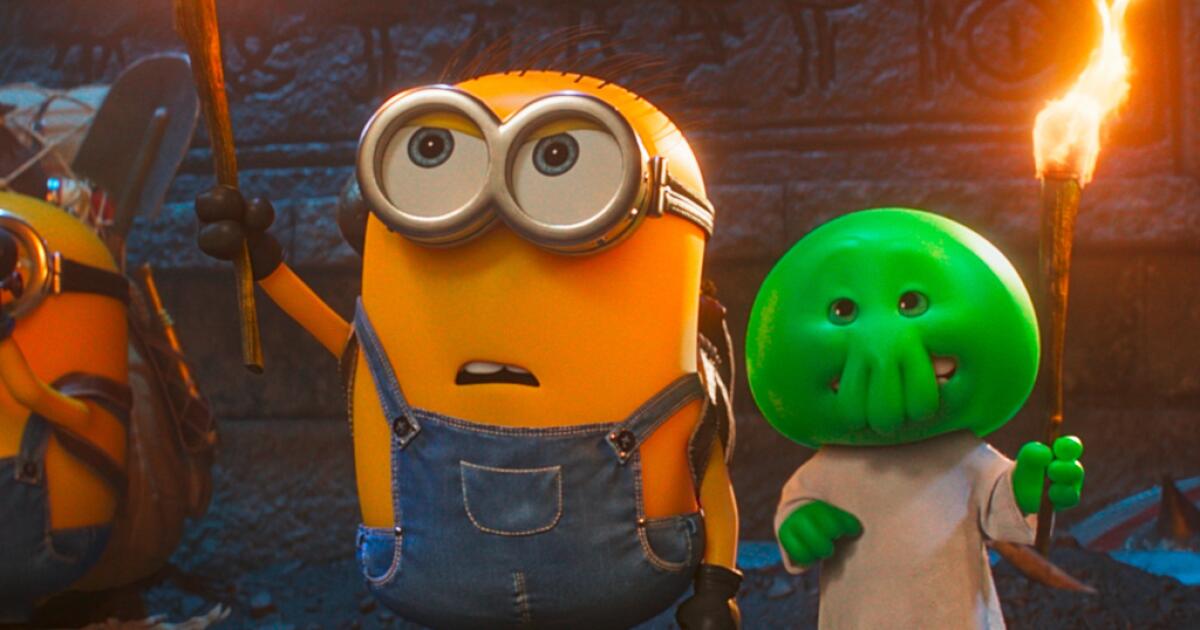
The Minions took over theaters this weekend as Universal Pictures and Illumination’s “Minions & Monsters” won the top spot at the box office, though with a lower-than-expected domestic haul.
The animated movie, which follows the Minions’ takeover of Hollywood, took in $61.4 million in the U.S. and Canada for the five-day Fourth of July holiday weekend, according to studio estimates. That haul was lower than analysts’ expectations for a domestic opening of about $68 million. The movie’s three-day total was $36.4 million.
But the Minions performed well internationally, bringing in about $85 million. In total, “Minions & Monsters” made $159.9 million worldwide on a production budget of about $85 million.
The film is the latest in the powerhouse franchise that began with “Despicable Me” in 2010. Across its previous six installments, the “Despicable Me” and “Minions” franchise has made more than $5.6 billion at the global box office. The last movie, 2022’s “Minions: The Rise of Gru,” made more than $940 million worldwide.
“Minions & Monsters” marks the lowest opening for the franchise. Part of the issue could be timing — the box office can be negatively affected when the Fourth of July lands on a Saturday, said Paul Dergarabedian, head of marketplace trends at Rentrak.
Walt Disney Co. and Pixar’s “Toy Story 5” came in second at the box office this weekend with a domestic three-day gross of $31 million. Angel Studios’ biopic “Young Washington” ($20.8 million), Warner Bros. and DC Studios’ “Supergirl” ($9.6 million) and Universal’s “Disclosure Day” ($6 million) rounded out the top five, according to Rentrak.
The haul for “Minions & Monsters,” coupled with the strong holdover performance of “Toy Story 5,” proved again that family films are making a dent in the summer box office.
“Toy Story 5” has now brought in a total of $764.3 million worldwide, and last month, Universal, Illumination and Nintendo’s “The Super Mario Galaxy Movie” crossed $1 billion at the global box office, becoming the first film of any kind to do so this year.
The rest of the summer theatrical lineup is also expected to bring in audiences and push domestic box office totals closer to pre-pandemic figures. Next week, Disney will release its live-action “Moana,” followed by Christopher Nolan’s “The Odyssey” and Sony Pictures’ “Spider-Man: Brand New Day.”
To date, the summer box office is now about $2.3 billion, a nearly 12% increase compared with the same period a year ago, according to Rentrak data. Compared with pre-pandemic 2019’s numbers, however, it is still down about 7%.

Earlier this year, a widely circulated 15-second AI-generated video of Brad Pitt fighting Tom Cruise on a rooftop sparked outrage across Hollywood. One screenwriter called the cinematic clip “terrifying.” The Motion Picture Assn. demanded the company behind the artificial intelligence tool — Chinese tech giant ByteDance — halt its “infringing activity.”
Despite the uproar, the former majority owner of TikTok has quietly continued to court filmmakers, independent artists and executives who are eager to adopt the AI video generation model called Seedance.
Seedance was launched in the U.S. this spring at a Santa Monica event hosted by a group linked to the Chinese government.
ByteDance began hiring for 100 open roles, signed multiple independent filmmakers and artists and held private conversations about financing AI films. The company threw a lavish caviar party at Cannes and in May hosted panels promoting its cinematic tool at Amazon’s AI on the Lot event in Culver City.
“Like any new technology, Hollywood ultimately has no choice but to react to market realities. And that reality is that the new crop of AI-empowered Hollywood creatives see Seedance as having the most powerful video generator in the market right now,” said Peter Csathy of Creative Media, an entertainment and AI business advisory firm.
Joel Kuwahara, the animation producer on early seasons of “The Simpsons,” echoed Hollywood’s quiet embrace.
“Within the industry, I know that a lot of studios haven’t approved Seedance, but yet with a wink and a nod, they’re allowing Seedance to be used. … It’s kind of like a ‘don’t ask, don’t tell’ kind of a thing,’” Kuwahara told The Times.
ByteDance declined to comment on its U.S. expansion.
The race to build the dominant AI video model has created a fierce rivalry, pitting U.S. companies against the fast-closing Chinese competitors. On the American side, there are Google Veo and startups such as Runway and Luma. OpenAI’s Sora has discontinued its video tool.
The Chinese challengers Seedance, Kling and Alibaba’s HappyHorse have rapidly closed the gap on cinematic realism and have upstaged their American rivals by undercutting them on cost.
According to Artificial Analysis, a company that tracks cost and performances of different AI models, China’s Seedance is currently the most cost-effective and high-quality option compared with U.S. competitors. Seedance costs $9 per minute for video with audio generation, significantly lower than the $24 per minute required by Google’s Veo model.
That makes it an attractive tool for independent filmmakers like Rupert Wainwright, who recently met with Seedance executives at AI on the Lot.
He wants to use the the tool to help make his feature-length film called “Sebastian,” about a Christian saint set in 3rd century Rome. The hybrid AI film will be shot partly on location in Europe and partly generated with artificial intelligence.
“It’s the equivalent to when streaming a movie over the internet onto your TV finally became possible,” Wainwright said.
Kavan Cardoza.
(Kayla Bartkowski/Los Angeles Times)

A scene from “The Chronicles of Bone.”
(Kayla Bartkowski/Los Angeles Times)
In May, Steven Schneider, the producer of “Paranormal Activity,” famous for its handheld grainy footage-style filmmaking, announced “Terrarium,” his first hybrid AI horror production. The film’s director, Jason Zada, said it will be entirely generated using Seedance’s model.
Zada’s filmmaking workflow involves writing, casting, prompting and editing all simultaneously, allowing him to rewrite scripts based on “dailies” generated by AI that day.
He estimates that generating 15 seconds of high-definition video costs only $5.
“We could go from a very detailed outline, very detailed characters and have it be a bit more fluid, because we could regen[erate] as much as we want,” Zada said.
Zada plans to shoot the movie first on a soundstage with real actors and will decide later which parts work better traditionally and what should be done synthetically. He’s a member of the Directors Guild of America and said he will be employing union actors for his hybrid AI film.
Seedance also has continued building ties by offering indie creators, AI-native studios and filmmakers free monthly credits and access to unreleased features. These “tastemakers” beta test its models, offer feedback on what works, and use it for their personal filmmaking projects — which creates corporate brand awareness.
Kavan Cardoza is one such breakout filmmaker. His AI fantasy series, “The Chronicle of Bones,” which uses Seedance, features half a dozen distinct storylines and an ensemble of characters. New episodes, each not more than 30 minutes, are released on YouTube once a month. The solo filmmaker averages 3 million views per episode and has cultivated a YouTube audience of 500,000.
Most filmmakers are tool agnostic, but lately Cardoza has become completely dependent on Seedance, he said, because it solves a persistent problem: maintaining character consistency between shots.

Kavan Cardoza unmasked.
(Kayla Bartkowski/Los Angeles Times)
To create one of his characters, “the last lost boy,” Cardoza took self-portraits wearing a three-faced mask and a tattered brown jacket. He used those reference images for the AI character and transforms them into a stylized person, with a personality, backstory and visual details. He fed those images back to Seedance to get consistent characters — repeating the process for each member of the cast.
“I can’t go get Brad Pitt because he costs like $5, 10, 20 million to be in my film,” Cardoza said. “I can probably get a synthetic actor that will act just as good as Brad Pitt in the future. That’s crazy to me.”
Cardoza has copyrighted his script and characters, and aims to eventually attract major studio interest to turn his intellectual property into a film which comes with a built-in fan base.
Such plans are likely to face resistance from the performers union SAG-AFTRA, which has decried the use of synthetic actors such as Tilly Norwood.
“The rise of Seedance comes down to [its] focus on pleasing filmmakers and making things that look filmic,” said Stephan Vladimir Bugaj, senior vice president of JioStar, a joint venture between Disney and India’s Reliance Industries.
ByteDance introduced timeline-based prompting so filmmakers can actually pick specific moments and tweak them, and improved the understanding of camera direction, physics, lighting and fluidity of action. All of this, Bugaj said, “unlocked a kind of spectacle filmmaking that the other models are not delivering quite as well.”
The company’s tool has been in such high demand, Zada said, that Seedance has been quoting some major Hollywood studios $2 million for unrestricted special access.
While acknowledging Seedance’s popularity and its U.S. expansion, Amit Jain, chief executive of Luma, said its ceiling in Hollywood is severely limited. Traditional studios might adopt Chinese models for some preproduction tasks such as concepting, but the geopolitical and intellectual property risks for commercial generations are too prohibitive.
“Can you imagine Disney using the ByteDance model for the next ‘Snow White’? No way,” Jain said. “This is not even a technical argument, really. That’s the reality.”
Luma has been making inroads into Hollywood selling its software but has separately funded a production service company to teach filmmakers to make hybrid AI films using its tools.
Despite conservative production budgets, AI spending by media companies is projected to grow from $2.6 billion to $12.5 billion from 2024 to 2029, according to a State of Generative AI Media report.

Kavan Cardoza flips through pages of his fine-art photography book.
(Kayla Bartkowski/Los Angeles Times)
Bugaj warned that the quality and competitive price of Chinese models should be a “wake-up call” for American players fighting for market share.
“We’re not loyal,” said Zada, the filmmaker. “Whatever is the best, we’re going to use it.”
-

 Fitness3 minutes ago
How Jackass Star Chris Pontius’ Simple ‘1-Rep’ Rule Keeps Him Jacked at 51 – and Why it’s so Effective
-

 Movie Reviews14 minutes ago
Movie Review – The Fetus (2025)
-

 World26 minutes ago
India's auto industry defends ethanol fuel mandate amid backlash
-
 Lifestyle1 hour ago
How to enter your Sporty Spice era : It’s Been a Minute
-

 Technology1 hour ago
Some of the nation’s rich are letting AI teach their kids
-

 World1 hour ago
Experts ‘deeply’ concerned over Iran’s work at underground nuclear site
-

 Politics1 hour ago
Trump shares news of ‘crystal clear’ Reflecting Pool, calls for vandalism suspect’s arrest
-

 Health1 hour ago
How a 93-year-old soccer referee credits wartime rations and discipline for his longevity

