Business
Column: Federal regulators step up their campaign against predatory payday lenders and their rip-offs

In 2017, the federal government was poised to give low-income consumers a respite from the myriad abuses and rip-offs visited on them by the payday lending industry.
The Consumer Financial Protection Bureau, created in 2010 as part of the banking reforms enacted after the 2008 financial meltdown, had completed a five-year project to finalize a rule that would prevent payday and installment lenders from predatory practices such as enticing borrowers into loans they couldn’t afford while extracting a vigorish that would make a Mafia loan shark blush.
Then Donald Trump happened. As president, he installed Mick Mulvaney, his budget director and a former Republican congressman from North Carolina, as the bureau’s acting director. Mulvaney effectively canceled the new rule on Jan. 16, 2018, the day it was to go into effect.
A payday advance that is repaid on payday is a payday loan, and fintech cash advance apps that call themselves ‘earned wage access’ are just high-cost lending in disguise.
— Lauren Saunders, National Consumer Law Center
Two days later, Mulvaney withdrew a lawsuit in Kansas state court that had charged four lenders with saddling borrowers with annual interest rates as high as 950%. And he closed an investigation into a lender that had contributed to his political campaign.
In the words of Sen. Elizabeth Warren (D-Mass.) — who had pushed for the creation of the CFPB — these actions “unwound years of careful CFPB work — all to benefit an industry that has close ties to Mr. Mulvaney and that has contributed more than $60,000 to his political campaigns.”
Mulvaney, absurdly, redirected the agency away from its purpose of consumer protection: “We work for the people,” he told its employees. “And that means everyone: those who use credit cards, and those who provide those cards; those who take loans, and those who make them; those who buy cars, and those who sell them.”
In other words, the CFPB would be protecting not only consumers but those who take advantage of consumers.
It now looks as if the cop is back on the beat. On July 18, the bureau proposed a new rule making clear that payday advances are loans within the definition of the federal Truth in Lending Act, meaning that companies have to fully disclose all the costs and fees to borrowers — before the borrowers sign any loan documents.
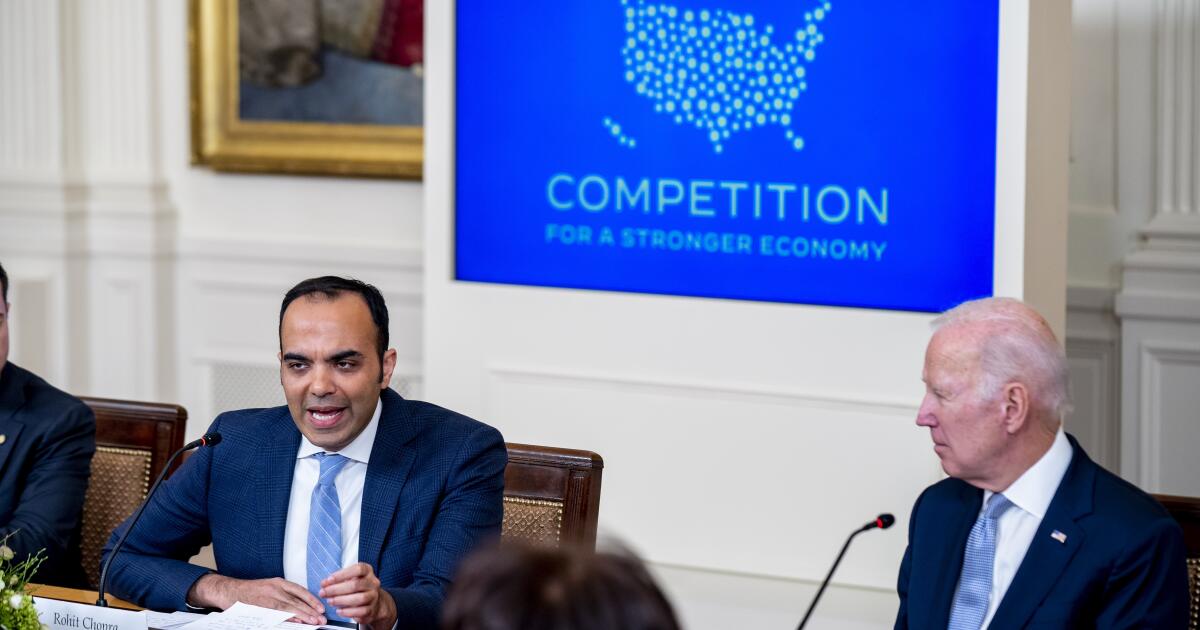
“When interest rates and fees on these loans are high, this can lead to a treadmill of debt that keeps getting faster and faster,” CFPB Director Rohit Chopra said in announcing the new rule.
The bureau also has returned to court. On May 17, it sued L.A.-based lending marketplace SoLo Funds in federal court in Los Angeles, asserting that the firm’s “advertising and disclosures … falsely tout no-interest loans when, in fact, consumers are routinely subject to fees that result in an exorbitant total cost of credit.” When the fees are toted up, the agency says, the true annualized interest rate on the loans can be more than 300%.
SoLo hasn’t yet responded to the allegations in court and didn’t reply to my emailed request for comment.
The bureau has been energized in part by a Supreme Court decision that lifted a shadow over its future. This was a lawsuit brought by some of the targeted lenders contending that the bureau was unconstitutional because it was funded by the Federal Reserve System rather than through congressional appropriations.
Several pending CFPB cases had been placed on hold while the Supreme Court pondered the appropriations issue. But the court ruled in the CFPB’s favor on May 16 in a 7-2 decision written by Justice Clarence Thomas.
Among those cases was a federal lawsuit the bureau filed in July 2022 against Texas-based ACE Cash Express, which then operated out of nearly 1,000 storefronts in 22 states, including California. The CFPB charged that when ACE borrowers said they were unable to pay back their existing loans, ACE offered them repayment plans bearing new fees but sometimes didn’t tell them a no-fee option was available in some states.
ACE already was subject to a 2014 consent order in which it agreed to pay a $5-million penalty and $5 million in customer restitution, and pledged to offer customers a refinancing of their loans as well as the free option. “ACE has not done as it pledged,” the CFPB charged in its lawsuit.
ACE responded to the lawsuit by citing the case then headed to the Supreme Court. “The days of the Bureau’s unchecked administrative agency power … are, hopefully, over,” its lawyers wrote. “Because the CFPB itself is unconstitutional,” the case should be dismissed, they argued. The trial court put the case on hold, but with the Supreme Court ruling, the case is back on the docket, with briefs due at the trial court over the next two months.
The Supreme Court ruling was long overdue. In the years since Mulvaney tore up the CFPB’s project against payday and installment lenders, that industry underwent a troubling transformation.
Once operating out of storefronts where customers could cash their paychecks for a fee, it had grown more sophisticated. Customers could now take loans as advances on their paychecks but typically had to provide the lenders with links to their bank accounts so that repayments could be drawn directly from those accounts.
The industry now styled its products as “earned wage access” providers. The firms today have innocuous, homely names such as Dave.com and Brigit; their websites are adorned with stock photos of young people and families evidently basking in the relief of a short-term financial crisis averted. Some claim to charge zero interest on their short-term loans, but that’s misleading.
One should respect the financial tightrope walked by many low-wage households living paycheck to paycheck. The CFPB knows this market; its proposed rule acknowledges that “a significant driver of demand for consumer credit … derives from the mismatch between when a family receives income and when a family must make payments for expenses.” Meanwhile, “employers have a strong incentive to delay the payment of compensation to workers, which drives demand for short-term credit.”
When the true cost of that credit is hidden from the borrowers or they’re forced to refinance, incurring multiple fees, that’s a problem the CFPB was born to address.
“A payday advance that is repaid on payday is a payday loan, and fintech cash advance apps that call themselves ‘earned wage access’ are just high-cost lending in disguise,” Lauren Saunders, associate director of the National Consumer Law Center, says on the center’s website. “The CFPB has seen through fintech payday lenders’ new clothes.”
Some firms have made deals with employers such as Walmart, Amazon, Uber, Lyft and Kroger to provide advances to workers to be repaid from their next paycheck. In 2022, the CFPB says, more than 7 million workers accessed about $22 billion via these employer-lender partnerships. According to a survey cited by the bureau, most users of paycheck advance services fall below the federal poverty line and more than 80% are hourly or gig workers.
The chief constant tying the new system to the old is fees. About 90% of workers paid a fee for the advances in 2022, averaging about $3.18 per transaction. Since most took out repeated advances, the average annual cost was almost $69.
The CFPB found that among the fees most prevalent in the wage-advance sector are those charged for “expedited” access to cash — which after all is the goal of resorting to paycheck advances in the first place.
But new kinds of fees have appeared. One is often described by the finance firms as “tips” — solicited from borrowers in acknowledgment of the service they’re being provided or to defray the cost the firms ostensibly incur by lending out at 0%.
Those are among the issues in the CFPB’s lawsuit against SoLo. The firm functions as a sort of loan broker — needy customers apply for loans, and other customers provide the loans after judging an applicant’s creditworthiness. (“Earn money with your money,” SoLo tells these small-money lenders on its website. “You lend money to other members to help them replace a tire, cover a bill or for any other reason. They pay you back and add a voluntary tip as a sign of appreciation.”)
The maximum loan is $575. Borrowers can set a repayment date that is less than a month away; if repayment isn’t made after 35 days, the bureau says, SoLo charges a late fee.
The CFPB says the tips aren’t really “voluntary” at all; lenders tend to judge loan applications based on the size of the “tip” being offered, as SoLo suggests. SoLo also prompts applicants to select among three default “donation” fees that go directly to the firm.
None of the defaults is for $0, and borrowers can’t click to the next page without making a choice. Customers can opt for a $0 donation, but only by finding the option in another part of SoLo’s mobile app as though by accident.
“Virtually all consumers who receive loans incur a Lender tip fee, a Solo donation fee, or both,” the CFPB alleges.
It’s proper to note that this isn’t SoLo’s first rodeo. Last year, the California Department of Financial Protection and Innovation reached a consent agreement with the firm over some of the same practices targeted by the CFPB; SoLo paid a penalty of $50,000 and committed to reimbursing its California customers for their “donations.”
Also last year the District of Columbia settled its own case against SoLo, in which it alleged that despite advertising no-interest, no-fee loans, the firm compelled “nearly all borrowers to provide monetary ‘tips’ and ‘donations’” that effectively drove up the annualized interest rates to more than 500%, well beyond the district’s 24% usury limit. SoLo paid a $30,000 penalty and pledged that lenders would no longer be able to know that a borrower had offered a tip or how much it would be.
And in 2022, Connecticut authorities imposed a $100,000 penalty on SoLo and required it to reimburse Connecticut customers for all “tips,” “donations,” late fees and other charges. SoLo was barred from the lending business in that state without obtaining any required license.
The battle against predatory lending to small borrowers isn’t over. Project 2025, the right-wing document designed as a manifesto of the Trump presidential campaign, has targeted the CFPB for extermination, calling it “a highly politicized, damaging, and utterly unaccountable federal agency.” The manifesto says “the next conservative President should order the immediate dissolution of the agency.”
(The document was written before the Supreme Court ruled in the CFPB’s favor, so it takes the agency’s unconstitutionality as gospel.)
The specter of rampant Mulvaneyism still lurks on the horizon in a Republican administration: taking government off the backs of the people, so predatory businesses can again saddle up.



The Los Angeles City Council on Tuesday unanimously advanced an ordinance to halt new oil and gas drilling and phase out all existing production over the next 20 years. L.A. is home to more than 2,000 active oil wells.
The measure revives a similar ban passed in 2022, which was struck down by a judge following legal challenges from the oil and gas industry.
It must pass a second vote before final adoption later this summer, and would make L.A. the largest city in the United States to phase out existing oil wells.
“Today, Los Angeles is making a decision that aligns with our need to turn the page on urban oil drilling,” Councilmember Katy Yaroslavsky said during Tuesday’s council meeting. “The absence of an enforceable oil ordinance has had real consequences for our communities.”
The ban in 2022 was seen as a historic move for a region built on the petroleum industry.
But in 2024, a Los Angeles County Superior Court judge invalidated the law, ruling that the state, not the city, has jurisdiction over petroleum production. The legal challenge was brought by oil companies including Warren Resources, which operates a large oil field in Wilmington. Much of the field is beneath the city of Long Beach, but it also extends under Los Angeles.
Shortly after that, state legislators advanced Assembly Bill 3233, which reaffirmed city and county authority to regulate oil and gas activity. It was largely seen as the missing piece that made the original ordinance vulnerable.
“It’s now unequivocal that cities have the authority to regulate, limit and prohibit oil and gas operations within our jurisdiction,” Yaroslavsky said.
The new ordinance, written by the Department of City Planning, prohibits new oil and gas extraction, including drilling, redrilling or deepening existing oil wells for the purposes of production. It also designates all existing and active idle wells as “nonconforming uses,” meaning they may only operate during the phaseout period and are no longer compliant with current zoning.
Warren Resources, which led the lawsuit against the previous ban, did not immediately respond to a request for comment. The company previously argued that the 2022 ban was rushed and would lead to more oil imports to the area, causing increased emissions from tankers and trucks and other environmental consequences.
Many wells in the city operate near schools, homes and parks. Most are concentrated in low-income areas and communities of color, such as Wilmington and the harbor district, West L.A. and South L.A., where residents have long reported respiratory issues, headaches, throat irritation and other health problems. Studies have found oil wells can emit carcinogens and are linked to adverse health effects.
“This ordinance is such an important step toward giving every frontline community in Los Angeles access to clean air,” Silvia Esparza, a South L.A. resident and member of environmental justice group Stand-L.A., said in a news conference ahead of Tuesday’s vote.
Ashley Hernandez, a Wilmington resident and organizer with the nonprofit Communities for a Better Environment, said bloody noses and noxious fumes were a regular part of life in the neighborhood growing up.
She noted that in addition to oil drilling, L.A. residents continue to face other environmental hazards, such as the recent oil pipeline rupture that sent crude into the L.A. River or the ongoing cold storage warehouse fire in Boyle Heights that is spewing toxic smoke.
“I’m here to remind L.A. city and these toxic neighbors that Wilmington residents are more important than any ‘black gold’ under their homes,” Hernandez said. “We need our city to protect our families now and to stop the oil industry’s reign of power in our city. A passage of the oil phaseout ordinance today gives the city a chance to correct this wrong.”
Times staff writer Dakota Smith contributed to this report.

Shares in Elon Musk’s rocket company SpaceX halted their three-day slide that had erased roughly $600 billion off its market value.
SpaceX shares closed at $156.11 with a nearly 1% gain on Tuesday, a slight recovery from a 16% fall on Monday.
That loss dropped the stock below $160.95, where it ended the day June 12 after a 19% surge during its record initial public offering. The IPO gave it a market cap of $2.2 trillion, making SpaceX one of the world’s most valuable public companies.
It also turned Musk into the world’s first trillionaire, a status he retains despite the sell-off.
The downturn probably reflects investor unease over the company’s spending plans and potential debt load, analysts say.
SpaceX raised a total of $86 billion after underwriters exercised their right to sell additional shares, on top of the $75 billion initially raised. It was the largest IPO in history.
A little more than half a billion shares were distributed to institutional and retail investors at a price of $135, with the stock opening at $150 as some holders immediately flipped shares for a profit.
Shares rose as high as $176.52 during the IPO before settling at the $160.95 price. In the weeks since, shares reached a high of $225.64, meaning that some investors lost money or are underwater with paper losses.
Since the IPO, SpaceX has dropped some big bucks.
It announced last week that it was acquiring AI coding startup Cursor for $60 billion in a deal expected to close in the third quarter. The San Francisco company, founded in 2022, enables engineers to instruct software in English to run coding tasks autonomously.
It also sold $25 billion in bonds on Tuesday , unusual for a company that just went public, much less for one that just raised a record sum.
The IPO surpassed the 2019 offering by Saudi Aramco, Saudi Arabia’s state-owned oil giant, which raised $29.4 billion, the prior record holder.
S&P Global issued a report last week that assigned SpaceX a “BBB” credit rating, the lowest possible rating to qualify as an investment grade credit risk. It noted the company will have “elevated capital expenditure” through 2029.
SpaceX rivals OpenAi and Anthropic filed this month for initial public offerings that, while not expected to be as large as Musk’s company, will be large in their own right.
Wedbush analyst Dan Ives, who has been bullish on SpaceX stock, said the market is digesting “massive debt and equity raises from Big Tech players” in the coming years.
“This is part of an industry wave of debt offerings on Wall Street, like Alphabet and SpaceX among others,” he wrote in an email.
With the stock already giving up gains since the IPO, it will be further tested when tranches of locked-up shares held by current and former employees are released.
At least 20% of the shares will be released after second-quarter results are disclosed sometime in the coming months, with all the lockups expiring in December.
SpaceX, based in Texas, is the leading launch services company in the world, with its Falcon 9 rocket accounting last year for the vast majority of satellites sent into space.
It is also the leading satellite-based broadband provider with its Starlink service. But the extraordinary interest in the IPO was driven by Musk’s plans to make the company an AI leader — including plans to launch orbiting satellite data centers powered by the sun that crunch AI data.
He merged his xAI artificial intelligence company into SpaceX this year, with the combined entity recently announcing it was leasing computer power to rivals Anthropic and Google at two terrestrial data centers it has constructed.
Musk moved the company’s headquarters from Hawthorne to Texas in 2024, but it retains large operations in the South Bay city and blasts off regularly from Vandenberg Space Force Base in Santa Barbara County.
Investment research firm Morningstar placed a $780-billion valuation on SpaceX, focusing on its core rocket and Starlink broadband satellite businesses. It suggested investors wait a few months for the stock to settle before buying in.
“I think the day-to-day stock price movements are usually based on market sentiment,” said report co-author Nicolas Owens, an equity analyst at Morningstar. “So I was not surprised when it went way up right after the IPO — and I’m not surprised it [came down]. Not much has really changed in the fundamentals.”
Mike Alves, founder of Pasadena’s Vida Vision Fund, has a stake in SpaceX that accounts for 46% of his AI and robotics fund.
He said he was not perturbed by the stock drop, noting that Facebook fell under $18 a share just months after its May 2012 IPO closed at $38 a share. It has since risen more than 1,000% above its offering price.
“The volatility doesn’t really matter because you’re going to multiply your best investment many times, so I’m not so worried about it,” he said, adding that investors seeking shares could now “scoop them up at a good deal.”

The nation is awash in data center hate and California is no exception.
Temporary bans have cropped up across the state as residents from Imperial County to San José fight proposals in their communities. Monterey Park became the first city in the country earlier this month to permanently ban data centers by a popular vote. And a recent poll sponsored by the environmental group Net-Zero California showed 70% of state residents don’t want data centers in their communities.
But unlike in Virginia, Texas, Ohio and other states where residents are fighting 400-plus megawatt hyperscaler facilities in their backyards, California has some major barriers keeping data centers at bay.
Sky high industrial electricity prices are more than double the national average. Long wait times to connect to the grid have some new data centers sitting empty in Silicon Valley. And the state regulates the size of the backup generators that keep the centers running when the grid goes down. That has limited most facilities to a fraction of the size that artificial intelligence increasingly demands.
That all means that California is seeing less of a boom — fewer proposed data centers, and smaller in size — than in the country’s hot spots.
“California isn’t even on the map today,” said Mehdi Paryavi, chairman of the International Data Center Authority. “Taxes are high, land is expensive, water is scarce, energy is difficult to find, communities are pushing back. There are all kinds of problems.”
Northern California and Southern California were hubs for an earlier generation of data centers. “But over time, as the sector has grown, the overwhelming majority has been developed elsewhere,” said Andrew Batson, head of data center research at real estate intelligence firm JLL.
“Almost all the data center demand being generated from California is being serviced by adjacent states,” from places such as Phoenix and Las Vegas, Batson said, “where power is much cheaper, land is more affordable, and regulations are quite less.”
Still, “California can’t outsource all it’s data center capacity,” and the state expects to see growth over the coming years.
Fifty-one facilities are currently planned in the state, according to a recent study from the Pew Research Center, an 18% increase over the 277 operating today. According to a study from UC Riverside, data center electricity use in the state doubled between 2019 and 2023.
But some grid operators elsewhere are already seeing overwhelming loads, such as the Pennsylvania-New Jersey-Maryland Interconnection that expects about 40% to be added to its total demand, largely from data centers, by 2035. Compare that to the California Energy Commission which expects data centers to drive an increase of about 2 gigawatts by 2030, and 5 GW by 2040. That’s about 4 and 9% of its 52 GW peak load respectively.
“It’s a significant amount of demand growth, but it’s not dwarfing all the other factors,” said Mark Specht, a senior energy manager at the Union of Concerned Scientists who put out a report on California data center growth last month. “Some of the projections we’re seeing for increased electricity demand from electric vehicles in 2045 is actually higher than the demand from data centers.”
California regulations are part of what’s keeping data centers relatively small: A state rule requires any backup generator bigger than 100 megawatts to be certified as a power plant.
Specht’s report found none of the current data centers in California and almost none of the proposed ones require that certification because they fall under the 100 MW cap. (Exceptions include a 417 MW planned facility in Santa Clara and a 330 MW one in Imperial County blocked Tuesday by a moratorium vote.)
One hundred MW could power a small city’s peak demand, yet the average U.S. data center is expected to demand over 600 MW by 2030, according to the energy intelligence company Cleanview.
A San Francisco Chronicle analysis showed that California facilities currently make up about 5% of national data center power demand, but that share is expected to fall to 1% if building proceeds as planned across the country.
Still, the growth that does exist is raising concerns among utility ratepayer advocates and environmentalists, not to mention the general public.
“There are real costs at stake,” said Mark Toney executive director at The Utility Reform Network, a ratepayer advocacy group.
He noted Pacific Gas & Electric anticipates a massive amount of new demand from data centers — about 10 GW worth — or enough to power 7.5 million homes. That would require grid upgrades he estimates at about $10 billion, partly borne by ratepayers. Interest has been high in PG&E territory because it serves the San Francisco Bay area, where California’s projected data center buildout is concentrated around San Jose, now that Santa Clara has reached capacity.
Data center electricity projections come with uncertainty, and PG&E says its confirmed large load in the pipeline — mostly data centers — is closer to 5.3 GW.
Whatever demand materializes, TURN and others are fighting to shield ratepayers from the costs of PG&E’s buildout, a battle playing out at the Public Utilities Commission.
PG&E spokesperson Rob Stillwell said data centers help reduce rates by spreading the costs of grid maintenance over more customers. He noted data centers already have to pay the up front costs of connecting to the grid, under a temporary rule.
But TURN says those don’t include all of the infrastructure and broader grid updates that PG&E will have to invest in to support data centers.
And the rule only applies for PG&E territory and doesn’t require data centers to bring their own clean power.
TURN is now backing a bill from State Sen. Steve Padilla (D-Chula Vista) that would require all data centers to pay for 100% of the costs of new transmission upgrades as well as new clean energy to cover at least half their required electricity. The industry is opposing the effort.
Another Padilla bill would approve data centers faster if they use more clean energy. One from Assemblymember Rebecca Bauer-Kahan (D-Orinda), would require data centers to disclose their energy use to the state. And bills by Assemblymember Diane Papan (D-San Mateo) would require them to project and report their water use as part of permitting and licensing.
Yet politicians have been hesitant to regulate. Last year, similar bills were either watered down, didn’t make it through the legislature or were vetoed by Gov. Gavin Newsom.
At a panel in January, gubernatorial candidates were asked how they would balance environmental concerns about data centers with their potential to drive economic activity.
“We have to make sure that those data centers are paying their fair share,” said Xavier Becerra, adding that businesses need to move away from diesel backup generators.
Former candidate Tom Steyer of San Francisco answered with a dodge or a dose of realism, depending on your view.
“What data centers are looking for is cost to compute and speed to compute, and the good news is that California’s energy is so expensive on a cost basis, they’ll never come here,” Steyer said. “We may talk all we want about data centers, but they’re not coming.”
-

 Ohio1 minute ago
Is Ohio at the Great American State Fair? Latest as some states opt out
-

 Oklahoma4 minutes ago
Woman hospitalized after house fire in northeast Oklahoma City
-
Oregon9 minutes ago
Puffins return to the Oregon Coast: where and when to see them
-

 Pennsylvania16 minutes ago
Pennsylvania coroners refuse to release autopsy reports – and that hinders research on deaths in custody
-

 Rhode Island19 minutes ago
‘Condom Hut’ Movie Adds Another Big Name
-
 South-Carolina24 minutes ago
Star Fox Review: Can’t quite teach an old Fox new tricks
-

 South Dakota31 minutes ago
Rounds, Office of the Inspector General requesting first-hand accounts of poor mail service in South Dakota
-

 Tennessee34 minutes ago
ESPN updates NBA mock draft for Ja’Kobi Gillespie, Felix Okpara in second round

