Business
California's tech titans say H-1B visas are vital. Will Trump defy MAGA and support them?

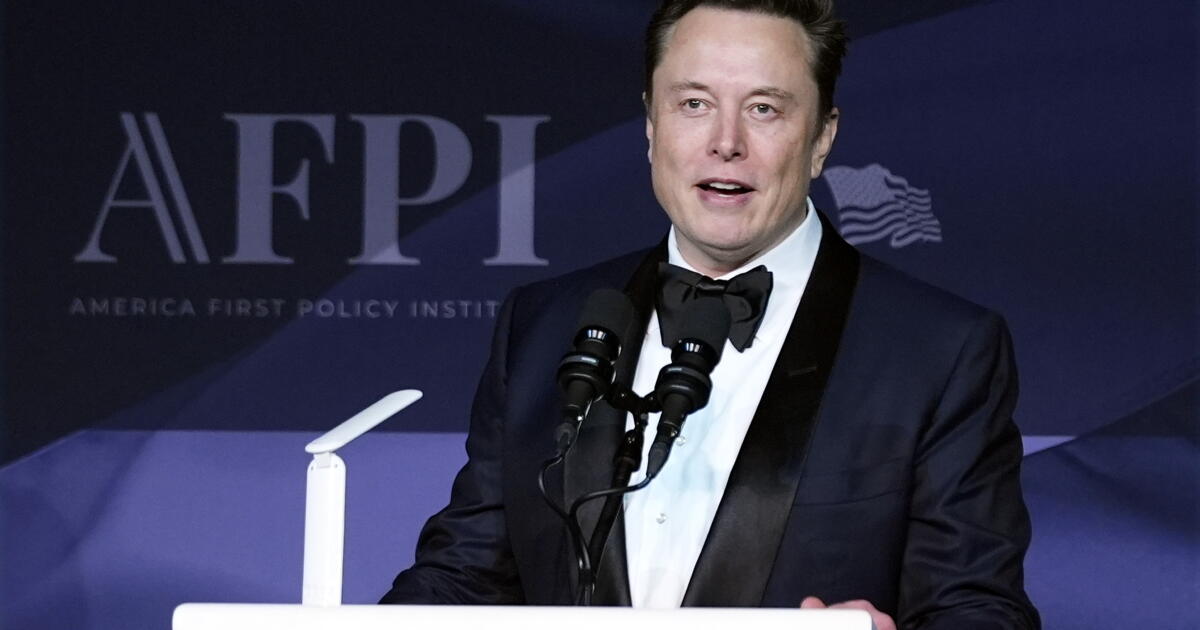
WASHINGTON — Of all the rich and powerful people cozying up to President-elect Donald Trump, few have rushed to Mar-a-Lago faster than the crowned heads of big tech, including California’s own chiefs of Google and Meta.
And few have a stronger motive to curry Trump’s favor than Silicon Valley: The fate of the H-1B visa program that permits foreign-born computer scientists, engineers and other highly skilled workers to migrate to the United States hangs in the balance.
Support for retaining H-1B from Elon Musk, the incoming president’s new closest associate, has stirred rage through much of Trump’s MAGA base, which is against immigration in almost any form. But keeping the pipeline open for tech and other skilled workers is seen by many business leaders as critical for the American economy, especially in California.
The state is by far the biggest user of the H-1B. More than 9,600 employers in California sought clearance for at least one H-1B worker in fiscal 2024, with 78,860 visa applications for new and continuing employment being approved, according to data from U.S. Citizenship and Immigration Services (USCIS).
They include all kinds of skilled work in various industries, including nurses and science teachers. But the top 10 beneficiaries of H-1B visas in California — accounting for almost one-third of all the approvals — were dominated by tech giants, most of them in the Bay Area.
“Those companies are the ones that can afford to hire outside firms that navigate the paperwork, the bureaucracy, and can jump through the hoops,” said Todd O’Boyle, who leads technology policy at the Chamber of Progress, a group backed by big tech firms.
The number of H-1B visas for new employment is capped at 65,000 a year nationally. An additional 20,000 are set aside for foreign nationals who have earned a master’s degree or higher in the U.S. H-1B visas are good for three years but can be extended for up to another three years.
Tech companies in California and elsewhere have relied on the program even as they made massive job cuts following the pandemic, during which many went overboard on hiring and other spending.
The fact that tech companies have fired thousands of American workers while hiring large numbers of foreign workers has added to the fury of anti-immigration Trump supporters, who have long argued immigrants take jobs away from Americans by working for less pay.
The question of whether that claim is valid does not have an easy or simple answer.
U.S. graduate school students in engineering and the sciences are disproportionately foreign-born, and even with that there are shortages of some highly skilled workers, particularly in high-tech engineering and emerging areas such as artificial intelligence.
Nvidia, the major Santa Clara supplier of AI hardware and software, got H-1B visa approvals for more than 1,500 workers last year in California, according to USCIS data. The company declined to comment, and other top tech users of the H-1B, including Google, Meta and Apple, didn’t immediately respond to requests for comment.
“If you lay off a programmer, it’s not the same skill set as somebody who has a post-doctorate in AI, so you have to look at the skills that are sought and why,” said Rep. Zoe Lofgren (D-San José), who sits on the House Subcommittee on Immigration and Citizenship.
But she said the H-1B isn’t without its challenges, pointing to cases in the past at UC San Francisco and Southern California Edison in which U.S. workers were reported displaced by lower-paid H-1B visa holders.
Employers who hire H-1B workers are required to pay wages at least as much as for similar U.S. professionals, but there are abuses. Lofgren said systemic improvements are needed, including stronger analysis on skill sets for the jobs available and more robust advertising on openings.
What’s more, workers from India dominate H-1B visas, in part because there are country quotas for permanent immigration, and temporary work visas are seen as a bridge to that, although the wait is often many years.
“People say the immigration system is broken, and this is part of the brokenness,” Lofgren said, adding that especially for California, “our economy is dependent on, and our prosperity is tied to, immigrants.”
The acrimony over the H-1B in recent days spiraled after far-right activist Laura Loomer attacked H-1B as a threat to American workers and national security.
She and other critics of worker visas say they lead to fewer jobs for U.S. workers, but academic research over the years has found little evidence to support that claim overall. And although some laid-off workers have been forced to retire or switch careers, studies have found many also have been re-employed relatively quickly.
For computer and mathematical occupations, the November unemployment rate was just 2.5%, up from 1.7% a year ago; and it was unchanged at 2% for architectural and engineering occupations, according to the U.S. Bureau of Labor Statistics.
Loomer suggested a major clash ahead between immigration hardliners like Stephen Miller, named as Trump’s deputy chief of staff for policy, and those including Vivek Ramaswamy, the former Republican presidential candidate who with Musk has been charged by Trump to cut government spending and regulation.
Musk, the world’s richest person who runs Tesla and SpaceX and is himself an immigrant and onetime H-1B visa holder, has come out championing the hiring of skilled foreign workers.
The visa program has certainly helped Tesla, which this fiscal year received H-1B approvals for 1,765 new and continuing workers, although SpaceX has grown with little benefit of H-1B workers. (Musk moved Tesla’s headquarters to Austin from Palo Alto at the end of 2021, and said this year that he was relocating SpaceX to Texas as well.)
“OF COURSE my companies and I would prefer to hire Americans and we DO, as that is MUCH easier than going through the incredibly painful and slow work visa process,” Musk wrote on Christmas Day on his social media platform, X. “However, there is dire shortage of extremely talented and motivated engineers in America.” He added: “It comes down to this: do you want America to WIN or do you want America to LOSE. If you force the world’s best talent to play for the other side, America will LOSE.”
Trump on Saturday seemed to side with Musk.
“I’ve been a believer in H-1B. I have used it many times,” he told the New York Post. “It’s a great program.”
(Trump’s businesses have used predominantly the H-2B program, which are for temporary seasonal workers that hotels and tourist businesses, for example, make heavy use of during summer. H-2A is for temporary farm workers.)
Despite his record and promises to seal the borders and deport millions of undocumented immigrants, Trump’s remarks raised hopes among some immigration advocates that the incoming president could take a softer tack on H-1B visas.
In his first term, Trump’s team made it a lot tougher for employers to get H-1B approvals, and denial rates jumped above 20% in fiscal years 2018 and 2019, triple the average of the prior administration, according to the National Foundation for American Policy, a Washington think tank that favors higher levels of immigration.
“At minimum it muddies the waters,” said Stuart Anderson, the group’s executive director. “It could signal a neutral policy rather than a hostile one.”
Stephen Yale-Loehr, an immigration expert at Cornell Law School, said that despite the deficiencies in H-1B, he believes that “most employers try to follow the rules. At the macro-level H-1B workers are helping our economy and creating more jobs for U.S. workers.”
Entrepreneurs, in particular, have talked about skilled worker visas as being critical for their growth.
Yale-Loehr also noted that recent changes have given U.S. immigration officials greater authority to tighten up the H-1B program, including imposing penalties and inspections.
That could strengthen enforcement and cut down on abuses, if Trump actually follows through on his supportive remarks.
“It’s too early to see. You’ve got some people in the administration like Elon Musk who want to preserve the H-1B category and other people like Stephen Miller who want to restrict all immigration, including H-1B,” Yale-Loehr said. “We’ll see which side wins over the four years of the Trump administration.”


The luxury shopping center in Pacific Palisades will reopen next month after more than $100 million in renovations forced by the January 2025 wildfire that devastated the Los Angeles neighborhood.
Palisades Village will reopen Aug. 15, owner Rick Caruso announced Wednesday. The outdoor center survived the blaze that destroyed homes and other businesses but needed refurbishment to eliminate contaminants that the fire could have spread.
Crews are putting finishing touches on mall buildings after tearing them down to the studs, treating the wood and rebuilding the walls, Caruso said.
“Everybody’s working, and stores are moving their products in,” he said. “It’s a really cool feeling that people have really locked arms and are working together.”
An electrician installs lighting for a restaurant at Rick Caruso’s Palisades Village on Thursday. The shopping center is scheduled to reopen mid-August.
(Myung J. Chun / Los Angeles Times)
Pacific Palisades resident Allison Polhill, who is rebuilding the home of 30 years that her family lost in the blaze, said she is “thrilled” at the prospect of returning to the mall she used to frequent. Its comeback is a boost for the community, she said.
“Every single step that we make to reopen our commercial corridors is going to bring more people back into the Palisades,” said Polhill, who expects to move back into her home at the end of August.
A total of 6,822 structures were destroyed in the Palisades fire, including more than 5,500 residences and 100 commercial businesses, according to the California Department of Forestry and Fire Protection.
Caruso previously attributed the mall’s survival to the hard work of private firefighters and the fire-resistant materials used in the mall’s construction.
The $200-million shopping and dining center opened in 2018 with a movie theater and a roster of upmarket tenants, including Erewhon, which may be the only grocer in the heart of the fire-ravaged neighborhood when it opens.
Caruso’s company was able to fill the mall with tenants despite the long shutdown.
Palisades Village is 99% leased, with the majority of tenants returning, said Jackie Levy, chief financial and revenue officer. Nearly one-third of the shops and restaurants are new to the property.
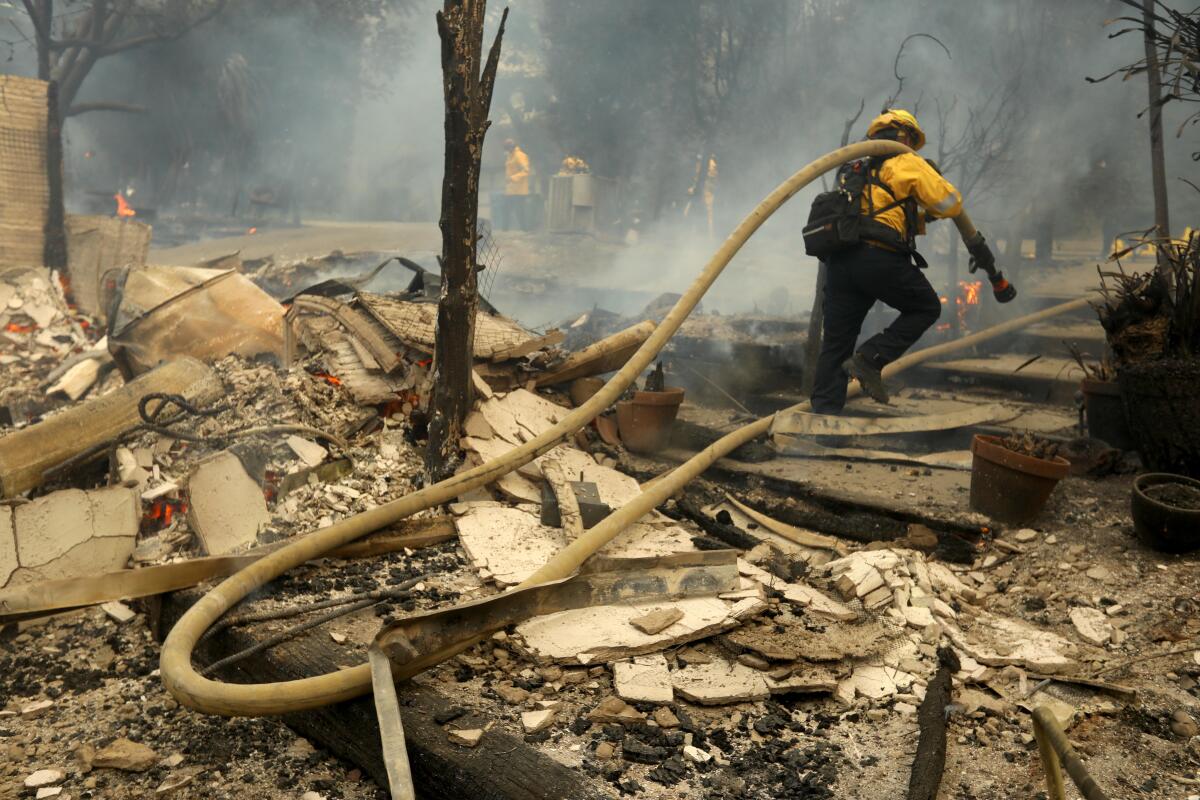
A firefighter carries a hose back to his rig while walking through a destroyed home from the Palisades fire in Pacific Palisades on Jan. 7, 2025.
(Genaro Molina / Los Angeles Times)
Last year, Pacific Palisades-based fashion designer Elyse Walker said she would reopen her eponymous store in Palisades Village after losing her 25-year flagship location on Antioch Street to the inferno.
Other neighborhood shops destroyed in the fire that are reopening at the mall include K Bakery and Loomey’s Toys, which caters to children up to age 12 and used to be across the street from Palisades Elementary Charter School.
“It’s been a journey and I’m excited because I wasn’t sure that there was going to be a place to come back to,” said toy store owner Amanda Rastegar. “Hopefully we can bring some of that magic back.”
Rastegar’s home in the Palisades survived but was damaged by the fire. The family returned about eight weeks ago. Her last memory of the fire was a burning supermarket.
“I just couldn’t wrap my brain around what was happening,” she said. “By the time I left, Gelson’s was on fire.”
Among the returning tenants is Angelini Ristorante & Bar. Well-known Los Angeles chef Gino Angelini said he will be in the kitchen next month for a return of the Italian restaurant.
“We won’t do a big celebrity open,” he said. “We want to have a very soft opening and see our customers come back.”

Construction takes place at Rick Caruso’s Palisades Village on Thursday. The shopping center is scheduled to reopen mid-August.
(Myung J. Chun / Los Angeles Times)
An elaborate celebration would not feel “correct for me,” Angelini said, because the devastation has been “very sad” for so many.
Other new tenants include local chef Nancy Silverton, who has agreed to move in with a new Italian steakhouse called Spacca Tutto. Women’s activewear retailer LESET will open its first West Coast location.
Caruso said he is optimistic that customers will return to the center, even though many Pacific Palisades residents are still dispersed. One tracking system estimated that about 30% of the Village’s customer base was impacted by the fire, he said.
“That means 70% did not get impacted, so there’s a lot of customers still left out there,” Caruso said. Historically, the center drew customers from as far away as Beverly Hills and Calabasas, as well as Malibu, Brentwood and Santa Monica.
He also hopes many will be inspired to visit the revived mall.
“I believe in the goodness of people and I believe that people are going to want to support the Palisades,” he said. “They’re going to want to be there and support the businesses that have had the courage and the heart to reopen.”

Walmart is rapidly expanding its network of electric vehicle chargers designed for customers to use while they shop.
The network could help fill gaps in EV infrastructure in states with greater need for chargers. Walmart, which has more than 5,000 locations in the U.S. and hundreds in California, says more than 90% of Americans live within 10 miles of one of its stores.
The chargers also offer an incentive for customers to choose Walmart — Walmart Plus members will receive a 10% discount off an average price of $0.46 per kilowatt-hour of energy at the company’s chargers.
Walmart chargers are already available at more than 75 locations in 17 states, with Texas boasting the most charging stations, followed by Florida and Arizona.
Matthew Nelson, Walmart’s director of energy policy, said last week on LinkedIn that the network will soon reach 29 states, including California.
“We are delivering on the promise of affordable, reliable and convenient charging,” Nelson said in his post.
According to Walmart’s website, six charging stations are coming to California soon, though the company did not offer a specific timeline.
The chargers will be installed at stores in Antelope, Brea, Fresno, Stockton, Suisun City and Vallejo.
Most charging sites in California will include eight to 16 fast-charging stalls, said Walmart spokesperson Kelsey Bohl.
The company first announced plans in April 2023 to install its own EV chargers at Walmart and Sam’s Club stores, with a goal of installing thousands of chargers by 2030. Partnering with ABB E-Mobility and Alpitronic, it added 25 new charging sites this past May and six more in June.
“Walmart is building a leading retail-integrated EV fast-charging network, focused on delivering an affordable, reliable and convenient charging experience where customers already shop,” Bohl said in an emailed statement. “Customers can charge while they shop, access stations through the Walmart app they already use, and benefit from affordable pricing.”
The charging stations already available include 612 individual charging stalls using 400-kilowatt chargers. Each stall has a dual charging cord with both Combined Charging System and North American Charging Standard connectors. The standard connectors, designed by Tesla, are smaller and lighter than the combined systems.
The primary way to pay for the chargers is through the Walmart app, but the company is also experimenting with built-in credit card readers to allow those without the app to use the stations.
Customers can check charger availability on the Walmart app. The company said the chargers will be available 24 hours a day.

Robotaxis could be turning into robocops.
A self-driving Waymo reported two teens to San Mateo, Calif., police on Monday after they were found drinking alcohol and shooting toy guns in the back of the vehicle.
According to a social media post from the San Mateo Police Department, officers detained two 15-year-olds after the Waymo they were riding in contacted the department and stopped in a parking lot until law enforcement arrived.
“Parents do you know where your teens are?” the San Mateo Police Department wrote on Facebook following the incident. “Waymo does!”
Officers removed both teens from the vehicle and determined they were using toy guns to shoot Orbeez out the windows. Orbeez are small, water-absorbing beads sold at toy stores.
“Toy guns, water guns, and BB guns all pose real dangers, especially to an untrained eye,” the Police Department said. “The simple handling of them can cause fear in [passersby].” “
A video posted on Facebook shows at least five officers and a police dog responding to the scene and approaching the Waymo with their weapons raised.
Waymo did not immediately respond to a request for comment.
Waymo vehicles have internal cameras and microphones that may be used in an emergency or to “promote safety and security,” according to Waymo’s online support page.
The cameras are also used to ensure the vehicles are clean and to help find lost items, according to the support page.
The company said it does not use facial recognition or other biometric identification technologies to identify individuals.
“In more urgent circumstances, support may access live video during a trip,” the Waymo page said.
The San Mateo Police Department’s Facebook post has garnered nearly 60 comments, with one user accusing Waymo of “snitching.”
“At least they got a designated driver?!” one user commented.
-

 Virginia5 minutes ago
MEOC Organization hosts annual summer picnic for Southwest Virginia seniors
-

 Washington12 minutes ago
Future uncertain for site of former Mount Washington church destroyed in massive fire
-

 Wisconsin15 minutes ago
South Milwaukee, Wisconsin, officials in standoff with homeowner over year-round skeleton display
-

 West Virginia20 minutes ago
West Virginia coach Rich Rodriguez wants to save college football. Here’s his pitch:
-

 Wyoming27 minutes ago
Cathy Holman named 2026 Mick & Susie McMurry Cowboy Code Try Award recipient
-

 Crypto30 minutes ago
LAB Token Crashes 80% to $1.25 as $5B Market Cap Vanishes in 48 Hours
-

 Finance35 minutes ago
Intact Financial provides update on Q2 catastrophe and large losses
-

 Fitness42 minutes ago
Wellness Wednesday: Exercise & heart disease

