News
US: Skydiving plane crash leaves 12 people dead in Missouri

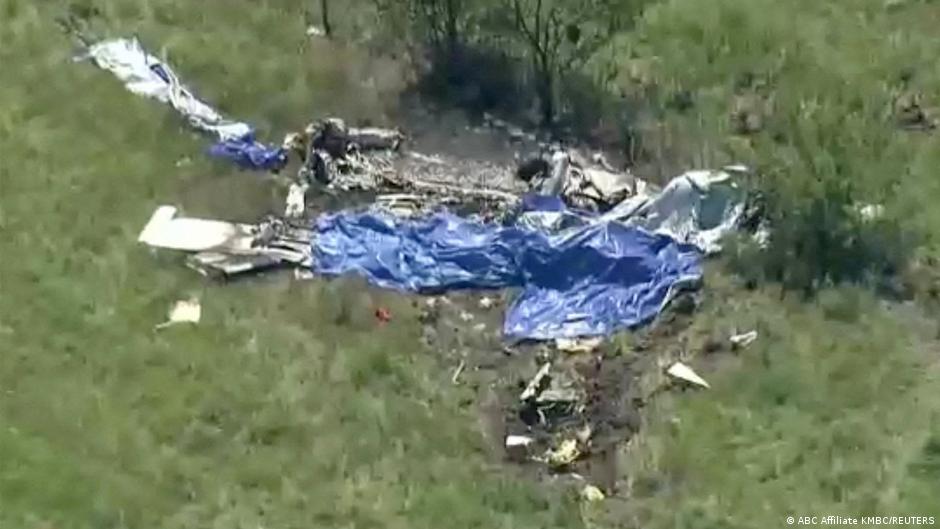
A private plane carrying skydivers crashed in the US state of Missouri on Sunday, killing all 12 people on board, authorities said.
The crash occurred near Butler Memorial Airport, about 60 miles (100 kilometers) south of Kansas City, shortly after the plane took off. The aircraft was operated by Skydive Kansas City.
“Tragically, all 12 individuals aboard lost their lives in the accident,” the skydiving company said in a statement. The pilot was among those killed.
What do we know?
The Federal Aviation Administration (FAA) identified the aircraft as a single-engine Pacific Aerospace P750.
Dennis Jacobs, the acting airport manager and Bates County emergency management director, told Reuters that the plane took off at around 11:20 a.m. CT (1620 UTC).
It did not appear to gain altitude and was seen making a sharp left turn before it came down about 300 yards (274 meters) from the runway, near a highway, Jacobs said.
First responders searched the flight path to find anyone who might have tried to jump from the plane as it began to nosedive but found no evidence of that, Jacobs added.
Investigation underway in Missouri crash
The cause of the crash was not immediately known.
The National Transportation Safety Board (NTSB), which is leading the investigation, said investigators were expected to arrive at the scene on Monday.
A final report on the cause of the crash is expected to be published in 12 to 24 months, news agencies cited the NTSB as saying.
“For all intents and purposes, (this) appears to be an accident,” Bates County Sheriff Chad Anderson said at a news conference.
Some of the victims’ family members witnessed the crash, Anderson said.
Images from the crash site showed blue and silver wreckage strewn across the grass as multiple emergency vehicles responded to the scene.
Edited by: Wesley Dockery
Don’t let the algorithm hide the news. If you rely on our team for trusted reporting, please take a moment to select us as your Preferred Source on Google, so you’ll always see our verified news first.



to “indirect assistance” or “permissible direct assistance.” Among these, most notably, are statutes dealing with transnational organized crime and international counterdrug efforts.
3. The Insurrection Act
A. Statutory Provisions
The most far-reaching legal exceptions to the Posse Comitatus Act, though, fall within the Insurrection Act. The Insurrection Act, 10 U.S.C. §§251-255, originally enacted in 1807, is a statute that, when invoked, provides the President with extraordinary powers to use the military in several distinct domestic contexts, if the President first “by proclamation” orders “the insurgents to disperse”:
First, in the event of an insurrection in any state against its government, the President, at the request of a state legislature or governor, can use the military to suppress the insurrection. 10 U.S.C. § 251.
Second, in the event that unlawful acts “make it impracticable to enforce the laws of the United States in any State by the ordinary course of judicial proceedings,” the President can use the military to enforce the law and suppress the rebellion. 10 U.S.C. § 252.
Third, in the event of “any insurrection, domestic violence, unlawful combination, or conspiracy” that makes enforcing the law impossible, or that results in any class of people being deprived of their rights, and which state authorities are unable or unwilling to resolve, the President can use the military to resolve the insurrection. 10 U.S.C. § 253(1).
And lastly, wherever any such “insurrection, domestic violence, unlawful combination, or conspiracy… opposes or obstructs the execution of the laws of the United States or impedes the course of justice under those laws,” the President may use the military to resolve the insurrection. 10 U.S.C. § 253(2).
B. Implications and Usage
While § 251 is cabined by the requirement for a request from state officials, the § 252 and § 253 authorities are incredible broad, allowing for essentially unbounded use of the military in any state, with or without state consent or acquiescence, with the only predicate being a Presidential proclamation declaring that an insurrection exists.
Many Presidents have invoked the Insurrection Act throughout American history. Abraham Lincoln invoked the Insurrection Act at the outset of the Civil War (indeed, the prosecution of the Civil War can be viewed as one long deployment of the military under the Act). Ulysses S. Grant similarly invoked the Insurrection Act during his suppression of the first Ku Klux Klan in the 1870s. In the late 1800’s, the Insurrection Act was invoked on a number of occasions to deal with labor strife. And perhaps most notably in recent history, three Presidents invoked the
3

new video loaded: 12 Dead in Missouri Skydiving Plane Crash
transcript
transcript
12 Dead in Missouri Skydiving Plane Crash
Eleven passengers and a pilot were killed shortly after taking off for a skydiving trip in Missouri on Sunday.
-
We’re still trying to identify family and make notifications. And so we’re going to be respectful of that. There were witnesses that were family members, yes.

By Cynthia Silva
June 14, 2026

Attorney and tour guide Raina Yancey wants the federal government to fully restore a slavery exhibit taken down months ago at the President’s House in Philadelphia.
Adrian Florido
hide caption
toggle caption
Adrian Florido
President Trump’s fight to reshape how American history is told has hit another hurdle.
Last week, a federal judge temporarily blocked his year-old executive order titled “Restoring Truth and Sanity to American History.” It ordered the Interior Secretary to remove from national parks and historic sites content that “inappropriately disparages Americans past or living.”
Months later, federal employees took crowbars and peeled away an exhibit about nine African-Americans President George Washington had enslaved at the nation’s first executive mansion in Philadelphia.
The removal sparked bipartisan condemnation and a separate lengthy legal battle that has wound its way to a federal court of appeals.
Some of the exhibit has since been restored, but a lot is still missing.

Lawyer and activist Michael Coard spent years fighting to create a site telling the stories of the people enslaved by George Washington in Philadelphia.
Henry Larson
hide caption
toggle caption
Henry Larson
Michael Coard is a lawyer and activist who advocated for the exhibit’s creation. It opened in 2010.
“It was the grand opening of the first slave memorial of its kind on federal property in the history of the U.S. We thought it would last forever. But 15 years later, the destruction came,” Coard said.
He and others want the full exhibit restored by the Fourth of July, when people will descend on historic Philadelphia to celebrate the 250th anniversary of the nation’s founding.
NPR’s Adrian Florido spoke with Coard, attorney and tour guide Raina Yancey and others at the President’s House in Philadelphia to understand the deadline pressure activists now face, and how they’re still telling the story of Washington’s enslaved workers as the legal battle wages on.
Listen to the full story by clicking the blue play button above.
-

 Movie Reviews4 minutes ago
Movie Review – Unidentified (2025)
-

 World16 minutes ago
Video: Russian Attack on Kyiv Damages Historic Orthodox Cathedral
-

 News19 minutes ago
Read Will Scharf’s Confidential Insurrection Act Memo
-

 Politics24 minutes ago
Read Will Scharf’s Confidential Habeas Corpus Memo
-
 Lifestyle54 minutes ago
If you plan to catch up on reading this summer, start with these 3 books
-

 Technology1 hour ago
Fox is buying Roku
-

 World1 hour ago
Iran’s regime spins nuclear and Strait of Hormuz deal with Trump as victory over US, Israel
-

 Politics1 hour ago
Trump bet tariffs would bring back American factory jobs. New report says it didn’t work

