Entertainment
‘Industry’ is TV’s last golden age drama


One day, when people say “they don’t make ’em like they used to,” they will be saying it about “Industry.”
First filmed before the pandemic and launched in its throes, a survivor of the era of streaming wars, corporate consolidation and Hollywood strikes, HBO’s addictively dissolute workplace drama remains as ambitious and authoritative as ever. Indeed, despite being divided from predecessors like “Mad Men,” “Succession” and “The Leftovers” by a series of epochal crises, it more closely resembles a vestigial tail of the medium’s past than most of its current counterparts: Out of place and out of time, “Industry” can best be understood as the last great drama of TV’s golden age.
Cast member and “Game of Thrones” alum Kit Harington, resident expert on series that reshaped the medium, agrees that “Industry” is a bit of a throwback in this respect.
“If you scroll back to ‘Game of Thrones’ in the first two seasons, it wasn’t a massive Goliath success, and it exploded after Season 3 with the Red Wedding. I think there’s a similar story going on here,” he says. “So often in TV at the moment, you’re given one season and everyone needs to pack in f— everything to get people hooked. But they’re burning through too much story. Season 2 is then done; the characters haven’t got anywhere to go. I think this is where this show has been successful, is that it was given that time to breathe.”
Earlier this spring, I convened “Industry’s” creators and cast in a conference room at The Times to walk me through its evolution into one of the best shows on television, and what to expect from its impending end.
Marisa Abela, left, Kit Harington and Myha’la.
(Jason Armond / Los Angeles Times)
‘What the f— are you thinking, guys?’
A trading-floor knife fight of hot, young strivers, or “grads,” competing for a permanent place at the fictional Pierpoint investment bank, the first season of “Industry,” filmed in 2019, premiered in the waning months of 2020 as a warped love letter to office culture. But for Konrad Kay and Mickey Down, the emerging writers at the helm, the voice of the series didn’t fully take shape until they’d found their main cast, including Myha’la, as hard-charging American Harper Stern, and Marisa Abela, as privileged publishing heiress Yasmin Kara-Hanani.
Kay: Season 1, me and Mickey were really green.
Down: We actually pitched HBO on the idea that it was going to be eight episodes, it was going to be in different months, and the big-bang dramatics were going to happen between the episodes. A bit like “Boyhood.” Huge things would happen in between episodes, and the episode would be about the reaction to those huge things. And they were like, “What the f— are you thinking, guys?” It was so antidramatic.
Abela: I had a lot of rounds of auditioning for Yasmin. They weren’t sure about me at all. I think part of it was because they were quite hellbent on her being vulnerable, on her being soft, and that was what I was playing in those first two, three episodes. … And what happens in any functional collaboration is you start to see what they really want from you — what it is that they need from your character. And in those moments of conflict, the moments of change, Yasmin has to stand up for herself at some point, otherwise it’s too wet.

Mickey Down.
(Jason Armond / Los Angeles Times)
Down: Yasmin was all vulnerability masked by Prada in script, and then you came in and you were very hard. [Laughs.]
Abela: There is one scene with [Yasmin’s abusive supervisor] Kenny [played by Conor MacNeill] in Season 2 where … Yasmin turns around to him and tells him to f— off, basically: “You don’t have a disease, you’re a narcissist, with a new excuse to lord it over people. You’re weak.” I think that’s the first time that Yasmin became a gangster. I was watching “Real Housewives of New Jersey” at the time, being completely honest. She can go really mob wife really quick.
Myha’la: I had almost the exact opposite experience in terms of finding or deciding who Harper was. When I read the scripts initially, I just thought, “There’s no way in hell that Harper can’t be steely and [on offense], because she’s clearly feeling out of her depth, and as a young woman of color going into a new space like this, you can’t show up like you’re vulnerable. You’re already expected to do poorly.” … On the page, Harper was an anxious person when I first met her in the pilot episode. She was sweaty and clammy and stammering. And I just thought, “Hell no!”

Down: Sometimes when we write the character, we focus on one thing, and then the actor comes in and then that one thing we thought the character was becomes the artifice that they have to play.
Harington: Great TV writers genuinely learn their actors as well as their characters, and they tie those things in as it goes through.
Abela: As much as they know how we speak now, we know how they speak. If Yasmin has a “F— off,” I know what they want with that. If she says “F— off,” it’s very different to “F— you.”
Down: It’s like playing the piano with the foot pedal, blindfolded.
Kay: When you get super-talented actors doing your writing, you sort of fall in love with them doing everything. There’s no story we can’t tell with them.
‘Am I being fired?’
The series’ second season, which opens with Pierpoint’s post-COVID return to office, found the grads established enough to become “active characters,” and the creators confident enough to begin breaking the mold they’d set for themselves in Season 1. From the nail-biting trade sequence with which Harper wins over hedge fund manager Jesse Bloom (Jay Duplass) to her firing from Pierpoint in the Season 2 finale, it marked the arrival of “Industry’s” distinctive, go-for-broke aesthetic.
Kay: [In] Season 2 we were still figuring out what the show was, and we had Jami O’Brien as our co-showrunner, who really professionalized me and Mickey towards the American system, towards how to be producers, curbed some of our more bombastic instincts, made us more professional in terms of some of the style of the writing we were doing, found a cleaner version of the show and a cleaner version of the story.

Konrad Kay.
(Jason Armond / Los Angeles Times)
Down: [The Bloom trade] was one of the first times in the show where we were like, “Wow, we’ve actually created something kind of singular,” in that we were able to create scenes of people trading, [using] financial jargon that no one understands, and make it feel like a car chase. The contrast between the Harper that’s on the trading floor being able to be in command of that with all the people looking at her, and then the Harper that’s in the loo afterwards in floods of tears, that for me was kind of the moment where we thought that we had a completely 3D, rounded character.
Myha’la: If you asked me to do the Jesse Bloom trade scene again, I’d piss myself. Because at least when I did it two seasons ago, I could have anxiety and fear percolating inside me. If I had to do it today, I’d have to do it confidently, and I would have to try really hard because so much of the language is truly blind memorization and being able to juggle particularly the f— phones. … You have to get the choreo[graphy] so good and you have to know the words so well so that you can do the important part, and that’s the subtext — communicating the feelings of the thing, which are not in the words. Which I love. It is so hard.
Harington: When you first read the scripts, you can’t understand a lot of what’s on the page. … You look at it, you go, “This is f— impossible.”

Myha’la.
(Jason Armond / Los Angeles Times)
Myha’la: This is not spoon-feeding the audience. “I’m sorry that you’re hurting because I know last summer your mom died in a car crash.” They don’t do that.
Kay: Do you know who hates that about us? Network executives. [Laughs.]
Down: We had a kind of mantra the first season especially, and then going into the second, that we would never have a scene that didn’t have one of our four main leads in it. And then, just for the necessity of the storytelling, we said, “We have to pop out of that perspective.” I don’t think HBO realized what a big decision that was, because I don’t think they’d actually realized we’d kept this mantra that we were never going to go away from the perspective of the grads.
Kay: It’s also where we broke the rule of, “We’re not going to just tell the bottom-up story; we’re going to go to the top.” When we sold the show, we were like, “This is a bottom-up story,” and then by that point we were like, “Actually, we have these older characters who might have these really rich inner lives that we should also explore.”
Myha’la: We blew the s— up. [Harper’s firing] forced us all outside the bank, which was dangerous and scary for me and really exciting and was how we got to see all the other things that Mickey and Konrad are capable of doing. I think they didn’t tell me before, so I was like, “Am I being fired?” [Laughs.]
Down: We thought we were all being fired. The reason the show evolves so much is because we basically never know whether we’re coming back, so we just blow up everything. We try to leave the audience with a satisfying conclusion. And then we get renewed, and then we have to basically write ourselves out of a corner. So Harper getting fired could have ended the whole show.
‘Oh, poor Henry’
Given time to develop its characters, refine its style and grow its audience, “Industry” returned for Season 3 with all the trappings of a series that had finally arrived: effusive critical acclaim, proliferating fan accounts and buzzy arcs by Sarah Goldberg and Harington, as playboy and erstwhile green–energy executive Henry Muck. Had it premiered just a few years later, “Industry” may have ended up on the chopping block before finding its footing; instead, it was allowed to achieve “terminal velocity.”
Kay: What happened between Seasons 2 and 3 was, we got renewed. We didn’t think we were going to get renewed. We operated from the principle of, “We might never get to do this again.” And that was incredibly freeing for me and Mickey because it was just like, “We’re gonna get eight hours, let’s just do everything we possibly can within that eight hours. Let’s indulge every creative impulse we’ve ever had. Let’s take the stabilizers off the story. Let’s not necessarily keep it within Pierpoint.” What we felt like was a perfect marriage of creative latitude, trust in ourselves and the right point in our arc of writing the show and directing and producing. We reached terminal velocity, where we could actually do all of the stuff that we were pretending we could do in the first two seasons.

Kit Harington.
(Jason Armond / Los Angeles Times)
Harington: When I joined up in Season 3, I had a good handful of friends who watched the show. It may be bigger than you think it was from the inside. It’s been fascinating for me, joining when I did and seeing it grow again … We all want to do stuff that people actually watch. We’d be lying if we said we didn’t. We’ve all done jobs that we really love and no one’s f— seen. When there’s a focus in on something that you know is good and you love, that’s more rare than you think. I started in this job in “Game of Thrones” and just assumed, “That’s, like, how jobs go. You get invited to the Emmys every year and everyone frigging watches it.”
Kay: The softness in Henry was a function of Kit playing the character and us writing to that vulnerability. There’s a totally different version of that character which never unlocks that kind of thinking in me and [Mickey].
Harington: You know that moment where it’s all going to s— with Lumi and he just gets up and he’s like, “None of this is real” and he f— off? For me, that was it. Because it was like, “Wait a minute, he can’t just leave the f— room” — and he does. I think that kind of sums him up. I got a handle of him properly then, and that was quite an early one we shot.
Down: He has a sense of entitlement most of the other characters don’t have.
Myha’la: But you still manage to make me feel bad for you. I’m like, “Oh, poor Henry.” Do you know what I mean? Isn’t that psychotic?
Down: I said it to him in an email recently. Somehow he managed to make an ex-Tory minister who bankrupted his company twice and needed bailouts from the British public — [a] junkie, adulterer — the most vulnerable and probably most empathetic character on the show, in some respects.
Harington: He’s one of the few characters who is actually trying to do good. Even if it’s about him being perceived as doing good. … It’s also very smartly done in how you demarcate addiction and drug-taking. You’ve got most of the characters, who can kind of put it down, but then you’ve got Rishi [a Pierpoint trader played by Sagar Radia] and Henry, who are a different kettle of fish. And also how it creeps up.
Kay: As a sober person playing that stuff, is there a psychic trigger in your brain that sort of feels like it’s happening?
Harington: I was very worried about coming in and doing some of this stuff, but quite quickly realized I was A) sober enough for long enough to go back there safely; and B) it was a sort of muscle memory, a lot of it. I get to exorcise this stuff in my job. How many ex-addicts get to do that? It was a kind of cathartic thing.

Marisa Abela.
(Jason Armond / Los Angeles Times)
Abela: There’s a real freedom that comes with drugs, alcohol, whatever it is, for the character. Those are the moments when you can really open the lid on something.
Myha’la: When you’re f— up, you’re uninhibited, so you can do your own thing, but I think you’re also taking the other person at face value. I feel like it sort of takes the judgment away. It creates a kind of childlike innocence.
Down: If you’re in a situation like that, you can skip like five stages of relationship if there’s a big bag of drugs in front of you. That’s something we try to capture.
‘Where we leave the characters feels so perfect’
Earlier this year, HBO announced that “Industry” had been renewed for a fifth and final season. But it was Season 4 — which finds Harper and Yasmin’s friendship in tatters, Yasmin and Henry’s marriage at an end, and the structure of the show evolving yet again to draw on new characters and genre influences — that led Down and Kay to determine that the series’ time had come.
Kay: We did think to ourselves, “OK, so we’re going to do a Season 4, which means the show is a kind of success in and of itself, which means we can start to think about ending. If you get four seasons, you’re probably going to get five. So we felt that it created latitude there. What we thought to ourselves was, “We meet these two women in the pilot. If you’re going to spend five seasons of TV with them, what is the starkest contrast you can do between how you meet them and where they end up?” … When we started, the show was about not having power. Five seasons in, they have it. Then what do you do with it? The phrase me and Mickey have been talking about is this idea of “arrival fallacy.” You climb and climb, you’re at the top of the mountain. Is there another peak? Do I sit here and enjoy the view?
Down: We’re writing Season 5 right now, and without giving too much away, we’re approaching that season very differently in terms of how information’s parceled out.
Kay: It’s very dense, though, isn’t it? Honestly, it might be the densest season. There’s a lot of theology in it, actually.
Down: We talked about doing a sixth [season], and then quite honestly we thought that was going to be diminishing returns. … We would have been pulling our punches constantly. This has been one of the most creatively fulfilling versions of the show, because we are writing towards a conclusion that we know is the conclusion. We’re thinking of images for the last 10 minutes that we know are going to be what the audience is left with, and that’s really, really thrilling for us as writers. I’ve never once thought, “God, I wish we were doing a sixth one,” as much as I love writing and making the show. Where we leave the characters feels so perfect.



Controversial AI actor Tilly Norwood will star in her first movie, a comedy drama called “Misaligned.”
The film portrays Tilly as an AI being with “no real body” and lived experience but with access to everyone else’s, according to Particle 6, the London-based company behind Norwood.
Norwood drew intense ire from many Hollywood actors last year, when an executive behind her creation said Norwood would soon be signed to a talent agency. Some actors worried that AI characters trained on human likenesses without permission or compensation could one day replace them in movies and shows.
Particle 6 emphasized that the movie is a “hybrid production” with film and TV professionals working with AI specialists.
“Our ambition with Tilly Norwood has always been to show the creative industry what is possible with AI at any one point in time,” said Eline van der Velden, Particle 6 chief executive in a statement. der Velden said the film will help traditional filmmakers “upskill and transition to a world where AI will play an increasingly important part.”
“We remain passionate about helping people develop AI skills that will ensure they – and the industry – continue to thrive,” der Velden said.
In “Misaligned,” the plot progresses when Tilly is later convinced by a rogue bot to ignore her guardrails and start developing ambitions of her own, which make her more human and famous, and “Tilly begins to develop shame that her very being has been built on the whole of humanity,” Particle 6 said.
“The film will absolutely be funny, chaotic and self-aware — very Tilly,” van der Velden said in a statement. “But underneath it, there’s something deeper about identity, performance, and our very human fears around AI. And yes, art will most definitely be imitating life.”
AI remains a controversial topic in Hollywood, as many people in the entertainment industry are preparing themselves for the way the technology will change jobs and the way things are done. AI companies have touted how their tools could lower the cost and the amount of time it takes to produce visual effects . Meanwhile, writers and actors have expressed worries about their work being misused to train AI models.
“They are taking our professional members’ work that has been created, sometimes over generations, without permission, without compensation and without acknowledgment, building something new,” SAG-AFTRA President Sean Astin said last year regarding the controversy surrounding Tilly Norwood.
“But the truth is, it’s not new. It manipulates something that already exists, so the conceit that it isn’t harming actors — because it is its own new thing — ignores the fundamental truth that it is taking something that doesn’t belong to them,” Astin said.
SAG-AFTRA did not immediately return a request for comment on Tilly’s first movie.
The union has been advocating for more AI protections for actors, recently approving a contract with major studios in which producers agreed to “a principle strongly favoring human performances” and that producers would only use a synthetic if it “brings significant additional value to the motion picture.” If a producer decided to use a synthetic in a role that could be done by a human, they would need to notify the union and bargain in good faith.
SAG-AFTRA is also supporting the NO FAKES Act, a federal bill that would give individuals the authorization to use their own voice and likeness in digital replicas and creates a way to hold bad actors liable.

The Fetus, 2025.
Directed by Joe Lam.
Starring Bill Moseley, Lauren LaVera, Julian Curtis, Evan Towell, and Ariel Yasmine.
SYNOPSIS:
A couple become pregnant with a half-human, half-demonic fetus with a thirst for blood-and must uncover its terrifying origins before it’s too late.

In The Fetus, Alessa (Lauren LaVera) discovers she has accidentally gotten pregnant by her boyfriend Chris (Julian Curtis), but instead of this being a cause for celebration Alessa tells Chris that they must visit her father Maddox (Bill Moseley) instead of going to a hospital as Maddox insisted she do that if she ever got pregnant. Chris has his own reasons for not wanting a baby and goes along with her, but Maddox is not an easy man to get to know as he is blind and suffering from PTSD as a result of being in Vietnam.
However, there are bigger stakes here than just trying to impress your girlfriend’s father as it is revealed that Alessa’s baby is the result of a pact Maddox made with a demon decades before, and that his blindness was due to him not sacrificing Alessa to that demon. Now he has a second chance to appease the demon with the vampiric tentacle monster that keeps appearing to suck the blood of anyone who isn’t kin, and Chris has to step up and decide whether he wants to be a father or not.

Or something like that, as The Fetus is a little confused by its own mythology. Taking its cue from Larry Cohen’s It’s Alive!, The Fetus is a low-budget indie affair that has its star names to thank for lifting it up and out of the bin marked ‘utter nonsense’ and into the realms of watchable nonsense. What’s the difference? Well, there is no way to try and sell it as a serious horror movie as the premise is totally daft, the visuals give it the look of a Megadeth music video from the 1990s and it ties itself up in knots trying to tell us who needs to be sacrificed and why (although neither become very clear by the end of it), but Bill Moseley has made enough of these types of schlocky horror movies to know exactly what he’s doing and how to pitch it, plus Lauren LaVera has enough clout with modern horror audiences to give it some appeal and she proves once again why she is one of the best scream queens of recent times (although she is better than this movie), and so the combination of these two actors gives The Fetus more weight than it would have had if two lesser-known actors were in the roles.
Julian Curtis as Chris also lends an air of comic relief, although when the plot is as silly as it is you cannot help but deliver your lines with that sort of sarcastic smirk on your face (”You can’t get pregnant overnight” – well, she did and no one questions it). He plays off against Bill Moseley very well and, if nothing else, his character is the one that has the biggest arc, and if you wanted to dig deeper and salvage some sort of message about nature versus nurture, what it means to be a father, telling your girlfriend when the condom splits and that type of thing then it is there, but don’t stress too much if you just want to watch vampiric tentacles coming out from between Lauren LaVera’s legs because that is really what everyone is here for rather than social commentary.

The Fetus works because everyone involved knows exactly what kind of movie they are making, and that movie is a low-budget black comedy about a demonic baby with naff-but-passable effects and three lead performers who bounce off each other very well. Going into it expecting The Exorcist or The Omen levels of filmmaking quality is only going to lead to anger and disappointment, and you can’t really be angry at a movie that has a man sticking his you-know-what into a fiery hole in the floor to conceive a baby. Temper your expectations and go into The Fetus prepared to enjoy 84 minutes of diabolical baby B-movie hilarity and you’ll have a good time… maybe.
Flickering Myth Rating – Film: ★ / Movie: ★ ★ ★
Chris Ward
https://www.youtube.com/watch?v=embed/playlist

In New York, the Brooklyn Bridge went up in flames briefly during a fireworks display. In Washington D.C., stormy weather delayed a grievance-filled speech by President Trump.
And here in Los Angeles? On Saturday night, tens of thousands of Angelenos joined voices peacefully at the L.A. Memorial Coliseum to sing along with Chris Stapleton as the country star compared a lover to Tennessee whiskey.
A unifying cultural figure beloved by both liberals and conservatives, Stapleton was the headlining act at a Fourth of July benefit concert that also featured Smashing Pumpkins, Chaka Khan, Maren Morris and Queen Latifah. (I’d be surprised if those five names had previously appeared together in the same sentence.) The show, with tickets priced at $17.76, was presented by America250, a bipartisan commission that Congress created in 2016 to plan celebrations for the country’s 250th birthday; proceeds went to Feeding America, which calls itself the largest domestic hunger-relief organization in the United States.
-
Share via
“No politics — just purpose” is how America250 Chair Rosie Rios described the night in remarks from the stage, and it wasn’t hard to interpret the distinction she was seeking to draw between her group and Freedom 250, Trump’s rival semiquincentennial initiative that organized Saturday’s windblown event on the National Mall (not to mention an earlier concert by Vanilla Ice that was called off due to the threat of rain).
But here’s the thing: Compared with the president’s celebration, where he complained about his treatment by the justice system and suggested we should refer to his current term as his third, the show at the Coliseum really did feel like a politics-free zone — the somewhat rare occasion these days when folks from different walks of life come together just to listen to music and drink overpriced micheladas.
Said Stapleton not long into his set: “I won’t waste time talking.”
America250’s success was hardly a sure thing. Despite the relatively low price, tickets moved slowly in the weeks before the concert; one guy I talked to Saturday told me he’d paid six bucks for a discounted pass. Yet to my eyes the Coliseum was close to full by the time Stapleton came on.
The country singer was as solid and soulful as always, snarling gently through “Bad as I Used to Be,” then trading loving harmonies with his wife, Morgane, in “Millionaire.” He closed with “Tennessee Whiskey,” of course — a trusty yet somehow un-shopworn piece of Americana that’s earned a place on the shelf next to Ray Charles’ “Georgia on My Mind” and Willie Nelson’s “Angel Flying Too Close to the Ground.”
Smashing Pumpkins was perhaps a stranger fit for an explicitly patriotic event — “The world is a vampire,” frontman Billy Corgan sneered in “Bullet With Butterfly Wings” — yet the band sounded sharp and punchy in the ’90s alt-rock hits that have brought zoomers and even Gen Alpha kids into its audience.
Billed not inaccurately on the concert’s poster as “the legendary Chaka Khan,” the 73-year-old funk doyenne flexed her vocal chops in jammy renditions of “Ain’t Nobody” and “Tell Me Something Good” and got people hoisting their drinks for “I’m Every Woman.” Morris, who’d flown in from New York after attending her pal Taylor Swift’s wedding on Friday night, made an improbably smooth segue between her and Zedd’s synthed-up “The Middle” and the rustic “My Church.”
As the show’s host, Queen Latifah dispensed uplifting thoughts about American idealism throughout the evening but also got a slot of her own to do her classic “U.N.I.T.Y.” with help from a rambunctious drum line. It’s an unapologetic message song about demanding respect, and what was moving about hearing it here is that nobody seemed put off by that idea.
I’ll wave a flag for that.
Here are more photos from Saturday’s concert:
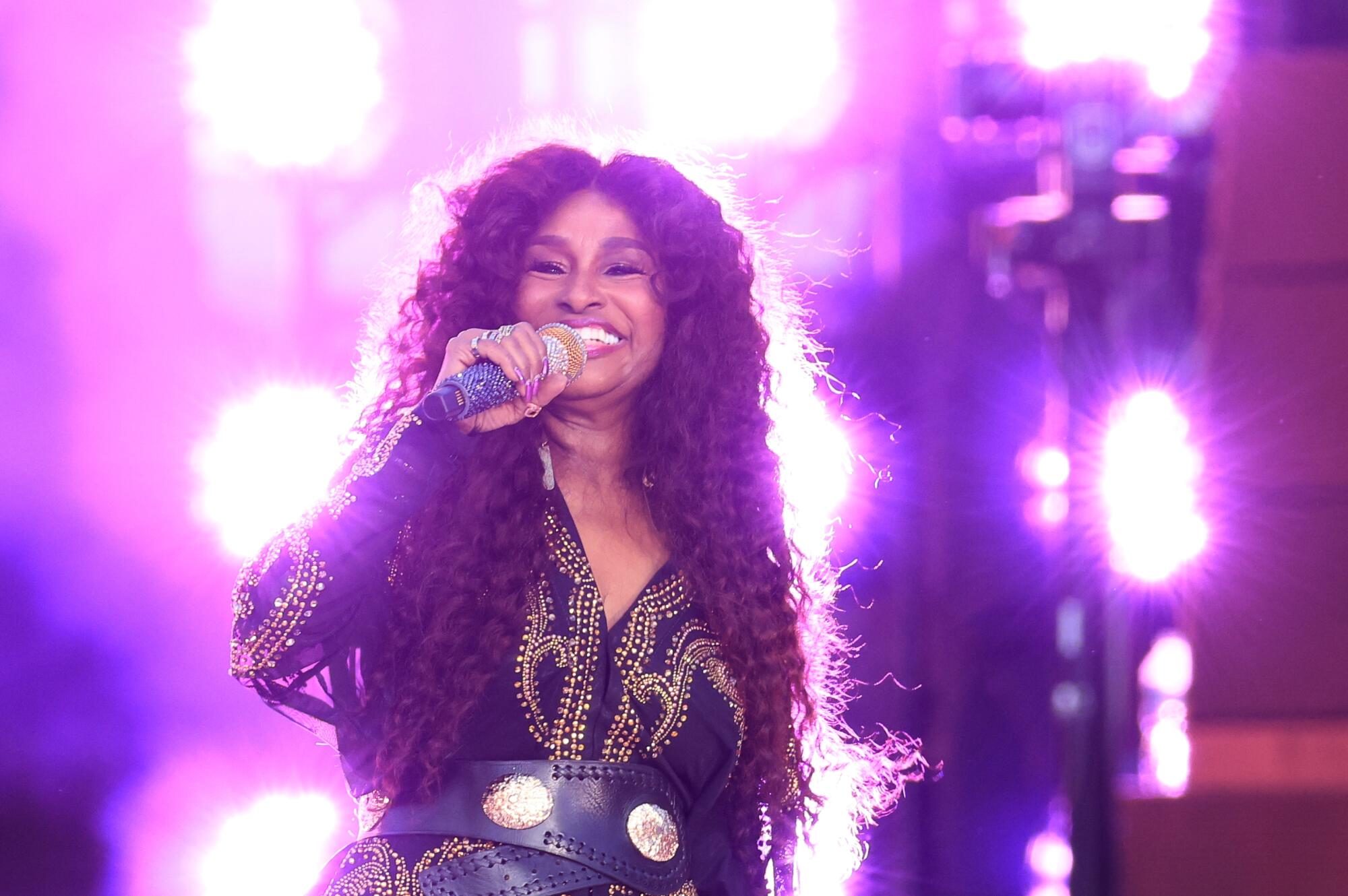
Chaka Khan performs.
(Myung J. Chun / Los Angeles Times)

Queen Latifah hosted the show.
(Myung J. Chun / Los Angeles Times)

A couple in patriotic garb share a kiss.
(Myung J. Chun / Los Angeles Times)

Smashing Pumpkins performs.
(Myung J. Chun / Los Angeles Times)

A concertgoer enjoys confetti.
(Myung J. Chun / Los Angeles Times)

Maren Morris performs.
(Myung J. Chun / Los Angeles Times)
-
 Lifestyle3 minutes ago
‘Alice and Steve’ might be a mess — but it’s also too fun to stop watching
-

 Technology11 minutes ago
America’s greatest idea is still under threat
-

 World18 minutes ago
Zelenskyy pressures US and Europe for more ‘air defense’ assistance amid ongoing war with Russia
-

 Politics21 minutes ago
ICE renews hunt for El Chapo’s last two fugitive sons with massive reward
-

 Health33 minutes ago
Biohacker hoping to live to 160 reveals alarming diagnosis: ‘My stomach is eating itself’
-

 Sports36 minutes ago
FIFA president addresses Trump call amid scrutiny over decision on USA World Cup star
-

 Technology41 minutes ago
Fake Booking.com travel credit scam targets travelers
-
 Business48 minutes ago
Many indie festival films struggle to get distribution. Alamo Drafthouse is trying to change that

