Lifestyle
One of L.A.’s most personal theater experiences is disguised as a tarot reading


There’s a sense of quiet mystery in tarot. That’s why during my reading last week, it was more peculiar than disruptive when a dancer hopped on a table to lay at a 90-degree angle and jet her feet in the air.
Despite said activity, the tone was contemplative, and moments later, as I was being asked to describe the colors and mood of a Ten of Swords card, I was tapped on the shoulder. After a gesture to follow, I was handed a lantern.
The way I swayed the light would now dictate the performer’s movements. We may not have been dancing, but it was close. Melancholic and intimate, the performer (Haylee Nichele) silently guided me to become comfortable in my discomfort, to sit with the evening’s themes of longing, loss, confusion and impending grief.
Sam Alper’s Bill, foreground, and Haylee Nichele’s Constance in Koryn Wicks’ “You Must Be Here for the Reading,” an immersive tarot show.
(Daniel Kleen)
“You Must Be Here for the Reading,” running through June 20 at North Hollywood’s After Hours Theatre, is part theatrical and dance performance, part tarot reading and part cocktail hour. It’s also personal, led by two actors who encourage the attendees to open up, to complete poems and to generally tune into their vulnerability.
The 60-minute show, partly scripted and partly improvised, comes from the mind of Koryn Wicks. Trained in dance and choreography, Wicks’ day job is in themed entertainment while her personal projects explore the immersive space. They’re theatrical works that experiment with audience interaction. “You Must Be Here for the Reading” is no different.
The setup: Collectively, our group of eight has arrived at a tarot reading, only the famed reader we are there to work with, Constance, performed by Nichele on the night I saw, never arrives for her assigned role. We know her fate, but her partner, Sam Alper’s Bill, who nervously attempts to carry on with the performance in her absence, does not.
From there, “You Must be Here for the Reading” becomes a show heavy on audience participation. There are scripted, story-specific beats, but the cards pulled — and the tales they tell — is, of course, randomized.

Sam Alper as Bill, an unsuspecting tarot card reader in Koryn Wicks’ “You Must Be Here for the Reading.”
(Daniel Kleen)
“I knew that I wanted the audience to be the primary drivers of the tarot reading,” Wicks says. “I knew that I wanted the host to not be a tarot reader and there to be some sort of event that made it so the audience would have to take the reins and read the tarot.”
In turn, “You Must Be Here for the Reading” works for both those who are novices to the space as well as those who are more experienced. During the pre-show, guests can explore tarot books and uncover slips of paper hidden in them that prompt us to answer questions or complete poems — the latter will figure into the performance. A worksheet given to us asks us to interpret some core tenets, as well as to enter the reading with a question we would like to explore.
The show then focuses on how each attendee’s desires, concerns or lived experiences shape the perception of the reading.
“What’s drawn me to tarot is the way it’s built on symbolism and the way that symbolism is embedded in the collective unconscious,” Wicks says. “I think it’s really fascinating that we have this artifact that has this ability to give us insight into a lot of shared experiences. When I’ve read different books about tarot, or had my cards read by different people, there is an openness to interpenetration.
“The assignment I gave myself for this piece,” Wicks continues, “was to create an experience in which you had a group of people coming together and going through the process of defining the symbolism and meaning of the cards in real time.”
And yet the show also pulls from Wicks’ background in dance. While Constance never shows for the reading, her presence is still felt, often hovering or circling around the table with movements designed to interpret the tone of the reading. She’s a ghostly presence, the gracefulness heightening the somber emotions of the night. Though she and Bill never interact directly, much of the dance seeks to explore their unseen bond. At times, Constance may call on various audience members to act as a dance partner.
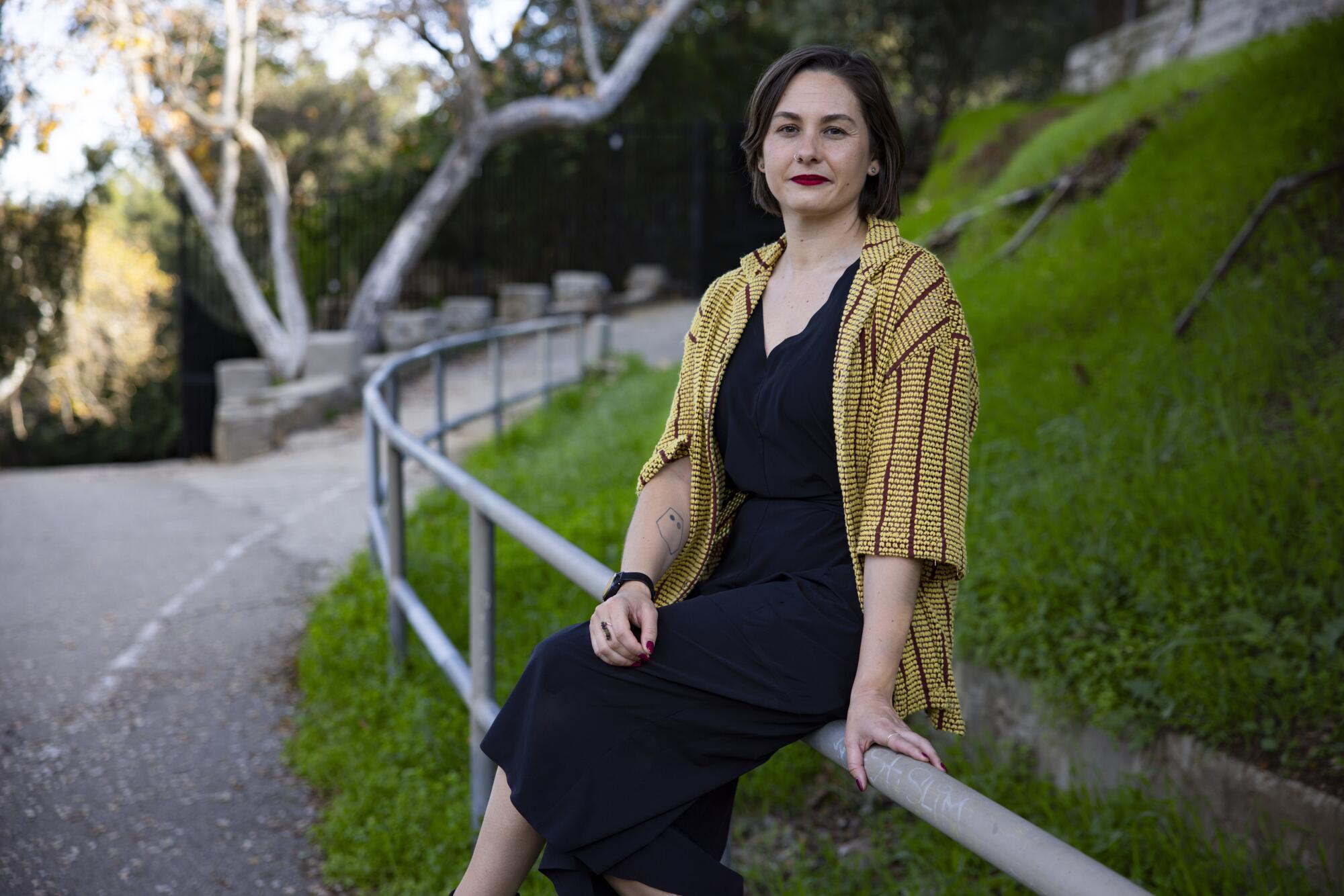
Koryn Wicks, creator of “You Must Be Here for the Reading,” an immersive tarot performance in which audiences are tasked with deciphering their own cards while a melancholic story unfolds around them.
(Kayla Bartkowski / Los Angeles Times)
“I really believe that one of the most beautiful things art does for us is remind us that we are not alone,” Wicks says.
Immersive art allows for a sense of participation, which Wicks hopes will increase one’s appreciation of dance.
“Dance is an embodied art form,” Wicks says. “There is science that shows that some of the enjoyment from watching dance comes from imagining yourself moving. In North America, a lot of people haven’t had an experience or education with dance, especially not concert dance. Then we ask them to sit in a dark auditorium in a small chair and not move to enjoy it. I found through my research, both practical and academic, there is something to inviting audiences to participate in dance that allows them to derive meaning from it.”
‘You Must Be Here for the Reading’
While there isn’t enough time in the show for everyone to have a one-on-one experience with the dancer, watching an audience and cast member attempt to get in sync with each other underlines the night’s themes of connecting. Ultimately, that’s the space where the show resides. “You Must Be Here for the Reading” uses tarot as a means to bring some structure to our often disconnected lives.
“It stands in contradiction to our current historical moment,” Wicks says of the show. “It’s very anti-AI. It’s asking people to sit with books and to find little seeds and not necessarily pursue solutions or puzzles. It’s asking us to connect, sometimes with strangers.”
I kept my question that I brought to the reading secret, but I found the show provided a hopeful answer. Not because the cards offered a solution. Instead, they provided a community.


In Alice and Steve, Jemaine Clement and Nicola Walker play long-time friends who turn on each other after he gets involved with her 26-year-old daughter.
Lara Cornell/Disney+
hide caption
toggle caption
Lara Cornell/Disney+
I grew up watching episodic shows on network TV, nearly all of them formulaic but some indelibly great. Then, like everyone else, I moved into the days of what my colleague David Bianculli dubbed Platinum TV, where series like The Sopranos and The Wire and Fleabag aspired to something higher. What both these eras had in common was that their shows were carefully crafted — they had an internal logic, and a tone, that held them together.
In recent years, though, there’s been a proliferation of shows that, possibly obeying some algorithm, care less for coherence than sensation. They lurch among tones, from cuteness to sentimentality to meanness, stirring in random plot twists along the way. Bouncing all over the emotional map, these shows depend on compelling actors and a few memorable scenes to make us overlook their loose construction.
A great example is Alice and Steve, an entertaining but sometimes exasperating six-part British comedy on Hulu about two 50-something best friends who turn on each other after he gets involved with her 26-year-old daughter.


While the premise is juicy, it’s also a tad yucky, and I mainly tuned in because its title characters are played by performers Jemaine Clement from Flight of the Conchords and Nicola Walker, whom I’ve raved up on this show more than once.
The series starts poorly with Steve and Alice going on a cutesy bender after a friend’s funeral. Now, I always hate drunk scenes, which are an invitation to overact. As Clement and Walker bray their lines, we learn that Steve’s a divorced celebrity hair stylist who can’t find a girlfriend while Alice is a clothes designer with a doting younger husband, nicely played by Joel Fry, a sweetie-pie of a teenage son — that’s Tyrese Eaton-Dyce — and, of course, that 26-year-old daughter, Izzy, who has inherited her mother’s willfulness. Played by Yali Topol Margalith, Izzy kickstarts the plot by flirting with Steve. Predictably, he succumbs.

Almost immediately, they think they’re in love. While the weak-willed Steve wants to hide their romance — he knows it’s inappropriate — Izzy just blurts out the facts to her mom. Alice flips. And from hereon out in this series where the women are as alpha as the men are hangdog, Alice drives the action. Betrayed and violently angry, she’ll do whatever it takes to break them up — no matter who gets hurt. Her antics unleash Steve’s own malice. We’re in Beef territory.
At its core, Alice and Steve hinges on the way that platonic friendships are often richer and more powerful than romantic ones. It’s a fascinating subject, which may be why I found the script by Sophie Goodhart so frustrating. I wanted her to dig deeper. While the show’s got some very funny bits — Alice’s sharp-tongued mother is a blast — it’s often annoyingly lax.

If Steve really does the hair of Charli XCX, how come he’s a clueless older guy whose pop culture references are Willie Nelson and Woody Allen? If Izzy truly adores her mother as she claims, why does she keep rubbing her relationship with Steve in her mom’s face? Halfway through, one character nukes the other’s career, but this life-shattering event has no real weight: It’s barely even mentioned for the rest of the series.
That said, Alice and Steve is worth seeing for scenes like the one in which Steve spinelessly sells Izzy out or the lacerating discussion between Alice and her husband when he fully grasps that he adores a woman who views him as a reliable but dull concierge, not a man she likes hanging with. Most touching of all may be the lovely sequence when Alice, wise for once, smooths a romantic crisis between her son and his would-be girlfriend, a pair who are the show’s emblem of hope. For once, we understand why people love her.

While most viewers will find Steve more likable than Alice — the show takes pains not to make him appear predatory or creepy — the role doesn’t give Clement a whole lot to do except play variations on shambolic dread and discomfort. The show gets its galvanizing zing from Walker, a beloved star in England with amazing, luminous eyes. Her Alice is the kind of complicated, volcanic heroine that you don’t see in movies and rarely see on TV, one who shows her apocalyptic rage freely and in many different forms.
At least once in every episode, something would lead me to say, “Man, is this show a mess.” But that wasn’t a deal breaker. I kept watching. After all, life is messy, too.


How to enter your Sporty Spice era.
Getty Images/quantic69/Olga Kurbatova/Anastasiia Zvonary/Photo Illustration by NPR
hide caption
toggle caption
Getty Images/quantic69/Olga Kurbatova/Anastasiia Zvonary/Photo Illustration by NPR
Reality dating and professional sports are not as different as you’d think.
Brittany is in her Sporty Spice era – she watched the NBA playoffs, she’s following World Cup games, and she’s watching the New York Liberty play their WNBA season. These games are daily – and so is the reality dating show Love Island. And she noticed that the two formats are not very different at all. Defector.com staff writer and co-owner Kelsey McKinney came to the same conclusion – so the two of them discuss why these games of athleticism and love can bring us together… and why they get valued differently in our culture.
For more episodes on sports and reality TV, check out:
Get rich or die trying: how sports betting is changing our love of the game
Is this the end of reality TV?
The ugly truth of America’s expensive homes
Support Public Media. Join NPR Plus.
Follow Brittany on Instagram: @bmluse
This episode was produced by Liam McBain. It was edited by Neena Pathak. Our Supervising Producer is Cher Vincent. Our Executive Producer is Barton Girdwood. Our VP of Programming is Yolanda Sangweni.

-

 Nevada3 minutes ago
U. Nevada Reno department merger will study social life via ‘intersectional, decolonial, humanistic’ lens | The College Fix
-

 New Hampshire8 minutes ago
Seacoast Double Shooting | Escapee Captured | 10-Year Preservation Plan Released: PM Patch NH
-

 North Carolina13 minutes ago
SIGN: Pass Duke’s Rescue Act to Protect Dogs and Cats in North Carolina
-

 New Jersey15 minutes ago
New Jersey Underground Railroad camp brings history to life for students
-

 New Mexico18 minutes ago
Roswell UFO Festival organizers share 2026 attendance numbers
-
North Dakota30 minutes ago
ND ATTORNEY GENERAL TO RELEASE 2025 CRIME STATISTICS – North Dakota Attorney General
-

 Ohio33 minutes ago
Veteran Officer Among 4 Dead in Ohio Shooting
-

 Oklahoma38 minutes ago
FFA members attend Oklahoma FFA Alumni Leadership Camp

