Lifestyle
L.A. Marathon won’t give trans runners prize money. This past champion wants to change the game


Cal Calamia remembers stepping into his power at the Los Angeles Marathon two years ago.
It was a cool and especially windy March morning, and Calamia had run through a succession of L.A. neighborhoods — Chinatown, Echo Park, Silver Lake and Los Feliz, to start. He cruised by some of his favorite L.A. landmarks, including the Hollywood Walk of Fame, which he’d romanticized as a glittering oasis while growing up in the Midwest in a conservative Republican family. Here in California, “a sanctuary for transgender people” like him, and ensconced by the cheering L.A. Marathon crowds, he felt not only safe, but celebrated.
During one section of the race in Westwood, with about eight miles left to the finish line, energetic spectators on Santa Monica Boulevard huddled onto a concrete median shrieking and waving signs — one read, “You’re running better than our government,” he recalls. Toddlers sat perched on adults’ shoulders, seniors wielded cardboard posters. He says the crush of rippling flags is an image he’ll cherish forever — more pink-blue-and-white-striped trans flags than he’d ever seen in one place.
“Being in this particular race environment knowing there was genuine love and support for me, for people like me, just felt like being held,” Calamia says. “It was really beautiful.”
Calamia is determined to best his personal record — 2:41:59 from the Berlin Marathon in 2024 — at Sunday’s LA Marathon.
(Josh Edelson / For The Times)
Calamia would go on to win first place in the L.A. Marathon’s nonbinary division that year, clocking in at 2:53:02 — one of myriad victories in his career. Based in San Francisco, Calamia (whose pronouns are they/he and who asked that both be used in this article) is the only nonbinary marathoner ever to podium (finish in a top-three spot) in six of the Abbott World Marathon Majors. They’re also a leading transgender advocate, helping to educate marathon organizers around the world about equity and inclusion — and a poet, a collection of poems inspired by their gender transition, published in 2021.
Calamia hasn’t participated in the L.A. Marathon since that memorable 2024 race, but they hope to reclaim the top spot in the nonbinary division on Sunday. The race, from Dodger Stadium to Century City, is 26.2 miles long; but the fight for equity for trans and nonbinary marathoners across the sport, Calamia says, is a far longer road.
“It’s changing, but we’re not there yet. So, so much more needs to be done in the realm of education,” they say.
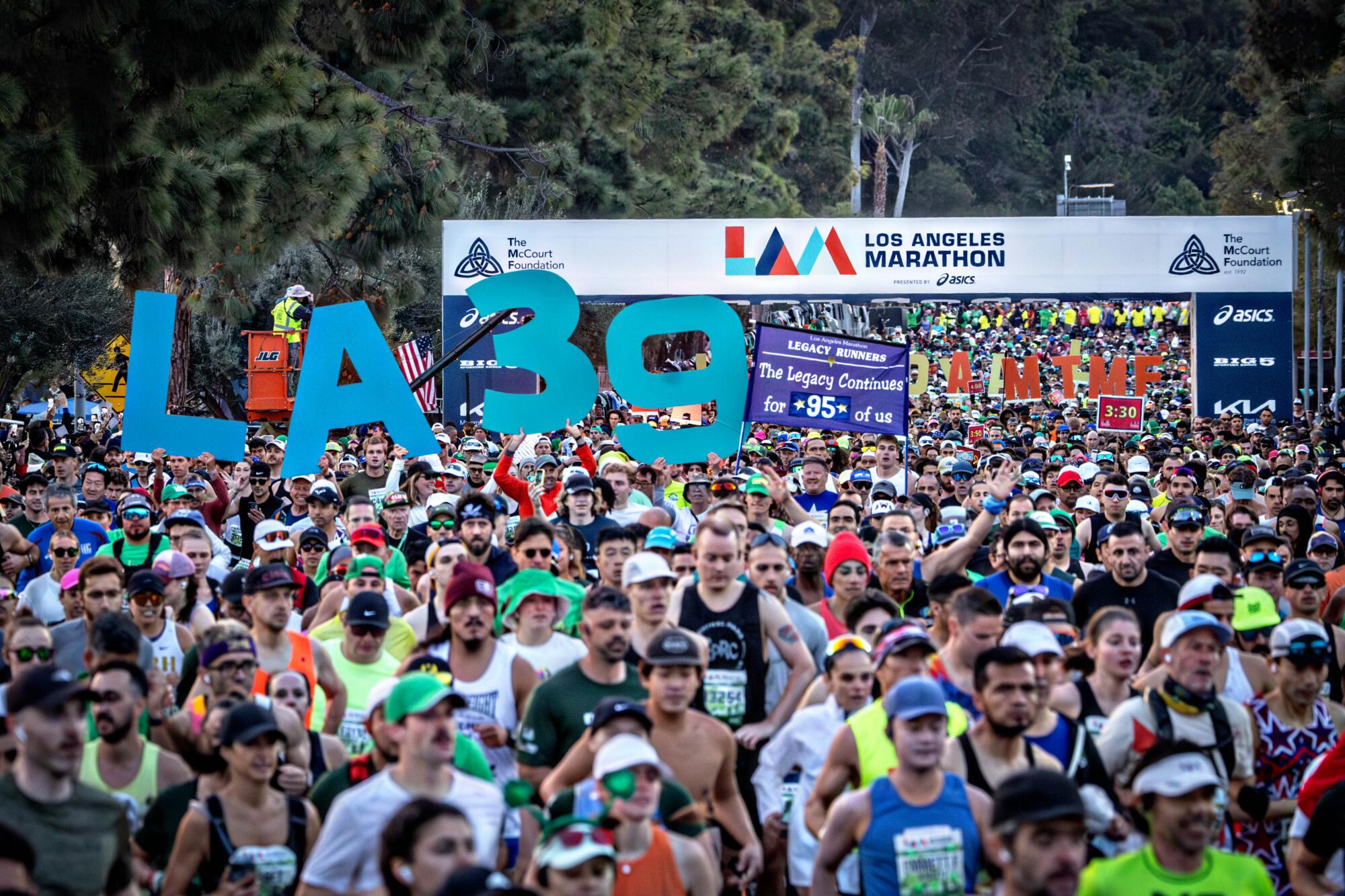
Runners start the 39th Los Angeles Marathon at Dodger Stadium on March 17, 2024.
(Jason Armond / Los Angeles Times)
Calamia is competing in a moment when transgender athletes are a topic of national political debate.
The Trump administration has been trying to ban transgender athletes from participating in youth sports competitions throughout the country, a battle that is playing out in court. The Supreme Court is considering whether to uphold state bans on transgender athletes competing in girls’ sports in Idaho and West Virginia. In 2025 alone, hundreds of bills were introduced at the state and federal levels to restrict the rights of transgender people — not only targeting their participation in sports, but their medical care and their identity documents.
Within the marathoning world, the introduction of a nonbinary division is relatively new and has been a quickly evolving issue. Trans and nonbinary marathoners, historically, have run in either the category in which they were assigned at birth — in which they didn’t identify personally — or, depending on the marathon, in the category aligned with their self-identified gender. In the latter case, some might be at a disadvantage, others an advantage (trans men, for example, might be physically smaller and weaker, with regard to muscular strength and lung capacity, than the cis men they’re competing against.

Trans marathoner Cal Calamia started running in fifth grade. “It was the first time I felt like I had autonomy over my body,” they say.
(Josh Edelson / For The Times)
The Los Angeles and New York City marathons were the first to introduce nonbinary divisions in 2021. Now all seven Abbott World Marathon Majors — in New York, Boston, Chicago, Tokyo, Berlin, London and Sydney — include a nonbinary division for mass participation runners.
But non-binary runners typically aren’t awarded prize money because there isn’t a category for them in elite divisions (in which where prize money is typically awarded) as there is for cis runners. (The New York City Marathon does offer prize money to nonbinary runners within its New York Road Runners-member general division, as do some local races.)
One reason: Most marathons take their cues from the Monaco-based World Athletics, the international governing body for the World Marathon Majors as well as large-scale road races such as the L.A. Marathon. And in the elite field, “our categorisation of either male or female for entry purposes and results are based on an athlete’s biological sex,” spokesperson Maggie Durand said in an email, adding that the dispersion of prize money is ultimately up to the races.
Another issue is that the nonbinary category is smaller and therefore less competitive, the L.A. Marathon says. In 2021, zero nonbinary runners crossed the finish line at the L.A. Marathon; 38 runners did in 2024 and 267 did in 2025. This year, the marathon is expecting 150 participants in the category. That represents just 0.54% of registration for the race, which has about 27,000 participants in all. (A portion of registration fees goes toward prize money.)
While the L.A. Marathon doesn’t have a professional nonbinary division with prize money, it does award the top three nonbinary finishers a trophy or a medal as well as inclusion in post-race publicity.
“World Athletics and USA Track & Field set our industry standards and we look to their regulations,” L.A. Marathon spokesperson Meg Treat said. “But at the end of the day, the category is small. And while some of the runners will clock fast times, many of them are going to be finishing alongside our everyday athletes as part of the general field. We’re watching how the competitiveness of that category develops and we’ll evaluate potential changes.”
Calamia, calls it a “chicken and egg issue.” “There’s a lot of, ‘Oh, it’s not competitive enough and too small,’ but how could it be competitive enough if it’s not recognized?”
Calamia, who was assigned female at birth, grew up in a suburb of Chicago in a “loud, conservative household,” as he describes it, the second oldest of four siblings. “There were a lot of people with strong opinions,” he says, and not much tolerance for “anything different,” which he felt inside. He started running cross-country in fifth grade and it brought him a sense of freedom — from the dissonance inside his mind as well as from the house.

Calamia recently became a vegan. “There’s an intersection between transness and veganism,” they say.
(Josh Edelson / For The Times)
“It was the first time I felt like I had autonomy over my body,” he says.
They moved to San Francisco in 2018 and began their gender transition, having top surgery in 2019. Later that year while training, they ran shirtless through the streets of San Francisco as a nonbinary transmasculine athlete and felt more themself than ever, embracing “the in-between.”
“Early in my transition, my goal was, ‘I don’t want to be perceived as a woman. But I’m not quite like these cisgender men, either.’ It took me a lot of work to understand how beautiful occupying that liminal space is instead. Having the nonbinary division in marathons is an extension of that.”
His family has “come a long way,” but relations remain strained, he says. “They’re not just, ‘We voted for Trump;’ they’re Blue Lives Matter flag up in the yard and Trump bumper stickers and ‘Don’t Tread on Me’ flag and tattoos,” he says. “To try to have a relationship with them is challenging. Because they’re actively voting against not just my rights, but human rights.”
Calamia backed into an activism career when in 2022 he led a campaign pressuring San Francisco’s Bay to Breakers race to let nonbinary participants win awards. (The race was letting the runners register, but not place.) Calamia won that battle — and then took first place in the race days later.
“I was like: ‘Wow, look what we just did. What else can we do?’” he says.
The answer: The San Francisco, Chicago and Boston marathons all introduced nonbinary categories within a year, partly due to Calamia’s efforts. Calamia, would become the San Francisco Marathon’s inaugural nonbinary division winner as well.
Post-victory elation, however, was short-lived: In mid-2023, Calamia had to tirelessly defend their right to use testosterone, which they’d been taking since 2019 as part of their gender transition, to the U.S. Anti-Doping Agency. It ultimately granted them a 10-year therapeutic use exemption so they can continue to compete.
Early in my transition, my goal was, ‘I don’t want to be perceived as a woman. But I’m not quite like these cisgender men, either.’ It took me a lot of work to understand how beautiful occupying that liminal space is instead. Having the nonbinary division in marathons is an extension of that.
— Cal Calamia
Now the four pillars of Calamia’s career — marathoning, activism/education, writing and community building (they founded a nonbinary run club that meets weekly in the Bay Area) — are working together with the gusto of an elite athlete. But Calamia feels added pressure to win races because it amplifies their advocacy voice.
“None of it works if the sports performance isn’t up to par, because then no one is paying attention,” they say. “But also, I’m putting pressure on myself to try and beat all the women or compete with at least some of the fastest men. Because I don’t want to feel like a charity entry. I’m a fast runner. I want to be recognized as a strong athlete — not as someone who got the chance to be here because ‘we’re so inclusive.’”

Calamia says he feels a sense of freedom and calm when running. “It’s a flow state.”
(Josh Edelson / For The Times)
With the L.A. Marathon just days away, Calamia is feeling positive about the race. His personal record is 2:41:59 from the Berlin Marathon in 2024 and he hopes to best that. Toward that end, Calamia will do what he always does the day before a race: visit a spa for contrast therapy (between a hot tub and cold plunge) while visualizing every stage of the imminent marathon, its hurdles and eventual successes. On race morning, he’ll eat his usual: a bagel with peanut butter and a banana.
Next up: Calamia will compete in the open division of the Athletic Brewing Ironman 70.3 Oceanside on March 28, with two other trans athletes as his teammates, Schuyler Bailar and Chella Man. And after competing in the Sydney Marathon this August, he’ll run a 100-mile ultramarathon in Arizona in October.
Marathoning, says Abbott World Marathon Majors Chief Operating Officer Danny Coyle, is “one of the most inclusive movements” in sports globally. “If you’re lucky enough to stand on the side of the street on any given race day in the WMM — and some of the big races like Los Angeles — it’s just this melting pot and stream of humanity of all shapes and sizes, all creeds and colors, with one shared objective: to get to the finish line.”
Calamia, however, says there are still miles ahead until the sport is truly inclusive for trans and nonbinary runners.
“But I love the sport,” they say. “The fact that it’s still evolving is a beautiful thing and I’ve learned so much about myself, and grown so much, because of my relationship with running.”
The L.A. Marathon, they add, plays a central role in the sport’s own evolution.
“L.A. is this place where all these different people from all over the place come together to pursue their dreams, which is inspiring,” they say. “Having nonbinary representation on the course, as well as support from spectators, sets a precedent for other cities around the globe: that no one should have to choose between being who you are and doing what you love.”

Transgender athlete-activist-poet Calamia shows off a tattoo reading, “Eyes up. Look ahead.”
(Josh Edelson / For The Times)


Milly Alcock in Supergirl.
Warner Bros. Pictures
hide caption
toggle caption
Warner Bros. Pictures
Hollywood’s newest Supergirl is kind of a dirtbag — in the good way. Fearless and grumpy, Supergirl (Milly Alcock) sets out on a quest to support a new pal’s revenge journey and to make a point that should be clear by now: Never mess with a lady’s dog. Also featuring David Corenswet and Jason Momoa, is Supergirl a worthy follow up to Superman?
If you want more DC superhero action, check out these episodes:
‘Superman’ takes off and nails the landing
‘The Batman’ puts the emo in emote
Connect with Pop Culture Happy Hour:
Letterboxd / Facebook
Our weekly newsletter
Support Pop Culture Happy Hour+
Lifestyle
L.A. Affairs: After decades of near-misses, I finally told him: ‘I’m not leaving here without you’

It didn’t take endless quarantining with my spouse during the COVID-19 pandemic to end my marriage of over two decades. By the summer of 2019, menopause — and the extra-added “bonus” of frontal fibrosing alopecia that it awakened — was pummeling me physically and mentally to the extent that I no longer had the capacity to function inside the dysfunction of my life.
The relief that came with the decision to finally let go was completely dwarfed by the immense pain of severing a family in two. I cried as I packed. I cried as I unpacked. I was rolling endlessly in a dark wave that would not stop; my feet could not tell sand from sky. Once I managed to break the surface, I reached out.
I called Tish, Diane and Michelle, three smart, strong, nurturing women who’d been through and survived divorce. I also called my brother, Dan, and my friends Doug and Steve, three kind, creative, funny men who always “got” me.
As for Steve, we met in the spring of 1984 when he auditioned to be the drummer for the Secrets, the band Dan, Doug and I had started the year before. In our small-town high school of fewer than 400 students, he had flown completely under my radar, as he was two years younger, and he joined marching band the year after I’d ditched my baritone horn for a microphone and Pat Benatar tights. Steve aced the audition, and the four of us clicked immediately over our shared love of the Pretenders and all things Monty Python. By mid-June, the Secrets were playing local bars and biker parties in the middle of nowhere, and I was head over heels in love with the drummer.
It wasn’t supposed to happen like that. I wasn’t supposed to fall in love with a boy from my hometown.
I had spent my whole life dying to get out of Middlebourne, W.Va., and had been champing at the bit to leave for college, but by late August, that no longer meant freedom; it meant that I’d have to leave Steve behind. I told myself we’d defy the odds and make it work. He was my soul mate. But we were just kids, and there was no internet, no cellphones with unlimited text and calling. By February 1985, the divide was too great. In a moment of loneliness, I cheated on him. It was over, and I was firmly told to take my place in the friend zone.
I spent the following year flailing and failing in college before making the bold, half-baked decision to drop out of the West Virginia University theater program and move to Los Angeles, a place I’d never been, to pursue a singing career. When Steve found out that I was moving across the country, he softened his friend-zone stance and told me he loved me. On July 13, 1986, he went with my parents to Pittsburgh International Airport to see me off.
For the next 33 years, we would come together and drift apart — sometimes as lovers but mostly as friends. During a visit to my Hollywood apartment in 1988, when he was still in college and the timing was still wrong, I told him, “Who knows. Maybe in 30 years, I’ll come back and get you.”
In November 2019, Steve came to visit me for a long weekend.
I picked him up at Los Angeles International Airport and took him straight to Zuma Beach for a picnic, where we watched dolphins jumping in the waves while the seagulls stole our potato chips. The following day, we cozied up for an afternoon of wine and cheese at Cornell Wine Co. in Old Agoura, then made our way over Topanga Canyon for dinner at Canyon Bistro & Wine Bar.
The night before he flew home, we watched the sun set from our table by the lake at Zin Bistro Americana in Westlake Village. I felt giddy, excited, seen, understood and appreciated in a way I hadn’t felt in a very long time. While it was tempting to jump right in with both feet, we decided to date long distance and take things slowly.
On March 26, 2020, while Steve was still recovering from being profoundly ill with COVID, I arrived at his doorstep at 6 a.m. and proclaimed, “I’m not leaving here without you.”
Two weeks later, after packing most of his belongings into U-Haul shipping crates, we left Parkersburg, W.Va., in Steve’s red Volkswagen Golf with two suitcases, one Treeing Walker Coonhound and one Aussie/Chow mix. I-40 West was practically empty; just us and the occasional car or Amazon truck.
We arrived in California on Easter Sunday and joined the rest of the world in quarantine, not knowing how it would affect our work and financial future. We took a lot of long walks to help deal with the stress of the not knowing, but the magic panacea for me came the day Steve’s Harley-Davidson arrived in one of the crates.
We cruised up and down PCH, and roared our way up and over Mulholland Highway, Stunt Road, Malibu Canyon and Decker Canyon, stopping along the way to stretch our legs, feel the sea spray on our faces and take in views from the valleys to the coastline. We were surrounded by so much beauty; it was almost impossible to let trepidation win.
On one particularly memorable ride on Mulholland Highway between Kanan Road and SR 23 near Saddle Rock, we came around a bend and — bam! — right in front of me was the greenest mountain range I’d ever seen in California, gleaming spectacularly in the sunlight. As I inhaled its gorgeousness and exhaled my stress, I thought, “I can’t believe I get to see this. I can’t believe I get to do this. I can’t believe I get to be with Steve.”
In September 2024, I got to marry Steve.
As my brother, Dan, said at the reception, “What a long, strange trip it’s been.”
The author lives in the suburbs of Los Angeles with her husband, Steve, and their dogs, Coco Puff and Kira.
L.A. Affairs chronicles the search for romantic love in all its glorious expressions in the L.A. area, and we want to hear your true story. We pay $400 for a published essay. Email LAAffairs@latimes.com. You can find submission guidelines here. You can find past columns here.

Sydney (Ayo Edebiri) and Carmy (Jeremy Allen White).
FX
hide caption
toggle caption
FX
There has always been a metaphorical parallel between The Bear, the television show, and The Bear, the fictional restaurant on the television show. Even as Carmy (Jeremy Allen White) and Sydney (Ayo Edebiri) transformed the Italian beef joint into the fancy restaurant of their dreams and wished for a Michelin star, there were undoubtedly locals who thought, “This is great and all, and I’m sure the food is good, but … I liked the beef sandwiches.” There’s still a window at The Bear to get them, but the focus is certainly elsewhere.
When it started, The Bear was mostly about the work that took place in the kitchen. The stresses of too many orders, territoriality from Richie (Ebon Moss-Bachrach), the arrival of Sydney, and the tightly wound but undeniably talented Carmy, making everybody both extremely stressed and significantly better. Over time, it shifted and grew, putting together beloved departure episodes like “Fishes” in Season 2, which introduced a boatload of guest stars for a flashback story of a disastrous family dinner before Mikey (Jon Bernthal) died. It spent time with Sydney’s family, it explored the way Tina (Liza Colón-Zayas) and Mikey originally met, it followed Marcus (Lionel Boyce) to Copenhagen, and it went with Richie to work for Andrea (Olivia Colman). All these episodes were excellent. And there was still a kitchen. But the focus seemed to be elsewhere.

At times, the show seemed to have disappeared up its own nose, to the point where you weren’t watching the show The Bear as much as you were watching the phenomenon The Bear. There were too many real-life chef cameos, until it seemed like those chefs were checking a box on a list of “things all the cool kids do.” There were too many other cameos, culminating in a rare miss from the reliably charismatic John Cena. The show placed a lot of narrative weight on Carmy’s love interest, Claire (Molly Gordon) — weight that the underwritten character couldn’t support. But even if every experiment and every diversion had worked, viewers couldn’t be blamed for missing the close focus on the kitchen and the camaraderie — for thinking, “This is all really special, but I do miss the beef sandwiches.”
The fifth and final season dispenses with the departure episodes, and it mostly dispenses with cameos. It all takes place on one day, just after Carmy tells Richie and Sydney that he wants to step back from the restaurant and give it to them and Sugar (Abby Elliott) to run, and it mostly takes place right there at The Bear. Now that the clock set by Jimmy (Oliver Platt) has run out, his money has run out as well, and a series of cascading disasters puts Sydney, Carmy and Richie behind the 8-ball from very early in the day, not least because of the tension hanging over all three of them as they prepare to tell the staff about Carmy’s decision to leave.

Tina (Liza Colón-Zayas).
FX
hide caption
toggle caption
FX
We spend this day mostly with the people we know best: our three leads, along with Sugar, Tina, Marcus, and the rest of the staff — including Luca (Will Poulter), who has stayed around to keep working with Marcus. Jimmy is running around with Computer (Brian Koppelman) and a young apprentice of his named Cheese (Elsie Fisher of Eighth Grade), trying to figure out what to do about his finances since it is Jimmy, and not just the restaurant, who’s out of money.
This day takes a while to get cooking, so to speak. The first three episodes of the season are slow, the first two in particular. It’s pouring rain outside, the lighting is dim, and the score maintains the same contemplative melancholy for a long, long time. For about two and a half episodes, it feels like one extended, low-energy scene.
But after that, there’s a shift in tone as the staff looks to get through service, and through seven episodes (FX did not make the finale available in advance for critics), the rest of the season is terrific. What you see is the core story of The Bear, which is people trying to serve food and overcome problems, but through the lens of everything that has happened over the show’s run: Carmy’s retreat from his obsessiveness, Richie’s expansive (and inspiring) discovery of his gift for hospitality; Sydney’s stepping forward from second-in-command to leader; Tina’s complex relationship with the restaurant and her grief over Mikey; Sugar and Carmy’s relationship with Donna (Jamie Lee Curtis); the arrival of Marcus as a high-end pastry chef.
The question the show asks over the last four episodes is: Given all those digressions and flashbacks, given all those visits with families and others, given everything we know about where all these people have been and what they’ve experienced, how does a high-pressure service — of the same kind we used to see in that first season — look now? How do they behave differently, and how does their behavior read differently? How are they the same people we have always known, but at a different juncture, in a different context? How do their wins mean more to them, and to the audience?
On the one hand, making a season this way, there are fewer surprising grace notes, like “Napkins,” the Tina/Mikey flashback episode in Season 3, or “Worms,” the episode in Season 4 where Sydney hung out with her cousin (Danielle Deadwyler) and her cousin’s kid. The Bear feels less daring and more conventional.
But oh, when they have victories under pressure? Victories, large or small? It is immensely, richly satisfying. There’s also more comedy other than just the goofy Faks family than we’ve had in a few seasons; Richie is perhaps the MVP of the season, and that’s partly because of how often he gets to be really funny. Ayo Edebiri continues to be the show’s best reactor, showing Syd eternally a little bit surprised (dismayed?) that she’s chosen to throw in her lot with these people.
There are a couple of questions yet to answer in the finale, both little plot items and broader character resolutions. Over these seven episodes, though, there is much to cheer.


-

 Utah4 minutes ago
Utah weather conditions trigger historic red flag warning as wildfires rage in state
-

 Vermont11 minutes ago
Arlington Common, Albert Construction recognized by Preservation Trust of Vermont
-

 Virginia13 minutes ago
Virginia Cannabis: Will Retail Finally Start In 2027?
-

 Washington19 minutes ago
Touring Trump’s Washington: How the president is putting his imprint on the nation’s capital
-

 Wisconsin26 minutes ago
Northwest Wisconsin Highway Construction Update – Jun. 26, 2026
-

 West Virginia28 minutes ago
West Virginia AD: McAfee’s Value to School ‘Maybe Eight Figures’
-
 Wyoming34 minutes ago
Politicians mull action as details of alleged abuse, falsified records at Wyoming Boys’ School become public
-

 Crypto41 minutes ago
CLARITY Act Needs 60 Votes and 7 Democrats as GOP Races the August Recess Clock

