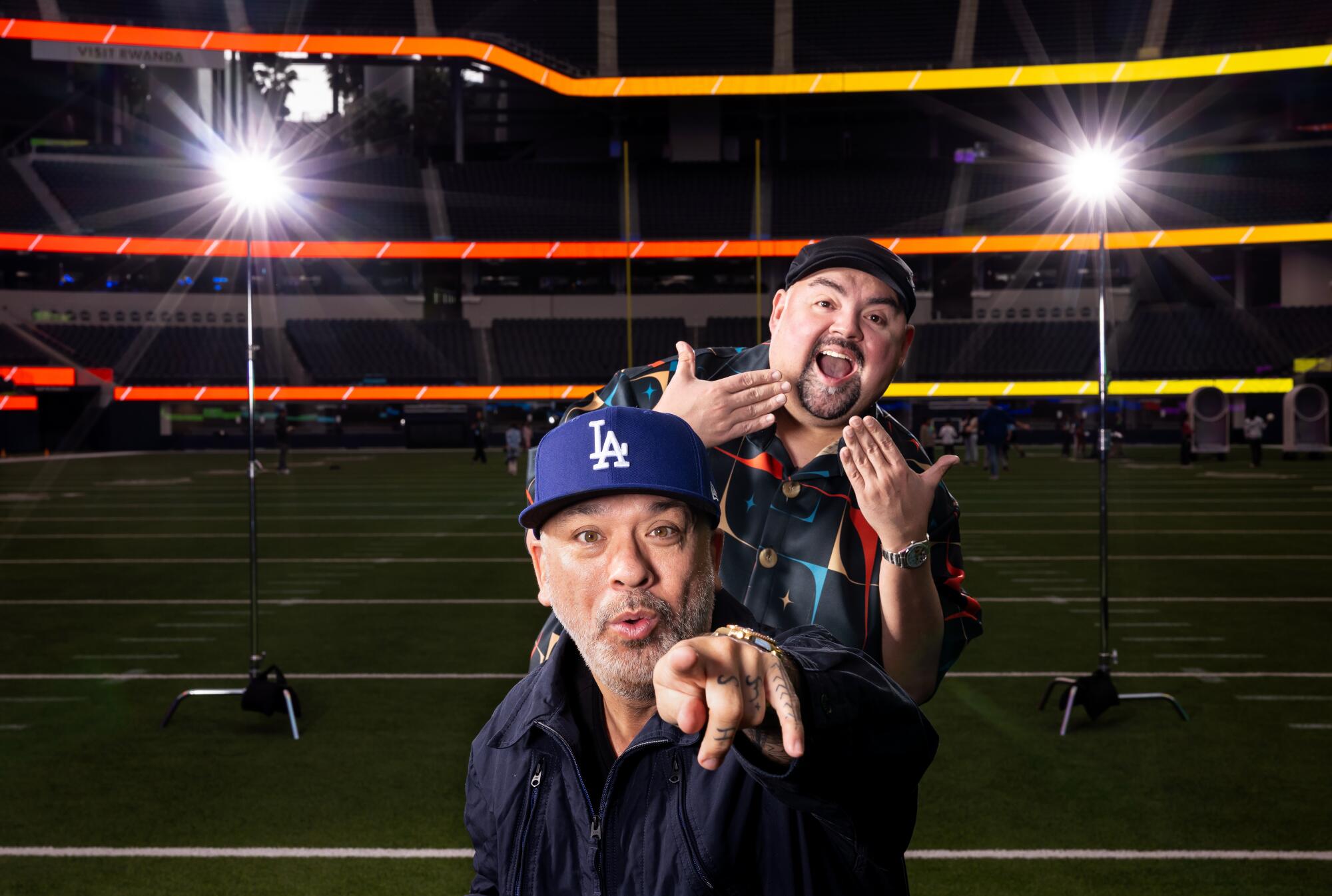
Running free during a game of catch on the empty field at SoFi Stadium is a fantasy most Angelenos will never experience. For comedians Jo Koy and Gabriel Iglesias, it’s just a warm-up to a dream that’s been a lifetime in the making.
Gripping the football with fingers covered in Filipino tribal tattoos extending in a sleeve up his arm, Koy looks across the expanse of emerald green turf at his son jogging toward the south end zone of the Inglewood stadium on a recent afternoon. “To be able to throw at SoFi is crazy,” Koy said with a sparkling grin of bright white veneers.
The 54-year-old comedian with a beard full of gray stubble drops back to pass, launching a tight spiral underneath SoFi’s massive technicolor halo scoreboard hovering above a sea of empty stands. Joseph Jr. — a wiry 22-year-old with a head full of curly dark brown hair — runs briskly toward the goal line with a black cast on his left arm. He raises his right arm just in time to scoop it into his chest for a touchdown. The imaginary crowd goes wild.
Advertisement
“Yes!!!” Koy shouts, his excitement echoing in the stadium. He jogs over to Joseph in his navy blue coverall jumpsuit and L.A. Dodgers cap to deliver a satisfying father-son chest bump.
A few yards away, Iglesias is watching Roka, his tiny black chihuahua, dart around the field like four pounds of rambunctious entitlement. The plus-sized comedian — better known as “Fluffy” — is sporting his typical loose-fitting vintage Hawaiian shirt, denim shorts and black flat cap. Whenever they stand together, the duo’s dynamic is like a modern-day Laurel and Hardy.
Nearly 70% of tickets for Koy and Iglesias’ SoFi show sold within days, making this the largest stadium stand-up performance to date.
(Christina House/Los Angeles Times)
“The fact that we’ve known each other as long as we have is wild … we’ve known each other since we both had hair,” Iglesias, 49, says as they both lift up their caps in unison, laughing and exposing their shiny bald heads.
Advertisement
On March 21, this stadium will be filled with more than 70,000 guests as the pair takes center stage at the Super Bowl of comedy — the largest stadium stand-up show to date. Koy and Iglesias are now part of a small fraternity of comics, including Kevin Hart, Dane Cook, Bill Burr and Larry the Cable Guy, who’ve sold out stadiums across the country.
The one-night-only show, which won’t be televised or recorded as a special, is meant to be one giant party for comedy fans who’ve supported Koy and Iglesias since their early days. The comics will be passing the mic back and forth throughout the night, which will feature special guests, surprise moments and plenty of other unplanned interruptions that will make for a roughly four-hour show. Though the L.A. comedy scene tends to exist in the shadow of Hollywood, this feat managed by two of its biggest names puts a historic spotlight on stand-up.
“It’s more sweet because it’s taken so long,” Iglesias said. “This wasn’t an overnight thing. Nowadays, everybody wants everything so fast. Between the two of us, we’ve got about 60 years of comedy experience.”
“It’s insane. I can’t explain it,” Koy adds, staring up at the stadium’s glass roof, preparing to crack it with decibels of laughter. “Every time we come in here and look up, I’m like, ‘There’s going to be a stage here the size of the end zone.’ We took the stage from the arenas that we normally play and injected steroids into it.”
For comedians who’ve witnessed their ascent, which now literally includes hands and feet cemented in front of TCL Chinese Theatre and a star for Fluffy on the Hollywood Walk of Fame, the journey has been incredible to watch.
Advertisement
“It’s huge for stand-up, it used to be just in dingy clubs and bars and always something small and intimate and kinda like an afterthought,” said fellow comedy star Tiffany Haddish, a longtime friend to both Koy and Iglesias. “To be honest I never thought comedy would be this big.”
Jay Leno, a confidant to Iglesias and the man who inspired him to start his own insane car collection and offered Koy his first late-night appearance on “The Tonight Show,” agrees that a show like this is a huge step for comedy.
“My attitude when I came to this town was if you can’t get in through the front door, go in the back door,” Leno said. “And they didn’t do it the traditional way, they got to where they are as comedians, one audience member at a time.”
For the two L.A. comedians, the historic milestone represents decades of work and signals comedy’s arrival in mainstream entertainment venues.
(Christina House/Los Angeles Times)
Advertisement
When the pair of arena-selling comics announced last year they’d be joining forces to perform at SoFi, the task of filling the massive concert venue and football stadium seemed laughable. But within a week, it clearly wasn’t a joke. Nearly 70% of the tickets were sold just days after going on sale. Now, weeks before the gig, the show is completely sold out with more seats being added. If there’s one person who is not necessarily surprised, it’s Iglesias. By his calculations — including his ability to sell out Dodger Stadium twice for the filming of his 2022 Netflix special, “Stadium Fluffy,” and Koy’s ability to sell out the Forum a record-setting six consecutive times (more than any other comedian) — the math checked out.
“At a certain point it’s like we’ve been doing [huge stand-up shows] for so many years, it becomes normal,” Iglesias said. “What do you do to change things? What do you do to grow? The worst thing that happens is it fails. But at least we know we tried it. Then we know what our ceiling is. But as of now, this isn’t the ceiling.”
Despite the logic, looking at the stadium’s massive seating chart during an initial meeting with the venue made the task feel akin to climbing Mt. Everest.
“SoFi is the size of like five Forums. That seating chart on a wall was the most discouraging thing I could possibly look at,” Koy said. “And then looking at the amount of money it was gonna cost us even before we sell one ticket. Me and Gabe should’ve been looking at that and been like, ‘What … are we thinking? Hell nah we ain’t doing this … !’”
It took more than a little convincing from Iglesias to get Koy on board. “[Jo] does not like change. I had to break down the math for him and I pushed it a lot,” Iglesias said. “And I’m glad we did because now that it’s sold out, the hard part is over. We just have to show up and deliver a kick-ass show. And then we can both celebrate after, crack a couple bottles and I know I’m taking a week off after that.”
Advertisement
Unlike a typical arena show, which takes several months to coordinate, their big night at SoFi required a full year of planning. The production and stage will be three times the size of the comedians’ normal stages and will be managed by the same team that produces stadium shows for acts like Los Bukis and Bad Bunny.
“It’s more sweet because it’s taken so long,” Iglesias said. “This wasn’t an overnight thing. Nowadays, everybody wants everything so fast. Between the two of us, we’ve got about 60 years of comedy experience.”
(Christina House/Los Angeles Times)
“It’s almost like a chessboard,” Iglesias said. “You got to do a bunch of moves in order to pull something like this off, it’s not just we’re gonna do it. This took a lot of planning, a lot of coordinating.”
When asked how the tickets could’ve possibly moved so fast, outside of typical avenues of good marketing and promotion, Koy says it was really comedy fans making a statement of support for them and for stand-up.
Advertisement
“There’s no such thing as marketing on this one, to me it’s a phenom,” he said, noting the pride both he and Iglesias have to see the excitement and support from local fans, especially Filipino and Latin communities across L.A. that have been a major part of their respective fanbases. “That type of reaction and that response to us saying we’re gonna be at SoFi is almost like a bragging right and it’s ‘our night, we’re gonna be there, I don’t care where we’re sitting.’”
The SoFi gig was conceived in February of 2024 during Koy’s sixth sold-out show at Kia Forum. In the hoopla of Koy breaking his own audience record at the venue, Iglesias crashed the show, presented his friend with a plaque and laid down the gauntlet in front of 17,500 fans. When Iglesias asked Koy if they should contemplate performing “across the street” together, the crowd erupted with excitement.
“Our agents and managers were like, ‘Are you sure you wanna do that?’’’ Iglesias said. “I think they missed a couple bonuses. But at the end of the day, it’s part of history.”
“That’s what’s beautiful about Gabe, he’s not scared to take on those big risks,” Koy said. “But the whole thing was a risk. We gotta alter our tour dates and sacrifice other opportunities to make this happen.”
“Every time we come in here and look up, I’m like, ‘There’s going to be a stage here the size of the end zone,‘” Koy said about the upcoming SoFi show on Mar. 21. “We took the stage from the arenas that we normally play and injected steroids into it.”
(Christina House/Los Angeles Times)
Advertisement
For Koy, a life of comedy was a risk inspired by his heroes while growing up in Tacoma, Wash. He traces it back to being 15 and seeing Eddie Murphy perform at Climate Pledge Arena during his “Raw” tour in Seattle. He remembers taking a panoramic look at the sold-out crowd roaring in the darkness before the leather-suited legend even took the stage. “I’m like, ‘Wait a minute, this guy got this many people in here?’ I just thought that was the most impossible thing,” Koy remembers. “And now I get to share this moment with my son and let him walk with me and let him see that this is possible.”
When Koy was moving up the comedy ranks under his real name Joseph Glenn Herbert, the thought of calling himself a comedian felt like a pipe dream. Koy, the son of a white father and Filipina mother, saw comedy as a way to channel an overactive personality and need to make people laugh into a career. Going from coffee shop open mics in Tacoma to clubs and casinos in Las Vegas in 1989, Koy scratched out a living doing random jobs to move to L.A. in 2001 with hopes of making it big.
Working at a bank or Nordstrom Rack offered some stability as he drove up and down Sunset Boulevard in his battered Honda Prelude with one broken headlight, looking for a way forward to pursue his passion. Haddish, his longtime friend, spent years working with Koy, who served as her mentor at the Laugh Factory. Between sets on stage, the two would often take breaks to fantasize about fame.
“Jo and I would sit outside of the Laugh Factory and have these conversations and we’d be eating hot dogs wrapped in bacon and we’d be dreaming about being in a big movie, playing big theaters and helping people heal through laughter,” Haddish said. “Now here we are.”
Advertisement
“At the end of the day, this is a big stamp. And I think it also lets other comics know, ‘Hey, man, step up your game. Let’s grow this,’” Iglesias said.
(Christina House/Los Angeles Times)
Pulling off a show of this magnitude is jaw-dropping to think about, Iglesias said, even after having achieved a similar feat just a few years ago at Dodgers Stadium where he filmed his special over the course of two shows. He also set a record for fines incurred by a performer for going over his allotted time slot (a hefty $250,000 for not leaving the venue until 4 a.m.). The SoFi gig leaves him only one shot to get it right. This time around, Iglesias feels infinitely less pressure despite the bigger venue.
“[Dodger Stadium] for me was grueling,” Iglesias said. “I didn’t know what to expect, I didn’t know how it was gonna go. Every day we were pulling our hair out trying to figure it out. Fortunately we were still able to pull it off and we learned a lot from it. This time around, believe me when I tell you the stress of this show is not even there.”
Iglesias, a native of Long Beach, has spent over 30 years rising up the comedy ranks. Among his accomplishments are seven major comedy specials, a TV show (“Mr. Iglesias”) and becoming the first Mexican American comic with a top-grossing worldwide tour. Like Koy, who also has seven major specials, Iglesias went through a lot of metamorphosis on stage prior to finding his calling as a gregarious, fun-loving comedian with a penchant for doing cartoon-ish voices.
Advertisement
Leno says one of the key factors in Fluffy’s mass appeal is his likability.
“The great thing about Gabriel is that the kindness comes across, there’s not a mean spirit in his body,” he said. “There’s a lot of comics who are really funny but people don’t like them because they think they’re mean-spirited. … When you watch Gabe even when he does something that’s not fall-down hysterical, you smile because you like him. … I find him a joy to watch.”
Much of what Iglesias learned about marketing himself was inspired by the WWE. The costumes, witty banter and theatrics of the wrestling ring influenced his consistent look and even allowed the name “Fluffy” to become his calling card.
Comedians Gabriel Iglesias, aka, “Fluffy,” in front, and Jo Koy are photographed at SoFi Stadium in Inglewood on February 10, 2026, ahead of their March 21st show.
(Christina House/Los Angeles Times)
Advertisement
“There is a certain level of pandemonium, as they say in wrestling, that’s needed to get people excited,” Iglesias said. “Then there’s the marketing and the way that you do it — so I did study wrestling a lot.”
Handing the kingdom of SoFi over to the court jesters for a night is a feat worthy of celebration.
“At the end of the day, this is a big stamp. And I think it also lets other comics know, ‘Hey, man, step up your game. Let’s grow this,’” Iglesias said. “And it’s not, ‘Step up your game,’ like we’re competing with each other. It’s more so like, ‘Let’s elevate the game of comedy.’”
Right now Koy feels plenty elevated, as though he’s floating every time he enters the stadium and looks up at the stands — like the night he saw Eddie Murphy all those years ago.
“You should’ve heard the whispers me and Gabe had to ourselves walking out of the stadium tunnel, like, ‘Yo, is this really happening?!’” Koy said with a megawatt smile. “Coming from an open mic night at a coffee house, never in my wildest dreams did I say, ‘Someday, a football stadium’ … we’re literally living our dreams right now.”
In K M Chaitanya’s Aa Dinagalu (2007), actor Atul Kulkarni, playing gangster Agni Sreedhar, says man is the biggest weapon in the underworld. “The rest are just properties,” he adds. The yesteryear Kannada crime drama, based on the real incidents from a big chapter of the Bengaluru underworld, stood out for its understated storytelling.
In Balaramana Dinagalu, which has the skeleton of a sequel to Aa Dinagalu, weapons are seen in the first scene. As the film progresses, we encounter an arsenal of knives, razors, machetes, and guns — each an extension of the gangsters’ identities and an indispensable tool in their quest to remain feared and lethal. Chaitanya attempts to make the movie a mix of reality and entertaining tropes.
Storyline: Balarama, an ordinary young man from a remote village in Karnataka, becomes a dreaded gangster who rules Bengaluru
The director has roped in the same cast, who played the dreaded gangster trio of Kotwal Ramachandra (essayed by Sharath Lohitashwa), Jayaraj (Ashish Vidyarthi), and Agni Sreedhar (Atul) in Aa Dinagalu. That’s what makes one instantly curious about Balaramana Dinagalu. The only difference in the latest movie from the previous one is the fictionalised names of the real dons. Jayaraj becomes Jayaram, Sreedhar is Shashidhar, and Muthappa Rai is called Monnappa Rai (played by Ramesh Indira).
Even if these characters are the big draw in the movie, the plot revolves around the journey of Balarama, a character with a small yet significant presence in Aa Dinagalu. Vinod Prabhakar’s portrayal of the titular role is the film’s biggest takeaway. He makes us feel for the character, and is quite impressive in the final portions of the movie, where Balarama struggles to break free from the underworld’s trap.
Balaramana Dinagalu is impressive when it reflects the psychology of a gangster. Jayaram is shown helping the needy while Balarama urges young boys to focus on education. It’s as if these men who commit heinous acts, have a heart as well. Shashidhar is often called “intellectual gangster”, as the film reflects how the underworld fears well-read men in the field. Politicians and policemen, the supposedly the protectors of people being part of the crime nexus, strengthen the movie’s world-building.
The film falters in its inability to rise above the plot’s predictability. Balarama’s journey is no different from the often-seen life of an innocent man from a small town who becomes a gangster owing to uncontrollable circumstances. I wish the film had delved a bit more into Balaram’s personality. Why does he not resist becoming a gangster? What dreams did he have when he moved to Bengaluru from a small town?
Advertisement
“My hands speak louder than my words,” says Balarama. This signals that he is someone who settles conflicts with fists rather than conversations. Despite this detail, Balaram’s entry into the underworld feels too sudden. The predictability strips the sheen away from the well-shot action sequences, as the result of every fight is known beforehand.
Chaitanya is careful not to glorify the act of violence. He wants to portray the negative effects of violence on the children in a family, as the movie ends with a hard-hitting frame. It’s impressive that the actor-director duo has delivered a non-hero-worshipping gangster saga.
That said, the movie could have benefited from a couple of gripping episodes. While it’s important not to romanticise the life of a gangster, there is no harm in delivering moments of peak tension, the biggest plus of the genre.
The assassination of Jayaram, the impact of Kotwal’s elimination on the underworld, or the Sakleshpura incident involving Monnappa Rai, had the potential to offer edge-of-the-seat, high-stakes portions, but they are rushed. The love story is simple, but it lacks emotional intensity between the lead couple. Santhosh Narayanan’s dance numbers are forgettable (despite it being his forte) while his montage melodies are beautiful.
Balaramana Dinagalu adopts a restrained, almost clinical approach to the gangster genre. While that keeps it from glorifying violence, it also leaves the narrative feeling a touch too neat and emotionally muted.
Advertisement
Balaramana Dinagalu is currently running in theatres
It seems “Love Island USA” producers pulled one bombshell aside for a chat, one that has led to her firing from the hit reality dating series.
Contestant Alannah Keyser’s time in Fiji has officially come to an end as she faces backlash for apparently using a racial slur in a video and social media comments that recently resurfaced on social media. “Love Island USA” streamer Peacock confirmed to The Times on Friday that Keyser, a film student at USC from Miami, will no longer appear on the series. She is the second contestant Peacock dismissed this season over a racial slur scandal.
Keyser made her “Love Island USA” debut last week as one of the six women hopeful to strike up a connection with the male contestants in Casa Amor, testing the men’s relationship with their partners back in the villa. Keyser appeared to pair up with contestant Zach Georgiou. In her debut episode, she informed Georgiou she had a brief romance with his older brother Charlie, a previous “Love Island USA” contestant.
“Love Island USA” parted ways with contestant Alannah Keyser after she used a racial slur in social media comments and posts.
(Ben Symons / Peacock)
Advertisement
She faced allegations of racism amid her first “Love Island USA” episode when a social media user surfaced screenshots of Keyser allegedly using the N-word on Snapchat and Instagram. A user on X (formerly Twitter) also published video of Keyser seemingly saying the slur as she sings along to Roddy Ricch’s “The Box” at a party. Some viewers — and other contestants on the series — also observed that Keyser interacted less with the Black men on the series in her debut episode.
A source familiar with “Love Island USA” production said the controversial video and posts only became public on social media after Keyser’s first episode and that the posts were not viewable during the series’ vetting process. Peacock confirmed Kesyer’s firing hours after the U.S. Sun reported her exit and minimized screen time. “Producers were disappointed and embarrassed that this has become another mishap,” a source told the outlet.
Keyser did not immediately respond to a request for comment via social media.
Keyser is the fourth “Love Island USA” contestant in two years to face scrutiny for her past use of racial slurs. Earlier this month, Peacock pulled beauty technician Vasana Montgomery from its Season 8 lineup before the season started. Last year, contestant Cierra Ortega prematurely left the villa as she faced criticism for her past social media posts that included a slur for Chinese (and, more generally, Asian) people. A month before that, contestant Yulissa Escobar was dismissed by the season’s second episode amid social media outcry over her use of the N-word.
Advertisement
Those three contestants have since publicly apologized for their posts.
Perhaps there’s a certain irony in a story about a fireworks factory mostly keeping away from explosive drama. Yoshitoshi Shinomiya‘s lowkey feature directorial debut A New Dawn is at the very least visually captivating, comprised of lush and rather hypnotic production design. The story is small scale focusing on a trio of friends who try to save a fireworks factory in their hometown, but the imagery feels expansive and lush. A New Dawn begins with a beautiful and vaguely familiar display of this beauty: the flowing, painterly imagery of its opening sequence recalls Shinomiya’s work on the flashback sequence in Makoto Shinkai‘s your name., immediately showing that the film’s visuals might transcend its small town drama.
A background artist himself on films by Makoto Shinkai as well as the similarly resplendent Pompo: The Cinéphile, it makes sense that this history would be felt in the background works of A New Dawn. They’re dense with detail, rich with almost luminous color and illustrative texture. Shinomiya, who also wrote and storyboarded the film, veers away from the photorealism associated with someone like Shinkai through some impressionist touches – like the splotches of green paint which represent treelines – which sometimes turns into outright abstraction like when a character begins to run through the space. Sometimes there are swaying, morphing textures in the background as splotches of paint subtly shift around. On a more intimate level, the cluttered and characterful interior spaces tell a story too. This is a long-winded way of saying A New Dawn looks really, really good.
It’s not just in the tableaux of its countryside habitats and ramshackle living spaces carved out of abandoned warehouses, but there’s a sense of invention permeating through A New Dawn‘s various experiments with visual languages of animation. The most prominent is an incredibly charming stop motion animated sequence using a cardboard diorama and real human hands invading the shot in a creative reflection of a drunken character’s perspective. Even though it broadly still looks “anime” through its character design, there are also smaller details which work to set A New Dawn apart from its contemporaries, touches like its occasional lineless artwork or the way rain is defined through smudged black brushstrokes.
It’s in the screenwriting where A New Dawn begins to feel more run of the mill. Its story about the constant chasing of the majesty of a fabled firework “Shuhari” feels both familiar in its premise but also a little bit alienating in its structure. The importance of the firework itself never feels clear – the moment its mystery is unravelled hardly feels like a revelation as a result, something amplified by how the writing often obfuscates what anyone is talking about. The whole story feels a little distancing, and despite the allure of the background art and design of the spaces the characters inhabit, the people themselves feel constantly at arms length.
It almost pulls things back with its climax – the detonation of the “Shuhari” goes a long way in justifying the circular conversations about its nature and origins – a painted streak of light launches into the sky before turning into something otherworldly, suddenly tripling down on the film’s captivating exaggerations.