Lifestyle
For Mel Depaz, the streets of Compton are her studio


As a muralist, Mel Depaz is a storyteller. But when you look at her work overall, it’s clear how much her surroundings influence what she puts down with her brush. She’s all about community.
Mel’s paintings are about Compton and the elements that make up the city. I think that her work is very important because it allows the people who live here to have a visual of their community. For example, her mural featuring the Compton Cowboys. When you come through the city, you don’t really just see people riding horses around at all times of day. Then Mel’s work makes you wonder: Where are they at? How do I get close? Her work is inviting the public to take a closer look.
I met Mel at her family home on the east side of Compton, before we took a short drive to see her murals. Like her large-scale work, Mel’s paintings told the story of our shared city.
Mr. Wash: All of your work and your whole practice is in the outside space. Let’s talk about it in the sense it’s your studio. What do you like about it?
Mel Depaz: Getting to know the neighborhood. I don’t use spray paint. I only brush, so it takes me a while. I usually spend a week minimum on a mural, and I get to know the regulars. People are really nice — at least they’ve been nice to me. I’ll get offered free food, sometimes free drinks.
I feel like I know different areas of L.A. pretty intimately. I’ve been outside and I’m watching all the cars and seeing the people go by. I like that aspect. And then I also like being away from home all day and coming back and being tired. I like being exhausted at the end of the day. It’s a good feeling. Like, damn, I really put a lot into the wall.
MW: What do you not like about it?
MD: Sometimes it can be sketchy and you feel vulnerable. The other day I was up in the ladder and I had a box of brand-new paint, and some guy just got out of a car and stole it. But then he came back ten minutes later. He was like, “I’m sorry, I had a change of heart.”
MW: Really? Wow. Can you talk through the practicalities of having an open-air practice?
MD: The reason I haven’t moved into a studio or rented one is because as a muralist, you don’t really need it; the outside is your studio. So I just have a car. I’d rather spend what I would on a studio on a car, ’cause I need a big one. I have to think about transportation and space and things like that.


MW: I go down to Texas to work with my nephew Poncho. He’s a mural artist. He basically works out of the bed of his truck, going back and forth. So you are working as an artist here in Compton, you mentioned you have a car. Is it a hatchback? Is it an SUV?
MD: A Jeep. A Wrangler. It has storage capacity for buckets and stuff. I used to drive an older Camry and it got to the point where I was crossing ladders through the passenger seat and I popped the spraycan in the backseat. I ran it through. So I was like, OK, I can get a used car. But I also had used car trauma — my check engine light coming on, my dashboard lights. So I thought, I can get a used car or just get a new car with space. And I really needed one that’s closed. If I bought a truck, someone could steal my stuff while I get lunch. With the Jeep, I’ve been good at keeping it clean. I’m thinking about buying it. But that’s why I was like, let me get a car instead of a studio, because that’s really what I need.
MW: Smart decision. How long have you been a muralist?
MD: Six years. The NHS [Neighborhood Housing Services, Center for Sustainable Communities] one was my first mural.
MW: Can we talk about that connection?
MD: That was the first time I saw you. That was crazy. I came to the opportunity to paint that mural because I did a painting for Patria Coffee. That’s the first Compton-based painting I had ever done.
They had a regular who worked at the center at NHS, and he got my Instagram. He was like, I see you don’t have any mural experience, but we need a muralist. Do you mind finding another Compton artist that might have experience? I’d seen Anthony [Lee Pittman, also featured in this book] at a show maybe a month before. So I DMed Anthony like, “Hey, I got this opportunity. I have a meeting tomorrow. Do you want to be part of it?” We met literally 15 minutes before the meeting and we got the job.
When I was painting with Anthony, you came one day. I had just got off the scissor lift and then you said you were supposed to paint the wall, but got too busy. I was like, that’s crazy.
MW: Yeah. That was crazy. That was way back. What was it about the first mural that had you hooked and wanted to keep on doing them?
MD: I think I just liked being able to drive somewhere and stare at how big it was. I’ve always been a fan of street art and outside work, and even graffiti is a pathway to that. I’ve never been good at graffiti or none of that. So I just brought what I learned in school through painting to walls.


I grew up in the east side of Compton, and I would say I feel more connected to Compton overall now that I’ve been in little pockets of it through several hours and days.
— Mel Depaz


MW: Well, you’re very good at what you do. Neat, clean, and a storyteller. How many murals have you got in Compton?
MD: I’ve done 27 total, and 14 in Compton.
MW: How do you think painting murals in Compton has changed your relationship with the city?
MD: I grew up in the east side of Compton, and I would say I feel more connected to Compton overall now that I’ve been in little pockets of it through several hours and days.
I wouldn’t sign the first few murals I did because I wasn’t really too happy with what I was doing. I still felt like I was learning. But these last ones that I painted I signed them. This older Latino man came up to me and he was like, “Hi, mija. I’ve seen your work before. I want to say thank you for everything that you’ve done. I’ve looked for your name and I haven’t been able to find it, and I’m so happy that you’re here.” And then he gave me some lunch money. I guess he was religious, and he blessed me.
It was a cute moment because I didn’t even know people knew of me. And there’s little moments like that where it’s like, oh people are really watching and you don’t even realize.
MW: I was thinking that a lot of people who live in Compton, they’re seeing your work as part of their everyday, and there’s something really special about that.
MD: Lately I feel more proud of what I’ve been doing. There’s more sense of like, damn, I really did that. But in the beginning it was kind of that imposter syndrome. Like, I don’t really know what I’m doing, but I’m just going to keep doing it.
MW: That’s how it grows. Listen, same here. When I painted the first picture, I knew what I wanted to try to do, but when it came out onto the brushes, it wasn’t what I had in my head. It was just something totally different.
I was like, should I start over? Should I quit? Should I throw it away? I said, no, I’m going to keep it and I’m going to find lessons inside of that and just build off of that. You get better and better.
This interview was excerpted from Artists in Space by Mr. Wash, available to order on Feb. 16. Fulton Leroy Washington, a.k.a. Mr. Wash, is a Compton-based, self-taught artist and criminal justice reform advocate. All book sales will go toward the Art by Wash Studio & Community Center. Mr. Wash’s work has been exhibited at Jeffrey Deitch L.A., the Hammer Museum, LACMA, the Huntington Library, Palm Springs Art Museum and more.


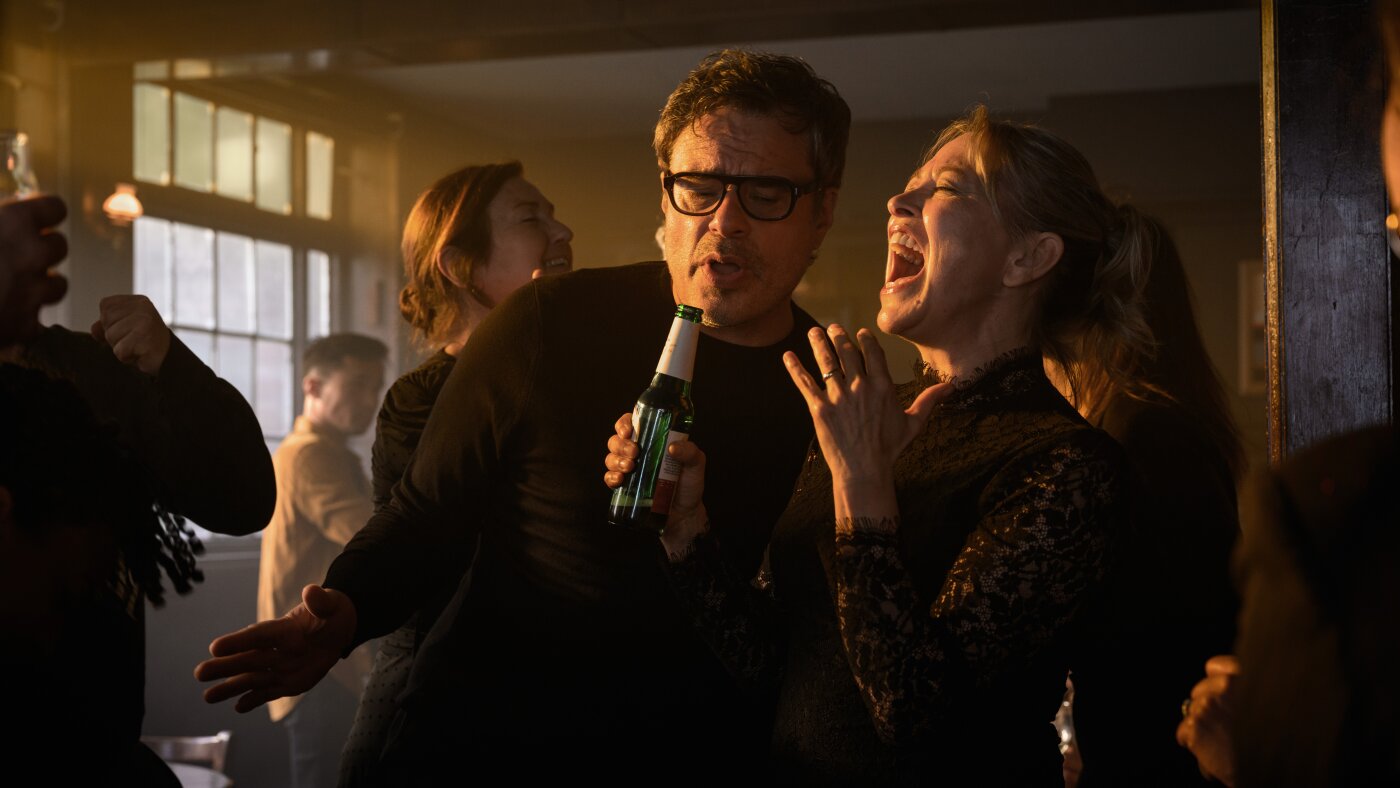
In Alice and Steve, Jemaine Clement and Nicola Walker play long-time friends who turn on each other after he gets involved with her 26-year-old daughter.
Lara Cornell/Disney+
hide caption
toggle caption
Lara Cornell/Disney+
I grew up watching episodic shows on network TV, nearly all of them formulaic but some indelibly great. Then, like everyone else, I moved into the days of what my colleague David Bianculli dubbed Platinum TV, where series like The Sopranos and The Wire and Fleabag aspired to something higher. What both these eras had in common was that their shows were carefully crafted — they had an internal logic, and a tone, that held them together.
In recent years, though, there’s been a proliferation of shows that, possibly obeying some algorithm, care less for coherence than sensation. They lurch among tones, from cuteness to sentimentality to meanness, stirring in random plot twists along the way. Bouncing all over the emotional map, these shows depend on compelling actors and a few memorable scenes to make us overlook their loose construction.
A great example is Alice and Steve, an entertaining but sometimes exasperating six-part British comedy on Hulu about two 50-something best friends who turn on each other after he gets involved with her 26-year-old daughter.


While the premise is juicy, it’s also a tad yucky, and I mainly tuned in because its title characters are played by performers Jemaine Clement from Flight of the Conchords and Nicola Walker, whom I’ve raved up on this show more than once.
The series starts poorly with Steve and Alice going on a cutesy bender after a friend’s funeral. Now, I always hate drunk scenes, which are an invitation to overact. As Clement and Walker bray their lines, we learn that Steve’s a divorced celebrity hair stylist who can’t find a girlfriend while Alice is a clothes designer with a doting younger husband, nicely played by Joel Fry, a sweetie-pie of a teenage son — that’s Tyrese Eaton-Dyce — and, of course, that 26-year-old daughter, Izzy, who has inherited her mother’s willfulness. Played by Yali Topol Margalith, Izzy kickstarts the plot by flirting with Steve. Predictably, he succumbs.

Almost immediately, they think they’re in love. While the weak-willed Steve wants to hide their romance — he knows it’s inappropriate — Izzy just blurts out the facts to her mom. Alice flips. And from hereon out in this series where the women are as alpha as the men are hangdog, Alice drives the action. Betrayed and violently angry, she’ll do whatever it takes to break them up — no matter who gets hurt. Her antics unleash Steve’s own malice. We’re in Beef territory.
At its core, Alice and Steve hinges on the way that platonic friendships are often richer and more powerful than romantic ones. It’s a fascinating subject, which may be why I found the script by Sophie Goodhart so frustrating. I wanted her to dig deeper. While the show’s got some very funny bits — Alice’s sharp-tongued mother is a blast — it’s often annoyingly lax.

If Steve really does the hair of Charli XCX, how come he’s a clueless older guy whose pop culture references are Willie Nelson and Woody Allen? If Izzy truly adores her mother as she claims, why does she keep rubbing her relationship with Steve in her mom’s face? Halfway through, one character nukes the other’s career, but this life-shattering event has no real weight: It’s barely even mentioned for the rest of the series.
That said, Alice and Steve is worth seeing for scenes like the one in which Steve spinelessly sells Izzy out or the lacerating discussion between Alice and her husband when he fully grasps that he adores a woman who views him as a reliable but dull concierge, not a man she likes hanging with. Most touching of all may be the lovely sequence when Alice, wise for once, smooths a romantic crisis between her son and his would-be girlfriend, a pair who are the show’s emblem of hope. For once, we understand why people love her.

While most viewers will find Steve more likable than Alice — the show takes pains not to make him appear predatory or creepy — the role doesn’t give Clement a whole lot to do except play variations on shambolic dread and discomfort. The show gets its galvanizing zing from Walker, a beloved star in England with amazing, luminous eyes. Her Alice is the kind of complicated, volcanic heroine that you don’t see in movies and rarely see on TV, one who shows her apocalyptic rage freely and in many different forms.
At least once in every episode, something would lead me to say, “Man, is this show a mess.” But that wasn’t a deal breaker. I kept watching. After all, life is messy, too.


How to enter your Sporty Spice era.
Getty Images/quantic69/Olga Kurbatova/Anastasiia Zvonary/Photo Illustration by NPR
hide caption
toggle caption
Getty Images/quantic69/Olga Kurbatova/Anastasiia Zvonary/Photo Illustration by NPR
Reality dating and professional sports are not as different as you’d think.
Brittany is in her Sporty Spice era – she watched the NBA playoffs, she’s following World Cup games, and she’s watching the New York Liberty play their WNBA season. These games are daily – and so is the reality dating show Love Island. And she noticed that the two formats are not very different at all. Defector.com staff writer and co-owner Kelsey McKinney came to the same conclusion – so the two of them discuss why these games of athleticism and love can bring us together… and why they get valued differently in our culture.
For more episodes on sports and reality TV, check out:
Get rich or die trying: how sports betting is changing our love of the game
Is this the end of reality TV?
The ugly truth of America’s expensive homes
Support Public Media. Join NPR Plus.
Follow Brittany on Instagram: @bmluse
This episode was produced by Liam McBain. It was edited by Neena Pathak. Our Supervising Producer is Cher Vincent. Our Executive Producer is Barton Girdwood. Our VP of Programming is Yolanda Sangweni.

-

 Ohio3 minutes ago
Veteran Officer Among 4 Dead in Ohio Shooting
-

 Oklahoma8 minutes ago
FFA members attend Oklahoma FFA Alumni Leadership Camp
-

 Oregon15 minutes ago
Oregon’s Class Surges in Team Recruiting Rankings to No. 3
-

 Pennsylvania18 minutes ago
Pennsylvania State Police on scene of ‘active incident’ in Marysville
-

 Rhode Island23 minutes ago
Rhode Island participates in ‘New England Drive to Save Lives’ campaign
-

 South-Carolina30 minutes ago
Georgetown County Sheriff Carter Weaver named South Carolina Sheriff of the Year: SCSA
-

 South Dakota33 minutes ago
South Dakota native lived near Iranian missile & drone attacks
-

 Tennessee38 minutes ago
The Recipient of Taylor Swift’s Bouquet Toss Has Strong Tennessee Football, Lady Vols Basketball Ties | Rocky Top Insider

