Thanks to Bad Bunny, it’s been a banner month for us Puerto Ricans.
Coming off the heels of his emotional, history-making Grammy win for album of the year, which made it the first time an all Spanish-language album has won the category, Bad Bunny continued to break ground on Sunday with his Super Bowl halftime performance.
As Latines in the United States, we’re still struggling to be properly and proportionately represented in Hollywood, politics and in the music industry, where Latin artists have been historically boxed into smaller roles, limited to exotic window dressing in the anglophone-dominated landscape of American pop. But through Bad Bunny, Puerto Rico had something to say: He tapped into his unique star power with his zeitgeist-defining magnum opus, his 2025 album “Debí Tirar Más Fotos.” Then, at the Super Bowl, he used a platform usually reserved for bombastic shows of U.S. patriotism to ensure that Puerto Rico, along with many other nations and territories that make up the Americas, would be celebrated, even as we are routinely being denigrated by American conservatives.
Sports have a rich history in Puerto Rico, from boxing to baseball — but with the exception of Super Bowl Sunday, American football doesn’t typically reach us. My parents, who have never watched a football game in their lives, excitedly watched back home on the island, while I, over a thousand miles away, watched from my freezing New York City apartment with my partner, wishing we were basking in the warmth of the Isla Del Encanto. But it didn’t matter where we were watching, as boricuas — and Latines — were united.
(Eric Thayer / Los Angeles Times)
Advertisement
The Instagram stories on my feed were filled with Puerto Ricans and other Latines hosting watch parties, taking in this much-needed moment of sheer joy during a treacherous time when speaking in our native language, or being a brown-skinned person is enough of a risk factor in being abducted by ICE. Having had the privilege of seeing Bad Bunny at the Choliseo during his residency in San Juan last August, I knew this performance would not only be an impactful homage to my island, but the Super Bowl halftime show carried an underlying, defiant message, that no matter how much conservatives prop up hatred and fear-mongering toward Latines and immigrants, nothing will stop us from being proud of our roots.
And Bad Bunny’s performance literally started straight from the roots. Levi’s Stadium was transformed into a labyrinthine sugarcane field, perhaps as a nod to Central San Vicente, the first sugarcane refinery in Puerto Rico, established in 1873 in Bad Bunny’s hometown of Vega Baja. Opening the show was an acoustic guitarist donning traditional jíbaro clothing — a straw pava hat and white linen — whose words, “qué rico es ser Latino,” established instant solidarity with Latinos all over the world.
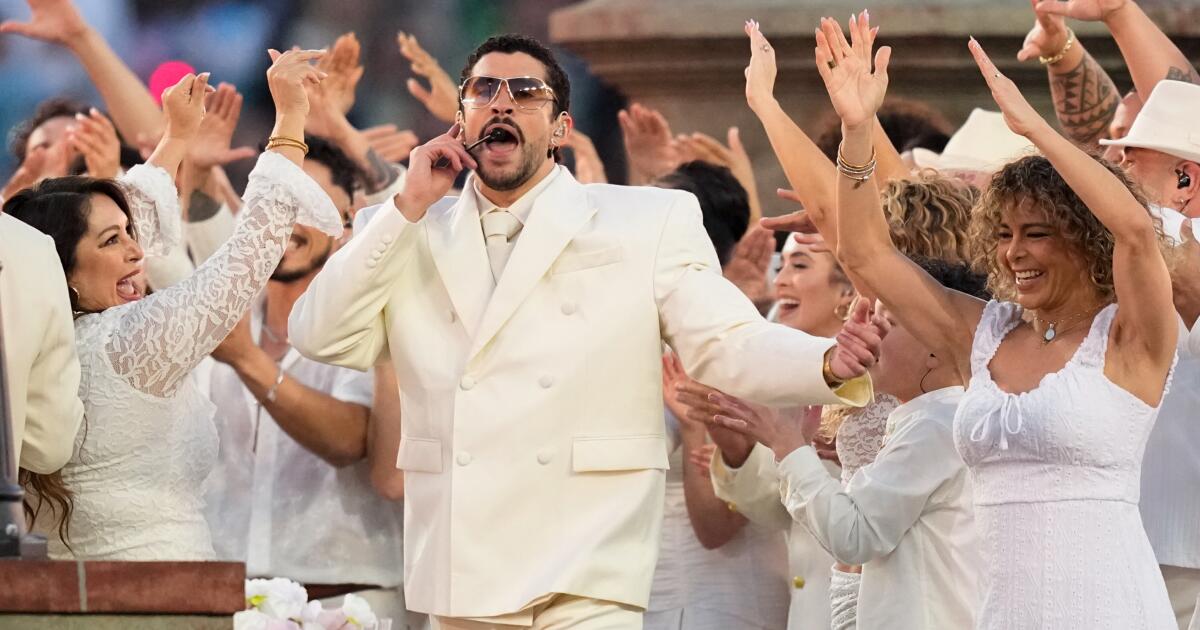
While launching into his 2022 dembow-trap hit, “Titi Me Preguntó,” Bad Bunny walked the cameras through the makeshift sugar cane field, which was tilled by dancers dressed as jíbaros. He was decked out in a custom all-white outfit, featuring a jersey bearing his mother’s last name, Ocasio, and the number 64, which is the number his uncle once wore as a football player.
Bad Bunny’s set was staged with many scenes from working-class life in Puerto Rico: a coconut stand, a piraguero, old men playing dominoes, manicurists, baddies, construction workers and a jeweler who buys back “oro y plata.” These scenes served as reminders that Puerto Rican music wasn’t made by and for the elite, but forged by everyday people with limited resources.
Advertisement
Everything about the performance was a wink to the Puerto Rico I grew up in: from the skirts worn by the backup dancers, reminiscent of Taíno taparrabos, to the temperamental power grids, and the garita, or the lookout tower inspired by Old San Juan. During the staged wedding sequence, I saw myself in the tired child napping over two chairs, waiting for the adults to wind down the party so I could go home to my own bed.
We’d seen the famously star-studded house, or the casita, in both his San Juan residency and international tour run, which was duly brought back for the halftime show. The Super Bowl edition of the casita was filled with Latinx pop culture icons like Cardi B, Pedro Pascal, Jessica Alba, Karol G, Ronald Acuña Jr. and Young Miko. But there was another set that was vital for this performance: a New York City backdrop that included a bodega, a barbershop and a bar modeled after Toñitas, a famous Caribbean social club in Williamsburg, Brooklyn.
Bad Bunny not only name-dropped Toñitas in “NUEVAYoL,” but its owner and namesake, María Antonia “Toñita” Cay, made a cameo during the halftime show from behind the bar — serving him a shot. Since the 1970s, Toñitas has become a symbol of resistance amid growing gentrification in the neighborhood, where businesses owned by people of color have been shuttered and longtime Williamsburg residents pushed out by exorbitant rent hikes. It’s a rare safe space for Latines in the city, one where anyone is welcome, but unmistakably ours. As one of many Puerto Ricans who’ve relocated to New York City, it meant a lot that Bad Bunny paid tribute to boricuas in the diaspora, showing that this moment is, too, for those who carry our pride far from home.
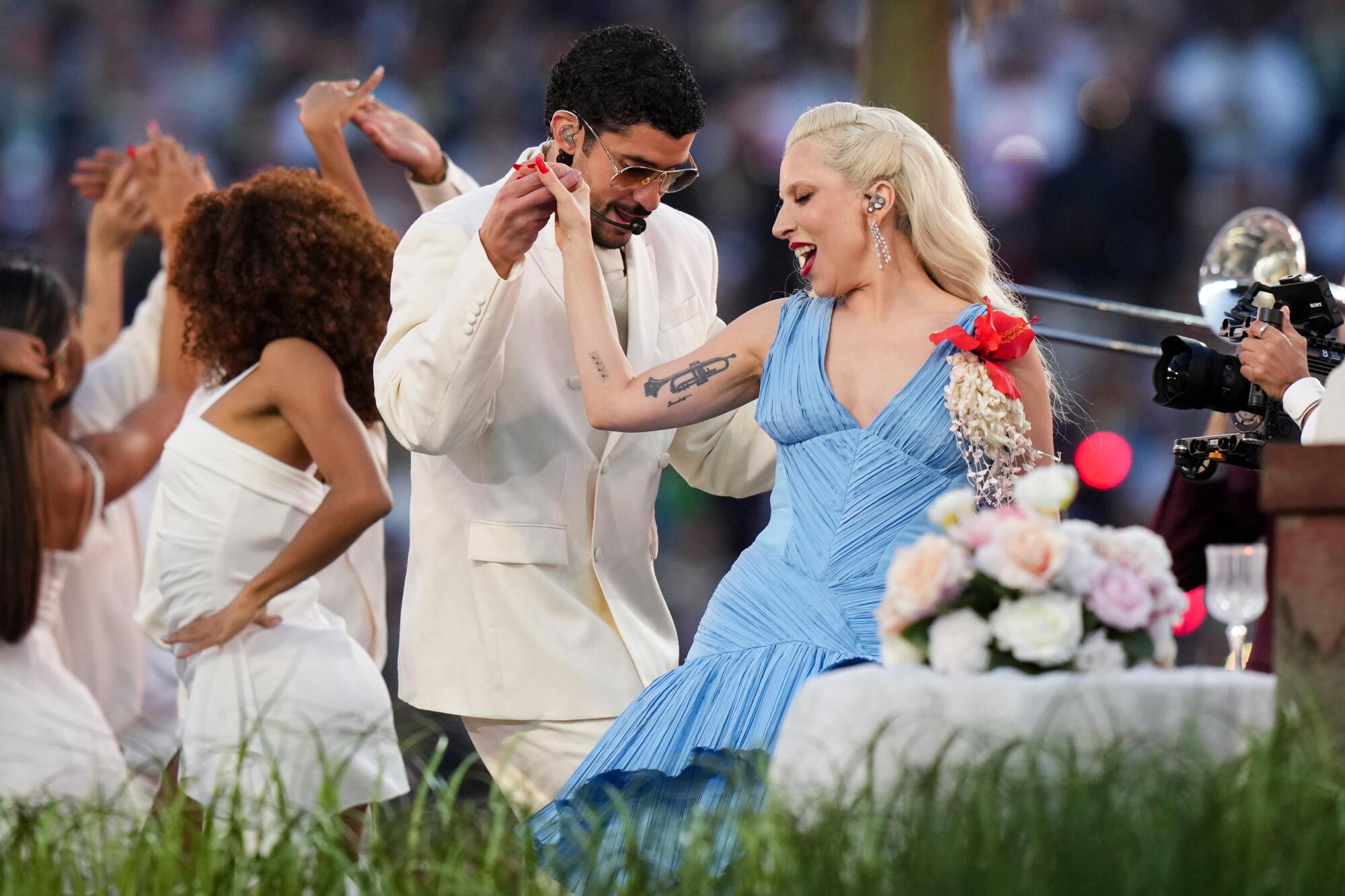
Yet unlike Bad Bunny’s first Super Bowl appearance — back in 2020 for Shakira and Jennifer Lopez’s joint headlining performance — this wasn’t an all-Latinx affair. Lady Gaga, who shared a touching moment with Benito at the Grammys, surfaced for a surprise salsa rendition of her collaborative hit with Bruno Mars, “Die With a Smile,” accompanied by Los Sobrinos. She had her own nod to the island with a brooch of a Flor de Maga, Puerto Rico’s national flower.
(Lynne Sladky / Associated Press)
Advertisement
While it feels like a loss to omit Bruno Mars (who is of Puerto Rican descent), it’s understandable why Bad Bunny chose Lady Gaga as the only non-Latinx person to perform during the set. Not only is Bad Bunny a longtime Gaga fan himself, but they have both used their platforms to champion trans and queer rights. It’s evident she feels a kinship with Bad Bunny not just for dedicating his career to fighting for the same rights she did, but also for creating opportunities for marginalized people in the face of conservative backlash. While speaking to the press after the Grammys, she raved about how lucky we are to have a musical leader like Bad Bunny speak up for “what is true and what is right.”
Surprisingly, though, one of the most powerful political moments from the halftime show didn’t come from Bad Bunny, but rather from another Puerto Rican icon: Ricky Martin.
Martin, who made himself a household name in the States with English-language songs like “Livin’ La Vida Loca” and “She Bangs,” never tried to posit himself as a revolutionary. But sitting in a plastic chair modeled after the “DTMF” album cover, he sang an impassioned rendition of Bad Bunny’s protest song “Lo Que Le Pasó a Hawaii” — in which he warns that Puerto Rico could face the same whitewashing that Hawaii experienced upon becoming a U.S. state, citing the privatization of our beaches and the gentrification of our hometowns as threats to our culture’s legacy.
Seeing Bad Bunny emerge with our original flag moments later only drove the pro-independence sentiment further; woven in a shade of baby blue, this version of the Puerto Rican flag was created to represent the island’s independence from Spain, but was outlawed from 1898 to 1957 once the island became a U.S. territory.
Bad Bunny carries the original Puerto Rican flag Sunday during the Super Bowl LX halftime show at Levi’s Stadium in Santa Clara, Calif.
(Eric Thayer / Los Angeles Times)
Advertisement
The average Super Bowl viewer may not know about the light-blue flag, or understand the words behind the heartbreaking song about the perils of being a colony. But for those native Puerto Ricans watching, it was a triumphant reminder that Puerto Rico no se vende. It is not a tax haven for gringos, nor is it a “floating island of garbage”; it’s a gem that needs to be nurtured for generations to come. And to Puerto Ricans like me, that will never be achieved through U.S. statehood.
Because Puerto Rico is a colony, its citizens cannot vote in presidential elections, but it is still affected by the U.S. government. The island’s governor, Jenniffer González Colón, is a staunch supporter of President Trump who pushes conservative values — such as banning gender-affirmative care for trans Puerto Ricans under 21 and approving a law that grants personhood to fetuses from conception. It’s been difficult for Puerto Ricans to feel like we’re being heard when we’re trapped in a political situation we didn’t ask for.
When Bad Bunny was announced as this year’s performer, conservatives voiced their opposition on Fox News and social media, designating themselves as the true judges of who’s “American enough” to perform at the Super Bowl. They seemingly forgot that the U.S. has occupied Puerto Rico for over a century — and that performing in a language besides English doesn’t make Bad Bunny any less of a citizen of this country.
The right tried, and failed, to draw attention elsewhere, with conservative group Turning Point USA organizing an “All-American Halftime Show” headlined by Kid Rock and featuring additional performances by MAGA-friendly country acts like Brantley Gilbert, Lee Brice and Gabby Barrett. While it drew in 6.1 million concurrent viewers, that number paled in comparison to the 135 million viewers who tuned in to Bad Bunny’s halftime show, according to initial reports from NBC and CBS News.
Advertisement
But there was one moment during the performance that stuck with me, when Bad Bunny gave an impassioned motivational speech in Spanish, urging the audience to recognize their worth.
“My name is Benito Antonio Martínez Ocasio. And I’m here at the Super Bowl 60 because I never stopped believing in myself — and you should also believe in yourself,” he said in Spanish. “You’re more valuable than you think. Believe it.”
As agents of the federal government continue to kidnap immigrants and place them in what have effectively become concentration camps — taking the dignity of those who’ve left their homes behind searching for a better life, only to render their hard work and assimilation as worthless — Bad Bunny’s halftime show felt like a call to make us even louder and prouder. The U.S. can no longer deny us Puerto Ricans and Latines of our value; its time we act like it. It’s time we move forward with love for ourselves and our communities, no matter how much hate and fear they try to lodge into us.
After all, as Bad Bunny put it at the halftime show: “The only thing more powerful than hate is love.”
Olivia Wilde’s new comedy drama is “the kind of smart, well-crafted film for adults we are constantly complaining we don’t get enough of,” said Benjamin Lee in The Guardian. Wilde, in her third directorial offering, co-stars as a stay-at-home-mom who, to the consternation of her failed musician husband, Joe, has invited the freewheeling couple upstairs to dinner. With Seth Rogen, Edward Norton, and Penelope Cruz filling out the cast, the charged get-together soon turns into “a night that Edward Albee would approve of,” except that this evening hits peak tension when the guests extend a surprise invitation to join them for a night of group sex.
The Week
Escape your echo chamber. Get the facts behind the news, plus analysis from multiple perspectives.
SUBSCRIBE & SAVE
Advertisement
Sign up for The Week’s Free Newsletters
From our morning news briefing to a weekly Good News Newsletter, get the best of The Week delivered directly to your inbox.
From our morning news briefing to a weekly Good News Newsletter, get the best of The Week delivered directly to your inbox.
Latest Videos From
Perhaps because it’s an adaptation of a 2016 Spanish play that has spawned overseas film versions, The Invite is “an American film that feels vaguely international,” said Matt Zoller Seitz in RogerEbert.com. Though the first half is overdirected to the point of being “irritating,” the showy camerawork fades away as the actors take over, creating a second half that’s “the best work Wilde has yet done as a director.” While all four actors excel, “it’s Rogen who’s the revelation,” said Alissa Wilkinson in The New York Times. “His line readings fill out Joe’s backstory brilliantly, a guy who was always used to being rejected, somehow landed a girl way out of his league 20 years ago, and now is miserable that she doesn’t really want him anymore.” In this movie, relationships change because people change. “To me, that feels true.”
‘Minions & Monsters’
Directed by Pierre Coffin (PG)
★★★
Advertisement
Though they’re “one of the more enduring creations of 21st-century cinema,” the Minions “still get no respect,” said Scott Roxborough in The Hollywood Reporter. Maybe, though, this seventh film in the Despicable Me franchise will finally end a 16-year awards shutout, because it’s a love letter to cinema that argues, between its mile-a-minute gags, that the highest-grossing animated franchise of all time deserves a place in Hollywood’s canon. Minions & Monsters is “very much a film of two halves,” said Drew Taylor in The Wrap. In the first, a quick history tour revisits how bad Minions have been in their quest to find villains to serve, until one group lands in 1920s Hollywood and stumbles into stardom. A flurry of homages to Buster Keaton and other legends follows, until talkies arrive and put the gibberish-spouting Minions out of work.
Join 350,000+ subscribers and keep yourself informed with a selection of
The Week’s most interesting, enlightening and entertaining stories – plus daily puzzles.
The second half offers more-conventional Minion action, yet it “builds to an open-hearted tribute to the power of the communal moviegoing experience.” When two of the Minions start work on creating a monster movie using real monsters, this outing “does rather lose momentum,” said Guy Lodge in Variety. But as the film speeds toward a standard save-the-world climax, the latest Minions serves up the usual mayhem “with gusto and a delirious cartoon grin.” It’s “a clear peak for the series: a Minions movie with an actual idea at its core beyond general cheerful chaos.”
Tom Sandoval’s former girlfriend Victoria Lee Robinson has filed a dueling restraining order against the reality TV star.
Reality TV star Tom Sandoval’s former girlfriend Victoria Lee Robinson has filed a dueling restraining order after she was arrested in June following an altercation that involved her father being pushed into a lit fire pit.
In the petition, filed Thursday in a Los Angeles court, Robinson claims that over the course of the former couple’s 2.5-year relationship, the former “Vanderpump Rules” star “routinely physically and verbally abused” her.
According to court documents reviewed by The Times, the model alleges that Sandoval shoved her down a flight of stairs in his home, pushed her to the ground at a hotel in Nashville, and attacked her and her father on June 3.
On Monday, a Los Angeles Superior Court judge denied Victoria Robinson’s request for the temporary domestic violence restraining order because Sandoval’s existing temporary restraining order requires a hearing (which was set for July 16) before Robinson’s could be granted.
Advertisement
Representatives for Sandoval told The Times in a statement, “It’s no surprise that Victoria’s request for a restraining order was immediately denied.”
Sandoval, known for the Scandoval cheating scandal that erupted on the hit Bravo series “Vanderpump Rules” in 2023, filed a temporary restraining order against Robinson and her father J. Will Robinson on June 25. In Sandoval’s petition, he claimed that since the two became a couple in February 2024, Victoria Robinson has been violent and attacked him physically.
Sandoval was granted a temporary restraining order which required Robinson and her father to vacate the Los Angeles rental the three had shared. According to Sandoval, he’d left the house and stayed in hotels and with friends following the June 3 incident.
“This is my home. We are both on the lease, but I paid the first month’s rent and deposit, surprised him with the keys and virtually every item in it is mine,” Victoria Robinson said in a statement shared with The Times. “I have filed my own legal action because I have my own account of what happened and it’s very different from what has been said publicly.”
Robinson said that while her father has been under media scrutiny, he was trying to protect her.
Advertisement
“My relationship with Tom has already controlled the past two years of my life,” she said. “I cannot allow a false narrative to control my future.”
The altercation involving Sandoval, Robinson and her father happened in the early morning hours after the couple returned home from a night out at a bar, according to both accounts.
In a video of the June 3 incident, obtained by TMZ, Robinson and her father are seen sitting next to a lit fire pit on the patio when Sandoval and the elder Robinson begin arguing. Sandoval is heard yelling at Will Robinson before he asks his girlfriend if she is recording and approaches her. Will Robinson stands up and wraps his arms around Sandoval, seemingly to get him to back away from Victoria Robinson. Sandoval turns and pushes Will Robinson, who falls backward into the lit fire pit.
After Will Robinson gets back up, he rushes after Sandoval into the home while Victoria Robinson screams for the men to stop.
According to Victoria Robinson’s petition, when Sandoval noticed she was recording his exchange with her father, he twisted her arm while trying to gain control of her phone.
Advertisement
Will Robinson allegedly suffered a thumb fracture and elbow and back injuries.
Victoria Robinson was arrested after police responded on June 3 and released on bond the same day. On June 4, Sandoval returned to their L.A. house to collect his things and Victoria Robinson called police, who escorted Sandoval from the home, according to the filing.
The Los Angeles Police Department declined to comment on the reason for Robinson’s arrest.
Will Robinson told TMZ last month, “The DA did not file the case for a reason. I lifted Tom off of my daughter because he was overpowering and twisting her arm and trying to take her phone aggressively after yelling at us in a very aggressive and threatening manner.”
“This is my daughter’s home and we just want Tom as far away from us as possible and to keep his lies and drunken abuse away,” Robinson said.
Advertisement
This isn’t the first time their fights have turned physical, according to both accounts. Victoria Robinson‘s petition claims that in August 2025, Sandoval shoved her down their hardwood stairs and she suffered knee injuries. She said she reported the incident to police but ultimately recanted her statements to protect Sandoval from being arrested. “In hindsight, I deeply regret this decision,” reads the suit.
Weeks before the fire pit incident, Robinson alleges that during a trip to Nashville to visit her grandfather who was in hospice care and has since died, Sandoval pushed her to the floor of their hotel and locked her out of their shared room.
“During their 2½-year relationship, Tom has made it clear he never physically harmed Victoria,” representatives for Sandoval said. “Instead, he lived in fear of her repeated physical attacks and unpredictable behavior. He will show he was the victim of ongoing physical and emotional abuse, and has substantial evidence documenting what he endured, which will be presented through the legal process.”
It’s summer blockbuster movie season and there have been a lot of new releases from many of the biggest studios and directors. Some of the biggest titles include “Supergirl”, “Disclosure Day”, and “Toy Story 5.”
GBH’s Morning Edition guest host Tori Bedford spoke with GBH correspondent and film critic Sarah G. Vincent, along with GBH’s Callie Crossley, an avid cinephile and host of Under the Radar with Callie Crossley, for their take on some of the season’s biggest releases. What follows is a lightly edited transcript.
SUPERGIRL
Tori Bedford: So one of the biggest movies to hit theaters lately has been the next installment in James Gunn’s new DC Universe, “Supergirl”, starring Millie Alcock. Sarah, let’s start with you. What did you think?
Sarah G. Vincent: I actually loved it. It’s the first summer movie where I didn’t have any disclaimers of “I liked it but…” I was very invested in the storyline because if someone hurt my fluffy baby, I would run around the universe and try to save him. Also, I like that it was like a superhero movie with a woman where she didn’t become a surrogate mother, where she wasn’t sexualized, where she was dealing with real emotion. The real emotion really hit me. I love the backstory. It was gorgeous. I understand that it’s a lot of jokey jokes.
Advertisement
Bedford: What do you mean jokey jokes?
Vincent: On the present day storyline where she’s helping Ruthye, they do try to keep it light because they’re dealing with a lot of heavy issues, and so there are a lot of like flippant jokes and one-liners and everything. And I didn’t mind that because this is still a blockbuster and I think that a blockbuster does need to have some like mass appeal. I’m not going for a Bergman film, right?
Bedford: Yeah, it’s summer. Like, chill out.
Vincent: Right.
Bedford: What’d you think, Callie?
Advertisement
Callie Crossley: I am the “but” — I liked it except some of the themes were so heavy, even though presented in an entertaining way. So, don’t take me wrong. You should see it. It’s a popcorn movie. But I was like, “OK…”
Bedford: You wanted more jokey jokes.
Crossley: Well, it was just to me, I looked at it and I thought, “Epstein Files” because we have a plot of young girls being trafficked to an island of crazy men. So that’s what came to me. But then I thought, I guess I’m just— I live in news, so this is what I would think of. But I can understand in the moment why it was there, but I’m not sure it resolved itself for me in the best way possible that sort of made it maybe not so uncomfortable about it. Now, she is great, Millie Alcock as Supergirl, and I loved her backstory. I really enjoyed that part. And there are some cameos from Superman. So you really get to see the difference between the two of them and why there is a difference, because now you know the backstory.
Bedford: I love their relationship, where he’s like, “This is why Krypto is not well-behaved” and she’s all disorganized.
DISCLOSURE DAY
Advertisement
Bedford: All right, next up — I can’t wait to talk about this. Steven Spielberg is back with an alien mystery thriller, “Disclosure Day.” This man is obsessed with aliens.
Callie, let’s start with you. What’d you think?
Crossley: I went because it’s Steven Spielberg, and I wanted everything. So again, this is a popcorn movie, and out of the gate, you are really on a ride, and you’re like, “What’s happening?” So, I would say the first part of the movie, you’re just caught up in trying to understand where he’s going with it, and it’s a lot of action, and it’s Spielberg-esque in that way. And that John Williams score is fabulous. What I had a problem with was the end of it. I’m going to use the word unimaginative because I am not giving away the plot, so no spoilers here, It’s unimaginative in how he resolves it because I think it’s old-fashioned in both how he presents some of the folk, and also in the methodology of how he wants to get the word out. So that sort of threw me off and I’m thinking, “That’s not a word I use with Steven Spielberg. I should not be using unimaginative.” I still say you should see it, but those are my thoughts.
Vincent: At 2.5 hours, I would say, I warned you. So as an action movie where people are being chased, like the bad guys are chasing the good guys, it’s a great movie. As a movie where it takes an alternate sort of sci-fi approach to the idea of possession and what it would look like, terrific. Actually, a really provocative, wonderful idea. Emily Blunt does a wonderful job.
Crossley: Fabulous.
Advertisement
Bedford: She’s great in the movie.
Vincent: I think she owns the movie, and if the movie was just about her character, I would probably give it like closer to a 90 than where I landed, which was probably in the 70s.
Bedford: I was just going to say … I got out of this, and I thought, “Am I stupid? Or was this really dumb?” It was fun though.
Crossley: This is not a Spielberg movie you’re going to remember, I say.
Vincent: No, yeah, you’re not.
Advertisement
Crossley: And there’s a lot of reviewers saying it’s fabulous. And I’m like, were we at the same place?
Bedford: Am I dumb?
Crossley: But still, it’s a popcorn movie. Got some really good stuff in there you could enjoy.
TOY STORY 5
Bedford: All right, finally: Woody, Buzz, and all their friends are back again for “Toy Story 5,” and this one is taking on big tech as a teaching tablet enters the toy box. Sarah, what’d you think?
Advertisement
Vincent: I loved it. It’s my favorite Toy Story. And I would say that what I loved about this movie is when you go to movies, usually technology is the bad guy, period. And this movie is much more nuanced. And no one is really the bad guy. It presents the pros and cons of everything. And it’s about authentic relationships and it shows how in the past, a relationship without technology was fraught, in retrospect, with problems for Jesse, with the trauma she endured by losing her person. Now in the present with their new human basically having this crisis of “how do I make friends?” So I think it shows the universal problem of how you make authentic relationships, and the technology is only showing how that problem persists. It embodies now, but it’s always been a problem.
Crossley: I think it’s brilliantly done in this way. It doesn’t demonize all the folks that usually get demonized. The tech gets demonized. Sometimes the parents get demonized. That did not happen at all. But for me, any story about friendship that’s told authentically is going to get me. And they know how to get you. It’s a really, really important story about finding your tribe, as Sarah said. Now, having said that, it’s still not my favorite. Toy Story 3 is my favorite. And I went back just to say, “Okay, let me just go look at the end of 3 again to see if I had the same response.”
Bedford: Oh, masochist, my God.
Crossley: Well, because I just wanted to see. I looked at my computer, watched only the end, and sobbed yet again.
Bedford: I know, that’s all I’ve got to say about this franchise. How much more crying do you want me to do?
Advertisement
Crossley: I misted up at the end of this. I did not sob, as I scared the children in 3 before in the theater. But this time I did mist up because really, they know how to get you. It’s so worth seeing.
GBH Daily
Your essential daily newsletter delivering trusted news, local insights, ways to connect, and can’t miss programs from Boston and beyond.