California
Labor unions urge Gov. Gavin Newsom, California lawmakers to rein in artificial intelligence

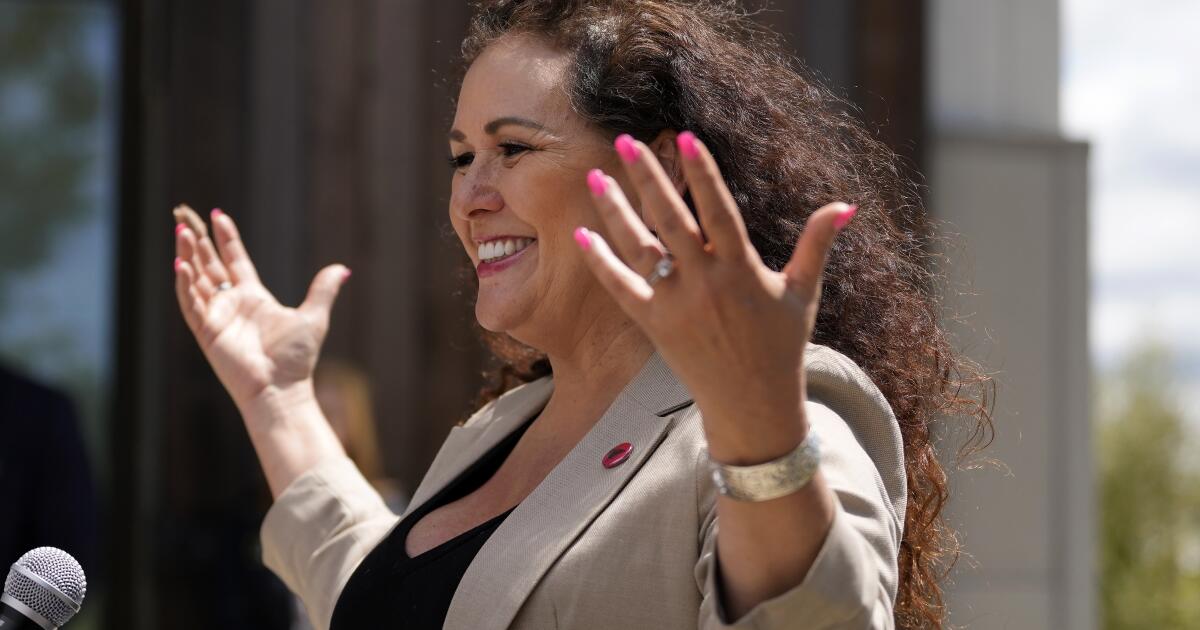
SACRAMENTO — National union leaders, including the head of one of California’s largest labor organizations, on Wednesday urged Gov. Gavin Newsom to protect workers as artificial intelligence threatens to replace or surveil employees — and warned that a failure to do so could hurt his presidential ambitions.
“This is a priority for the entire nation,” Lorena Gonzalez, president of the California Federation of Labor Unions, said at a news conference near the state Capitol. “He cannot spend his time waiting to be done in California and think he’s not going to get questions about the true issues surrounding AI, Big Tech and the Big Tech billionaires that are trying to buy our government.”
Gonzalez, a former state lawmaker from San Diego, said the federation is sponsoring a package of new bills aimed at reining in the use of AI and protecting the rights of workers, including safeguards against spying in the workplace and restrictions on layoffs.
The package of bills supported by labor organizations includes:
- Senate Bill 947 by Sen. Jerry McNerney (D-Stockton), which would require human oversight if an algorithm is used to justify the discipline or termination of an employee.
- Senate Bill 951, introduced by Sen. Eloise Gomez Reyes (D-Colton), which would require employers to provide a 90-day advance notice to workers and local and state governments before AI-related layoffs. It would apply to cases affecting 25 or more workers or 25% of the workforce, whichever is less. Recent layoffs, including at Amazon, Expedia and Pinterest, have been tied to AI, although some economists argue it’s challenging to determine whether that was the primary factor.
- Assembly Bill 1331, dubbed “No bosses in the bathroom,” would grant workers the right to remove workplace surveillance tools when entering public bathrooms or certain employee-only areas. The bill, authored by Assemblymember Sade Elhawary (D-Los Angeles), would subject employers to a $500 civil penalty for violations.
Gonzalez said labor organizations are often told to “work it out” with businesses but argued this was a dead end.
“We are not going to be able to achieve guardrails by working with bosses who want no guardrails,” she said. “It is time that the governor engages with workers in the workplace. Every AI convening he does, everybody he’s pulled together is [representing] AI and Big Tech lobbyists.”
Gonzalez was joined Wednesday by Liz Shuler, president of the AFL-CIO, and other labor leaders from Iowa, Georgia, North Carolina and Nevada.
“This is the most urgent issue that we [as workers] are facing,” Shuler said. “This is a crisis and no one is prepared.”
In a joint letter addressed to Newsom, they implored the governor to act quickly to establish meaningful safeguards around the technology.
“This fight extends beyond devastating job losses and new forms of union busting,” a copy of the letter states. “There is dignity in human work that is the foundation of a healthy, productive democracy. The future of our economy and our society cannot be left to the unchecked whims of profit driven technology corporations and billionaires.”
In an email to The Times, Newsom spokesperson Tara Gallegos said the governor had a strong record of fighting for workers’ rights, including raising the minimum wage and expanding sick leave and other worker protections.
“No Governor has done more than Governor Gavin Newsom to regulate AI in a way that protects workers without killing jobs or innovation,” she wrote. “Under his leadership, California has taken the most comprehensive, worker-centered approach to AI in the country.”
Adults in the United States are growing increasingly concerned about the ramifications of AI, according to a survey from the Pew Research Center. Fifty percent of those surveyed last year said they are “more concerned than excited” about the increased use of AI in daily life, up from 37% in 2021.



See the best High Desert fireworks through the years
Fireworks have long lit up the California High Desert, from community shows in Victorville and Apple Valley to backyard celebrations that filled the night sky. Revisit Fourth of July moments through the years.
Each year, fireworks light up the sky across the United States for the nation’s Independence Day. With 2026 marking the nation’s 250th birthday, fireworks shows may be a bigger draw.
With California being so fire-prone, the state has strict fireworks laws, but does that mean that people won’t enjoy fireworks without risking jail time on July 4?
Are fireworks illegal in California?
The California Department of Forestry and Fire Protection, or CalFire, is the agency in charge of managing fireworks and classifying which ones are safe to light.
The California Fireworks Law was passed in 1938 and designated the Office of the State Fire Marshal as the only fireworks classification authority in the state, according to CalFire.
The fire marshal’s office classifies fireworks through lab analysis and field testing. It also requires that all parties dealing in fireworks, such as pyrotechnic operators, manufacturers, and retailers, have licensing.
Along with the aforementioned law, the State’s Explosive Law authorizes the fire marshal to “adopt regulations for the safe use, handling, storage and transportation of explosives,” CalFire says.
“Safe and Sane” fireworks are less likely to cause injury and generally mean that the fireworks do not explode or fly, according to the City of Fontana.
There are almost 300 communities in the state that allow “Safe and Sane” fireworks.
It is illegal in the state to sell, transport, or use fireworks that don’t carry the “Safe and Sane” seal or use any in a nonpermitted community. If convicted, you can face a fine up to $50,000, a year in jail or both, according to CalFire.
All other fireworks are considered illegal in the state and are prohibited from being operated by unauthorized parties in most jurisdictions.
Some illegal fireworks include:
- Wire Core Sparklers
- Sky rockets
- Bottle rockets
- Roman candles
- Aerial shells
- Firecrackers
- Other fireworks that explode, go into the air, or move on the ground in an “uncontrollable manner.”
How to safely use fireworks
CalFire has put out a list of safety tips to avoid injury when handling fireworks.
CalFire recommends:
- Use only State Fire Marshal-approved fireworks
- Verify local ordinances before purchasing or using fireworks.
- Always read the directions on labels.
- Children should always have an adult present.
- Only use fireworks outdoors.
- Avoid using fireworks near dry grass or other flammable materials.
- Only light one firework at a time.
- Have a bucket of water and a hose nearby in case of fire.
- During a drought, it is recommended that you use a bucket of reused water to submerge your firework after use to ensure it’s completely extinguished.
- Never place any part of your body directly over a fireworks device when lighting the fuse.
- Back up several feet immediately after lighting a firework.
- Never point or throw fireworks at another person.
- Never attempt to relight or fix fireworks.
- Never experiment with fireworks.
- Do not wear loose-fitting clothing while lighting fireworks.
- Never carry fireworks in your pockets.
Ernesto Centeno Araujo covers breaking news for the Ventura County Star. He can be reached at ecentenoaraujo@vcstar.com, 805-437-0224 or @ecentenoaraujo on Instagram and X.
California
California bill to block registered sex offenders from local office rejected by Senate committee

FRESNO, Calif. (KFSN) — California bill aimed at preventing registered sex offenders from holding local elected office was halted Tuesday after a Senate committee declined to advance the measure without changes opposed by its author.
Assembly Bill 2753, introduced by Assemblywoman Esmeralda Soria in February, would have prohibited anyone who is or has been required to register as a sex offender from running for local elective office.
“This issue is critical. We have heard loud and clear from the community that we must do something,” Soria said.
The proposal came to a stop in the Senate Elections Committee, where lawmakers argued the bill’s restrictions were too broad.
California’s sex offender registration system is divided into three tiers. Tier 1 offenders are generally required to register for 10 years, Tier 2 offenders for 20 years and Tier 3 offenders for life.
According to Soria, committee members proposed limiting the bill to Tier 3 offenders. She rejected those amendments, arguing that the legislation should apply more broadly.
“For this not to be the law today, where we’re banning people that have committed some of the most horrific crimes against children, against other people, you know, and we have survivors out there, I think it’s a disservice,” Soria said.
The bill had attracted significant support before reaching the Senate. It was backed by the Fresno City Council and passed the Assembly floor in April.
Fresno City Council President Nelson Esparza traveled to Sacramento to testify in favor of the measure and said he was disappointed by the outcome.
“I call it really a gut punch for our community, and what we had experienced here, and sort of the upheaval… I don’t think we want that to happen again here at Fresno,” Esparza said.
Esparza referenced controversy earlier this year involving registered sex offender Rene Campos, who sought a seat on the Fresno City Council but ultimately did not qualify for the ballot.
Opponents of the bill argued that candidacies should be decided by voters rather than restricted by law.
“It should be a decision made by the voters, so a person should not be barred from running for office and let the voters make the decision that makes the most sense for them,” said civil rights attorney Janice Bellucci.
With the committee declining to move the bill forward under its current language, efforts to enact the proposed restrictions have stalled for now.
Copyright © 2026 KFSN-TV. All Rights Reserved.

BAKERSFIELD, Calif. (KBAK/KBFX) California voters will face a high-profile “billionaire tax” measure on the November ballot, a proposal supporters say would raise new revenue, but critics warn could push some of the state’s wealthiest residents to leave.
If passed, the measure would impose a one-time 5% tax on California billionaires living in the state as of Jan. 1, 2026.
Tal Eslick, owner of Vista Consulting, said, “I think there is this effort, especially on the part of progressive state leaders, to somehow, you know, go after billionaires or maybe even the trillionaires that may exist in the future.”
Billionaire tax measure heads to California’s November ballot, with Kern County watching (AP Photo/Jeff Chiu, File)
Political analysts say a proposal like this could encourage some of California’s wealthiest residents to relocate, potentially taking investment and business activity with them.
Eslick said, “And for that matter, they can come back occasionally to visit and do a little bit of business, but live in a state that is a little more accommodating for them from a tax standpoint.”
Questions have also been raised about what the impact could be for Kern County if billionaires leave the state.
Sherod Waite, CEO of Moneywise Guys, said, “It’s questionable how much revenue would actually be generated from the tax and how much revenue would be lost from those people exiting the state. It’s questionable. It’s a gamble.”
Waite said billionaires leaving could reduce state revenue that could be used in Kern County.
Billionaire tax measure heads to California’s November ballot, with Kern County watching (AP Photo/Jeff Chiu, File)
“Think of all the support services that the state offers to the entire state, including us here in Kern County, that are paid for by tax dollars,” he said.
Gov. Gavin Newsom has been outspokenly against a state wealth tax and is instead proposing a national tax policy that would tax anyone with a net worth of $100 million.
Newsom said, “It’s time for a national billionaire’s tax and a new social contract. Just think of this, just ten percent of people own 2/3’s of the nation’s wealth.”
Eslick said Newsom’s position can be difficult to square.
“It’s a naturally confusing sort of position to be opposed to the tax in California but be supportive of it at a national level. But I think that’s him walking a treacherous political road,” he said.
Billionaire tax measure heads to California’s November ballot, with Kern County watching (AP Photo/Jae C. Hong, File)
In a statement regarding the measure, Assemblyman Stan Ellis said in part, “This would hurt Kern’s energy, Agriculture, manufacturing, and working families through lost investment, fewer jobs and unstable state funding.”
-
 Lifestyle1 minute ago
How World Cup fans reflect America back at us : It’s Been a Minute
-

 Technology9 minutes ago
Apple’s entry-level MacBook Pro could be up for a redesign
-

 World16 minutes ago
Khamenei body in cold storage as feared Basij mobilizes ahead of historic Iran funeral
-

 Politics19 minutes ago
Coalition of 25 states sues Trump admin over Medicaid work rule designed to prevent fraud
-

 Health24 minutes ago
West Nile virus detected in southern state as health officials warn residents about mosquitoes
-

 Sports31 minutes ago
USA World Cup star Folarin Balogun receives controversial red card during Round of 32 match
-

 Technology34 minutes ago
A missing kitten rode under a car hood. AI brought her home
-
 Business39 minutes ago
As Trump reports $2.2 billion in 2025 income, ethics experts raise alarms

