West
Watchdog group exposes Idaho colleges’ alleged scheme to sidestep new DEI law

NEWYou can now listen to Fox News articles!
As a watchdog demands that Idaho’s attorney general launch an investigation into a new anti-DEI law, an attorney for the group exposed how four universities in the state have allegedly schemed to sidestep the law’s provisions.
In April, Idaho enacted the Freedom of Inquiry in Higher Education Act, which took effect in July and prohibits institutions of higher learning from forcing students to enroll in mandatory DEI courses that are unrelated to their field of study. Schools are allowed to apply for exemptions for programs of study that are primarily focused on racial, ethnic or gender studies.
But the Goldwater Institute says schools are already attempting to skirt the new regulations.
“The whole goal of this law is to make it so that no one is forced to take mandatory courses that indoctrinate students with these discriminatory ideologies as a condition of graduation in unrelated fields,” Parker Jackson, a staff attorney at the Goldwater Institute, told Fox News Digital. “So we’re talking about degree programs like social work or counseling or psychology, things that you wouldn’t normally think would involve things like critical theory, race and gender studies, ethnic studies.”
Homemade and hand-painted signs express a variety of viewpoints in a small group of eight adults within a huge crowd at Union Square. (John Senter/UCG/Universal Images Group via Getty Images)
UNIVERSITY DROPS JOB POSTING AFTER DEI REQUIREMENT EXPOSED, PROFESSOR SAYS ‘I WOULD NOT BE HIRED’ TODAY
The law is meant to ensure that unsuspecting students don’t wind up being indoctrinated by DEI programs when they are simply trying to obtain a degree for which DEI is irrelevant.
But the University of Idaho, Boise State University, Idaho State University and Lewis-Clark State College are skirting this law and applying for exceptions for courses that should not be exempt, according to a Goldwater Institute letter sent to Attorney General Raul Labrador asking him to look into the matter.
The letter also questions a memorandum sent to the schools by the Idaho Board of Education just before the law took effect, explaining the new law to the universities. That memorandum misinterprets the law to allow for more exceptions than intended, according to the letter.
“So, the statute specifically says that the exemptions can only be used for courses, the title of which indicates that they’re targeted towards these racial or gender or ethnic studies,” Jackson explained. “And what the board has did is they’ve gone through, and they’ve essentially tried to delete that portion of the statute and say that if the degree program requirements have these DEI mandates in them, then they can get an exemption for the class.”
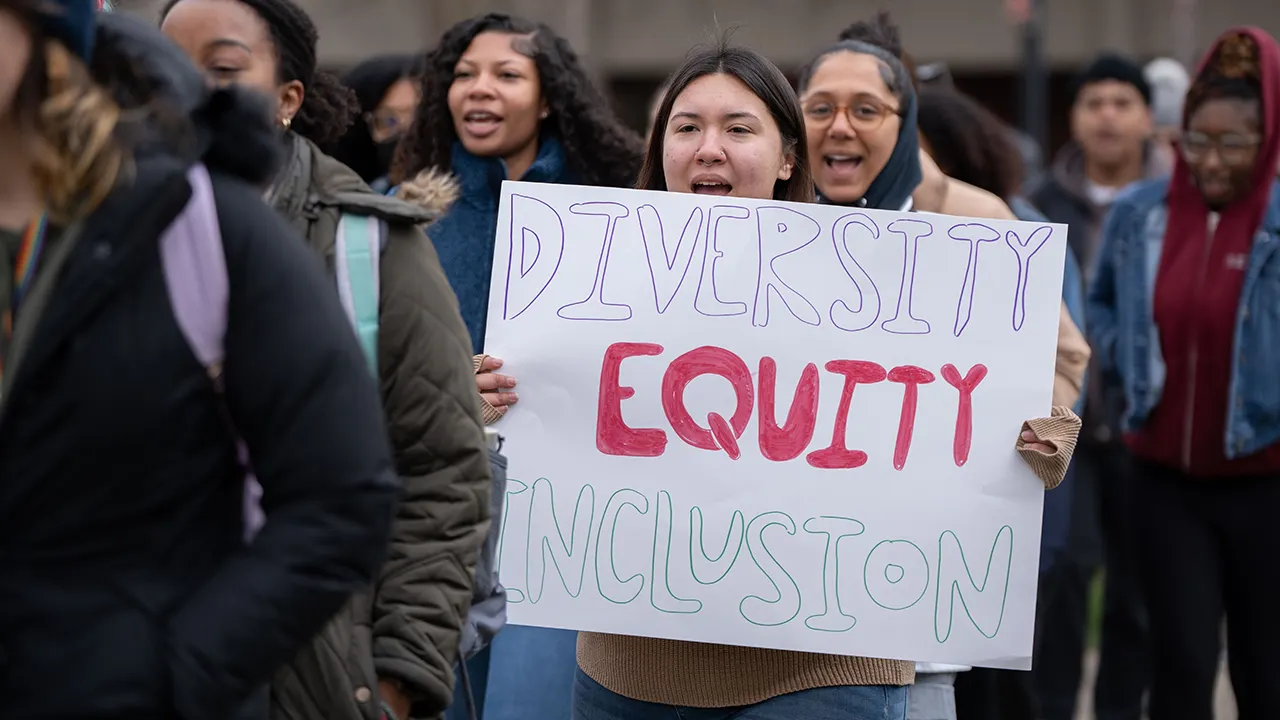
In New York City, members of the National Action Network rallied in support of DEI, diversity, equity and inclusion, on August 14, 2025. (Deb Cohn-Orbach/UCG/Universal Images Group via Getty Images)
GOT A SCOOP ON CAMPUS? SEND US A TIP HERE
According to Jackson, that is a perversion of the law.
“Well, that’s kind of circular. They can’t just avoid the mandate against these requirements by creating the requirements,” said Jackson. “And so, what we’re asking the attorney general to do is to take a look at all of these exemptions that the board has granted across the state at Boise State and Idaho State and University of Idaho — I think Lewis-Clark College — Lewis-Clark State College is the other one, and find that these are violations of the Freedom of Inquiry in Higher Education Act.”
The letter also says that the schools now require DEI-related courses in degree programs whose titles do not clearly indicate a primary focus on racial, ethnic or gender studies.
For example, a required course in the sociology program at the University of Idaho is called “Introduction to Inequity and Justice.” The school has received a DEI exemption for the sociology program because of this course and several other elective courses, despite the fact that the degree program, sociology, is not explicitly a race, ethnic or gender studies program.
LEAKED UNIVERSITY OF ILLINOIS LECTURE MATERIAL BLAMES TRUMP FOR ‘WHITE SUPREMACY,’ EMBRACES FAR-LEFT ACTIVISM
People participate in the Boise Pride Festival parade along River Street in Boise, Idaho, on Sept. 7, 2025. (Sarah A. Miller/The Idaho Statesman/Tribune News Service via Getty Images)
“Stated simply, DEI-related courses may not be mandated unless the title of the degree program (e.g., ethnic studies) clearly establishes that the degree program itself is primarily focused on racial, ethnic, or gender studies,” the letter says. “Only then may the institution require a DEI-related course for completion of the degree program. By omitting the title requirement, the guidance mischaracterizes which programs are eligible for an exemption under the Act, making exemptions available for a much broader category of degree programs.”
The letter ends with a call to action, asking Labrador to investigate the exceptions that have been made, and the memorandum sent by the Board of Education to the schools.
CLICK HERE TO DOWNLOAD THE FOX NEWS APP
“Taxpayers shouldn’t be on the hook for funding left-wing activism and indoctrination,” said Jackson. “And that’s part of the goal of these laws that are starting to be passed throughout the country is not only protecting students that are unsuspecting — they’re just trying to go get a job and get qualified for their jobs — from this type of political indoctrination, but it’s also protecting taxpayers.”
“Let students go and be social work students and become psychologists and counselors without having this radical, toxic political ideology shoved down their throats.”
The University of Idaho, Lewis-Clark State College and Idaho State University directed Fox News Digital to the Idaho Board of Education.
“The Office of the Idaho State Board of Education will cooperate fully with the Idaho Attorney General’s Office,” a spokesperson for the board told Fox News Digital. “The Office cannot comment further at this time.”
Boise State University did not return a request for comment.
Read the full article from Here



SAN FRANCISCO (KRON) — San Francisco District Attorney Brooke Jenkins announced multiple hate crime charges, as well as assault and vandalism charges against an Oakland man for an incident that happened in the Castro District last month.
On Thursday afternoon, Hans Haken pleaded not guilty to one felony count of assault with a deadly weapon, one count of assault with force likely to cause great bodily injury, one count of vandalism, one count of hit-and-run, and one count of reckless driving.
Prosecutors also allege each of the felony assault counts was a hate crime.
“In San Francisco, we have zero tolerance for any hate, hateful acts, certainly that cross the criminal line, and we will do everything that we can to protect our residents from these types of incidents,” said Jenkins at a Thursday afternoon news conference.
It was on May 16, around 5:30 p.m., when prosecutors say Haken spray-painted a homophobic slur on the wall next to Chartreuse by Roje, a gay-owned floral boutique in San Francisco’s Castro District.
“It was a reminder that even though we’re here in Castro, San Francisco, we live in this well-protected bubble that we have created very passionately and strongly, that that can still happen,” said Jeffrey Dumlao, the owner of Chartreuse by Roje. “If anything, that is what’s scary, that it happened here in broad daylight of all times.”
Dumlao says his store had already closed by that time, but Justin Donnelly, who lives above the store, heard the spray-painting and came down to confront the man and tell him to stop.
“He just became very agitated,” Donnelly said. “I tried to remain calm and just tell him, like, sir, you know, I don’t, I don’t, I’m not involved in any of that. I’m just, I live here, right, and this is, this is my home, and you know, this is vandalism.”
Donnelly says when he took a picture of Haken’s license plate, Haken got in the car and tried to run him over. Then, prosecutors say he got out of the car and punched Donnelly in the jaw while uttering homophobic slurs.
“I’m definitely doing a lot better than I was. It’s been, I don’t know, a month or so,” Donnelly said.
He says the incident has shaken him, but he’s been lifted up by the community’s support and law enforcement.
“A lot of people have said, ‘oh my god, I can’t believe something like this could happen in San Francisco, of all places.’ And the fact is that something like this can happen anywhere, but in San Francisco, we don’t stand for it, and we deal with it, so, so that makes me feel good,” Donnelly said.
In announcing the charges, Jenkins pointed out the climate in this country has become more hostile to the LGBTQ community. She says that makes it even more important for elected officials to protect that community, just like they do every other community.

Factors such as declining birth rates and families moving out of the city are contributing to declining enrollment at Denver Public Schools. In turn, it’s reshaping the district’s future.
“I think we’re in a good position, but it’s responsible for us to always be looking in the future and knowing we have to make some adjustments,” said Chuck Carpenter, the district’s CFO.
In a two-year span between this past school year and next, DPS expects a decline in enrollment of around 1,700 students.
“We haven’t really seen anything like this,” said Carpenter in response to the consistent decline.
Because of this trend, the district is facing a $28 million structural deficit over the next five years.
“We have a balanced budget now, and we’re not predicting that we’ll have an unbalanced budget in three years,” said Carpenter. “We’re saying we need to make adjustments over the next three, four years, so that our budgets are balanced.”
DPS’s Director of Campus Planning, Andrew Huber, told CBS Colorado in an interview last month that those adjustments will likely include closing down more schools.
“Additional school closures will be necessary in the upcoming years. When exactly that would be is hard to forecast right now,” said Huber.
The district’s CFO says his biggest takeaway from a recent round of closures is to make sure to give families options for what’s next.
“No one wants their school closed, but the second-best option isn’t going to be the same for every family,” said Carpenter.
This issue could be one Denver faces for years to come.
“We sort of say, how many kids are born here? Because in five years, those kids will be kindergartners,” Carpenter added.
The city’s birth rate peaked in 2005, meaning those babies have already graduated high school. And, according to the Colorado Department of Local Affairs, more young families move out of Denver and into surrounding counties than move into the city.
“I think school consolidation is very — I understand why people want to talk about it, but I think it’s more about, like, how do we make sure that the programs that are offered are rich programs,” said Carpenter.
Carpenter also says the district is closely monitoring some potential cuts to federal grants for students of poverty and language learners. He says those decisions will be made by October for the start of the new fiscal year, and cuts would have a “terrible” impact.
-

 West Virginia59 seconds ago
Delays expected during traffic shift on US 119 for bridge work
-

 Wyoming6 minutes ago
June 18 recap: Wyoming news you may have missed today
-

 Crypto13 minutes ago
El Salvador Adds to Bitcoin Reserve Again as Daily Buys Push Stack Past 7,680 BTC
-

 Finance16 minutes ago
LUMIQ Raises Strategic Funding to Become the AI Decision Layer for Financial Services
-

 Fitness21 minutes ago
When is the best time to exercise in the heat?
-

 Movie Reviews31 minutes ago
‘Maa Inti Bangaram’ Movie Review: Samantha Rocks, Writing Suffers
-

 World43 minutes ago
US tells ASML it is concerned China may have top chip tool, Bloomberg News reports
-

 News46 minutes ago
San Francisco Film Patrons Are Found Dead on Side of Highway

