Entertainment
How ‘Heated Rivalry’ became a joyful community: ‘It gave us a reason to dance’


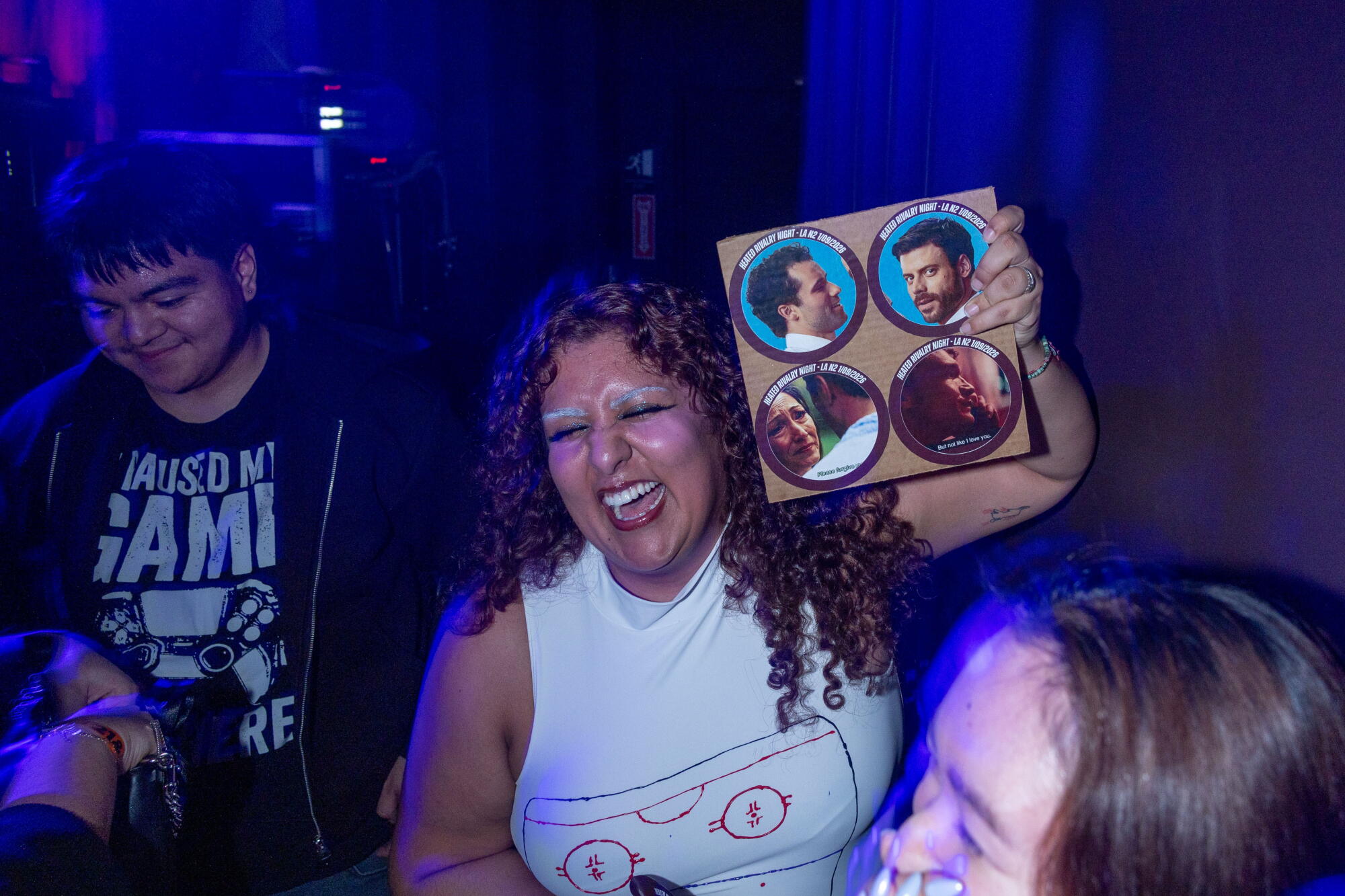
Picture this: You’re scrolling TikTok when a video grabs your attention — it’s a packed dance floor at an L.A. venue, lights low and moody with people vibing together as clips from “Heated Rivalry,” the hit queer hockey romance, flicker across the walls. The crowd sings along to pulse-thumping anthems from Britney Spears, Charli XCX and Bad Bunny, with a Paramore sing-along thrown in for everyone’s inner emo babe. Cheers erupt whenever favorite moments with the show’s central couple, Ilya Rozanov and Shane Hollander — played by Connor Storrie and Hudson Williams, respectively — come to life around them.
A TikTok offering a glimpse of this gathering, posted by Raven Yamamoto at a Heated Rivalry Night at the Vermont Hollywood, reads: “Never kill yourself. Just go to Heated Rivalry Night.”
The sentiment is tongue-in-cheek, but the feeling behind it is not. The dance party held at the Vermont and organized by Club 90s, channels the sensuous vacation-from-reality energy adored by fans of the TV show, and the book series it’s based on, that premiered in November and became a breakout hit for HBO Max. The show, acquired from the Canadian streamer Crave, has already been renewed for a second season and made stars out of its two leads, whose steamy onscreen romance has given rise to a new fandom and sprung a series of events that reflect its culture.
Heated Rivalry Night, curated by Club 90s founder and DJ Jeffrey Lyman, began as a single event that quickly sold out, leading to extra dates — another is being held at the Vermont on Sunday — and more than 100 multi-city pop-ups are planned over the next few months in places like Brooklyn, Washington, D.C., Chicago and London. Social media, particularly TikTok, has amplified the events, turning clips from the dance floor into viral, word-of-mouth-fueled promotion. The events almost didn’t happen: After a supporter emailed requesting a themed night, Lyman hadn’t considered it before because the show’s soundtrack has limited danceable music. But between his love for the series and an “I’ll figure it out” mindset, he dove in.
2

1. Heated Rivalry Night features different genres of music and clips from the TV series play on the walls of the venue. (Ronaldo Bolanos/Los Angeles Times) 2. Kaliah Dabee, center, sings during the event at the Vermont Hollywood. (Ronaldo Bolanos/Los Angeles Times)
“Me and my co-video creator were just working nonstop all week long figuring out how to make the night work. We found all these edits on TikTok and trimmed them into full-on music videos for the night, and then put together the show in four days. I had no idea what to expect. The response was just insane,” Lyman recalls. “Every single post I saw on TikTok was from the night, with hundreds of thousands of views and comments. I was like, all right, we gotta get this thing going because everyone was requesting us in every single city.”
The event has become a space for fans to gather and feel understood, surrounded by others who are drawn to the show’s tenderness, longing, steamy sex and emotional intensity that define it. For many, the universe also sparks a quiet, personal question: Is that sort of romance real — and could it exist in my own life too?
“Nights like these make life worth living. I had so much fun, more fun than I’ve had at a club in a long time,” says Yamamoto, whose entire friend group was “obsessed” with “Heated Rivalry” from the start. “I think it’s really easy to feel alone in a room with hundreds of people, even at events where you have something in common with everyone there.”

-
Share via
But Heated Rivalry Night, he says, is different, noting the warmth and mutual comfort among the crowd members in attendance. “I mean, you could have shown up alone and left with 10 new friends,” Yamamoto adds.
That sense of community is exactly what Lyman hoped to create, where people of all ages, genders and sexual preferences can come together to celebrate the themes of the show.
“I think it resonates so much because the show is just beautiful, everything about it,” he says. “That’s been my ultimate goal with every party — one big accepting space where everyone can let their freak flag fly and be whoever they want, with no judgment.”
Music is another key element of that celebration.
“I want everyone to have their culture represented. I’m Latino myself, I love Bad Bunny — of course I had to throw him in. This is kind of a no-holds barred thing, I’m throwing in every genre,” Lyman says, highlighting how the eclectic music selection mirrors the crowd’s range of tastes. A typical night can seamlessly bounce from CupcakKe to Robyn, Chappell Roan to Beyoncé and Lady Gaga’s aughts banger “Telephone,” and also “Rivalry,” the show’s theme song by Peter Peter.

“I think it resonates so much because the show is just beautiful, everything about it,” says Heated Rivalry Night organizer Jeffrey Lyman. “That’s been my ultimate goal with every party — one big accepting space where everyone can let their freak flag fly and be whoever they want, with no judgment.”
(Ronaldo Bolanos/Los Angeles Times)
Some moments hit even deeper emotionally. One of the standout sequences of a Heated Rivalry Night is when Lyman played a video montage of Shane coming out to his parents, set to Lorde’s “Supercut.”
“The first time I played it, I had, like, this emotional breakdown almost and I was in tears because everyone was cheering him on,” recalls Lyman, explaining that he didn’t personally get to come out to his family and the initial response was not positive or affirming. “And so flash forward so many years later, to have people literally screaming and cheering for this scene for him coming out — it blew my mind. And it just made me so happy for how far we’ve progressed in terms of acceptance.”
How the show has created a community
Ask a viewer on their umpteenth rewatch of “Heated Rivalry,” or a fan in the comments of a meticulous scene breakdown on TikTok, or a Hollanov enthusiast decked in cheeky merch, and the answer is consistently clear: The “Heated Rivalry” universe is a world that feels good to inhabit and revisit. In Los Angeles, the interest in the show has inspired other events as well, like “Heated Rivalry”-themed hot yoga and comedy shows, and fan-made merch, ranging from cozy blankets to graphic tees to custom hockey jerseys, has become ubiquitous.
Jose Bizuet, an educator in training, is still relatively new to the series — he’s four episodes into “Heated Rivalry” — but loves it so far. Waiting in line to enter the Vermont, Bizuet explained his motivation for attending the event.
Fans have created “Heated Rivalry” merch, and several events themed to the TV show have emerged in L.A. and beyond.
(Ronaldo Bolanos / Los Angeles Times)
“I feel like a lot of spaces aren’t accepting of queer bodies, but I know that this space will be accepting of it,” he says. “I’m just excited to have fun, be with my friends, explore different bodies, and just have fun with everybody.”
Inside, pop hits and 2000s classics played alongside clips of Ilya and Shane, as well as fan edits — like a montage of the character Scott Hunter (played by François Arnaud) set to Usher’s “Daddy’s Home” and the infamous IYKYK Google Drive edit set to Megan Thee Stallion’s “Big Ole Freak.” The latter, a fan-made video of Ilya and Shane, was originally shared widely on Google Drive before becoming difficult to find in full, making it a treasured “if you know, you know” gem among the fandom — and the kind of moment that had the crowd cheering in recognition.
Rachel Jackson and Nicole Chamberlain have loved hockey — and a good romance story — for years; they’re fans of the Nashville Predators and Chicago Blackhawks, respectively. “This series was right up our alley. We fell in love with it and read a bunch of the books,” says Jackson as she waited in line to enter the Vermont.
Chamberlain adds: “It’s cool to be part of something, and it’s just lovely to see the community rally around this story.”

Partygoers wearing Rozanov and Hollander hockey jerseys at Heated Rivalry Night. Organizer Jeffrey Lyman says he’s been surprised by the response to the themed dance party.
(Ronaldo Bolanos / Los Angeles Times)
In a post-quarantine landscape marked by isolation and digital overload, fans described a hunger for physical spaces where online connection could translate into real-world presence. Queer nightlife has long functioned as both refuge and community, and Heated Rivalry Night slots neatly into that lineage.
“I think it’s really special that ‘Heated Rivalry’ has become so popular in the U.S. under an administration that relentlessly attacks the rights and livelihoods of queer people,” says Yamamoto. “Celebrating a show about queer love with so many other queer people and allies who understand that felt like a protest in some ways.”
Assessing ‘Heated Rivalry’s’ effect and influence
Rachel Reid, the author of the Game Changers book series that the show is based on, has been struck by the scale and intensity of the fandom that’s grown around “Heated Rivalry.” From watch parties at a resort in the Philippines to drag shows, themed skate nights, and lively gatherings at West Hollywood’s gay sports bar Hi Tops, she’s seen fans across the globe bring the story to life in ways both big and intimate.
“I wish I could get to them all. I’m so proud to be a part of something that’s making people so happy and is also creating community and creating safe places for people to go,” Reid says. “It’s a really good feeling. It’s been my favorite part of all of this.”
She says people have told her the show has helped them try to find romance again. “Quite a few people have reached out to tell me they’d given up on relationships, and watching ‘Heated Rivalry’ made them want to try again, to believe in falling in love. That’s been incredible to hear.”


The tender queer romance depicted in “Heated Rivalry” has been refreshing for viewers. From left, François Arnaud, Robbie G.K., Connor Storrie and Hudson Williams in scenes from the show. (Sabrina Lantos/HBO Max)
The prioritization of queer joy and queer pleasure are foundational to the show, which is present even during emotional highs and lows, and that’s intentional. The trauma, harrowing ordeals or deaths that are typically depicted onscreen, and that audiences have come to expect from queer TV and films, were refreshingly absent.
“That’s extremely important to me, and I knew it was important to Jacob Tierney as well, who made the show,” says Reid. When the two brainstormed the creative direction, Reid says they were on the same page. “It would just be joyful. And it would be sexy in a way that nobody got punished for it. It was really important to me and really important to him, and I think it came through in the show for sure.”
Jacob Tierney, who adapted, wrote and directed the series for television, echoed this perspective. “Rachel’s book is unapologetically queer joy, and from the very first read, I knew I wanted to bring this shamelessly funny, glorious, romantic story to life, complete with the kind of happy ending that gay people so rarely see in the media,” he says.
He told Reid he wanted to honor the book with the seriousness it deserves.
“At a time when queer lives and love are still so often framed through pain or erasure, I felt it was important to tell a story that celebrates pleasure, tenderness, and happiness as something worth protecting,” Tierney adds. “Watching the series bring people together and spark meaningful conversations about how these stories are told has been profoundly moving.”

“Watching the series bring people together and spark meaningful conversations about how these stories are told has been profoundly moving,” says Jacob Tierney, who adapted “Heated Rivalry” for television.
(Ronaldo Bolanos / Los Angeles Times)
As the night wound down in Hollywood, partygoers lingered, sweaty and smiling, voices raspy from singing with friends and strangers who felt like friends.
Outside, the crowd spilled onto the sidewalk, already talking about the next Heated Rivalry Night. For a few hours, the story had leapt off the screen into something tangible — proof that the right song, room and people can make all the difference.
“Heated Rivalry” cannot fix all of the world’s ills, of course, but its influence is evident in Los Angeles and beyond. “It gave us a reason to dance. We haven’t had a lot of those in the past year,” Yamamoto says.
“Joy is resistance, too.”


Hello, dear reader! Do you like what you read here at Omnivorous? Do you like reading fun but insightful takes on all things pop culture? Do you like supporting indie writers? If so, then please consider becoming a subscriber and get the newsletter delivered straight to your inbox. There are a number of paid options, but you can also sign up for free! Every little bit helps. Thanks for reading and now, on with the show!
Warning: Full spoilers for the film follow.
I went into Slanted with rather limited expectations. The reviews have been middling, but I was willing to take a chance on it, both because I love body horror and because I love a film that grapples with complex social issues. To some extent, Slanted does do that–its story about a young Chinese-American woman who decides to undergo an experimental surgery that will transform her into a White person forever is one that has a great deal of contemporary relevance–but it ultimately isn’t willing to commit to its own bit. It stumbles in a host of ways, not least because it feels pulled in two different directions: on the one hand, its commentary is about as blunt as a sledgehammer, while on the other it never really goes whole-hog on its body horror conceit. The result is a film that’s both muddled and deeply frustrating.
Written and directed by Amy Wang, the film focuses on Joan Huang (Shirley Hunt), the daughter of Chinese immigrants Sofia and Roger Huang (Vivian Wu and Fang Du). Though she loves her father in particular, Joan carries around a deep shame and loathing of her Chinese identity, one that is exacerbated by her desperate desire to be prom queen. Her shame runs so deep, in fact, that when she’s offered the chance to undergo an experimental surgery to turn White, she jumps at the chance, transforming into Jo Hunt (Mckenna Grace). However, the transformation proves to be a double-edged sword, as it not only alienates her from her parents and her best friend but also has unforeseen physical side effects.
In order for a film like this one to really work–or, to put it slightly differently, for it to have real teeth as a piece of social and cultural commentary–it has to be willing to lean into whatever elements it’s playing with. This is particularly true when you decide to play in the genre of the body horror, which is known for its extremes and for its ability to make an audience squirm. For a while, I had hopes Slanted was going to go this route–there’s a quasi-gnarly moment during her hair transplant where we get a few close-ups of the machine pulling out her hair by the roots–but then the film just sort of limply indulges in some subpar body horror imagery, most of which involves Jo/Joan’s face starting to sag. It all leads to the fateful moment when she’s crowned prom queen, only for her once-beautiful visage to appear sagging and wrinkled, leading to her classmates’ revulsion.
In a braver film, this whole sequence could easily have been as horrifying and tragic as in Carrie, where the title character’s final humiliation leads to her self-immolation and that of most of her high school classmates. Slanted, however, chooses to play it safe. To be quite honest, I was very underwhelmed by the physicality of it all, which just felt sad rather than horrifying. I kept thinking…is this it? This is what all of this has been building to? It’s not that I wanted Joan to suffer, obviously, but when you’ve been told you’re watching a body horror film, you expect more…body horror? As it is, it was almost comedic, which just isn’t the vibe I think you were supposed to get from the film as a whole.
It’s especially frustrating that the most horror-inducing moment ends up being the very last frame, in which Jo, filled with remorse, has torn off parts of her White face, revealing glimmers of the girl she was before. One can easily imagine a film where this would’ve been the climax toward which it was all leading, and I’d go so far as to say this approach would have been genuinely horrifying. In my view, the best and most affecting horror films are those with an element of tragedy to them, and it’s hard to think of something more tragic than a young Asian American woman only recognizing the true consequences of what she’s done once it’s too late. As it is, it feels like more of an afterthought, and rather than engendering the emotions associated with horror it just left me frustrated for what the film might have been.
That said, I do think there’s something compelling, and more than a little terrifying about the film’s central premise, which suggests a distressing number of people of color would take the chance to be White if they could. One of the most genuinely disturbing films in the entire film is when we see an entire crowd of BIPOC folks clamoring to get in to see the doctor and get their own surgery. For his part, R. Keith Harris gives a chilling performance as Dr. Willie Singer, who was an Indian-American doctor who perfected the surgery, espousing the philosophy of “if you can’t beat them, be them.” However, as frightening as all this is, it just doesn’t quite gel with the rest of the film, in particular Joan’s desperate desire to be homecoming queen and the just general awfulness of her White peers, which sometimes become more caricatures than real people.
If there’s one thing that saves this film, it’s the performances of Vivian Wu and Fang Du as Joan’s parents. The scenes between Joan and her mother are particularly wrenching, especially since Sofia genuinely loves her daughter and wants to share important pieces of family lore and tradition with her. The fact that Joan can’t see this until too late is far more horrifying than anything that happens to her body after her transformation.
Is Slanted a bad movie? I wouldn’t go so far as to say that. However, it is undeniably a frustrating one, and I kept finding myself wishing it could’ve gone just a bit further, could’ve gone for the throat. Failing that, it could’ve been a bit subtler in its delivery, especially since its central message is an important one. The way that Whiteness–White identity, White skin, White culture–is constantly framed by our society as something toward which everyone should aspire is a problem, and it causes untold damage to BIPOC everywhere. However, while Slanted clearly aspires to Get Out levels of cultural commentary, it ultimately falls flat, leaving us wondering what might have been.

Thirty-five years after his death, jazz giant Miles Davis, who would have turned 100 years old Tuesday, remains a truly larger-than-life figure in music and well beyond.
Still possessor of the biggest-selling jazz record in history, “Kind of Blue,” Davis casts a huge influence over the whole music world for his uncompromising artistic vision, constant evolution, style and more. Though he came from jazz, he may be the biggest rock star there ever was. Talk to any musician, regardless of genre, and they will tell you Davis defined swagger and cool. He had a vibe unlike that of anyone else.
In honor of Davis’ centennial, The Times spoke to an array of notable artists from all walks of music, some who knew and played with him, some fans of the man, but all agreed, Miles Davis was and is a singular force in music, an artist like no other in his vision, passion and feeling for the music. In short, there was only one Miles Davis.
‘A complete innovator’
Chuck D, rapper: I like Miles Davis and all the exterior aesthetics. I like the Blue Note album covers, Prestige album covers, his style, his way of life.
Cindy Blackman Santana and her husband Carlos Santana in 2019.
(Ethan Miller / Getty Images)
Cindy Blackman Santana, drummer: Stylistically, Miles was a complete innovator. I remember hearing him say that he didn’t play right if he wasn’t dressed right. That is completely something that inspires me as well, because it becomes not only what you’re putting out on your horn or your drums or your guitar or your piano, but it’s your whole being that is expressing this innovative approach to music and to life.
Bilal, singer: If you play the music you’ve got to look the part, and it was almost like he got into a movie role or something like that. But he was always into the clothes … It was almost like every era had a different outfit. But, yeah, I definitely take his style. The clothes make you feel a certain way to play that way. So that’s the vibe. You’ve got to have that character, that attitude.

Emmet Cohen, left, performs with Terence Blanchard at Lincoln Center in 2025.
(Slaven Vlasic / Getty Images for Find Your Light)
Emmet Cohen, pianist and composer: I think when you listen to Miles’ records you can really appreciate them all the way through and there’s something in there for all sides of humanity. Whether it was the Prestige records that he pumped out in a couple of days, or there was “Birth of the Cool,” he just knew how to assemble musicians and let them tell their stories. And the storytelling is really where I think the deepest connections are made. He was a rock star, but he had a story to tell. And that always comes first.
‘Always evolving’

Guitarist Lenny Kaye performs onstage at Carnegie Hall in 2023.
(Noam Galai / Getty Images for Tibet House US)
Lenny Kaye, guitarist: He started in the bebop era, with the immortals of that moment in time. But I always got the sense that he was looking for something else. He didn’t want to participate in the faster-than-light speed changes and virtuosity. So, I really respect the fact that when he moved into “Birth of the Cool,” he pulled it back so he could inject more of his human self into it. And over the years, he kept on doing that, “Sketches of Spain,” “Kind of Blue,” one of the most jazz friendly records of all time.
Flea, bassist: Every time Miles changed it up, he destroyed everything that came before. He is the ultimate artist, always evolving, always coming organically from the depths. His music is the warmest and the wildest.

Flea of the Red Hot Chili Peppers released a solo jazz album in March.
(Allen J. Schaben / Los Angeles Times)
Bilal: I really like his electric era, but I would say I keep discovering and rediscovering stuff from Miles that I’m just like, “Damn, man. It’s like it’s another artist because he went through so many different changes.” … The other day I found his “Sketches of Spain” record. I put it on. I was like, “This is crazy. I forgot he was into this too.”
Wyclef Jean, rapper: When you go through Miles’ whole catalog, you see you can have quiet days. You can have loud days. You can have explosive days. But the key is that consistency. And that discipline.
Kaye: I respect Miles. For me, he’s an artist that transcends the jazz genre. He’s so alert to the shifting moods of the culture, the directions of the music. And what I find fascinating about him is his ability to morph into new styles and to keep challenging himself. One thing about Miles is that he doesn’t repeat who he is.

Musician Ron Carter in 2011.
(Theo Wargo / Getty Images)
Ron Carter, bassist: We always thought that we were honored to have Miles hire us out of other guys who were available to him. The first few gigs, we had a couple of weeks up and down the West Coast, and everybody but Miles was trying to find out what the tunes were, what the changes were. I was just trying to do what I thought was necessary to make this guy think he hired the right guy and make the band sound good. … Whatever his method was, it was successful.
Ibrahim Maalouf, trumpeter: Quincy [Jones] always spoke about Miles not just as a genius, but as someone who knew when to move on. And that’s a lesson I still carry with me every day.
Kaye: In “Bitches Brew” he created the template for what would be jazz fusion and made rock ‘n’ roll an important part of his evolution. Just an artist who never stands still and that is what I personally respect and honor within his work. When he saw what an artist like Jimi Hendrix was doing, he thought, ‘Yeah, I know how to access that and not be Jimi Hendrix. I can be myself.’ He understood the tides of cultural transformation as much or better than most musicians of the 20th century.

Don Was performs onstage at Ryman Auditorium in Nashville in 2022.
(Jason Davis / Getty Images for Americana Music)
Don Was, musician and producer: In life, as exemplified by music, if you don’t change, you stagnate. And the thing about Miles that really stands out, I think, is that he was always willing to risk losing his audience in order to keep moving forward. He was courageous in every era, including eras when maybe courage wasn’t held at a premium.
‘More than that’
Maalouf: For me, as a trumpet player, of course, the musical influence; space, phrasing, silence, we can talk about this for hours. But I think that more than that, there’s an attitude.

Ibrahim Maalouf performs at the Paris 2024 Cultural Olympiad at L’Olympia on July 24, 2024, in Paris France.
(Julien M. Hekimian / Getty Images)
Trombone Shorty, musician: Miles has inspired me because of that attitude, ‘I’m going to do what I want.’ He was playing what he felt in whatever time period or whatever decade he was inspired by. He really embraced that tremendously. And that’s always the thing that I admire about him as a person and as a musician. Whatever the spirit is, he’s going to go with that. That’s what I always got from Miles.
Nas, rapper: With Miles it wasn’t just about the music he made, it was about how he carried himself as an artist and a pioneer. His impact on me personally is as much on a human level as it is on the artist level.

Trombone Shorty performs at the Anaheim Convention Center in 2015.
(Jesse Grant / Getty Images for NAMM)
Trombone Shorty: The swagger, he may have created the swag.
Vince Wilburn Jr., nephew and drummer, who now co-manages Davis’ estate: He liked to catch things, that’s why the tape kept continuously rolling, because he said it was songs inside of songs.
Carlos Santana, guitarist: “I recommend that people who never heard of Miles Davis, I’ll say start with “Kind of Blue,” then move on to “Bitches Brew.” Because the thing about Miles Davis is that he teaches people who have never meditated how to stop and be coherent about absoluteness. In one note, Miles can play absoluteness. One note for Miles, like Billie Holiday, like Cindy says, that’s enough to understand all the whys and all the reasons why it’s sacred to be alive.
Was: He probably changed the face of music more than anybody did, at least four or five times. Maybe more than that. It’s a combination of mastery and an unstoppable spirit of adventure that I think make him unique. Because he was absolutely a master of harmony, rhythm, of creating a vibe. Yet he loved upsetting the cart and I think went out of his way to create friction musically, within the band, to keep things stirred up constantly and make every day an adventure. It requires tremendous courage. But also, supreme excellence to do it on the level that he did with the level of musicians that he surrounded himself with. That’s another thing, too. He wasn’t just the most innovative man on the horn. His genius was also as a curator of human chemistry.”
‘Larger than life’

Musician Wyclef Jean performs in 2023.
(Christian Petersen / Getty Images)
Jean: The main thing that I learned from Miles at a very young age is just the braveness, you can’t be scared to just go. Going doesn’t just mean learning one part of it. It means learning the entire metrics. … When it comes to Miles, he’s just a complete teacher; even on how he sees art, how he sees shapes, and also there’s a whole part of Miles that’s tough love when it comes to it. So, all of that instills character.
Bilal: As an older musician, you could see all of the building blocks are in those records. If you take some of those records out, I don’t know where jazz would be. You can see the essential building blocks.
Izzy Escobar, singer: Miles Davis made jazz feel cinematic to me. When I listen to songs like “It Never Entered My Mind” or “Flamenco Sketches,” there’s mystery, romance, restraint and tension in every note. Nothing feels overdone, yet somehow it says everything. As a songwriter, that’s deeply inspiring because the best music doesn’t just sound good … it creates an entire world you can step into. I think that’s why his influence has lasted a century. His music still feels fearless, elegant and emotionally alive — all of which never go out of style.
Jorma Kaukonen, guitarist: I had always thought of jazz as somewhat of a haughty art form. Probably because at the time many of the time signatures and chordal progressions that Miles used were over the head of a young guitar player still functioning in the blues and folk idioms. … The growing rock and art movement in the Bay Area in that era taught us to eschew boundaries and labels, and it became possible to see similarities and possibilities with jazz music that would have gone previously unnoticed. Our harmonic tendencies were nowhere near as complex, but they were rapidly becoming more sophisticated thanks to our exposure to such great improvisers as Miles! Miles knew no boundaries.
Jean: One thing that I learned from Miles is someone can have the best technique. They could be moving around. But if you can dig and play from your soul, this instrument just becomes a vessel of sound and orbit, bro, it’s over. There’s a connection with the soul. And I wouldn’t be able to do that, bro, if I didn’t have people like Miles to really teach me how to hear.

Theo Croker plays trumpet the Kennedy Center in 2018.
(Paul Morigi / Getty Images for Thelonious Monk)
Theo Croker, trumpeter: He was definitely a larger-than-life figure. And it encourages me to be a larger-than-life figure. Growing up as a kid, we sit in a room all day and play trumpet for hours. You see somebody like Miles Davis and you’re like, “Wow, I can be a rock star.” Because I couldn’t sing, otherwise, you end up being a pop star, Prince, Michael Jackson and Stevie and all that. But Miles was that for the trumpet, of course. So, it’s so much bigger than music.

Musician Mia Doi Todd performing in 2012.
(Paul Redmond)
Mia Doi Todd, musician and singer: Miles Davis was such an outstanding band leader, bringing together a group of musicians and seeking to break the boundaries. That is what I look to him most for as a celestial mentor, being a band leader and creating those sonic landscapes. The records that I love most of his are from that electronic jazz fusion era, which weren’t his most popular at the time. I love “On the Corner.” I’m a person of mixed race, so the records that he was bringing together, all these different musical elements, those are the ones that I really admire … “I wish I could play in that band.”
Maalouf: There’s this idea that music is not about providing something. It’s about searching. It’s about staying alive artistically. I think that strength goes far beyond music, it’s really a message for all the musicians that we are. Never stay where people expect you to stay. Every time the audience thought they understood him, he changed direction. And I think that’s definitely one of the most inspiring parts of his musical life.
Was: I never met him. But he was a heroic figure to me as a teenager, very much in the same way that simultaneously, like Bob Dylan and the Rolling Stones were, or John Lennon was, or Allen Ginsberg was.

Bilal performs in New York City in 2023.
(Roy Rochlin / Getty Images)
Bilal: That [artistic vision] is a major influence that I take from Miles. … I always approach the music in that way where you got to do your own thing. You’ve got to have something to say, and you’ve got to want to evolve and always look for ways to grow and change and with the music. Miles was quintessential at that.
Trombone Shorty: To me, Miles Davis was a real rock star. It just wasn’t the sound. When he walked on stage … he looked the way that the music sounded to him. … And as he grew, he just really embraced everything that was coming to him, and he didn’t run away from it. He wanted to have his influence and also be tremendously influenced by things that were happening. He was just the coolest; when they say cool, Miles Davis has to be next to that word.
‘Playing within the language that he created’

Nas performs in New York City in 2018.
(Bennett Raglin / Getty Images for Jenn-Air)
Nas: I think Miles’ impact on every inch of music after him is the most impressive part. Musicians from every genre speak on his influence. It has no language or cultural barriers.
Jean: I would literally tell everybody to do a deep dive and start with early Miles, start from the bebop and the blues, don’t just go in. I started my daughter with “Birth of the Cool.” Now she’s vibing and slowly working her way up.

Musician Vince Wilburn Jr. in 2011.
(Theo Wargo / Getty Images)
Wilburn Jr.: Style, creativity, forever evolving, ever looking back, unapologetic. Lenny White used to say everybody wanted to live and be like Miles, all the musicians. You have Miles, and then you have everyone else.
Santana: Miles is what I call a sacred rascal, a divine rascal, a genius. When I’ve been in the room with Herbie [Hancock], Wayne [Shorter] and Tony [Williams], and the name Miles comes up, they all stop. It has such an impact on all of them to this day it shows that Miles is Da Vinci, Stravinsky, Picasso. Collect all the geniuses of this planet, and that’s what Miles is in one note. In one note, he reveals more because in one note, he teaches an individual how to hug infinity with emotions.
Kaye: I think of him as a lodestar for someone who wants to continually move music forward into the future because that’s what music is about. When you play music, you’re moving from one note to the next and creating the future of that piece. I just find Miles a fascinating creature of transformation. Miles, for all his artistic innovation, was a pop star.
Maalouf: Miles Davis’ legacy is not only a sound, it’s a mindset. He gave all of us the permission to be many people in one lifetime. It feels to me it’s the secret and he was generous enough to do it himself and show the world and especially the jazz world that is not always easy to please that someone can be many people in one lifetime. It’s not only true for music. It’s true for everything in life.
Cohen: He’s always on the cutting edge of the next thing and the next group of musicians that he finds. The story in that is that there’s constant change, constant evolution, and to find the thread throughout is kind of the meaning of life. And to play his music is the same thing. He created a language. So, when we play his music, we’re playing within the language that he created.
Was: “That’s why he’s that cat. He’s the most rebellious musician of all time, I think. He was the complete package man, no one more innovative or influential.
Movie Reviews
‘Red Rocks’ Review: Weirdo, Cliff-Jumping Kiddies Are the Focus of Bruno Dumont’s Latest Experiment

From “The 400 Blows” to “The Florida Project,” kids have made fascinating cinematic subjects. Even if they’re working from scripts, there’s always the sense that they’re not entirely acting — that they can’t help but simply be themselves. The French director Bruno Dumont, a former philosophy professor who broke into Cannes nearly 30 years ago with his stark feature debut “The Life of Jesus,” has gravitated towards the raw naturalism of youngsters in the past. See “Li’l Quinquin” from 2014, and his musical curios about France’s patron saint “Jeannette,” (2017) and “Joan of Arc” (2019), all three of which find a strange, startling profundity in ragtag rugrats, say, debating theology or blankly witnessing acts of violence.
Childhood, for Dumont, isn’t a stage of pure innocence, but a transition period where adult behaviors are tried on by little ones who don’t entirely know what they mean, or what the stakes are. Such is the case with his latest feature, “Red Rocks,” which involves children roughly between the ages of five and seven jumping off cliffs, riding mini motorcycles and partaking in gang warfare — or its pre-verbal equivalent. Long, static, mostly wordless takes will make these activities seem less eventful than they sound. Patient arthouse viewers, however, will find much to chew on here as a subtly cerebral film about small bodies unsettlingly, hilariously navigating a big, violent world.
Blending documentary-style observation and a Romeo and Juliet framing device, “Red Rocks” — which premiered in the Cannes Directors’ Fortnight program — is scaled-back for Dumont compared to his 2021 Cannes competition entry “France,” a media satire starring Léa Seydoux, and last year’s “The Empire,” a critically divisive “Star Wars” spoof that premiered at the Berlinale.
Twitchy, blond tyke Géo (Kaylon Lancel) and his posse (Louise Podolski and Mohamed Coly) meet another trio of tinies while enjoying their favorite activity: scaling rock formations and taking (seemingly quite dangerous!) plunges into the ocean waters below. One member of the opposing crew, Eva (Kelsie Verdeilles), takes a liking to Géo, though their romance is hampered by Eva’s other boyfriend B (Alessandro Piquera). Not that romance, here, means anything beyond hand-holding and giggling while awkwardly staring into each other’s eyes.
Cinematographer Carlos Alfonso Corral (co-producer of Roberto Minervini’s “The Damned”) alternates between fish-bowl closeups of the children’s faces and extreme wide shots of the craggy, coastal landscape. The effect is a bit like watching a tripped-out version of “Mister Rogers’ Neighborhood” or “Thomas & Friends,” the Mediterranean setting — complete with arched viaducts and train tracks —miniaturized into a kind of fantasy playground for its band of tots to roam around freely.
A fair share of camera tricks and strategic angles make the kids’ climbing stunts look significantly riskier, though in a masterclass following the premiere, Dumont admitted to a degree of recklessness, choosing to shoot many of the film’s scenes in Italy as opposed to France, because of filming laws in the latter country pertaining to minors. In this Gallic Neverland, there’s not a safety helmet (or nervous parent) in sight, which admittedly adds to the film’s feral energy. Their twiggy legs and bony frames exposed in bathing suits, the kids do indeed look extra vulnerable within the film’s savage landscape. That’s precisely Dumont’s intention — freedom is fun and scary — but the choice is sure to raise eyebrows among critics of the director, who has historically been called out for his work with nonprofessional actors.
The star-crossed lovers drama is mostly a justification to watch the kids play and pull weird and mesmerizing expressions, which turns repetitive over the film’s slim 90-minute runtime. Still, there’s amusement and electricity in their physicalities and wry antics. Working, again, at the boundary between the sublime and the silly, Dumont nevertheless manages to stake out new territory with this alien portrait of childhood. This may be something of a transitional work for a director who tends to shape-shift, but you’ve got to hand it to a guy unafraid to experiment.
-

 South-Carolina4 minutes ago
Early voting begins Tuesday as South Carolina redistricting debate continues
-

 South Dakota10 minutes ago
70-year-old woman dead after being struck by bison in South Dakota – National | Globalnews.ca
-

 Tennessee16 minutes ago
Tennessee mayor wants pause on data centers, industry says focus should be on regulation
-

 Texas22 minutes ago
No injuries reported after vessel catches fire near Texas City Dike, Coast Guard officials say
-

 Utah28 minutes ago
Tick sightings near Orem park raise health concerns over holiday weekend
-

 Vermont34 minutes ago
Vermont Federal Credit Union leaders receive ESGR Patriot Award
-

 Virginia40 minutes ago
Everything From Virginia Tech’s Ethan Gibson, Henry Cooke After Monday’s NCAA Tournament Selection Show
-

 Washington46 minutes ago
Report: Skydiver killed in midair collision in Washington

