Entertainment
Review: Kinky ‘Pillion’ captures the thrill of attachment — even if BDSM is not your thing

Successful romances star at least one looker. I don’t mean someone attractive. I mean an actor who gazes at their scene partner with such delight that we swoon, too. Clark Gable was a looker. Diane Keaton was a looker. The combined eyeball voltage of Ryan Gosling and Emma Stone is so powerful that it’s turned silly scripts into hits.
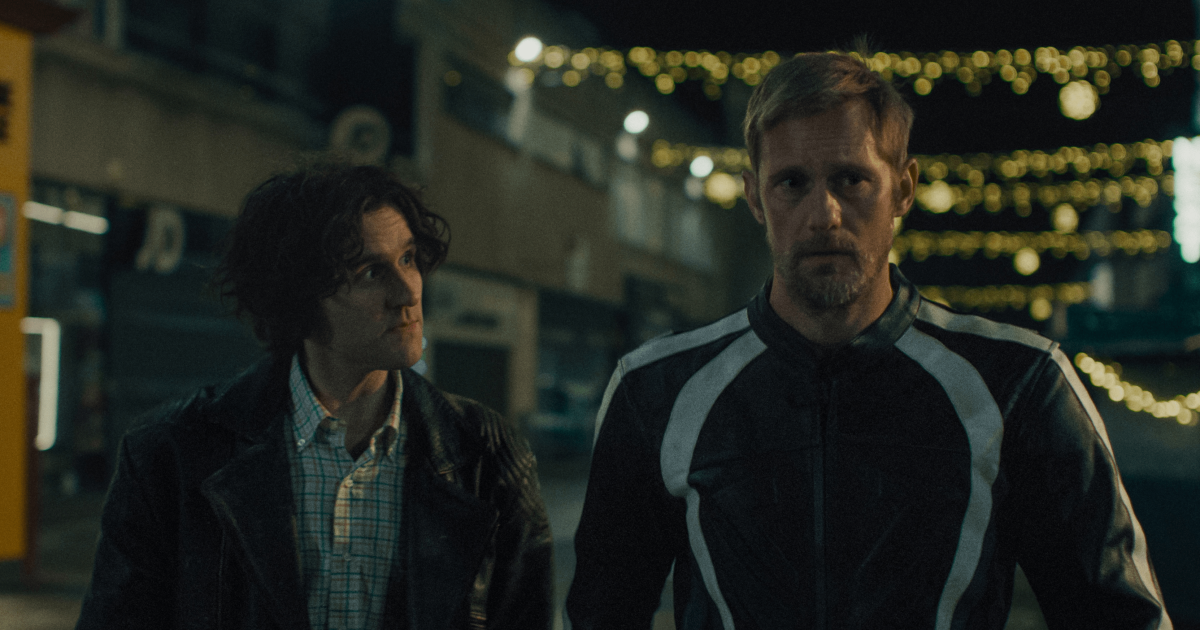
Harry Melling is a late-blooming looker. Onscreen most of his youth as the Muggle brat Dudley Dursley in the “Harry Potter” franchise, Melling is only just now getting to show off that talent in the funny-kinky “Pillion,” which puts him on his knees beaming up at Alexander Skarsgård’s 6-foot-4 biker as though this blond hunk was the sun. His Colin, a shy gay man who sings the high notes in a barbershop quartet, is so visibly infatuated licking Skarsgård’s leather boots in a dark alley that you believe he lusts for humiliation. Colin has only just discovered that fact about himself. He’s yet to even learn this man’s name. (It’s Ray.)
Perhaps you’d like to be taken to dinner first, but “Pillion” is about Colin’s needs — specifically his need to please — and first-time feature filmmaker Harry Lighton challenges us to root for his bliss. This fetishy adventure is a minimalist romantic comedy in which submissive meets dominant, and submissive explores his physical and emotional vulnerabilities. Marriage and a baby carriage are off the table; the journey matters, not the destination.
“Pillion” is what motorcyclists call the passenger seat, at least in suburban England where this is set. It’s a passive position compared to the driver, but still a cooler upgrade from where Colin starts the movie riding in: the rear of a sedan. Out the car’s back window, he sees Ray zoom by in white Stormtrooper-looking gear and, by happenstance, bumps into him that night at a pub where Colin’s mother, Peggy (Lesley Sharp), has set up a blind date with a nice bloke. That guy gets forgotten the instant Ray slips Colin a note with a time and place to meet.
Peggy isn’t panicked by her son’s alpha-male predilections. “I think a biker sounds exciting,” she says with a grin. His father, Pete (Douglas Hodge), just wants him to wear a helmet. Neither parent is privy to the fact that Ray simply isn’t very nice. Ray controls the gobsmacked Colin quietly, calculating the bare minimum of kindness required to have a house boy willing to cook dinner, tend to his Rottweiler and sleep on the floor. He withholds his approval to keep the paler, smaller man anxious.
That Rottweiler contended for the Palm Dog at last year’s Cannes, a prize for the festival’s best canine. Frankly, Melling himself should have won. His performance is pure puppy, from the way he silently studies Ray’s silent cues to the eagerness with which he leaps up to fetch Ray a beer. When Ray lavishes attention on another biker’s pet pillion, Kevin (Jake Shears of the Scissor Sisters), Colin sulks until his master unzips his trousers and gives him a treat.
Flexing his abs in shiny Motoralls, Skarsgård uses his own appeal to expose an unattractive wrinkle in human behavior: Ray is so gorgeous that everyone just takes it as fact that Colin is lucky to be near him. When a coworker asks this scrawny geek how he bagged a hunk like Ray, Colin brags that he has “an aptitude for devotion,” which includes wearing a padlock around his neck and shaving his Byronesque curls so that he looks like a zealot — which in a way, he is.
Over and over, Colin takes stock of his own debasement. But then he looks at his model-handsome lover and calculates that his suffering is worth it. He’s good at compartmentalizing; he’s a parking violations attendant who tickets angry people all day. When he needs an excuse to cry, he finds one (and it hurts to watch).
Lately, it’s been a thrill to see queer stories confidently leapfrog over coming-out narratives to the trickier question of whether two individuals in particular are a decent match. Lighton leaps further than that — he goes full Evel Knievel by daring to ask how we feel about a relationship that’s indecent, but still has worth as a set of training wheels for a wobbly young man learning what he wants.
It’s a more optimistic take on Colin and Ray’s coupledom than was in the book that inspired the script, Adam Mars-Jones’ 2020 novella “Box Hill,” which was subtitled “A Story of Low Self-Esteem.” A study of the psychology of abuse, that story’s more brainwashed version of Colin finds him decades older looking back on the affair and pining for a relationship that reads as horrible between the lines.
Lighton isn’t oblivious to the power imbalance, but he’s made a movie about going forward, not being stuck. He trusts his naif with more agency, and so “Pillion” is freer to play its insults for laughs. You’ll giggle a lot. That gleam in Melling’s eyes makes it feel like a comic fantasy, although who knows? Perhaps there really are BDSM biker gangs hosting afternoon picnics with serving boys tied spread-eagled on a buffet table. That bucolic scene is filmed in a slow pivot around the park, cinematographer Nick Morris getting a chuckle from how the image shifts from Georges Seurat to “Hellraiser.”
Eventually, Colin’s parents will be more flinchy about his new boyfriend, leading to a beat or two that don’t land with the impact they could. Oddly, Lighton might be too restrained himself. Like his leads, he prefers to say everything with a look.
But while Melling is always endearingly open and responsive, Skarsgård stays unreadable. His Ray always seems to be hiding behind a motorcycle visor even when he’s not and when he deigns to speak, the words trail off in a huff of exhaustion. The only thing we know about Ray’s life are the names of his two previous dogs, and that’s only because he has them tattooed on his chest.
Any more personal facts about Ray — his own job or family or romantic history, even his favorite movie — would risk us clinging onto it too tightly as an explanation of what he gets out of this himself. Serving Ray’s pleasure is Colin’s focus. And our focus is on Colin’s pursuit of that.
Yet with subtle skill, Skarsgård reveals that Ray is thinking about Colin more than he’s willing to let on. Curiosity flickers across his face when his submissive surprises him. He stays gruff, of course, but you sense that Ray is as manacled by his authoritarian role as Colin literally is in his hungry, slurping devotion to his master. Puny and pathetic as Colin appears, he begins to seem like the braver of the two. It takes courage to map your own boundaries — then to cross over that line and get hurt, and get back up and out there. Lighton’s biker BDSM rom-com might sound niche, but free yourself to see it and you’ll discover it’s a universal romance.
‘Pillion’
Not rated
Running time: 1 hour, 47 minutes
Playing: Opens Friday, Feb. 6 in limited release


Arts
Supergirl
Director: Craig Gillespie
DC Studios, Troll Court Entertainment, The Sagan Company
In theaters: 06.26.2026
I was a pretty big fan of James Gunn’s Superman. Building up to the release of the film, I relapsed into my comic book obsession, which I had laid to rest many years prior. I read whatever you get recommended when you look up “Superman comic recommendations:” For All Seasons, All Star, Birthright — whatever, you don’t care. David Corenswet’s portrayal of Big Blue was loving, thorough and unbelievably human, which is what Superman is (he’s not Jesus). He is the best of us. He is what we aspire to be.
Supergirl was announced, and I picked up the comic it was based on: Supergirl: Woman of Tomorrow. The questionable morals and talent of author Tom King aside, the book is good! The fantastic art by Bilquis Evely makes King’s (sometimes preachy) prose this beautiful and somber story about trauma and war. It appears that I’m ahead of director Craig Gillespie, who reportedly didn’t read the book and, boy, does it show.
During a bender, Superman’s cousin Kara (Milly Alcock, House of The Dragon) meets Ruthye (Eve Ridley), a child whose family is murdered by Krem (Matthias Schoenaerts, Amsterdam, The Old Guard), the leader of a raider group. She enlists Kara to hunt and kill him, and on their way, they confront their traumas.
Every change made from the original comic was for the worse. Most notably, this film simplifies the depth of the comic’s characters. Kara is reduced to a loud, charming alcoholic, which is fine, but in the comic, she’s somber and reflective, making an effort to teach Ruthye how the greater universe works. The antagonist, Krem, is sort of a loser in the comic. He’s a coward who spends his time running away, while in the film he’s a tattooed, pierced, menacing psychopath who appears in almost every major action sequence. He’s almost indistinguishable from The Joker — this all boils down to shame. While they’re becoming increasingly popular, comics are still for losers. Hinting at depth with characters who fly and shoot lasers from their eyes in brightly colored underpants isn’t something that a general audience will accept. They will accept a comic film so long as it constantly flogs itself for being comic-inspired.
Another bastardization is the look of this film. Everly’s amazing use of color in the comic makes the story so engaging. How is this translated? Brown. Just brown. When characters clash, it looks like someone’s wiping their finger across their dirt-covered lens, which is a total departure from Gunn’s fantastic color palette in Superman. The visual effects appear to be rushed and often look horrible — laughably horrible, as a matter of fact. How do you spot a bad action director? Look at the editing. If they have to hide poor action choreography and bad visual effects behind dizzying amounts of cuts, they’re bad. Gillespie is a bad action director. James Gunn promised that the DCU would prioritize artist voice over universal coherence, but if these are the artists he’s hiring, I’m not sure how long this could last.
Performances here are whatever. Alcock could have been good if the script and direction were right, but they’re not. I couldn’t get into Krem due to character assassination, but even if I wasn’t into the comic, I would find his performance as a crazy guy to be a standard for bad superhero movies. Ridley is good, especially for a debut in feature films, but the standout is Jason Momoa (Aquaman, A Minecraft Movie) as Lobo. He is loving the character, absolutely chewing up the scene with thick cigars. He’s a little cheesy-edgy, but that’s just what he is in the comics, so I won’t knock him for it.
While I was watching the film, I was suffering from a discrepancy. Supergirl is as powerful as Superman, but throughout this film, she doesn’t use her powers to their full potential. Something I actually loved about Superman is how much he got his ass kicked. Gunn was out to prove that Superman fights can have stakes — that he’s not just undefeatable and therefore boring as everyone says. Gunn’s ability to create ways to kill the Man of Steel without Kryptonite is amazing! Kara, in this film, is fighting space pirates and constantly forgets to finish the fight. It’s frustrating because the remedy to this in the comic is that they don’t see Krem until the last couple of issues, but in this film, Krem keeps showing up to menace Supergirl, and most of the time she has her powers.
I could ramble about how bad the dialogue can be, how derivative and uninspired it is or whatever lame comic thing I can talk about, but I’ll spare you. Here’s the moral of all this: Comic books are a valid storytelling medium. I recall recommending Alan Moore’s Watchmen to someone and being told that they have more important things to read. Watchmen is one of my favorite works of fiction. I did end up falling out of love with comics because I was told they were childish and I had grown bored of having costumes thrust into my peripherals all the time, but I’m back now, and I love them so much more than ever. I loved Superman because, above all else, it was earnest. There wasn’t a self-deprecatory tone toward its own plot. It didn’t try to bog its drama down with one-liners. It was just proud to be a comic book movie, and I think more movies should.
If you want to see Supergirl, go ahead, but I’d advise you to just read the comic, which is more dramatic, more meaningful and more impactful. —B. Allan Johnson
Read more reviews from B. Allan Johnson below:
Film Review: The Bride!
Film Review: Backrooms
Do you enjoy SLUG’s film reviews? Consider becoming one of our donors!

One Wednesday evening in May, at the boutique hotel Dream Hollywood — located just off the Walk of Fame — a young hotel staff member shuffled over to her co-worker to discuss a special guest on the top floor. Together they exchanged whispers about an artist’s unknown whereabouts and whether or not they would catch him on his descent to the first floor.
The name “Tito Double P” slipped out, referring to the Mexican corrido singer who happened to be in town promoting his latest album, “Acomodo.”
I met the 28-year-old on the top floor, where he opted for a warm, friendly hug in lieu of a firm business handshake. We were quickly rushed into a side room to conduct his last interview of the evening.
Those who’ve followed Tito Double P’s musical journey since 2023 would likely describe him as a chaotic force, with weathered vocals, off-the-cuff ad libs, riotous pelvic thrusts and suggestive tongue expressions.
Come Sunday, he’ll bring the ruckus when he headlines Belico Fest in L.A.’s BMO Stadium. But when we spoke about his second solo album, “Acomodo,” the Nayarit-born, Sinaloa-raised singer, whose real name is Jesús Roberto Laija García, arrived polished, perfumed and poised.
“After this LP, don’t be surprised if you see different things from me,” said Laija García.
Released on May 28, the LP contains 23 corridos, which see Laija García strike the commanding tone of brazen CEO. In its focus track, “Me Vale V,” the singer firmly declares he is manifesting his dreams and not paying anyone else mind. Its lyrics reveal it all: “Ya van tres días que no paro, pero bien trabado” (I’ve been going nonstop for three days now, but I’m totally locked in).
But listeners also get a more vulnerable side of the músicana mexicana singer, who agonizes over heartbreak in “La Fama” — while simultaneously voicing his vice for women and boozy escapades. Throughout the record, the singer sprinkles in the catchphrase, “Bélico pero no tanto, mija,” which translates to “warlike, but not too much, my dear” — striking a balance between his hard-shelled exterior and inner tenderness, namely in the yearning jazzy corrido “Pase y Pase,” in which he pleads for a late-night booty call.
Most notably, “Acomodo” boasts no features whatsoever, a rarity in an industry where artist collaborations play a key role in bringing in bigger audiences (and bigger payouts).
“Many people called me to ask why they weren’t going to be on [the record],” he said. But the solo move marked a milestone achievement for Laija García, who had no designs of becoming an international musical marvel.
“I was never the child who sang, who played the guitar in school festivities or at family parties,” said Laija García in a calm tone — occasionally referring to his stage name in the third person.
The singer still can’t fathom his own success. He cut his teeth by penning career-defining songs for his famous cousin, Peso Pluma — including anthemic corridos like “El Belicon,” “Siempre Pendientes” and “AMG.” These standout ballads touted a rugged lifestyle with elements of organized crime, which aided his primo’s ascent to the mainstream.

Tito Double P released his second solo album “Acomodo.”
(Adan Ornelas Anta)
In the process of composing his cousin’s Grammy-winning 2023 album, “Génesis,” Laija García asked him if he could also release his own material. “Let’s go!” he recalled Peso Pluma saying. “Your first song will be a duet with me.”
The plan was to debut Tito Double P with “La People,” a fiery narcocorrido that details the inner life of a cartel’s tactical security guard, who narrowly escapes a police raid.
But Laija García’s rollout plan took a detour when an unmastered version of his track was leaked to TikTok in spring 2023 — a bouncy tune he later renamed “Dembow Belico,” which is characterized by a Dominican-style boom-chi-boom-chick rhythm and raw, spitfire lyrics. This party track introduced audiences to a version of Tito Double P that radiated a lighthearted madness — fueled by Skyy vodka and Old Parr whiskey, as per the song’s lyrics.
“I liked it, it was something new,” said Luis R. Conriquez, who called up the new singer to be a collaborator. “What makes him special is his voice, his sound. He’s his own person.”
Together with Conriquez and Joel De La P, “Dembow Belico” was released on June 5, 2023, and became Tito Double P’s official debut in the music world — even giving life to one of the most viral clips of Mexican boxer Canelo Alvarez, who can be seen awkwardly dancing to it.
“From there on, Tito Double P was another persona,” said Laija García. Throughout his lively retelling of the story, he added a series of sound effects to move the story line — among them, wacha, pum, pum, pum, gol. “More than anything, Tito Double P came across as a character, because that guy was totally crazy, he didn’t give a damn.”

“More than anything, Tito Double P came across as a character, because that guy was totally crazy, he didn’t give a damn,” said Jesús Roberto Laija García, better known as Tito Double P.
(Adan Ornelas Anta)
In real life, Laija García considers himself a timid, camera-shy guy. That’s why he chose an illustration for the cover of his 2024 debut album “Incómodo,” rather than a real-life image of himself; the LP title directly translates to “discomfort.”
“I was going to be one of those artists that [only] releases songs, because [I thought,] ‘How embarrassing would it be if I got up on stage?’” he mused. “But now, I dominate the stage from head to toe. And I don’t want to come down.”
The debut record also served as an experimental project for Tito Double P, whose hard-won swagger elevated every sound he toyed with — whether it was on the brass-heavy banda song “La 701” with Luis R Conriquez, the techno thump of “La Bandolera,” the heavy-hitting urban track “Linda” with Neton Vega and the guitar-powered ballad “Los Cuadros” ft. Peso Pluma).
Featuring collaborations with established acts, such as Natanael Cano, Junior H and Grupo Frontera, the album peaked at No. 11 on the Billboard 200 chart and helped the rising star distinguish himself from his high-profile cousin — who he toppled from the No. 1 spot on the Top Latin Albums chart, five weeks after his debut release.
Although Laija García hasn’t shied away from embracing that familial tie either; in May, both Tito Double P and Peso Pluma concluded their “Dinastía” tour following their joint 2025 album of the same name.
“I still see comments on TikTok where people are surprised that we are cousins,” remarked Laija García.
Now with “Acomodo” — which debuted at the top of both Spotify Top Albums USA and Top Global Charts across all genres — Tito Double P affirmed his rightful place in música mexicana upper echelons.
“That’s why it’s called ‘Acomodo,’ because everything is aligning itself as it should be,” he said.
As Tito Double P made his way to the lobby, a member of the Dream Hollywood valet — who likely bore witness to Hollywood A-listers and other luminaries — asked if he could take a picture with the singer. “Tito, Tito, a photo please!” asked the employee.
Laija García flashed a friendly smile. Thankfully for the attendant, Tito Double P is always camera-ready.

A deliriously funny riff on The Wizard of Oz from director David Wain, Gail Daughtry and the Celebrity Sex Pass is a goofy patchwork of ideas. Some of them don’t work, but most of them do if you’re in on the joke. Written by Wain and his longtime collaborator Ken Marino, the comedy features an incredible number of hilarious people, sometimes playing absurdist versions of themselves. Jon Hamm, Jennifer Aniston, John Slattery, and Elizabeth Banks, among others, cameo alongside a cast of lesser-known but no less talented performers. Headlining the movie is Zoey Deutch, who, amid an impressive list of credits, has proven her knack for ridiculous humor like this (see 2019’s Zombieland: Double Tap). Wain directs a series of episodic segments that follow characters who skip along a yellow brick road of surreal gags and jokes about Hollywood. It’s all a bit nonsensical and ludicrous, but it made me laugh a lot.
For those of us who loved MTV’s sketch-comedy show The State (1993-1995) or Wain’s spoof movies such as Wet Hot American Summer (2001) and They Came Together (2014), Gail Daughtry will feel like a warm blanket. The State was a comedy troupe nesting ground for talent, many of whom went on to create and appear in dozens of other shows (Viva Variety, Reno 911!, Childrens Hospital, etc.), while member Michael Showalter has become a well-respected director whose output includes the indie comedy The Big Sick (2017) and the upcoming Colleen Hoover book adaptation Verity. Whenever Wain and Marino reteam with various members of The State (Michael Ian Black, Thomas Lennon, Kerri Kenney-Silver, Joe Lo Truglio, et al.), there’s usually something special in store. Even if the material doesn’t always work as a whole—see The Ten (2007), an anthology movie that pokes fun at the Ten Commandments—the result is bound to include some big laughs.
Deutch plays the titular Kansas bumpkin, a hairdresser who plans to marry her fiancé and lifelong sweetheart, the ingeniously named Tom Soursap McNoodleman (Michael Cassidy), in two weeks. At once naive and intense, she’s never been with anyone else. Neither has Tom. But after sharing their picks for a celebrity sex pass, Tom almost instantly encounters his choice in the flesh and then takes advantage of the opportunity. Burned because she didn’t actually think they were serious about following through, Gail resolves to seek out her chosen celebrity, Jon Hamm, and have sex with him to balance the scales. And so, Gail is off to see The Wonderful Wizard of Hollywood, alongside her coworker named Otto (Miles Gutierrez-Riley), an anagram of Toto. As the story unfolds, Gail Daughtry spoofs the structure of Dorothy’s adventure to Oz, except that Gail’s destination is Tinseltown.
Just as New York was “another character” in They Came Together, Los Angeles becomes one here. But instead of capturing the city’s flavor, Gail and Otto gravitate toward CityWalk at Universal Studios and, based on their hotel concierge’s recommendations, other local hotspots such as McDonald’s, Starbucks, and 7-Eleven. Gail and Otto begin searching for Hamm and gather friends along the way. Among them are Vincent (Marino), a former paparazzo who dreams of snapping a photo of Hamm; Caleb (Ben Wang), an aspiring CAA talent agent; and the crazed Slattery, who wants to work with Hamm again after their Mad Men days. Hot on their trail are two cartoonish mobsters (Joe Lo Truglio, Mather Zickel) desperate to recover a briefcase that was switched with Gail’s at LAX and contains information about their boss’ (Sabrina Impacciatore) plans to dismantle the global financial system. Their quest eventually brings them to Hamm, whose private security (Tobie Windham) enforces not with his fists or a taser, but with an obscure promise to make anyone who tests him “real sick.”
Gail’s travels are occasionally interrupted by Fourth Wall-breaking commentary from the film’s narrator, a mailman played by Fred Malmed. It’s one of the aspects of the movie that doesn’t work, but Gail Daughtry’s framework is less essential than the inspired jokes throughout. Wain and Marino riotously showcase the most banal aspects of LA, a signature of their delightfully dumb humor, which almost always lands as intended. Granted, some unfamiliar with their brand of comedy may take a while to get on its wavelength, and others may never understand why it’s funny. Still, there are enough non sequiturs and random punchlines blended with raunchy and occasionally dark-as-hell asides to keep the viewer off-kilter yet chuckling throughout.
There’s an irreverent surprise around every corner in Gail Daughtry, and Deutch fits right in with her comedian costars. Her impressive range renders the silliest moments without winking at the audience, but she also never reduces her character to a mere comic device. It’s also a joy to watch celebrities of Hamm and Aniston’s caliber poke fun at their image, even if the movie doesn’t challenge Being John Malkovich (1999) in its self-referentiality. Outside of last year’s disappointing The Naked Gun, few comedies today attempt to be pure joke machines. Wain and Marino deliver a movie that will probably take some time to be discovered and cherished for what it is, but after a few rewatches, much like the director’s other features, it’s sure to become a cult favorite.
-

 Detroit, MI17 minutes ago
Child shot while riding bike outside home on Detroit’s west side, police say
-

 San Francisco, CA29 minutes ago
Bay Area restaurant has strict policy on acceptable children behavior
-

 Dallas, TX32 minutes ago
Detroit Pistons trade Marcus Sasser to Dusty May’s Dallas Mavericks
-

 Miami, FL37 minutes ago
The offseason has been a massive success for the Miami Heat
-

 Boston, MA44 minutes ago
Can’t afford Boston’s priciest restaurants? Try these instead. – The Boston Globe
-

 Denver, CO47 minutes ago
City of Denver says images of piling waste a case of illegal dumping
-

 Seattle, WA52 minutes ago
14-year-old dies in electric motorcycle crash at Seattle bike park
-

 San Diego, CA59 minutes ago
Serial sex abuser sentenced to over 300 years for crimes against young relatives

