North Dakota
watch snøhetta’s theodore roosevelt presidential library take shape in north dakota


a long-awaited library is rising over north dakota’s badlands
Snøhetta has released new footage documenting construction progress at the Theodore Roosevelt Presidential Library in Medora, North Dakota. The video captures the building as it rises along the northeast edge of a butte bordering Theodore Roosevelt National Park. Here, the building’s rammed earth walls and living green roof begin to define the project’s presence within the vast and scenic Badlands.
Set across 93 acres, the site remains legible throughout construction. The camera follows graded footpaths leading toward the slowly sloping roof plane, which appears as a continuation of the land rather than a separate object dropped onto it. The building’s relationship with the landscape will be more than just formal as it is designed to be regenerative and self-sufficient, aiming toward carbon neutrality. See more visualizations of the project from its 2020 unveiling here!
Still under construction, the library is set to open on for the 250th anniversary of the United States, July 4th, 2026.
construction advances along the butte overlooking Theodore Roosevelt National Park | visualization courtesy Snøhetta
snøhetta’s living roof of native landscaping
Snøhetta‘s newly unveiled video offers a closer look at the living green roof, a central component of the Theodore Roosevelt Presidential Library. Layers of reused on-site soil are already being positioned to support a Native Plant Project developed with Resource Environmental Solutions and North Dakota State University. More than sixty native species will eventually occupy this surface, reconstructing a prairie ecology of grasses, sedges, forbs, and shrubs that once defined the region.
From an architectural perspective, the roof reads as both structure and landscape. Its thickness and gentle curvature suggest insulation, water management, and plantings working together. Construction activity reveals how the roof mediates between interior spaces and the long views across the Badlands.

Snøhetta’s latest footage reveals the library emerging from graded terrain | image courtesy Snøhetta
inside the self-sufficient structure
Inside, Snøhetta’s video shows the emerging scale of the Theodore Roosevelt Presidential Library’s galleries and circulation spaces. Structural bays frame future exhibition zones designed for immersive storytelling and digital archives, with careful attention to sound control, light modulation, and climate stability for artifacts.
The project’s regenerative ambitions include passive strategies and low-carbon materials which point toward targets of zero energy, zero emissions, zero water, and zero waste. At this phase, the Theodore Roosevelt Presidential Library reads as a building assembled through systems that support long-term performance and seasonal use, shaped by the environmental pressures of the North Dakota plains and guided by a measured architectural logic.

native prairie plant systems are prepared as part of the roof assembly | image courtesy Snøhetta

the project’s regenerative ambitions include passive strategies and low-carbon materials | image courtesy Snøhetta
project info:
name: Theodore Roosevelt Presidential Library
architect: Snøhetta | @snohetta
location: Medora, North Dakota, USA
client: Theodore Roosevelt Presidential Library Foundation (TRPLF) | @trlibrary
completion: expected July 4th, 2026
photography, video: courtesy Snøhetta



Theodore Roosevelt consistently ranks among the nation’s top five most popular presidents. On this upcoming July 4 holiday, 107 years after his death, T.R. is finally getting his own presidential library – but it’s not where you might think. That library is rising out of the prairie grass in the North Dakota Badlands – a 96,000-square-foot tribute to our 26th president.
It’s as grand as his likeness on Mt. Rushmore, except a lot more subtle, and that’s by design, says architect Craig Dykers. “Nature is transformative here,” he said. “It transformed Theodore Roosevelt, and it will transform new visitors to this library.”
Its gently sloping roof mimics the surrounding buttes, covered in native grasses and walking paths – yes, walking paths on the roof. The hope is they’ll get visitors up and out for a commanding view of Theodore Roosevelt National Park right next door.
“We wanted something that just felt primitive,” said Dykers. “And so, this form emerging from the Earth, it felt like it just arrived from the Earth.”‘ Dykers said.
Inside, a string of skylights will provide almost all the natural illumination the library would ever need, held up by walls made solely of compressed earth.
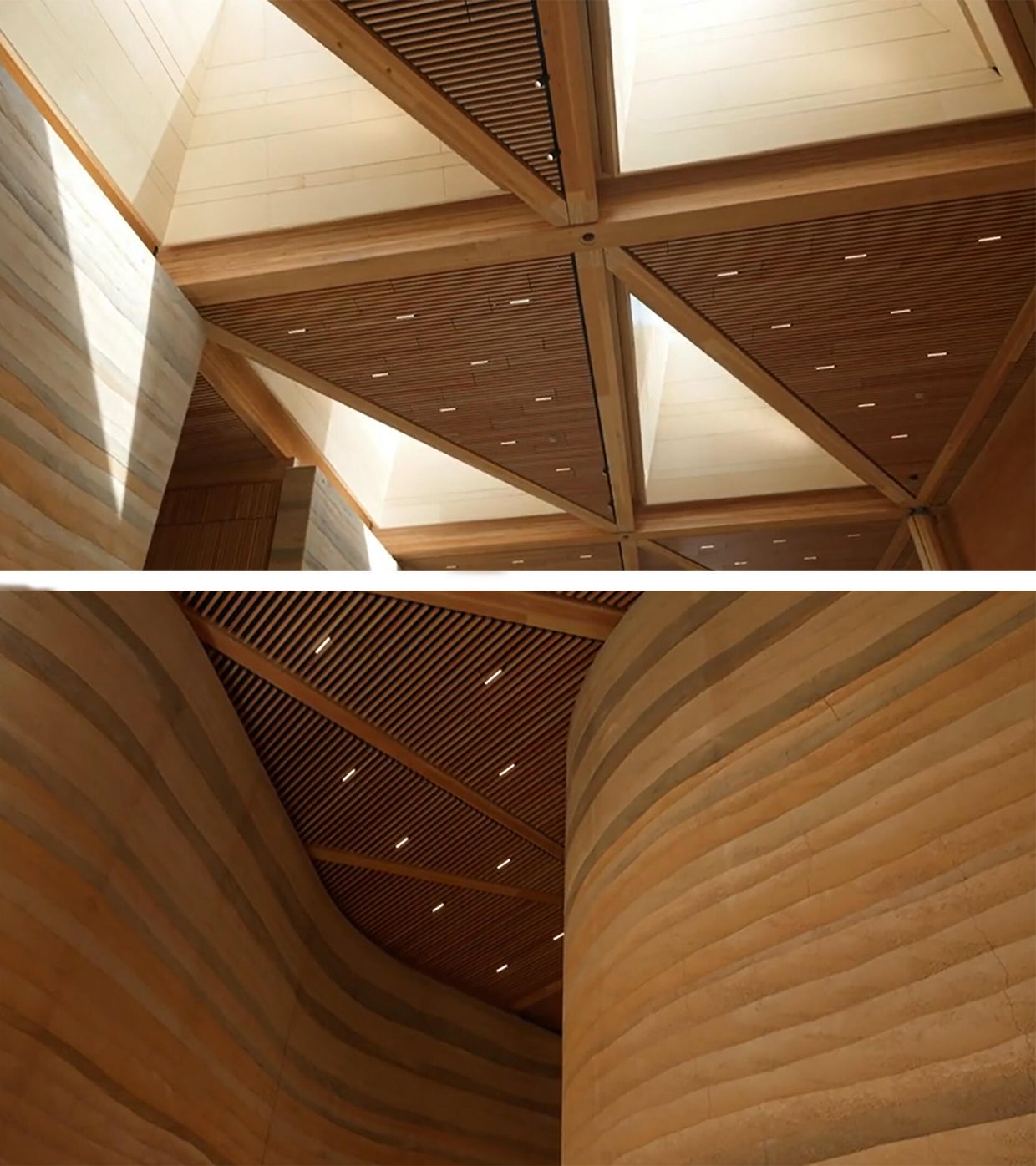
Everywhere we looked during our privileged sneak-peek back in March, it was hard to tell where nature ended and the library began. Its $450 million price tag is the biggest thing the small town of Medora, North Dakota, has ever experienced.
If you’re wondering why T.R.’s library is way out here instead of his native New York, it’s because were it not for his experiences way out here, Roosevelt said, he never would have been president.

Edward O’Keefe, CEO of the library, and author of the recent book “The Loves of Theodore Roosevelt: The Women Who Created a President” (Simon & Schuster), said, “Theodore Roosevelt grew up as a sickly, asthmatic child who lived his life through books and imagination. So here he is, 24 years old, on the plains and Badlands of North Dakota, and he’s living the life he only read about in books.”
But the reason he took up residence in the Badlands is hardly a happy one, said O’Keefe: “He was a broken man, in a broken land, and nature was his healer.”
In a tragic twist, Teddy Roosevelt’s mother, Mittie, and his young wife, Alice, both died in the same house, on the same day: Valentine’s Day 1884. “The light has gone out of my life,” Roosevelt wrote in his diary – the date marked by a bold X.
“At the funeral of his wife and mother – it was a double funeral – he was so desolate and so depressed, that they were concerned for his own safety,” said O’Keefe.
After settling his affairs (which included asking his sister to raise his newborn daughter, Alice), he headed West, alone. He’d been to the Dakota Territory just a year prior to hunt a pair of bison – the two that still hang in Roosevelt’s Long Island home to this day.

He dug in, and began living a kind of life many Dakota cowboys thought he wasn’t prepared to live. They were wrong.
O’Keefe said, “I think he had a ‘life wish.’ He realized that no matter how rich you are, no matter how privileged you are, that you don’t know what’s going to happen next. If you want to get something done in this world, if you want to love somebody, if you want to accomplish something, you gotta go.”
And it’s that kind of rugged, raw, and real intellectual journey that the library wants visitors not just to look at and to grasp, but experience. “Library and museum are the two worst descriptions of what the TR Library actually is,” said O’Keefe. “It’s a call to adventure.”
It’s the kind of place that couldn’t have been built even five years ago, because artificial intelligence is such a large part of it. For example, you don’t have to imagine what it’s like to be in T.R.’s boots; you can actually see it.
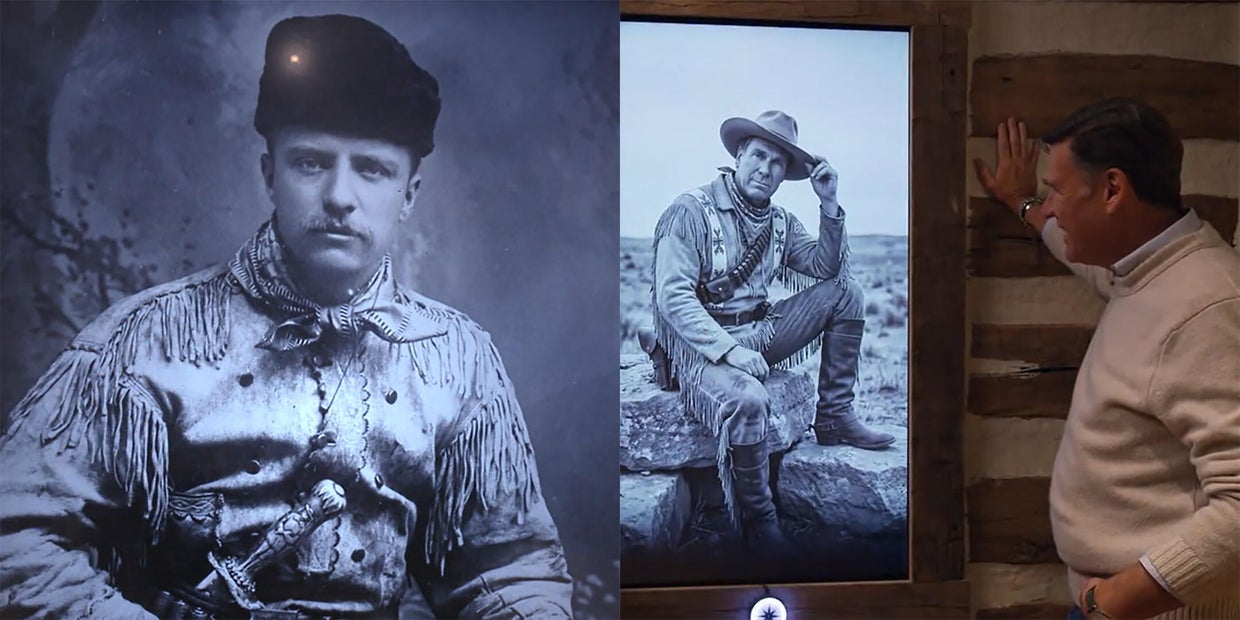
O’Keefe said, “We have created the world’s first presidential archive in AI. Participants can come here to the TR Library, and have an in-person conversation with an avatar of T.R. You do not come unprepared for a conversation with Theodore Roosevelt; he will have none of it.”
It will be the only presidential library that will have hitching posts for your horse. You can take a nature walk on a mile-long path through the prairie. You can sit by a campfire and hear tall tales of life on the range, and step into his cabin at the Elkhorn Ranch.
But for all the fun, there’s a serious bent, too. He was a man of his times, and his times weren’t always flattering.
“I wasn’t interested in doing a legacy project for Theodore Roosevelt,” said T.R.’s great-great-grandson, Theodore Roosevelt V. “There’s plenty of things named after him, plenty of statues. But the idea of just sort of basking in the glow of somebody and saying ‘This is a great man, let’s all look at him,’ isn’t particularly compelling. Normally, presidential libraries – it’s the principal [reason], the president trying to cement the first chapter of his legacy. In this case, we’ve got a hundred years-plus to be able to look back at his legacy, to really understand what that legacy is, what the lasting impacts were. We get to face those issues head-on.”
Including Roosevelt’s racist views of indigenous peoples, whom he often referred to as savages.
“We had a land blessing out here with the five tribes,” said Roosevelt, “to bless the land and really bring them into the project, so that we were working with them and making sure that their voices were heard, and that we were representing things appropriately.”
The library has taken possession of a statue of Roosevelt that was removed in 2022 from outside the American Museum of Natural History in New York. Critics argued that the message of a White man elevated above both a Native American and an African symbolized racial superiority.
“We are here to preserve the life and legacy of Theodore Roosevelt,” said O’Keefe. “I think it’s important that we eventually do something that contextualizes it appropriately, but not at the opening.”
If the Theodore Roosevelt Presidential Library has any message, it’s that courage and strength often come from personal tragedy, mis-steps, mistakes, and misunderstandings. As he famously said, it’s being in the arena that counts. And that, more than anything, may be the hindsight the library has to offer.
“He does not like the critic,” said O’Keefe. “He does not like the person on the sidelines pointing out how the strong man stumbles, or where the doer of deeds could have done them better. He likes the person who tries and fails. That’s a powerful lesson for today. I want kids in particular to come in and understand that if you want to change something in this world, you have got to be the source of that change.”
For more info:
Story produced by Aria Shavelson. Editor: George Pozderec.
For more info:
North Dakota
In ‘last chapter,’ North Dakota son who made ultimate sacrifice in World War II comes home

DAHLEN, N.D. — A spectacular summer day with blue skies, puffy clouds and a light breeze served as a perfect backdrop for the homecoming for a North Dakota hero of World War II.
Hundreds of people came to pay respects to U.S. Army Air Forces Staff Sgt. Irvin C. Ellingson on Saturday, June 20, in his hometown of Dahlen, North Dakota, 55 miles northwest of Grand Forks.
His funeral and burial were the culmination of three days worth of ceremonies, remembrances and celebrations for the extended Ellingson family, friends and community members.
Chris Flynn / The Forum
Brittany Jallo, a great niece to Ellingson, said the family has never let him be forgotten.
“It’s so surreal, it’s like I’m smiling and crying at the same time,” she said.
Terry Ellingson, one of Irvin’s nephews, said they can finally put him to rest alongside other family members.
“It’s a real gift to us, and it’s something that we don’t have to keep wondering about anymore,” he said.

Contributed / Lon Enerson
This was a day many prayed for
but feared might never come.
Ellingson, then 25, was working as a radar operator aboard a B-29 Superfortress that had completed a combat mission over Tokyo when it was fired upon by a Japanese fighter plane on April 14, 1945.
He and other crewmen parachuted safely, only to be captured by the Japanese military and held as prisoners of war. The American POWs in the Tokyo military prison died tragically six weeks later when a fire, sparked by U.S. bombing runs and high winds, swept through the wooden building.

Contributed
Positive identification of remains seemed almost impossible. But almost exactly one year ago, with the work of
forensic anthropologists using advanced DNA technology
and persistence by family members, it happened.
Lon Enerson, another of Ellingson’s nephews, spearheaded the years-long effort and plans to finally bring Ellingson’s remains back home.

Chris Flynn / The Forum
Enerson, now living in St. Cloud, Minnesota, grew up a few miles from the farmstead where Ellingson was born and raised.
He’s been trying to write a book about his uncle Irvin for four years.
“The book’s on hold, of course. I never knew we’d get this last chapter,” he said.
Ellingson’s remains arrived at Minneapolis-St. Paul International Airport from Joint Base Pearl Harbor-Hickam in Honolulu, Hawaii, early Wednesday, where family members waited on the tarmac.
“It was such an intimate experience for all of us, something that I’ll never forget, really,” Enerson said.
A contingent of law enforcement officers and motorcyclists escorted his remains north.
On Thursday, another convoy brought Ellingson’s remains
from the Fargo Air Museum to Grand Forks
for a ceremony featuring Gov. Kelly Armstrong, Sen. John Hoeven and Rep. Julie Fedorchak.
A family celebration on a rural Nelson County farmstead filled the day Friday leading up to Saturday’s farewell.

Chris Flynn / The Forum
At Dahlen Lutheran Church, one of Ellingson’s dress uniforms was on display in his open casket, with his wrapped remains situated toward the top.
His remains, and those of 61 other U.S. servicemen who perished in the Tokyo military prison fire,
first arrived at a forensic lab in Honolulu
in spring of 2022, where the painstaking work of identification began.
Many Ellingson family members contributed DNA to assist in that process.
Two forensic anthropologists from the Defense POW/MIA Accounting Agency, working in that lab in Hawaii, helped identify Ellingson’s remains.
The family grew so close to Kristen Grow and Melissa Menschel,
they invited them to Ellingson’s farewell. To many family members’ surprise, the two women were able to make the trip.

Chris Flynn / The Forum
“Everybody keeps thanking us, but we thank them for allowing us to be part of this process, for them having that persistence in the beginning, and then trusting us with this profound responsibility,” Grow said.
“We don’t interact very often with families unless they come to our lab, and so this is a rare opportunity for us … so we said we can’t miss it,” Menschel said.
The funeral featured music and scriptural readings from many extended Ellingson family members.
Enerson played the trumpet in several orchestral arrangements, and four other Ellingson nephews sang beautiful harmonies.
In the homily, Pastor Val Teppo spoke of the letters Ellingson wrote home to his family, saying it was time for him to get home.

Chris Flynn / The Forum
“Today isn’t the homecoming I am sure he was envisioning then when he wrote those letters, but more than 80 years later, Irvin is indeed coming home,” Teppo said.
Col. James Schlabach, commander of the 91st Missile Wing at the Minot Air Force Base, spoke of how Ellingson, at age 22, during the deadliest conflict in history, raised his right hand and said he was ready to serve.
“What I’d like to do as a final thank you on behalf of a grateful nation, a grateful U.S. military, is offer Staff Sgt. Irvin Ellingson one final salute,” Schlabach said.

Chris Flynn / The Forum
He left the lectern, approached the casket, and fired off a sharp, solemn salute.
Attendees loaded onto buses for the convoy to Middle Forest River Cemetery, just a few miles away on gravel roads.
First, the silver hearse carrying Ellingson’s casket had an important stop.

Chris Flynn / The Forum
It was driven onto the farmstead where Irvin once lived with his parents, Tommy and Ella Ellingson, and seven siblings — the place where the family spent many waking hours, wondering whether Irvin would ever come home.
The old farmhouse is no longer but the property is still very much in the family, as Ellingson’s great niece Brittany Jallo, her husband and children built a home there.

Chris Flynn / The Forum
The hearse circled the driveway and paused, looking out onto the rolling hills and creeks for one final farewell, as children waved American flags and a family member in Marine Corps blues stood at attention.

Chris Flynn / The Forum
The convoy proceeded to the cemetery for final military honors, which included the flyover of a B-52, a long-range strategic bomber from Minot Air Force Base.
With attendees craning their necks toward the sky, the plane’s wide wings appeared a stark contrast to fluffy clouds as it flew by.
At the conclusion, one attendee who said he wasn’t a family member, thanked Enerson and everyone involved for what he described as “an experience of a lifetime.”

Chris Flynn / The Forum

BISMARCK — North Dakota is experiencing losses on nearly every commodity outside of beef and cattle and the state is working toward finding solutions to the ongoing loss of cropland value. At the same time, costs have increased at a faster rate than farmers are used to. North Dakota Agriculture Commissioner Doug Goehring describes it as “death by a thousand paper cuts.”
“It’s not any one thing that’s taking farmers to their knees,” he said. “I needed to get a certain sensor in the fuel pump and that fall before COVID, we were coming out of a kind of a tough year and it was $1,700. I said, ‘Let’s just wait and put it in next spring.’ Well, next spring came around and it was $3,200. I mean, holy cow. And nothing changed. So, there just seems to be some opportunistic type of practices going on.”
Rules and regulations don’t seem to be helping. For Goehring, a look at certain regulations would be a good step. One example is the Regional Haze Rule adopted by the EPA in 1999, mandating that states develop and implement air quality protection plans to reduce the pollution that causes visibility impairment. North Dakota, with a clean coal emission in place and operating at 19 parts per million, was disadvantaged.
“You had air emission standards in Pennsylvania that were operating at 200. Then the memorandum came from the administration and EPA that you had to cut those emissions in half. How the heck do you cut 19 or 18 parts per million in half?” he said.
American culture has brought more hurdles, too.
Tom Campbell, USDA state director for Rural Development, notes the rise of GLP-1 drugs. People are eating less sugar, bread and starches, which could be hitting some key sectors regionally. Combined with rising expenses and fixed costs, it becomes a “double whammy.”
“You have to harvest everything, and hopefully we can get some big yields to offset some of the losses,” Campbell said, noting that weight-loss drugs may be “changing habits” among consumers.
“… I don’t know if it’s for sure or not, but we’re concerned about the future there, too.”
A bright spot for the region, but an unfortunate development for others, is drought in the Pacific Northwest. Low moisture levels there have added dollars to other markets.
“Unfortunately, somebody else’s disaster is our benefit. But, usually, that’s what it takes: somebody else’s problems to fix our problems,” Campbell said.
With prices, it’s a waiting game. High prices are generally thought to correct themselves with low demand. What can be controlled, Goehring believes, is the way rules and regulations are considered.
Measurable outcomes could give detailed accounts of the domino effect that takes place with either implementing regulations or taking them away.
“There has to be some measurable difference on a basis at which the public can derive some value from a rule or regulation that goes in place. Because every one of them is impacting our daily lives, whether it’s at home, on the road or in our businesses,” Goehring said.
Digital Content Producer and Sports Reporter at the Grand Forks Herald since December of 2020. Maxwell can be contacted at mmarko@gfherald.com.
-

 Connecticut2 minutes ago
Strong Storm Emerges For Northern Connecticut: Here’s When, What To Know
-

 Delaware9 minutes ago
Modest Delaware Home Boasts Incredible Connections to American History Over 250 Years
-

 Florida12 minutes ago
8 Best Small Towns On Florida’s Emerald Coast For A Crowd-Free Summer
-

 Idaho17 minutes ago
Renewing a Sanctuary for Salmon and People
-

 Georgia17 minutes ago
Georgia football trying to flip Grayson CB recruit
-
Hawaii24 minutes ago
I took my 30-year-old son on a vacation to Hawaii. We had to set ground rules first.
-

 Illinois32 minutes ago
Lake County detectives rescue girl from man they say drove to Illinois from Georgia to meet her
-

 Indiana39 minutes ago
US Education Department Oks Indiana Waiver To ‘Streamline’ Education Spending


