Entertainment
‘The Night Manager’ Season 2 returns with explosive reveals: ‘Every character’s heart is on fire’


This article contains spoilers for the first three episodes of “The Night Manager” Season 2.
It wasn’t inevitable that “The Night Manager,” an adaptation of John le Carré’s 1993 spy novel, would have a sequel. Le Carré didn’t write one and the six-episode series, which aired in 2016, had a definitive ending.
But after the show’s debut, fans clambered for more. They loved Tom Hiddleston’s brooding, charismatic Jonathan Pine, a hotel manager wrangled into the spy game by British intelligence officer Angela Burr (Olivia Colman). And at the heart of the series was the parasitic dynamic between Pine and his delightfully malicious foe, an arms dealer named Richard Onslow Roper (Hugh Laurie).
The show was so good that even the story’s author wanted it to continue. After the premiere of Season 1 at the Berlin International Film Festival, Le Carré sat across from Hiddleston, a twinkle in his eye, and said, “Perhaps there should be some more.”
“That was the first I’d heard of it or thought about it,” Hiddleston says, speaking over Zoom alongside the show’s director, Georgi Banks-Davies, from New York a few days before the U.S. premiere of “The Night Manager” Season 2 on Prime Video, which arrived Sunday with three episodes, 10 years after the first season. “But it was so extraordinary and inspiring to come from the man himself. That’s when I knew there might be an opportunity.”
Time passed because no one wanted a sequel of less quality. Le Carré died in 2020, leaving his creative works in the care of his sons, who helm the production company the Ink Factory. That same year, screenwriter David Farr, who had penned the first series, had a vision.
“We didn’t want to rush into doing something that was all style and no substance that didn’t honor the truth of it,” Farr says, speaking separately over Zoom from London. “There was this big gap of time. But I had this very clear idea. I saw a black car crossing the Colombian hills in the past towards a boy. I knew who was in the car and I knew who the boy was.”
That image transformed into a scene in the second episode of Season 2 where a young Teddy Dos Santos (Diego Calva) is waiting for his father, who turns out to be none other than Roper. From there, Farr fleshed out the rest of the season, as well as the already-announced third season. He was interested in the relationship between fathers and sons, an obsession of Le Carré’s, and in how Jonathan and Roper would be entangled all these years later.
Teddy Dos Santos (Diego Calva) is revealed to be Roper’s son.
(Des Willie / Prime Video)
“Teddy crystallized very quickly in my head,” Farr says. “All of the plot came later — arms smuggling and covert plans for coups in South America. But the emotional architecture, as I tend to call it, came to me quite quickly. That narrative of fathers and sons, betrayal and love is what marks Le Carré from more conventional espionage.”
“There was enormous depth in his idea,” Hiddleston adds. “It was a happy accident of 10 years having passed. They were 10 immeasurably complex years in the world, which can only have been more complex for Jonathan Pine with all his experience, all his curiosity, all his pain, all his trauma and all his courage.”
Farr sent scripts to Hiddleston in 2023 and planning for Season 2 began in earnest. The team brought Banks-Davies on in early 2024, impressed with her vision for the episodes. Hiddleston was especially attracted to her desire to highlight the vulnerability of the characters, all of whom present an exterior that is vastly different than their interior life.
“Every character’s heart is on fire in some way, and they all have different masks to conceal that,” Hiddleston says. “But Georgi kept wanting to get underneath it, to excavate it. Explore the fire, explore the trauma. She came in and said, ‘This show is about identity.’ ”
“I’m fascinated with how the line of identity and where you sit in the world is very fragile,” Banks-Davies says. “I’m fascinated by the strain on that line. In the heart of the show, that was so clearly there. I’m also always searching for what brings us together in a time, particularly in the last 10 years, that’s ever more divisive. These characters are all at war with each other. They’re all lying to each other. They’re deceiving each other for what they want. But what brings them together … instead of pushes them apart?”
The new season opens four years after the events of Season 1 as Jonathan and Angela meet in Syria. There, she identifies the dead body of Roper — a reveal that suggests his character won’t really be part of Season 2. After his death, Pine settles into a requisite life in London as Alex Goodwin, a member of an unexciting intelligence unit called the Night Owls.
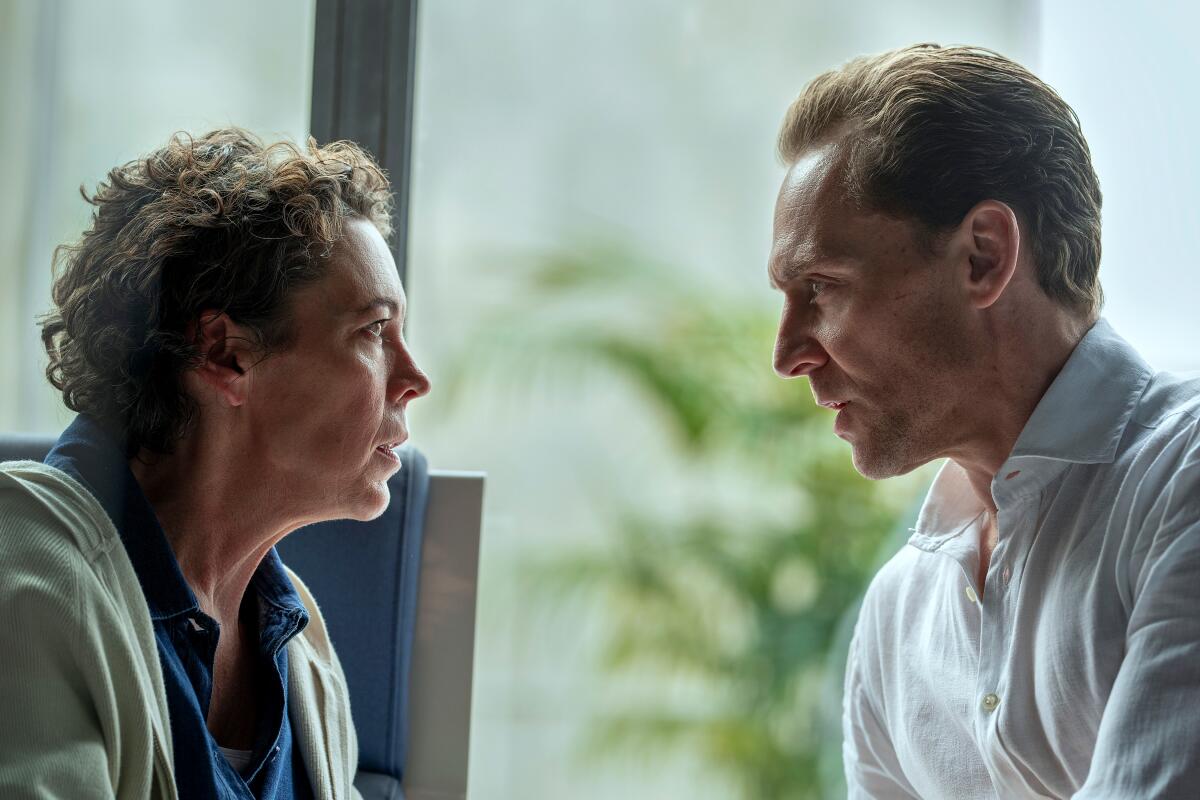
Angela (Olivia Colman) and Jonathan (Tom Hiddleston) meet in Syria, four years after the events of Season 1.
(Des Willie / Prime Video)
“He’s half asleep and he lacks clarity and definition,” Hiddleston says. “His meaning and purpose have been blunted and dulled. He is only alive at his greatest peril, and the closer his feet are to the fire, the more he feels like himself. He’s addicted to risk, but also courageous in chasing down the truth.”
That first episode is a clever fake-out. Soon, Jonathan is on the trail of a conspiracy in Colombia, where the British government appears to be involved in an arms deal with Teddy. It quickly becomes the globe-trotting, thrill-seeking show that captivated fans in Season 1. There are new characters, including Sally (Hayley Squires), Jonathan’s Night Owls’ partner, and Roxana Bolaños (Camila Morrone), a young shipping magnate in league with Teddy, and vibrant locations. Jonathan infiltrates Teddy’s organization, posing as a cavalier, rich businessman named Matthew Ellis. He believes Teddy is the real threat. But in the final moments of Episode 3 there’s another gut-punching fake-out: Roper lives.
“The idea was: We must do the classic thing that stories do, which is to lose the father in order that he must appear again,” Farr says. He confirms there was never an intention to make “The Night Manager” Season 2 without Laurie. “What makes it work is this feeling that you are off on something completely new,” Farr says. “But that’s not what I want this show to be.”
Hiddleston compares it to the tale of St. George and the dragon. “They define each other,” he says. “At the end of the first series, Jonathan Pine delivers the dragon of Richard Roper to his captors. But after that, he is lost. The dragon slayer is lost without the presence of the dragon to define him. And, similarly, Roper is obsessed with Pine.”
Jonathan realizes the truth as he sneaks up to a hilltop restaurant to listen in on a meeting. Banks-Davies opted to shoot the entire series on location, and she kept a taut, quick pace during filming because she wanted the cast to feel the tension all the way through. She and Hiddleston had a shared motto on set: “There’s no time for unreal.” Thanks to her careful scene-setting, Roper’s arrival and Jonathan’s reaction were shot in only 10 minutes.
“I felt everything we talked about for months and everything we’d shot up until that point and everything we’d been through was in that moment,” Banks-Davies says. “There are so many emotions going on, so much being expressed, and it’s just delivered like that. But it was hard to get us there.”
Farr adds, “It is the most important moment in the show in terms of everything that then follows on from that.” He wrote into the script that Roper’s voice would be heard before Laurie was seen on camera. “It’s more frightening when something is not instantly fully understood and seen,” he says. “You hear it and you think, ‘Oh, God, I know that [voice].’ ”
Hiddleston wanted to play a range of emotions in seconds. He describes it as a “moment of total vitality.” Right before the cameras rolled, Banks-Davies told Hiddleston, “The dragon is alive.”
“After all the work, that’s all I needed to hear,” he says. “This moment will be memorable to him and he’ll be able to recall it in his mind for the rest of his life. He is wide awake, and reality is re-forming around him. His sense of the last 10 years, his sense of what he can trust and who he can trust, the way he’s tried to evolve his own identity — the sky is falling. There is a mixture of shock, grief, disenchantment, disillusionment, surprise and perhaps even relief.”
As soon as Jonathan arrives in Colombia and meets Teddy, a calculating live-wire dealing with his own sense of isolation, he becomes more himself. Hiddleston expresses him as a character desperate to feel the edge. Despite his layered duplicity, Jonathan understands and defines himself by courting risk.
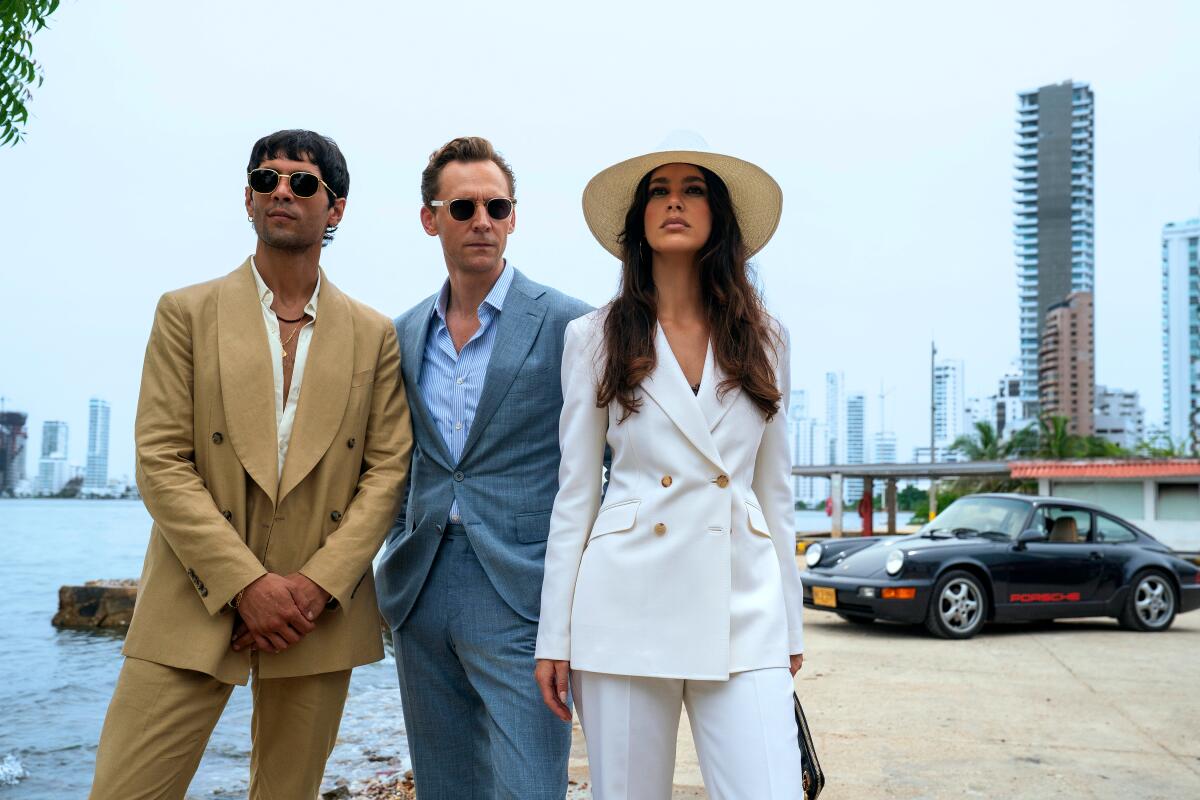
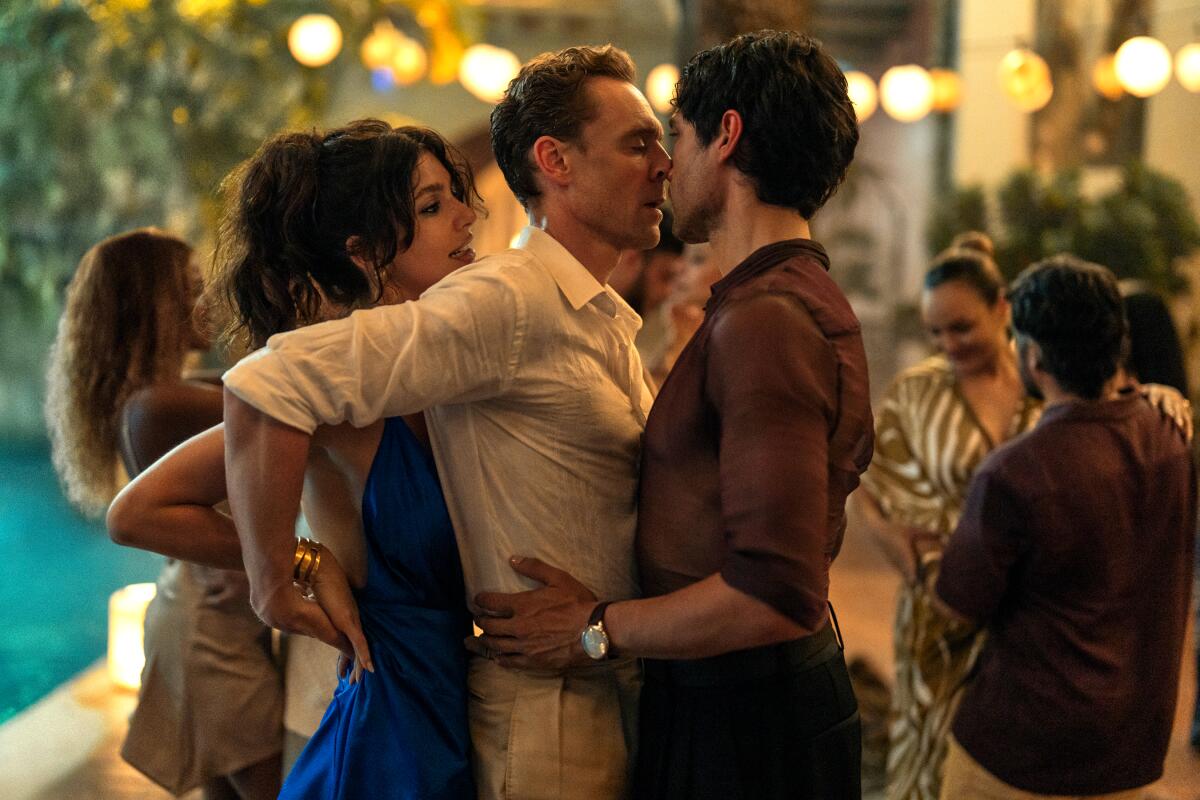
Teddy (Diego Calva), Jonathan (Tom Hiddleston) and Roxana (Camila Marrone) get close. “This is a character who pushes his body to the limit and sacrifices enormous parts of himself at great personal cost to his body and soul,” Hiddleston says of Jonathan. (Des Willie/Prime Video)
“This is a character who pushes his body to the limit and sacrifices enormous parts of himself at great personal cost to his body and soul,” Hiddleston says. “He goes through a lot of pain, but also there’s great courage and resilience and enormous vulnerability. That’s what I relish the most, these are heightened scenarios that don’t arise as readily and in my ordinary life.”
“I could feel that shooting moments like this,” Banks-Davies adds. “Like, ‘It’s right there. Are we going to get it?’ Our whole show exists in that space between safety and death.”
Roper’s presence sends a ripple effect across the remaining three episodes. As much as Jonathan and Teddy are in opposition, they are parallel spirits, both with complicated relationships to Roper. Hiddleston describes them as “a mirror to each other,” although they can’t quite figure out what to be to each other. And neither knows who the other person really is.
“It is interesting, isn’t it, that my first image of him was 7 years old and that stays in him all the way through,” Farr says. “This sense of this boy who is seeking something — an affirmation, a place in the world. And he’s done terrible things, as he says to Pine in Episode 3. All of that was present in that first image I had.”
Hiddleston adds, “There is a competition, too, because Roper is the father figure, and they both need him in very different ways. Teddy is a new kind of adversary because he’s a contemporary. He’s got this resourcefulness and this ruthlessness, but also this very open vulnerability, which he uses as a weapon. They recognize each other and see each other.”
The characters’ dynamic is at the root of what drew Banks-Davies to the series. “It’s not about where they were born, it’s not about their economic status or their religion or their cultural identity,” she says. “It’s about two men who are lost and alone and solitary, and see a kinship in that. They are pulled together on this journey.”
Season 2, which will release episodes weekly after the first drop, will lead directly into Season 3, although no one involved will spill on when it can be expected. Hopefully they will arrive in less than a decade.
“It won’t be as long, I promise,” Farr says. “I can’t tell you exactly when, because I don’t know. But definitely nowhere as long.”
“That was the thrill for us, of knowing that when we began to tell this story, we knew we had 12 episodes to tell it inside, rather than just six,” Hiddleston says. “So we can be slightly braver and more rebellious and more complex in the architecture of that narrative. And not everything has to be tied up neatly in a bow. There’s still miles to go before we sleep, to borrow from Robert Frost, and that’s exciting. It’s exciting for how this season ends, and it’s exciting for where we go next.”

Movie Reviews
‘Backrooms’ Review: Chiwetel Ejiofor and Renate Reinsve Get Lost in A24’s Creepy but Underbaked Liminal Horror

Appropriately for a surreal realm comprised of inexplicable angles that stretch across impossible dimensions and seem, as one explorer puts it, cobbled together by “construction workers on acid,” the Backrooms, as a premise, have no precise parameters. You might think of it less as a story than a shared alternate reality, originating as a creepypasta (internet-based urban legend) and then taking on a life of its own as fans added bits of lore and started to spin it into works of their own.
Now that concept seems poised to break containment into the mainstream with Backrooms, a slickly produced feature boasting a buzzy studio (A24), bona fide arthouse stars (Chiwetel Ejiofor, Renate Reinsve) and established genre leaders (James Wan, Osgood Perkins) among the producers.
Backrooms
The Bottom Line Unnerving but never quite frightening.
Release date: Friday, May 26
Cast: Chiwetel Ejiofor, Renate Reinsve, Mark Duplass, Finn Bennett, Lukita Maxwell
Director: Kane Parsons
Screenwriter: Will Soodik
Rated R,
1 hour 50 minutes
But if the film captures something of the concept’s intriguing unease — with 20-year-old director Kane Parsons drawing from his own Backrooms-set short films, created when he was just a teenager — its underbaked storytelling made me wonder if some spooky ideas might be better left as whispers in the dark.
Though the Backrooms are ineffably strange (“Imagine describing a dog to someone who’s never seen one and then asking them to draw it,” characters reply when asked to explain them), the world we cut through to get there is almost suspiciously normal. In a quiet California suburb circa 1990, Clark (Ejiofor) is a failed architect who makes his living as the proprietor of Cap’n Clark’s Ottoman Empire — or rather tries to, since the discount furniture store’s total lack of customers suggests a business on the verge of collapse. His life has gotten miserable enough that he’s seeing a therapist, Mary (Reinsve), to deal with the implosion of his marriage.
Up late watching TV at the store one night (because he’s been sleeping there ever since his wife kicked him out after a bitter, booze-fueled fight), he ventures downstairs to fiddle with the breaker, whereupon he discovers he can just kind of slip through one of the walls, as easily as stepping into a beam of light. On the other side lies a room not unlike the windowless carpeted basement he’s emerged from. But this one is lit in a sickly institutional yellow, with all its furniture haphazardly piled in the middle. Also, it seems to go on forever. No matter how deep Clark wanders into it, all he finds are more rooms, corridors, staircases, doorways, crawlspaces.
It’s a deliciously creepy concept, tickling the same elemental unease provoked by other liminal horror stories like 2022’s unsettling Skinamarink or Mark Z. Danielewski’s 2000 novel House of Leaves: If structures like homes and offices and stores are meant to contain and protect, there’s something disturbing about one that refuses to conform to those boundaries — that shifts beyond the known laws of the universe so that what should have been a safe space becomes a trap.
The horrors that lie within this particular trap take some time to reveal themselves. At first, our disquiet and Clark’s mostly stem from sights that, while not overtly threatening, simply feel wrong: a stop sign printed backwards and erected in a dark room, a cardboard cutout fitted with a tape recording of messages in foreign languages, shoes embedded in the floor at an angle that suggests said floor materialized suddenly out of nowhere to slice right through them.
But eeriness for its own sake has its limits. The longer we spend exploring the Backrooms, the less frightening and more random these oddities start to feel. They seem designed not according to some internal logic of this universe or psychology of these characters but simply as an attempt to keep us guessing; it works only until it becomes apparent that there are no meaningful answers forthcoming.
Meanwhile, Clark and Mary (to say nothing of other minor characters played by Mark Duplass, Finn Bennett and Lukita Maxwell) are painted in extremely broad strokes. Even allowing that one of the movie’s central concerns is the way we create mental loops that keep us fixed in our miseries, the choice to define each of them through a single formative trauma and nothing else renders them too flat to care about.
I suppose the advantage of Clark’s lack of any other traits, including a self-preservation instinct, is that it makes him an ideal conduit for us into this universe: Since he never stops to consider whether wandering freely around what amounts to a haunted maze might be a bad idea, we never have to stop poking around it either. The further he goes, the more harrowing things get. The roar of a monster that had seemed distant at first seems to grow louder and more frequent, evidence of its violence clearer and harder to ignore (though never very graphic; Backrooms traffics more in dread than gore).
In its best moments, Backrooms brushes up against something bittersweet about the way our memories warp a little every time we access them, until they’ve been stripped of real details and we’re left only with the emotional imprint they’ve left behind. In one striking sequence, the camera glides down a succession of living room floors, each one growing more abstracted until all that remains is a pitch-black hole radiating menace from a corner. In another, grotesque humanoid figures are frozen in a dinner table scene, so lacking in feeling or agency that they do not protest even when they’re stabbed.
At its worst, Backrooms tries to raise the stakes by trading subliminal chills for more explicit but also more generic thrills, culminating in an action-y climax that seems to exist solely to fulfill audience expectations of how a mainstream horror movie is supposed to end. The film wants to invite you in, but the more the Backrooms try to explain themselves, the more quotidian they feel. This is a realm better left to the shadows, where unsuspecting souls can fall down its rabbit holes before they even know what’s hit them.
Entertainment
Kevin Hart addresses Tony Hinchcliffe’s joke: ‘What do you want me to do? Drag him off?’

After his Netflix roast inspired tit-for-tat feuding among comedians and backlash from viewers over a joke about George Floyd, Kevin Hart’s stance is clear: All is fair in love, war and comedy.
During a Tuesday appearance on “The Breakfast Club,” Hart addressed the controversy stemming from Netflix’s “Roast of Kevin Hart,” which aired earlier this month and included material that shocked viewers. Tony Hinchcliffe, who helms the No. 1 live podcast in the world, “Kill Tony,” applied his politically incorrect approach to comedy that similarly outraged audiences at a 2024 campaign rally for then-presidential candidate Donald Trump.
“The Black community is so proud of you right now,” he quipped at Hart. “George Floyd is looking up at us all, laughing so hard that he can’t breathe.”
In 2020, Floyd was murdered by police Officer Derek Chauvin, who pressed his knee into Floyd’s neck for more than nine minutes, until he died. His last words were “I can’t breathe,” which he said more than 20 times. The killing sparked global unrest and the largest civil rights protest since the 1960s. Hart attended Floyd’s memorial and private service in Minneapolis.
“The George Floyd joke, it wasn’t a tasteful joke to our culture,” Hart told the podcast. “But our audience that’s watching the roast … you get why they’re doing it, you get why the racial humor is on the table.”
Hart continued that the approach to comedy is nothing new and said, “Tony Hinchcliffe arguably had the best set, or one of the best sets.”
“Would I tell those jokes? No, but do I get why they’re being told? Yes,” Hart said.
Floyd’s brother, Terrence Floyd, spoke with “Breakfast Club” host Loren LoRosa after the roast aired and said that he expected Hart to step in and tell Hinchcliffe he’d gone too far.
“What do you want me to do? Drag him off?” Hart asked during his appearance on the podcast. “That’s not what I agreed to do. That’s not the job at hand. The job at hand was to produce a successful roast, which I did.”
Not only has the Netflix roast caused a stir among viewers, but the comedians who participated also have been trading slights in recent weeks. Chelsea Handler didn’t mince words when she offered her take on Hinchcliffe, as well as Shane Gillis, who also performed a set during the roast. According to Handler, ex-girlfriends of the controversial comedians slid into her DMs and told her what she said she already knew about them.
“They’re racist,” she said during an appearance on Deon Cole’s “Funny Knowing You” podcast. “That they’re bigots, that they’re sexist, that they think they’re like invincible.”
Handler said that one of Gillis’ jokes about lynching Hart was “worse than rape.” In response, Gillis told the Hollywood Reporter in a statement that Handler was capitalizing on the moment.
On Monday’s episode of “Kill Tony,” Hinchcliffe responded to Handler’s remarks by calling her “a bit of a c—. “
Movie Reviews
‘Madame’ Review: A Working-Class Frenchwoman Looks After a Saudi Prince’s Mistress in This Smart and Nuanced Debut

Laura (Malou Khebiz), a young French woman, takes a job as a personal assistant/cleaner/chef for Souria (Soundos Mosbah), the effectively incarcerated mistress of a Saudi prince (Kassem Al Khoja), in the smart, psychologically nuanced French drama Madame (Le Triangle d’Or).
A debut feature for director Hélène Rosselet-Ruiz, written in collaboration between Rosselet-Ruiz and Pauline Guéna, this was reportedly inspired by a very similar experience the director herself had working for a wealthy Gulf state family, although tweaks have been made to facilitate the drama. The often imperious behavior of the titular Souria, who is not allowed to leave her gilded cage of a mansion, and the conspicuous consumption she and her lover enjoy may seem outrageous, but the milieu is largely convincingly depicted — right down to the keeping of a miserable black panther in a closet enclosure, whom the prince’s factotum Emre (Ziad Bakri) has to drug daily lest it cry all day and night out of despair. All in all, the film offers a well-considered analysis of the class, gender and cultural dynamics inherent in the core situation that doesn’t preach or polemicize.
Madame
The Bottom Line Perceptive and credible.
Venue: Cannes Film Festival (Special Screenings)
Cast: Malou Khebiz, Soundos Mosbah, Ziad Bakri, Kassem Al Khoja
Director: Hélène Rosselet-Ruiz
Screenwriters: Hélène Rosselet-Ruiz and Pauline Guéna
1 hour 27 minutes
The opening sequence shows a variety of women, including Laura, being interviewed for the assistant position by a recruiter, all of it filmed by low-resolution security cameras, a device deployed throughout, although thankfully not for the entire film. The security footage, with its date and time stamps and weird angles, acts as a reminder of the vigilance of the Saudi family who eventually hire Laura, shadowy figures who are mostly behind the cameras watching to ensure their employees and subjects like Souria are doing what they’re supposed to do.
In fact, there is a kind of fuzziness around whom Laura is meant to report to. She’s paid to be at Souria’s beck and call every moment of the day and often gets awakened at strange times in the night for errands, like going out to buy every item on a fast-food restaurant’s menu and bring it back for a midnight feast. At the same time, Palestinian employee Emre reminds Laura that its actually the sheikh who is paying her wages, and when Emre and the boss are off on trips (usually to visit the sheikh’s legal wife, whom we never meet), Laura’s job is to spy on Souria, making sure she never leaves, and to report on everything she does.
Even so, Souria likes to pretend, if only to herself, that she’s in charge and she will often say abusive things to Laura, ridiculing her dress sense, embarrassingly scrutinizing her body, and reminding her in every way that she is a servant. Laura is not supposed to ever look the prince in the eyes when he’s there, and at one point early on she’s advised to never look more attractive than Souria, who has a very jealous streak, which is mostly directed at the prince’s legitimate wife. A little deluded and possibly driven a little crazy by the constant isolation of living in a harem of one, Souria is convinced that someday he will leave his wife and marry her and then everything will be coming up roses. Indeed, he sends a truckful of red roses one day to the house after a fight, but all they do is get in the way and slowly wilt.
After Laura snaps one day and threatens to quit after Souria goes too far with her insults, the power shifts abruptly. Laura decides to stay when she sees Souria’s desperate reaction, literally beating herself up like a contrite child. Similarly, she grows closer to Emre, who has a heart underneath his veneer of cold professionalism and worries profoundly about his family back in Palestine, whom the sheikh has promised to help emigrate.
In a way, Laura has the least investment in the situation as she can walk away any time she wants and pursue her ambition to join the army, a goal she’s working toward by doing push-ups and pull-ups everyday in her tiny maid’s bedroom. She’s only there for the money, which is needed to help out her sister, who has a young daughter — although the longer Laura spends with these ultra-wealthy foreigners in their tower of gold, the less she can relate to her sister’s working-class Parisian friends, met on a rare night out to celebrate a birthday.
Guena and Rosselet-Ruiz’s deft script tracks the power shifts and realignments of sympathy in this claustrophobic environment with persuasive subtlety, although a near final scene where Laura, Souria and Emre all finally drop their rigid roles and get drunk together may seem a little abrupt to some. The homestretch of the drama, however, takes the story in a chilling direction, packing an aching quantity of feeling into a single glance at a security camera as someone climbs into a car and leaves the compound, never to be heard from again. For all the high tech and haute couture on display throughout, this feels much like a modern fairy tale, one warning young women against seeking love and riches that have hidden costs to the soul, deadly as a depressed panther in a cage.
-

 New Hampshire2 minutes ago
SEE THE GOOD: New Hampshire teens jump in to fix broken car wash equipment – Boston News, Weather, Sports | WHDH 7News
-

 New Jersey8 minutes ago
The House Is Our Firewall. NJ-07 Is How We Build It. – Insider NJ
-

 New Mexico14 minutes ago
New Mexico early voting turnout surpasses 2024 Primary Election
-

 North Dakota26 minutes ago
University of North Dakota seeks to scale up critical mineral refining
-

 Ohio32 minutes ago
Columbus public safety leaders say they were abused by OSU doctor
-

 Oklahoma38 minutes ago
Deadly shooting overnight near NW 23rd and Portland in Oklahoma City
-

 Oregon44 minutes ago
Oregonians to see rare ‘blue moon’ and ‘micromoon’ early next week
-

 Pennsylvania50 minutes ago
Man working on vehicle crushed to death, Pennsylvania officials say

