Business
Kevin Costner’s western ‘Horizon’ faces more claims of unpaid fees


In the midst of attempting to complete filming on his western anthology ”Horizon: An American Saga,” Kevin Costner is facing another legal dispute over the production.
On Monday, Western Costume Co. sued Costner and the production companies behind the epic western, claiming unpaid costume fees and damages to some of the clothing during the filming of the series’ second episode.
“The costumes are costly to replace if damaged or not returned,” states the complaint, which included copies of invoices for about $134,000 in costume rentals. “Without a reasonable basis for doing so and/or with reckless regard to the consequences, defendants failed to pay for the rented costumes and failed to return the costumes undamaged.”
Western Costume, the iconic business based in North Hollywood, is seeking to recover roughly $440,000, including legal fees, according to the lawsuit filed Monday in Los Angeles Superior Court.
A spokesperson for Costner did not immediately respond to a request for comment.
The lawsuit is the latest in a series of legal and financial problems that have dogged the sprawling western drama, which Costner directed, co-wrote, starred in and partially funded.
In May, United Costume Corp., sued the production, claiming $350,000 in unpaid fees for the first two chapters of “Horizon.” Two months later, the costume firm filed to dismiss the suit with prejudice.
In May, Devyn LaBella, a stunt performer on “Chapter 2,” sued the production for sexual discrimination, harassment and retaliation in Los Angeles Superior Court. LaBella alleged an unscripted rape scene was filmed without the presence of a contractually mandated intimacy coordinator.
In a motion filed in August to get the suit tossed, Costner said he had reviewed LaBella’s complaint and was “shocked at the false and misleading allegations she was making.”
In October, a Los Angeles Superior Court judge denied Costner’s anti-SLAPP motion to dismiss the case. The judge also denied LaBella’s claim that Costner had interfered with her civil rights through the use of intimidation or coercion with respect to her participation in the filming of a rape scene, but allowed several of her other claims to proceed.
The case is pending.
The production is also facing an arbitration claim for alleged breaches in its co-financing agreement with its distributor New Line Cinema and City National Bank, “Horizon” bondholder, according to the Hollywood Reporter.
In June 2024, “Chapter 1” of the planned four-part series was released in theaters followed by a streaming broadcast on HBO Max, but it was largely panned by critics.
In its review, The Times described “Horizon” as “a massive boondoggle, a misguided and excruciatingly tedious cinematic experience.”
It failed at the box office, grossing just $38.8 million worldwide, on a reported $100 million budget.
“Chapter 2” premiered at the Venice International Film Festival last September, but its theatrical release was pulled and remains indefinitely delayed, while the final two chapters remain in production or development, according to IMDb.


Internet culture is showing up in a big way in theaters, as low-budget horror films “Backrooms” and “Obsession” led this weekend’s box office and beat out big franchise films like “Star Wars: The Mandalorian and Grogu.”
A24’s “Backrooms” topped the charts with $81.5 million in the U.S. and Canada in its opening weekend, according to studio estimates. The film is directed by 20-year-old YouTuber Kane Parsons, who based it on his internet series of the same name.
“Backrooms,” which reportedly had a production budget of about $10 million, stars Chiwetel Ejiofor as a furniture store owner who finds a mysterious portal in his basement. The film made a total of $118 million worldwide.
In second place was Focus Features’ “Obsession,” which hauled in $26.4 million in its third weekend in theaters, up 10% from the previous weekend’s total. The film, which had a production budget of less than $1 million, has now grossed $104.7 million domestically for a global total of $148 million.
“Obsession” director Curry Barker is also known for his YouTube sketch comedy channel.
The success of two YouTube-native filmmakers at the box office indicates the growing power of the platform — and online culture as a whole — in attracting audiences to cinemas.
Walt Disney Co. and Lucasfilm’s “The Mandalorian and Grogu” fell to third place this weekend with a domestic gross of $25 million. Lionsgate’s musical biopic “Michael” ($11.7 million) and Sony Pictures’ family comedy “The Breadwinner” ($7.5 million) rounded out the top five at the box office, according to Comscore data.

Fernando Flores can spend eight hours a day pouring the same cup of coffee.
He is not a barista. He’s a robot puppeteer, trying to train humanoids.
He manipulates mechanical arms remotely, using hand and arm sensors to make them pick up a pot of coffee, pour it into a mug and put the pot back in the coffee maker. Flores checks for spills, then empties the mug back into the pot by hand and does it again — hundreds of times.
“The repetitiveness, it can cause some discomfort,” said Flores, who has the title of senior robotic pilot at San Francisco startup Encord. “It becomes second nature after a while.”
This Sisyphus of Silicon Valley is on the front lines of a rapidly expanding industry of robot trainers, preparing to teach and operate the army of humanoid robots scheduled to march out of nearby factories in the coming year. Encord practices, records and sells data about movement to the companies racing to bring humanoids to homes, offices and factories.
If tech companies’ optimistic plans are to be believed, a swarm of American-built robots is about to hit the market.
Tesla’s Fremont factory stopped car production this year to make way for production lines for its Optimus robots, with unbelievable plans to ramp up capacity to 1 million units a year. Palo Alto-based 1X Technologies is already manufacturing its 66-pound, 5-foot-6 humanoid named Neo at its factory in Hayward. The company received 10,000 preorders, and its first shipment is expected later this year. Figure AI’s humanoid factory in San Jose has increased its manufacturing capacity to produce one Figure 03 robot an hour, with the goal of producing 12,000 a year.
Fernando Flores demonstrates the articulation of a robot performing a whisking motion at Encord on May 21.
(Paul Kuroda / For The Times)
Goldman Sachs projects the global market for humanoids could reach $38 billion by 2035.
The AI of these humanoid robots needs an immense amount of data on human movement. How humans write, speak, code and compose was easily scraped off the internet, but the bots need more information to master how to stand, step, lift, squeeze, pour and perform other physical movements. That is where companies like Encord come in.
The $10 billion invested in robotics in 2026, according to CB Insights, has spawned an industry focused on training robots. Initially, that meant humans strapping iPhones to their foreheads, recording actions like cooking, cleaning and performing household chores. That, however, doesn’t capture the exact torque, force and grip required for a robot hand to work flawlessly.
Now, humans are directly guiding robots through expensive rigs that let them control the robots’ movements. Data collected using robot arms offer richer insights into motor skills and object manipulation. Encord charges clients up to $1,000 per hour for training data.
The information gathered from trainers controlling robots is “super important to bridge the next level of learning,” where robots will learn to correct mistakes and do the chores on their own, said Vineeth Velmurugan, head of robotics learning at Encord.
The company is already working with some of the top companies in robotics, but said it couldn’t share most names. Among the clients it could mention were Toyota Research Institute and Weave, which already has laundry-folding robots in a few homes.

Brian Gonzalez pulls an ethernet cable using a robotic arm at startup Encord on May 20.
(Paul Kuroda / For The Times)
Many of the new robotic data companies are focusing on industrial use cases. Robots can perform better in a structured, predictable environment, like a factory or warehouse.
Home tasks are tougher, as layouts and tasks are more varied and messy. While many bots have mastered walking, they still struggle to open doors, fridges and washing machines smoothly. They don’t know where or how to grasp a doorknob, handle or door edge or how much pulling, pushing or twisting force to apply.
Flores has mastered making the robot arms pour coffee, but he still often spills. When that happens, he deletes records of the attempt.
“Typically, we don’t want any mistakes,” he said. “If we have more than three consecutive mistakes within a 15‑second window, that’s not going to be good data.”
Inside Encord’s test facility in Hayward, it has replicated a standard American home with a fully furnished living room, kitchen and bathroom.
In the living room, a pilot rearranges an untidy study desk. She first scatters AA-size batteries, pens and scissors on the table, and walks back to the nearby control rig to make the robot arms place each one inside the tray of a desk organizer.
Depending on the day’s training, the pilots could be opening and closing refrigerator doors, whisking liquids in a bowl, sorting silverware or turning a water faucet on and off over and over until the robot arms get it right.

Cortney Weintz, left, and Tony Schiller record data with cameras at Encord.
(Paul Kuroda / For The Times)
In another corner of the facility, people wearing smart glasses place and pick up playing cards and sort plastic plates by hand, collecting first-person videos.
One key skill for the coming bot invasion: plugging in cables.
Companies want robots that can crawl into duct spaces, identify ports and plug cables to help build the massive data centers needed for AI. Encord replicated a real data center server rack, where an operator inserts blue cables into penny-sized sockets all day.
Many companies have entered this business. Meta-backed Scale AI and Palo Alto-based Micro1 are major players in the space. China has more than 40 state-owned robot data-collection facilities where hundreds of on-site humans mimic train bots how to move in the real world.
In Watertown, Mass., Tutor Intelligence has set up a 100-robot facility dedicated to harvesting movement data. Its robot arms, which are being trained to do factory work, are controlled by a human team split across Mexico, the Philippines and Boston. This is in part to train its robot, Sonny, which will hit the market later this year.

Elaine Batchlor sorts screws and bolts with a robot in a mockup at Encord.
(Paul Kuroda / For The Times)
“We built the Data Factory to bootstrap the initial intelligence for the Sonny robot, so that we can begin to deploy Sonny into the field,” said Josh Gruenstein, co-founder of Tutor. Ten of its remote operators are based in Boston, and the rest are international.
Remote operation is emerging as an integral part of the humanoid robot business. Employing teleoperators in countries where wages are much lower than in the U.S. could, in theory, mean a robot controlled by a human in another country could do a task at a fraction of the cost of having an American do it.
This month, a humanoid robot cleaning service in San Francisco called Gatsby completed a robot cleaning of a U.S. home using a teleoperator in Mexico.
The technology is still evolving, said Aron Frishberg, co-founder of Gatsby, but being a first mover means Gatsby is getting more training.
“There’s obviously stuff that goes wrong,” he said. “It’s really hard to get precise hand movements or arm movements and grab something.”
Encord co-founder Ulrik Hansen said it will be setting up a teleoperations center in its Hayward facility in the next three months. Even as more robots are deployed and master increasingly sophisticated tasks, they will still need humans to occasionally take control remotely.
“They will need some exception handling when they get things wrong,” he said.
Hundreds of teleoperators will learn where the system succeeds, where it breaks and step in when needed. Once those patterns emerge, Hansen said, they can move teleoperations to cheaper locations abroad or to the Midwest.
Back in Hayward, Flores created new coffee-pouring challenges for his robot arms. He changed what was on the counter around the coffee maker and moved the mug to different spots. It takes a lot of know-how to puppet and train a robot, he said.
“A lot of people would (guess) this might be easy, this is dumb,” Flores said. “There actually is thought here. There actually is critical thinking.”
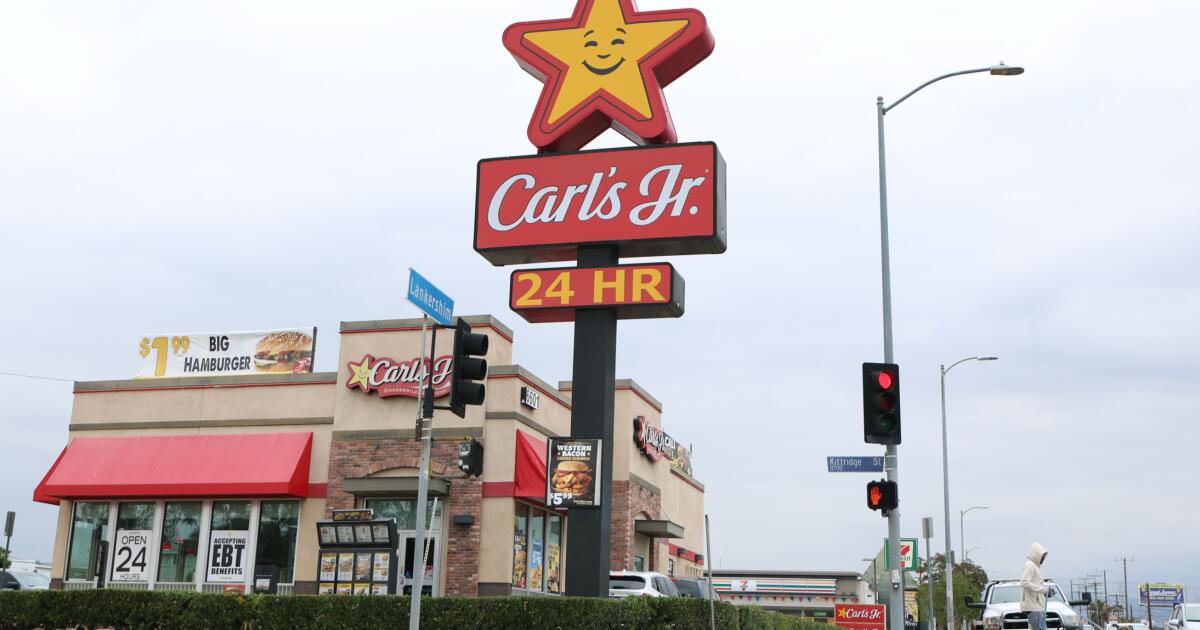
A Carl’s Jr. franchisee is trying to close and sell his 59 locations in California after filing for bankruptcy protection in April.
The franchisee, Harshad Dharod, who has branches mostly in Southern California, intends to close 10 of the branches he controls and find a buyer for the remainder, according to a broker helping find buyers.
In earlier bankruptcy filings, Dharod had blamed California and Carl’s Jr. for his stores’ struggles. Dharod said a lack of support and innovation from Carl’s Jr. and an increase in labor costs from a $20 minimum wage left him unable to cover his expenses.
Dharod couldn’t be reached for comment.
A spokesperson for Carl’s Jr. and its parent company CKE Restaurants, said they are aware of Dharod’s decision to sell.
“This situation is specific to this individual franchisee’s financial and business circumstances,” said the spokesperson. “This has no impact on the operations of any other Carl’s Jr. locations.”
National Franchise Sales will oversee the sale, which spans Southern and Northern California.
A spokesperson for the broker said it already has interest from prospective buyers. The spokesperson said that when a franchise changes owners, employees and managers usually keep their jobs.
Carl’s Jr. began in 1941 as a hot dog cart on the corner of Florence and Central in Los Angeles and grew into one of the region’s best-known burger chains. It opened its first sit-down restaurants with expanded menus in Anaheim in 1946. Its smiling yellow star was born in the 1950s and rapidly spread across California throughout the 1970s.
Although it moved its headquarters from Carpinteria to Tennessee in the last 10 years, its menu still reflects its California origins, with items such as the Cali XL, a double cheeseburger. The chain was among the first to spot the meat-free trend and introduced plant-based burgers and the charbroiled turkey burger. In the early 2000s, it made a splash with commercials pointing to its California origins.
It has had a tough time this year remaining relevant amid new competitors and fast-food consumers who are becoming more picky about what they will pay for and eat, analysts say.
Like most restaurants, Carl’s Jr. has been struggling to attract customers at a time when many are increasingly concerned about inflation and the health of the economy. Some chains are slashing prices. Smaller chains can’t compete well in the price wars. Those without a strong brand identity and fan base have been suffering.
Dharod told the bankruptcy court that business had become particularly bad in the last two years, leaving him without sufficient access to cash to cover wages, rent, supplies and insurance. Although his outlets have generated more than $6 million in monthly revenue, they have been losing more than $600,000 per month this year.
He had to ask for special permission to use his daily cash flow to fund expenses, or risk running out of money and being forced to close his outlets.
A small group of the close to 1,000 employees working for the franchisee say the efforts to cut costs to the bone have left them overworked, understaffed and exposed to violence.
Some say they are getting injured as they have to do the work of multiple people. Some detailed violent interactions with customers, including robberies and physical assaults, and said the company didn’t provide safety training. Some have staged multiple walkouts in recent months to bring attention to their concerns.
-

 Los Angeles, Ca1 hour ago
Ballots burned, vote center vandalized in possible acts of election interference, Los Angeles County officials say
-

 Detroit, MI2 hours ago
Frontier bids to expand in former Spirit space at Detroit Metro Airport
-

 San Francisco, CA2 hours ago
VIDEO: Car crashes into SF Castro restaurant, driver flees scene
-

 Dallas, TX2 hours ago
Free Agent Focus: Dallas Stars
-

 Miami, FL2 hours ago
Miami lands commitment from Rivals300 LB Noah Glover
-

 Boston, MA2 hours ago
Free June events: Pride Month, Father’s Day, and more – The Boston Globe
-

 Denver, CO2 hours ago
Two Colorado smoke shops shut down for selling restricted products to minors
-

 Seattle, WA2 hours ago
WEST SEATTLE SCHOOLS: Graduation season begins Monday

