Minnesota
Peatlands are protecting Minnesota’s ecosystem. Scientists are working to restore them


Here in Minnesota, scientists say we are sitting on a climate change superhero.
Peatlands, a type of wetland, cover more than 10% of the state — that’s the most of any in the lower 48. But over time, peatlands have been misunderstood and mistreated. Now some are trying to change that.
“You might feel like we’ve jumped into a Dr. Suess novel,” said Mark Felice, a peatland scientist with The Nature Conservancy.
At the Cedar Creek Ecosystem Science Reserve in East Bethel, truffle top black spruces, cotton grass puffs, colorful mosses and carnivorous plants fill in where glacial lakes retreated.
“It’s just like a whole little world,” said Eric Seabloom, interim director of Cedar Creek Ecosystem Science Reserve.
Except in this world each step squishes shaking the ground around it.
“It feels like walking on a water bed,” said Felice.
Scientists say the moss-carpeted wetland is pure magic.
“Peatlands are basically areas where as plants die they fall on the ground and then slowly decompose like your compost pile,” said Seabloom.
When that happens, it pulls carbon dioxide out of the atmosphere and stores it in the soil.
“So slowly little by little, layer by layer, we’ve built up the soil we’re standing on,” said Felice.
And while peatlands occupy just 3% of Earth’s land surface, scientists say they store about 30% of the planet’s land-based carbon. That’s more than double held by the world’s forests, according to the Nature Conservancy.
To capture their power, Felice brings along his portable greenhouse gas analyzer, which he says reminds him of R2D2 from “Star Wars.” He also carries with him laser sensors that detect methane and carbon dioxide emissions.
“Peat soil can hold about 20 times its weight in water,” said Felice
It acts like a sponge for both carbon and water, and can provide flood protection and water filtration.
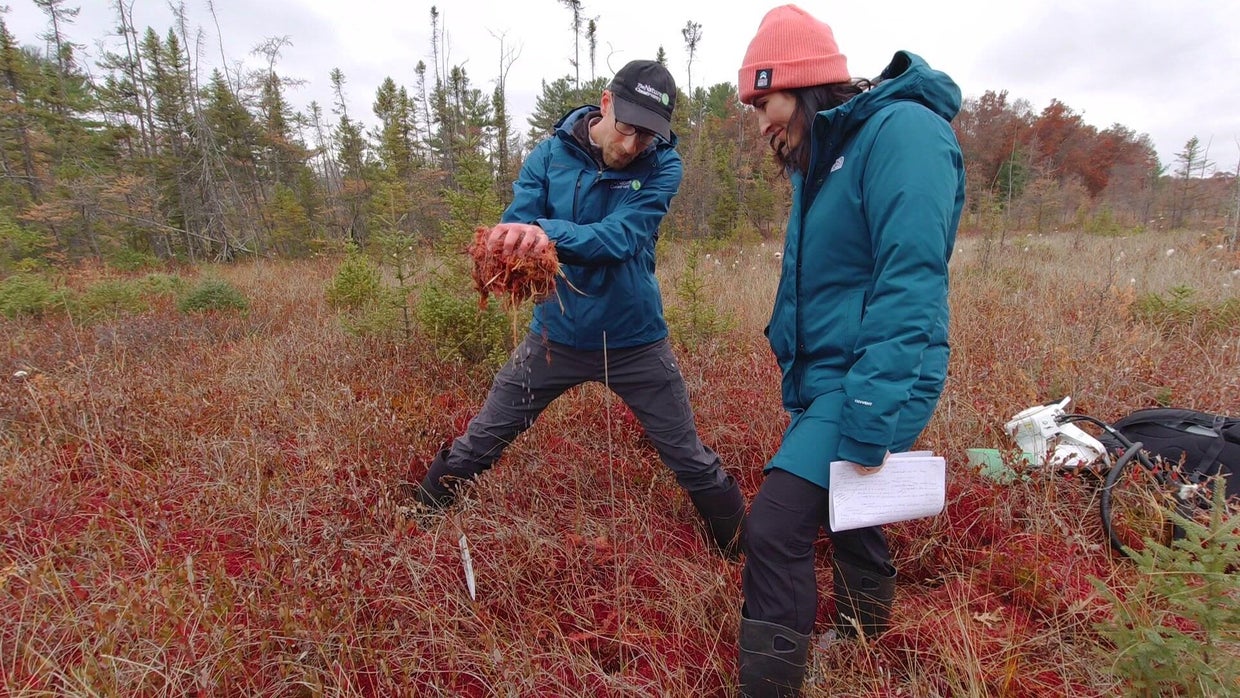
“They’re sort of a hidden treasure that we don’t really think about,” said Seabloom. “Now we can understand better how these are really important, huge stores of carbon. We definitely need them.”
But over time scientists say peatlands have been misunderstood, drained for development or agriculture and scientists are now learning why that was a mistake and how we can fix it.
“People always thought of peatlands or wetlands as sort of a menace to society or something in the way to be drained away,” said Chris Lenhart, a restorationist at The Nature Conservancy. “We’re right along Cedar Creek here. This is the part that’s been straightened about 100 to 120 years ago.”
The Nature Conservancy says up to one sixth of Minnesota’s peatlands were drained in the early 20th century.
The soil of a drained peatland looks a lot like dirt.
“It’s breaking down the organic matter and releasing the carbon dioxide as opposed to holding it in place,” said Lenhart.
To fix it, restoration teams will take a straightened section of the stream and rewiggle it to it’s original form.
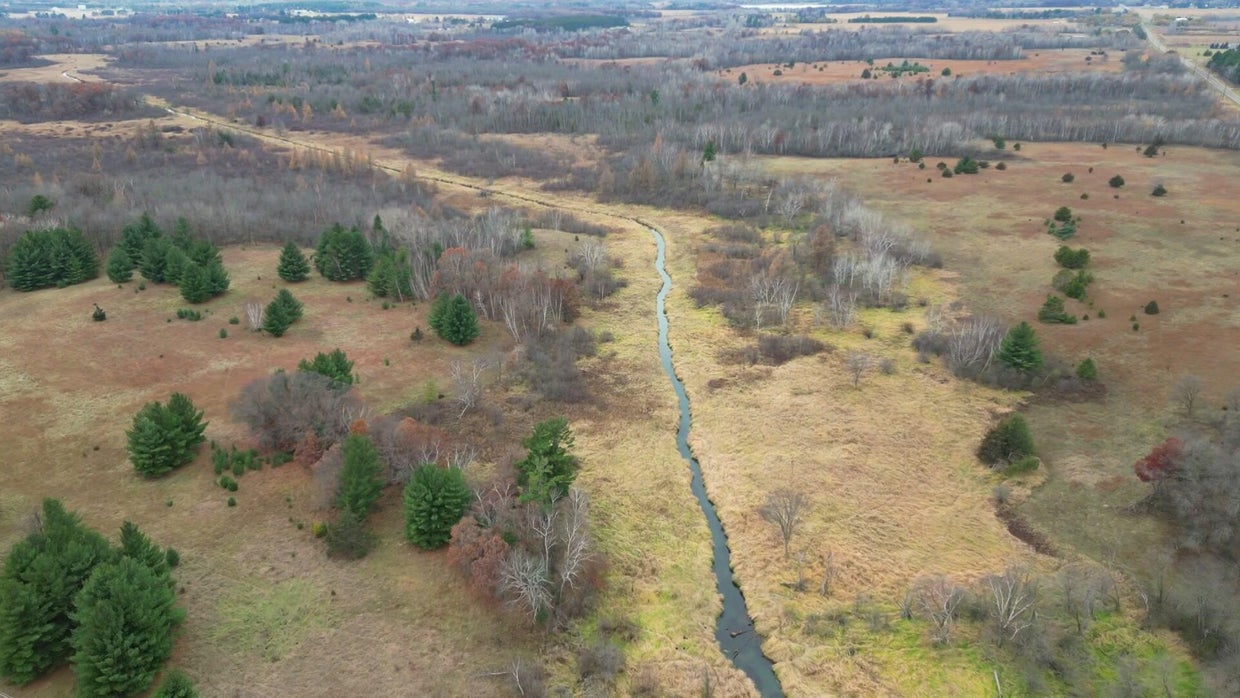
Restoring the stream to its original form slows the water, raises the levels, and rewets the peat soils on the shores, emitting less carbon dioxide and accumulating valuable peat once again.
The Nature Conservancy says restoring and rewetting farmed and partially-drained peatlands in Minnesota could cut roughly 6.36 million metric tons of carbon dioxide equivalents, which is like getting rid of nearly 1.5 million gas powered cars for a year.
“We can have a lot of impact by managing and taking care of a pretty small blueprint,” said Felice.
“Even around the world people know about Minnesota I’d say for peatland and wetland science and protection,” said Lenhart.
Cedar Creek Ecosystem Science Reserve is owned by the University of Minnesota. It’s an area with many active research studies and restoration projects. It’s also known nationally for its research.



The Portland Trail Blazers picked Minnesota Timberwolves assistant Micah Nori as their next head coach on Tuesday, after making the playoffs for the first time in five years under the direction of interim coach Tiago Splitter.
Nori, who spent the past five seasons with the Timberwolves, has interviewed for multiple head coach vacancies, including the Chicago Bulls earlier this month, the New York Knicks last year, and the Los Angeles Lakers in 2024.
Nori, 52, was the lead assistant under Timberwolves head coach Chris Finch while the club made the playoffs each season, won five series, and reached the Western Conference finals in 2023 and 2024. Nori, who began his NBA career in 1998 as a scout with the Toronto Raptors, has also been an assistant for the Raptors, the Sacramento Kings, the Denver Nuggets, and the Detroit Pistons. His son, Dante, is a minor league baseball player in the Philadelphia Phillies organization.
Splitter, who was hired last week as head coach of the Chicago Bulls, was promoted from assistant to interim coach when then-head coach Chauncey Billups was arrested in October in a federal takedown of a sprawling gambling operation. Billups has pleaded not guilty to charges of wire fraud and money laundering.
The Blazers went 42-40 with a five-game loss to NBA finalist San Antonio in the first round of the playoffs, the first postseason appearance and first time they finished with a winning record in five years.
The news comes a day after the Wolves reportedly traded three-time All-Star Julius Randle to the Brooklyn Nets in a three-team trade that sends Nic Claxton to the Chicago Bulls.

The Minnesota Timberwolves are reportedly trading three-time All-Star Julius Randle to the Brooklyn Nets in a three-team trade that sends Nic Claxton to the Chicago Bulls.
Minnesota is sending the 28th pick to the Nets and will be receiving the No. 33 pick that will be made in the second round on Wednesday night, according to a person who spoke to the Associated Press on condition of anonymity because the deal has not received the required approvals from the league office.
For Minnesota, the trade opens up a slew of financial possibilities. It creates a $33 million trade exception, plus gives the Timberwolves room they can use to re-sign Ayo Dosunmu and target more players in free agency.
Randle, a three-time All-Star, will be moving to his fifth team after stints with New York, the Los Angeles Lakers, New Orleans and the Timberwolves. He averaged 21.1 points this past season, though shot just 39% from the field and 24% from 3-point range in Minnesota’s 12 playoff contests.
Claxton just finished his seventh NBA season, all with Brooklyn. He averaged 11.7 points this past season.
The 2026 NBA Draft begins Tuesday night.

At Senator Westrom’s St. Paul office, visitors are greeted by the classic Minnesota state flag, which the DFL leaders should not have taken away from Minnesotans.
However, local communities have the authority to keep flying it, like many have done, and Senator Westrom encourages communities interested in keeping it to do so.
-

 Los Angeles, Ca1 hour ago
Air quality concerns remain as the Boyle Heights warehouse fire continues to burn
-

 Detroit, MI1 hour ago
Wenceel Pérez returns home, but when will he return to Detroit Tigers?
-

 San Francisco, CA2 hours ago
San Francisco Supervisor Jackie Fielder to return following mental health leave
-
Dallas, TX2 hours ago
Impact: How Jeffery Simmons’ extension could affect Quinnen Williams
-
Miami, FL2 hours ago
Jaylen Brown bidding war? Haslem drove this? All the fallout from Antetokounmpo trade to Miami
-

 Boston, MA2 hours ago
Your next Uber ride in Boston could be a taxi
-

 Denver, CO2 hours ago
Nuggets 2026 NBA mock draft tracker 2.0: What national experts predict Denver will do
-

 Seattle, WA2 hours ago
How to watch Bosnia vs. Qatar in next Seattle World Cup match


