Business
Commentary: H-1B visas have always been a scam. Trump's changes won't fix the problem

Among the government programs that produce more confusion than benefits, H-1B visas are right up there.
If you’ve been hearing about H-1B visas, it’s probably because President Trump abruptly changed its rules with a proclamation on Sept. 19.
As is typical of Trump’s shoot-from-the-hip policy-making, the proclamation produced an outbreak of fear and chaos, in this case among holders of the visas. That’s because it seemed at first that the administration was imposing a $100,000 fee not only on applicants for the visas, but on current holders reentering the U.S. from abroad, say from home leave or a business trip.
This is a de facto ban, as few organizations will be able to afford it.
— Robert D. Atkinson, Information Technology and Innovation Foundation
Until the White House clarified that the charge would be a one-time fee for new H-1B applications, not charged annually or for renewals or reentry, holders were advised by some employers not to leave the U.S. for the present; those who were caught off-guard overseas scurried to get home by Sunday, when the fee began.
A Sept. 19 Emirates flight from San Francisco to Dubai had to abort its departure to allow several panicky passengers to debark, according to Bloomberg.
The administration’s subsequent assurances have quelled the panic. But the proclamation has created new befuddlements, including over whether it opens the door to illicit dealings between Trump and companies bidding for the visas, and whether it’s even legal.
As my colleagues Queenie Wong and Nilesh Christopher reported, there are concerns that “a selective application of the fee could be a way the White House can reward its friends and punish its detractors.”
Importantly, there’s room to question whether the proclamation will solve long-standing problems with H-1B visas. So let’s take a look at the program’s malodorous history.
H-1B visas were created in 1990, under President George H.W. Bush, to relieve what high-tech companies asserted was a chronic shortage of U.S.-born workers in the STEM fields (science, technology, engineering and math).
The idea was to give highly-skilled foreign workers in “specialty occupations” the right to three years of U.S. residence renewable for a further three years — an opportunity to obtain permanent residency or even citizenship.
After a few rounds of tweaking, the annual cap on new applications was set at 85,000, including 20,000 holders of advanced degrees from U.S. universities. Higher education and nonprofit research institutions are exempt from the cap.
Things didn’t work out as anticipated. U.S. employers came to see the H-1B visas as tools to replace native-born technicians with cheaper foreign workers. Scandalously, some of the American workers were required as conditions of their severance to train the newcomers to do their jobs.
I documented that practice at Southern California Edison in 2015. The giant utility acknowledged that the outsourcing of workers would cost the jobs of 500 technicians who did the work of installing, maintaining and managing Edison’s computer hardware and software for payroll and billing, dispatching and electrical load management.
Essentially, Edison was replacing domestic IT specialists earning $80,000 to $160,000 with workers provided by two India-based outsourcing firms, Tata Consultancy Services and Infosys, which were paying their recruits $65,000 to $71,000. By the time the outsourcing process was complete, Edison said, its IT expenses would fall by about 20%.
“They told us they could replace one of us with three, four, or five Indian personnel and still save money,” one laid-off Edison worker told me at the time, recounting a group meeting with supervisors. “They said, ‘We can get four Indian guys for cheaper than the price of you.’ You could hear a pin drop in the room.”
Then there’s the University of California, which announced in 2016 that it would lay off 49 career IT staffers and eliminate 48 other IT jobs that were vacant or filled by contract employees. The American workers were ordered to train their own replacements, who were employees of the Indian outsourcing firm HCL Technologies.
Although the visa law specified that hiring foreign workers would not harm American workers, “the H-1B program is most definitely harming American workers, harming them badly, and on a large scale,” Ronil Hira of Howard University, an expert in the visa program, told the Senate Judiciary Committee in 2015. “Most of the H-1B program is now being used to import cheaper foreign guestworkers, replacing American workers, and undercutting their wages.”
The high-tech industry’s dirty little secret, I reported, was that the STEM shortage was a myth. The same companies wringing their hands over the supposed dearth of STEM-qualified workers were simultaneously laying them off by the tens of thousands. Indeed, experts in technology employment consistently found that “the supply of graduates is substantially larger than the demand for them in industry,” one told me. Anyway, a significant portion of H-1B recruits weren’t in jobs demanding unique skills, but workaday technicians.
Since 2020, the top employer of H-1B visa holders has been Amazon, with a total of 43,375 workers over that period — followed closely by the Indian outsource companies Infosys and Tata. In the current fiscal year, Amazon reigns, with more than 14,000 H-1B holders, followed by Tata, Microsoft, Meta Platforms, Apple and Google. I asked Amazon why it needs so many foreign workers and what work they do, but didn’t receive a reply.
The Indian outsourcing firms have dominated the H-1B system since at least 2009. For years their role has stoked controversy, in part because their employment practices have come under question.
In court, government prosecutors and civil plaintiffs have alleged that Infosys and Tata were exploiting the guest workers they brought to the U.S. Infosys settled federal fraud charges with a $34-million payment in 2013, the largest penalty in an immigration case at that time. The company denied the allegations.
That same year, Tata settled a class action lawsuit with a $29.8-million payment. The plaintiffs alleged that workers imported by Tata were forced to sign over their federal and state tax refunds to Tata, among other claims. The company didn’t admit wrongdoing.
Over the years, the H-1B program has made for political controversy, though Congress hasn’t taken a firm hand in correcting its issues. Conservatives and progressives alike have found reason to complain that it undermines domestic employment. Near the end of his first term, Trump shut down H-1B issuance entirely, along with some other specialty visa programs, but his initiative was blocked in federal court.
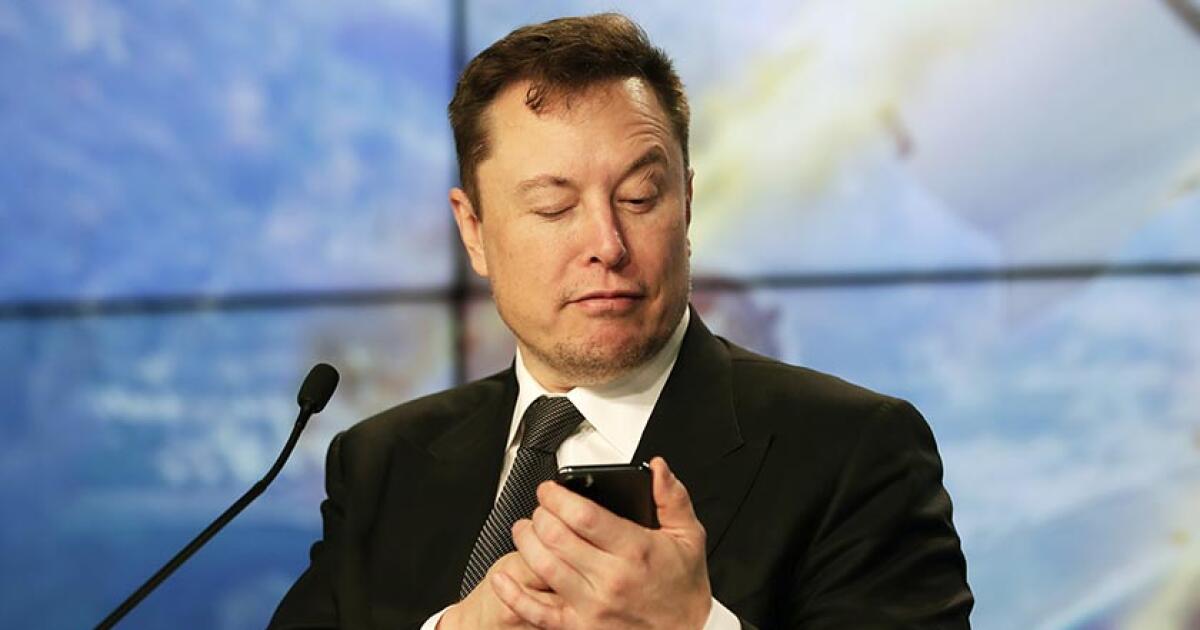
But the program remains enormously popular in the high-tech world, which has long agitated for an expansion. Its fans include Elon Musk, who tweeted in December that “the reason I’m in America along with so many critical people who built SpaceX, Tesla and hundreds of other companies that made America strong is because of H-1B.” He underscored his position with a burst of profanity, but he did promise to “go to war on this issue,” although he acknowledged that some fixing is in order.
That brings us to the issues with Trump’s proclamation. Its shortcomings resemble those that prompted federal Judge Jeffrey S. White of Oakland to overturn Trump’s ban in 2020 in a case brought by the National Assn. of Manufacturers and the U.S. Chamber of Commerce, among others.
White ruled that the authority to change the terms of the visas belonged to Congress, not the president, and that the administration hadn’t evaluated the effect of the ban on the domestic economy, as federal law required. The case was rendered moot when Trump’s ban was reversed by President Biden. I asked the White House if it was concerned that this proclamation could also be blocked in court, but got no reply.
A bigger question concerns the ramifications of the $100,000 fee. “H-1B visa fees of this magnitude will strongly discourage the hiring of the most talented members of the global labor force,” says University of Chicago economist Steven Durlauf. Instead, the policy will create incentives to move high-tech and scientific activity to other countries, effectively offshoring economic activity that should occur in the U.S., he says.
The fee is so high that only the biggest and richest employers will be able to pay it, locking out small start-ups that have tried to use H-1B visas to build their professional teams. The proclamation doesn’t make clear whether universities and research institutions will be exempt from the fee. Even financially well-endowed universities would find it hard to justify paying $100,000 to import a faculty member from abroad.
“This is a de facto ban, as few organizations will be able to afford it,” says Robert Atkinson, president of the Information Technology and Innovation Foundation, a high-tech think tank.
The White House says it intends to replace the current system, a random lottery apportioning available H-1B slots among all applicants, with one favoring applications to fill the highest-paid slots.
The proclamation states that H-1B abuses “present a national security threat by discouraging Americans from pursuing careers in science and technology, risking American leadership in these fields.” Never mind that students considering careers in scientific and technical fields are being profoundly discouraged by Trump’s freezes on research funding across the scientific landscape.
So the bottom line is that, as is usual, Trump’s H-1B policy works at cross-purposes with his other initiatives. For decades, the H-1B program has been ripe for fixing. If only the Trump White House took the time to craft a sensible repair.


Ethics experts sounded the alarm Wednesday after new financial disclosure reports revealed that President Trump’s income ballooned to $2.2 billion in 2025, with $1.4 billion coming from various new cryptocurrency-related businesses.
“It’s bribery. It’s graft. It’s exploitation of public power for private financial gain,” said Kathleen Clark, a law professor at Washington University and an expert in government ethics. “Trump has — with the acquiescence of a somnolent, GOP-controlled Congress and the active assistance of John Roberts’ Supreme Court — transformed the presidency into a massive corruption racket.”
Trump reported income of over $600 million in 2024. But after he entered the White House in 2025, he reported that his income had soared to more than $2.2 billion.
The 2025 annual disclosure report filed with the Office of Government Ethics shows that Trump ramped up his real estate business in countries across the globe, particularly in the Middle East, at a time when his government was negotiating over vital issues of military aid and economic tariffs. The president also expanded his dealings in the relatively new realm of cryptocurrency.
According to the 927-page report, Trump made $635 million in royalties from Celebration Coins and more than $500 million from his World Liberty Financial crypto firm. He drew in millions from a raft of Trump-branded merchandise including God Bless the USA Bibles and sneakers depicting him with his hand raised in a fist. He also brought in $10.4 million from a property in the United Arab Emirates and $9 million from a property in Saudi Arabia.
Noah Bookbinder, an ethics expert and former president of Citizens for Responsibility and Ethics, a nonprofit watchdog group in Washington, described Trump’s business dealings while in the White House as “entirely unprecedented, certainly in modern history, but I think by most ways of measuring, in all of American history.”
“This is corruption,” Bookbinder said. “You have a president who has been quite transparently using the presidency in ways that benefit his business interests and intertwining the presidency and business interests.”
But the president and the White House brushed aside ethics concerns about the money Trump is making.
Trump told reporters Wednesday that he made a lot of money before he came to the White House, he had “big institutions” run his money, and that he had benefited, like every other American, as the stock market went up.
“We’re all profiting,” he said. “I’m profiting because I have a lot of money and a lot of cash.”
In a statement, White House spokesperson Anna Kelly said: “Neither the President nor his family has ever engaged — or will ever engage — in conflicts of interest. … All actions by President Trump and his administration are taken in the best interest of the American people.”
Although the report does not show exactly how much Trump is earning — it provides details of revenue, rather than profit — the scale of the president’s cryptocurrency dealings elevated ethics watchdogs’ long-standing concerns.
Jordan Libowitz, a vice president at Citizens for Responsibility and Ethics, said the most concerning detail of the new report is the hundreds of millions of dollars coming in from various crypto ventures partnered with companies that the American public knows little about.
“At a time when his own administration itself is setting regulation for these types of companies,” Libowitz said, “there’s just this massive opportunity for corruption when foreign governments and foreign nationals can pour tens of millions of dollars into the president’s pocket.”
As a real estate mogul, Trump has long invested in hotels, condominiums and golf courses. But cryptocurrency, Libowitz said, offers vastly more potential for corruption.
“There’s only so many hotel rooms you can book, so many rounds of golf, but there’s no limit with crypto,” Libowitz said. “You can just buy his meme coin and he gets a cut, so you kind of take out the middleman, but also the cap or the amount of money you can funnel to the president.”
Libowitz said it was also problematic for Trump to expand his real estate empire in foreign countries, particularly in the Middle East.
“Now it seems that almost all his new developments are in foreign countries, and that opens up, if you’re building this giant resort, you’re going to need help from the local government, whether it’s tax breaks or utility issues, or building a road, or speeding up permits,” Libowitz said. “These are ways that foreign governments can do favors for the American president.”
In the half a century before Trump was elected, ethics experts say, presidents from Nixon to Obama publicly released their tax returns, sold properties or put the proceeds in a blind trust managed by someone they did not know.
“They weren’t doing it because they legally had to, but because they thought it was the right thing to do,” Libowitz said.
Ever since Trump was first elected in 2016 and opted to not sell his businesses or put them in blind trusts, ethics experts have urged Congress to impose more aggressive financial oversight over money in politics.
“Congress needs to update the law, and basically, mandate blind trusts and sale of assets and disclosure of tax returns,” Libowitz said.
Noting that the Constitution’s Emoluments Clause explicitly states that the president cannot accept things of value from foreign or domestic governments, ethics experts say Trump is flouting the law and Congress has chosen to not enforce it.
Richard Painter, a law professor at the University of Minnesota and former White House ethics lawyer under President George W. Bush, said Congress needed to close loopholes that exempt presidents from federal conflict of interest laws as well as enforce the Foreign Emoluments Clause.
“Nobody holding a position of trust with the United States government can accept emoluments, profits and benefits from foreign governments, and that is flatly prohibited under the United States Constitution,” Painter said. “Now, if the United Arab Emirates put money into Liberty Financial, as I understand they did … and then Trump makes money off Liberty Financial, that’s a Foreign Emoluments Clause problem.”
Congress, he said, should empower an independent prosecutor to investigate such conflicts.
“The problem with the Foreign Emoluments Clause is how do we enforce it?” Painter said. “The founders and head of the Congress enforced it by impeaching anybody who took a bunch of foreign government money, but I guess that system’s not working. That’s a serious problem.”
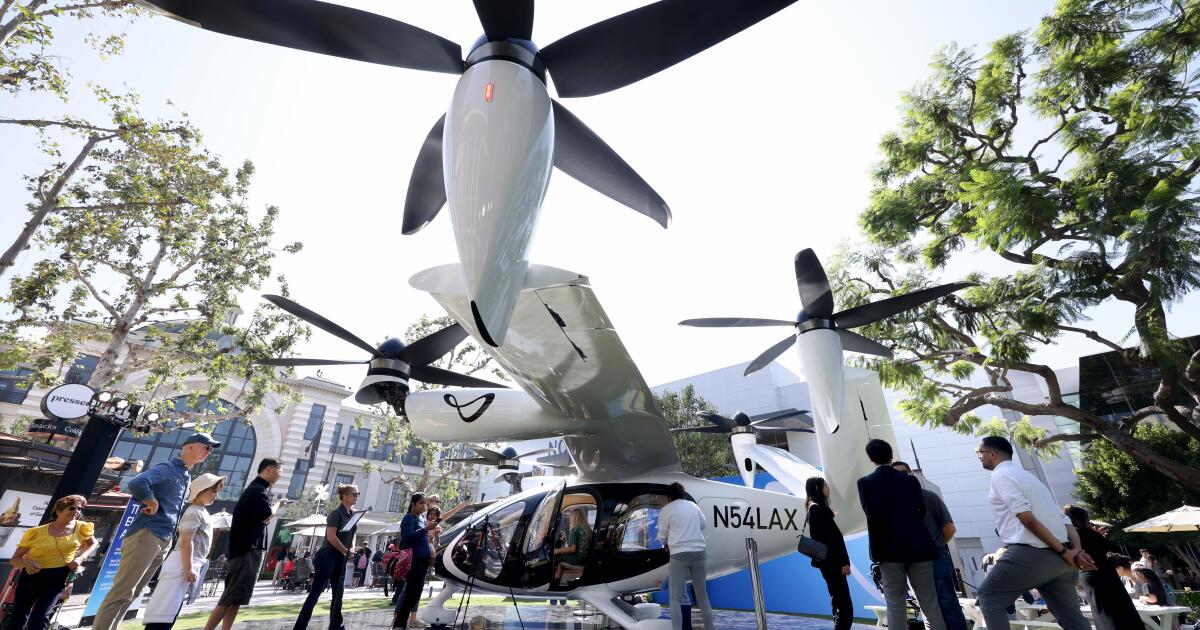
The race to bring air travel to the sky is heating up as Santa Cruz-based Joby Aviation and Toyota launch a joint venture to commercially produce air taxis.
The companies said in a news release Tuesday that they will work together on productivity, quality and costs and move toward mass production of Joby’s electric vertical takeoff aircraft. Joby and Toyota were first linked when Toyota made a nearly $400-million investment in the company in 2020. It has since increased its backing of the company to $900 million.
“It’s really meaningful for us to take on this challenge together with Joby, a partner that shares the same vision,” Toyota Chair Akio Toyoda said. “We believe this strengthened relationship is an important step forward in realizing the future mobility society.”
Joby‘s all-electric vertical takeoff vehicles are designed to hold four passengers and a pilot and can travel at up to 200 mph. The vehicle uses six tilting propellers to achieve vertical takeoff before switching to forward flight.
In February, Joby announced a partnership with Uber to start service in the United Arab Emirates this year, bringing on-demand air taxi rides to the country. It plans to expand to the U.S. after the completion of its final stage of Federal Aviation Administration testing.
Prior to its full FAA certification, Joby is hoping to launch early flight operations later this year as part of a White House program that will bring flights to several states, including New York, Texas and Arizona. Flights in California will not begin until after obtaining FAA certification.
Joby has been in a fierce battle to be the first with taxis in the sky with its Northern California competitor Archer Aviation. The two companies are involved in overlapping lawsuits, with Joby alleging corporate espionage against Archer, and Archer filing a suit alleging dubious ties to China that sparked an investigation into Joby by the U.S. International Trade Commission.
“Toyota has been by Joby’s side for nearly a decade, providing invaluable guidance and support as we built the foundation for manufacturing our aircraft,” JoeBen Bevirt, Joby’s chief executive and founder, said in the news release. “Together, we share a vision of making aerial mobility an everyday reality, and we look forward to delivering on that promise together.”
Joby Aviation’s shares, which have fallen more than 30% this year, climbed 3% on Tuesday to $8.92.
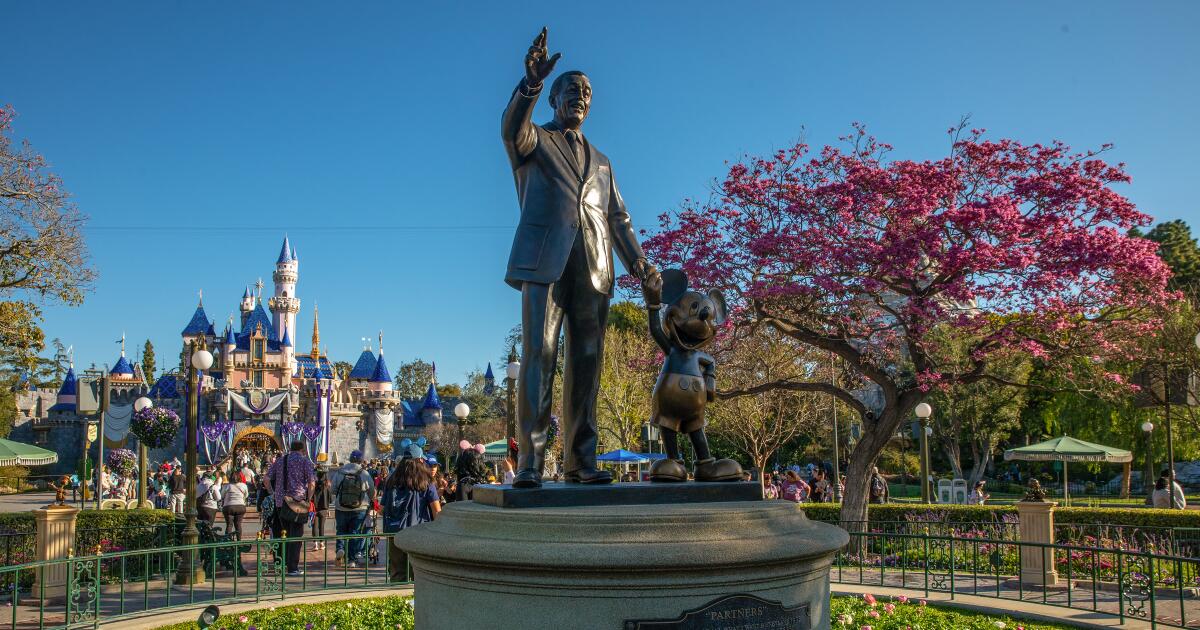
Disneyland Resort in Anaheim will offer $59 tickets for select evening admission to either theme park as part of a new promotion.
The one-day, one-park evening ticket offer will allow attendees to enter Disney California Adventure at 5 p.m. or Disneyland at 7 p.m. Park reservations are still required, as has been the case since the COVID-19 pandemic.
The offer only applies for admission from July 12 through Aug. 5 on Sundays to Wednesdays.
Disneyland Resort is commemorating its 70th anniversary through Aug. 9, and has introduced new shows and additions to rides as part of the occasion.
Walt Disney Co.’s theme parks and experiences business are a crucial boost to its finances, making up about 56% of the company’s operating income last fiscal year.
During the Burbank-based company’s most recent earnings call in May, Disney executives said attendance at its U.S.-based parks was down 1% compared with the prior year, a shift they attributed to “continued softness” in international visitations. However, the company said at the time that it was starting to move past those issues.
Disney’s experiences division reported $9.5 billion in revenue in that fiscal second quarter, up 7% compared with the same period a year ago, something executives said was due to higher guest spending domestically and more capacity on its cruise line.
-

 Wisconsin3 minutes ago
How much will Shawn Eichorst make as Wisconsin Badgers’ athletic director?
-

 West Virginia5 minutes ago
Moundsville police investigate pharmacy break-in, narcotics theft
-

 Wyoming10 minutes ago
Win By Colorado Socialist Could Galvanize Wyoming Independence, Says Politico
-

 Crypto13 minutes ago
Robert Kiyosaki Says Spiritual Mission Led Him to Financial Education
-

 Finance18 minutes ago
Former Semmes finance director indicted on ethics, theft charges
-

 Fitness25 minutes ago
6 Best Exercise Bikes (2026): Trainer Approved | Fortune
-

 Movie Reviews33 minutes ago
Sender
-
World43 minutes ago
Bereaved South Koreans try AI-generated videos of deceased loved ones


