Ohio
Here’s what won’t make the November ballot in Ohio


COLUMBUS, Ohio — The proposals to overturn legislation overhauling higher education, eliminate property taxes and end qualified immunity will not be on the November ballot, despite advocates trying to get the question to Ohio voters.
Public education advocates have fallen short 50,000 signatures of the needed 250,000 to put a referendum on the Ohio ballot, Youngstown State University Professor Dr. Cryshanna Jackson Leftwich said. She was aiming to repeal Senate Bill 1, a controversial college overhaul bill.
The effort was led by a small grassroots organization made up of mainly Youngstown State professors like Jackson Leftwich. The group had no money, no backing from statewide or national education groups or paid canvassers — which she said was a problem.
Typically, successful coalitions submit hundreds of thousands more signatures, because oftentimes they are invalid. When Ohioans United for Reproductive Rights, the group putting an amendment on the ballot to protect abortion, IVF and contraception, they submitted 300,000 more signatures than needed as cushion room. The group needed around 415,000, submitted 710,000 and ended with about 500,000 valid.
“It shouldn’t take millions of dollars to fight [for] democracy,” she said. “It shouldn’t take millions of dollars for consultants and lawyers for average voting citizens to say, ‘Hey, this is an unjust bill.’”
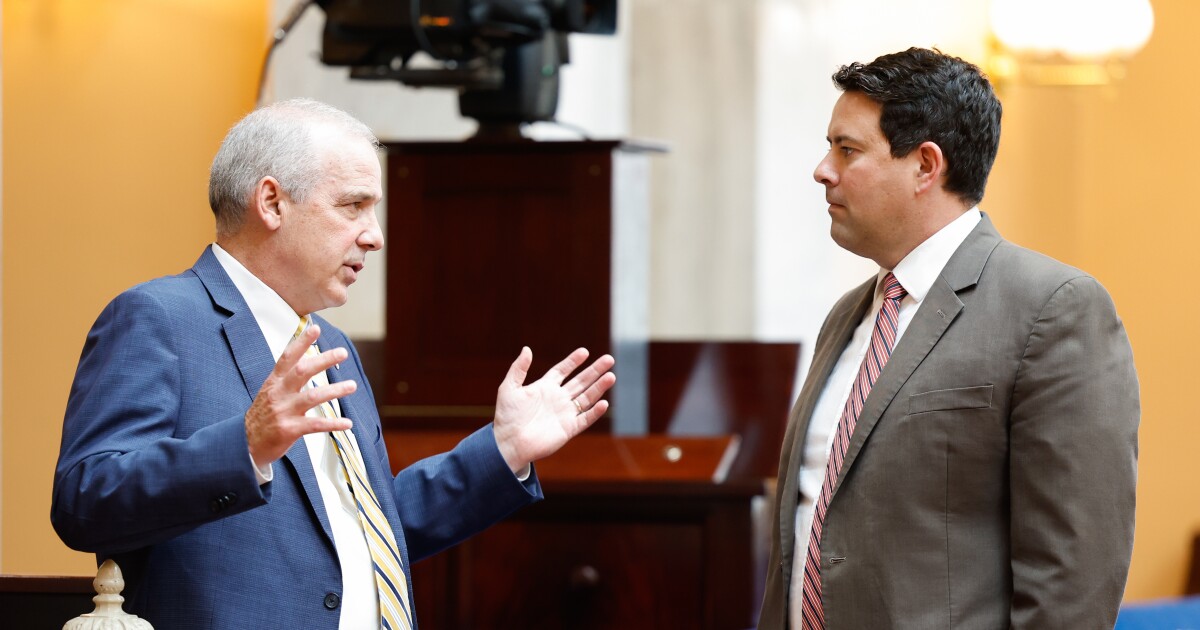
State Sen. Jerry Cirino, the top Republican on the influential Finance Committee, introduced the legislation.
“It provides for a policy to be established for what I call intellectual diversity, which is very important,” Cirino said. “It means openness to all various thoughts about various issues, which is the opposite of indoctrination — indoctrination is when you expose students to only one train of thought, so a monolithic thought environment. That is not good for students.”
Ohio Gov. Mike DeWine signs controversial college overhaul bill banning DEI
This massive bill focuses on what the Republican calls “free speech,” banning public universities in Ohio from Diversity, Equity and Inclusion initiatives, having “bias” in the classroom, and limiting how “controversial topics” can and can’t be taught. Eliminating DEI would mean no diversity offices, training, or scholarships.
“I believe that will benefit students greatly and produce better students who know how to think and analyze and come to their own conclusions,” he added.
Students and professors from across the state have continued to argue that there is nothing wrong with their education, and they are furious that lawmakers are trying to interrupt their classes.
Ohio House bans DEI, passes education overhaul bill
This is one of the most protested-against bills in recent Ohio history. There were roughly 1,500 people who submitted opponent testimony against S.B. 1, and there were about 30 who submitted in support. Which is why Amanda Fehlbaum, a YSU professor, was shocked when no larger organizations “stepped up” to help them, she said.
The group raised $45,000 in six weeks and collected the signatures without any paid assistance, which was very challenging, Fehlbaum added, emphasizing that larger groups said that a referendum would be “too expensive,” she said.
Cirino told us Thursday that he isn’t surprised that the effort failed, because he said the bill is good policy.
“I think their biggest problem was that this was a group of disgruntled faculty members, mostly from Youngstown State, who are satisfied with the status quo in higher education,” he said. “They couldn’t be more detached from reality in terms of what needs to be done to make Ohio’s Higher Ed the very best we can be.”
But the S.B. 1 repeal wasn’t the only “everyday” group that couldn’t get on the ballot.
The Citizens for Property Tax Reform didn’t submit the signatures they gathered.
“It’s such a huge undertaking,” organizer Beth Blackmarr said Thursday.
Blackmarr helped create a coalition of homeowners in Cuyahoga County, hoping to put a constitutional amendment on the November ballot that would eliminate property taxes.
Ohio citizens working to get proposal on ballot to abolish property taxes
Her team, Citizens for Property Tax Reform, knew they weren’t near the 415,000 they needed. She didn’t have an estimate of how many they collected, nor how much money they raised.
“As naive as we are, we may have underestimated, just a little bit, how big the response was really going to be,” she said. “That’s been quite rewarding, so we’ve asked everybody to keep on trucking and keep going.”
Despite both being grassroots, her situation is different from Jackson Leftwich’s for two main reasons: constitutional amendment proposals can be pushed back to future elections, and she told us a month ago that her proposal didn’t even have to reach the ballot.
“Hopefully, what legislators will do is counter with some legislation of their own,” she told me in May.
And it has worked.
“I’m hoping this does help to push us,” State Rep. David Thomas (R-Jefferson) said when I asked him about the tax amendment.
Thomas leads property tax relief discussions in the House and said that he and the other members heard Blackmarr. Since her amendment, lawmakers have been proposing more property tax relief bills and have passed several in the budget.
“This is a win-win for Ohio,” Blackmarr said.
Strategy has to come into play when getting an issue proposed statewide, she added.
“Is this indicative of the challenges that regular people face when trying to access the ballot?” I asked the professors.
“Ohio makes it as difficult as possible,” YSU’s Education Association President Mark Vopat said, detailing all of the work that must be done to go through the extensive collection process. “I believe that the state has made it as onerous as possible for individual citizens like us, — we’re doing this as a voluntary effort — to actually get some sort of referendum passed.”
For all ballot proposals, campaigns need valid signatures from at least 44 of Ohio’s 88 counties.
For referendums, the total signatures must be 6% of the total votes cast for governor during the last gubernatorial election. This makes the number about 248,092 valid signatures.
For initiated statutes, the total signatures must be 3% of the total vote cast for governor during the last gubernatorial election. This makes the number about 124,046 valid signatures.
For constitutional amendments, the total signatures must be 10% of the total vote cast for governor during the last gubernatorial election. This makes the number about 413,487 valid signatures.
There have been efforts to make this harder, though.
Republican leaders in Columbus are floating the idea of attempting to make it more difficult to amend the state constitution, a proposal that was defeated in 2023 by Ohioans across the political spectrum.
Another fight over majority rule in Ohio? Republican leaders float the idea.
Issue 1 in 2023 would have taken away majority rule in Ohio. The proposed constitutional amendment would have raised the threshold for constitutional amendments to pass from 50%+1, a simple majority, to 60%. It was defeated 57-43%.
The following year, 2024, the Senate GOP moved to increase the amount of counties campaigns must collect from and put more bureaucratic layers on advocates. They wanted to require all groups rallying for a cause that is receiving donations and spending money to register as a political action committee (PAC). This means that groups would have to file disclosures with the government, and it could make it more difficult to collect signatures to get a proposal on a township ballot.
OH House agrees to compromise on Biden ballot fix if ‘anti-democratic’ Senate provisions taken out of bill
Other challenges campaigns can face deal with the political offices they must go through.
Ohio activists are starting to gather signatures to get a constitutional amendment on the ballot that would end qualified immunity — a protection for police and other government officials that prevents citizens from suing them.
State law prevents government officials from being held liable for civil damages unless the victim can prove that the officer violated their constitutional rights, which can be an uphill battle, advocates say.
The Ohio Coalition to End Qualified Immunity has been battling Attorney General Dave Yost to get their summary language approved so that they can collect signatures. He has rejected it eight times, and recently, in short, courts have required him to allow them to move forward.
From their approval, they would have only had two months at most to collect signatures. Although initially hopeful for November, their team told us Thursday that they are now aiming for 2026.
But when it comes to S.B. 1, Jackson Leftwich said this isn’t the end for them, either.
“If we got this on the ballot, we would have overturned it,” she said.
The group didn’t specify if and how they would try again, or just rely on the larger groups in future years.
Follow WEWS statehouse reporter Morgan Trau on Twitter and Facebook.





Real estate transfers in Licking County, Ohio, range from $85,000 to $865,000
The following are property transfers recorded in Licking County from June 1-5, 2026.
First name indicates the seller; second name represents the buyer
Buckeye Lake
- 502 Providence Lane; Cohagen, Christopher C and Lori A; Adams, Jeffrey L and Boyce-Adams, Jo Anna; 6/1/2026; $511,000
- 131 Cranberry Lane; Smart, Amy and Kidwell, Kevin K; Sew and Minor, Christian; 6/1/2026; $262,000
Etna Township
- 116 Cameron Drive SW; Ray, Erica L; Darjee, Sanjay and Laxmi and Dil; 6/2/2026; $412,000
- 119 Kraner St. SW; Adkins, Zane and Amy; Culbertson, Brenton Howard; 6/1/2026; $368,500
- 160 Dusky Willow Drive; Willow Reserve LLC; Martin, Alaina K; 6/2/2026; $290,940
Granville
- 119 Derwyn Del Way; Lifer, David C and Julia H; Martin, Michael and Lisa; 6/1/2026; $865,000
- 39 Victoria Drive; Acton, Wendy S and Paul J; Cannon, Matthew Evan and Zywica, Natalie Nicole; 6/2/2026; $835,000
Granville Township
- 49 Alberry Drive; Halliday, Lucas and Breayne; Howe, Jason and Kathryn; 6/2/2026; $570,000
Harrison Township
- 102 Whirlaway Loop; Rice, Dawn (Trustee); Bope, Maria and Shane; 6/2/2026; $420,000
Heath
- 1306 Kacey Court; Fischer Homes Columbus II LLC; Owens, Blake Andrew and Taylor Marie; 6/2/2026; $437,779
- 805 Fieldson Drive; Flowers, Ingrit; Harder, Noah C; 6/2/2026; $250,000
Hebron
- 802 Cumberland Meadows Circle; Lines, Marlene S; Gerhart, Jamie A and Ralph W Jr; 6/2/2026; $232,000
Johnstown
- 101 Bigelow Drive; McGovern, Matthew S and Jennifer L; Sanford, Jessica; 6/2/2026; $442,500
Liberty Township
- 5844 Nichols Lane Road NW; La Jeunesse, Garth E and Debra; Nesselroad, William Heath and Annie; 6/1/2026; $629,000
- 7211 Northridge Road NW; Devault, Robert E Jr and Joann; Esbenshade, Travis M and Lowe, Shelby M; 6/1/2026; $495,000
Newark
- 2110 Overlook Way; D.R. Horton-Indiana LLC; Tarsha, Michele A; 6/1/2026; $433,335
- 1162 Taylor Ave.; Heath Fluid LLC; Anglada, Gabriel P and Salina T; 6/1/2026; $200,000
- 32 Postal Ave. W.; Palmisano, Phil; Moore, Dominic Michael and Miksich, Paige Elizabeth; 6/1/2026; $198,900
- 75 Gay St.; Velez, Marcos A; Camell, Campbell; 6/1/2026; $155,000
- 655 Evans St.; TNL; McRada Properties LLC; 6/1/2026; $145,000
- 63 Wallace St.; FDA Peachtree LLC; Burns, Amber L; 6/2/2026; $86,500
- 404 10th St.; Synergy Group Properties LLC; Busy Boys Restoration LLC; 6/2/2026; $85,000
Reynoldsburg
- 8447 Rodebaugh Road; Collins, Carol J; Thorpe, Kimberley Lynn and Henry, Steven; 6/2/2026; $340,000

COLUMBUS, Ohio (AP) — Ohio’s law requiring children under 16 to get parental consent to use social media apps must be restored, a divided panel of the Sixth Circuit Court of Appeals ruled Thursday.
The decision comes as a blow to NetChoice, which has won court victories against identical digital identification laws in other states, including Arkansas, Louisiana and Georgia. The trade group representing TikTok, Snapchat, Meta and other major tech companies said the Ohio decision went against “clear national consensus” and that it intended to keep fighting.
“An unconstitutional law protects no one, and we remain focused on ensuring the First Amendment rights of Ohioans are protected,” said Paul Taske, director of the NetChoice Litigation Center.
Netchoice brought suit against Ohio’s law in 2024, arguing that it was overly broad, vague and represented an unconstitutional impediment to free speech.
The Cincinnati-based Sixth Circuit’s panel disagreed. In a 2-1 decision, it found that the law was not unconstitutional and sent it back to a lower court to have a block on the law’s enforcement vacated.
“At bottom, the Act imposes a parental consent requirement,” Judge Eric Clay wrote in the lead opinion. “That requirement constitutes a marginal burden that precisely targets the multi-faceted problem that Ohio has identified: Children’s unsupervised assent to terms and conditions for use of platforms that take advantage of and harm them.”
Judge Alice Batchelder concurred, writing that “a statute is not vague just because it has a wide berth.”
Known as the Social Media Parental Notification Act, the Ohio law was part of an $86.1 billion state budget bill that Republican Ohio Gov. Mike DeWine signed into law in July 2023.
The administration pushed the measure as a way to protect children’s mental health, with then-Lt. Gov. Jon Husted, now a U.S. senator, saying at the time that social media was “intentionally addictive” and harmful to kids.
The law requires companies to get parental permission for social media and gaming apps and to provide their privacy guidelines so families know what content would be censored or moderated on their child’s profile.
Republican Ohio Attorney General Andy Wilson called Thursday’s ruling “a win for Ohio families.”
“The court agreed that parents –- not social media companies –- should get a say in what kids see online,” he said in a statement. “We have an obligation to keep our children safe, and today, the most dangerous place for our kids is the internet. This decision gives parents the tools to be involved and provide oversight.”

Piketon, Ohio (WSAZ) – Folks in southern Ohio are waking up to power outages and road closures.
Route 32 in Pike County is down to one westbound and one eastbound lane due to debris on the roadway.
Drivers are also dealing with tree limbs on roadways.
The Athens County 911 dispatcher told WSAZ that it’s not believed a tornado touched down, but there is storm damage.
The dispatcher said storm damage from flooding and trees being knocked down has affected US 50.
Power outages are being reported in Athens, Pike, Vinton, Scioto and Meigs Counties and even as far south as Boyd County, Ky.
If you’re in a tornado warning area, you’re urged to get to the lower part of your home.
Keep checking the WSAZ app for the latest.
Copyright 2026 WSAZ. All rights reserved.
-

 Technology3 minutes ago
NASA selects Eric Schmidt’s rocket company for a 2028 mission to Mars
-

 World10 minutes ago
British Prime Minister Keir Starmer faces potential leadership challenge from newly-elected Andy Burnham
-

 Politics13 minutes ago
Reporter’s Notebook: How Trump’s surprise move on DNI confirmation upended key Senate deal on FISA
-

 Health25 minutes ago
Weight-loss drugs linked to ‘Ozempic ears’ and other cosmetic complaints, surgeons say
-

 Sports28 minutes ago
Florida AG launches civil rights investigation into MLB’s warning to Christian pitchers over Pride Night caps
-

 Technology33 minutes ago
Fox News AI Newsletter: Bezos predicts labor shortage
-
 Business40 minutes ago
Landmark downtown apartment tower faces foreclosure
-
 Entertainment43 minutes ago
Bob Dylan is absolutely cooking on the road right now

