Ohio
Ohio GOP infighting stalls marijuana legislation

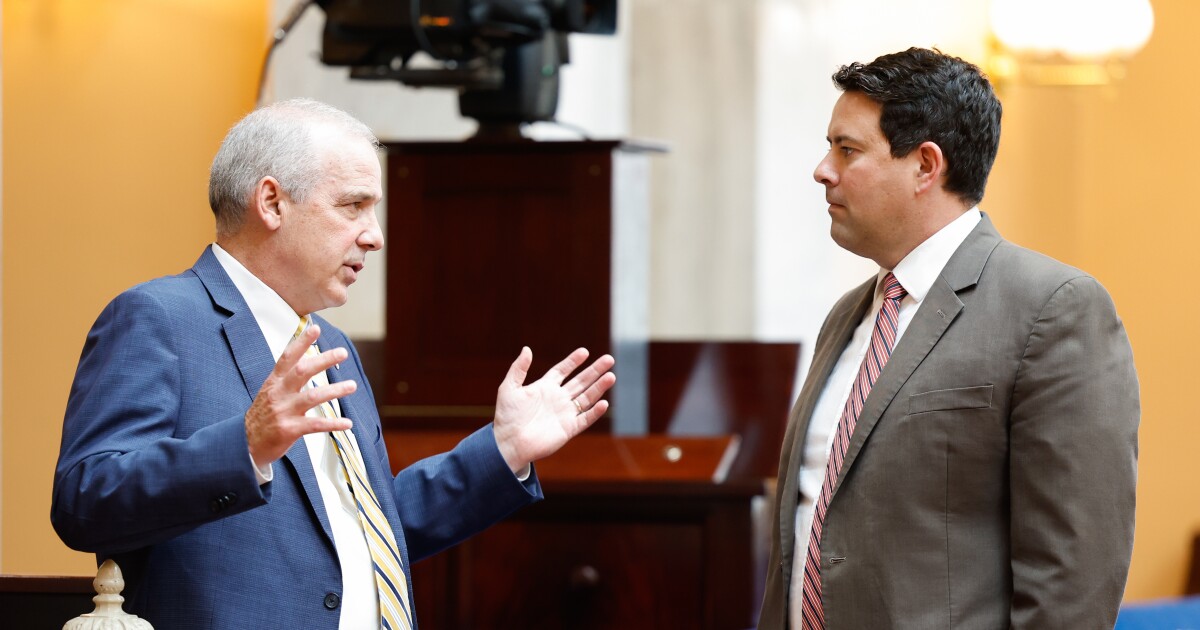
COLUMBUS, Ohio — Ohio House and Senate Republicans had finally agreed on a bill changing the state’s recreational marijuana policy, but hours before the vote was supposed to take place, it was pulled from the schedule.
Voters spoke loud and clear in November of 2023, with 57% of Ohioans voting yes on Issue 2: legalizing recreational marijuana.
“I voted for it,” state Rep. Jamie Callender (R-Concord), the House’s resident cannabis expert.
Callender has been smoking marijuana for decades and has been trying to reduce stigma around the product for just as long.
If you are 21 years old, you can smoke, vape, and ingest marijuana. Individually, you can grow six plants, but you can grow up to 12 plants per household if you live with others.
But since then, other Republican leaders have been trying to change the law.
For the past several months, the House and Senate chambers have been trying to compromise on their separate bills.
I have been covering marijuana policy extensively for years, including a series answering viewer questions about cannabis.
Ohio GOP plans to pass marijuana restrictions by end of June
In short, the Senate’s proposal decreases THC content, reduces home growing from 12 plants to 6, imposes more criminal penalties and takes away tax money from local municipalities that have dispensaries. The House’s latest version had none of those.
Click here for Senate version and here for House version changes.
“The Senate had proposed taking that tax away, and the House has fought really hard to keep that in…” Callender said. “We finally had that negotiated so it would stay in.”
Recently, Callender told me an agreement was reached on following most of the House’s new version, which mainly focused on preventing children from accessing the drug. The bill was set to hit the House floor Wednesday.
But in a turn of events, Republican infighting is preventing the bill from being passed.
“Apparently, the Senate changed their mind,” Callender said.
In a shock to House Speaker Matt Huffman (R-Lima), the Senate pulled out of the compromise.
“I’m pretty disappointed — we’re not going to have it on the floor today,” Huffman said. “To my surprise, there was a whole new set of issues, additional issues, which were raised Monday night by the Senate regarding what we were trying to do.”
It was a Senate push for 16 changes, ones that Huffman didn’t get to even see until the day before the vote was set to take place.
“They wanted to make a mandatory jail sentence for passing a joint between friends,” Callender said, referencing a provision on “sharing.”
The main holdup is the tax money, he added.
The law gives the 10% tax revenue from each marijuana sale to four different venues: 36% to the social equity fund, to help people disproportionately impacted by marijuana-related laws; 36% to host cities — ones that have dispensaries; 25% to the state’s mental health and addiction services department; and 3% to the state’s cannabis control department.
Instead, the Senate wants all the revenue from the tax to be sent to the state’s General Revenue Fund, meaning lawmakers can choose to allocate that money toward whatever they want.
The House, as Callender had mentioned, has a major sticking point with making sure that at least the local municipalities get at least some percentage of the tax revenue.
“What changed in the past 72 hours to pull the Senate out of the marijuana deal?” I asked Senate President Rob McColley (R-Napoleon)
“Well, I wouldn’t say anything has changed; I think the conversations have gone pretty well on it,” McColley responded. “I think, maybe, there was a misunderstanding as to where we might have been on the bill as both chambers.”
The president wants to follow his version of the legislation.
“Our priorities are in the bill that we already passed,” he said.
The teams will work together to actually come to an agreement as soon as possible, he continued.
“I would like to get something done by the end of June; I think [Huffman] would like to get something done by the end of June,” McColley added. “We’ll see if we can get something done in the next week.”
Huffman said he’s “not very optimistic” about that.
“I just told my caucus: ‘We’re not going to just say, “OK,” because we’re so anxious to pass the marijuana bill,’ which I’d like to get it done, but we’re not going to give up house priorities to do that,” the speaker said.
Several hours later, Huffman responded to additional cannabis questions.
“I thought we were on a path, this time last week, to pass it [this week],” the speaker said. “That was the kind of clear indication we had.”
However, when I pointed out to Huffman how McColley denied their agreement, he switched gears.
“There was no agreement to pull out of,” he said.
I asked why he would put a bill on the floor if there wasn’t an agreement.
“We were hoping that there would be, anticipating there would be, sounded like we might have, but it’s not correct to say that there was an agreement that anybody pulled out of,” he said.
However, his cousin and the resident marijuana expert in the opposite chamber, state Sen. Steve Huffman (R-Tipp City), said there was. The senator had been the main negotiating party for that chamber.
“We were in an agreement,” S. Huffman said.
He continued that policy staff and McColley brought “ongoing concerns” to him, but he believes they could be easily fixed. An additional reason why it was pulled is due to drafting issues with the bill language, he added.
“I believe that things are still being worked out, and I have the utmost confidence that we will resolve this by next Wednesday,” the senator said.
Callender isn’t so sure about that.
“Do you believe that the Senate will be going against the will of the voters with all of their requests?” I asked him.
“Yes,” he said.
Callender said that this reminds him of the last General Assembly, when M. Huffman and former Speaker Jason Stephens (R-Kitts Hill) were squabbling constantly about everything, but especially marijuana.
Stephens and Callender prevented then-Senate President Huffman’s legislation from passing. Back in 2023-24, Huffman proposed a bill very similar to the Senate’s current version.
It appears that Huffman, with the House GOP, has shifted away from a more restrictive view to a position similar to the one Stephens held in the past.
Follow WEWS statehouse reporter Morgan Trau on Twitter and Facebook.






Where do bed bugs come from? How they get could get into your home
Does the thought of bed bugs keep you up at night? Here’s what to know.
Columbus remains one of the nation’s top cities for bed bug treatments, according to Orkin’s latest annual rankings, while Ohio continues to dominate the list more than any other state.
Orkin ranked Columbus eighth on its 2026 list of U.S. cities with the most bed bug treatments, the same position the city held last year. Cleveland ranked even higher at No. 4. Cincinnati came in at No. 15.
Overall, six Ohio cities made the Top 50, more than any other state: Cleveland, Columbus, Cincinnati, Youngstown, Dayton and Toledo. The rankings are based on residential and commercial bed bug treatments Orkin performed between May 2025 and May 2026.
Chicago claimed the top spot for the sixth consecutive year, followed by Los Angeles, Detroit, Cleveland and Indianapolis.
Ohio continues to rank high for bed bugs
Ohio’s strong showing on the list comes as the state has repeatedly appeared near the top of national pest rankings.
A recent USA TODAY report, citing an analysis by Casino.ca, estimated Ohio has the second-highest bed bug risk for travelers in the country, behind only Michigan.
The Orkin rankings do not measure the total number of bed bugs in a city. Instead, they reflect where the company performed the greatest number of residential and commercial treatments over the past year.
Columbus has dealt with bed bug sightings before
The rankings also follow several high-profile bed bug incidents in downtown Columbus government offices.
Last fall, The Dispatch reported a bed bug was discovered inside the Ohio Department of Medicaid’s downtown office, prompting treatment of the affected area.
The Dispatch also reported that employees at the Ohio Bureau of Workers’ Compensation had reported bed bug sightings, leading to inspections and pest-control efforts.
Those incidents highlighted the challenges large office buildings face when dealing with pests that can hitch rides on clothing, backpacks and luggage rather than originating inside the buildings themselves.
It’s not just bed bugs
Bed bugs aren’t the only pests putting Columbus on Orkin’s radar.
In October 2025, Orkin ranked Columbus No. 21 on its annual “Rattiest Cities” list, a slight improvement from previous years but still among the nation’s leading metro areas for rodent treatments.
Taken together, the rankings suggest central Ohio remains a busy market for pest-control companies as the city holds steady on this year’s bed bug list.
Which Ohio cities made Orkin’s 2026 list?
Among Ohio cities, the rankings were:
- Cleveland– No. 4
- Columbus– No. 8
- Cincinnati– No. 15
- Youngstown– No. 32
- Dayton– No. 38
- Toledo– No. 42
Trending reporter Amani Bayo can be reached at abayo@dispatch.com.

After years of unchecked dominance from the SEC, the Big Ten Conference cemented its place as the best in college football in the 2025-2026 season.
The Indiana Hoosiers completed a remarkable 16-0 season by winning a National Championship, beating Ohio State in the conference championship game, dominating Alabama in the Rose Bowl, then blowing out Oregon in the College Football Playoff semifinal.
That completed a Big Ten trifecta, with the Michigan Wolverines winning a championship in 2024, then the Buckeyes following it up by beating Notre Dame to win the title in 2025. While the SEC might have better depth overall, it’s no question that the top of the Big Ten is as good or better than anyone.
SEC, BIG TEN ARE DOMINATING COLLEGE FOOTBALL THANKS TO MASSIVE ADVANTAGES OVER OTHER CONFERENCES
Indiana Hoosiers head coach Curt Cignetti after defeating the Miami Hurricanes in the College Football Playoff National Championship game at Hard Rock Stadium in Miami Gardens, Florida on Jan. 19, 2026. (Mark J. Rebilas/Imagn Images)
And a new program might be ready to take their turn at the top of the Big Ten: those same Oregon Ducks.
One of the most predictive measures of a team’s strength from year to year is how much production they return from the previous season. It makes sense; the more key players that stay with the team, the better it is for continuity and development.
The Big Ten, oddly enough, has several teams that return much of their production on both sides of the ball. ESPN’s Bill Connelly ran the numbers, finding that teams like Maryland, Nebraska, Minnesota and UCLA all ranked in the top 10 nationally in returning value. Though given how these teams played in 2025, that’s less important. Number 12, though? The Oregon Ducks.
And that carryover production is coming from a team that lost just two games all season, both to Indiana. They handled a very good USC team, 42-27, overcame miserable conditions to outlast the Iowa Hawkeyes on the road, beat the rival Washington Huskies, and most impressively, shut out an elite Texas Tech team 23-0 in the College Football Playoff. And they bring back the players responsible for 66% of their overall production, including star quarterback Dante Moore.
Oregon Ducks quarterback Dante Moore (5) warms up prior to the 2025 Orange Bowl and College Football Playoff quarterfinal against the Texas Tech Red Raiders at Hard Rock Stadium in Miami Gardens, Fla. (Sam Navarro / Imagn Images)
Just behind them at 65%? USC, heading into a pivotal season under Lincoln Riley.
Here’s where Oregon has the advantage, however. They bring that percentage back from a team that was significantly better than USC. It’s no surprise then, that per Connelly’s SP+ projections, Oregon is expected to be the No. 2 team in the country, by efficiency on offense, defense and special teams.
IF YOU’RE LOOKING FOR A BIG 12 WINNER NOT NAMED TEXAS TECH OR BYU, CONSIDER THE HOUSTON COUGARS
What about the other Big Ten schools, though?
USC is the biggest wildcard. They sit at No. 13 in the SP+ projections, thanks to an elite offense and a defense that’s expected to be solid, if unspectacular. But their special teams projections are all the way down at No. 100 in the country, thanks to a series of disastrous mistakes in 2025. Special teams, though, should be the easiest area to improve upon. So if the Trojans can make some adjustments, they could exceed the eight game win expectancy.
Ohio State and Indiana, the two most recent champions, have a bit of a tougher hill to climb, though their roster composition is far from disastrous. The Buckeyes bring back 60% of their production, while Indiana is at 56%, even with several huge departures. That ranks at No. 31 and No. 52, respectively. Important, but not enough to push either team out of the top 5 in the national projections. And Ohio State sits at No. 1, thanks to consistently elite recruiting and key players like Julian Sayin and Jeremiah Smith returning.
Oregon head coach Dan Lanning attends Oregon Pro Day on March 17, 2026, at the Moshofsky Center in Eugene, Oregon. (Ben Lonergan/The Register-Guard / USA TODAY NETWORK via Imagn Images)
But if there is an upset brewing at the top of the conference, Oregon might be the place to look. The question then becomes, can they put it all together against a difficult schedule? The Ducks play USC on the road, host Nebraska, travel to Illinois, play Ohio State on the road, host Michigan and have their rivalry game against Washington at Autzen.
OUTKICK IS NOW ON THE FOX APP: CLICK HERE TO DOWNLOAD
It won’t be easy, but don’t be surprised if at the end of the season, Dan Lanning and the Ducks are right back in the mix.

A Kentucky woman who had been missing for more than two weeks was found dead in her vehicle in Ohio, authorities said.
The body of Debra Wireman was found in her vehicle on July 3 in Clermont County, Ohio, the Flemingsburg Police Department in Kentucky said on Facebook on Wednesday. Investigators were called to the scene after a report identifying the vehicle as belonging to a missing person, police said. The remains were identified as Wireman’s by the Clermont County Coroner’s Office on July 7, according to law enforcement.
Police in Kentucky said the Clermont County Sheriff’s Office in Ohio is investigating the woman’s death. No additional information will be released by Flemingsburg police “out of respect for Debra’s family and the integrity of that investigation.”
“While this is not the outcome any of us hoped and prayed for, we are thankful that Debra has been found and that her family can now begin to receive the closure they deserve,” police added on Facebook.
Wireman, according to police, was last seen on June 17 at around 4:30 p.m. in Aberdeen, Ohio, while traveling toward Maysville, Kentucky. She was driving a white 2020 Kia Forte with front-end damage. Police said family and friends were “concerned for her welfare.”
“The overwhelming response from our community, neighboring agencies, the media, and countless individuals across the region demonstrated the very best of people coming together in the hope of bringing someone home safely,” Flemingsburg police said.
-

 New Jersey4 minutes ago
Family describes frantic moments delivering baby on the NJ Turnpike
-

 New Mexico12 minutes ago
Hidden gem in Cloudcroft, New Mexico has best BBQ in US
-

 North Carolina15 minutes ago
North Carolina Airport Looks to Expand Commercial Service | AirlineGeeks.com
-

 North Dakota20 minutes ago
San Francisco plots risky socialist bank modeled after controversial experiment
-

 Ohio27 minutes ago
Feeling itchy? Ohio leads nation with 6 cities on Orkin’s 2026 bed bug list
-

 Oklahoma29 minutes ago
Oklahoma’s Brent Venables named to 2026 Dodd Trophy Preseason watch list
-

 Oregon35 minutes ago
Ryan Reynolds-backed Aviation Gin shutters Oregon distillery
-

 Pennsylvania42 minutes ago
PA state rep. wants to force the York State Fair to change its name

