Nebraska
The Northern Catalpa Tree | Nebraskaland Magazine


By Gerry Steinauer, Botanist
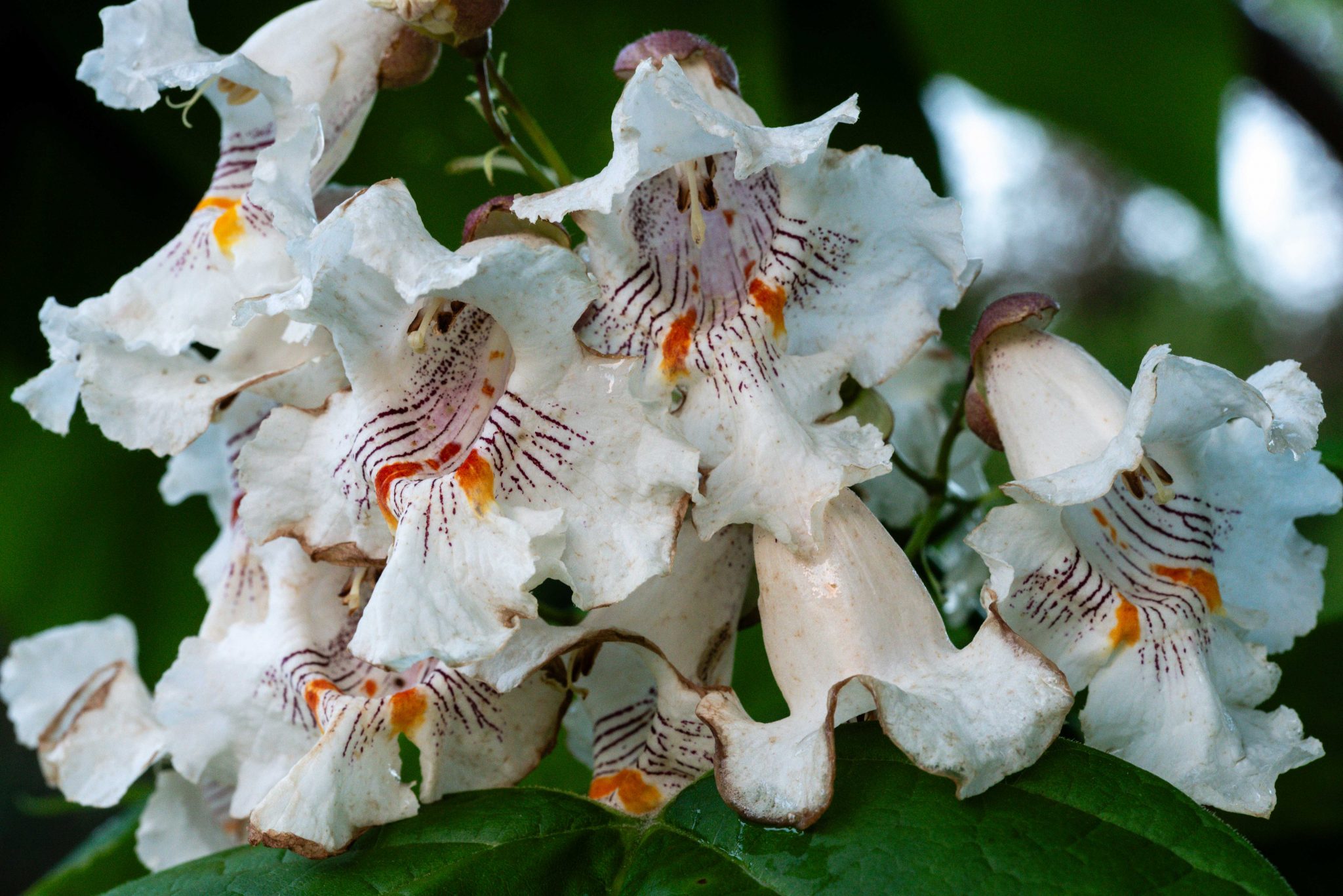
The northern catalpa is a tree you likely recognize but may not know by name. Perhaps you’ve seen it adorned with striking clusters of large, white flowers, standing out like a snow cone amid otherwise green woodlands. Or maybe, as a child, you were grudgingly sent outside to rake up its huge fallen leaves cluttering the yard. Most memorably, you and your friends may have ventured into the woods, plucked a few of the catalpa’s cigar-shaped seed pods and pretended to smoke them.
The tree is native to the central Mississippi River valley where it is called the Catawba tree (cuh-tah-buh). For reasons unknown, early settlers or botanists in this region named the tree after the Catawba people, a local Native American tribe. The northern catalpa has been widely planted in the eastern half of Nebraska, mainly as an ornamental and as a source of fence posts, where it has escaped cultivation and now grows in the wild in moist bottomlands with well-drained soils.
Several years ago, I gathered seed pods from a catalpa tree growing near an abandoned house up the road from our farm. I planted seeds in pots and transplanted several seedlings into our yard. I’ve been impressed by the trees’ rapid growth, shapely form and diversity of pollinators attracted to the flowers. Recently, I read that catalpa worms, a prized catfish bait, live on the trees. This summer I plan to pay even closer attention to this interesting tree … as I love to catfish.

Natural History
The northern catalpa is a stout-trunked tree that, in Nebraska’s drier climate, can reach about 40 feet in height and live up to 150 years in age. Its pale-colored wood is weak yet durable when in contact with the soil, making it historically popular for fence posts. To form the best post, saplings were cut back to the ground after the first or second year of growth and then only one or two of the best sprouts were left un-thinned to grow to post-size.
The tree’s telltale heart-shaped leaves can reach an impressive 4 to 10 inches long and 3 to 8 inches wide. The bell-shaped, 2-inch-long flowers bloom from late May to mid-June. The seed pods, which can reach an amazing 20 inches in length, ripen from green to purplish-brown in late summer and hang from the tree through winter. These distinctive pods give the tree two of its other common names: the Indian bean tree and cigar tree.
The nectar-rich flowers attract a variety of pollinators including hummingbirds, native bees and bumble bees, and night-flying moths. The lower flower petal has purple lines and yellow blotches that act as guides for incoming pollinators, which are drawn to the blooms by their sweet, citrus- or jasmine-like fragrance. Honeybees also swarm to catalpas, making the trees a beekeeper’s delight.
In Nebraska, the northern catalpa can only be confused with its cousin, the southern catalpa. The latter is native to the Gulf Coastal states, is less suited to the rigors of the Plains and has been planted sparingly in our southeastern towns and cities. A few distinguishing characteristics: the northern catalpa has larger and more pointed leaves, larger but fewer flowers, and longer, thicker seed pods than the southern catalpa. Interestingly, their leaf scents also differ — when crushed, northern catalpa leaves emit a sweet fragrance, while their southern cousin’s leaves produce a foul odor.
While the southern catalpa has never escaped cultivation in Nebraska, the northern catalpa escape into the wild has raised concerns among conservationists. For instance, along the central Platte River valley, the tree is taking hold along wet riverbanks and sandbars, displacing native vegetation.
In addition, this stretch of the Platte River is critical spring roosting habitat for migrating sandhill and whooping cranes. There, the open, sandy channel provides the birds with a clear view of approaching predators and encroaching trees obstruct this visibility, reducing the cranes feeling of safety and potentially limiting their use of the area. Local conservation groups are cutting and grinding larger catalpas and other invasive trees on the riverbank and disking sandbars to uproot saplings in an effort to maintain an open channel.
Catalpa Worms
The catalpa sphinx moth is named for its caterpillars, called catalpa worms, which feed exclusively on catalpa leaves, sometimes defoliating entire trees. The moth has migrated northward and westward from its native range, following planted catalpas. Over the past two decades, my friend Mark Brogie, who attracts moths with night lights, has photographed several catalpa moths in his backyard in Creighton in Knox County. “A catalpa tree just down the street is the likely source of these moths,” Brogie said. If the catalpa sphinx moth has reached as far northward and westward as Knox County, it could be present wherever catalpas grow in Nebraska.

In spring, the female moths lay masses of eggs on the underside of catalpa leaves. Typically, two broods of caterpillars hatch each summer. Mature caterpillars can reach 2 inches in length and are usually black on the back with a broad yellow stripe along the side. They have a single thorn-like, black horn at the tail end. When fully developed, the caterpillars drop from the leaves and burrow into the soil where they overwinter, metamorphosize and emerge as adult moths the following spring.
In the South, these caterpillars are called Catawba worms, and anglers prize them as bait for bass, bluegill, catfish and other fish. Fishermen pick the worms individually from the underside of leaves where they hang out or shake a branch or tree to collect entire coffee cans full of the fallen worms. Some anglers turn the worms inside out on the hook, claiming that their soft, juicy insides better entice fish. Lastly, it’s rumored that smart fishermen never reveal the location of their favorite Catawba worm tree.
It’s likely that northern catalpa trees will continue to spread in Nebraska. How much of a nuisance they become remains unknown. On the positive side, in the coming decades, Nebraska anglers may have a new go-to fish bait.






The future of data centers in Nebraska took center stage at a North Omaha town hall Thursday evening.
The event was hosted by State Sens. Terrell McKinney and Ashlei Spivey, who alongside Sen. Machaela Cavanaugh sponsored a bill in the Nebraska Legislature that looked to help regulate data centers.
Parts of their bill were adopted and passed in LB1010, which requires reports on annual power usage, water usage and ownership.
“Having this passed in a package showed a lot of bipartisan work,” Spivey told a crowd of attendees at Nelson Mandela Elementary School.
The proposed regulations were shaped in part by Bold Nebraska, an advocacy group focused on eminent domain and clean energy. Jane Kleeb, chair of the Nebraska Democratic Party and founder of Bold Nebraska, said before the bill passed there were “zero laws on the books” to address a boom in data centers.
“If one is coming into the community, we wanted to make sure that there were some basic transparency things in place,” Kleeb said.
Political discussions around data centers heated up in recent months following reporting by the Flatwater Free Press that showed Google is considering a data center in Nebraska that could require more than three times the amount of power the entire city of Lincoln uses at peak demand in the summer.
The Nebraska Legislature recently passed another bill, LB1261, that allows private developers to build and own power plants to serve a large industrial customer, including data centers. That bill was proposed by the governor’s office and celebrated by Gov. Jim Pillen.
“Our state is once again taking a bold and strategic step – one that will create an environment that attracts business and multibillion dollar investment, while legally preserving Nebraska’s unique and consumer-friendly public power model,” Pillen said at the time.
At Thursday’s town hall, McKinney called LB1261 “the bogeyman bill.”
“It’s a bill that the governor pushed through the legislature to allow for data centers to create their own power,” McKinney said. “It’s a bill that I stood on the floor and said this is going to harm our communities.”

LINCOLN, Neb. (KOLN) – Hundreds of people are without power in southeast Nebraska after a severe storm passed through Thursday morning.
The Lincoln Electric System outage map showed 115 customers without power across the city at 11:36 a.m.
Norris Public Power District’s outage map also shows 45 customers affected by the storm. As of 11:36 a.m., there were nine active outages.
According to the Nebraska Public Power District outage map, 657 customers were affected by the storm. Most of the affected customers were near Plattsmouth in southeast Nebraska. As of 11:37 a.m., 27 customers remain without power.
Submit your weather photos and videos below.
Click here to subscribe to our 10/11 NOW daily digest and breaking news alerts delivered straight to your email inbox.
Copyright 2026 KOLN. All rights reserved.

Mandatory evacuations have been ordered near Crawford, including Fort Robinson State Park, as the South Fork Fire continues to spread in western Nebraska.
According to the City of Crawford, evacuations are currently underway for an area north of Crawford that includes the area south of Dodd Road, west of Dodd Road, and FF Street.
Fort Robinson has also been evacuated.
The Nebraska Game and Parks Commission said Fort Robinson State Park and Peterson Wildlife Management Area have been temporarily closed due to the fire.
The fire has burned approximately 9,000 acres and is currently 0% contained, according to the U.S. Forest Service.
Nebraska Game and Parks said the park and the WMA will remain closed until further notice to support firefighting operations and protect public safety.
-
 Lifestyle23 minutes ago
‘Stop! That! Train!’ is Loud! Dumb! and Gay!
-

 Technology31 minutes ago
So you want to buy a gaming handheld PC
-

 World39 minutes ago
Former South Korean President Yoon Suk Yeol sentenced to 30 years over North Korea drone flights
-

 Politics41 minutes ago
Mamdani touts massive taxpayer-funded investment for trans healthcare: ‘First step’
-

 Health47 minutes ago
Nightly glass of wine may not be as harmless as many people think, study suggests
-

 Sports54 minutes ago
2026 World Cup Odds: Teams Favored to Advance to Knockout Stage
-

 Technology57 minutes ago
Stolen iPhones fuel scary passcode scam
-
Business1 hour ago
AI is cutting hours of office work, but also creating a new kind of busywork