Movie Reviews
‘Marianne’ Review: Isabelle Huppert’s One-Woman Conceptual Art Project Sparks Deep Thoughts and Profound Annoyance


Well, that’s a wrap. As I look back on my two-decade tenure at Variety, I’m incredibly proud of the 2,000-plus reviews that the publication (and you, my readers) have entrusted me with. It’s the greatest privilege any film critic could ask for. And yet, I can’t shake the responsibility of what I refer to as my “guilt list”: all the films I’ve seen, but didn’t have the time to review. Most critics don’t have this problem. They have clear-cut assignments, which they fulfill in time for a film’s release. At an industry paper like Variety, however, we endeavor to cover as many films as humanly possible, from Hollywood blockbusters to relatively obscure art films and indies. And because that mission matters to me, I don’t forget the ones that slip through the cracks.
Maybe it was something I saw at a festival, but couldn’t get around to, like György Pálfi’s dialogue-free “Hen” (which ranks right up there with Cannes sensation “Eo,” but never got the same critical attention) or Jack Begert’s smart, self-questioning Sundance orphan “Little Death,” which radically pivots from jaded industry cynicism to something more life-affirming midway through. Or else a movie looking for distribution that just might have found a home if I’d only had time to review it, such as Ari and Ethan Gold’s resonant, one-shot “Brother Verses Brother,” a Linklater-esque walk-and-talk gem that shadows the pair around San Francisco. I bear the responsibility of not covering these and so many odd outliers, from fringe offerings like “Abruptio,” a serial killer thriller made entirely with puppets, to Andy Warhol’s “San Diego Surf” (thought lost until 2012), in which Taylor Mead takes an enthusiastic interest in SoCal water sports.
I reckon I have time to scratch just one of these oversights off my guilt list before leaving, and so I find myself circling back to an earnest little movie called “Marianne,” whose squeaky-wheel director, Michael Rozek, has been pestering me on X for more than a year. Rozek, who felt compelled to make his first feature late in life, describes the project as a “revolutionary one-woman film,” starring my all-time favorite actress, Isabelle Huppert. So after several frustrated attempts, I finally made time to watch it (since Rozek claims a release is coming later this year).
Looking elegant as ever, Huppert appears with script in hand, half-reading, half-reciting a long, self-important monologue, written by Rozek. It’s not so much a performance as a run-through, shot in several long takes in which the camera zooms, wobbles and repositions itself while she speaks. Alas, English is not Huppert’s native language, and though gravitas comes easy, the red-headed actress makes strange pauses and even stranger gestures, which can be disconcerting. Huppert reacts to the text as it leaves her mouth, when we ought to believe that these words are hers (or “Marianne’s”) to begin with.
How Rozek convinced the courageous French star to do this, I can only imagine, but accepting such an assignment is the kind of fearless act we’ve come to appreciate from Huppert, who’s played a demented disciplinarian in “The Piano Teacher” and a woman excited by assault in “Elle” — risky roles few would even consider, much less embrace. A few years back, I managed to catch Huppert onstage. She was performing “Mary Said What She Said,” an avant-garde one-woman show directed by Robert Wilson, which she has toured around the world. I can only assume Rozek must have seen this as well, since it was around the time he made “Marianne” (three years ago now), and yet, he opted not to emulate it.
In that piece, Huppert “played” Mary Queen of Scots (in the sense that she “plays” a character named Marianne in “Marianne,” making no attempt to embody or otherwise become a different person). The French star moved energetically back and forth, up and down the stage — it was a positively calisthenic performance — as she delivered her lines in double time. I’m no expert on Brecht, but this seems like a classic example of the “alienation effect,” whereby audiences are intended to be made aware of the theatrical artificiality of the experience.
Rozek mischievously seeks something similar. Huppert spends most of “Marianne” seated on an expensive blue couch with his script in her hands, holding what’s meant to feel like a one-way conversation with the audience — more of a lecture, really, as “Marianne” represents Rozek’s manifesto about what is “real” in a medium where every creative choice is constructed. Plots aren’t real. Stories aren’t real. Lord knows reality TV isn’t real.
“Wake up!” Huppert screams at one point, looking directly into the camera. “Be real!”
Who is Rozek chiding exactly? And who exactly does this indignant idealist suspect is “suppressing” his film? (That’s the word he keeps using on X to describe a dynamic in which buyers aren’t swarming to release Rozek’s tedious disquisition on all that’s wrong with the film industry today.) There’s no such conspiracy. The truth is, nobody cares. He might as well carve it up into 30-second clips and share it on TikTok. Responding as someone who found “Marianne” too pedantic to watch through to the end until now — but who identifies with many of Rozek’s frustrations — I would argue that cinema can achieve much nobler goals than “realism.”
Consider this: A photograph captures whatever appears directly in front of the camera, but it’s still composed, excluding whatever exists beyond the frame. It’s far more difficult to create something expressionistic — that is, an entirely stylized alternate reality — that audiences still find engaging, relatable and emotionally true. Picture Jean Cocteau’s “Beauty and the Beast,” the best of Tim Burton’s films or anything brought to life from scratch by brilliant animation artists. That should be the goal: achieving some kind of communion between the audience and whoever they’re watching on-screen. That’s what Rozek (in his “revolutionary” way) imagines he’s offering with “Marianne.” But it’s also what the most bottom-line-minded studio execs most want when attempting to make a hit popcorn movie.
About midway through, Huppert-as-Marianne says, “Some will say, ‘This is not a film. This is a play.’” Why is Rozek being so defensive? Audiences aren’t as dumb as the film implies — certainly not the ones who’d seek out and watch something as nontraditional as “Marianne.” Neither are distributors and other would-be backers, any of whom can see that such a project, while not without merit, stands no chance of financial success (budgeted at an estimated $350,000, it will be lucky to break even). “Marianne” is a film, just not a very good one — it’s nowhere near as effective as Julian Rosefeldt’s “Manifesto,” in which we sit riveted as a shape-shifting Cate Blanchett recites a range of world-changing treatises, from Karl Marx to Dogma 95. The validity of his argument aside, Rozek may as well be screaming into the void.
I don’t recall Martin Luther complaining, after nailing his 95 theses to the Castle Church door, that a bidding war didn’t immediately break out among publishers to reprint his grievances. “Marianne” means well, but comes from a place of profound naivete. It’s meant to get audiences thinking about what they watch — the “content” they consume — by raising awareness of what film can be. But it hasn’t figured out the carrot that will entice them to hear its message. If even a die-hard Huppert admirer like me has trouble getting through it, why would a casual cinephile bother?
“They think that you need to escape,” Huppert says, “to forget … your pain.” The royal “they” in this case are “the suits” who call the shots and hold the purse strings. Rozek believes that he’s on to something new when he suggests that if the film industry would only “help you get to the bottom of your pain, instead of numb it,” they’d have people lining up to pay. Sounds great, but movies don’t work that way, and “Marianne” isn’t well written enough — not performed with sufficient conviction — to prove otherwise.
Sure, it can be demoralizing for intelligent adults to investigate what’s available at their local megaplex and see only prequels, sequels, spinoffs and superhero movies. But tens of thousands of films are made each year, and quite a few of them break the rules, defy conventional narrative expectations and smack us deep in our souls. To repeat Bergman (as paraphrased in the film), the greatest filmmakers capture life in a reflection. Film is a looking glass — a role it plays quite literally here when the scene changes and Huppert reads the “love chapter” from I Corinthians into the mirror.
In its most profound moments, “Marianne” alludes to mortality, to “real life.” But it doesn’t dare suggest what others have (here I’m thinking of Kubrick at the end of “Eyes Wide Shut”), that movies may illuminate life, but they can’t replace it. Now, I say this as someone who’s spent nearly as many hours in the dark vicariously sharing the lives of others — imaginary people, no less — as I have engaging with real people: In order to succeed as a revolutionary act, “Marianne” must achieve the kind of cathartic epiphany Rozek refers to, but ultimately fails to deliver. It needs to serve up an insight that hasn’t already occurred to us, rather than a Holden Caufield-callow attack on phoniness. Alternately, at any point, Huppert could interrupt herself, stare the audience straight in the face and advise them to turn off, walk out and experience the world.
That, my dear Marianne, is what it means to get real.



Heat Advisory
from THU 12:00 PM EDT until THU 8:00 PM EDT, Eastern Montgomery County, Lower Bucks County, Philadelphia County, Delaware County, Eastern Chester County, Gloucester County, Northwestern Burlington County, Camden County, Mercer County, New Castle County

By and large, the zombie subgenre has bitten off more than it can chew in modern times. Between George Romero survival films and camp comedies, the well has become pretty infected. But once in a while, along comes a movie like This Is Not A Test.
Let’s sink our teeth into this new release and see how it stacks up against the classics.
The tone and tenor of this film represent the classic survival movies like Night Of The Living Dead. But the thing that grabs the audience about This Is Not A Test is the trauma of the characters. Holt shines as a withdrawn survivor of an abusive home, trying to cut through the wreckage to reunite with her sister. Each of the main characters have standout traits, and they bathe in strongly acted moments as the stress of the situation changes who they are.
The gore in This Is Not A Test is pretty strong. The attacks spring quickly and when they do, the special effects team does a good job showcasing the battle scars. The camera work is also frenetic in a good way, because the chaos of the chase scenes puts the viewers in a first-person perspective. This film lets you feel like a part of the survivors, so their journeys are interactive.

Longtime fans may say that there’s nothing new in This Is Not A Test, and maybe they’re right. There’s no fresh take on the monsters here, no crazy origin, nothing that we haven’t seen in the past fifty-eight years. But the pacing nails a great balance between getting to know the characters and getting the zombie splatter fest. The mental meltdowns of the characters feel well earned, and the arc of Sloane and her sister brings a lot of heart and investment to the story. Even the most jaded zombie horror fans will find something to appreciate here, even as a background movie.
Adam MacDonald has made another intense hit here, and This Is Not A Test is currently available to stream on Shudder.

- THE ODYSSEY
- Starring: Matt Damon, Tom Holland and Anne Hathaway
- Directed by: Christopher Nolan
- Rated: R
- Running time: 2 hrs 45 mins
- Universal
Our score: 4.5 out of 5
EPIC. If I was asked to describe Christopher Nolan’s latest film, that is the word I would use. He has mounted a film that rivals the greatest achievements of filmmakers like Cecil B. DeMille or David Lean. And, like the films of those mentioned, it’s runs a tad too long.
I was shocked, but pleased, to see that my 12-year-old granddaughter recently did a school paper on King Agamemnon. Thank goodness they’re still teaching History in our schools. Based on Homer’s “The Odyssey,” the film tells the story of King Odysseus (Damon) and his adventures which, if you’ve read “The Odyssey,” include the Trojan Horse, the Cyclops and assorted angry Greek gods. The film covers each of these adventures in great detail, sparing nothing in the production design department. While Odysseus is away – and he’s gone for a l-o-n-g time, his wife Penelope (Hathaway) has to endure a never ending string of “suitors,” men lining up in the hopes of replacing the King should he not return. The men are nothing more then scavengers, taking advantage of the law of Zeus, which decrees no one should be turned away. This angers the Queen’s son, Telemachus (Holland), who must control his temper when the men try to bait him into a fight, the idea being if Telemachus is killed, the new husband would become the King. It’s all very interesting and complicated. And long.
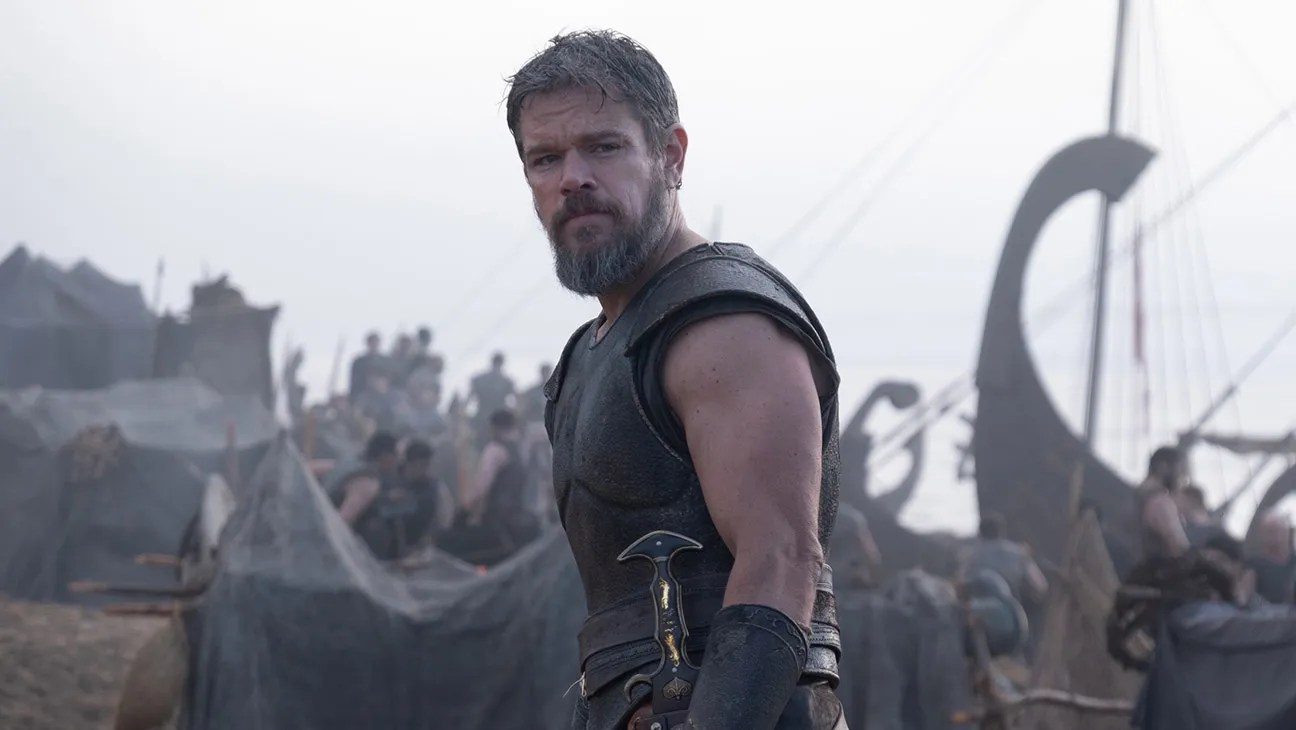
Director Nolan is one of the rare filmmakers who, in my opinion, has never made a bad film. From “Memento” to the “Dark Knight” trilogy to the Oscar-winning “Oppenheimer,” he has proven himself a true master of cinema. “The Odyssey” only adds to that distinguished resume’
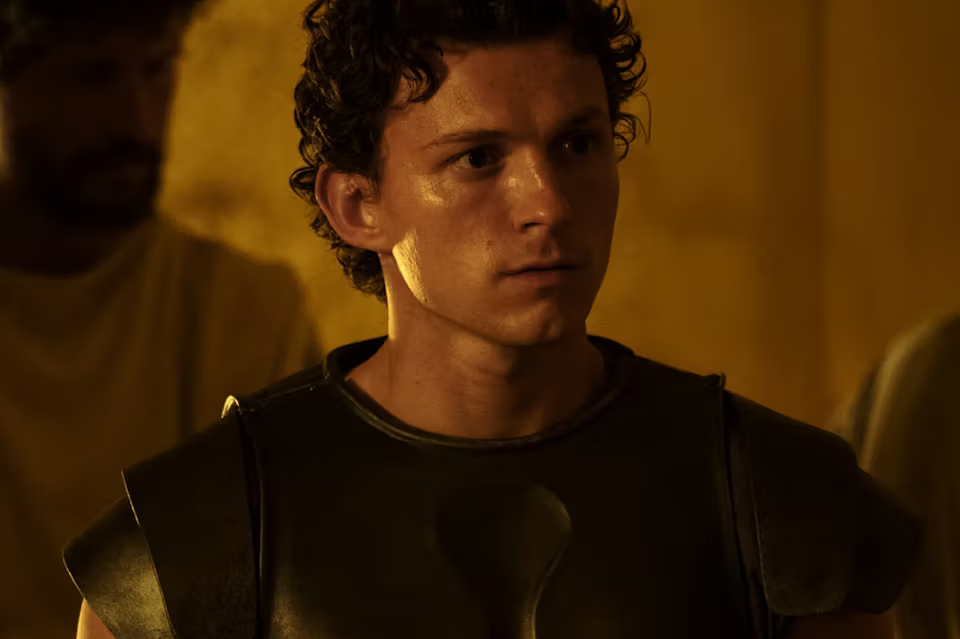
The cast is a tribute to Nolan himself who, like Woody Allen, can pretty much get anyone he wants for his films because, as an actor, why wouldn’t you want a credit in one of his films. Besides the three stars named above, the cast includes Robert Pattinson, John Leguizamo, Zendaya, James Remar, Jon Bernthal, Oscar nominees Samantha Morton and Elliot Page as well as Oscar winners Charlize Theron and Lupita Nyongo. As MGM used to advertise, “more stars than there are in heaven.”
The script and story are pretty faithful to the source material, though for some reason it bothered me whenever Telemacus referred to Odysseus as “dad.” Never father. The weird things you notice. Visual.y the film is stunning and the Trojan Horse and battle of Troy are worth the price of admission alone. I will add that I did see the film in 70 mm and, if that format is playing in your town, I urge you to see it in that format.
On a scale of zero to five, “The Odyssey” receives ★★★★ ½
-

 Vermont25 seconds ago
A Vermont couple builds an 800-square-foot home on a budget – The Boston Globe
-

 Virginia6 minutes ago
Virginia Tech HC James Franklin Gives High Praise For Clemson’s Dabo Swinney
-

 Washington12 minutes ago
Will air quality be even worse in Washington DC on Friday?
-

 Wisconsin18 minutes ago
LIVE UPDATES: Wisconsin air quality, wildfire smoke blankets region
-

 West Virginia24 minutes ago
Repair work on busiest bridge in West Virginia to happen in phases to “minimize disruptions”
-
Wyoming30 minutes ago
Wyoming Rodeo Stars Set for National High School Finals
-

 Crypto36 minutes ago
New law protects consumers from cryptocurrency kiosk/ATM fraud | Maui Now
-

 Fitness48 minutes ago
‘This works’: Fitness icon Suzy Jalowsky, 60, shares the simple exercise formula she swears by


