Politics
Commentary: Fix the potholes or fight the power? That’s the choice facing California’s next governor


You may have missed it, what with President Trump’s endless pyrotechnics, but California voters will decide in November who succeeds Gavin Newsom, the highest-profile governor since the Terminator returned to Hollywood.
Unfortunately for those attempting to civically engage, the current crop of contenders is, shall we say, less than enthralling.
In alphabetical order (because there is seriously no prohibitive front-runner), the major candidates are Xavier Becerra, Chad Bianco, Ian Calderon, Steve Hilton, Matt Mahan, Katie Porter, John Slavet, Tom Steyer, Eric Swalwell, Tony Thurmond, Antonio Villaraigosa and Betty Yee.
Whew! (Pause to catch breath.)
Armed with that knowledge, you can now go out and win yourself a few bar bets by asking someone to name, say, even two of those running.
Meantime, fear not. Your friendly columnists Mark Z. Barabak and Anita Chabria have surveyed the field, weighed the odds, pondered California’s long history and concluded … they have absolutely no clue what will happen in the June 2 primary, much less who’ll take the oath of office come next January.
Here, they discuss the race that has Californians sitting on neither pins nor needles.
Chabria: Mark, I do this for a living and I’m having trouble summoning up any interest in this race — yet, anyway.
Part of my problem is that national events are so all-consuming and fast-moving that it’s hard to worry about potholes. I admit, I appreciate that our White House-contending governor is fighting the big fight. But remind me again, what’s a governor supposed to do?
Barabak: End homelessness. Elevate our public schools to first-class rank. Make housing and college tuition affordable. Eliminate crime. End disease and poverty. Put a chicken in every pot. Make pigs fly and celestial angels sing. And then, in their second year …
Seriously, there’s a pretty large gap between what voters would like to see happen and what a governor — any governor — can plausibly deliver. That said, if our next chief executive can help bring about meaningful improvement in just a few of those areas, pigs and angels excepted, I’d venture to say a goodly number of Californians would be pleased.
Broadly speaking, my sense when talking to voters is they want our next governor to push back on Trump and his most egregious excesses. But not as a means of raising their national profile or positioning themselves for a run at the White House. And not to the exclusion of bettering their lives by paying attention to the nitty and the gritty, like making housing and higher education more readily available and, yes, fixing potholes.
Chabria: All that is fair enough. As the mom of two teens, I’d especially like to see our university system be more affordable and accessible, so we all have our personal priorities. Let’s agree to this starting point: The new governor can’t just chew gum and walk. She or he must be able to eat a full lunch while running.
But so far, candidates haven’t had their policy positions break through to a big audience, state-focused or not — and many of them share broadly similar positions. Let’s look at the bits of daylight that separate them because, Republicans aside, there aren’t canyon-size differences among the many candidates.
San José Mayor Matt Mahan, the newest entry in the race, is attempting to position himself as a “can’t-we-all-just-get-along” centrist. How do you think that will go over with voters?
Barabak: You’re having me tiptoe uncomfortably close to the Make A Prediction Zone, which I assiduously avoid. As I’ve said before, I’m smart enough to know what I don’t know. (Many readers will doubtless question the underlying premise of the former if not the latter part of that statement.)
I think there is at least a potential for Mahan to tap into a desire among voters to lower the hostilities just a bit and ease up on our constant partisan war-footing.
You might not know it if you marinate in social media, or watch the political shout-fest shows where, as in nature, the loudest voices carry. But there are a great many people working two or even three jobs, ferrying their kids to soccer practice, worrying about paying their utility and doctor bills, caring for elderly parents or struggling in other ways to keep their heads above water. And they’re less captivated by the latest snappy clap-back on TikTok than looking for help dealing with the many challenges they face.
I was struck by something Katie Porter said when we recently sat down for a conversation in San Francisco. The former Orange County congresswoman can denigrate Trump with the best of ‘em. But she said, “I am very leery of anyone who does not acknowledge that we had problems and policy challenges long before Donald Trump ever raised his orange head on the political horizon.”
California’s homelessness and affordability crises were years in the making, she noted, and need to be addressed as such.
I heard Antonio Villaraigosa suggest something similar in last week‘s gubernatorial debate, when the former Los Angeles mayor noted the state has spent billions of dollars in recent years trying to drastically reduce homelessness with, at best, middling results. “We cannot be afraid to look in the mirror,” he said.
That suggests to me Mahan is not the only candidate who appreciates that simply saying “Trump = Bad” over and over is not what voters want to hear.
Chabria: Certainly potholes and high electricity bills existed before Trump. But if the midterms don’t favor Democrats, the next governor will probably face a generational challenge to protect the civil rights of residents of this diverse state. It’s not about liking or disliking Trump, but ensuring that our governor has a plan if attacks on immigrants, the LBGTQ+ community and citizens in general grow worse.
I do think this will matter to voters — but I agree with you that candidates can’t simply rage against Trump. They have to offer some substance.
Porter, Swalwell and Becerra, who have the most national experience and could be expected to articulate that sort of vision, haven’t done much other than to commit to the fight. Steyer and Thurmond want to abolish ICE, which a governor couldn’t do. Mahan has said focusing on state policy is the best offense.
I don’t think this has to be a charisma-driven vision, which is what Newsom has so effectively offered. But it needs to bring resoluteness in a time of fear, which none of the candidates to my mind have been able to project so far.
But this all depends on election results in November. If Democrats take Congress and are able to exert a check to this terrible imbalance, then bring on the asphalt and fix the roads. I think a lot of what voters want from a governor won’t fully be known until after November.
Barabak: The criticism of this collective field is that it’s terminally boring, as if we’re looking to elect a stand-up comic, a chanteuse or a juggler. I mean, this is the home of Hollywood! Isn’t it the birthright of every California citizen to be endlessly entertained?
At least that’s what the pundits and political know-it-alls, stifling yawns as they constantly refresh their feeds on Bluesky or X, would have you believe.
Voters elected Ronald Reagan and Arnold Schwarzenegger as governor — that’s two movie stars in the state’s 175-year history — and, from the way the state is often perceived, you’d think celebrity megawattage is one of the main prerequisites for a chief executive.
But if you look back, California has seen a lot more George Deukmejian, Pete Wilson and Gray Davis types, which is to say bland-persona governors whom no one would mistake for box-office gold.
It seems to me no coincidence that Schwarzenegger, who arrived as a political novelty, was replaced by Jerry Brown, who was as politically tried-and-true as they come. That political pendulum never stops swinging.
Which suggests voters will be looking for someone less like our gallivanting, movie matinee governor and someone more inclined to keep their head down in Sacramento and focus on the state and its needs.
Who will that be? I wouldn’t wage a nickel trying to guess. Would you care to?
Chabria: I certainly don’t care to predict, but I’ll say this: We may not need or get another Terminator. But one of these candidates needs to put some pepper flakes in the paste if they want to break out of the pack.



NEWYou can now listen to Fox News articles!
President Donald Trump said Tuesday he plans to lift U.S. sanctions on Turkey and signaled he is prepared to move forward with the long-stalled sale of F-35 stealth fighter jets, marking a dramatic reversal in U.S. policy toward the NATO ally years after Ankara was expelled from the program for its purchase of a Russian missile defense system.
Speaking alongside Turkish President Recep Tayyip Erdoğan during a bilateral meeting at the NATO summit in Ankara, Turkey, Tuesday, Trump said his administration would remove sanctions imposed on Turkey’s defense sector.
“I can tell you we’re going to be taking the sanctions off, OK?” Trump said. “I don’t want him to waste his time answering that question. It’s time. We don’t sanction friends.”
TRUMP BETS ON FORMER NATO TROUBLEMAKER AS TURKEY’S STRATEGIC VALUE SURGES
Turkish President Recep Tayyip Erdogan welcomes US President Donald Trump at Ankara Airport, who is paying an official visit to Turkey ahead of the 36th NATO Heads of State and Government Summit in Ankara, Turkey, on July 07, 2026. (Dogukan Keskinkilic/Pool via REUTERS)
Asked whether he would sell F-35 fighter jets to Turkey despite existing legal restrictions tied to Ankara’s purchase of the Russian-made S-400 air defense system, Trump indicated he was open to doing so.
“Many people, including the people sitting right here thinks why wouldn’t we do that?” Trump said. “Turkey has been in many ways much more loyal than other countries that we think would be loyal.”
Pressed on concerns about Turkey’s continued possession of the S-400, Trump dismissed them.
“I have no concerns about anything.”
The remarks represent Trump’s clearest indication yet that he intends to restore defense ties with Turkey, building on months of efforts to revive military cooperation with one of NATO’s largest armed forces after years of strained relations.
Turkey was removed from the multinational F-35 program in 2019 after taking delivery of the Russian-made S-400 air defense system, prompting Washington to argue that operating the Kremlin-built system alongside America’s most advanced stealth fighter could expose sensitive U.S. technology. Congress subsequently imposed sanctions under the Countering America’s Adversaries Through Sanctions Act, or CAATSA.
‘WRITTEN IN OUR DNA’: POLISH PILOTS WHO REMEMBER SOVIET RULE PREPARE FOR AMERICA’S MOST LETHAL FIGHTER JET
Congress long has been one of the biggest obstacles to restoring Turkey’s access to the F-35, with bipartisan lawmakers arguing that Ankara should not receive America’s most advanced fighter aircraft while it continues to possess the Russian-made S-400 air defense system and pursues policies they say run counter to U.S. interests.
A U.S. airmen watches an Air Force F-35 Lightning II joint strike fighter aircraft approach for the first time on July 14, 2011 at Eglin Air Force Base in Florida. (Samuel King Jr./U.S. Air Force)
Beyond political opposition, the Trump administration also faces legal hurdles.
While the president has authority over sanctions policy, Congress enacted additional restrictions after Turkey’s purchase of the S-400. Section 1245 of the fiscal year 2020 National Defense Authorization Act bars the transfer of F-35 aircraft to Turkey unless the executive branch certifies that Ankara has met statutory requirements related to the Russian missile system.
In recent days, a bipartisan group of House lawmakers urged Trump not to move forward with an F-35 sale, arguing that doing so without satisfying those legal requirements would violate U.S. law and undermine national security.
Lawmakers also have warned that Turkey’s continued possession of the S-400, support for Hamas and tensions with fellow NATO allies Greece and Cyprus raise broader concerns about restoring Ankara’s access to the stealth fighter.
Russian S-400 missile air defence systems are seen before the military parade to commemorate the 75th anniversary of the battle of Stalingrad in World War Two, in the city of Volgograd, Russia February 2, 2018. REUTERS/Tatyana Maleyeva – UP1EE220T3A2B
CLICK HERE TO DOWNLOAD THE FOX NEWS APP
The Pentagon has maintained that the S-400’s sophisticated radar could collect data on the F-35’s radar signature and electronic profile during routine operations, potentially allowing Russia to better detect and defeat the aircraft in a future conflict if that information were shared with Moscow.
When the Trump administration removed Turkey from the F-35 program in 2019, the White House said “the F-35 cannot coexist with a Russian intelligence collection platform that will be used to learn about its advanced capabilities.”
Pentagon acquisition chief Ellen Lord similarly warned at the time that allowing Turkey to operate both systems would jeopardize the long-term security of the F-35 program because “much of the F-35’s strength lies in its stealth capabilities.”
SEATTLE — Is everybody happy now? You good, Mr. President?
Put our boys in a blender, President Trump did, with those phone calls to FIFA President Gianni Infantino. Messed with their mojo by politicking to get American striker Folarin Balogun’s red card rescinded.
We’ll have to check VAR, but it might be the first time Trump succeeded at having a decision overturned.
Probably because this time what he sought to overturn — discipline stemming from Balogun’s accidental contact in the United States’ victory over Bosnia and Herzegovina — actually was unjust. Balogun should not have received a red card.
The problem is, having our President butt in here was a joke. Unfunny and out of bounds, offsides, an own goal — all of the things.
It put the U.S. team at the center of a geopolitical maelstrom, which is exactly what they did not need in the hours before the biggest match of their lives and the biggest match in the history of the U.S. men’s soccer program.
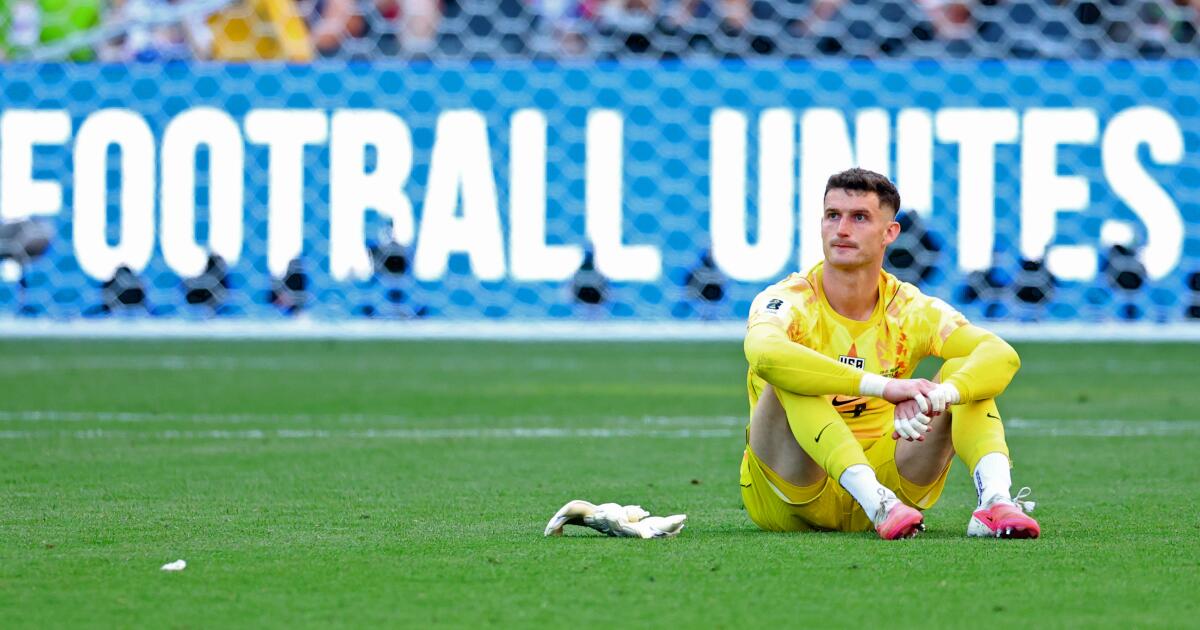
Some 40 or 50 million viewers were expected to tune in; how many of them watched for the first time? And what sort of impression did Monday’s 4-1 blunder-filled meltdown against Belgium make? That we stink at soccer — still?
If you were one of them, please, believe your soccer-fan friends when they tell you the Americans played much better in previous matches.
But so much for a magical run. On their home turf, the Americans pulled up lame before the finish line (aka, for the U.S. team’s purposes, its first quarterfinals since 2002).
To their credit, after the debacle, members of the U.S. team didn’t complain about anything being rigged. They didn’t use the distraction as an excuse. And they didn’t point fingers at anyone — anyone at all.
U.S. striker Folarin Balogun (20) walks to the locker room at halftime against Belgium in the World Cup on Monday at Lumen Field in Seattle.
(Allen J. Schaben / Los Angeles Times)
“We’re playing on home soil,” defender Chris Richards said. “So the only pressure we put on ourselves is to perform for our country, and ultimately didn’t feel the way we wanted to today. But I don’t think the antics of the last 24 hours had anything to do with it.”
No, they said the “debate,” or “outside noise” or “political manipulation” — as Tim Ream, Alex Freeman and coach Mauricio Pochettino described what others are calling “Balogate” — were not to blame for the gut-punch that answered the question: Why not us?
Because the U.S. is not yet good enough to beat the world’s great teams. Especially not when their pregame preparation includes having to try to block out an international uproar.
To have any hope against the Belgians in the round of 16 — a matchup between FIFA’s Nos. 9- and 17-ranked sides — the Americans needed to be going full-tilt, to be focused and ferocious and probably also a little bit lucky.
Instead, they looked shook, rattled. And they got rolled.
They were the worst version of themselves at the worst time, which was so weird from a team that had been on its front foot from the first whistle against Paraguay.
Not Monday. Against Belgium, they were on their heels from the outset. Heavy touches, slow afoot, playing like they had the weight of the World Cup on their shoulders.
And all that White House maddening meddling — for what?
Balogun started and played most of the match, but it could just as well have been reserve striker Ricardo Pepi. Or you or me, Balogun was that ineffective.
His play of the day came postmatch, when he approached Belgian coach Rudi Garcia and the two had a respectful exchange. A real diplomat, that Brooklyn-born, Britain-raised American by birthright.

This loss was a real team effort, of course. Christian Pulisic came off in the 59th minute after twisting his right ankle — leaving this World Cup without a goal in the four matches he appeared.
Matt Freese, the Harvard-educated starting goalkeeper, had a brain cramp of epic proportions when he stepped outside of the box and failed to corral a ball. Belgium’s Charles De Ketelaere kicked it loose and set up Hans Vanaken, whose shot traveled behind Ream for an easy score that made it 3-1 in the 57th minute.
There was a lot of poor decision-making with this match, on and off the pitch.
In the end, Trump’s appeal to Infantino did more harm than good. But what if some good could come from it?
Hey, FIFA, what about giving teams a process to appeal cards, like our American athletes in the NBA, NFL and MLB have?
Offering a suggestion box wouldn’t be opening Pandora’s box, not if it were a transparent and regular part of the game that would, hopefully, offer increasingly fair outcomes in a tournament where every match is so monumental — as our President recognized, much too enthusiastically.

U.S. coach Mauricio Pochettino waves to the crown after a 4-1 loss to Belgium at the World Cup on Monday.
(Allen J. Schaben / Los Angeles Times)
Prosecutors on Monday began laying out their case against the man accused of murdering Charlie Kirk. It was the first day of a weeklong preliminary hearing that will determine whether or not there is enough evidence against the accused killer to stand trial.
-

 Pennsylvania2 minutes ago
The 11 Most Picturesque Small Towns in Pennsylvania
-

 Rhode Island4 minutes ago
The Must C’s of Rhode Island
-

 South-Carolina10 minutes ago
When is South Carolina’s tax free weekend? Here’s what to know
-

 South Dakota17 minutes ago
150-mile power line to connect substation near Fargo to northeast South Dakota
-

 Tennessee19 minutes ago
When is Tennessee’s tax-free weekend in 2026? Here’s what you need to know
-
Texas25 minutes ago
Trump takes credit for Toyota moving some truck production from Mexico to Texas: ‘That’s what tariffs do’
-

 Utah32 minutes ago
Utah Shutters Boarding School Paris Hilton Says Abused Her
-

 Vermont35 minutes ago
Letter to the Editor | Judy Murphy: In support of Molly Gray

