West
ICE arrests ‘criminal alien’ released from prison with sex crimes conviction: 'He won’t be welcome back'

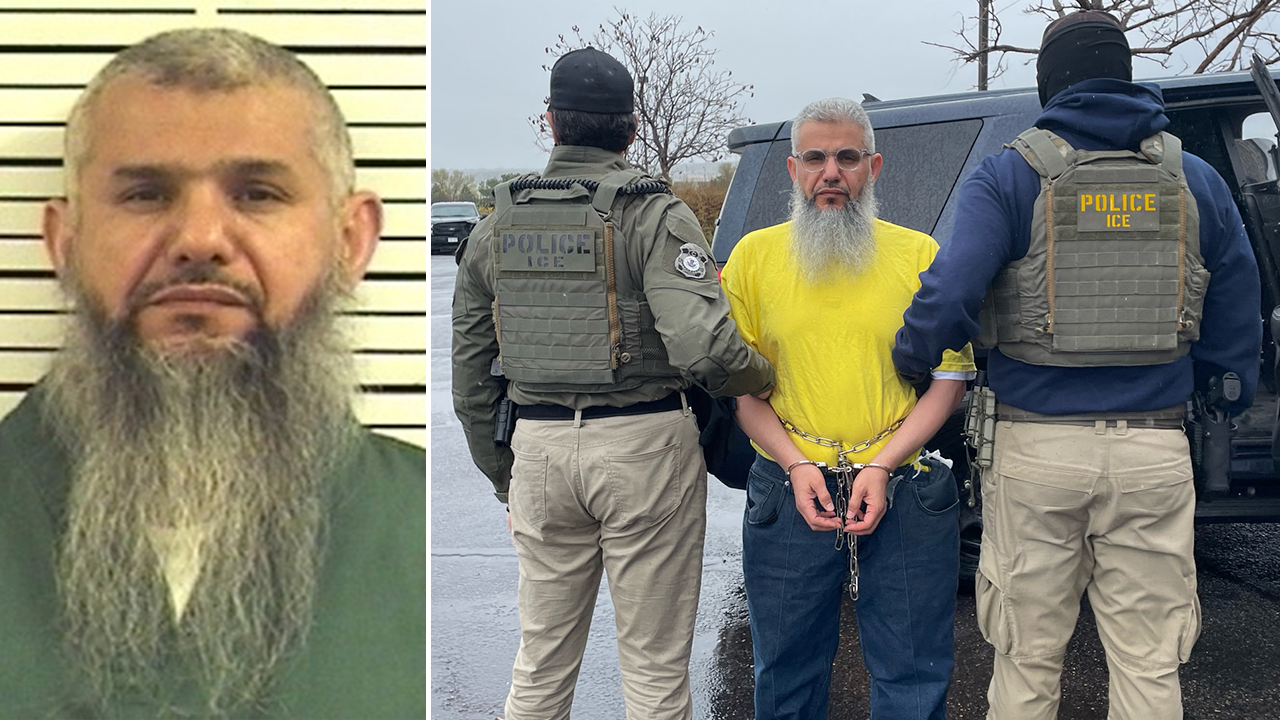
A “criminal alien” and “suspected terrorist” who served 19 years in prison for holding his housekeeper captive and repeatedly molesting her, was arrested by U.S. Immigration and Customs Enforcement (ICE) officials after his release from the Arapahoe County Jail in Centennial, Colorado, Tuesday, and will be deported back to Saudi Arabia.
Following a jury trial in 2006, Homaidan Al-Turki Al-Turki was convicted of misdemeanor false imprisonment, misdemeanor conspiracy to commit false imprisonment, 11 counts of felony unlawful sexual contact, felony extortion, and felony theft of $15,000 or more.
Al-Turki served a six-years-to-life sentence at the Colorado Department of Corrections (DOC).
Homaidan Al-Turki was arrested by ICE in Colorado, and will not be welcome in the United States again. (ICE)
DEPORTATION FLIGHTS TO LIBYA WOULD VIOLATE COURT ORDER WITHOUT PRIOR NOTICE, FEDERAL JUDGE SAYS
He first became parole-eligible in 2011, but failed to participate in the DOC’s sex-offender treatment program, preventing his release and delaying his deportation back to Saudi Arabia.
Al-Turki filed numerous motions with the courts while incarcerated, including a recent pending motion alleging his defense counsel did not adequately represent him at trial.
In granting him a hearing, District Court Judge Eric White said, “[t]he defendant’s counsel may not have understood fundamental aspects of the submitted jury instructions, particularly that misdemeanor unlawful sexual contact could be elevated to a felony conviction if the jury found that Al-Turki used force, intimidation, or threats to cause the victim’s submission.”
Homaidan Al-Turki, 56, pleaded guilty, and was immediately sentenced to concurrent terms of six years in the Colorado DOC. (18th Judicial District Attorney’s Office)
FEDERAL JUDGE OPENS DOOR TO ALIEN ENEMIES ACT TARGETS SUING TRUMP ADMINISTRATION
Al-Turki’s original attorneys said they thought the unlawful sexual contact convictions were for misdemeanor offenses, which would have carried a jail sentence of up to two years.
However, because the jury found him guilty of unlawful sexual contact offenses that were committed through physical force and violence, the charges were enhanced to class 4 felonies.
Al-Turki was sentenced to several concurrent terms of six-years-to-life in prison on those counts and was ordered to complete sex offender treatment.
The 18th Judicial District Attorney’s Office agreed on Tuesday to amend some of the felony counts, with the condition he is sent back to his home country.
Al-Turki, now 56, pleaded guilty, and was immediately sentenced to concurrent terms of six years in the Colorado DOC.
ILLEGAL IMMIGRANT MURDERERS COULD FACE DEATH PENALTY UNDER NEW GOP BILL
The sentence on each count was ordered to be served concurrently, to include a mandatory period of parole supervision that Al-Turki had already served due to his nearly 19 years in prison.
He was taken into ICE custody Tuesday afternoon pursuant to a removal order to deport him back to Saudi Arabia.
“Based on careful analysis of the facts and evidence presented through the 35(c) motion, as well as the difficulty in re-trying the case nearly two decades later if the motion was successful, our office determined that resentencing Al-Turki to 11 felony sex offenses, in addition to the other offenses that he stands convicted of, and resulting in his removal from the United States, is the appropriate outcome in this case at this time,” Colorado 18th Judicial District Assistant District Attorney Ryan Brackley said.
STAY IN YOUR LANE: FLORIDA AG FIRES NEXT VOLLEY AGAINST JUDGE HALTING STATE IMMIGRATION LAW
While Brackley said it was a difficult decision, he noted it “strikes the right balance between ensuring that Al-Turki remains a convicted sex felon and is removed from our community, while at the same time considering the resources that have been expended in holding this defendant accountable.”
ICE officials said Al-Turki first entered the U.S. at an unknown location in 1992, before leaving in 1993. In 1994, he lawfully reentered again at an unknown location.
In 2001, Al-Turki was questioned about the 9/11 attacks, and left the U.S. again at an unknown time and place. He lawfully reentered the U.S. again in 2002.
He was convicted of the crimes in 2006, and has had an administrative order of removal since 2013.
“He won’t be welcome back to the United States again,” ICE officials wrote in a post on X.
Read the full article from Here



NOGALES, Ariz. (KGUN) — Approximately 400 Marines are working along the southern border in the Tucson sector, adding brackets and two types of wire to the border wall as part of an infrastructure improvement and barrier reinforcement mission.
Company Commander Kyle Harrison showed me the work underway in southern Arizona, where groups are operating in states bordering Mexico.
“Our purpose down here, ma’am, is primarily going to be infrastructure improvement and barrier reinforcement. So, general engineering is what we’re doing,” Harrison said.
The reinforcement work includes welding brackets onto the barrier and laying barbed wire along the wall.
“Marines, the furthest on the right, on that lift on the right, they’re actually welding the brackets onto the baller. It’s onto the barrier to the left. The next lift is going to be a group of Marines that are laying out the barbed wire,” Harrison said.
In two and a half months, the unit has put up wire across 25 miles of the wall in the Tucson sector, including in Douglas and Nogales.
“The purpose of laying the wire is just to reinforce the preexisting barrier, preexisting infrastructure,” Harrison said.
For most of the service members, this is their first time doing this kind of work. Harrison said the majority have been learning on the job.
“So vast majority of these marines have been receiving training on the job. Once they got here on site, they’ve been picking up the training and experience here,” Harrison said.
Part of that training includes obtaining the proper licenses to operate aerial lifts, which are civilian contracted equipment.
“So seeing as how it’s civilian contracted equipment, they did have to receive instruction and licensing and certification in order to run and operate them,” Harrison said.
With temperatures on the rise, units are also taking precautions to stay cool, including having medical personnel available on site.
“Hydration obviously on the front side, ma’am. Before anybody leaves the border patrol station on their way to the barrier, make sure that we have plenty of water, plenty of food, and then plenty of ice to keep everyone cool,” Harrison said.
Harrison said the unit will continue working along the border until every mile of the Tucson sector is complete.
This story was reported on-air by a journalist and has been converted to this platform with the assistance of AI. Our editorial team verifies all reporting on all platforms for fairness and accuracy.
——-
Alexis Ramanjulu is a reporter in Cochise County for KGUN 9. She began her journalism career reporting for the Herald/Review in Sierra Vista, which she also calls home. Share your story ideas with Alexis by emailing alexis.ramanjulu@kgun9.com or by connecting on Facebook.
California
CDFW News | California Fish and Game Commission Takes Emergency Action to Prevent White Shark Take and Reduce Potential Interactions Between Hooked Sharks and Swimmers

Prosecutors Honored for Their Work to Protect Wildlife; Southern Resident Killer Whale Named CESA Candidate
Anticipating a larger presence of white sharks in Southern California as a result of warmer El Niño ocean conditions, the California Fish and Game Commission (Commission) adopted emergency regulations at its June 17-18, 2026 meeting to further protect the large ocean predator and reduce the potential for dangerous interactions with ocean users. These regulations will prohibit the use of certain fishing gear from beaches and nearshore that are used to hook large sharks and could create hazards for nearby beachgoers.
Forecasted warmer waters shift the preferred range for juvenile white sharks northward from Mexico and lead them to stay in California nearshore areas later in the year. The emergency regulations protect not only white sharks but also people recreating in the ocean, decreasing the risk of dangerous human encounters with sharks that are hooked with wire leaders from piers and beaches.
Specific gear types used to target large sharks, including hooks greater than 1.5 inches in maximum inside measurement and wire or metallic lines and leaders, will be prohibited when recreational fishing from shore or within 1,000 yards of shore from Pigeon Point (San Mateo County) south to the U.S.-Mexico border. Shore fishing includes beaches, banks, piers, jetties, breakwaters, docks and other man-made structures connected to the shore. Unless extended, the emergency regulations will expire 180 days after being filed with the secretary of state. The Commission may pursue up to two 90-day extensions of the emergency action and, ultimately, may propose continuing the restrictions through a regular rulemaking if the regulations prove to be effective.
Prosecutor of the Year
Commissioners recognized two deputy district attorneys who have demonstrated their dedication to protecting California’s natural resources and have effectively collaborated with the California Department of Fish and Wildlife (CDFW) to prosecute wildlife crimes. San Luis Obispo County Deputy District Attorney Ken Jorgensen and San Diego County Deputy District Attorney Michael McCann were presented with the Prosecutor of the Year Award for 2025.
Jorgenson’s work resulted in a landmark $165,000 settlement and injunctions in a case involving rare plant habitat destruction, and in another case a $12,500 fine and five years of probation for often under-prosecuted commercial fishing violations.
McCann assisted in the prosecution and investigation surrounding a global wildlife trafficking ring connected to illegal drug and firearm trade. The investigation disrupted a sophisticated trafficking network and resulted in multiple felony and misdemeanor charges, with more anticipated.
Southern Resident Killer Whale
The Commission named the southern resident killer whale (orca) a candidate species for listing under the California Endangered Species Act (CESA). This population of orcas inhabits ocean waters from British Columbia to California and is estimated to now number as few as 75.
Orcas face threats such as limited availability of prey; Chinook salmon are a primary food source and have experienced population decline across the entire West Coast range of orcas. The species’ abundance has also been impacted by past practices of capture for live display.
CDFW will have one year to complete a review on the status of orcas, of the best available science, before the Commission can make a final decision on CESA listing. Orca is currently listed as endangered under the federal Endangered Species Act and is considered depleted under the federal Marine Mammal Protection Act.
Western Spadefoot
Continued from the Commission’s April meeting, a decision to consider CESA candidacy for western spadefoot frog was postponed to the August meeting to give environmental advocates and the solar industry additional time to collaborate on proposing exceptions to CESA protections that would be allowed under Fish and Game Code Section 2084.
Meeting Participation and Next Meeting
Commission President Eric Sklar, Vice President Darius Anderson and Commissioners Samantha Murray and Erica Zavaleta were in attendance for both days of the June Commission meeting. Commissioner Jacque Hostler-Carmesin was in attendance for the first day. The meeting was held in Sacramento.
The complete agenda for the meeting, along with supporting information, is available on the Commission website. Archived video of past Commission meetings is available online. The next regularly scheduled meeting of the Commission is scheduled for Aug. 12-13, 2026, at the California Natural Resources Agency building in Sacramento. Participants are encouraged to attend in person, with options available for Zoom or phone; for more information visit the Commission website.
The Commission authorized public notice of upcoming potential regulation changes related to:
Harpoons and Flying Gaffs Allowance: A discussion hearing is scheduled for Aug. 12-13 and an adoption hearing Oct. 14-15 on amendments to regulations related to allowing use of harpoons and flying gaffs in the recreational tuna fishery.
###
Media Contacts:
Krysten Kellum, CDFW Communications, (916) 825-7120
Alicia de la Garza, CDFW Communications, (916) 754-7237
-

 Minneapolis, MN4 minutes ago
Minneapolis City Council approves 5-month pause on data center development
-

 Indianapolis, IN11 minutes ago
Indiana veteran completes 250-mile march for semiquincentennial
-

 Pittsburg, PA14 minutes ago
Hoffmann family makes very good first impression: ‘You will win in Pittsburgh’
-
Augusta, GA19 minutes ago
Nancy H. Bowers Obituary Jun 24, 2026 – Platt’s Funeral Home
-

 Washington, D.C26 minutes ago
Watch: Americans visit Great American State Fair in Washington DC
-

 Cleveland, OH29 minutes ago
U.S. Marshals arrest suspect in murder of Northeast Ohio rapper
-

 Austin, TX34 minutes ago
New podcast searches for accountability after 2025 Central Texas flood
-

 Alabama41 minutes ago
Millions in SNAP Overpayments: Alabama and Florida Required to Submit Corrective Action Plans


